engine YAMAHA YZ250F 2009 User Guide
[x] Cancel search | Manufacturer: YAMAHA, Model Year: 2009, Model line: YZ250F, Model: YAMAHA YZ250F 2009Pages: 190, PDF Size: 12.83 MB
Page 21 of 190
1-11
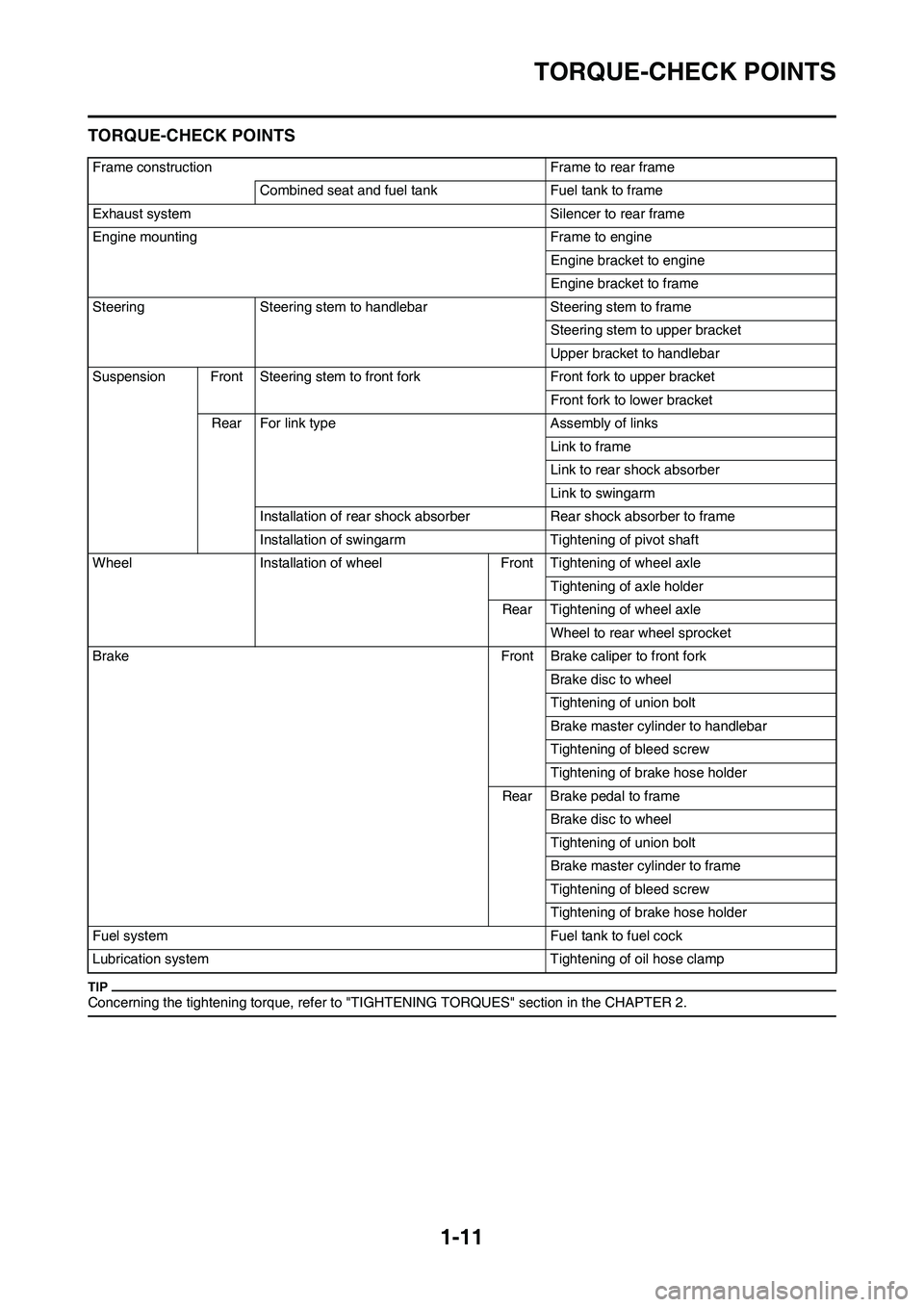
TORQUE-CHECK POINTS
TORQUE-CHECK POINTS
Concerning the tightening torque, refer to "TIGHTENING TORQUES" section in the CHAPTER 2.
Frame construction Frame to rear frame
Combined seat and fuel tank Fuel tank to frame
Exhaust system Silencer to rear frame
Engine mounting Frame to engine
Engine bracket to engine
Engine bracket to frame
Steering Steering stem to handlebar Steering stem to frame
Steering stem to upper bracket
Upper bracket to handlebar
Suspension Front Steering stem to front fork Front fork to upper bracket
Front fork to lower bracket
Rear For link type Assembly of links
Link to frame
Link to rear shock absorber
Link to swingarm
Installation of rear shock absorber Rear shock absorber to frame
Installation of swingarm Tightening of pivot shaft
Wheel Installation of wheel Front Tightening of wheel axle
Tightening of axle holder
Rear Tightening of wheel axle
Wheel to rear wheel sprocket
Brake Front Brake caliper to front fork
Brake disc to wheel
Tightening of union bolt
Brake master cylinder to handlebar
Tightening of bleed screw
Tightening of brake hose holder
Rear Brake pedal to frame
Brake disc to wheel
Tightening of union bolt
Brake master cylinder to frame
Tightening of bleed screw
Tightening of brake hose holder
Fuel system Fuel tank to fuel cock
Lubrication system Tightening of oil hose clamp
Page 22 of 190
1-12
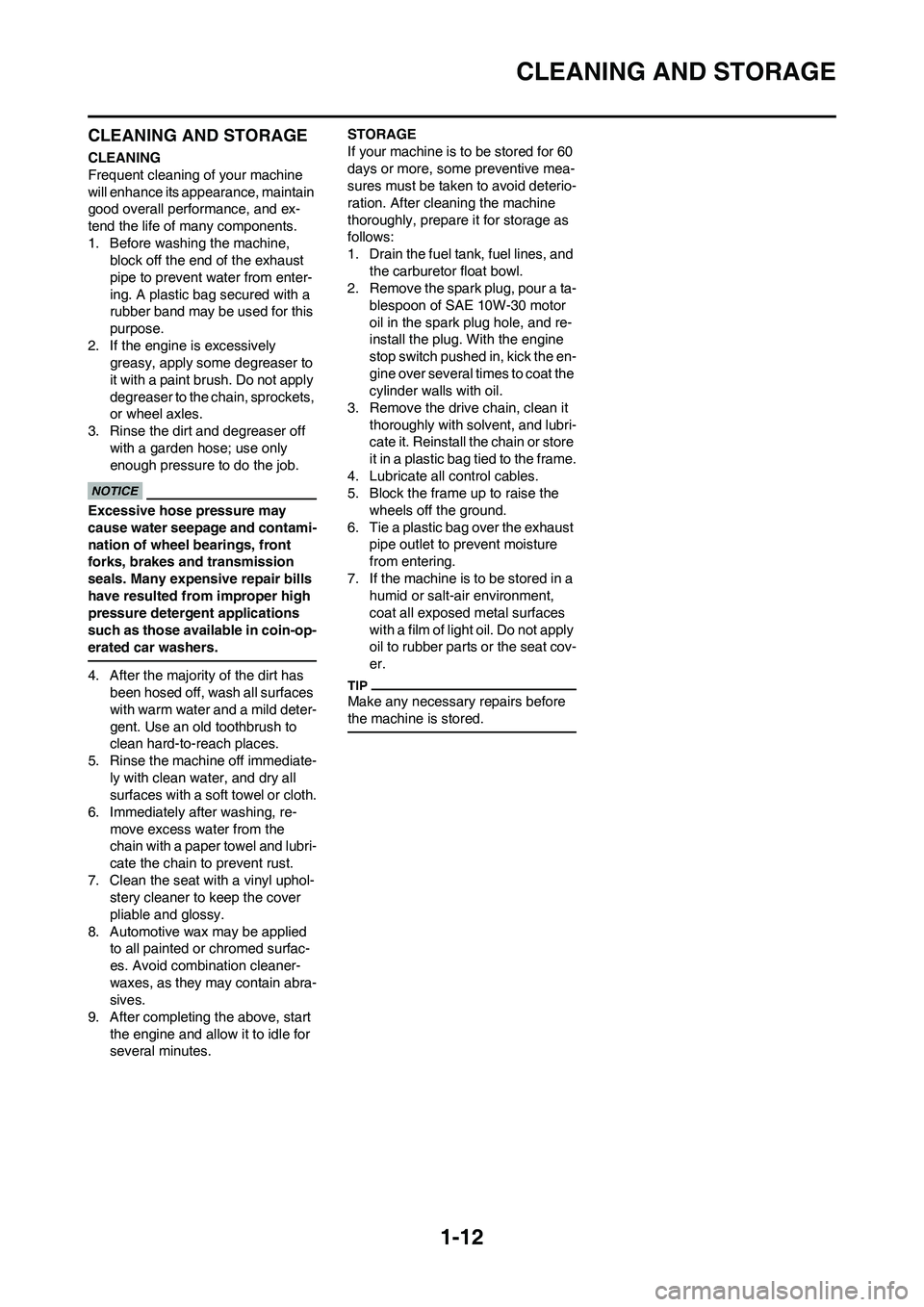
CLEANING AND STORAGE
CLEANING AND STORAGE
CLEANING
Frequent cleaning of your machine
will enhance its appearance, maintain
good overall performance, and ex-
tend the life of many components.
1. Before washing the machine,
block off the end of the exhaust
pipe to prevent water from enter-
ing. A plastic bag secured with a
rubber band may be used for this
purpose.
2. If the engine is excessively
greasy, apply some degreaser to
it with a paint brush. Do not apply
degreaser to the chain, sprockets,
or wheel axles.
3. Rinse the dirt and degreaser off
with a garden hose; use only
enough pressure to do the job.
Excessive hose pressure may
cause water seepage and contami-
nation of wheel bearings, front
forks, brakes and transmission
seals. Many expensive repair bills
have resulted from improper high
pressure detergent applications
such as those available in coin-op-
erated car washers.
4. After the majority of the dirt has
been hosed off, wash all surfaces
with warm water and a mild deter-
gent. Use an old toothbrush to
clean hard-to-reach places.
5. Rinse the machine off immediate-
ly with clean water, and dry all
surfaces with a soft towel or cloth.
6. Immediately after washing, re-
move excess water from the
chain with a paper towel and lubri-
cate the chain to prevent rust.
7. Clean the seat with a vinyl uphol-
stery cleaner to keep the cover
pliable and glossy.
8. Automotive wax may be applied
to all painted or chromed surfac-
es. Avoid combination cleaner-
waxes, as they may contain abra-
sives.
9. After completing the above, start
the engine and allow it to idle for
several minutes.STORAGE
If your machine is to be stored for 60
days or more, some preventive mea-
sures must be taken to avoid deterio-
ration. After cleaning the machine
thoroughly, prepare it for storage as
follows:
1. Drain the fuel tank, fuel lines, and
the carburetor float bowl.
2. Remove the spark plug, pour a ta-
blespoon of SAE 10W-30 motor
oil in the spark plug hole, and re-
install the plug. With the engine
stop switch pushed in, kick the en-
gine over several times to coat the
cylinder walls with oil.
3. Remove the drive chain, clean it
thoroughly with solvent, and lubri-
cate it. Reinstall the chain or store
it in a plastic bag tied to the frame.
4. Lubricate all control cables.
5. Block the frame up to raise the
wheels off the ground.
6. Tie a plastic bag over the exhaust
pipe outlet to prevent moisture
from entering.
7. If the machine is to be stored in a
humid or salt-air environment,
coat all exposed metal surfaces
with a film of light oil. Do not apply
oil to rubber parts or the seat cov-
er.
Make any necessary repairs before
the machine is stored.
Page 23 of 190
2-1
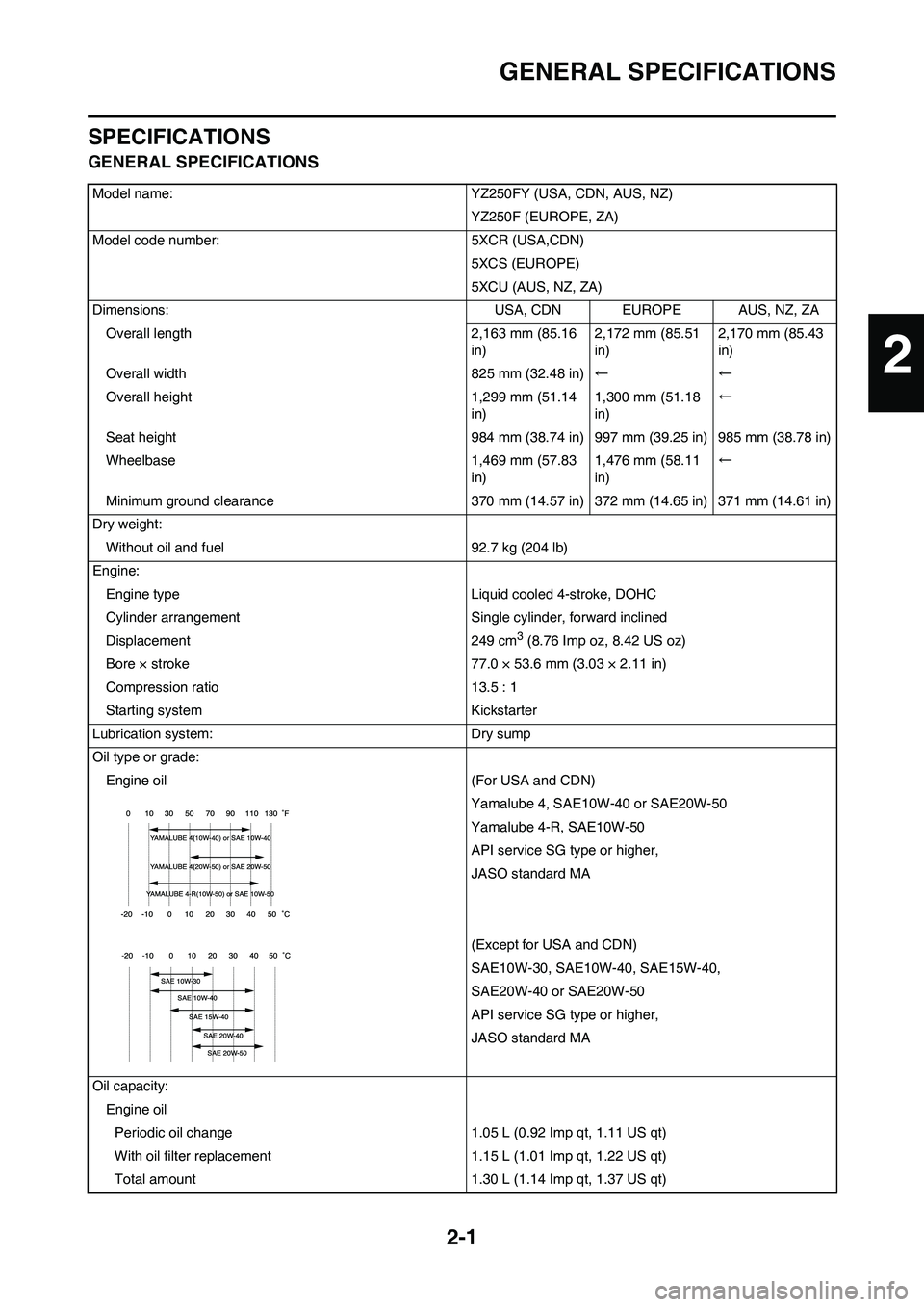
GENERAL SPECIFICATIONS
SPECIFICATIONS
GENERAL SPECIFICATIONS
Model name: YZ250FY (USA, CDN, AUS, NZ)
YZ250F (EUROPE, ZA)
Model code number: 5XCR (USA,CDN)
5XCS (EUROPE)
5XCU (AUS, NZ, ZA)
Dimensions: USA, CDN EUROPE AUS, NZ, ZA
Overall length 2,163 mm (85.16
in)2,172 mm (85.51
in)2,170 mm (85.43
in)
Overall width 825 mm (32.48 in)←←
Overall height 1,299 mm (51.14
in)1,300 mm (51.18
in)←
Seat height 984 mm (38.74 in) 997 mm (39.25 in) 985 mm (38.78 in)
Wheelbase 1,469 mm (57.83
in)1,476 mm (58.11
in)←
Minimum ground clearance 370 mm (14.57 in) 372 mm (14.65 in) 371 mm (14.61 in)
Dry weight:
Without oil and fuel 92.7 kg (204 lb)
Engine:
Engine type Liquid cooled 4-stroke, DOHC
Cylinder arrangement Single cylinder, forward inclined
Displacement 249 cm
3 (8.76 Imp oz, 8.42 US oz)
Bore × stroke 77.0 × 53.6 mm (3.03 × 2.11 in)
Compression ratio 13.5 : 1
Starting system Kickstarter
Lubrication system: Dry sump
Oil type or grade:
Engine oil (For USA and CDN)
Yamalube 4, SAE10W-40 or SAE20W-50
Yamalube 4-R, SAE10W-50
API service SG type or higher,
JASO standard MA
(Except for USA and CDN)
SAE10W-30, SAE10W-40, SAE15W-40,
SAE20W-40 or SAE20W-50
API service SG type or higher,
JASO standard MA
Oil capacity:
Engine oil
Periodic oil change 1.05 L (0.92 Imp qt, 1.11 US qt)
With oil filter replacement 1.15 L (1.01 Imp qt, 1.22 US qt)
Total amount 1.30 L (1.14 Imp qt, 1.37 US qt)
2
Page 25 of 190
2-3
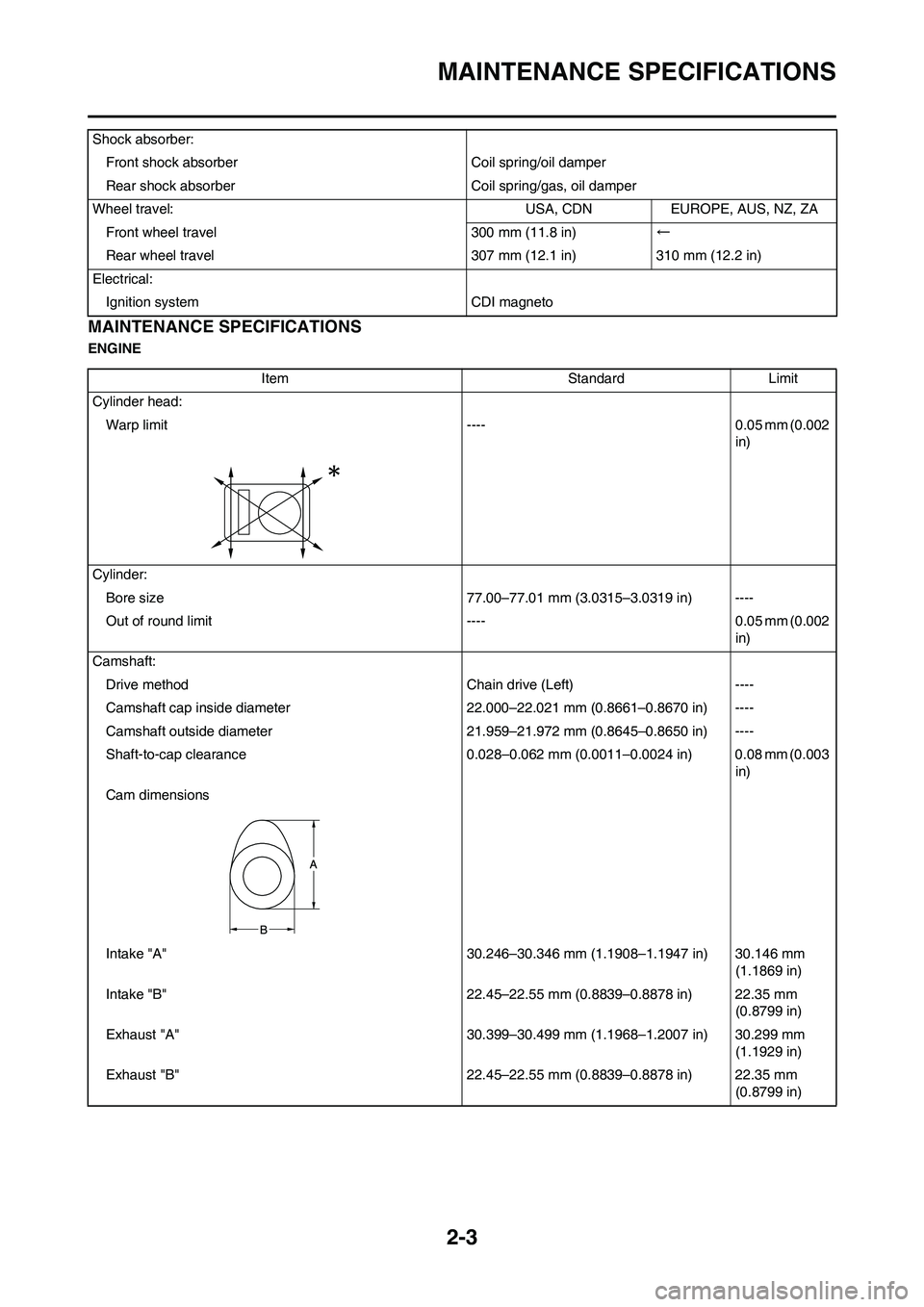
MAINTENANCE SPECIFICATIONS
MAINTENANCE SPECIFICATIONS
ENGINEShock absorber:
Front shock absorber Coil spring/oil damper
Rear shock absorber Coil spring/gas, oil damper
Wheel travel: USA, CDN EUROPE, AUS, NZ, ZA
Front wheel travel 300 mm (11.8 in)←
Rear wheel travel 307 mm (12.1 in) 310 mm (12.2 in)
Electrical:
Ignition system CDI magneto
Item Standard Limit
Cylinder head:
Warp limit ---- 0.05 mm (0.002
in)
Cylinder:
Bore size 77.00–77.01 mm (3.0315–3.0319 in) ----
Out of round limit ---- 0.05 mm (0.002
in)
Camshaft:
Drive method Chain drive (Left) ----
Camshaft cap inside diameter 22.000–22.021 mm (0.8661–0.8670 in) ----
Camshaft outside diameter 21.959–21.972 mm (0.8645–0.8650 in) ----
Shaft-to-cap clearance 0.028–0.062 mm (0.0011–0.0024 in) 0.08 mm (0.003
in)
Cam dimensions
Intake "A" 30.246–30.346 mm (1.1908–1.1947 in) 30.146 mm
(1.1869 in)
Intake "B" 22.45–22.55 mm (0.8839–0.8878 in) 22.35 mm
(0.8799 in)
Exhaust "A" 30.399–30.499 mm (1.1968–1.2007 in) 30.299 mm
(1.1929 in)
Exhaust "B" 22.45–22.55 mm (0.8839–0.8878 in) 22.35 mm
(0.8799 in)
Page 29 of 190
2-7
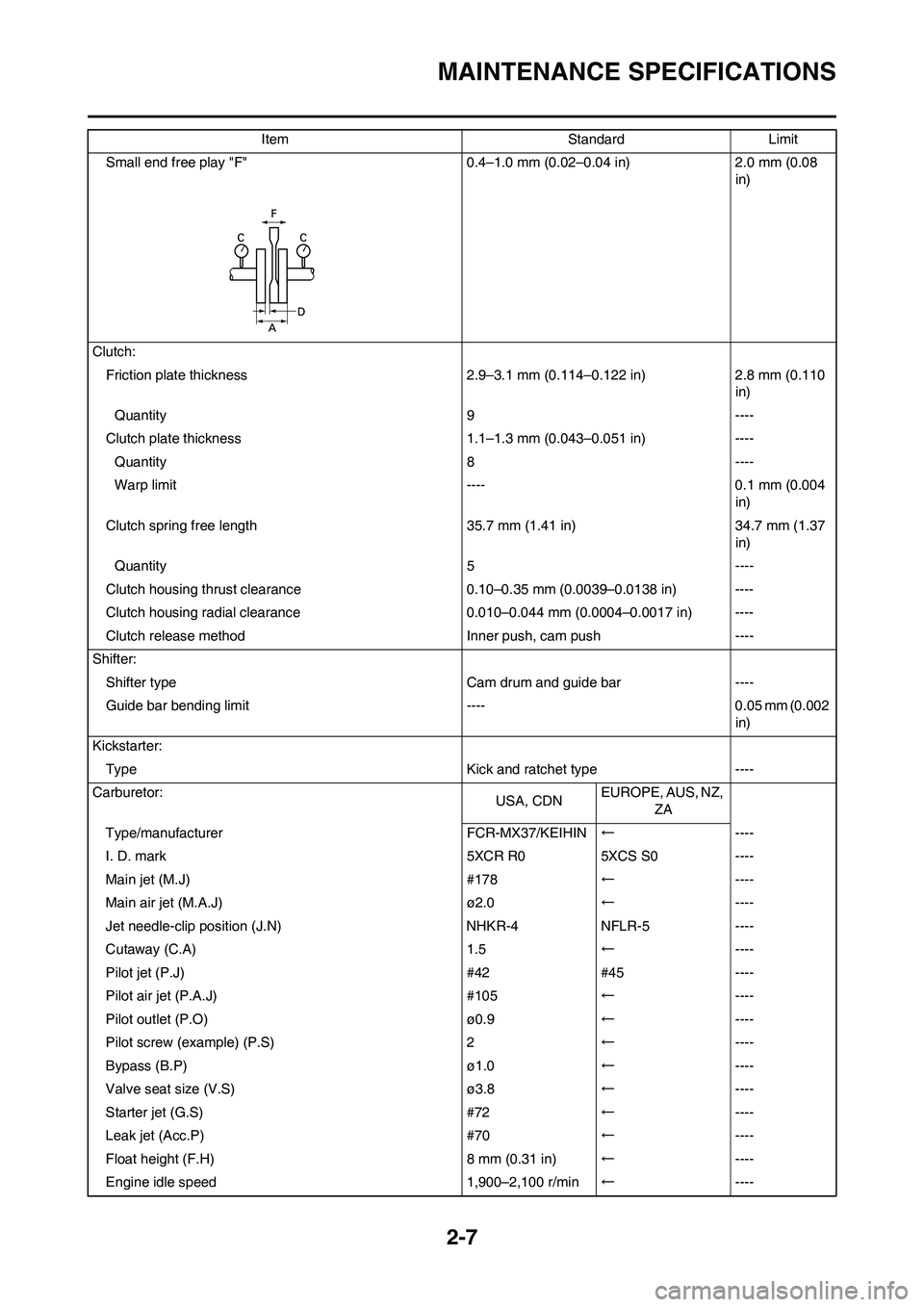
MAINTENANCE SPECIFICATIONS
Small end free play "F" 0.4–1.0 mm (0.02–0.04 in) 2.0 mm (0.08
in)
Clutch:
Friction plate thickness 2.9–3.1 mm (0.114–0.122 in) 2.8 mm (0.110
in)
Quantity 9 ----
Clutch plate thickness 1.1–1.3 mm (0.043–0.051 in) ----
Quantity 8 ----
Warp limit ---- 0.1 mm (0.004
in)
Clutch spring free length 35.7 mm (1.41 in) 34.7 mm (1.37
in)
Quantity 5 ----
Clutch housing thrust clearance 0.10–0.35 mm (0.0039–0.0138 in) ----
Clutch housing radial clearance 0.010–0.044 mm (0.0004–0.0017 in) ----
Clutch release method Inner push, cam push ----
Shifter:
Shifter type Cam drum and guide bar ----
Guide bar bending limit ---- 0.05 mm (0.002
in)
Kickstarter:
Type Kick and ratchet type ----
Carburetor:
USA, CDNEUROPE, AUS, NZ,
ZA
Type/manufacturer FCR-MX37/KEIHIN←----
I. D. mark 5XCR R0 5XCS S0 ----
Main jet (M.J) #178←----
Main air jet (M.A.J) ø2.0←----
Jet needle-clip position (J.N) NHKR-4 NFLR-5 ----
Cutaway (C.A) 1.5←----
Pilot jet (P.J) #42 #45 ----
Pilot air jet (P.A.J) #105←----
Pilot outlet (P.O) ø0.9←----
Pilot screw (example) (P.S) 2←----
Bypass (B.P) ø1.0←----
Valve seat size (V.S) ø3.8←----
Starter jet (G.S) #72←----
Leak jet (Acc.P) #70←----
Float height (F.H) 8 mm (0.31 in)←----
Engine idle speed 1,900–2,100 r/min←---- Item Standard Limit
Page 32 of 190
2-10
TIGHTENING TORQUES
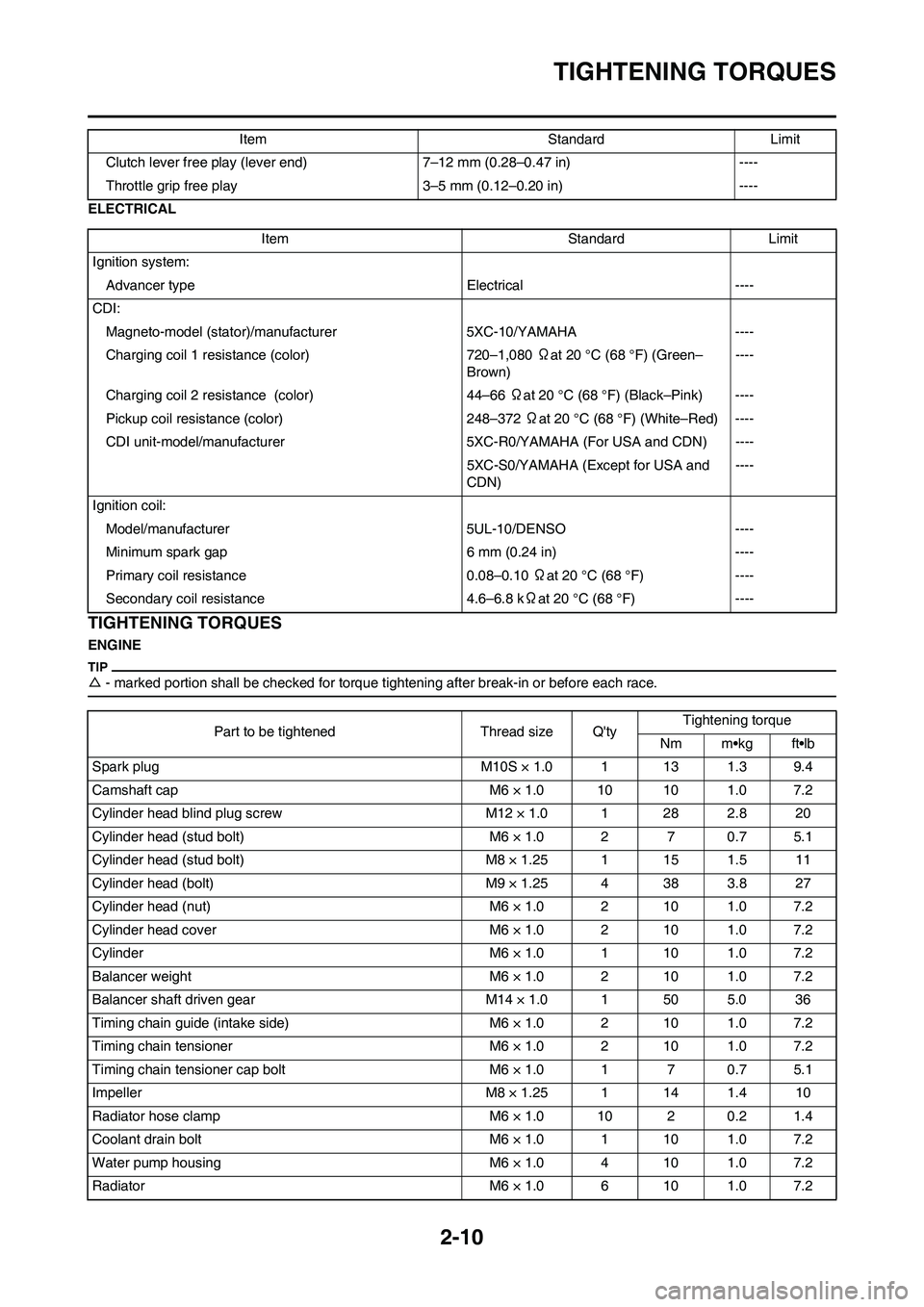
ELECTRICAL
TIGHTENING TORQUES
ENGINE
△- marked portion shall be checked for torque tightening after break-in or before each race.
Clutch lever free play (lever end) 7–12 mm (0.28–0.47 in) ----
Throttle grip free play 3–5 mm (0.12–0.20 in) ----Item Standard Limit
Item Standard Limit
Ignition system:
Advancer type Electrical ----
CDI:
Magneto-model (stator)/manufacturer 5XC-10/YAMAHA ----
Charging coil 1 resistance (color) 720–1,080 Ωat 20 °C (68 °F) (Green–
Brown)----
Charging coil 2 resistance (color) 44–66 Ωat 20 °C (68 °F) (Black–Pink) ----
Pickup coil resistance (color) 248–372 Ωat 20 °C (68 °F) (White–Red) ----
CDI unit-model/manufacturer 5XC-R0/YAMAHA (For USA and CDN) ----
5XC-S0/YAMAHA (Except for USA and
CDN)----
Ignition coil:
Model/manufacturer 5UL-10/DENSO ----
Minimum spark gap 6 mm (0.24 in) ----
Primary coil resistance 0.08–0.10 Ωat 20 °C (68 °F) ----
Secondary coil resistance 4.6–6.8 kΩat 20 °C (68 °F) ----
Part to be tightened Thread size Q'tyTightening torque
Nm m•kg ft•lb
Spark plug M10S × 1.0 1 13 1.3 9.4
Camshaft cap M6 × 1.0 10 10 1.0 7.2
Cylinder head blind plug screw M12 × 1.0 1 28 2.8 20
Cylinder head (stud bolt) M6 × 1.0 2 7 0.7 5.1
Cylinder head (stud bolt) M8 × 1.25 1 15 1.5 11
Cylinder head (bolt) M9 × 1.25 4 38 3.8 27
Cylinder head (nut) M6 × 1.0 2 10 1.0 7.2
Cylinder head cover M6 × 1.0 2 10 1.0 7.2
Cylinder M6 × 1.0 1 10 1.0 7.2
Balancer weight M6 × 1.0 2 10 1.0 7.2
Balancer shaft driven gear M14 × 1.0 1 50 5.0 36
Timing chain guide (intake side) M6 × 1.0 2 10 1.0 7.2
Timing chain tensioner M6 × 1.0 2 10 1.0 7.2
Timing chain tensioner cap bolt M6 × 1.0 1 7 0.7 5.1
Impeller M8 × 1.25 1 14 1.4 10
Radiator hose clamp M6 × 1.0 10 2 0.2 1.4
Coolant drain bolt M6 × 1.0 1 10 1.0 7.2
Water pump housing M6 × 1.0 4 10 1.0 7.2
Radiator M6 × 1.0 6 10 1.0 7.2
Page 35 of 190
2-13
TIGHTENING TORQUES
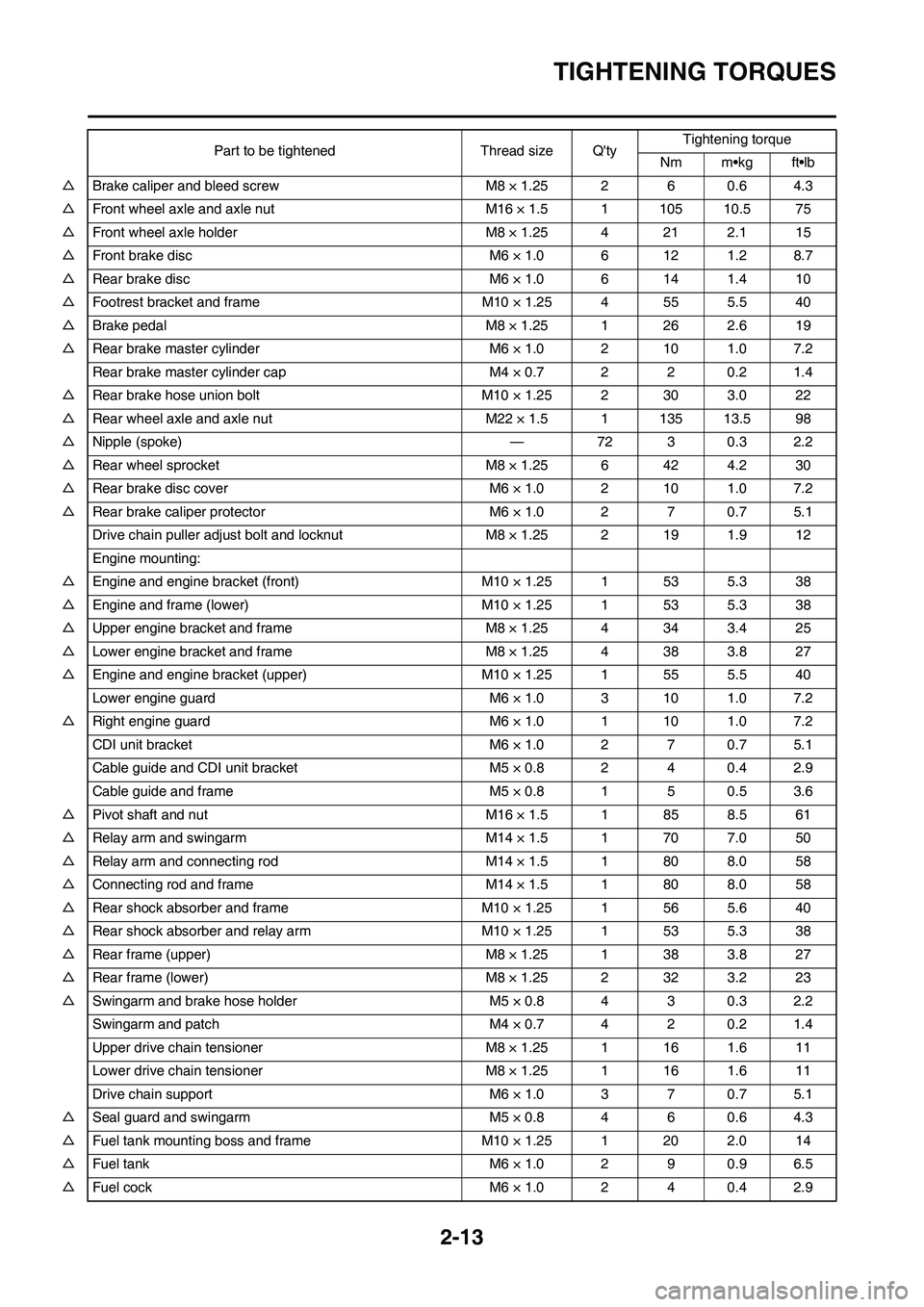
△Brake caliper and bleed screw M8 × 1.25 2 6 0.6 4.3
△Front wheel axle and axle nut M16 × 1.5 1 105 10.5 75
△Front wheel axle holder M8 × 1.25 4 21 2.1 15
△Front brake disc M6 × 1.0 6 12 1.2 8.7
△Rear brake disc M6 × 1.0 6 14 1.4 10
△Footrest bracket and frame M10 × 1.25 4 55 5.5 40
△Brake pedal M8 × 1.25 1 26 2.6 19
△Rear brake master cylinder M6 × 1.0 2 10 1.0 7.2
Rear brake master cylinder cap M4 × 0.7 2 2 0.2 1.4
△Rear brake hose union bolt M10 × 1.25 2 30 3.0 22
△Rear wheel axle and axle nut M22 × 1.5 1 135 13.5 98
△Nipple (spoke) — 72 3 0.3 2.2
△Rear wheel sprocket M8 × 1.25 6 42 4.2 30
△Rear brake disc cover M6 × 1.0 2 10 1.0 7.2
△Rear brake caliper protector M6 × 1.0 2 7 0.7 5.1
Drive chain puller adjust bolt and locknut M8 × 1.25 2 19 1.9 12
Engine mounting:
△Engine and engine bracket (front) M10 × 1.25 1 53 5.3 38
△Engine and frame (lower) M10 × 1.25 1 53 5.3 38
△Upper engine bracket and frame M8 × 1.25 4 34 3.4 25
△Lower engine bracket and frame M8 × 1.25 4 38 3.8 27
△Engine and engine bracket (upper) M10 × 1.25 1 55 5.5 40
Lower engine guard M6 × 1.0 3 10 1.0 7.2
△Right engine guard M6 × 1.0 1 10 1.0 7.2
CDI unit bracket M6 × 1.0 2 7 0.7 5.1
Cable guide and CDI unit bracket M5 × 0.8 2 4 0.4 2.9
Cable guide and frame M5 × 0.8 1 5 0.5 3.6
△Pivot shaft and nut M16 × 1.5 1 85 8.5 61
△Relay arm and swingarm M14 × 1.5 1 70 7.0 50
△Relay arm and connecting rod M14 × 1.5 1 80 8.0 58
△Connecting rod and frame M14 × 1.5 1 80 8.0 58
△Rear shock absorber and frame M10 × 1.25 1 56 5.6 40
△Rear shock absorber and relay arm M10 × 1.25 1 53 5.3 38
△Rear frame (upper) M8 × 1.25 1 38 3.8 27
△Rear frame (lower) M8 × 1.25 2 32 3.2 23
△Swingarm and brake hose holder M5 × 0.8 4 3 0.3 2.2
Swingarm and patch M4 × 0.7 4 2 0.2 1.4
Upper drive chain tensioner M8 × 1.25 1 16 1.6 11
Lower drive chain tensioner M8 × 1.25 1 16 1.6 11
Drive chain support M6 × 1.0 3 7 0.7 5.1
△Seal guard and swingarm M5 × 0.8 4 6 0.6 4.3
△Fuel tank mounting boss and frame M10 × 1.25 1 20 2.0 14
△Fuel tank M6 × 1.0 2 9 0.9 6.5
△Fuel cock M6 × 1.0 2 4 0.4 2.9Part to be tightened Thread size Q'tyTightening torque
Nm m•kg ft•lb
Page 37 of 190
2-15
TIGHTENING TORQUES
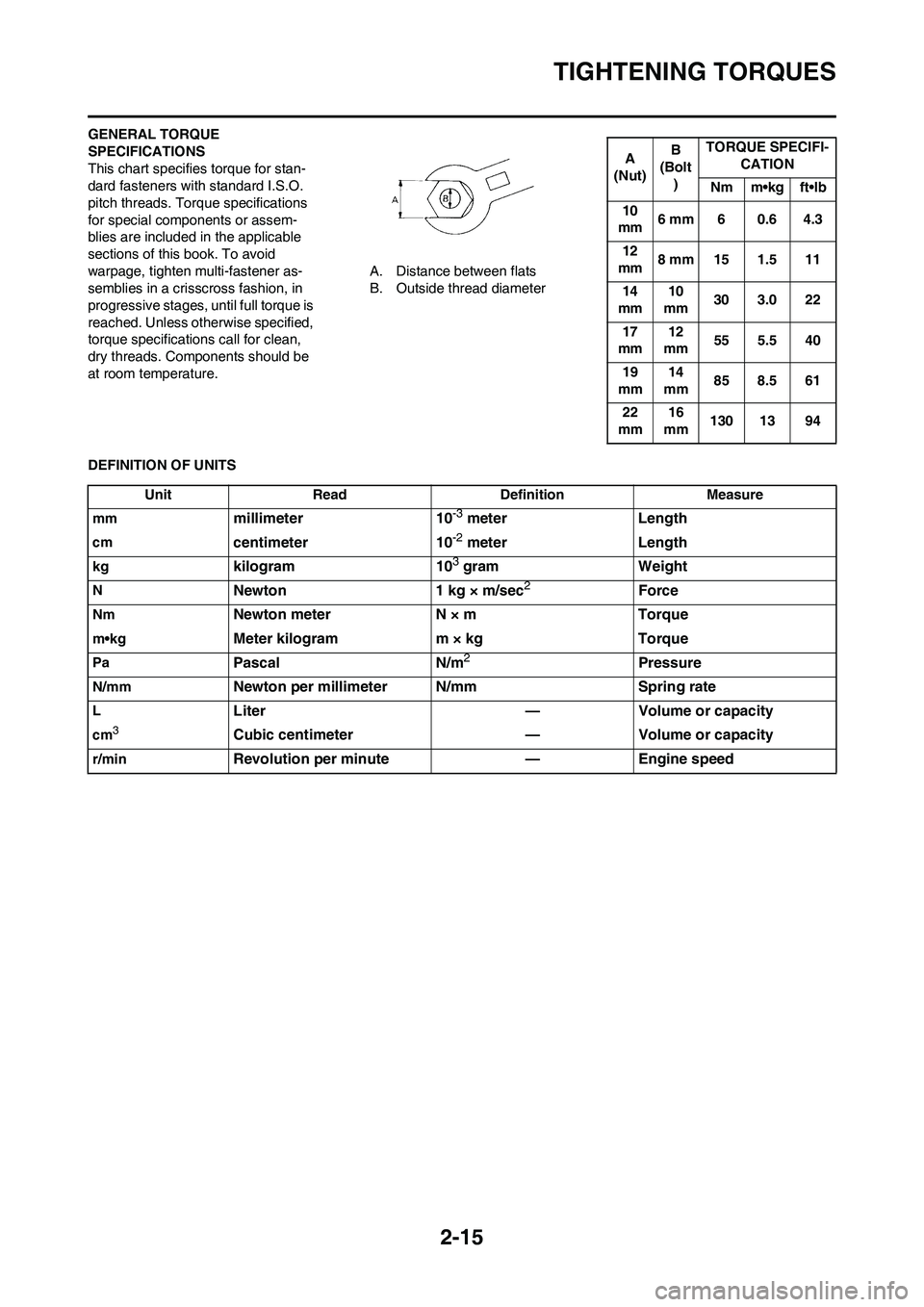
GENERAL TORQUE
SPECIFICATIONS
This chart specifies torque for stan-
dard fasteners with standard I.S.O.
pitch threads. Torque specifications
for special components or assem-
blies are included in the applicable
sections of this book. To avoid
warpage, tighten multi-fastener as-
semblies in a crisscross fashion, in
progressive stages, until full torque is
reached. Unless otherwise specified,
torque specifications call for clean,
dry threads. Components should be
at room temperature.A. Distance between flats
B. Outside thread diameter
DEFINITION OF UNITS
A
(Nut)B
(Bolt
)TORQUE SPECIFI-
CATION
Nm m•kg ft•lb
10
mm6 mm 6 0.6 4.3
12
mm8 mm 15 1.5 11
14
mm10
mm30 3.0 22
17
mm12
mm55 5.5 40
19
mm14
mm85 8.5 61
22
mm16
mm130 13 94
Unit Read Definition Measure
mm
millimeter 10-3 meter Length
cmcentimeter 10-2 meter Length
kgkilogram 103 gram Weight
NNewton 1 kg × m/sec2Force
NmNewton meter N × m Torque
m•kgMeter kilogram m × kg Torque
PaPascal N/m2Pressure
N/mmNewton per millimeter N/mm Spring rate
LLiter — Volume or capacity
cm3Cubic centimeter — Volume or capacity
r/minRevolution per minute — Engine speed
Page 40 of 190
2-18
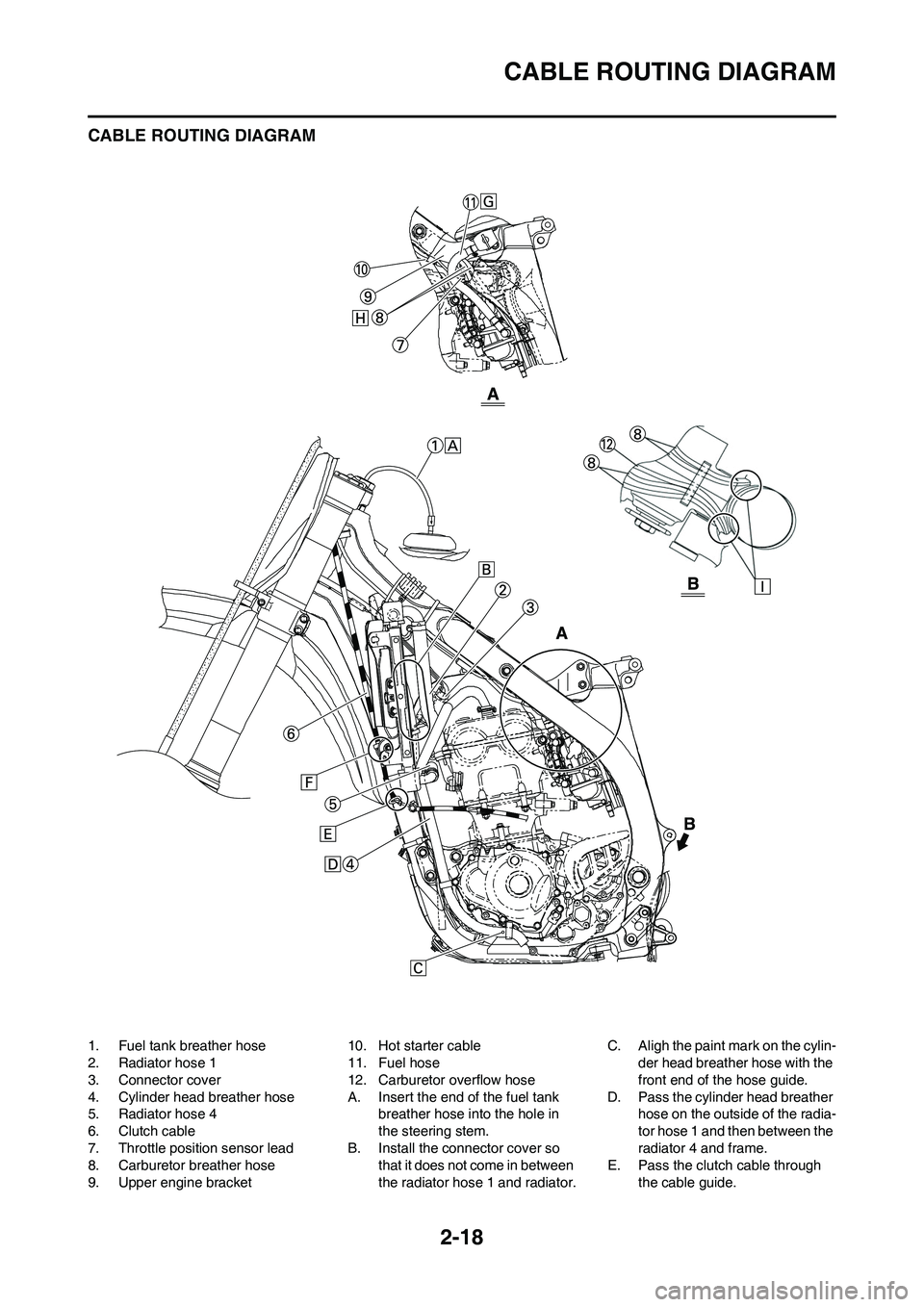
CABLE ROUTING DIAGRAM
CABLE ROUTING DIAGRAM
1. Fuel tank breather hose
2. Radiator hose 1
3. Connector cover
4. Cylinder head breather hose
5. Radiator hose 4
6. Clutch cable
7. Throttle position sensor lead
8. Carburetor breather hose
9. Upper engine bracket10. Hot starter cable
11. Fuel hose
12. Carburetor overflow hose
A. Insert the end of the fuel tank
breather hose into the hole in
the steering stem.
B. Install the connector cover so
that it does not come in between
the radiator hose 1 and radiator.C. Aligh the paint mark on the cylin-
der head breather hose with the
front end of the hose guide.
D. Pass the cylinder head breather
hose on the outside of the radia-
tor hose 1 and then between the
radiator 4 and frame.
E. Pass the clutch cable through
the cable guide.
Page 41 of 190
2-19
CABLE ROUTING DIAGRAM
F. Pass the clutch cable in front of
the radiator mounting boss.
G. Pass the fuel hose on the out-
side of throttle position sensor
lead.
H. Pass the carburetor breater hos-
es so that they are not pinched
between the upper engine
bracket and carburetor.
I. Pass the carburetor breather
hoses and overflow hose so that
all there hoses do not contact
the rear shock absorber.