piston YAMAHA YZ250F 2016 Owners Manual
[x] Cancel search | Manufacturer: YAMAHA, Model Year: 2016, Model line: YZ250F, Model: YAMAHA YZ250F 2016Pages: 356, PDF Size: 11.25 MB
Page 22 of 356
IMPORTANT INFORMATION
1-8
EAS20180
IMPORTANT INFORMATION
EAS1SM9020PREPARATION FOR REMOVAL AND DIS-
ASSEMBLY
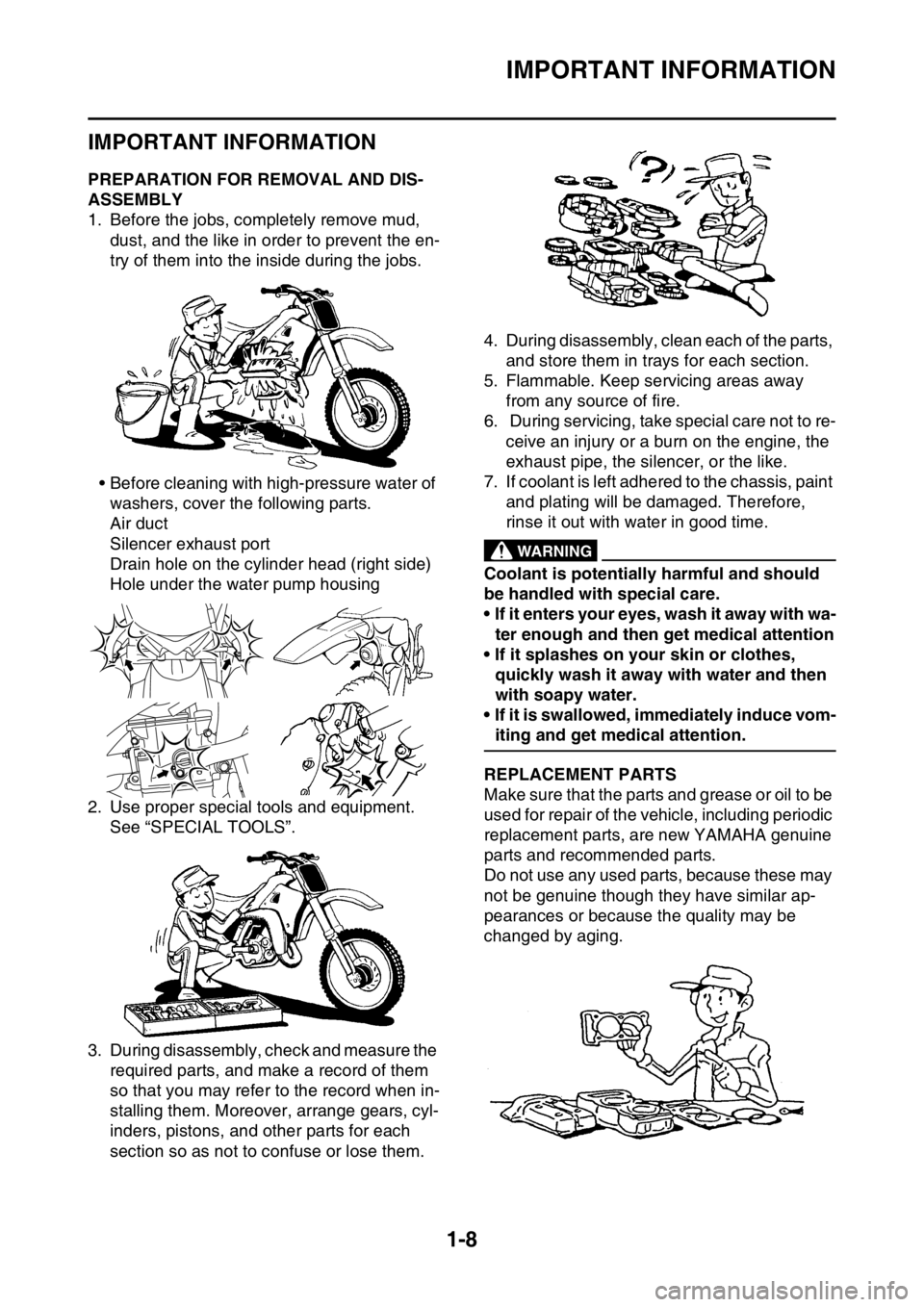
1. Before the jobs, completely remove mud,
dust, and the like in order to prevent the en-
try of them into the inside during the jobs.
• Before cleaning with high-pressure water of
washers, cover the following parts.
Air duct
Silencer exhaust port
Drain hole on the cylinder head (right side)
Hole under the water pump housing
2. Use proper special tools and equipment.
See “SPECIAL TOOLS”.
3. During disassembly, check and measure the
required parts, and make a record of them
so that you may refer to the record when in-
stalling them. Moreover, arrange gears, cyl-
inders, pistons, and other parts for each
section so as not to confuse or lose them.4. During disassembly, clean each of the parts,
and store them in trays for each section.
5. Flammable. Keep servicing areas away
from any source of fire.
6. During servicing, take special care not to re-
ceive an injury or a burn on the engine, the
exhaust pipe, the silencer, or the like.
7. If coolant is left adhered to the chassis, paint
and plating will be damaged. Therefore,
rinse it out with water in good time.
EWA
WARNING
Coolant is potentially harmful and should
be handled with special care.
• If it enters your eyes, wash it away with wa-
ter enough and then get medical attention
• If it splashes on your skin or clothes,
quickly wash it away with water and then
with soapy water.
• If it is swallowed, immediately induce vom-
iting and get medical attention.
EAS1SM9021REPLACEMENT PARTS
Make sure that the parts and grease or oil to be
used for repair of the vehicle, including periodic
replacement parts, are new YAMAHA genuine
parts and recommended parts.
Do not use any used parts, because these may
not be genuine though they have similar ap-
pearances or because the quality may be
changed by aging.
Page 27 of 356
SPECIAL TOOLS
1-13
EAS1SM9028
SPECIAL TOOLS
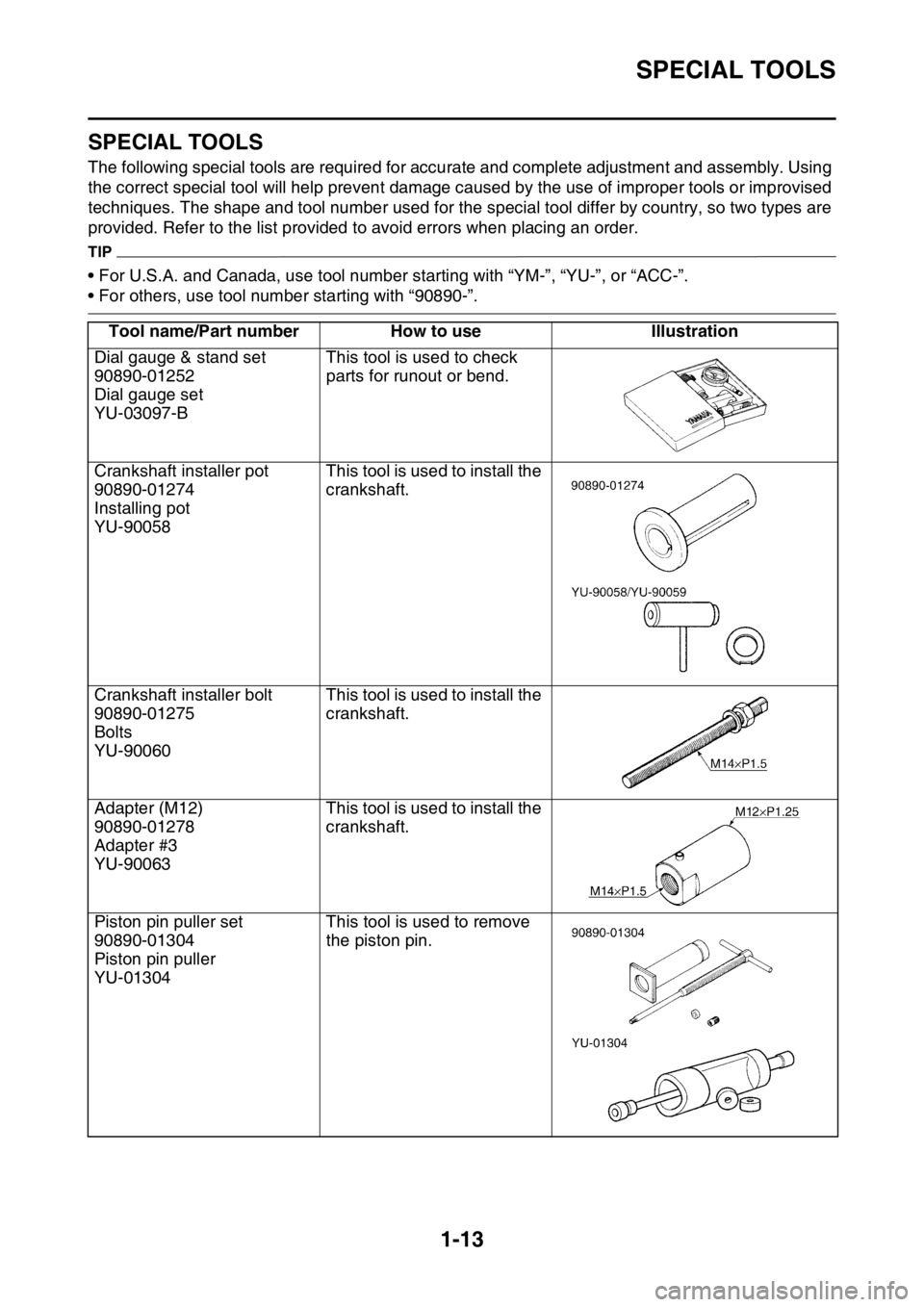
The following special tools are required for accurate and complete adjustment and assembly. Using
the correct special tool will help prevent damage caused by the use of improper tools or improvised
techniques. The shape and tool number used for the special tool differ by country, so two types are
provided. Refer to the list provided to avoid errors when placing an order.
TIP
• For U.S.A. and Canada, use tool number starting with “YM-”, “YU-”, or “ACC-”.
• For others, use tool number starting with “90890-”.
Tool name/Part number How to use Illustration
Dial gauge & stand set
90890-01252
Dial gauge set
YU-03097-BThis tool is used to check
parts for runout or bend.
Crankshaft installer pot
90890-01274
Installing pot
YU-90058This tool is used to install the
crankshaft.
Crankshaft installer bolt
90890-01275
Bolts
YU-90060This tool is used to install the
crankshaft.
Adapter (M12)
90890-01278
Adapter #3
YU-90063This tool is used to install the
crankshaft.
Piston pin puller set
90890-01304
Piston pin puller
YU-01304This tool is used to remove
the piston pin.
Page 34 of 356
STARTING AND BREAK-IN
1-20
EAS1SM9039
STARTING AND BREAK-IN
EAS1SM9040FUEL
Always use the recommended fuel as stated
below. Also, be sure to use new gasoline the
day of a race.
ECA
NOTICE
Use only unleaded gasoline. The use of
leaded gasoline will cause severe damage
to the engine internal parts such as valves,
piston rings, and exhaust system, etc.
TIP
Your Yamaha engine has been designed to use
premium unleaded gasoline with a pump oc-
tane number [(R+M)/2] of 91 or higher, or a re-
search octane number of 95 or higher. If
knocking (or pinging) occurs, use a gasoline of
a different brand.
EWA
WARNING
• For refueling, be sure to stop the engine
and use enough care not to spill any fuel.
Also be sure to avoid refueling close to a
fire.
• Refuel after the engine, exhaust pipe, etc.
have cooled off.
Gasohol (For USA and Canada)
There are two types of gasohol: gasohol con-
taining ethanol and that containing methanol.
Gasohol containing ethanol can be used if the
ethanol content does not exceed 10%. Gasohol
containing methanol is not recommended by
Yamaha because it can cause damage to the
fuel system or vehicle performance problems.
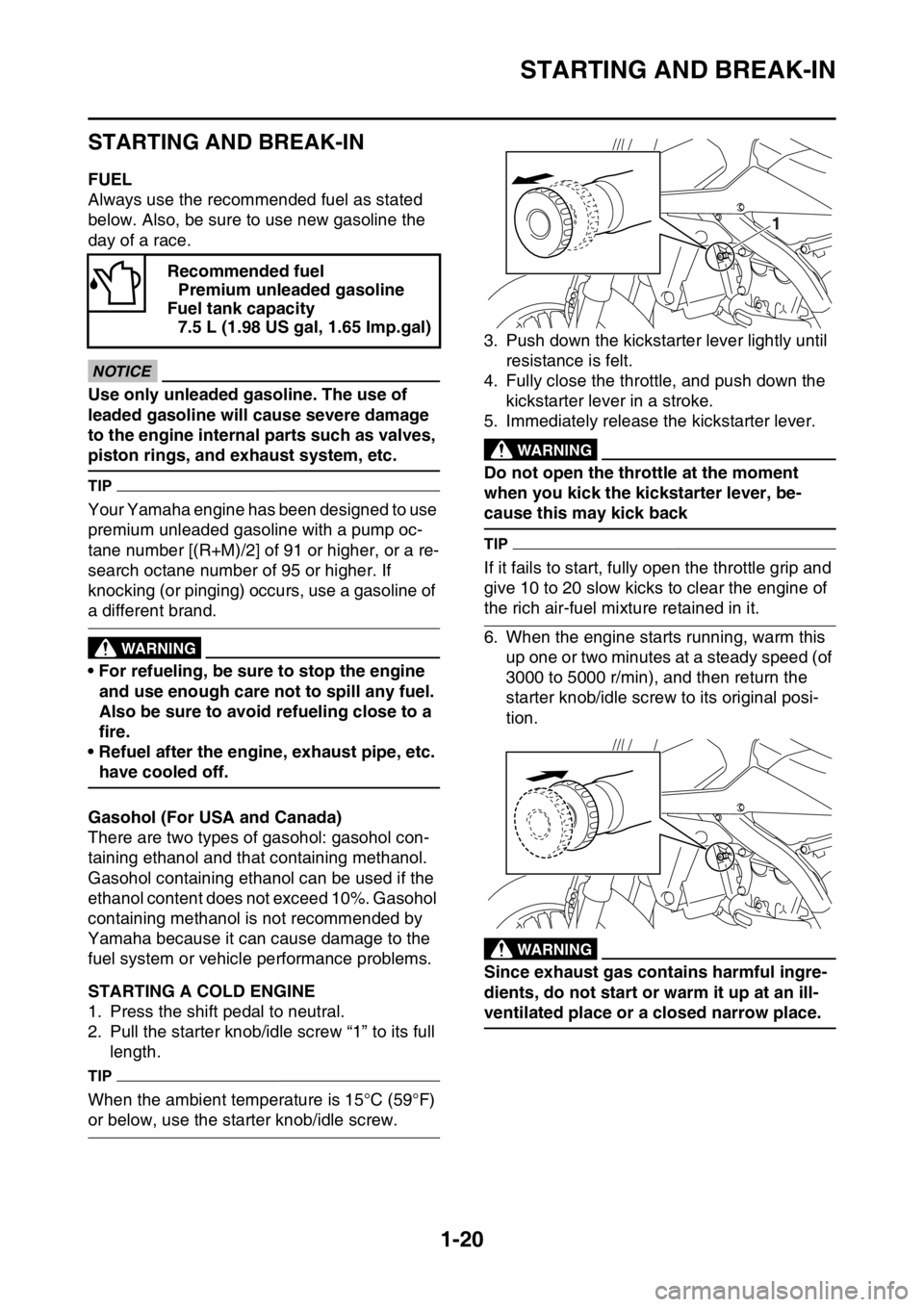
EAS1SM9041STARTING A COLD ENGINE
1. Press the shift pedal to neutral.
2. Pull the starter knob/idle screw “1” to its full
length.
TIP
When the ambient temperature is 15°C (59°F)
or below, use the starter knob/idle screw.3. Push down the kickstarter lever lightly until
resistance is felt.
4. Fully close the throttle, and push down the
kickstarter lever in a stroke.
5. Immediately release the kickstarter lever.
EWA
WARNING
Do not open the throttle at the moment
when you kick the kickstarter lever, be-
cause this may kick back
TIP
If it fails to start, fully open the throttle grip and
give 10 to 20 slow kicks to clear the engine of
the rich air-fuel mixture retained in it.
6. When the engine starts running, warm this
up one or two minutes at a steady speed (of
3000 to 5000 r/min), and then return the
starter knob/idle screw to its original posi-
tion.
EWA
WARNING
Since exhaust gas contains harmful ingre-
dients, do not start or warm it up at an ill-
ventilated place or a closed narrow place. Recommended fuel
Premium unleaded gasoline
Fuel tank capacity
7.5 L (1.98 US gal, 1.65 Imp.gal)
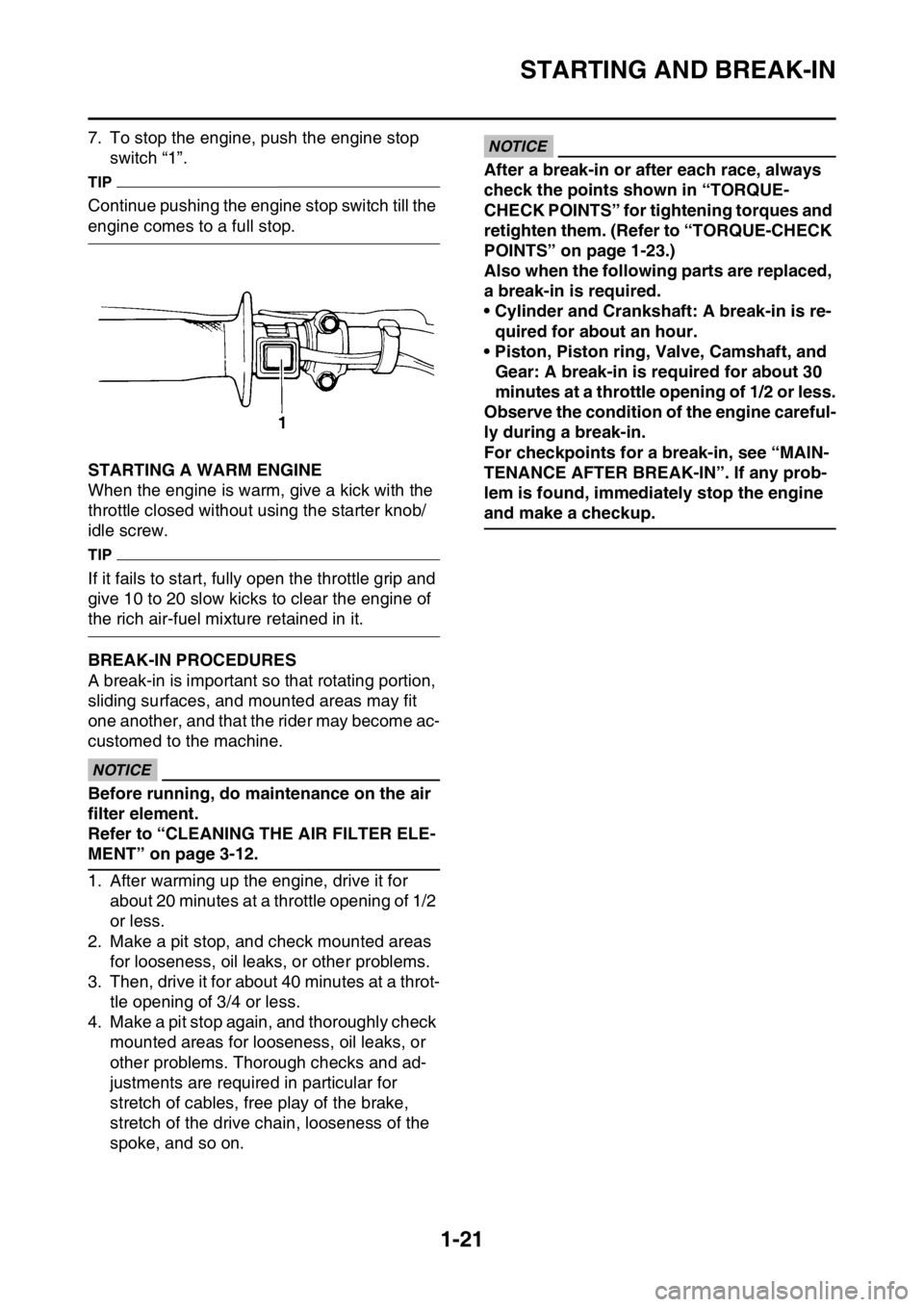
1
Page 35 of 356
STARTING AND BREAK-IN
1-21
7. To stop the engine, push the engine stop
switch “1”.
TIP
Continue pushing the engine stop switch till the
engine comes to a full stop.
EAS1SM9042STARTING A WARM ENGINE
When the engine is warm, give a kick with the
throttle closed without using the starter knob/
idle screw.
TIP
If it fails to start, fully open the throttle grip and
give 10 to 20 slow kicks to clear the engine of
the rich air-fuel mixture retained in it.
EAS1SM9043BREAK-IN PROCEDURES
A break-in is important so that rotating portion,
sliding surfaces, and mounted areas may fit
one another, and that the rider may become ac-
customed to the machine.
ECA
NOTICE
Before running, do maintenance on the air
filter element.
Refer to “CLEANING THE AIR FILTER ELE-
MENT” on page 3-12.
1. After warming up the engine, drive it for
about 20 minutes at a throttle opening of 1/2
or less.
2. Make a pit stop, and check mounted areas
for looseness, oil leaks, or other problems.
3. Then, drive it for about 40 minutes at a throt-
tle opening of 3/4 or less.
4. Make a pit stop again, and thoroughly check
mounted areas for looseness, oil leaks, or
other problems. Thorough checks and ad-
justments are required in particular for
stretch of cables, free play of the brake,
stretch of the drive chain, looseness of the
spoke, and so on.
ECA
NOTICE
After a break-in or after each race, always
check the points shown in “TORQUE-
CHECK POINTS” for tightening torques and
retighten them. (Refer to “TORQUE-CHECK
POINTS” on page 1-23.)
Also when the following parts are replaced,
a break-in is required.
• Cylinder and Crankshaft: A break-in is re-
quired for about an hour.
• Piston, Piston ring, Valve, Camshaft, and
Gear: A break-in is required for about 30
minutes at a throttle opening of 1/2 or less.
Observe the condition of the engine careful-
ly during a break-in.
For checkpoints for a break-in, see “MAIN-
TENANCE AFTER BREAK-IN”. If any prob-
lem is found, immediately stop the engine
and make a checkup.
Page 36 of 356
MAINTENANCE AFTER BREAK-IN
1-22
EAS1SM9044
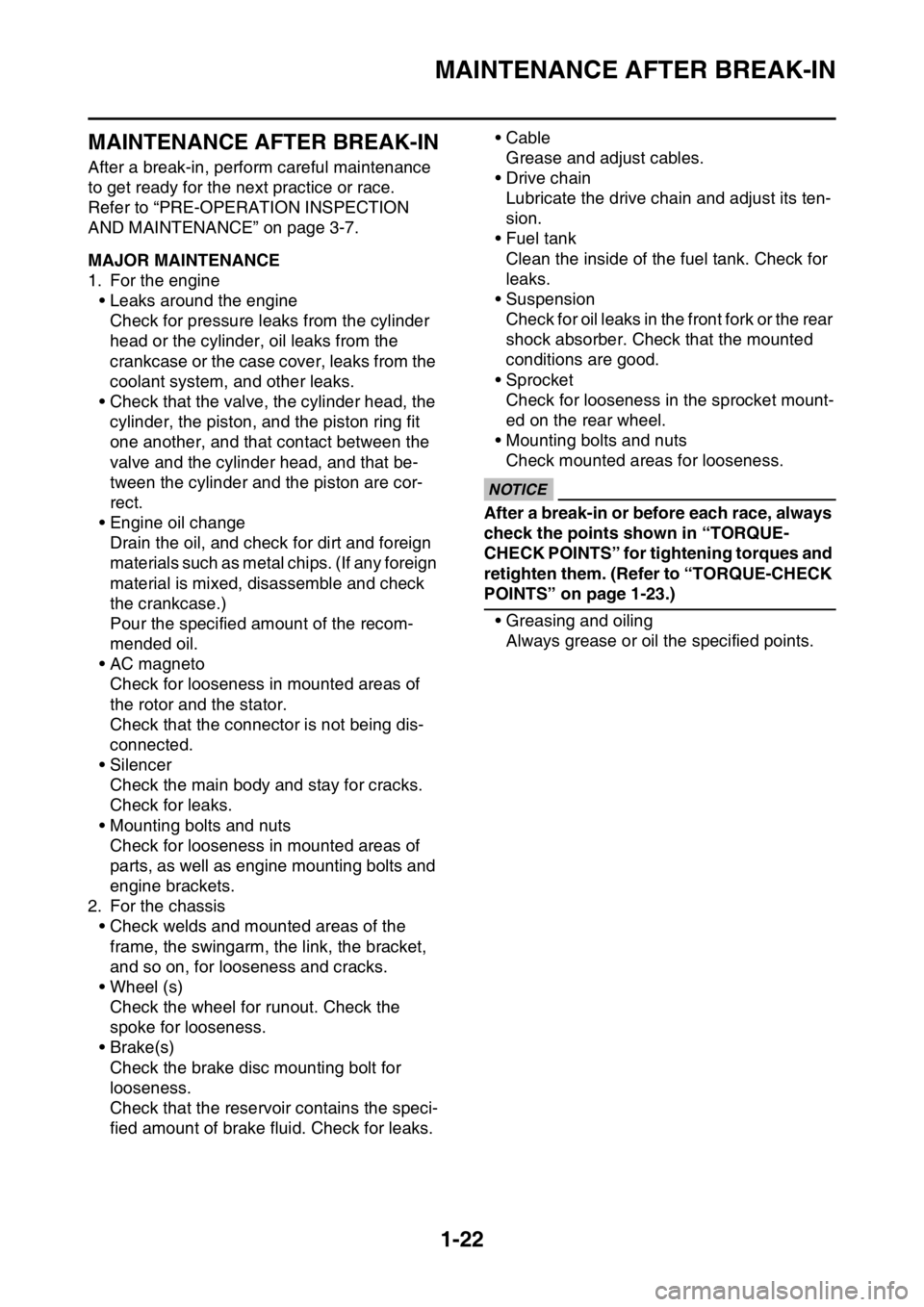
MAINTENANCE AFTER BREAK-IN
After a break-in, perform careful maintenance
to get ready for the next practice or race.
Refer to “PRE-OPERATION INSPECTION
AND MAINTENANCE” on page 3-7.
EAS1SM9045MAJOR MAINTENANCE
1. For the engine
• Leaks around the engine
Check for pressure leaks from the cylinder
head or the cylinder, oil leaks from the
crankcase or the case cover, leaks from the
coolant system, and other leaks.
• Check that the valve, the cylinder head, the
cylinder, the piston, and the piston ring fit
one another, and that contact between the
valve and the cylinder head, and that be-
tween the cylinder and the piston are cor-
rect.
• Engine oil change
Drain the oil, and check for dirt and foreign
materials such as metal chips. (If any foreign
material is mixed, disassemble and check
the crankcase.)
Pour the specified amount of the recom-
mended oil.
• AC magneto
Check for looseness in mounted areas of
the rotor and the stator.
Check that the connector is not being dis-
connected.
• Silencer
Check the main body and stay for cracks.
Check for leaks.
• Mounting bolts and nuts
Check for looseness in mounted areas of
parts, as well as engine mounting bolts and
engine brackets.
2. For the chassis
• Check welds and mounted areas of the
frame, the swingarm, the link, the bracket,
and so on, for looseness and cracks.
• Wheel (s)
Check the wheel for runout. Check the
spoke for looseness.
• Brake(s)
Check the brake disc mounting bolt for
looseness.
Check that the reservoir contains the speci-
fied amount of brake fluid. Check for leaks.• Cable
Grease and adjust cables.
•Drive chain
Lubricate the drive chain and adjust its ten-
sion.
• Fuel tank
Clean the inside of the fuel tank. Check for
leaks.
• Suspension
Check for oil leaks in the front fork or the rear
shock absorber. Check that the mounted
conditions are good.
• Sprocket
Check for looseness in the sprocket mount-
ed on the rear wheel.
• Mounting bolts and nuts
Check mounted areas for looseness.
ECA
NOTICE
After a break-in or before each race, always
check the points shown in “TORQUE-
CHECK POINTS” for tightening torques and
retighten them. (Refer to “TORQUE-CHECK
POINTS” on page 1-23.)
• Greasing and oiling
Always grease or oil the specified points.
Page 45 of 356

ENGINE SPECIFICATIONS
2-4
Valve spring
Free length (intake) 36.69 mm (1.44 in)
Limit 34.85 mm (1.37 in)
Free length (exhaust) 34.86 mm (1.37 in)
Limit 33.11 mm (1.30 in)
Installed length (intake) 31.40 mm (1.24 in)
Installed length (exhaust) 28.50 mm (1.12 in)
Spring rate K1 (intake) 29.65 N/mm (2.99 kgf/mm, 169.30 lbf/in)
Spring rate K2 (intake) 39.31 N/mm (4.01 kgf/mm, 222.46 lbf/in)
Spring rate K1 (exhaust) 23.11 N/mm (2.36 kgf/mm, 131.96 lbf/in)
Spring rate K2 (exhaust) 30.88 N/mm (3.15 kgf/mm, 176.32 lbf/in)
Installed compression spring force (intake) 146.00–168.00 N (14.89–17.13 kgf,
32.82–37.77 lbf)
Installed compression spring force (exhaust) 137.00–157.00 N (13.97–16.01 kgf,
30.80–35.29 lbf)
Spring tilt (intake) 2.5 °/1.6 mm (2.5 °/0.06 in)
Spring tilt (exhaust) 2.5 °/1.5 mm (2.5 °/0.06 in)
Winding direction (intake) Clockwise
Winding direction (exhaust) Clockwise
Cylinder
Bore 77.000–77.010 mm (3.0315–3.0319 in)
Taper limit 0.050 mm (0.0020 in)
Out of round limit 0.050 mm (0.0020 in)
Piston
Piston-to-cylinder clearance 0.030–0.055 mm (0.0012–0.0022 in)
Limit 0.15 mm (0.006 in)
Diameter 76.955–76.970 mm (3.0297–3.0303 in)
Measuring point (from piston skirt bottom) 4.0 mm (0.16 in)
Offset 0.00 mm (0.0000 in)
Piston pin bore inside diameter 16.002–16.013 mm (0.6300–0.6304 in)
Limit 16.043 mm (0.6316 in)
Piston pin outside diameter 15.991–16.000 mm (0.6296–0.6299 in)
Limit 15.971 mm (0.6288 in)
Piston ring
Top ring
Ring type Barrel
Dimensions (B T) 0.90 2.70 mm (0.04 0.11 in)
End gap (installed) 0.15–0.25 mm (0.0059–0.0098 in)
Limit 0.50 mm (0.0197 in)
Ring side clearance 0.030–0.065 mm (0.0012–0.0026 in)
Limit 0.120 mm (0.0047 in)
Oil ring
Dimensions (B T) 1.50 2.25 mm (0.06 0.89 in)
End gap (installed) 0.10–0.35 mm (0.0039–0.0138 in)
Crankshaft
Crank assembly width 55.95–56.00 mm (2.203–2.205 in)
Runout limit 0.030 mm (0.0012 in)
Big end side clearance 0.110–0.690 mm (0.0043–0.0272 in)
Page 59 of 356
LUBRICATION POINTS AND LUBRICANT TYPES
2-18
EAS1SM9057
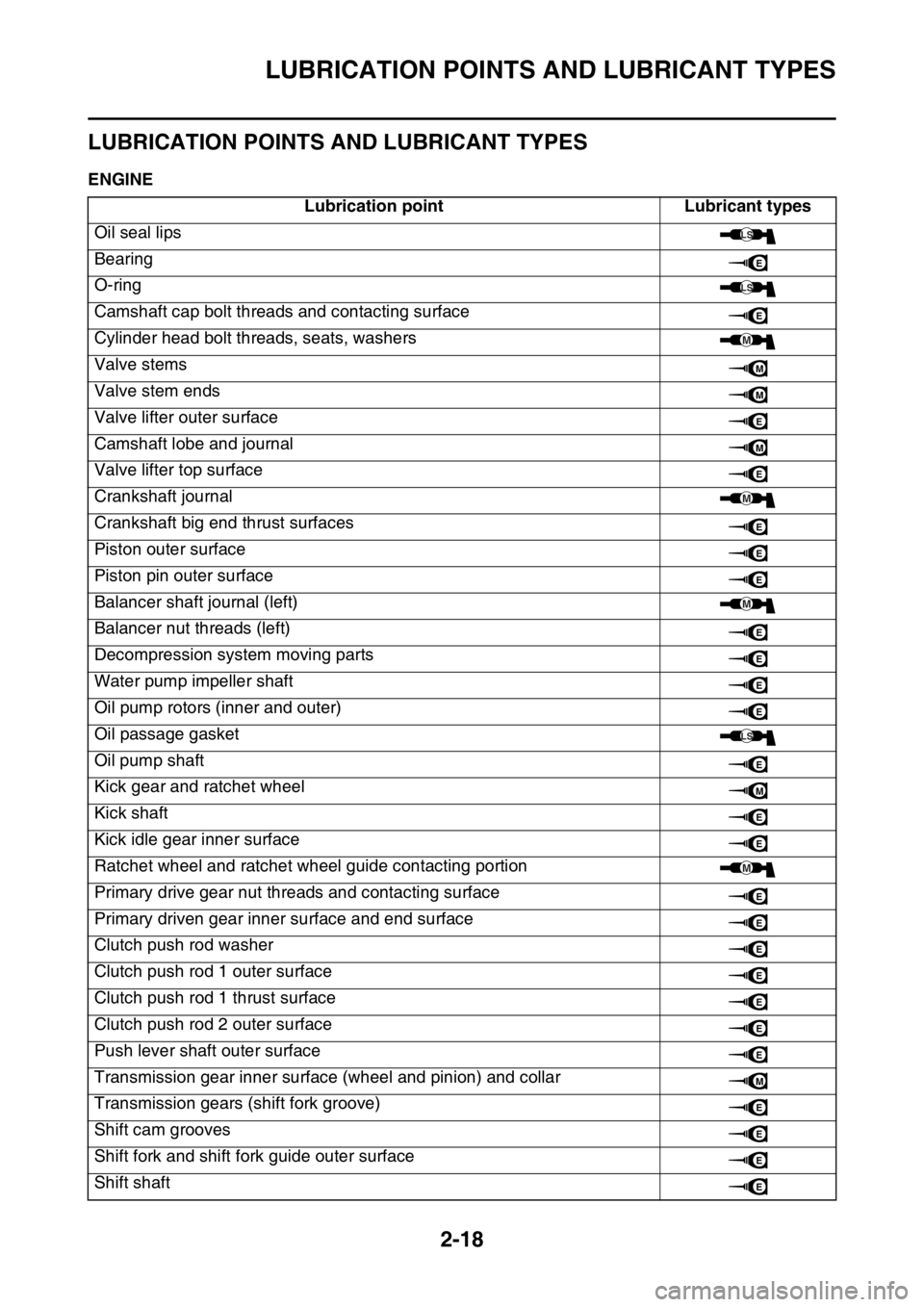
LUBRICATION POINTS AND LUBRICANT TYPES
EAS1SM9058ENGINE
Lubrication point Lubricant types
Oil seal lips
Bearing
O-ring
Camshaft cap bolt threads and contacting surface
Cylinder head bolt threads, seats, washers
Valve stems
Valve stem ends
Valve lifter outer surface
Camshaft lobe and journal
Valve lifter top surface
Crankshaft journal
Crankshaft big end thrust surfaces
Piston outer surface
Piston pin outer surface
Balancer shaft journal (left)
Balancer nut threads (left)
Decompression system moving parts
Water pump impeller shaft
Oil pump rotors (inner and outer)
Oil passage gasket
Oil pump shaft
Kick gear and ratchet wheel
Kick shaft
Kick idle gear inner surface
Ratchet wheel and ratchet wheel guide contacting portion
Primary drive gear nut threads and contacting surface
Primary driven gear inner surface and end surface
Clutch push rod washer
Clutch push rod 1 outer surface
Clutch push rod 1 thrust surface
Clutch push rod 2 outer surface
Push lever shaft outer surface
Transmission gear inner surface (wheel and pinion) and collar
Transmission gears (shift fork groove)
Shift cam grooves
Shift fork and shift fork guide outer surface
Shift shaft
LS
E
LS
E
M
M
M
E
M
E
M
E
E
E
M
E
E
E
E
LS
E
M
E
E
M
E
E
E
E
E
E
E
M
E
E
E
E
Page 61 of 356
LUBRICATION POINTS AND LUBRICANT TYPES
2-20
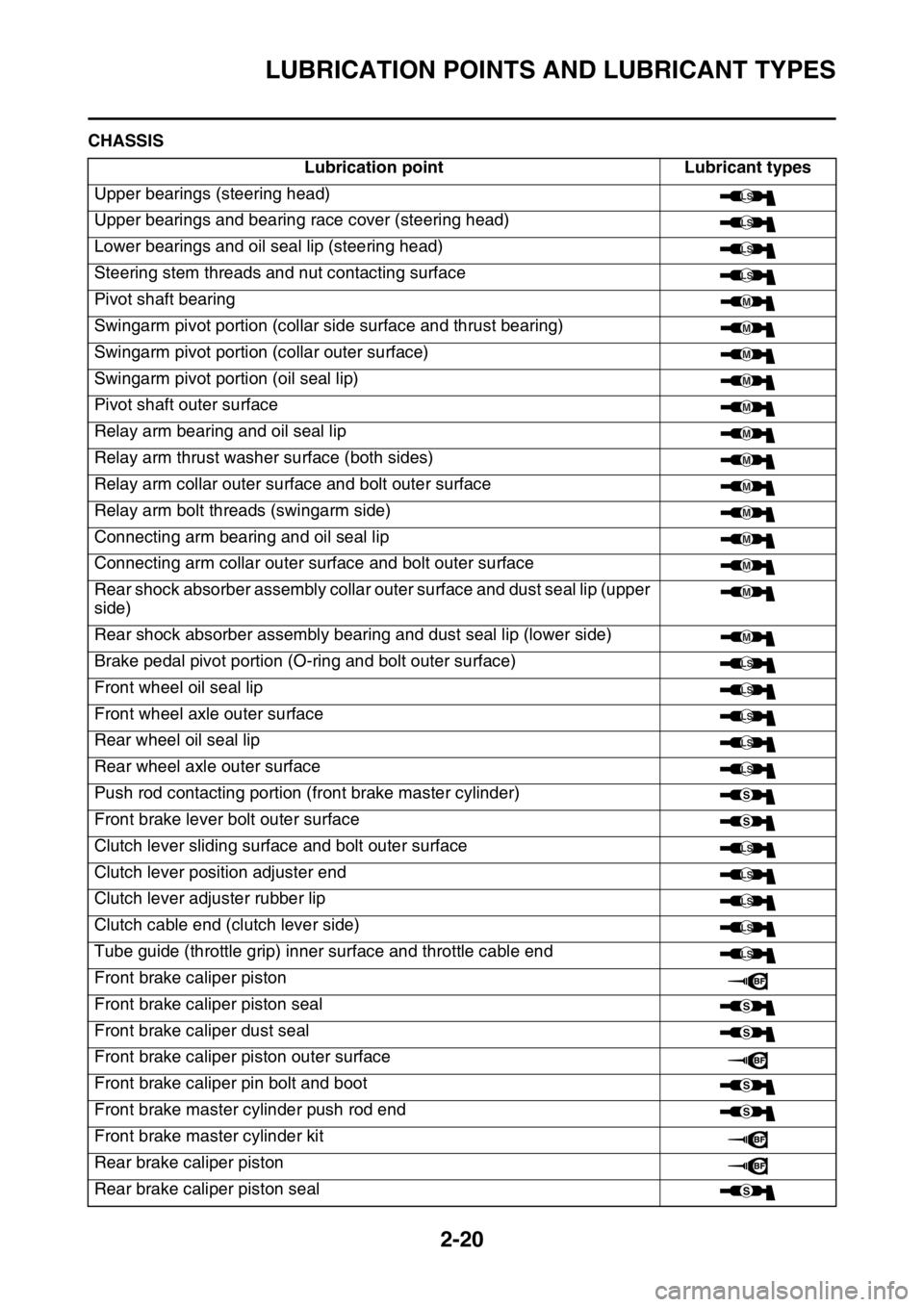
EAS1SM9059CHASSIS
Lubrication point Lubricant types
Upper bearings (steering head)
Upper bearings and bearing race cover (steering head)
Lower bearings and oil seal lip (steering head)
Steering stem threads and nut contacting surface
Pivot shaft bearing
Swingarm pivot portion (collar side surface and thrust bearing)
Swingarm pivot portion (collar outer surface)
Swingarm pivot portion (oil seal lip)
Pivot shaft outer surface
Relay arm bearing and oil seal lip
Relay arm thrust washer surface (both sides)
Relay arm collar outer surface and bolt outer surface
Relay arm bolt threads (swingarm side)
Connecting arm bearing and oil seal lip
Connecting arm collar outer surface and bolt outer surface
Rear shock absorber assembly collar outer surface and dust seal lip (upper
side)
Rear shock absorber assembly bearing and dust seal lip (lower side)
Brake pedal pivot portion (O-ring and bolt outer surface)
Front wheel oil seal lip
Front wheel axle outer surface
Rear wheel oil seal lip
Rear wheel axle outer surface
Push rod contacting portion (front brake master cylinder)
Front brake lever bolt outer surface
Clutch lever sliding surface and bolt outer surface
Clutch lever position adjuster end
Clutch lever adjuster rubber lip
Clutch cable end (clutch lever side)
Tube guide (throttle grip) inner surface and throttle cable end
Front brake caliper piston
Front brake caliper piston seal
Front brake caliper dust seal
Front brake caliper piston outer surface
Front brake caliper pin bolt and boot
Front brake master cylinder push rod end
Front brake master cylinder kit
Rear brake caliper piston
Rear brake caliper piston seal
LS
LS
LS
LS
M
M
M
M
M
M
M
M
M
M
M
M
M
LS
LS
LS
LS
LS
S
S
LS
LS
LS
LS
LS
S
S
S
S
S
Page 62 of 356

LUBRICATION POINTS AND LUBRICANT TYPES
2-21
Rear brake caliper dust seal
Rear brake caliper piston outer surface
Rear brake caliper pin bolt and boot
Rear brake master cylinder push rod end
Rear brake master cylinder kitLubrication point Lubricant typesS
S
S
Page 65 of 356

LUBRICATION SYSTEM CHART AND DIAGRAMS
2-24
1. Intake camshaft
2. Exhaust camshaft
3. Piston
4. Oil nozzle
5. Oil filter element
6. Oil pump
7. Oil strainer
8. Crankshaft
9. Drive axle
10. Main axle