oil YAMAHA YZ426F 2000 Service Manual
[x] Cancel search | Manufacturer: YAMAHA, Model Year: 2000, Model line: YZ426F, Model: YAMAHA YZ426F 2000Pages: 608, PDF Size: 45.52 MB
Page 206 of 608

3 - 32
INSP
ADJ
DRIVE CHAIN SLACK ADJUSTMENT
5. Install:
lDrive chain 1
lJoint 2
lMaster link clip 3
CAUTION:
Be sure to install the master link clip to the
direction as shown.
aTurning direction
6. Lubricate:
lDrive chain
Drive chain lubricant:
SAE 10W-30 motor oil or suit-
able chain lubricants
New
EC36A060
DRIVE CHAIN SLACK ADJUSTMENT
1. Elevate the rear wheel by placing the
suitable stand under the engine.
2. Check:
lDrive chain slack a
Above the seal guard installation bolt.
Out of specification ® Adjust.
NOTE:
Before checking and/or adjusting, rotate the
rear wheel through several revolutions and
check the slack several times to find the tight-
est point. Check and/or adjust chain slack with
rear wheel in this “tight chain” position.
Drive chain slack:
40 ~ 50 mm (1.6 ~ 2.0 in)
Page 208 of 608
3 - 33
INSP
ADJ
FRONT FORK INSPECTION
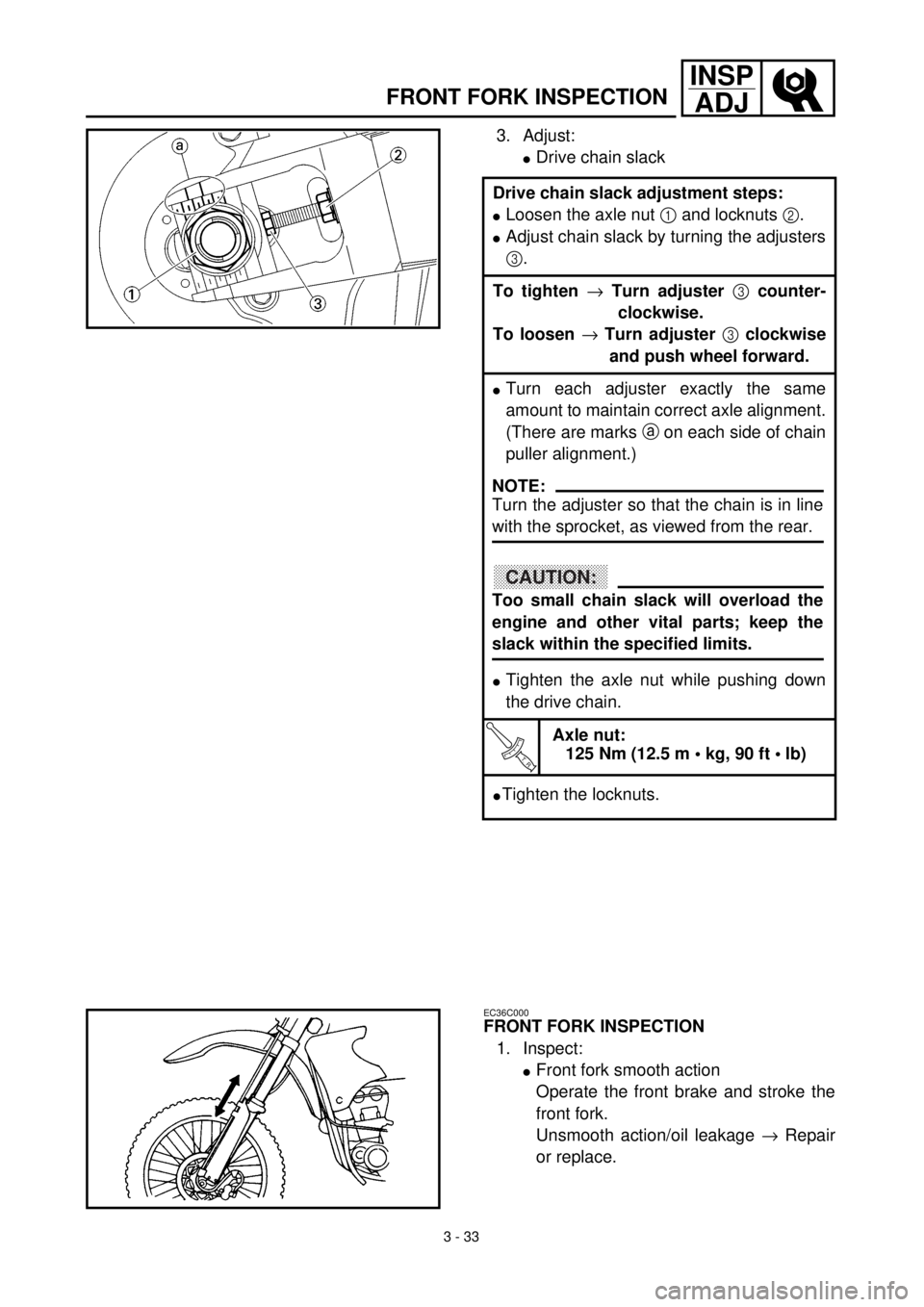
3. Adjust:
lDrive chain slack
Drive chain slack adjustment steps:
lLoosen the axle nut 1 and locknuts 2.
lAdjust chain slack by turning the adjusters
3.
To tighten ® Turn adjuster 3 counter-
clockwise.
To loosen ® Turn adjuster 3 clockwise
and push wheel forward.
lTurn each adjuster exactly the same
amount to maintain correct axle alignment.
(There are marks a on each side of chain
puller alignment.)
lTighten the axle nut while pushing down
the drive chain.
T R..
Axle nut:
125 Nm (12.5 m • kg, 90 ft • lb)
lTighten the locknuts.
NOTE:
Turn the adjuster so that the chain is in line
with the sprocket, as viewed from the rear.
CAUTION:
Too small chain slack will overload the
engine and other vital parts; keep the
slack within the specified limits.
EC36C000
FRONT FORK INSPECTION
1. Inspect:
lFront fork smooth action
Operate the front brake and stroke the
front fork.
Unsmooth action/oil leakage ® Repair
or replace.
Page 210 of 608
3 - 34
INSP
ADJFRONT FORK OIL SEAL AND DUST SEAL CLEANING/
FRONT FORK REBOUND DAMPING FORCE ADJUSTMENT
EC36D001
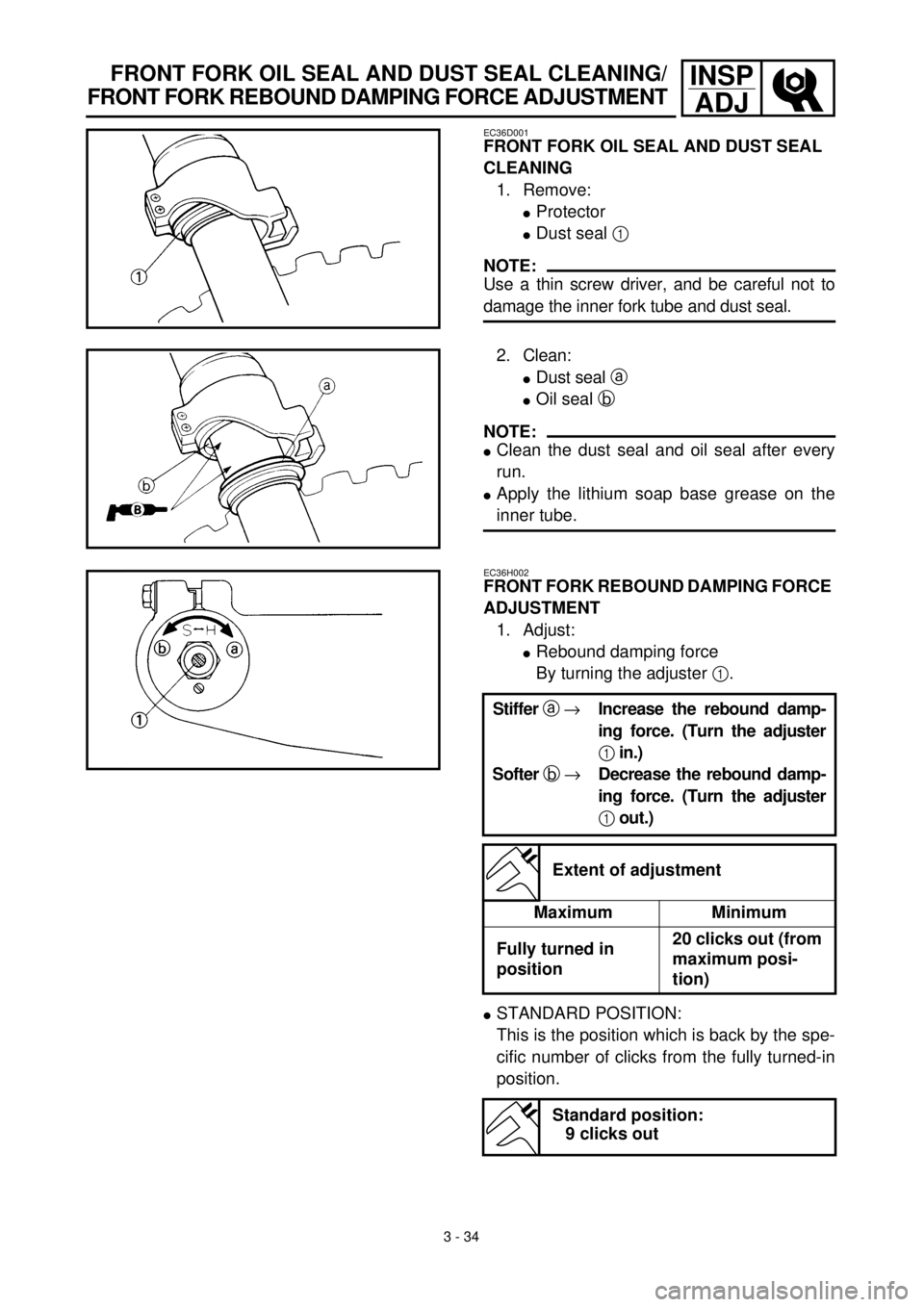
FRONT FORK OIL SEAL AND DUST SEAL
CLEANING
1. Remove:
lProtector
lDust seal 1
NOTE:
Use a thin screw driver, and be careful not to
damage the inner fork tube and dust seal.
2. Clean:
lDust seal a
lOil seal b
NOTE:
lClean the dust seal and oil seal after every
run.
lApply the lithium soap base grease on the
inner tube.
EC36H002
FRONT FORK REBOUND DAMPING FORCE
ADJUSTMENT
1. Adjust:
lRebound damping force
By turning the adjuster 1.
lSTANDARD POSITION:
This is the position which is back by the spe-
cific number of clicks from the fully turned-in
position. Stiffer a ®Increase the rebound damp-
ing force. (Turn the adjuster
1 in.)
Softer b ®Decrease the rebound damp-
ing force. (Turn the adjuster
1 out.)
Extent of adjustment
Maximum Minimum
Fully turned in
position20 clicks out (from
maximum posi-
tion)
Standard position:
9 clicks out
Page 214 of 608
3 - 36
INSP
ADJ
REAR SHOCK ABSORBER INSPECTION
lSTANDARD POSITION:
This is the position which is back by the spe-
cific number of clicks from the fully turned-in
position.
* For EUROPE
CAUTION:
Do not force the adjuster past the minimum
or maximum extent of adjustment. The
adjuster may be damaged.
WARNING
Always adjust each front fork to the same
setting. Uneven adjustment can cause poor
handling and loss of stability.
3. Install:
lRubber cap
T R..
Standard position:
8 clicks out
*10 clicks out
EC36K000
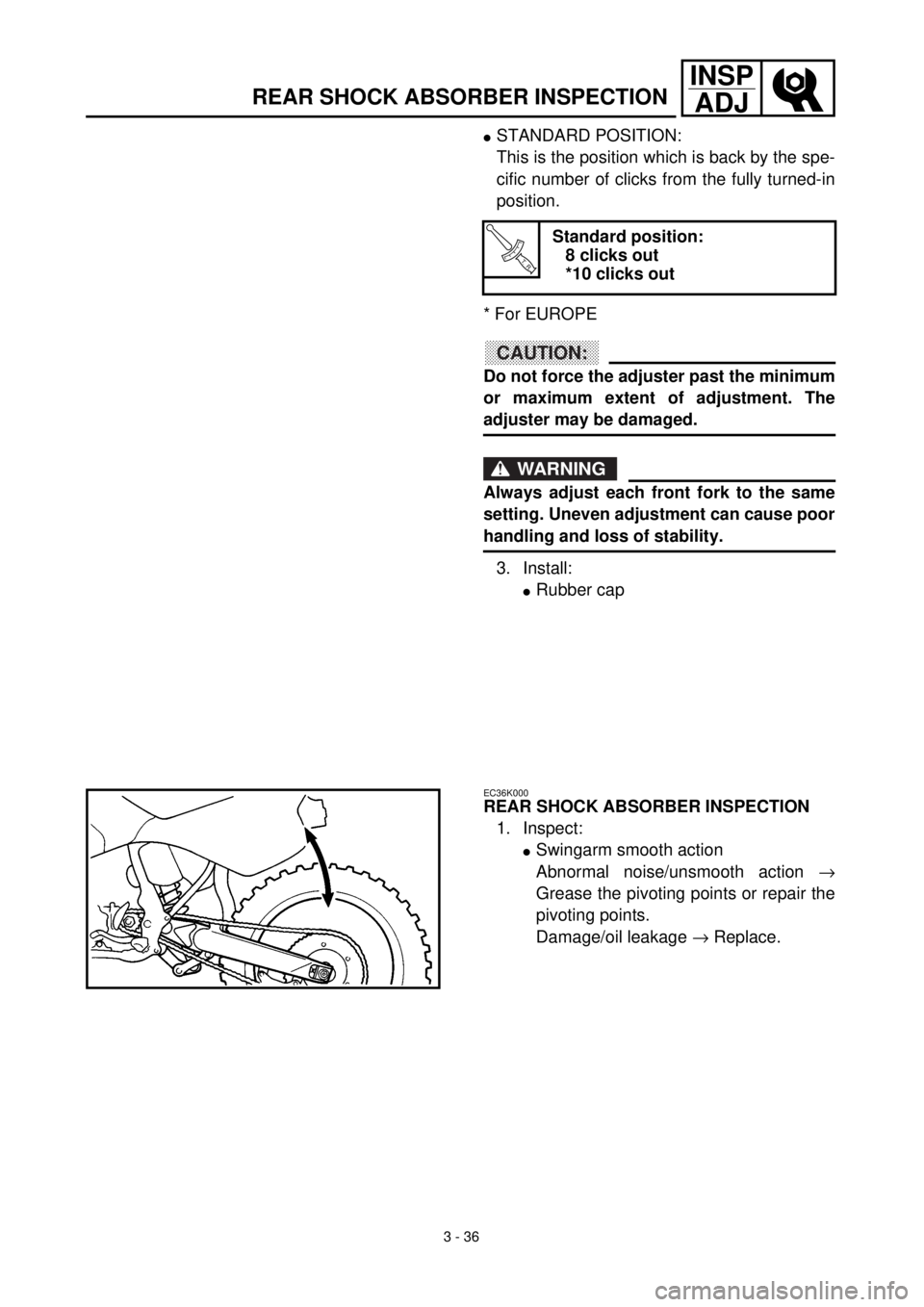
REAR SHOCK ABSORBER INSPECTION
1. Inspect:
lSwingarm smooth action
Abnormal noise/unsmooth action ®
Grease the pivoting points or repair the
pivoting points.
Damage/oil leakage ® Replace.
Page 225 of 608
INSP
ADJ
CONTROLE DE PRESSION DES PNEUS/CONTROLE ET SERRAGE DES
RAYONS/CONTROLE DE LA ROUE
REIFENLUFTDRUCK KONTROLLIEREN/SPEICHEN KONTROLLIEREN
UND FESTZIEHEN/RÄDER KONTROLLIEREN
REIFENLUFTDRUCK KONTROLLIEREN
1. Messen:
lReifenluftdruck
Unvorschriftsmäßig ® Einstellen.
HINWEIS:
lDen Reifenluftdruck bei kalten Reifen kon-
trollieren.
lBei zu niedrigem Reifendruck liegt die Rei-
fenwulst nicht fest an, was dazu führen kann,
daß sich der Reifen von der Felge löst.
lEin geneigter Reifenventilschaft deutet an,
daß der Reifen verrutscht ist.
lBei geneigtem Reifenventilschaft muß die
Reifenposition berichtigt werden.
Standard-Reifenluftdruck
100 kPa (1,0 bar)
SPEICHEN KONTROLLIEREN UND
FESTZIEHEN
1. Kontrollieren:
lSpeichen 1
Verzug/Beschädigung ® Erneuern.
Speichen locker ® Nachspannen.
2. Festziehen:
lSpeichen
HINWEIS:
Die Speichen müssen vor und nach dem Ein-
fahren nachgezogen werden. Nach jeder
Übungsfahrt bzw. Rennen die Speichenspan-
nung prüfen.
T R..3 Nm (0,3 m · kg)
RÄDER KONTROLLIEREN
1. Messen:
lFelgenschlag
Das Rad anheben und drehen.
Übermäßig ® Erneuern. CONTROLE DE PRESSION DES PNEUS
1. Mesurer:
lPression des pneus
Hors spécification ® Régler.
N.B.:
lVérifier le pneu alors qu’il est froid.
lDes butées de bourrelet lâches permettent au
pneu de se détacher de sa position sur la jante
lorsque la pression des pneus est basse.
lUne tige de soupape de pneu inclinée indique que
le pneu se détache de sa position sur la jante.
lSi la tige de soupape de pneu est inclinée, le pneu
a tendance à se détacher de sa position. Corriger
la position du pneu.
Pression des pneus standard:
100 kPa (1,0 kg/cm2, 15 psi)
CONTROLE ET SERRAGE DES RAYONS
1. Contrôler:
lRayons 1
Déformation/endommagement ® Changer.
Rayons desserrés ® Resserrer.
2. Serrer:
lRayon
N.B.:
Ne pas oublier de retendre les rayons avant et après
le rodage. Après un entraînement ou une course,
contrôler si les rayons ne sont pas détendus.
T R..3 Nm (0,3 m · kg, 2,2 ft · lb)
CONTROLE DE LA ROUE
1. Mesure:
lVoile de roue
Soulever la roue et la tourner.
Voile excessif ® Changer.
3 - 41
Page 230 of 608

3 - 44
INSP
ADJ
LUBRICATION
EC36a041
LUBRICATION
To ensure smooth operation of all compo-
nents, lubricate your machine during setup,
after break-in, and after every race.
1All control cable
2Brake and clutch lever pivots
3Shift pedal pivot
4Footrest pivot
5Throttle-to-handlebar contact
6Drive chain
7Tube guide cable winding portion
8Throttle cable end
9Clutch cable end
0Decompression cable end
AAA
AAB
CC
Use Yamaha cable lube or equivalent on these
areas.
õUse SAE10W-30 motor oil or suitable chain lubri-
cants.
‚Lubricate the following areas with high quality,
lightweight lithium-soap base grease.
CAUTION:
Wipe off any excess grease, and avoid get-
ting grease on the brake discs.
Page 268 of 608
ENG
4 - 17
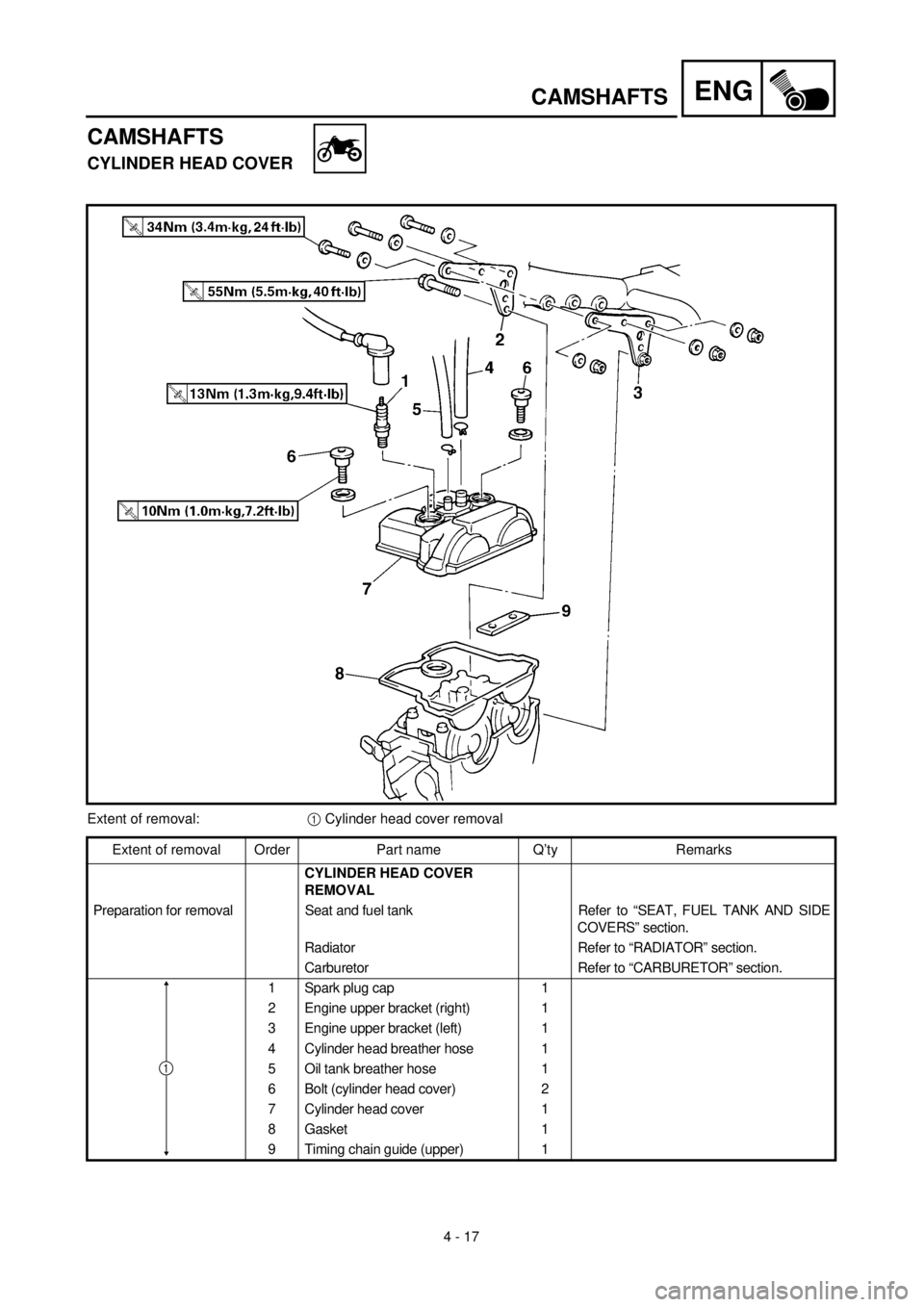
CAMSHAFTS
CAMSHAFTS
CYLINDER HEAD COVER
Extent of removal:1 Cylinder head cover removal
Extent of removal Order Part name Q’ty Remarks
CYLINDER HEAD COVER
REMOVAL
Preparation for removal Seat and fuel tank Refer to “SEAT, FUEL TANK AND SIDE
COVERS” section.
Radiator Refer to “RADIATOR” section.
Carburetor Refer to “CARBURETOR” section.
1 Spark plug cap 1
2 Engine upper bracket (right) 1
3 Engine upper bracket (left) 1
4 Cylinder head breather hose 1
5 Oil tank breather hose 1
6 Bolt (cylinder head cover) 2
7 Cylinder head cover 1
8 Gasket 1
9 Timing chain guide (upper) 1
1
Page 282 of 608

ENG
4 - 24
CYLINDER HEAD
CYLINDER HEAD
CYLINDER HEAD
Extent of removal:
1
Cylinder head removal
Extent of removal Order Part name Q’ty Remarks
CYLINDER HEAD REMOVAL
Preparation for removal Seat and fuel tank Refer to “SEAT, FUEL TANK AND SIDE
COVERS” section.
Exhaust pipe and silencer Refer to “EXHAUST PIPE AND
SILENCER” section.
Radiator Refer to “RADIATOR” section.
Carburetor Refer to “CARBURETOR” section.
Camshaft Refer to “CAMSHAFTS” section.
1 Decompression cable 1
2 Cable guide 1
3 Bolt 1
4 Decompression shaft 1
5 Oil delivery pipe 1
6 Nut (M6) 2
7 Nut (M8) 2
8 Bolt (L = 150 mm) 2
9 Bolt (L = 160 mm) 2
10 Cylinder head 1
1
Page 287 of 608
4 - 26
ENG
CULASSE
ZYLINDERKOPF
PRÜFUNG
Zylinderkopf
1. Entfernen:
lÖlkohleablagerungen (im Brennraum)
Einen abgerundeten Schaber verwen-
den.
HINWEIS:
Keine scharfkantigen Gegenstände benutzen,
um Beschädigungen und Kratzer an folgenden
Stellen zu vermeiden:
lZündkerzenbohrung
lVentilsitze
2. Kontrollieren:
lZylinderkopf
Kratzer/Beschädigungen ® Erneuern.
3. Messen:
lZylinderkopf-Verzug
Grenzwert überschritten ® Planschlei-
fen.
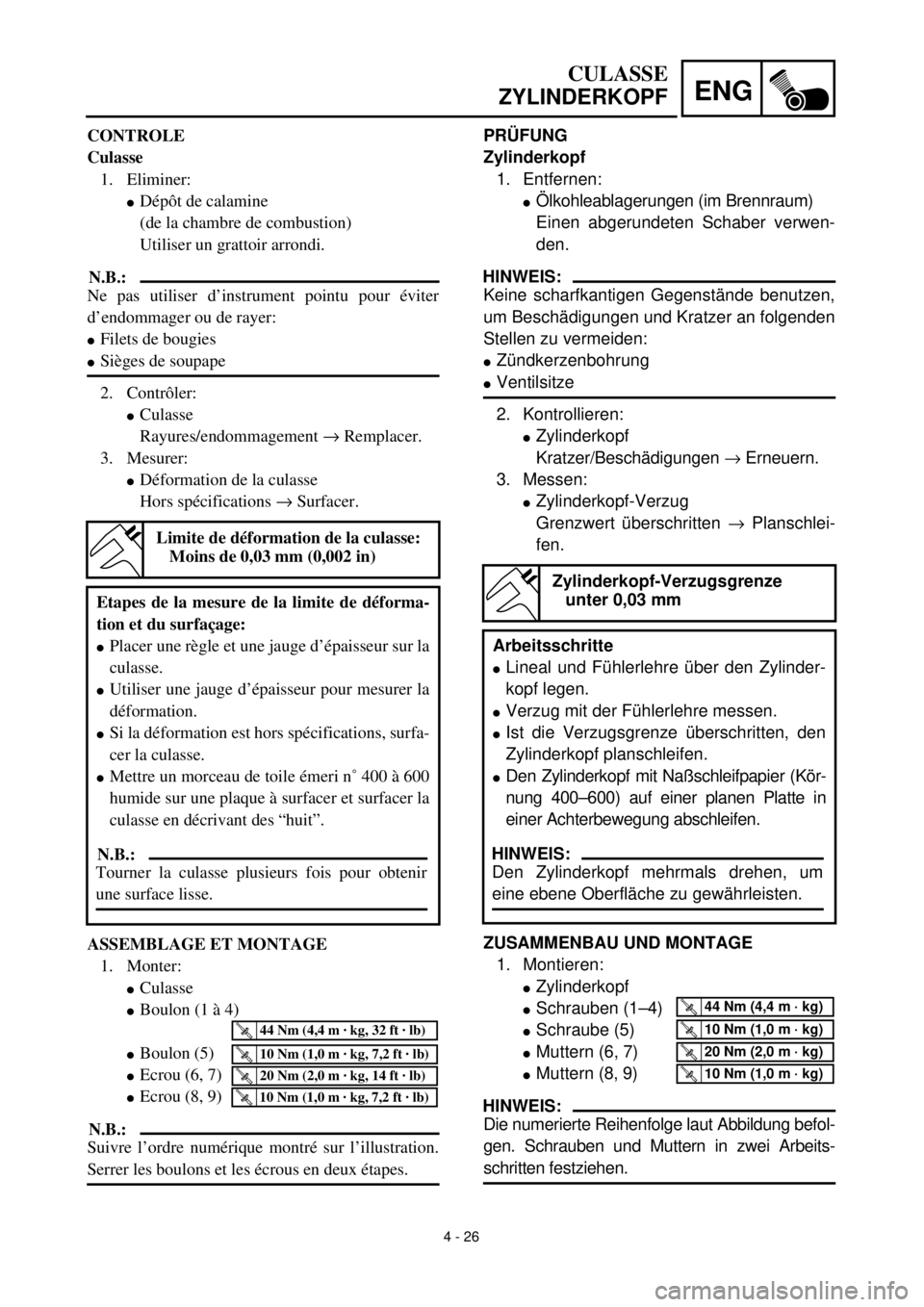
ZUSAMMENBAU UND MONTAGE
1. Montieren:
lZylinderkopf
lSchrauben (1–4)
lSchraube (5)
lMuttern (6, 7)
lMuttern (8, 9)
HINWEIS:
Die numerierte Reihenfolge laut Abbildung befol-
gen. Schrauben und Muttern in zwei Arbeits-
schritten festziehen.
Zylinderkopf-Verzugsgrenze
unter 0,03 mm
Arbeitsschritte
lLineal und Fühlerlehre über den Zylinder-
kopf legen.
lVerzug mit der Fühlerlehre messen.
lIst die Verzugsgrenze überschritten, den
Zylinderkopf planschleifen.
lDen Zylinderkopf mit Naßschleifpapier (Kör-
nung 400–600) auf einer planen Platte in
einer Achterbewegung abschleifen.
HINWEIS:
Den Zylinderkopf mehrmals drehen, um
eine ebene Oberfläche zu gewährleisten.
T R..44 Nm (4,4 m · kg)
T R..10 Nm (1,0 m · kg)
T R..20 Nm (2,0 m · kg)
T R..10 Nm (1,0 m · kg)
CONTROLE
Culasse
1. Eliminer:
lDépôt de calamine
(de la chambre de combustion)
Utiliser un grattoir arrondi.
N.B.:
Ne pas utiliser d’instrument pointu pour éviter
d’endommager ou de rayer:
lFilets de bougies
lSièges de soupape
2. Contrôler:
lCulasse
Rayures/endommagement ® Remplacer.
3. Mesurer:
lDéformation de la culasse
Hors spécifications ® Surfacer.
ASSEMBLAGE ET MONTAGE
1. Monter:
lCulasse
lBoulon (1 à 4)
lBoulon (5)
lEcrou (6, 7)
lEcrou (8, 9)
N.B.:
Suivre l’ordre numérique montré sur l’illustration.
Serrer les boulons et les écrous en deux étapes.
Limite de déformation de la culasse:
Moins de 0,03 mm (0,002 in)
Etapes de la mesure de la limite de déforma-
tion et du surfaçage:
lPlacer une règle et une jauge d’épaisseur sur la
culasse.
lUtiliser une jauge d’épaisseur pour mesurer la
déformation.
lSi la déformation est hors spécifications, surfa-
cer la culasse.
lMettre un morceau de toile émeri n˚ 400 à 600
humide sur une plaque à surfacer et surfacer la
culasse en décrivant des “huit”.
N.B.:
Tourner la culasse plusieurs fois pour obtenir
une surface lisse.
T R..44 Nm (4,4 m · kg, 32 ft · lb)
T R..10 Nm (1,0 m · kg, 7,2 ft · lb)
T R..20 Nm (2,0 m · kg, 14 ft · lb)
T R..10 Nm (1,0 m · kg, 7,2 ft · lb)
Page 294 of 608
4 - 30
ENGVALVES AND VALVE SPRINGS
3. Inspect:
lValve face
Pitting/wear ® Grind the face.
lValve stem end
Mushroom shape or diameter larger
than the body of the stem ® Replace.
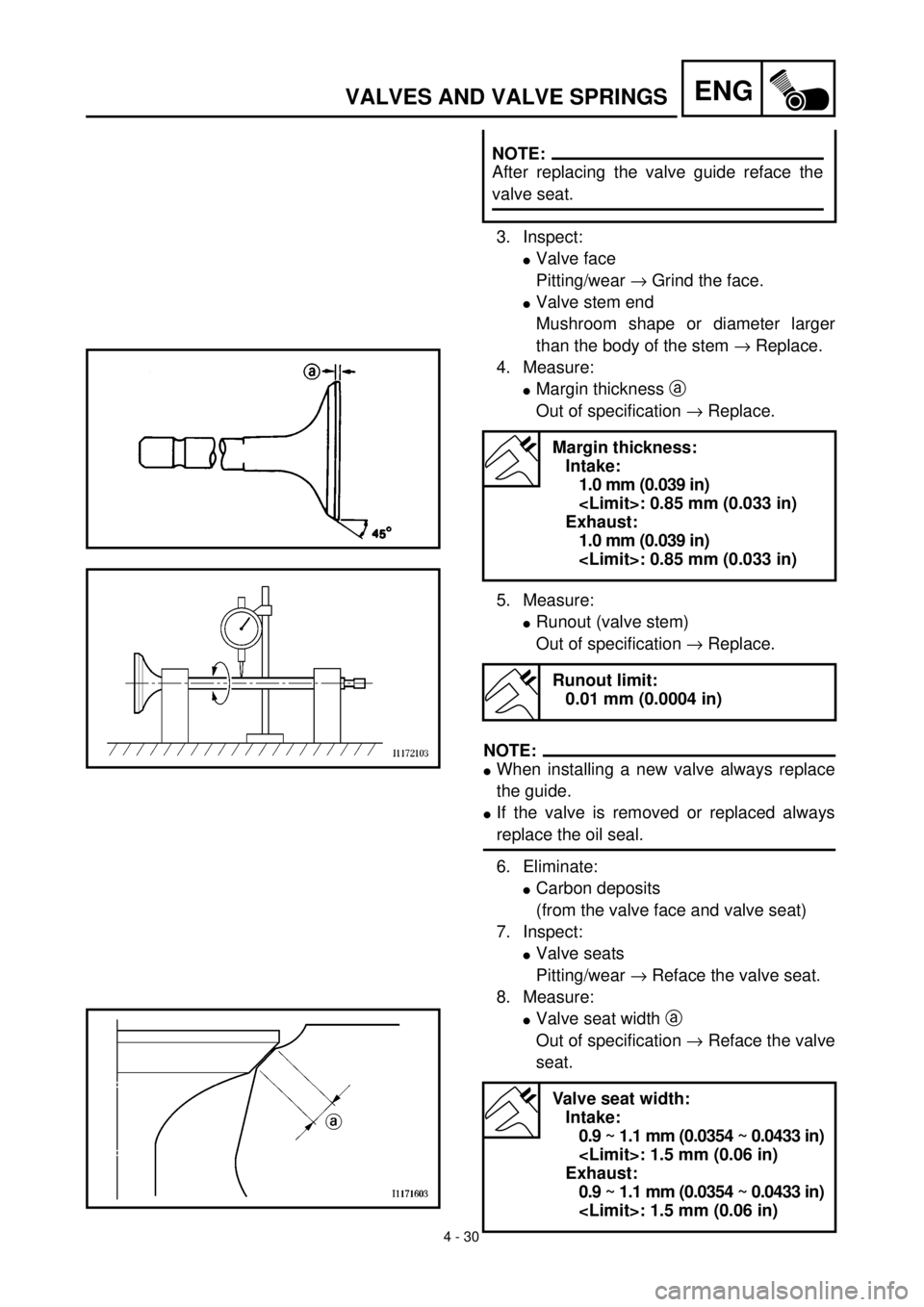
4. Measure:
lMargin thickness a
Out of specification ® Replace.
5. Measure:
lRunout (valve stem)
Out of specification ® Replace.
NOTE:
lWhen installing a new valve always replace
the guide.
lIf the valve is removed or replaced always
replace the oil seal.
6. Eliminate:
lCarbon deposits
(from the valve face and valve seat)
7. Inspect:
lValve seats
Pitting/wear ® Reface the valve seat.
8. Measure:
lValve seat width a
Out of specification ® Reface the valve
seat.
Margin thickness:
Intake:
1.0 mm (0.039 in)
Exhaust:
1.0 mm (0.039 in)
Runout limit:
0.01 mm (0.0004 in)
Valve seat width:
Intake:
0.9 ~ 1.1 mm (0.0354 ~ 0.0433 in)
Exhaust:
0.9 ~ 1.1 mm (0.0354 ~ 0.0433 in)
NOTE:
After replacing the valve guide reface the
valve seat.