ABS YAMAHA YZ426F 2001 Repair Manual
[x] Cancel search | Manufacturer: YAMAHA, Model Year: 2001, Model line: YZ426F, Model: YAMAHA YZ426F 2001Pages: 626, PDF Size: 47.57 MB
Page 536 of 626

5 - 55
CHASSWINGARM
5. Install:
lRelay arm 1
lBolt (relay arm) 2
lPlain washer 3
lNut (relay arm) 4
To swingarm.
NOTE:
lApply the molybdenum disulfide grease on
the bolt.
lDo not tighten the nut yet.
6. Install:
lSwingarm 1
lPivot shaft 2
NOTE:
lApply the molybdenum disulfide grease on
the pivot shaft.
lInsert the pivot shaft from right side.
T R..85 Nm (8.5 m · kg, 61 ft · lb)
7. Check:
lSwingarm side play a
Free play exists ® Replace thrust bear-
ing.
lSwingarm up and down movement b
Unsmooth movement/binding/rough
spots ® Grease or replace bearings,
bushes and collars.
8. Install:
lBolt (connecting rod) 1
lPlain washer 2
lNut (connecting rod) 3
NOTE:
lApply the molybdenum disulfide grease on
the bolt.
lDo not tighten the nut yet.
9. Install:
lPlain washer 1
lBolt (rear shock absorber-relay arm) 2
NOTE:
lApply the molybdenum disulfide grease on
the bolt.
lInsert the bolt from right side.
T R..53 Nm (5.3 m · kg, 38 ft · lb)
Page 540 of 626

5 - 57
CHASREAR SHOCK ABSORBER
EC580000
REAR SHOCK ABSORBER
Extent of removal:1 Rear shock absorber removal2 Rear shock absorber disassembly
Extent of removal Order Part name Q’ty Remarks
Preparation for removalREAR SHOCK ABSORBER
REMOVAL
Hold the machine by placing the
suitable stand under the engine.
WARNING
Support the machine securely so there is nodanger of it falling over.
Seat and fitting band Refer to “SEAT, FUEL TANK AND SIDE
COVERS” section.
Silencer Refer to “EXHAUST PIPE AND
SILENCER” section in the CHAPTER 4.
1 Bolt (reservoir tank) 1
2 Clamp (air cleaner joint) 1 Only loosening.
3 Rear frame 1
4 Bolt (rear shock absorber-relay
arm)1 Hold the swingarm.
5 Bolt (rear shock absorber-frame) 1
6 Rear shock absorber 1
7 Locknut 1 Only loosening.
8 Adjuster 1 Only loosening.
9 Spring guide (lower) 1
1
2
Page 542 of 626
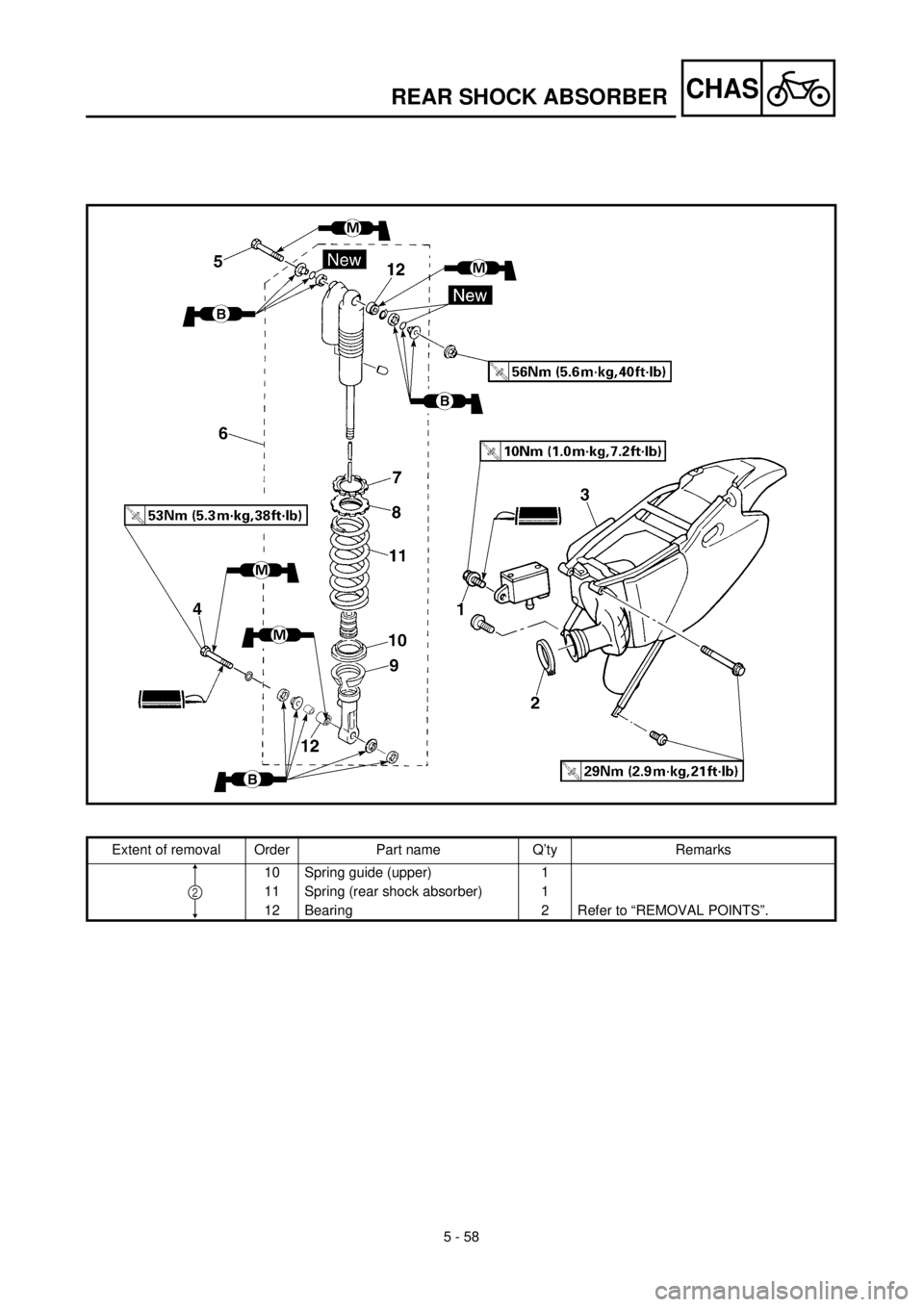
5 - 58
CHASREAR SHOCK ABSORBER
Extent of removal Order Part name Q’ty Remarks
10 Spring guide (upper) 1
11 Spring (rear shock absorber) 1
12 Bearing 2 Refer to “REMOVAL POINTS”.
2
Page 544 of 626
5 - 59
CHAS
EC586000
HANDLING NOTE
WARNING
This shock absorber is provided with a
separate type tank filled with high-pressure
nitrogen gas. To prevent the danger of
explosion, read and understand the follow-
ing information before handling the shock
absorber.
The manufacturer can not be held respon-
sible for property damage or personal
injury that may result from improper han-
dling.
1. Never tamper or attempt to disassem-
ble the cylinder or the tank.
2. Never throw the shock absorber into
an open flame or other high heat. The
shock absorber may explode as a
result of nitrogen gas expansion and/
or damage to the hose.
3. Be careful not to damage any part of
the gas tank. A damaged gas tank will
impair the damping performance or
cause a malfunction.
4. Take care not to scratch the contact
surface of the piston rod with the cylin-
der; or oil could leak out.
5. Never attempt to remove the plug at
the bottom of the nitrogen gas tank. It
is very dangerous to remove the plug.
6. When scrapping the shock absorber,
follow the instructions on disposal.
EC587000
NOTES ON DISPOSAL (YAMAHA DEALERS
ONLY)
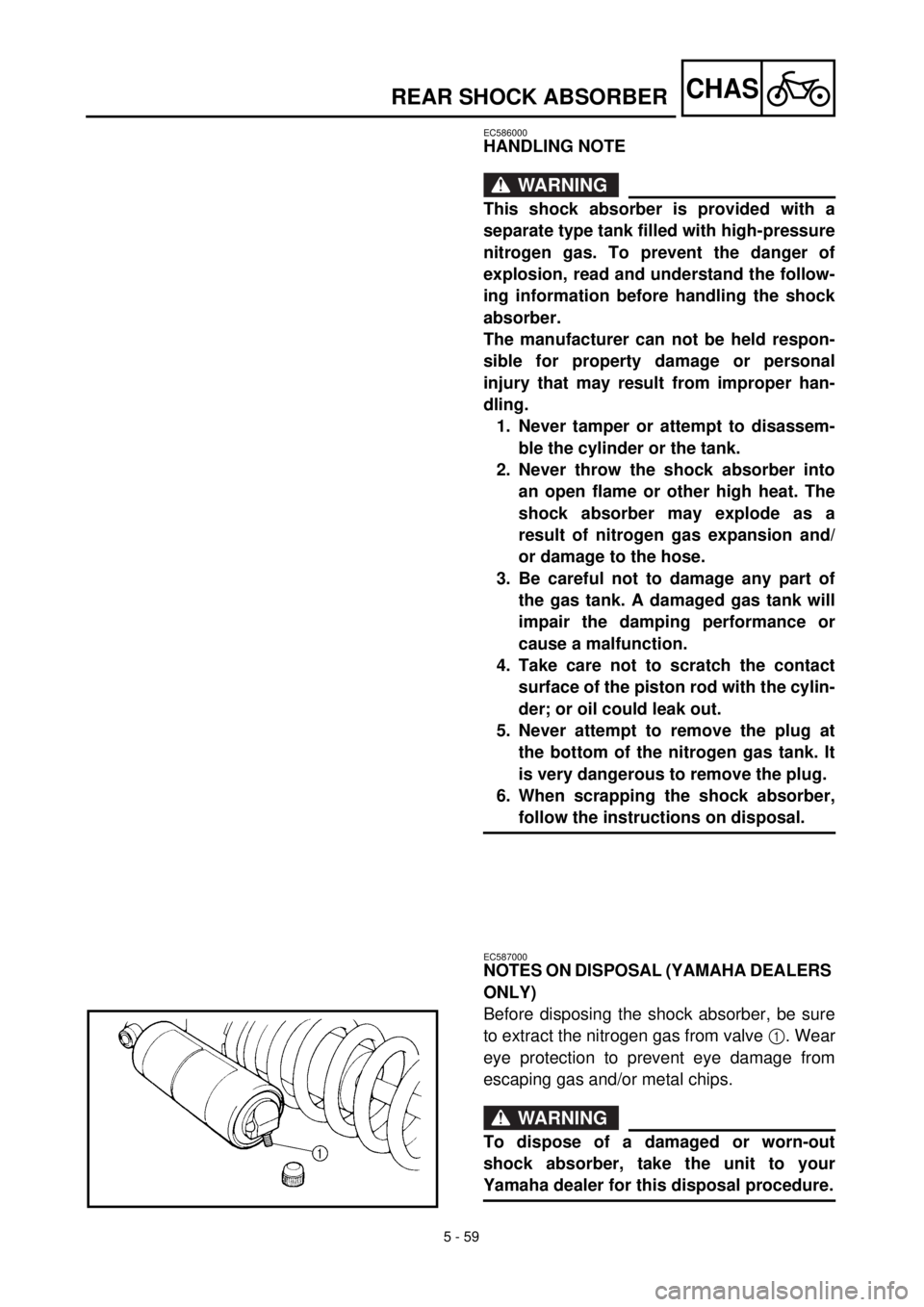
Before disposing the shock absorber, be sure
to extract the nitrogen gas from valve 1. Wear
eye protection to prevent eye damage from
escaping gas and/or metal chips.
WARNING
To dispose of a damaged or worn-out
shock absorber, take the unit to your
Yamaha dealer for this disposal procedure.
REAR SHOCK ABSORBER
Page 546 of 626
5 - 60
CHAS
EC583000
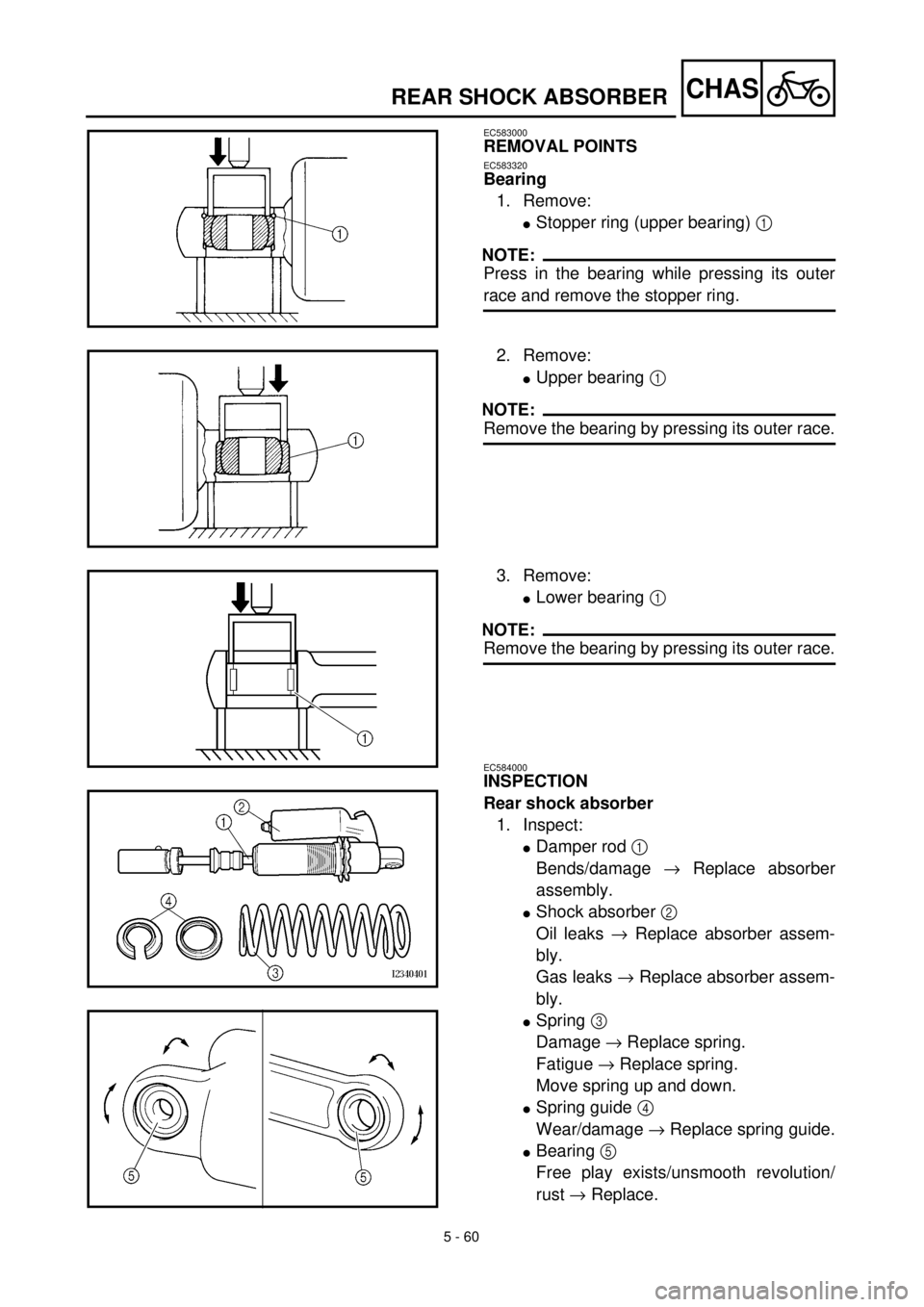
REMOVAL POINTS
EC583320
Bearing
1. Remove:
lStopper ring (upper bearing) 1
NOTE:
Press in the bearing while pressing its outer
race and remove the stopper ring.
2. Remove:
lUpper bearing 1
NOTE:
Remove the bearing by pressing its outer race.
3. Remove:
lLower bearing 1
NOTE:
Remove the bearing by pressing its outer race.
EC584000
INSPECTION
Rear shock absorber
1. Inspect:
lDamper rod 1
Bends/damage ® Replace absorber
assembly.
lShock absorber 2
Oil leaks ® Replace absorber assem-
bly.
Gas leaks ® Replace absorber assem-
bly.
lSpring 3
Damage ® Replace spring.
Fatigue ® Replace spring.
Move spring up and down.
lSpring guide 4
Wear/damage ® Replace spring guide.
lBearing 5
Free play exists/unsmooth revolution/
rust ® Replace.
REAR SHOCK ABSORBER
Page 548 of 626
5 - 61
CHAS
REAR SHOCK ABSORBER
EC585000
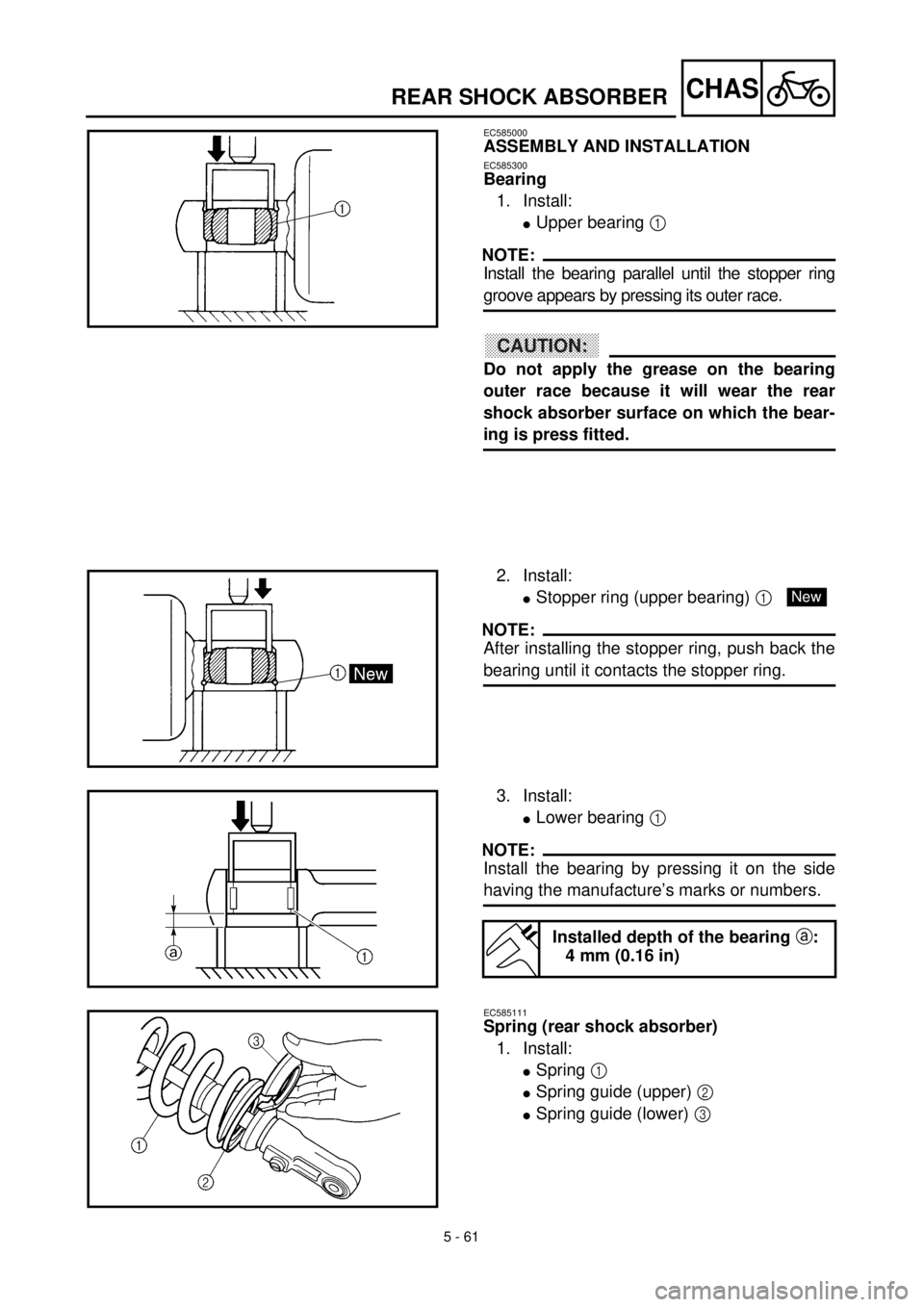
ASSEMBLY AND INSTALLATION
EC585300
Bearing
1. Install:
l
Upper bearing
1
NOTE:
Install the bearing parallel until the stopper ring
groove appears by pressing its outer race.
ACHTUNG:CAUTION:
Do not apply the grease on the bearing
outer race because it will wear the rear
shock absorber surface on which the bear-
ing is press fitted.
2. Install:
l
Stopper ring (upper bearing)
1
NOTE:
After installing the stopper ring, push back the
bearing until it contacts the stopper ring.
New
3. Install:
l
Lower bearing 1
NOTE:
Install the bearing by pressing it on the side
having the manufacture’s marks or numbers.
Installed depth of the bearing a:
4 mm (0.16 in)
EC585111
Spring (rear shock absorber)
1. Install:
lSpring 1
lSpring guide (upper) 2
lSpring guide (lower) 3
Page 550 of 626
5 - 62
CHAS
REAR SHOCK ABSORBER
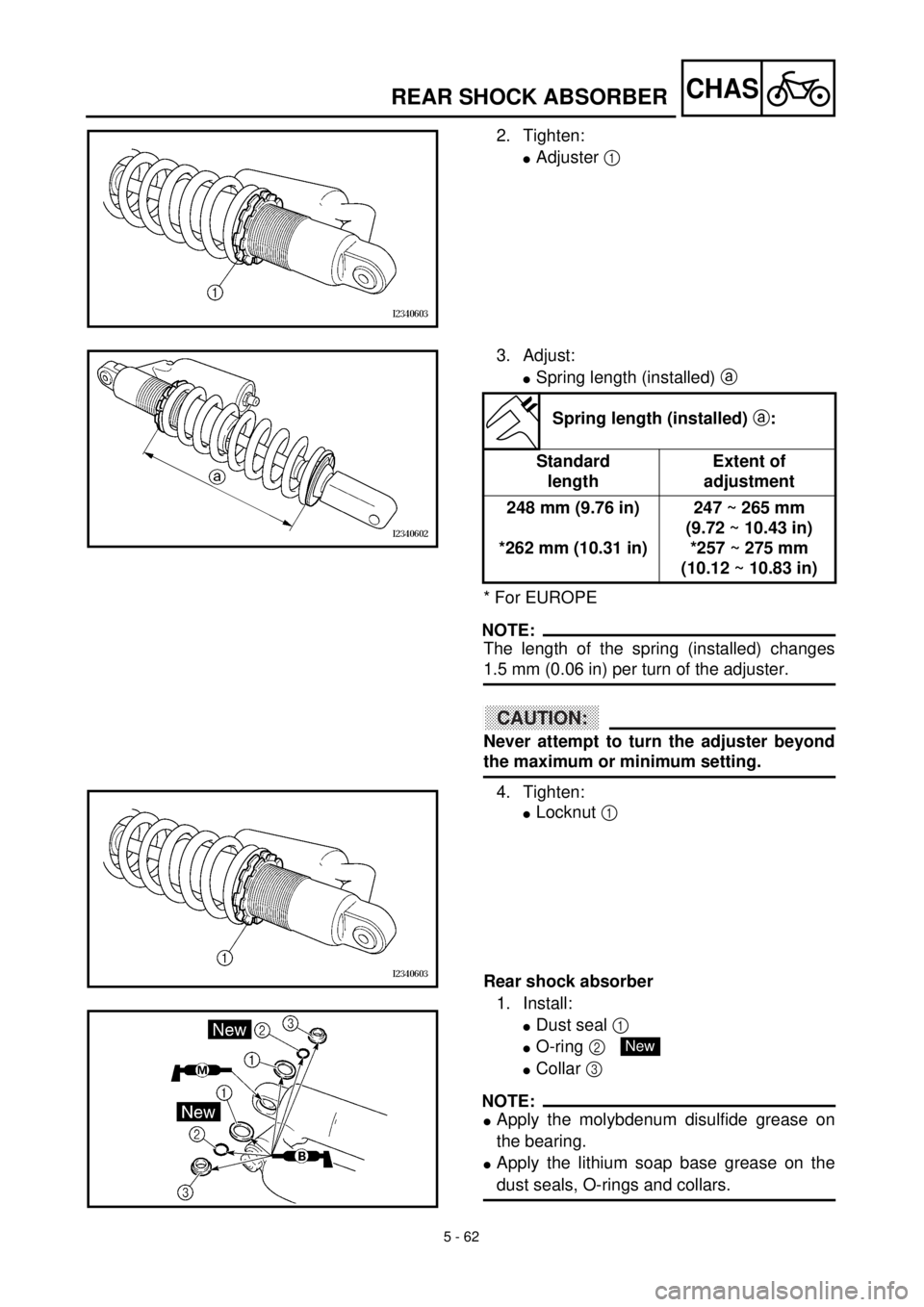
2. Tighten:
l
Adjuster
1
3. Adjust:
l
Spring length (installed)
a
* For EUROPE
NOTE:
The length of the spring (installed) changes
1.5 mm (0.06 in) per turn of the adjuster.
ACHTUNG:CAUTION:
Never attempt to turn the adjuster beyond
the maximum or minimum setting.
4. Tighten:
l
Locknut
1
Rear shock absorber
1. Install:
l
Dust seal
1
l
O-ring
2
l
Collar
3
NOTE:
l
Apply the molybdenum disulfide grease on
the bearing.
l
Apply the lithium soap base grease on the
dust seals, O-rings and collars.
Spring length (installed)
a
:
Standard
lengthExtent of
adjustment
248 mm (9.76 in)
*262 mm (10.31 in)247 ~ 265 mm
(9.72 ~ 10.43 in)
*257 ~ 275 mm
(10.12 ~ 10.83 in)
New
Page 552 of 626

5 - 63
CHAS
REAR SHOCK ABSORBER
2. Install:
l
Bush
1
l
Collar
2
l
Dust seal
3
NOTE:
l
Apply the molybdenum disulfide grease on
the bearing.
l
Apply the lithium soap base grease on the
bush, collars and dust seals.
l
Install the dust seals with their lips facing
outward.
3. Install:
l
Rear shock absorber
4. Install:
l
Bolt (rear shock absorber-frame)
1
l
Nut (rear shock absorber-frame)
2
NOTE:
Apply the molybdenum disulfide grease on the
bolt.
5. Install:
l
Plain washer
1
l
Bolt (rear shock absorber-relay arm)
2
NOTE:
l
Apply the molybdenum disulfide grease on
the bolt.
l
Insert the bolt from right side.
6. Install:
l
Rear frame
1
l
Bolt (rear frame)
2
l
Bolt (reservoir tank)
3
T R..56 Nm (5.6 m · kg, 40 ft · lb)
T R..53 Nm (5.3 m · kg, 38 ft · lb)
T R..29 Nm (2.9 m · kg, 21 ft · lb)
T R..10 Nm (1.0 m · kg, 7.2 ft · lb)
7. Tighten:
l
Screw (air cleaner joint)
1
1
T R..3 Nm (0.3 m · kg, 2.2 ft · lb)
Page 575 of 626

–+ELEC
TPS-AUSTAUSCH UND EINSTELLUNG
1. Entfernen:
l
TPS-Steckverbindung
l
Schraube (TPS)
1
l
Unterlegscheibe
2
l
TPS
3
2. Austauschen:
l
TPS
3. Einbauen:
l
TPS
1
l
Unterlegscheibe
2
l
Schraube (TPS)
3
l
TPS-Steckverbindung
HINWEIS:
l
Die Kerbe
a
im TPS auf den Vorsprung
b
am Vergaser ausrichten.
l
Die Schrauben (TPS) vorübergehend fest-
ziehen.
4. Einstellen:
l
Leerlaufdrehzahl
Siehe hierzu den Abschnitt “EINSTEL-
LUNG DER LEERLAUFDREHZAHL” in
KAPITEL 3.
5. Errechnen:
l
TPS-Spulenwiderstand bei Leerlauf
Wenn der TPS-Spulenwiderstand weniger als
5 k
W
beträgt, dann ist der TPS-Spulenwider-
stand bei Leerlauf:
5 k
W
´
(0,13–0,15) = 650–750
W
Zum TPS-Spulenwiderstand bitte mit
dem Abschnitt “INSPEKTION DES
TPS-SPULENWIDERSTANDS” ver-
gleichen. TPS-Spulenwiderstand bei Leerlauf
TPS-Spulenwiderstand ´ (0,13–0,15)
REMPLACEMENT ET REGLAGE DU TPS
1. Déposer:
lCoupleur du TPS
lVis (TPS) 1
lRondelle ordinaire 2
lTPS 3
2. Remplacer:
lTPS
3. Installer:
lTPS 1
lRondelle ordinaire 2
lVis (TPS) 3
lCoupleur TPS
N.B.:
lAligner la fente a pratiquée dans le TPS sur la
saillie b du carburateur.
lSerrer temporairement les vis (TPS).
4. Ajuster:
lVitesse de ralenti
Voir la section “Réglage de la vitesse de
ralenti” dans le CHAPITRE 3.
5. Calculer:
lRésistance de la bobine de TPS au ralenti.
Si la résistance de la bobine de TPS est de 5 kW, la
résistance de la bobine de TPS au ralenti sera:
5 kW ´ (0,13 à 0,15) = 650 à 750 W
Voir la section “Contrôle de la bobine de
TPS” pour la résistance de la bobine de
TPS. Résistance de la bobine de TPS au ralenti:
Résistance de la bobine de TPS ´
(0,13 à 0,15)
SYSTEME TPS (CAPTEUR DU PAPILLON D’ACCELERATION)
TPS-SYSTEM (DROSSELKLAPPEN-POSITIONSSENSOR)
6 - 9
Page 579 of 626
TUN
ABSTIMMUNG
MOTOR
Vergaser einstellen
l
Das Luft/Kraftstoffgemisch variiert mit den
atmosphärischen Bedingungen. Daher muß
die Einstellung des Vergasers in Abhängig-
keit von Luftdruck, Feuchtigkeit und Tempe-
ratur vorgenommen werden.
l
Führen Sie eine Probefahrt durch, um die
ordnungsgemäße Motorleistung (Ansprech-
verhalten des Motors) zu überprüfen sowie
die Verfärbung der Zündkerze bzw. die Abla-
gerungen darauf zu kontrollieren. Wählen
Sie unter Beachtung dieser Punkte die best-
möglichen Vergasereinstellungen aus.
HINWEIS:
Es wird empfohlen, die Vergasereinstellungen
und Werte wie atmosphärische Bedingungen,
Zustand der Strecke, Rundenzeiten usw.
schriftlich festzuhalten, um zukünftige Verga-
sereinstellungen zu erleichtern.
WARNUNG
l
Der Vergaser ist Bestandteil der Kraft-
stoffanlage. Er muß daher in einer gut be-
lüfteten Umgebung montiert werden, in
sicherer Entfernung von brennbaren Stof-
fen und jeglichen Feuerquellen.
l
Schauen Sie niemals in den Vergaserein-
laß. Es können Flammen herausschießen,
falls der Motor beim Anlassen zurück-
schlägt. Kraftstoff kann aus der Be-
schleunigungspumpe entweichen, wenn
der Vergaser demontiert wurde.
REGLAGE
EINSTELLUNG
MISES AU POINT
MOTEUR
Réglage de carburateur
l
La qualité de l’émulsion air/essence dépend des
conditions atmosphériques. C’est pourquoi il est
nécessaire de régler le carburateur en fonction de
la pression atmosphérique, de la température, de
l’humidité, etc.
l
Effectuer un test de conduite afin de contrôler les
performances du moteur (p. ex. la réponse à
l’accélération) et l’état de la bougie (décoloration
ou encrassement). Régler ensuite le carburateur
au vu des résultats obtenus.
N.B.:
Afin de faciliter les réglages de carburateur ulté-
rieurs, il est utile de conserver toutes les données,
c.-à.-d. les réglages correspondant aux diverses
conditions atmosphériques, conditions du terrain,
les temps, etc.
AVERTISSEMENT
l
Le carburateur fait partie du circuit de carbu-
rant. Il est donc important d’effectuer tout
travail sur le carburateur dans un endroit bien
aéré et à une distance sûre d’objets inflamma-
bles ou d’une source de flammes.
l
Ne jamais regarder à l’intérieur de l’admis-
sion d’un carburateur. Des flammes risquent
de s’échapper du tuyau en cas de ratés lors de
la mise en marche du moteur. De l’essence
pourrait s’écouler du gicleur de la pompe
d’accélérateur lorsque le carburateur est
déposé.
7 - 1
7