engine oil YAMAHA YZ450F 2012 Service Manual
[x] Cancel search | Manufacturer: YAMAHA, Model Year: 2012, Model line: YZ450F, Model: YAMAHA YZ450F 2012Pages: 228, PDF Size: 11.42 MB
Page 139 of 228
4-58
TRANSMISSION, SHIFT CAM AND SHIFT FORK
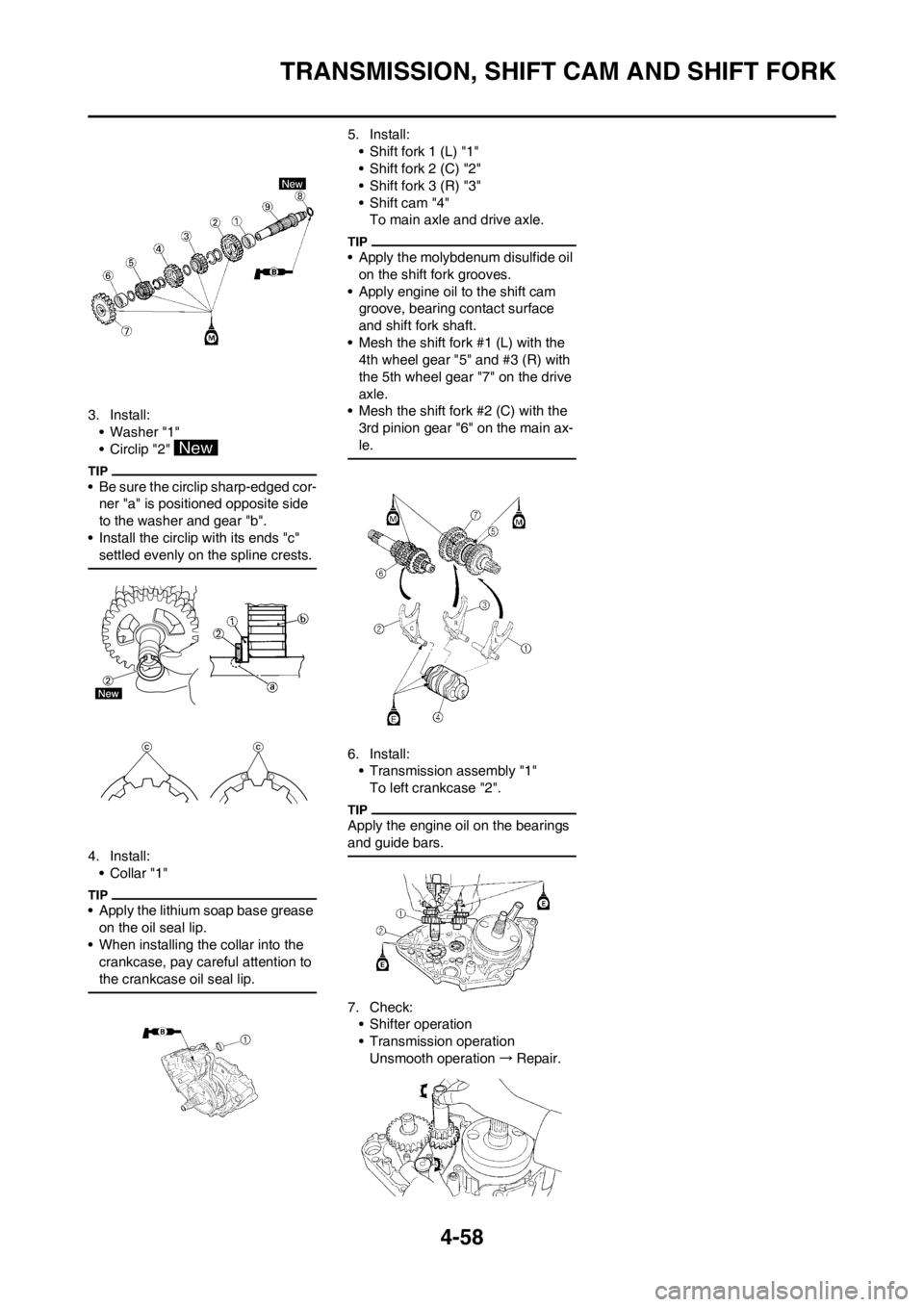
3. Install:
• Washer "1"
• Circlip "2"
• Be sure the circlip sharp-edged cor-
ner "a" is positioned opposite side
to the washer and gear "b".
• Install the circlip with its ends "c"
settled evenly on the spline crests.
4. Install:
•Collar "1"
• Apply the lithium soap base grease
on the oil seal lip.
• When installing the collar into the
crankcase, pay careful attention to
the crankcase oil seal lip.
5. Install:
• Shift fork 1 (L) "1"
• Shift fork 2 (C) "2"
• Shift fork 3 (R) "3"
• Shift cam "4"
To main axle and drive axle.
• Apply the molybdenum disulfide oil
on the shift fork grooves.
• Apply engine oil to the shift cam
groove, bearing contact surface
and shift fork shaft.
• Mesh the shift fork #1 (L) with the
4th wheel gear "5" and #3 (R) with
the 5th wheel gear "7" on the drive
axle.
• Mesh the shift fork #2 (C) with the
3rd pinion gear "6" on the main ax-
le.
6. Install:
• Transmission assembly "1"
To left crankcase "2".
Apply the engine oil on the bearings
and guide bars.
7. Check:
• Shifter operation
• Transmission operation
Unsmooth operation→Repair.
Page 140 of 228
5-1
FRONT WHEEL AND REAR WHEEL
CHASSIS
This section is intended for those who have basic knowledge and skill concerning the servicing of Yamaha motorcycles
(e.g., Yamaha dealers, service engineers, etc.) Those who have little knowledge and skill concerning servicing are request-
ed not to undertake inspection, adjustment, disassembly, or reassembly only by reference to this manual. It may lead to
servicing trouble and mechanical damage.
FRONT WHEEL AND REAR WHEEL
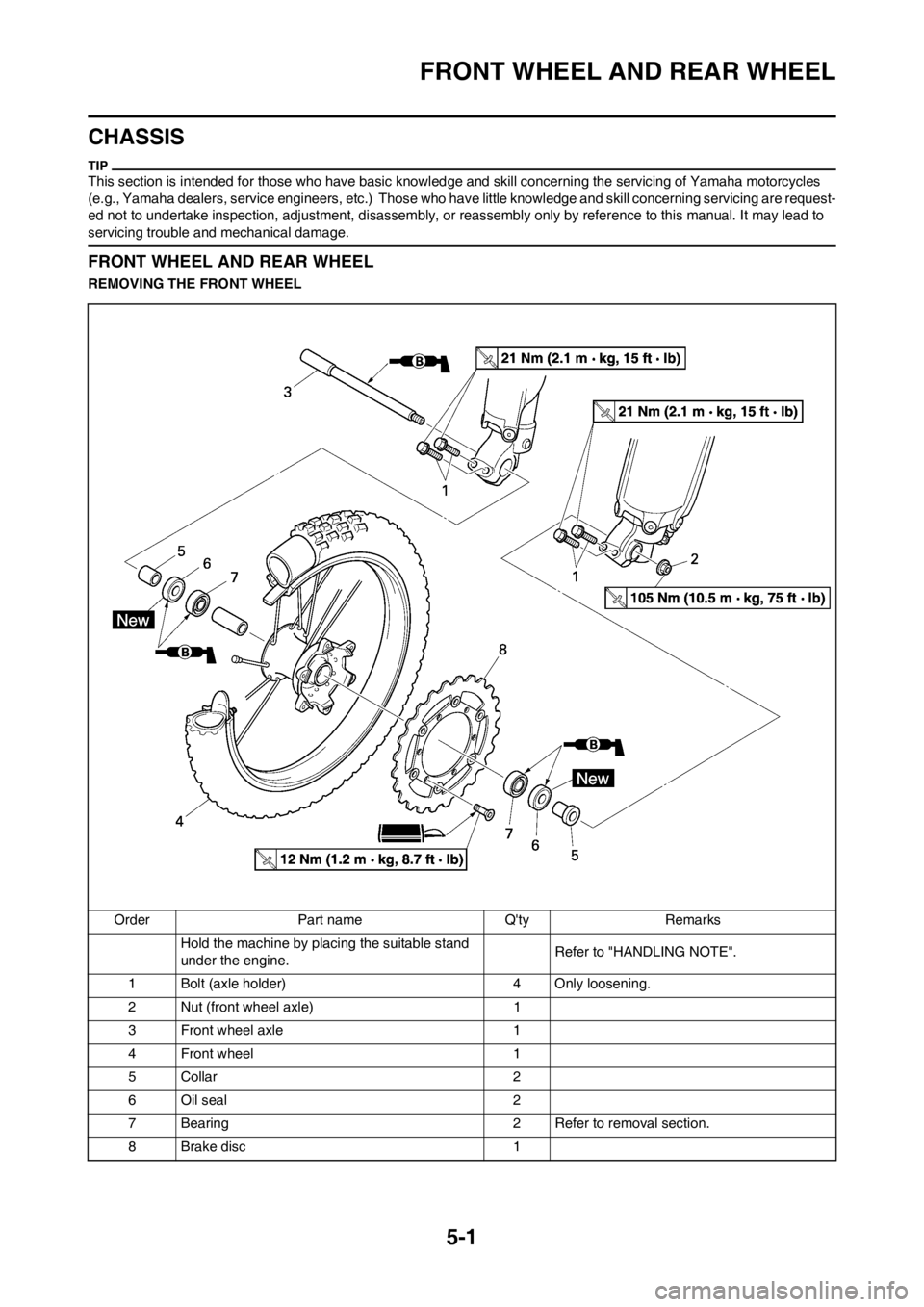
REMOVING THE FRONT WHEEL
Order Part name Q'ty Remarks Hold the machine by placing the suitable stand
under the engine. Refer to "HANDLING NOTE".
1 Bolt (axle holder) 4 Only loosening.
2 Nut (front wheel axle) 1
3 Front wheel axle 1
4 Front wheel 1
5 Collar 2
6 Oil seal 2
7 Bearing 2 Refer to removal section.
8 Brake disc 1
Page 141 of 228
5-2
FRONT WHEEL AND REAR WHEEL
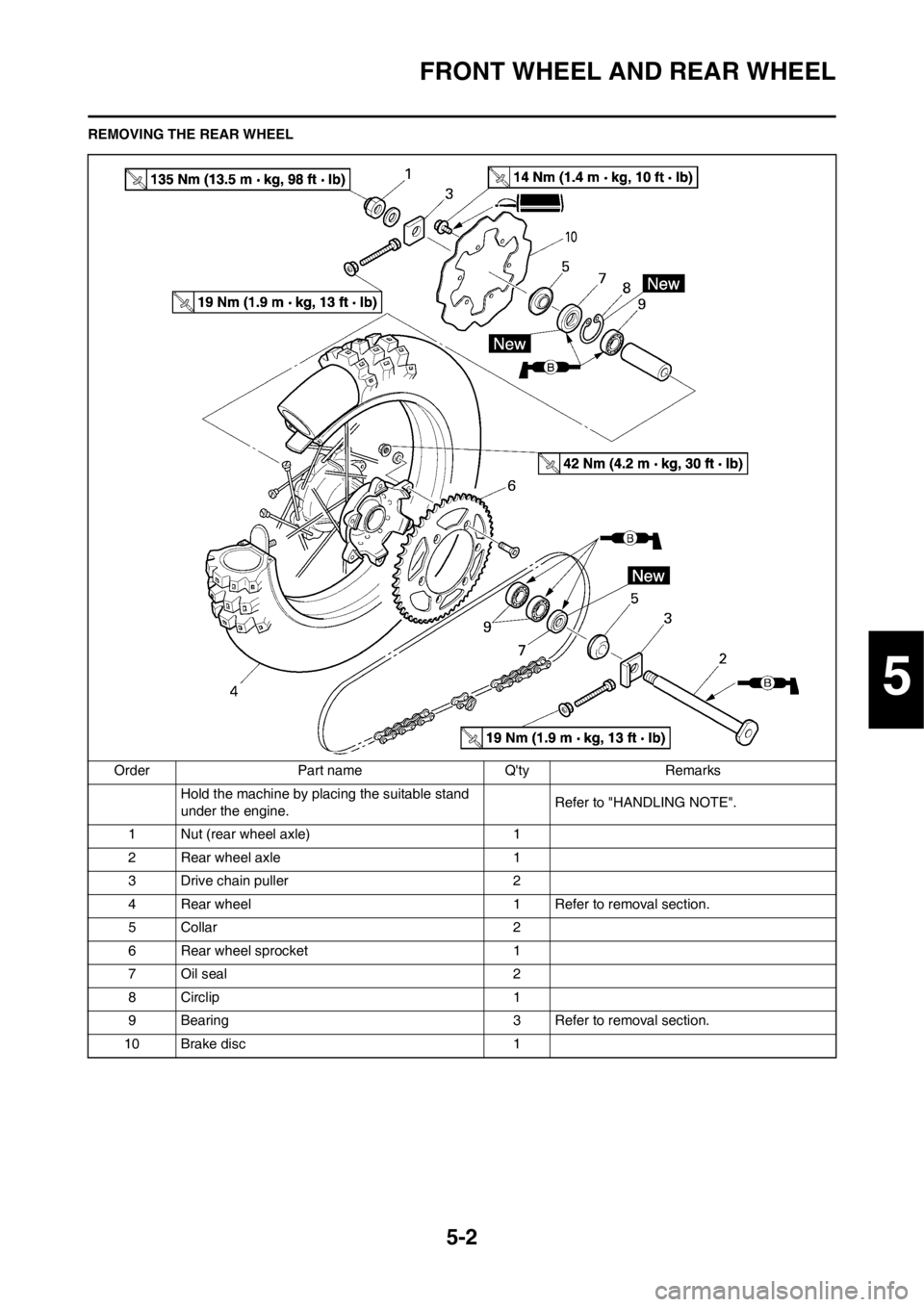
REMOVING THE REAR WHEEL
Order Part name Q'ty Remarks
Hold the machine by placing the suitable stand
under the engine.Refer to "HANDLING NOTE".
1 Nut (rear wheel axle) 1
2 Rear wheel axle 1
3 Drive chain puller 2
4 Rear wheel 1 Refer to removal section.
5 Collar 2
6 Rear wheel sprocket 1
7 Oil seal 2
8 Circlip 1
9 Bearing 3 Refer to removal section.
10 Brake disc 1
5
Page 185 of 228
7-1
ELECTRICAL COMPONENTS AND WIRING DIAGRAM
ELECTRICAL
This section is intended for those who have basic knowledge and skill concerning the servicing of Yamaha motorcycles
(e.g., Yamaha dealers, service engineers, etc.) Those who have little knowledge and skill concerning servicing are request-
ed not to undertake inspection, adjustment, disassembly, or reassembly only by reference to this manual. It may lead to
servicing trouble and mechanical damage.
ELECTRICAL COMPONENTS AND WIRING DIAGRAM
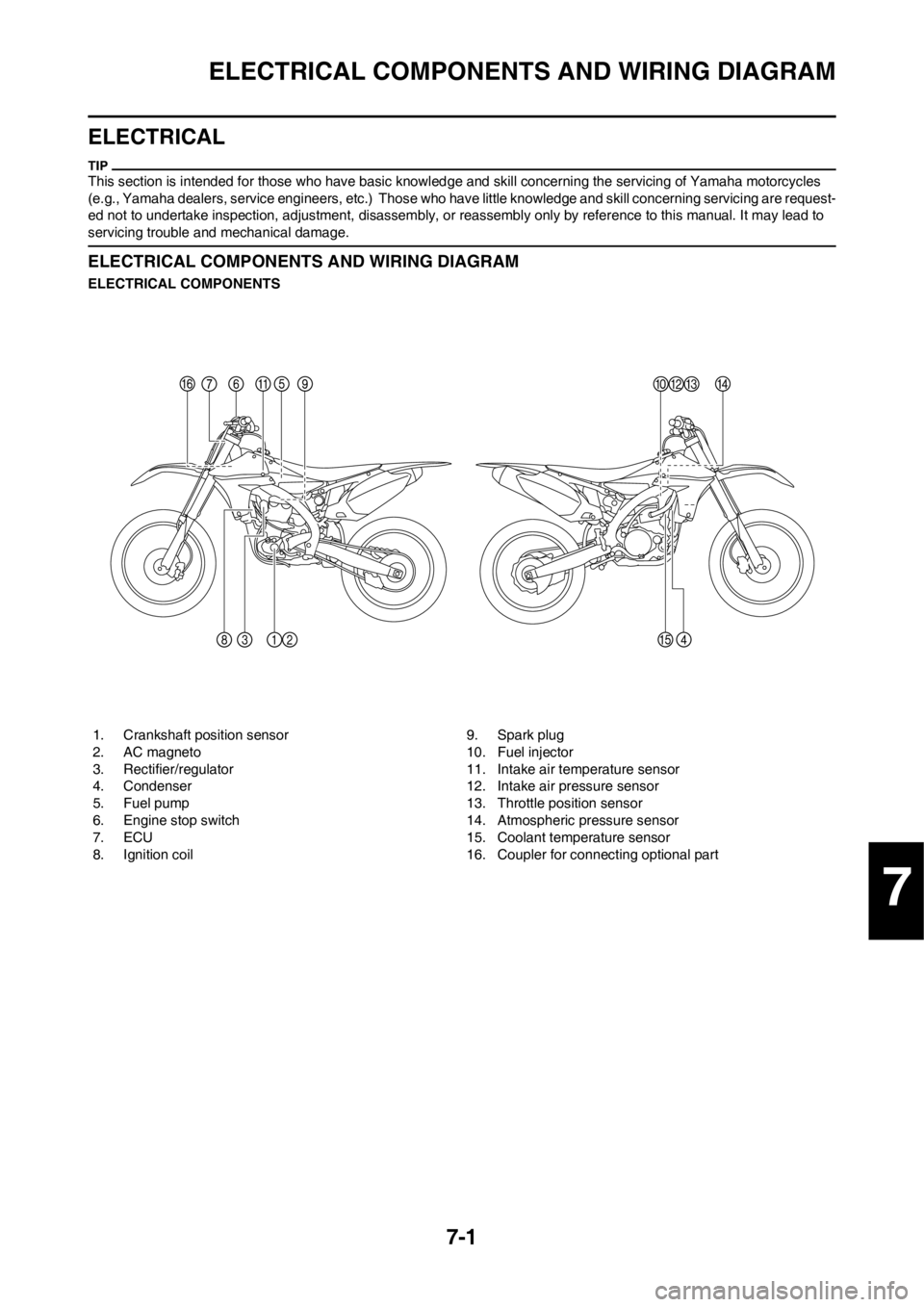
ELECTRICAL COMPONENTS
1. Crankshaft position sensor
2. AC magneto
3. Rectifier/regulator
4. Condenser
5. Fuel pump
6. Engine stop switch
7. ECU
8. Ignition coil9. Spark plug
10. Fuel injector
11. Intake air temperature sensor
12. Intake air pressure sensor
13. Throttle position sensor
14. Atmospheric pressure sensor
15. Coolant temperature sensor
16. Coupler for connecting optional part
7
Page 186 of 228
7-2
ELECTRICAL COMPONENTS AND WIRING DIAGRAM
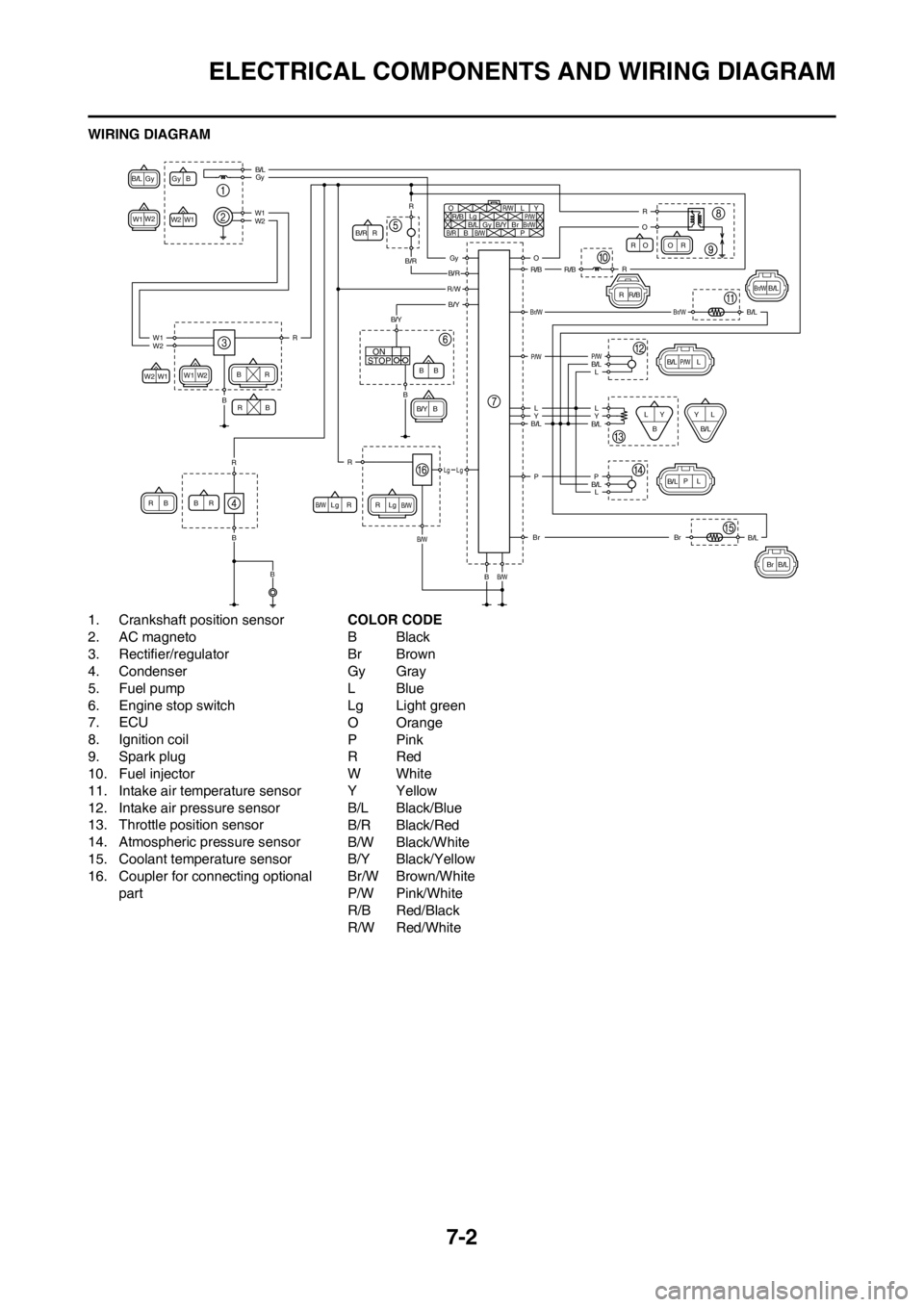
WIRING DIAGRAM
1. Crankshaft position sensor
2. AC magneto
3. Rectifier/regulator
4. Condenser
5. Fuel pump
6. Engine stop switch
7. ECU
8. Ignition coil
9. Spark plug
10. Fuel injector
11. Intake air temperature sensor
12. Intake air pressure sensor
13. Throttle position sensor
14. Atmospheric pressure sensor
15. Coolant temperature sensor
16. Coupler for connecting optional part COLOR CODE
BBlack
Br Brown
Gy Gray
LBlue
Lg Light green
O Orange
PPink
RRed
WWhite
YYellow
B/L Black/Blue
B/R Black/Red
B/W Black/White
B/Y Black/Yellow
Br/W Brown/White
P/W Pink/White
R/B Red/Black
R/W Red/White
STOPON
Gy
Gy
B
B/L
W1
W2
W2 O
R/B
R RR
R
R
R R
Lg
Lg Lg L
P/W
P
YB/RB
B B
BB BB
BB/W
B/W B/W Br/WGyB/L
W1 W1
W2 W2 B/Y
B/Y Br
B/R
R/W
OO
R/B RR
R
L
P/W
PYL
L
LY
Br/WB/L
B/L B/L
B
B/L
B/L
Br
W1
Br/W
W2
R
R O
B/L
L
Y
B/L
Br
R
P
Gy
Gy
B/R
B/R
R/WB/Y
B/L
W1
W2
W1 R
R R
B
B/Y
Lg Lg
O
R/B R/B
Br/W
P/W P/W
LL
Y
B/L B/L
B/L
Br
B
B/W
B/W
B
B
B L
B/L P
Page 187 of 228
7-3
IGNITION SYSTEM
IGNITION SYSTEM
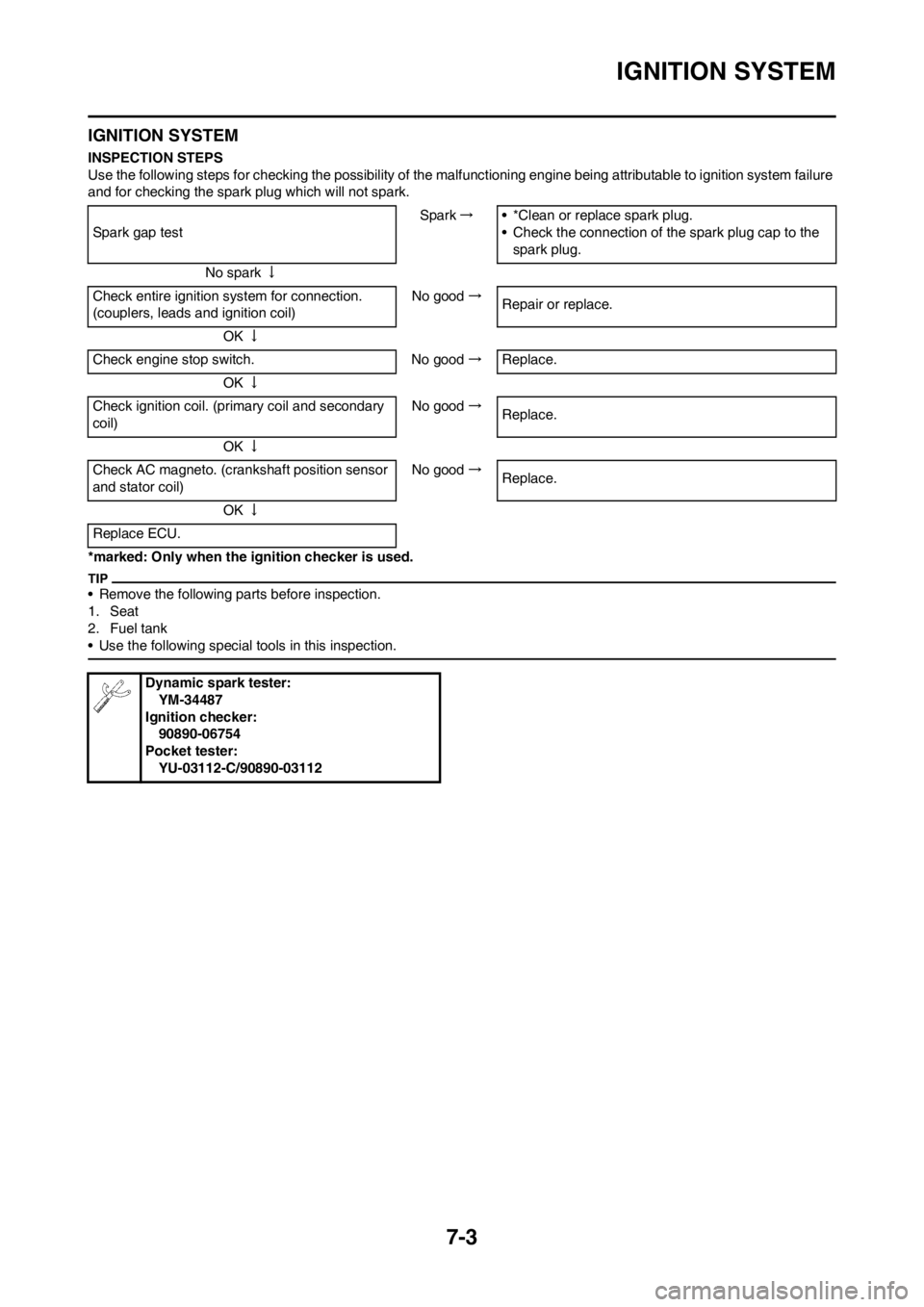
INSPECTION STEPS
Use the following steps for checking the possibility of the malfunctioning engine being attributable to ignition system failure
and for checking the spark plug which will not spark.
*marked: Only when the ignition checker is used.
• Remove the following parts before inspection.
1. Seat
2. Fuel tank
• Use the following special tools in this inspection.
Spark gap testSpark→• *Clean or replace spark plug.
• Check the connection of the spark plug cap to the
spark plug.
No spark↓
Check entire ignition system for connection.
(couplers, leads and ignition coil)No good→
Repair or replace.
OK↓
Check engine stop switch. No good→Replace.
OK↓
Check ignition coil. (primary coil and secondary
coil)No good→
Replace.
OK↓
Check AC magneto. (crankshaft position sensor
and stator coil)No good→
Replace.
OK↓
Replace ECU.
Dynamic spark tester:
YM-34487
Ignition checker:
90890-06754
Pocket tester:
YU-03112-C/90890-03112
Page 188 of 228
7-4
IGNITION SYSTEM
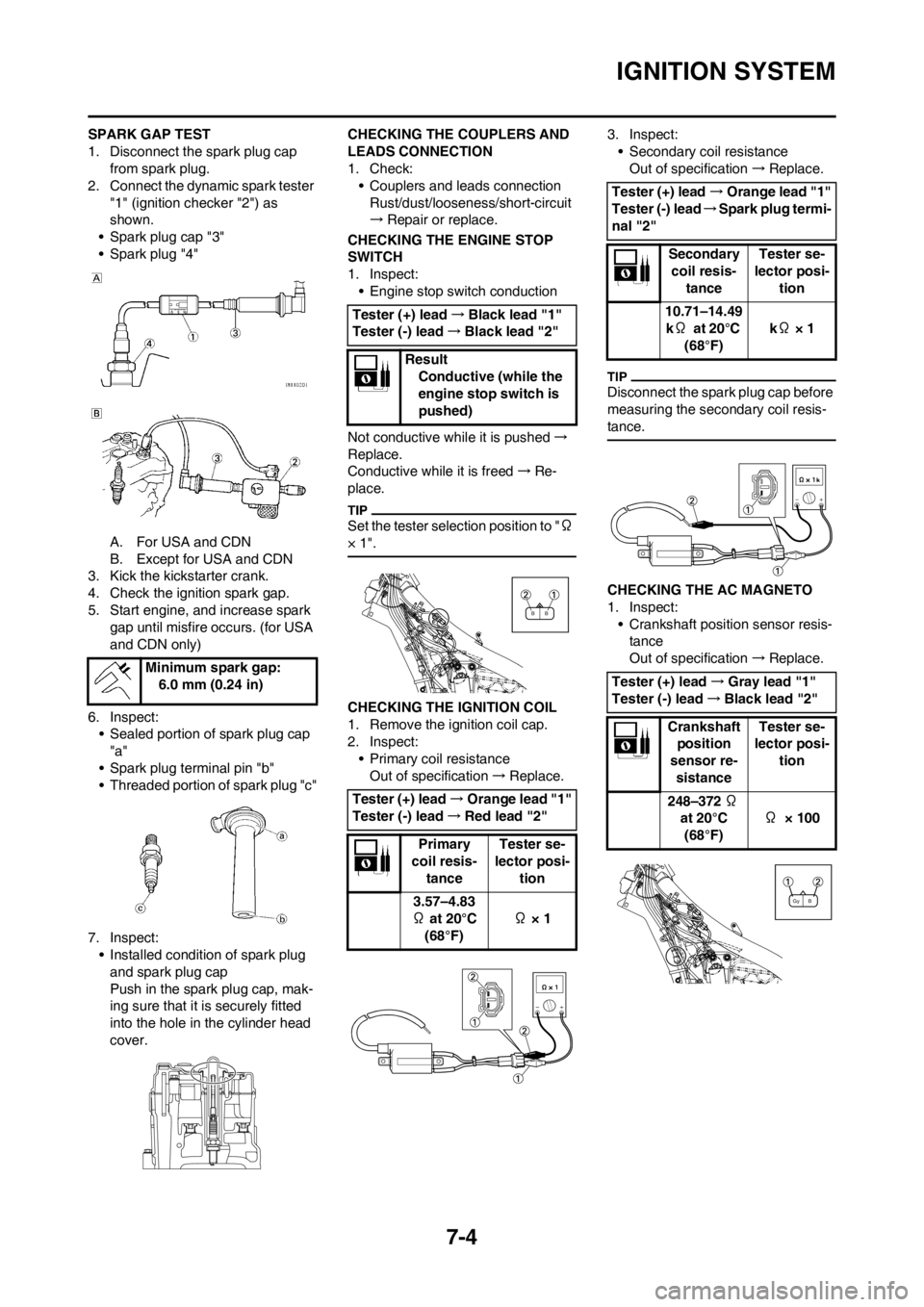
SPARK GAP TEST
1. Disconnect the spark plug cap
from spark plug.
2. Connect the dynamic spark tester
"1" (ignition checker "2") as
shown.
• Spark plug cap "3"
• Spark plug "4"
A. For USA and CDN
B. Except for USA and CDN
3. Kick the kickstarter crank.
4. Check the ignition spark gap.
5. Start engine, and increase spark
gap until misfire occurs. (for USA
and CDN only)
6. Inspect:
• Sealed portion of spark plug cap
"a"
• Spark plug terminal pin "b"
• Threaded portion of spark plug "c"
7. Inspect:
• Installed condition of spark plug
and spark plug cap
Push in the spark plug cap, mak-
ing sure that it is securely fitted
into the hole in the cylinder head
cover.CHECKING THE COUPLERS AND
LEADS CONNECTION
1. Check:
• Couplers and leads connection
Rust/dust/looseness/short-circuit
→Repair or replace.
CHECKING THE ENGINE STOP
SWITCH
1. Inspect:
• Engine stop switch conduction
Not conductive while it is pushed→
Replace.
Conductive while it is freed→Re-
place.
Set the tester selection position to "Ω
× 1".
CHECKING THE IGNITION COIL
1. Remove the ignition coil cap.
2. Inspect:
• Primary coil resistance
Out of specification→Replace.3. Inspect:
• Secondary coil resistance
Out of specification→Replace.
Disconnect the spark plug cap before
measuring the secondary coil resis-
tance.
CHECKING THE AC MAGNETO
1. Inspect:
• Crankshaft position sensor resis-
tance
Out of specification→Replace.
Minimum spark gap:
6.0 mm (0.24 in)
Tester (+) lead→Black lead "1"
Tester (-) lead→Black lead "2"
Result
Conductive (while the
engine stop switch is
pushed)
Tester (+) lead→Orange lead "1"
Tester (-) lead→Red lead "2"
Primary
coil resis-
tanceTester se-
lector posi-
tion
3.57–4.83
Ω at 20°C
(68°F) Ω × 1
BB
Tester (+) lead→Orange lead "1"
Tester (-) lead→Spark plug termi-
nal "2"
Secondary
coil resis-
tanceTester se-
lector posi-
tion
10.71–14.49
kΩ at 20°C
(68°F) kΩ × 1
Tester (+) lead→Gray lead "1"
Tester (-) lead→Black lead "2"
Crankshaft
position
sensor re-
sistanceTester se-
lector posi-
tion
248–372 Ω
at 20°C
(68°F)Ω × 100
GyB
Page 191 of 228
7-7
THROTTLE POSITION SENSOR SYSTEM
HANDLING NOTE
Do not loosen the screw (throttle
position sensor) "1" except when
changing the throttle position sen-
sor due to failure because it will
cause a drop in engine perfor-
mance.
CHECKING THE COUPLERS AND
LEADS CONNECTION
1. Check:
• Couplers and leads connection
Rust/dust/looseness/short-circuit
→Repair or replace.
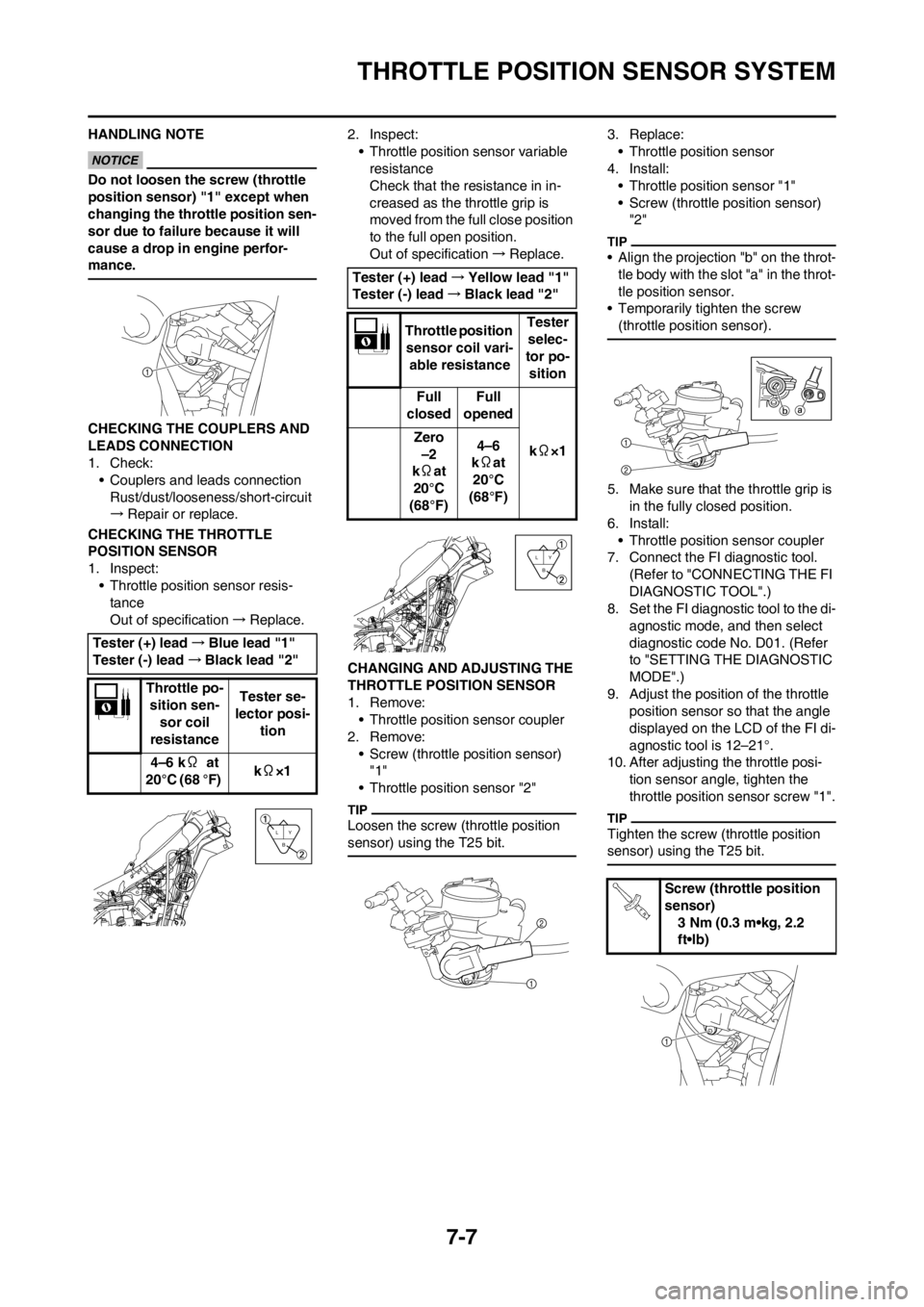
CHECKING THE THROTTLE
POSITION SENSOR
1. Inspect:
• Throttle position sensor resis-
tance
Out of specification→Replace.2. Inspect:
• Throttle position sensor variable
resistance
Check that the resistance in in-
creased as the throttle grip is
moved from the full close position
to the full open position.
Out of specification→Replace.
CHANGING AND ADJUSTING THE
THROTTLE POSITION SENSOR
1. Remove:
• Throttle position sensor coupler
2. Remove:
• Screw (throttle position sensor)
"1"
• Throttle position sensor "2"
Loosen the screw (throttle position
sensor) using the T25 bit.
3. Replace:
• Throttle position sensor
4. Install:
• Throttle position sensor "1"
• Screw (throttle position sensor)
"2"
• Align the projection "b" on the throt-
tle body with the slot "a" in the throt-
tle position sensor.
• Temporarily tighten the screw
(throttle position sensor).
5. Make sure that the throttle grip is
in the fully closed position.
6. Install:
• Throttle position sensor coupler
7. Connect the FI diagnostic tool.
(Refer to "CONNECTING THE FI
DIAGNOSTIC TOOL".)
8. Set the FI diagnostic tool to the di-
agnostic mode, and then select
diagnostic code No. D01. (Refer
to "SETTING THE DIAGNOSTIC
MODE".)
9. Adjust the position of the throttle
position sensor so that the angle
displayed on the LCD of the FI di-
agnostic tool is 12–21°.
10. After adjusting the throttle posi-
tion sensor angle, tighten the
throttle position sensor screw "1".
Tighten the screw (throttle position
sensor) using the T25 bit.
Tester (+) lead→Blue lead "1"
Tester (-) lead→Black lead "2"
Throttle po-
sition sen-
sor coil
resistanceTester se-
lector posi-
tion
4–6 kΩ at
20°C (68 °F) kΩ×1
Y
B L
Tester (+) lead→Yellow lead "1"
Tester (-) lead→Black lead "2"
Throttle position
sensor coil vari-
able resistanceTester
selec-
tor po-
sition
Full
closedFull
opened
kΩ×1 Zero
–2
kΩat
20°C
(68°F)4–6
kΩat
20°C
(68°F)
Y
B L
Screw (throttle position
sensor)
3 Nm (0.3 m•kg, 2.2
ft•lb)
Page 195 of 228

7-11
FUEL INJECTION SYSTEM
SENSOR OPERATION TABLE
Diagnos-
tic code
No.ItemActuation or
displayChecking methodActuation or LCD standard display
values
D01 Throttle angle DisplayDisplays the throttle angle. 0–125°
Check with throttle fully closed. When throttle is fully closed:15–19°
Check with throttle fully open. When throttle is fully
opened:95–101 °
D02 Atmosphere DisplayDisplays the atmospheric pres-
sure.
• Measure the atmospheric pres-
sure.0–126 kPa
Displays the atmospheric pressure
according to the elevation and
weather.
Example
0 m above sea level: Approx: 101
kPa
3000 m above sea level:Approx: 70
kPa
D03 Intake air pressure DisplayDisplays the intake air pressure.
• Check the intake manifold pres-
sure.
• Check that the intake air pres-
sure changes while the engine is
being cranked.0–126 kPa
While the engine is stopped: Dis-
plays the atmospheric pressure ac-
cording to the elevation and
weather.
Example
0 m above sea level: Approx: 101
kPa
3000 m above sea level:Approx: 70
kPa
While the engine is being cranked:
Displays the intake air pressure.
D05 Intake air temperature DisplayDisplays the intake air tempera-
ture.
• Check the temperature in the in-
take manifold.-20–100°C
Cold engine: Displayed tempera-
ture is close to the ambient temper-
ature.
Warm engine: Displayed tempera-
ture is approximately 20 °C higher
than the ambient temperature.
D06 Coolant temperature DisplayDisplays the coolant temperature.
• Check the coolant temperature.-20–150°C
Cold engine: Displayed tempera-
ture is close to the ambient temper-
ature.
Warm engine: Displayed tempera-
ture is the current coolant tempera-
ture.
D08 Lean angle sensor DisplayDisplays the lean angle sensor
output voltage.
Remove the ECU and incline it 45°
or more.0–5.0 V
1.0 V: Upright
4.0 V: Overturned
D30 Ignition coil ActuationCheck that power is supplied to
the ignition coil.
• Check that a spark is generated.
• Illuminates the engine trouble
warning light.Actuates the ignition coil for five
times every second.
The "WARNING" LED on the FI di-
agnostic tool comes on each time
the fuel injector is actuated.
Page 210 of 228

7-26
FUEL INJECTION SYSTEM
Fault code No. 33
Symptom Ignition system circuit signal is not received properly.
Fail-safe system Unable to start
Unable to drive
Diagnostic code No. D30
FI diagnostic tool display Actuates the ignition coil for five times every second.
The "WARNING" LED on the FI diagnostic tool comes on each time the ignition coil is ac-
tuated.
Checking methodCheck the spark five times.
• Connect an ignition checker.
Item Item/components and probable cause Check or maintenance job Checking method
1 Check the connection and locking condition of
the ignition coil coupler.
Disconnect the coupler and check the pins.
(bent or broken terminals and locking condition
of the pins)Poor connection→ Properly con-
nect, repair, or replace.Start the engine and let it
idle for approximately 5
seconds.
After completing the above
operation, check whether a
fault code number is dis-
played.
Fault code number is not
displayed → Service is
finished.
Fault code number is dis-
played → Refer to item 2.
2 Check the connection and locking condition of
the wire harness ECU coupler.
Disconnect the coupler and check the pins.
(bent or broken terminals and locking condition
of the pins)Poor connection → Properly con-
nect, repair, or replace.Start the engine and let it
idle for approximately 5
seconds.
After completing the above
operation, check whether a
fault code number is dis-
played.
Fault code number is not
displayed → Service is
finished.
Fault code number is dis-
played → Refer to item 3.
3 Continuity of harness Open or short circuit → Replace.
Between Ignition coil coupler and
ECU coupler.
(Orange–Orange)Start the engine and let it
idle for approximately 5
seconds.
After completing the above
operation, check whether a
fault code number is dis-
played.
Fault code number is not
displayed → Service is
finished.
Fault code number is dis-
played → Refer to item 4.