engine oil YAMAHA YZ450F 2012 Owner's Manual
[x] Cancel search | Manufacturer: YAMAHA, Model Year: 2012, Model line: YZ450F, Model: YAMAHA YZ450F 2012Pages: 228, PDF Size: 11.42 MB
Page 74 of 228
3-18
CHASSIS
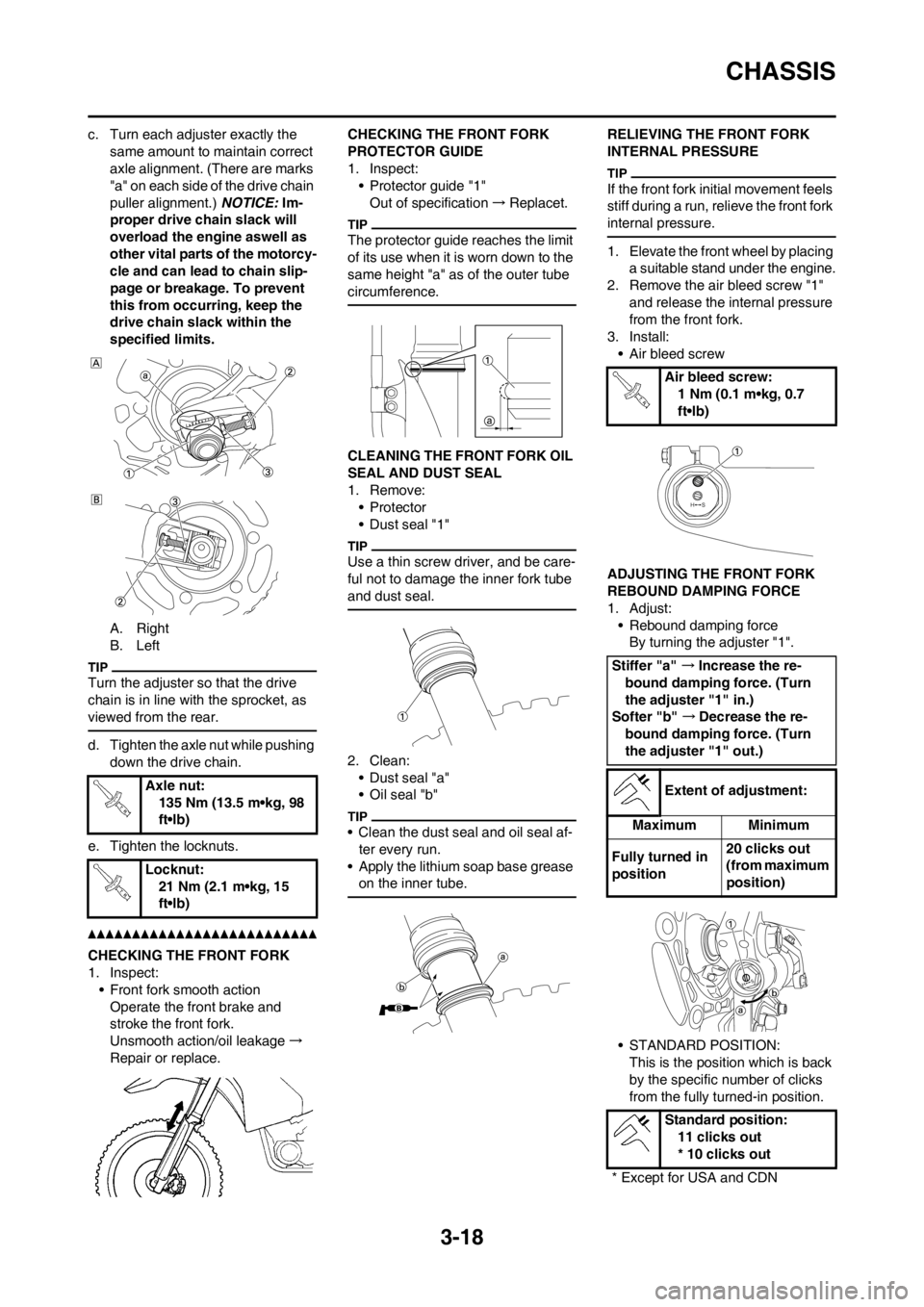
c. Turn each adjuster exactly the
same amount to maintain correct
axle alignment. (There are marks
"a" on each side of the drive chain
puller alignment.) NOTICE: Im-
proper drive chain slack will
overload the engine aswell as
other vital parts of the motorcy-
cle and can lead to chain slip-
page or breakage. To prevent
this from occurring, keep the
drive chain slack within the
specified limits.
A. Right
B. Left
Turn the adjuster so that the drive
chain is in line with the sprocket, as
viewed from the rear.
d. Tighten the axle nut while pushing
down the drive chain.
e. Tighten the locknuts.
CHECKING THE FRONT FORK
1. Inspect:
• Front fork smooth action
Operate the front brake and
stroke the front fork.
Unsmooth action/oil leakage→
Repair or replace.CHECKING THE FRONT FORK
PROTECTOR GUIDE
1. Inspect:
• Protector guide "1"
Out of specification→Replacet.
The protector guide reaches the limit
of its use when it is worn down to the
same height "a" as of the outer tube
circumference.
CLEANING THE FRONT FORK OIL
SEAL AND DUST SEAL
1. Remove:
•Protector
• Dust seal "1"
Use a thin screw driver, and be care-
ful not to damage the inner fork tube
and dust seal.
2. Clean:
• Dust seal "a"
• Oil seal "b"
• Clean the dust seal and oil seal af-
ter every run.
• Apply the lithium soap base grease
on the inner tube.
RELIEVING THE FRONT FORK
INTERNAL PRESSURE
If the front fork initial movement feels
stiff during a run, relieve the front fork
internal pressure.
1. Elevate the front wheel by placing
a suitable stand under the engine.
2. Remove the air bleed screw "1"
and release the internal pressure
from the front fork.
3. Install:
• Air bleed screw
ADJUSTING THE FRONT FORK
REBOUND DAMPING FORCE
1. Adjust:
• Rebound damping force
By turning the adjuster "1".
• STANDARD POSITION:
This is the position which is back
by the specific number of clicks
from the fully turned-in position. Axle nut:
135 Nm (13.5 m•kg, 98
ft•lb)
Locknut:
21 Nm (2.1 m•kg, 15
ft•lb)
Air bleed screw:
1 Nm (0.1 m•kg, 0.7
ft•lb)
Stiffer "a" →Increase the re-
bound damping force. (Turn
the adjuster "1" in.)
Softer "b" →Decrease the re-
bound damping force. (Turn
the adjuster "1" out.)
Extent of adjustment:
Maximum Minimum
Fully turned in
position20 clicks out
(from maximum
position)
Standard position:
11 clicks out
* 10 clicks out
* Except for USA and CDN
Page 80 of 228
3-24
ELECTRICAL
ELECTRICAL
CHECKING THE SPARK PLUG
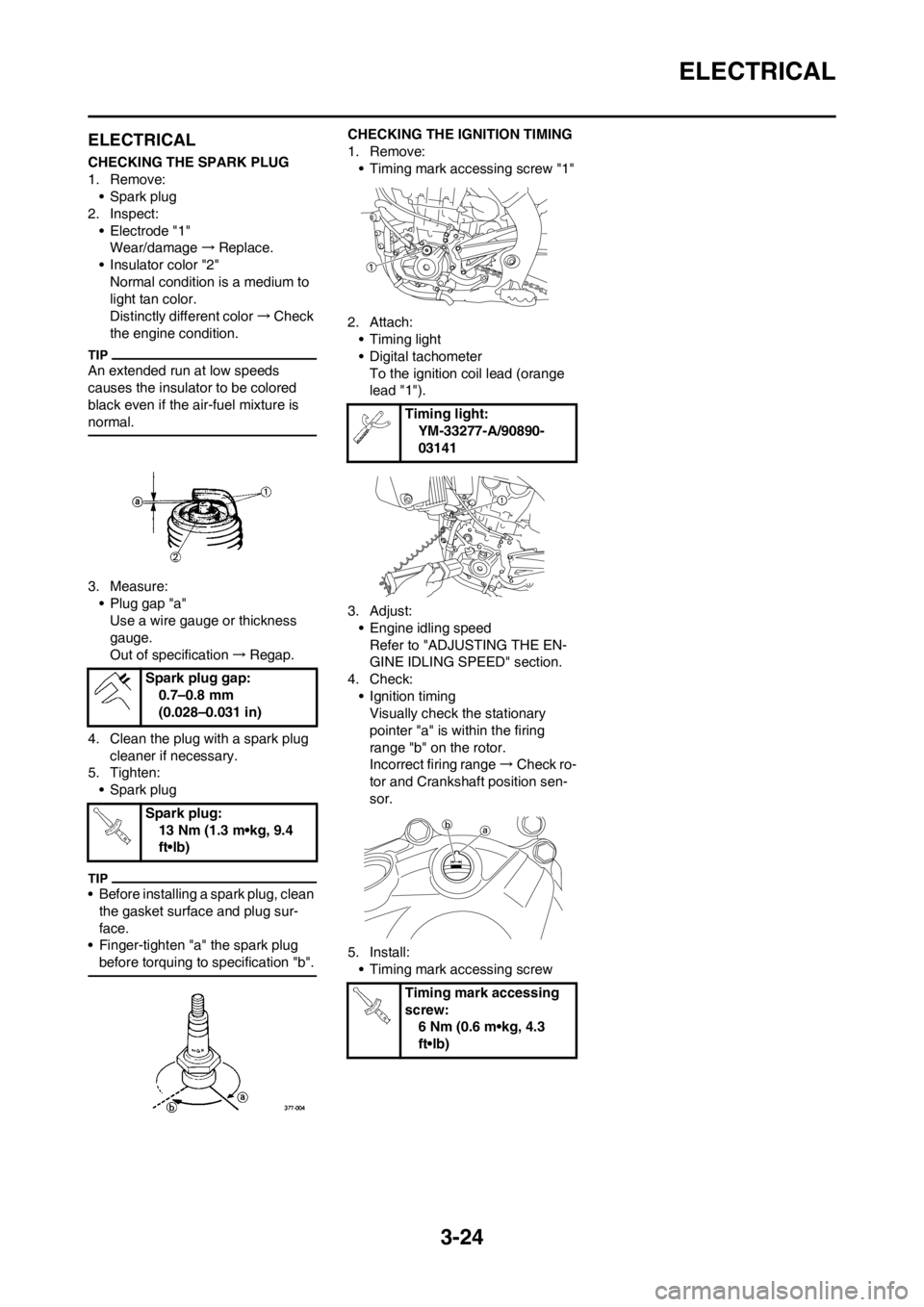
1. Remove:
• Spark plug
2. Inspect:
• Electrode "1"
Wear/damage→Replace.
• Insulator color "2"
Normal condition is a medium to
light tan color.
Distinctly different color→Check
the engine condition.
An extended run at low speeds
causes the insulator to be colored
black even if the air-fuel mixture is
normal.
3. Measure:
• Plug gap "a"
Use a wire gauge or thickness
gauge.
Out of specification→Regap.
4. Clean the plug with a spark plug
cleaner if necessary.
5. Tighten:
• Spark plug
• Before installing a spark plug, clean
the gasket surface and plug sur-
face.
• Finger-tighten "a" the spark plug
before torquing to specification "b".
CHECKING THE IGNITION TIMING
1. Remove:
• Timing mark accessing screw "1"
2. Attach:
• Timing light
• Digital tachometer
To the ignition coil lead (orange
lead "1").
3. Adjust:
• Engine idling speed
Refer to "ADJUSTING THE EN-
GINE IDLING SPEED" section.
4. Check:
• Ignition timing
Visually check the stationary
pointer "a" is within the firing
range "b" on the rotor.
Incorrect firing range→Check ro-
tor and Crankshaft position sen-
sor.
5. Install:
• Timing mark accessing screw Spark plug gap:
0.7–0.8 mm
(0.028–0.031 in)
Spark plug:
13 Nm (1.3 m•kg, 9.4
ft•lb)
Timing light:
YM-33277-A/90890-
03141
Timing mark accessing
screw:
6 Nm (0.6 m•kg, 4.3
ft•lb)
Page 81 of 228
3-25
ELECTRICAL
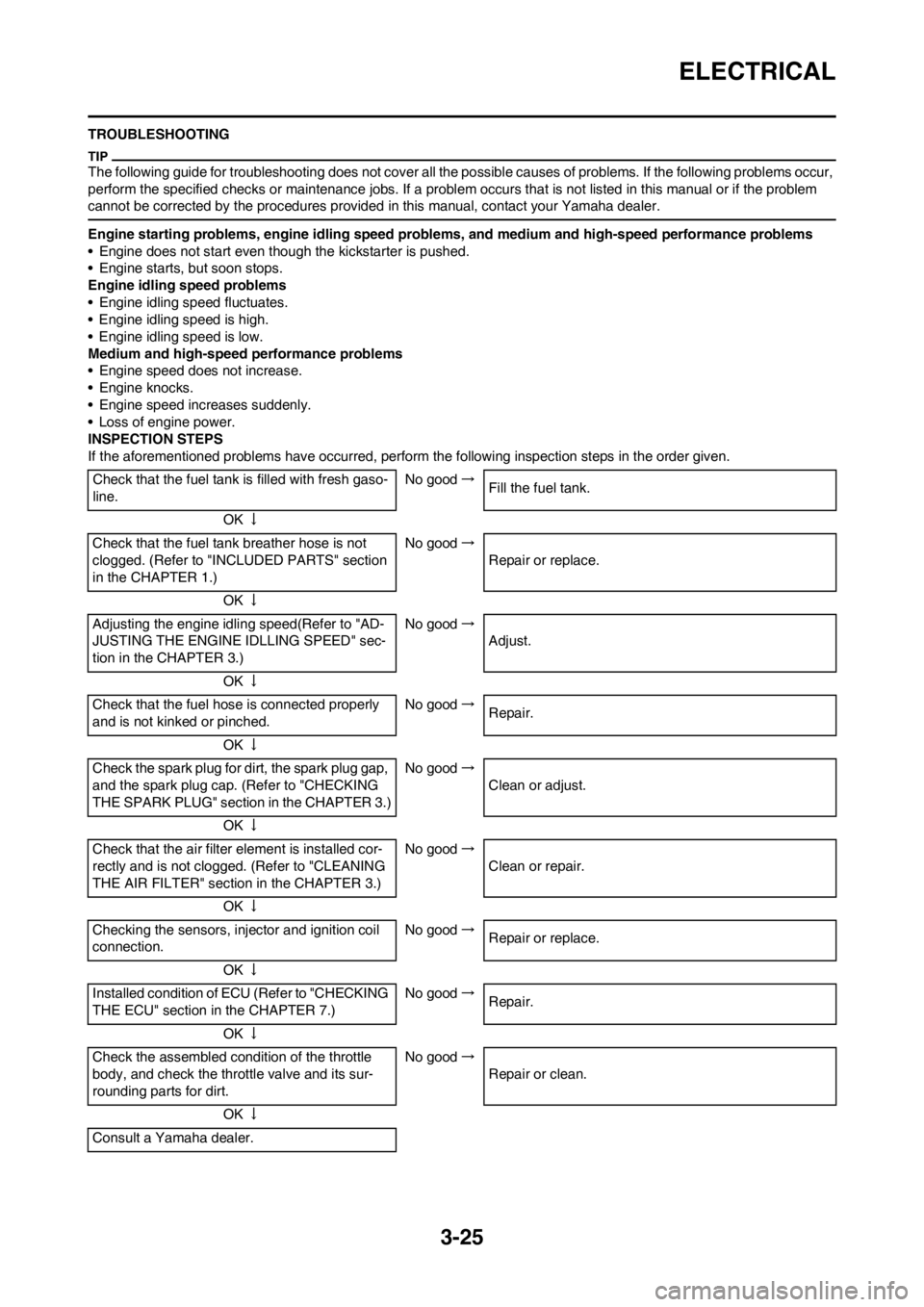
TROUBLESHOOTING
The following guide for troubleshooting does not cover all the possible causes of problems. If the following problems occur,
perform the specified checks or maintenance jobs. If a problem occurs that is not listed in this manual or if the problem
cannot be corrected by the procedures provided in this manual, contact your Yamaha dealer.
Engine starting problems, engine idling speed problems, and medium and high-speed performance problems
• Engine does not start even though the kickstarter is pushed.
• Engine starts, but soon stops.
Engine idling speed problems
• Engine idling speed fluctuates.
• Engine idling speed is high.
• Engine idling speed is low.
Medium and high-speed performance problems
• Engine speed does not increase.
• Engine knocks.
• Engine speed increases suddenly.
• Loss of engine power.
INSPECTION STEPS
If the aforementioned problems have occurred, perform the following inspection steps in the order given.
Check that the fuel tank is filled with fresh gaso-
line.No good→
Fill the fuel tank.
OK↓
Check that the fuel tank breather hose is not
clogged. (Refer to "INCLUDED PARTS" section
in the CHAPTER 1.)No good→
Repair or replace.
OK↓
Adjusting the engine idling speed(Refer to "AD-
JUSTING THE ENGINE IDLLING SPEED" sec-
tion in the CHAPTER 3.)No good→
Adjust.
OK↓
Check that the fuel hose is connected properly
and is not kinked or pinched.No good→
Repair.
OK↓
Check the spark plug for dirt, the spark plug gap,
and the spark plug cap. (Refer to "CHECKING
THE SPARK PLUG" section in the CHAPTER 3.)No good→
Clean or adjust.
OK↓
Check that the air filter element is installed cor-
rectly and is not clogged. (Refer to "CLEANING
THE AIR FILTER" section in the CHAPTER 3.)No good→
Clean or repair.
OK↓
Checking the sensors, injector and ignition coil
connection.No good→
Repair or replace.
OK↓
Installed condition of ECU (Refer to "CHECKING
THE ECU" section in the CHAPTER 7.)No good→
Repair.
OK↓
Check the assembled condition of the throttle
body, and check the throttle valve and its sur-
rounding parts for dirt.No good→
Repair or clean.
OK↓
Consult a Yamaha dealer.
Page 92 of 228
4-11
CAMSHAFTS
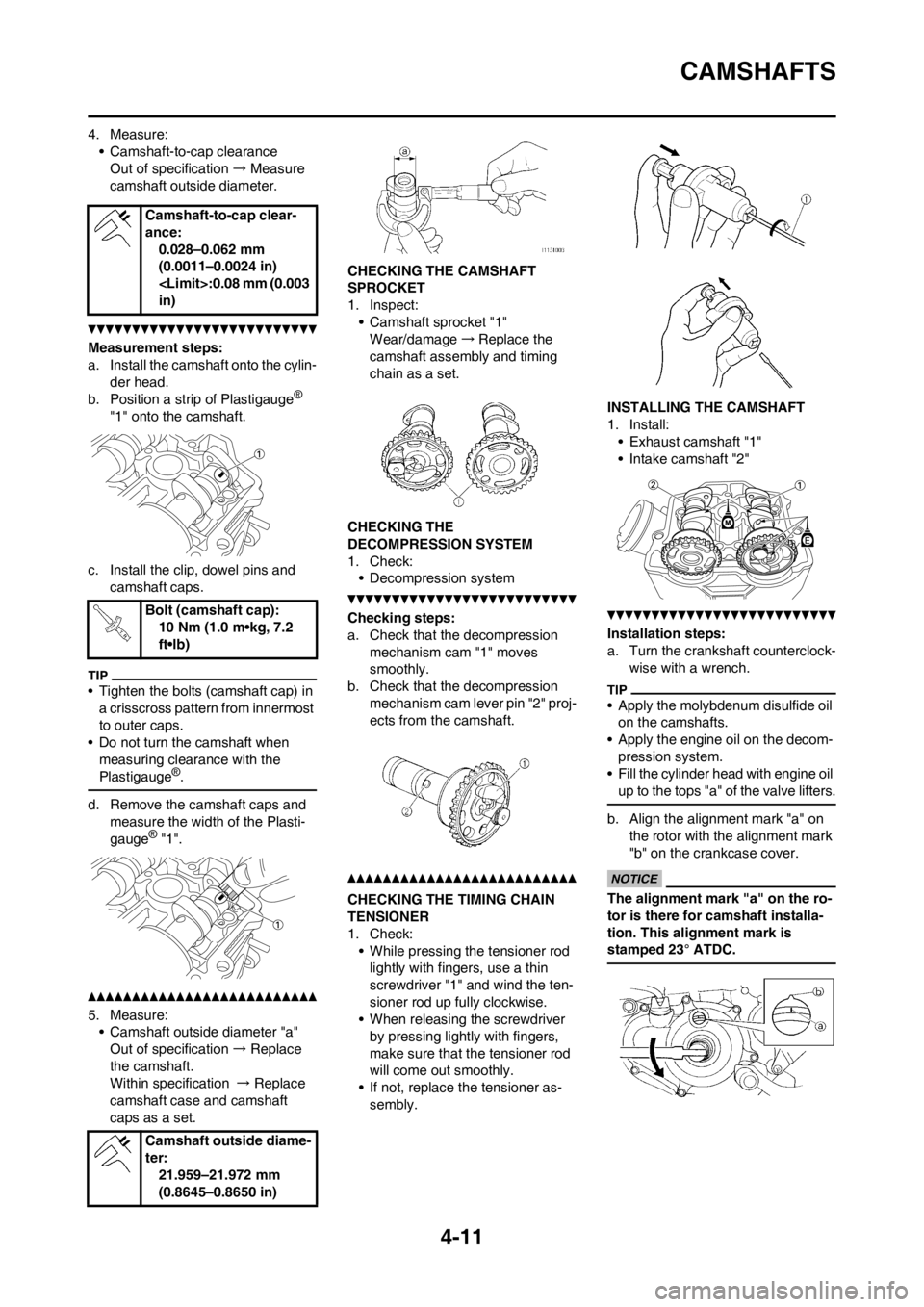
4. Measure:
• Camshaft-to-cap clearance
Out of specification → Measure
camshaft outside diameter.
Measurement steps:
a. Install the camshaft onto the cylin-
der head.
b. Position a strip of Plastigauge
®
"1" onto the camshaft.
c. Install the clip, dowel pins and
camshaft caps.
• Tighten the bolts (camshaft cap) in
a crisscross pattern from innermost
to outer caps.
• Do not turn the camshaft when
measuring clearance with the
Plastigauge
®.
d. Remove the camshaft caps and
measure the width of the Plasti-
gauge
® "1".
5. Measure:
• Camshaft outside diameter "a"
Out of specification → Replace
the camshaft.
Within specification → Replace
camshaft case and camshaft
caps as a set.CHECKING THE CAMSHAFT
SPROCKET
1. Inspect:
• Camshaft sprocket "1"
Wear/damage→Replace the
camshaft assembly and timing
chain as a set.
CHECKING THE
DECOMPRESSION SYSTEM
1. Check:
• Decompression system
Checking steps:
a. Check that the decompression
mechanism cam "1" moves
smoothly.
b. Check that the decompression
mechanism cam lever pin "2" proj-
ects from the camshaft.
CHECKING THE TIMING CHAIN
TENSIONER
1. Check:
• While pressing the tensioner rod
lightly with fingers, use a thin
screwdriver "1" and wind the ten-
sioner rod up fully clockwise.
• When releasing the screwdriver
by pressing lightly with fingers,
make sure that the tensioner rod
will come out smoothly.
• If not, replace the tensioner as-
sembly.INSTALLING THE CAMSHAFT
1. Install:
• Exhaust camshaft "1"
• Intake camshaft "2"
Installation steps:
a. Turn the crankshaft counterclock-
wise with a wrench.
• Apply the molybdenum disulfide oil
on the camshafts.
• Apply the engine oil on the decom-
pression system.
• Fill the cylinder head with engine oil
up to the tops "a" of the valve lifters.
b. Align the alignment mark "a" on
the rotor with the alignment mark
"b" on the crankcase cover.
The alignment mark "a" on the ro-
tor is there for camshaft installa-
tion. This alignment mark is
stamped 23° ATDC.
Camshaft-to-cap clear-
ance:
0.028–0.062 mm
(0.0011–0.0024 in)
in)
Bolt (camshaft cap):
10 Nm (1.0 m•kg, 7.2
ft•lb)
Camshaft outside diame-
ter:
21.959–21.972 mm
(0.8645–0.8650 in)
Page 101 of 228
4-20
VALVES AND VALVE SPRINGS
f. Apply Mechanic's blueing dye
(Dykem) to the valve face.
g. Install the valve into the cylinder
head.
h. Press the valve through the valve
guide and onto the valve seat to
make a clear pattern.
i. Measure the valve seat width
again. If the valve seat width is out
of specification, reface and relap
the valve seat.
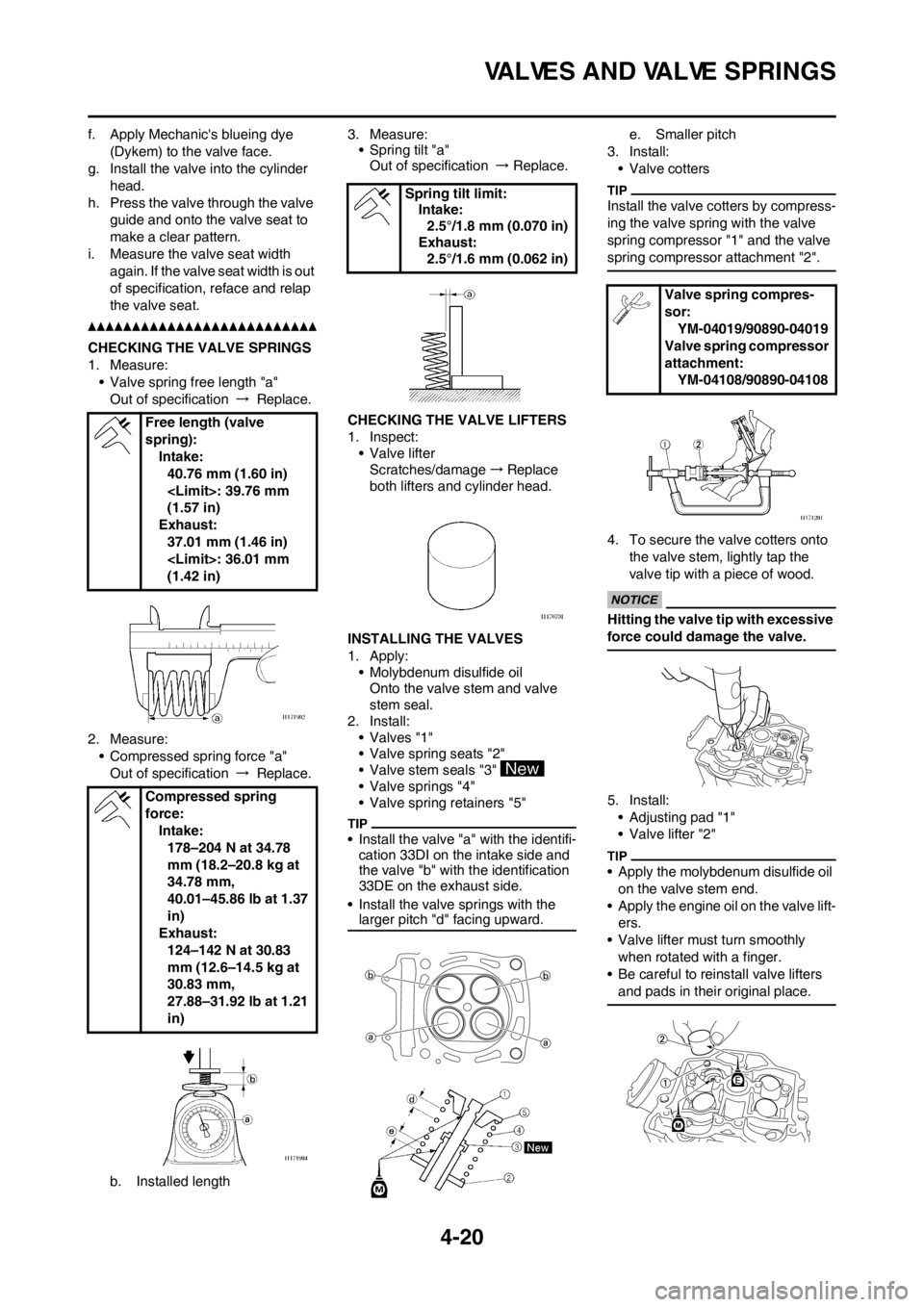
CHECKING THE VALVE SPRINGS
1. Measure:
• Valve spring free length "a"
Out of specification → Replace.
2. Measure:
• Compressed spring force "a"
Out of specification → Replace.
b. Installed length3. Measure:
• Spring tilt "a"
Out of specification → Replace.
CHECKING THE VALVE LIFTERS
1. Inspect:
• Valve lifter
Scratches/damage→Replace
both lifters and cylinder head.
INSTALLING THE VALVES
1. Apply:
• Molybdenum disulfide oil
Onto the valve stem and valve
stem seal.
2. Install:
• Valves "1"
• Valve spring seats "2"
• Valve stem seals "3"
• Valve springs "4"
• Valve spring retainers "5"
• Install the valve "a" with the identifi-
cation 33DI on the intake side and
the valve "b" with the identification
33DE on the exhaust side.
• Install the valve springs with the
larger pitch "d" facing upward.
e. Smaller pitch
3. Install:
• Valve cotters
Install the valve cotters by compress-
ing the valve spring with the valve
spring compressor "1" and the valve
spring compressor attachment "2".
4. To secure the valve cotters onto
the valve stem, lightly tap the
valve tip with a piece of wood.
Hitting the valve tip with excessive
force could damage the valve.
5. Install:
• Adjusting pad "1"
• Valve lifter "2"
• Apply the molybdenum disulfide oil
on the valve stem end.
• Apply the engine oil on the valve lift-
ers.
• Valve lifter must turn smoothly
when rotated with a finger.
• Be careful to reinstall valve lifters
and pads in their original place.
Free length (valve
spring):
Intake:
40.76 mm (1.60 in)
(1.57 in)
Exhaust:
37.01 mm (1.46 in)
(1.42 in)
Compressed spring
force:
Intake:
178–204 N at 34.78
mm (18.2–20.8 kg at
34.78 mm,
40.01–45.86 lb at 1.37
in)
Exhaust:
124–142 N at 30.83
mm (12.6–14.5 kg at
30.83 mm,
27.88–31.92 lb at 1.21
in)
Spring tilt limit:
Intake:
2.5°/1.8 mm (0.070 in)
Exhaust:
2.5°/1.6 mm (0.062 in)
Valve spring compres-
sor:
YM-04019/90890-04019
Valve spring compressor
attachment:
YM-04108/90890-04108
Page 104 of 228
4-23
CYLINDER AND PISTON
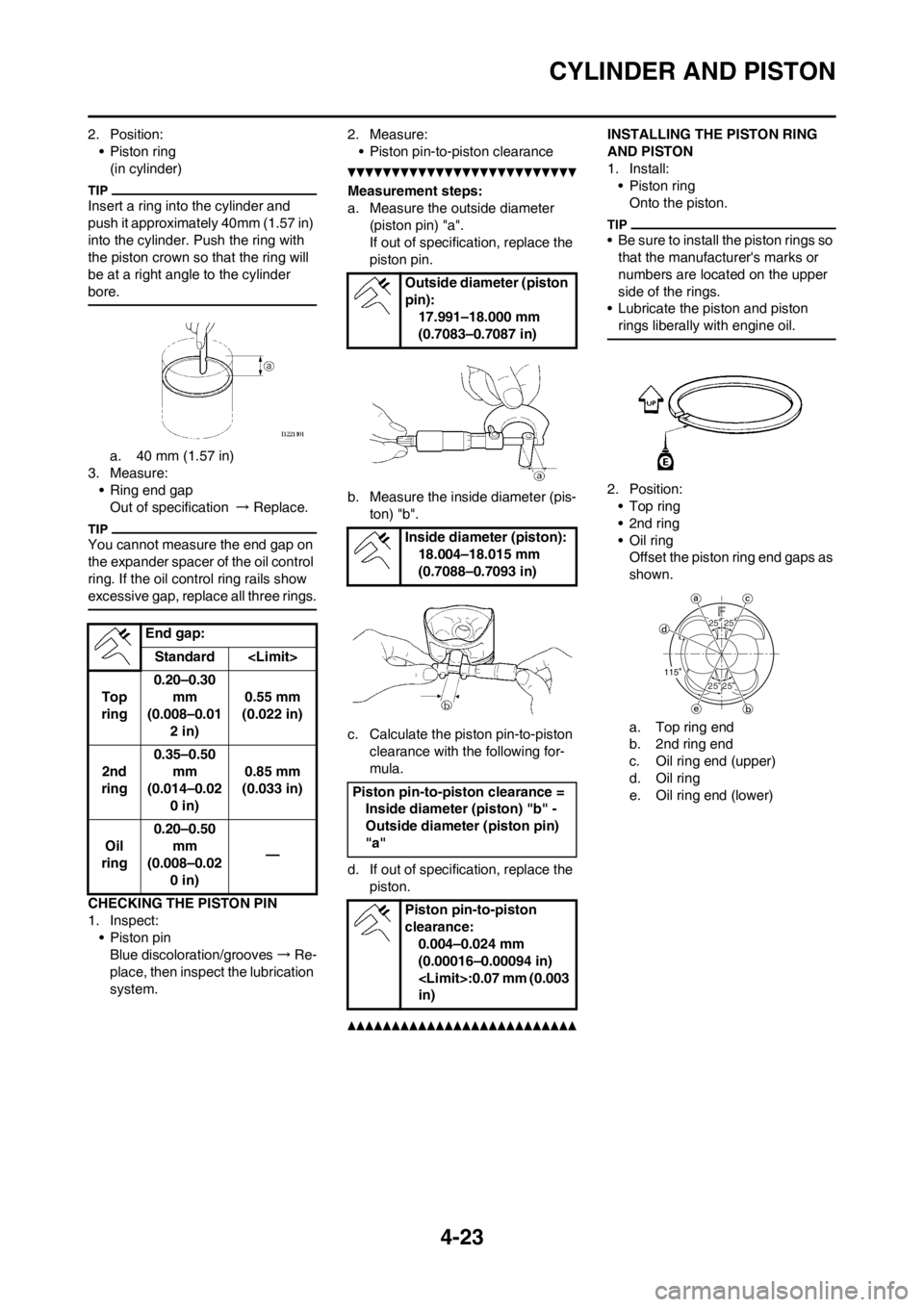
2. Position:
• Piston ring
(in cylinder)
Insert a ring into the cylinder and
push it approximately 40mm (1.57 in)
into the cylinder. Push the ring with
the piston crown so that the ring will
be at a right angle to the cylinder
bore.
a. 40 mm (1.57 in)
3. Measure:
• Ring end gap
Out of specification → Replace.
You cannot measure the end gap on
the expander spacer of the oil control
ring. If the oil control ring rails show
excessive gap, replace all three rings.
CHECKING THE PISTON PIN
1. Inspect:
• Piston pin
Blue discoloration/grooves→Re-
place, then inspect the lubrication
system.2. Measure:
• Piston pin-to-piston clearance
Measurement steps:
a. Measure the outside diameter
(piston pin) "a".
If out of specification, replace the
piston pin.
b. Measure the inside diameter (pis-
ton) "b".
c. Calculate the piston pin-to-piston
clearance with the following for-
mula.
d. If out of specification, replace the
piston.
INSTALLING THE PISTON RING
AND PISTON
1. Install:
• Piston ring
Onto the piston.
• Be sure to install the piston rings so
that the manufacturer's marks or
numbers are located on the upper
side of the rings.
• Lubricate the piston and piston
rings liberally with engine oil.
2. Position:
•Top ring
•2nd ring
•Oil ring
Offset the piston ring end gaps as
shown.
a. Top ring end
b. 2nd ring end
c. Oil ring end (upper)
d. Oil ring
e. Oil ring end (lower) End gap:
Standard
Top
ring0.20–0.30
mm
(0.008–0.01
2 in)0.55 mm
(0.022 in)
2nd
ring0.35–0.50
mm
(0.014–0.02
0 in)0.85 mm
(0.033 in)
Oil
ring0.20–0.50
mm
(0.008–0.02
0 in)—
Outside diameter (piston
pin):
17.991–18.000 mm
(0.7083–0.7087 in)
Inside diameter (piston):
18.004–18.015 mm
(0.7088–0.7093 in)
Piston pin-to-piston clearance =
Inside diameter (piston) "b" -
Outside diameter (piston pin)
"a"
Piston pin-to-piston
clearance:
0.004–0.024 mm
(0.00016–0.00094 in)
in)
2525
2525115
Page 105 of 228

4-24
CYLINDER AND PISTON
3. Install:
• Piston "1"
• Piston pin "2"
• Piston pin clip "3"
• Apply engine oil onto the piston.
• Apply molybdenum disulfide oil
onto the piston pin.
• Install the piston with the F mark "a"
on it pointing to its intake (front)
side.
• Before installing the piston pin clip,
cover the crankcase with a clean
rag to prevent the piston pin clip
from falling into the crankcase.
INSTALLING THE CYLINDER
1. Install:
• Dowel pins
• Cylinder gasket "1"
• Cylinder "2"
Install the cylinder with one hand
while compressing the piston rings
with the other hand.
• Pass the timing chain "3"
through the timing chain cavity.
• Be careful not to damage the tim-
ing chain guide "4" during instal-
lation.
2. Install:
• Bolt (cylinder)
Bolt (cylinder):
10 Nm (1.0 m•kg, 7.2
ft•lb)
Page 106 of 228

4-25
CLUTCH
CLUTCH
REMOVING THE CLUTCH
Order Part name Q'ty Remarks
Drain the engine oil. Refer to "CHANGING THE ENGINE OIL"
section in the CHAPTER 3.
Brake pedal Refer to "ENGINE REMOVAL" section.
Clutch cable Disconnect at engine side.
1 Clutch cover 1
2 Gasket 1
3 Clutch spring 6
4 Pressure plate 1
5 Push rod 1 1
6 Circlip 1
7 Washer 1
8 Bearing 1
9Ball 1
10 Push rod 2 1
11 Clutch plate 7
12 Friction plate 8
13 Nut (clutch boss) 1 Refer to removal section.
Page 108 of 228
4-27
CLUTCH
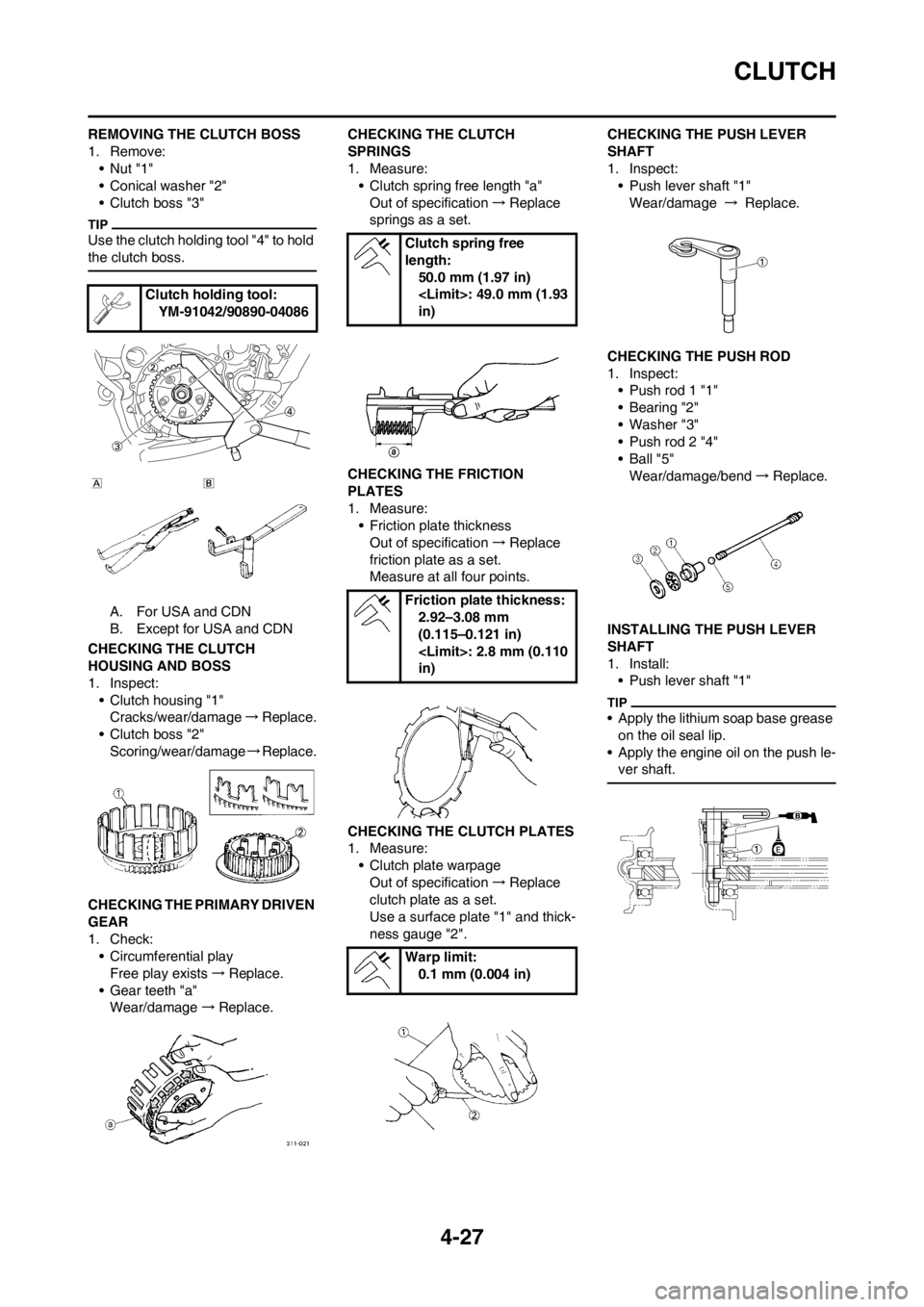
REMOVING THE CLUTCH BOSS
1. Remove:
•Nut "1"
• Conical washer "2"
• Clutch boss "3"
Use the clutch holding tool "4" to hold
the clutch boss.
A. For USA and CDN
B. Except for USA and CDN
CHECKING THE CLUTCH
HOUSING AND BOSS
1. Inspect:
• Clutch housing "1"
Cracks/wear/damage→Replace.
• Clutch boss "2"
Scoring/wear/damage→Replace.
CHECKING THE PRIMARY DRIVEN
GEAR
1. Check:
• Circumferential play
Free play exists→Replace.
• Gear teeth "a"
Wear/damage→Replace.CHECKING THE CLUTCH
SPRINGS
1. Measure:
• Clutch spring free length "a"
Out of specification→Replace
springs as a set.
CHECKING THE FRICTION
PLATES
1. Measure:
• Friction plate thickness
Out of specification→Replace
friction plate as a set.
Measure at all four points.
CHECKING THE CLUTCH PLATES
1. Measure:
• Clutch plate warpage
Out of specification→Replace
clutch plate as a set.
Use a surface plate "1" and thick-
ness gauge "2".CHECKING THE PUSH LEVER
SHAFT
1. Inspect:
• Push lever shaft "1"
Wear/damage → Replace.
CHECKING THE PUSH ROD
1. Inspect:
• Push rod 1 "1"
• Bearing "2"
• Washer "3"
• Push rod 2 "4"
•Ball "5"
Wear/damage/bend→Replace.
INSTALLING THE PUSH LEVER
SHAFT
1. Install:
• Push lever shaft "1"
• Apply the lithium soap base grease
on the oil seal lip.
• Apply the engine oil on the push le-
ver shaft.
Clutch holding tool:
YM-91042/90890-04086
Clutch spring free
length:
50.0 mm (1.97 in)
in)
Friction plate thickness:
2.92–3.08 mm
(0.115–0.121 in)
in)
Warp limit:
0.1 mm (0.004 in)
Page 109 of 228
4-28
CLUTCH
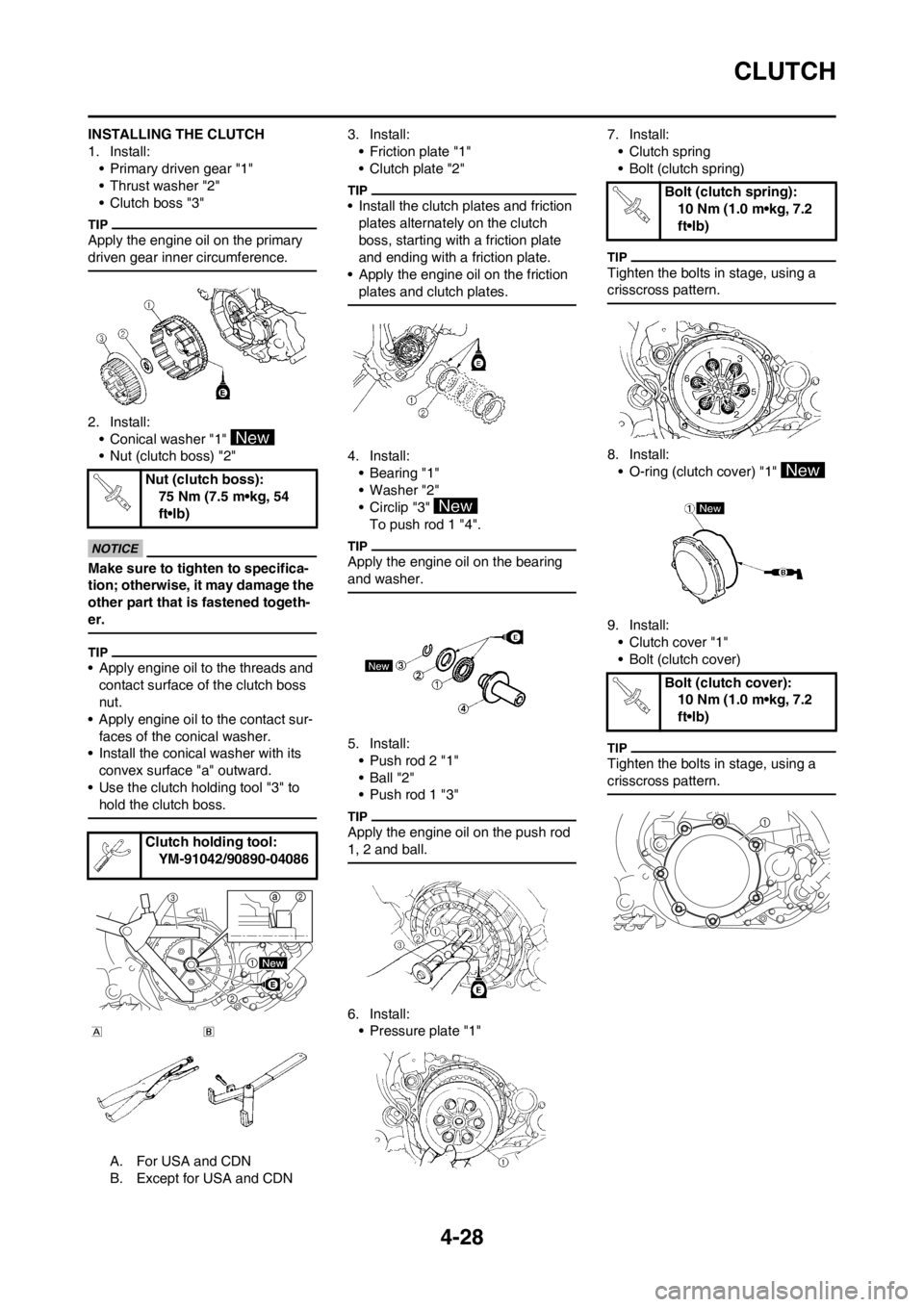
INSTALLING THE CLUTCH
1. Install:
• Primary driven gear "1"
• Thrust washer "2"
• Clutch boss "3"
Apply the engine oil on the primary
driven gear inner circumference.
2. Install:
• Conical washer "1"
• Nut (clutch boss) "2"
Make sure to tighten to specifica-
tion; otherwise, it may damage the
other part that is fastened togeth-
er.
• Apply engine oil to the threads and
contact surface of the clutch boss
nut.
• Apply engine oil to the contact sur-
faces of the conical washer.
• Install the conical washer with its
convex surface "a" outward.
• Use the clutch holding tool "3" to
hold the clutch boss.
A. For USA and CDN
B. Except for USA and CDN3. Install:
• Friction plate "1"
• Clutch plate "2"
• Install the clutch plates and friction
plates alternately on the clutch
boss, starting with a friction plate
and ending with a friction plate.
• Apply the engine oil on the friction
plates and clutch plates.
4. Install:
•Bearing "1"
• Washer "2"
• Circlip "3"
To push rod 1 "4".
Apply the engine oil on the bearing
and washer.
5. Install:
• Push rod 2 "1"
• Ball "2"
• Push rod 1 "3"
Apply the engine oil on the push rod
1, 2 and ball.
6. Install:
• Pressure plate "1"7. Install:
• Clutch spring
• Bolt (clutch spring)
Tighten the bolts in stage, using a
crisscross pattern.
8. Install:
• O-ring (clutch cover) "1"
9. Install:
• Clutch cover "1"
• Bolt (clutch cover)
Tighten the bolts in stage, using a
crisscross pattern.
Nut (clutch boss):
75 Nm (7.5 m•kg, 54
ft•lb)
Clutch holding tool:
YM-91042/90890-04086
Bolt (clutch spring):
10 Nm (1.0 m•kg, 7.2
ft•lb)
Bolt (clutch cover):
10 Nm (1.0 m•kg, 7.2
ft•lb)