brake YAMAHA YZ450F 2014 Owner's Manual
[x] Cancel search | Manufacturer: YAMAHA, Model Year: 2014, Model line: YZ450F, Model: YAMAHA YZ450F 2014Pages: 360, PDF Size: 11.76 MB
Page 94 of 360
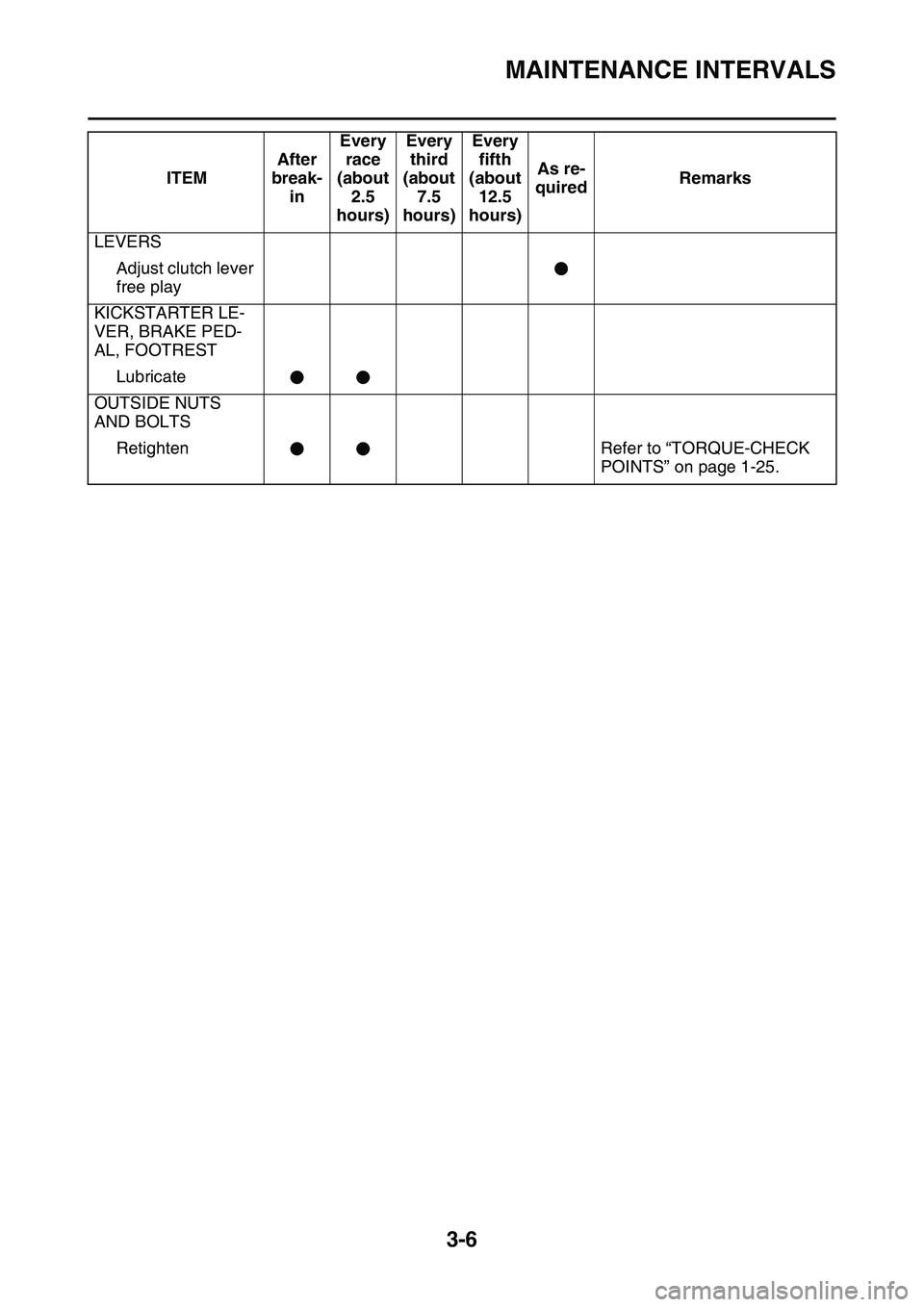
MAINTENANCE INTERVALS
3-6
LEVERS
Adjust clutch lever
free play
KICKSTARTER LE-
VER, BRAKE PED-
AL, FOOTREST
Lubricate
OUTSIDE NUTS
AND BOLTS
RetightenRefer to “TORQUE-CHECK
POINTS” on page 1-25.
ITEMAfter
break-
inEvery
race
(about
2.5
hours)Every
third
(about
7.5
hours)Every
fifth
(about
12.5
hours)As re-
quiredRemarks
Page 95 of 360
PRE-OPERATION INSPECTION AND MAINTENANCE
3-7
EAS1SL1067
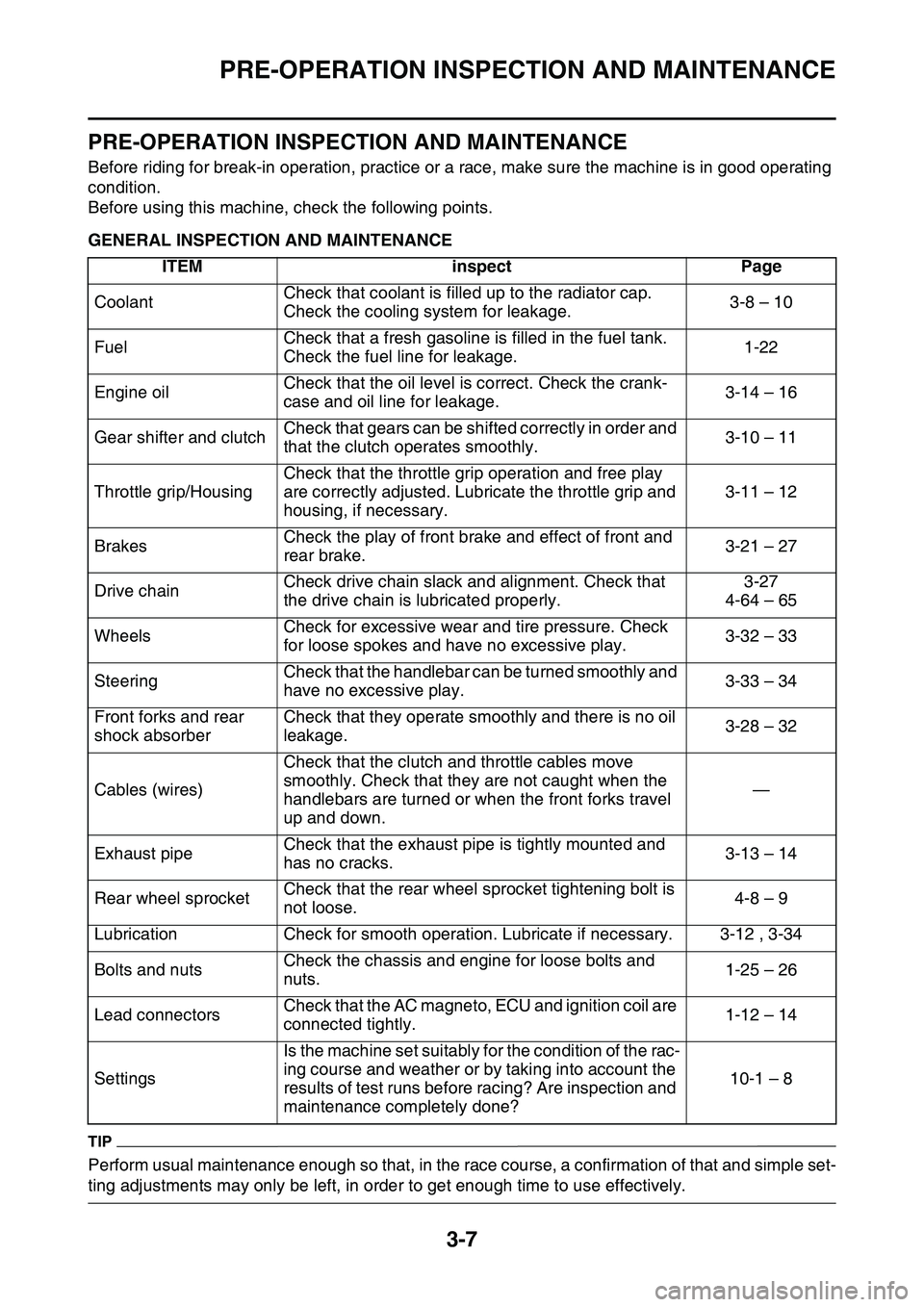
PRE-OPERATION INSPECTION AND MAINTENANCE
Before riding for break-in operation, practice or a race, make sure the machine is in good operating
condition.
Before using this machine, check the following points.
EAS1SL1068GENERAL INSPECTION AND MAINTENANCE
TIP
Perform usual maintenance enough so that, in the race course, a confirmation of that and simple set-
ting adjustments may only be left, in order to get enough time to use effectively.
ITEMinspectPage
CoolantCheck that coolant is filled up to the radiator cap.
Check the cooling system for leakage.3-8 – 10
FuelCheck that a fresh gasoline is filled in the fuel tank.
Check the fuel line for leakage.1-22
Engine oilCheck that the oil level is correct. Check the crank-
case and oil line for leakage.3-14 – 16
Gear shifter and clutchCheck that gears can be shifted correctly in order and
that the clutch operates smoothly.3-10 – 11
Throttle grip/Housing
Check that the throttle grip operation and free play
are correctly adjusted. Lubricate the throttle grip and
housing, if necessary.
3-11 – 12
BrakesCheck the play of front brake and effect of front and
rear brake.3-21 – 27
Drive chainCheck drive chain slack and alignment. Check that
the drive chain is lubricated properly.3-27
4-64 – 65
WheelsCheck for excessive wear and tire pressure. Check
for loose spokes and have no excessive play.3-32 – 33
SteeringCheck that the handlebar can be turned smoothly and
have no excessive play.3-33 – 34
Front forks and rear
shock absorberCheck that they operate smoothly and there is no oil
leakage.3-28 – 32
Cables (wires)
Check that the clutch and throttle cables move
smoothly. Check that they are not caught when the
handlebars are turned or when the front forks travel
up and down.
—
Exhaust pipeCheck that the exhaust pipe is tightly mounted and
has no cracks.3-13 – 14
Rear wheel sprocketCheck that the rear wheel sprocket tightening bolt is
not loose.4-8 – 9
LubricationCheck for smooth operation. Lubricate if necessary. 3-12 , 3-34
Bolts and nutsCheck the chassis and engine for loose bolts and
nuts.1-25 – 26
Lead connectorsCheck that the AC magneto, ECU and ignition coil are
connected tightly.1-12 – 14
Settings
Is the machine set suitably for the condition of the rac-
ing course and weather or by taking into account the
results of test runs before racing? Are inspection and
maintenance completely done?10-1 – 8
Page 109 of 360
CHASSIS
3-21
EAS1SL1089
CHASSIS
EAS1SL1090BLEEDING THE BRAKE SYSTEMEWA13100
WARNING
Bleed the brake system whenever:
• The system is disassembled.
• A brake hose is loosened, disconnected,
or replaced.
• The brake fluid level is very low.
• Brake operation is faulty.
1. Remove:
• Brake master cylinder cap
• Reservoir diaphragm
• Reservoir float (front brake)
• Protector (rear brake)
TIP
• Be careful not to spill any brake fluid or allow
the reservoir to overflow.
• Make sure that there is enough brake fluid be-
fore applying the brake. Ignoring this precau-
tion could allow air to enter the brake system,
considerably lengthening the bleeding proce
-
dure.
• If bleeding is difficult, it may be necessary to
let the brake fluid settle for a few hours. Re
-
peat the bleeding procedure when the tiny
bubbles in the hose have disappeared.
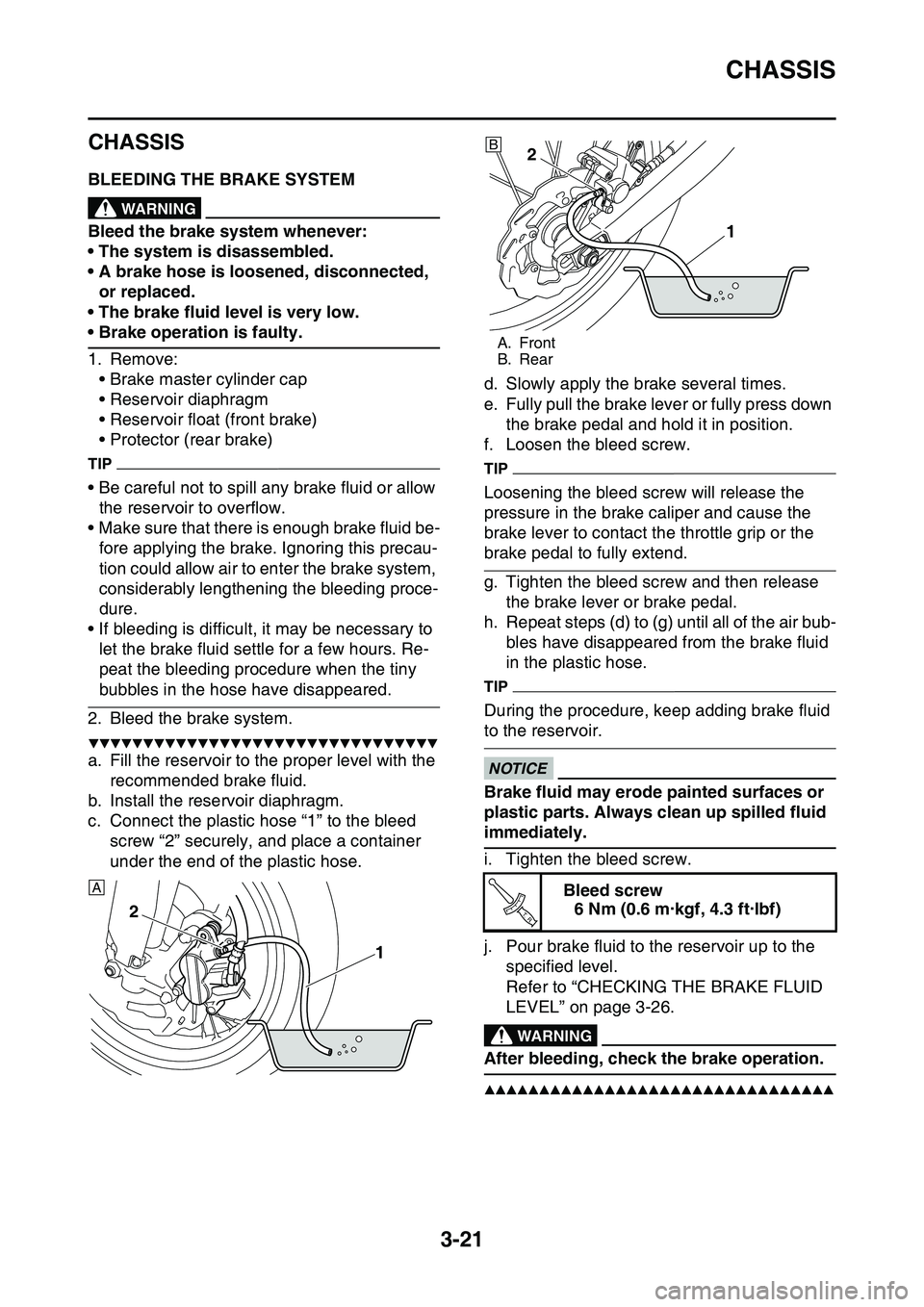
2. Bleed the brake system.
▼▼▼▼▼▼▼▼▼▼▼▼▼▼▼▼▼▼▼▼▼▼▼▼▼▼▼▼▼▼▼▼
a. Fill the reservoir to the proper level with the
recommended brake fluid.
b. Install the reservoir diaphragm.
c. Connect the plastic hose “1” to the bleed
screw “2” securely, and place a container
under the end of the plastic hose.
d. Slowly apply the brake several times.
e. Fully pull the brake lever or fully press down
the brake pedal and hold it in position.
f. Loosen the bleed screw.
TIP
Loosening the bleed screw will release the
pressure in the brake caliper and cause the
brake lever to contact the throttle grip or the
brake pedal to fully extend.
g. Tighten the bleed screw and then release
the brake lever or brake pedal.
h. Repeat steps (d) to (g) until all of the air bub-
bles have disappeared from the brake fluid
in the plastic hose.
TIP
During the procedure, keep adding brake fluid
to the reservoir.
ECA
NOTICE
Brake fluid may erode painted surfaces or
plastic parts. Always clean up spilled fluid
immediately.
i. Tighten the bleed screw.
j. Pour brake fluid to the reservoir up to the
specified level.
Refer to “CHECKING THE BRAKE FLUID
LEVEL” on page 3-26.EWA13110
WARNING
After bleeding, check the brake operation.
▲▲▲▲▲▲▲▲▲▲▲▲▲▲▲▲▲▲▲▲▲▲▲▲▲▲▲▲▲▲▲▲
EAS1SL1091
1 2
A
A. Front
B. Rear
Bleed screw
6 Nm (0.6 m·kgf, 4.3 ft·lbf)
2
1B
T R..
Page 110 of 360
CHASSIS
3-22
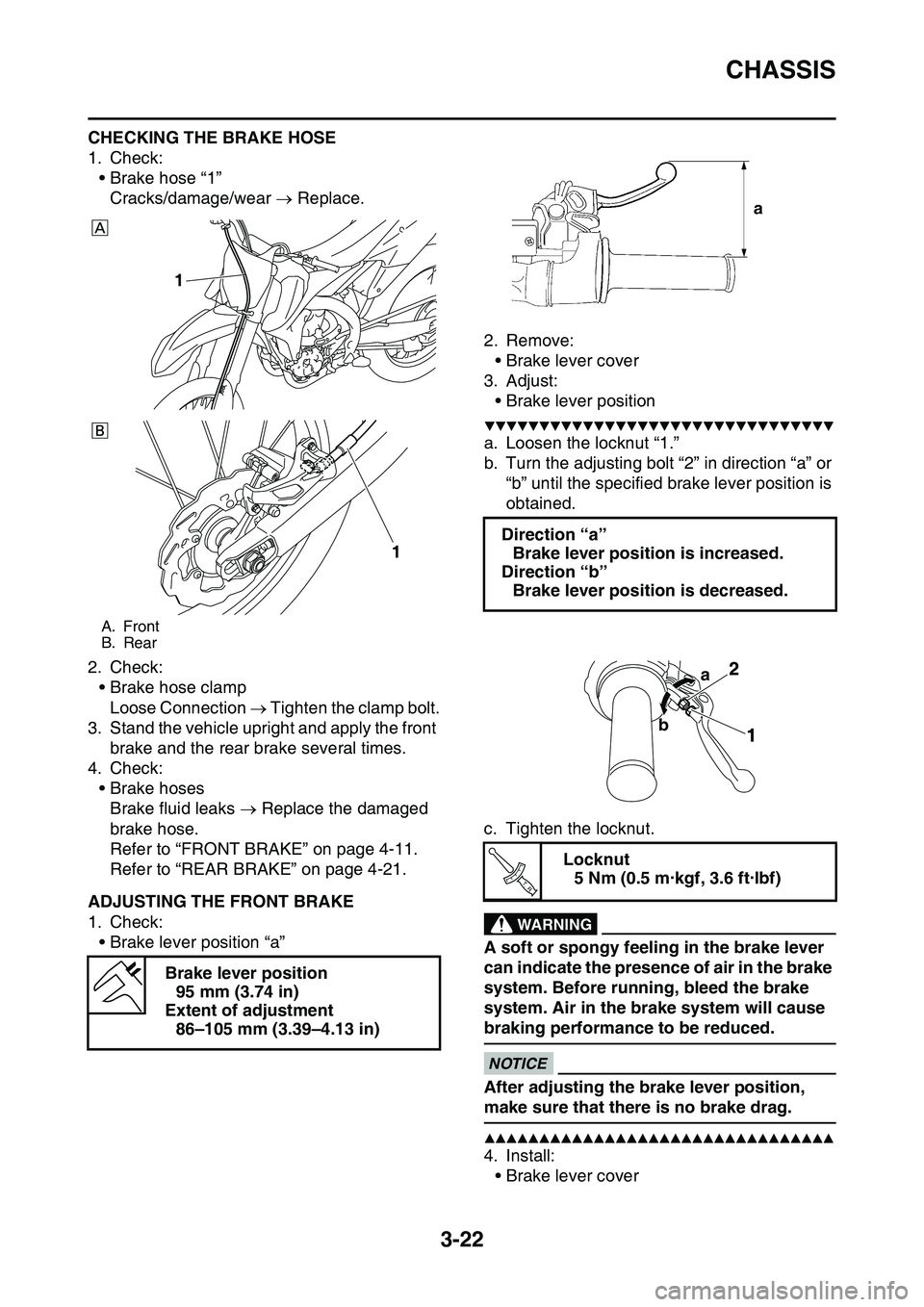
CHECKING THE BRAKE HOSE
1. Check:
• Brake hose “1”
Cracks/damage/wear Replace.
2. Check:
• Brake hose clamp
Loose Connection Tighten the clamp bolt.
3. Stand the vehicle upright and apply the front
brake and the rear brake several times.
4. Check:
• Brake hoses
Brake fluid leaks Replace the damaged
brake hose.
Refer to “FRONT BRAKE” on page 4-11.
Refer to “REAR BRAKE” on page 4-21.
EAS1SL1092ADJUSTING THE FRONT BRAKE
1. Check:
• Brake lever position “a”
2. Remove:
• Brake lever cover
3. Adjust:
• Brake lever position
▼▼▼▼▼▼▼▼▼▼▼▼▼▼▼▼▼▼▼▼▼▼▼▼▼▼▼▼▼▼▼▼
a. Loosen the locknut “1.”
b. Turn the adjusting bolt “2” in direction “a” or
“b” until the specified brake lever position is
obtained.
c. Tighten the locknut.
EWA13050
WARNING
A soft or spongy feeling in the brake lever
can indicate the presence of air in the brake
system. Before running, bleed the brake
system. Air in the brake system will cause
braking performance to be reduced.
ECA13490
NOTICE
After adjusting the brake lever position,
make sure that there is no brake drag.
▲▲▲▲▲▲▲▲▲▲▲▲▲▲▲▲▲▲▲▲▲▲▲▲▲▲▲▲▲▲▲▲
4. Install:
• Brake lever cover
A. Front
B. Rear
Brake lever position
95 mm (3.74 in)
Extent of adjustment
86–105 mm (3.39–4.13 in)
1
1
Direction “a”
Brake lever position is increased.
Direction “b”
Brake lever position is decreased.
Locknut
5 Nm (0.5 m·kgf, 3.6 ft·lbf)
a
b
T R..
Page 111 of 360
CHASSIS
3-23
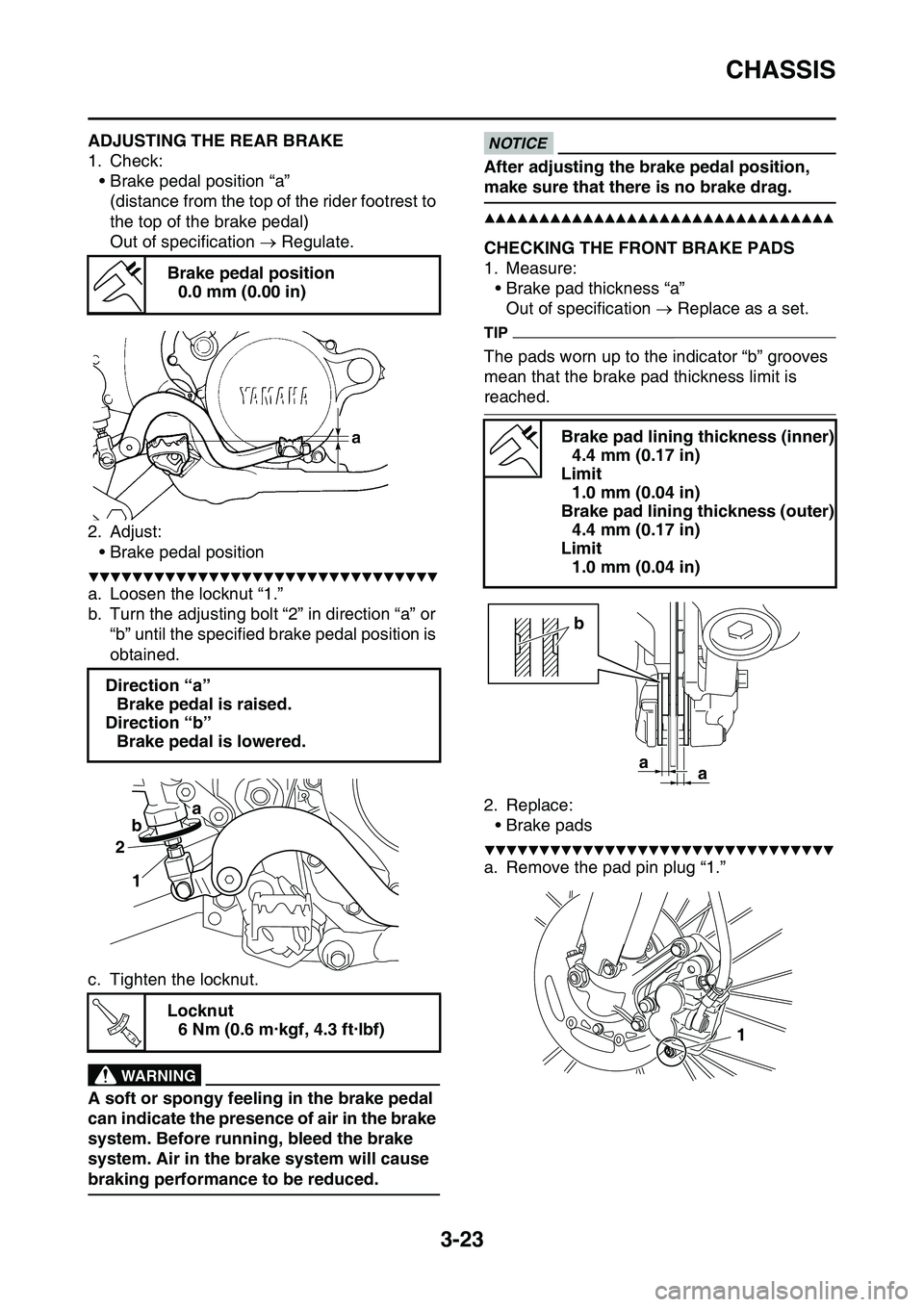
EAS1SL1093ADJUSTING THE REAR BRAKE
1. Check:
• Brake pedal position “a”
(distance from the top of the rider footrest to
the top of the brake pedal)
Out of specification Regulate.
2. Adjust:
• Brake pedal position
▼▼▼▼▼▼▼▼▼▼▼▼▼▼▼▼▼▼▼▼▼▼▼▼▼▼▼▼▼▼▼▼
a. Loosen the locknut “1.”
b. Turn the adjusting bolt “2” in direction “a” or
“b” until the specified brake pedal position is
obtained.
c. Tighten the locknut.
EWA1DX1001
WARNING
A soft or spongy feeling in the brake pedal
can indicate the presence of air in the brake
system. Before running, bleed the brake
system. Air in the brake system will cause
braking performance to be reduced.
ECA13510
NOTICE
After adjusting the brake pedal position,
make sure that there is no brake drag.
▲▲▲▲▲▲▲▲▲▲▲▲▲▲▲▲▲▲▲▲▲▲▲▲▲▲▲▲▲▲▲▲
EAS1SL1094CHECKING THE FRONT BRAKE PADS
1. Measure:
• Brake pad thickness “a”
Out of specification Replace as a set.
TIP
The pads worn up to the indicator “b” grooves
mean that the brake pad thickness limit is
reached.
2. Replace:
• Brake pads
▼▼▼▼▼▼▼▼▼▼▼▼▼▼▼▼▼▼▼▼▼▼▼▼▼▼▼▼▼▼▼▼
a. Remove the pad pin plug “1.”
Brake pedal position
0.0 mm (0.00 in)
Direction “a”
Brake pedal is raised.
Direction “b”
Brake pedal is lowered.
Locknut
6 Nm (0.6 m·kgf, 4.3 ft·lbf)
1 2
a
b
T R..
Brake pad lining thickness (inner)
4.4 mm (0.17 in)
Limit
1.0 mm (0.04 in)
Brake pad lining thickness (outer)
4.4 mm (0.17 in)
Limit
1.0 mm (0.04 in)
a
b
a
1
Page 112 of 360
CHASSIS
3-24
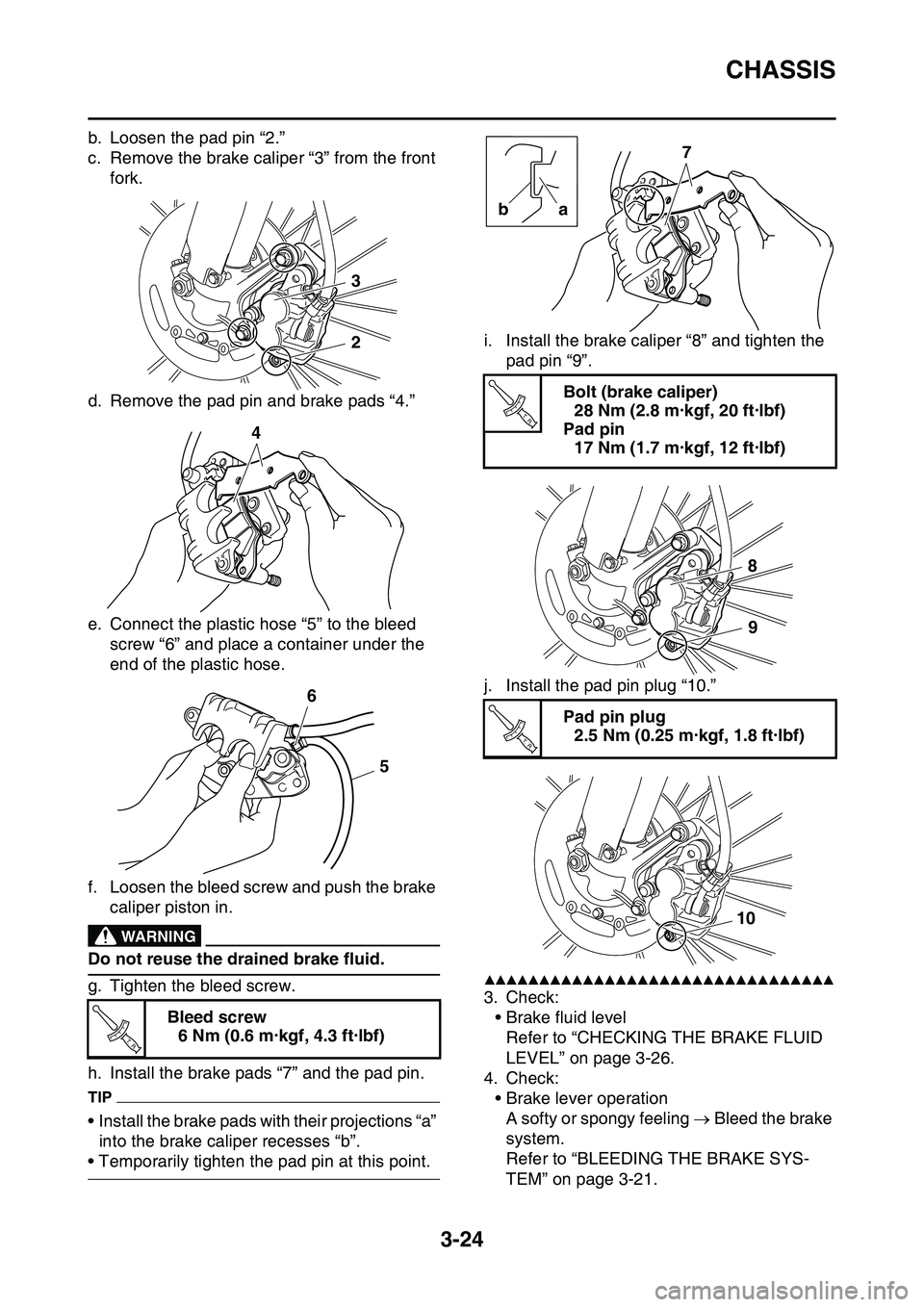
b. Loosen the pad pin “2.”
c. Remove the brake caliper “3” from the front
fork.
d. Remove the pad pin and brake pads “4.”
e. Connect the plastic hose “5” to the bleed
screw “6” and place a container under the
end of the plastic hose.
f. Loosen the bleed screw and push the brake
caliper piston in.
EWA@
WARNING
Do not reuse the drained brake fluid.
g. Tighten the bleed screw.
h. Install the brake pads “7” and the pad pin.
TIP
• Install the brake pads with their projections “a”
into the brake caliper recesses “b”.
• Temporarily tighten the pad pin at this point.
i. Install the brake caliper “8” and tighten the
pad pin “9”.
j. Install the pad pin plug “10.”
▲▲▲▲▲▲▲▲▲▲▲▲▲▲▲▲▲▲▲▲▲▲▲▲▲▲▲▲▲▲▲▲
3. Check:
• Brake fluid level
Refer to “CHECKING THE BRAKE FLUID
LEVEL” on page 3-26.
4. Check:
• Brake lever operation
A softy or spongy feeling Bleed the brake
system.
Refer to “BLEEDING THE BRAKE SYS-
TEM” on page 3-21.
Bleed screw
6 Nm (0.6 m·kgf, 4.3 ft·lbf)
3
2
4
6
5
T R..
Bolt (brake caliper)
28 Nm (2.8 m·kgf, 20 ft·lbf)
Pad pin
17 Nm (1.7 m·kgf, 12 ft·lbf)
Pad pin plug
2.5 Nm (0.25 m·kgf, 1.8 ft·lbf)
7
a b
T R..
8
9
T R..
10
Page 113 of 360
CHASSIS
3-25
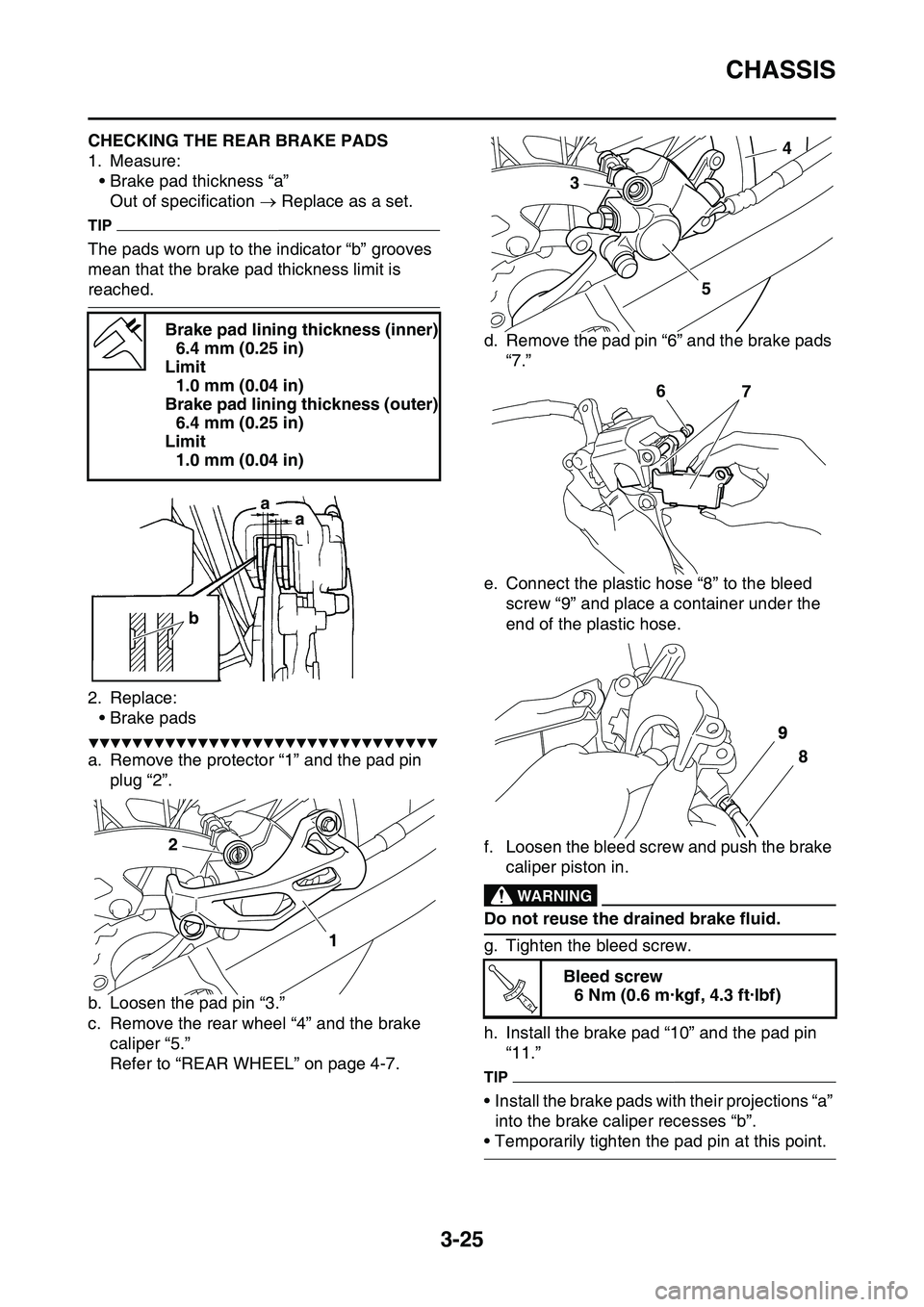
EAS1SL1095CHECKING THE REAR BRAKE PADS
1. Measure:
• Brake pad thickness “a”
Out of specification Replace as a set.
TIP
The pads worn up to the indicator “b” grooves
mean that the brake pad thickness limit is
reached.
2. Replace:
• Brake pads
▼▼▼▼▼▼▼▼▼▼▼▼▼▼▼▼▼▼▼▼▼▼▼▼▼▼▼▼▼▼▼▼
a. Remove the protector “1” and the pad pin
plug “2”.
b. Loosen the pad pin “3.”
c. Remove the rear wheel “4” and the brake
caliper “5.”
Refer to “REAR WHEEL” on page 4-7.
d. Remove the pad pin “6” and the brake pads
“7.”
e. Connect the plastic hose “8” to the bleed
screw “9” and place a container under the
end of the plastic hose.
f. Loosen the bleed screw and push the brake
caliper piston in.
EWA@
WARNING
Do not reuse the drained brake fluid.
g. Tighten the bleed screw.
h. Install the brake pad “10” and the pad pin
“11.”
TIP
• Install the brake pads with their projections “a”
into the brake caliper recesses “b”.
• Temporarily tighten the pad pin at this point.
Brake pad lining thickness (inner)
6.4 mm (0.25 in)
Limit
1.0 mm (0.04 in)
Brake pad lining thickness (outer)
6.4 mm (0.25 in)
Limit
1.0 mm (0.04 in)
ba
a
1 2
Bleed screw
6 Nm (0.6 m·kgf, 4.3 ft·lbf)
34
5
7 6
9
8
T R..
Page 114 of 360
CHASSIS
3-26
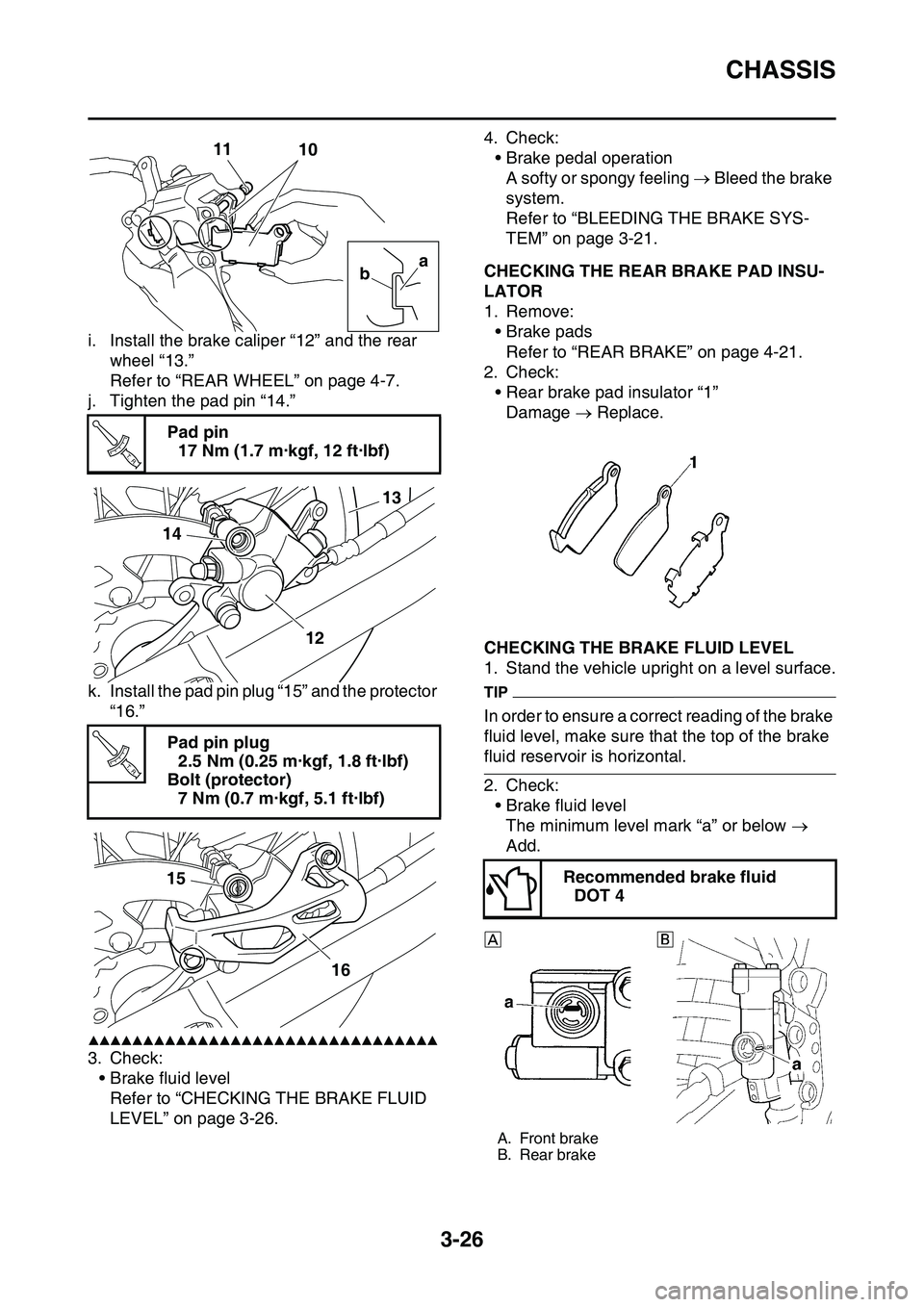
i. Install the brake caliper “12” and the rear
wheel “13.”
Refer to “REAR WHEEL” on page 4-7.
j. Tighten the pad pin “14.”
k. Install the pad pin plug “15” and the protector
“16.”
▲▲▲▲▲▲▲▲▲▲▲▲▲▲▲▲▲▲▲▲▲▲▲▲▲▲▲▲▲▲▲▲
3. Check:
• Brake fluid level
Refer to “CHECKING THE BRAKE FLUID
LEVEL” on page 3-26.
4. Check:
• Brake pedal operation
A softy or spongy feeling Bleed the brake
system.
Refer to “BLEEDING THE BRAKE SYS-
TEM” on page 3-21.
EAS1SL1096CHECKING THE REAR BRAKE PAD INSU-
LATOR
1. Remove:
• Brake pads
Refer to “REAR BRAKE” on page 4-21.
2. Check:
• Rear brake pad insulator “1”
Damage Replace.
EAS1SL1097CHECKING THE BRAKE FLUID LEVEL
1. Stand the vehicle upright on a level surface.
TIP
In order to ensure a correct reading of the brake
fluid level, make sure that the top of the brake
fluid reservoir is horizontal.
2. Check:
• Brake fluid level
The minimum level mark “a” or below
Add.
EWA13090
Pad pin
17 Nm (1.7 m·kgf, 12 ft·lbf)
Pad pin plug
2.5 Nm (0.25 m·kgf, 1.8 ft·lbf)
Bolt (protector)
7 Nm (0.7 m·kgf, 5.1 ft·lbf)
10 11
a
b
T R..
13
14
12
T R..
15
16Recommended brake fluid
DOT 4
A. Front brake
B. Rear brake
Page 115 of 360
CHASSIS
3-27
WARNING
• Use only the designated brake fluid. Other
brake fluids may cause the rubber seals to
deteriorate, causing leakage and poor
brake performance.
• Refill with the same type of brake fluid that
is already in the system. Mixing brake flu
-
ids may result in a harmful chemical reac-
tion, leading to poor brake performance.
• When pouring the brake fluid, be careful
that water does not enter the reservoir.
Water will significantly lower the boiling
point of the brake fluid and could cause
vapor lock.
ECA13540
NOTICE
Immediately wipe off the spilled brake fluid
to avoid damage to painted surfaces or
plastic parts.
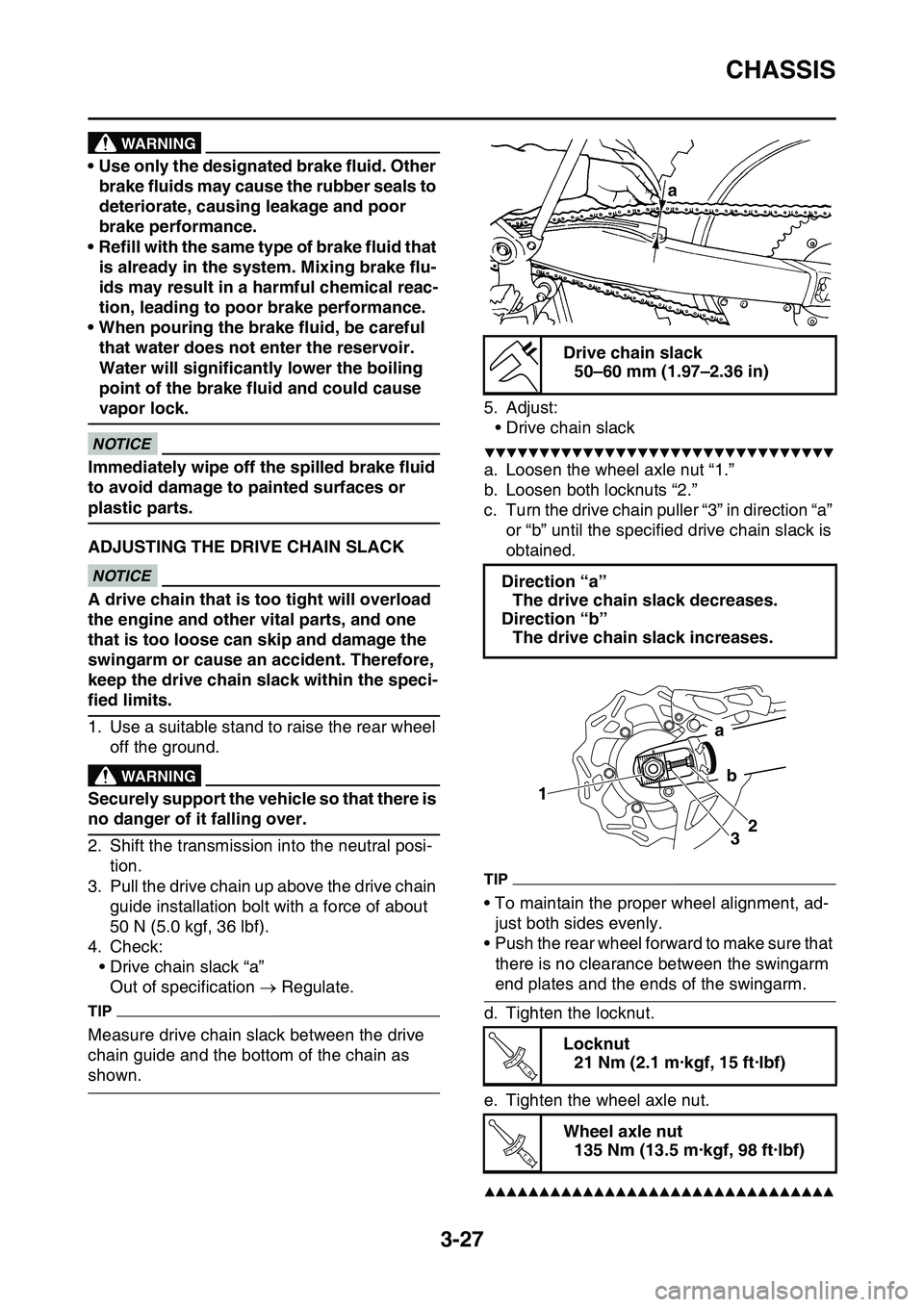
EAS1SL1098ADJUSTING THE DRIVE CHAIN SLACKECA13550
NOTICE
A drive chain that is too tight will overload
the engine and other vital parts, and one
that is too loose can skip and damage the
swingarm or cause an accident. Therefore,
keep the drive chain slack within the speci
-
fied limits.
1. Use a suitable stand to raise the rear wheel
off the ground.
EWA13120
WARNING
Securely support the vehicle so that there is
no danger of it falling over.
2. Shift the transmission into the neutral posi-
tion.
3. Pull the drive chain up above the drive chain
guide installation bolt with a force of about
50 N (5.0 kgf, 36 lbf).
4. Check:
• Drive chain slack “a”
Out of specification Regulate.
TIP
Measure drive chain slack between the drive
chain guide and the bottom of the chain as
shown.
5. Adjust:
• Drive chain slack
▼▼▼▼▼▼▼▼▼▼▼▼▼▼▼▼▼▼▼▼▼▼▼▼▼▼▼▼▼▼▼▼
a. Loosen the wheel axle nut “1.”
b. Loosen both locknuts “2.”
c. Turn the drive chain puller “3” in direction “a”
or “b” until the specified drive chain slack is
obtained.
TIP
• To maintain the proper wheel alignment, ad-
just both sides evenly.
• Push the rear wheel forward to make sure that
there is no clearance between the swingarm
end plates and the ends of the swingarm.
d. Tighten the locknut.
e. Tighten the wheel axle nut.
▲▲▲▲▲▲▲▲▲▲▲▲▲▲▲▲▲▲▲▲▲▲▲▲▲▲▲▲▲▲▲▲
Drive chain slack
50–60 mm (1.97–2.36 in)
Direction “a”
The drive chain slack decreases.
Direction “b”
The drive chain slack increases.
Locknut
21 Nm (2.1 m·kgf, 15 ft·lbf)
Wheel axle nut
135 Nm (13.5 m·kgf, 98 ft·lbf)
a
1
32
a
b
T R..
T R..
Page 116 of 360
CHASSIS
3-28
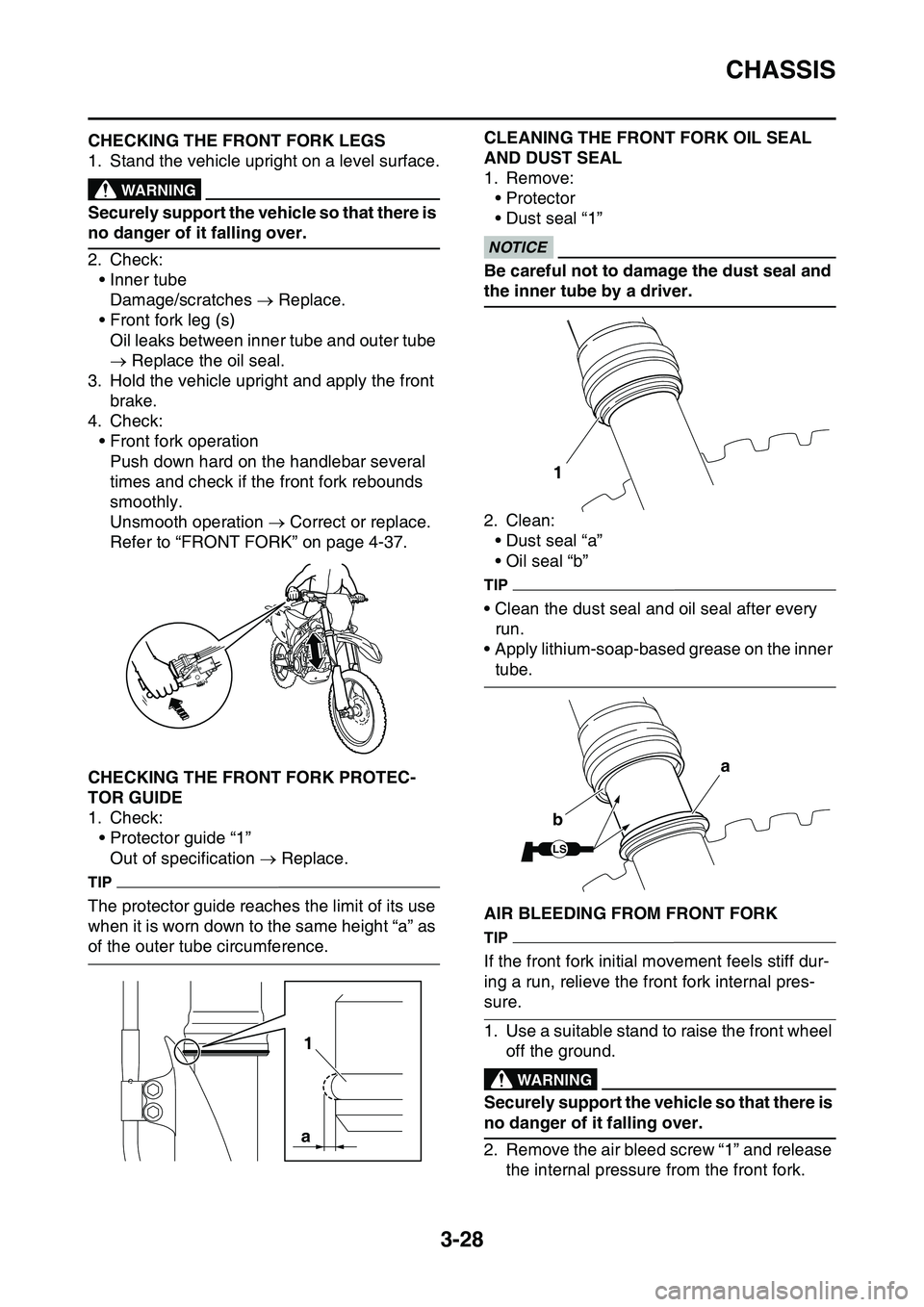
EAS1SL1099CHECKING THE FRONT FORK LEGS
1. Stand the vehicle upright on a level surface.EWA13120
WARNING
Securely support the vehicle so that there is
no danger of it falling over.
2. Check:
• Inner tube
Damage/scratches Replace.
• Front fork leg (s)
Oil leaks between inner tube and outer tube
Replace the oil seal.
3. Hold the vehicle upright and apply the front
brake.
4. Check:
• Front fork operation
Push down hard on the handlebar several
times and check if the front fork rebounds
smoothly.
Unsmooth operation Correct or replace.
Refer to “FRONT FORK” on page 4-37.
EAS1SL1100CHECKING THE FRONT FORK PROTEC-
TOR GUIDE
1. Check:
• Protector guide “1”
Out of specification Replace.
TIP
The protector guide reaches the limit of its use
when it is worn down to the same height “a” as
of the outer tube circumference.
EAS1SL1101
CLEANING THE FRONT FORK OIL SEAL
AND DUST SEAL
1. Remove:
•Protector
• Dust seal “1”ECA?
NOTICE
Be careful not to damage the dust seal and
the inner tube by a driver.
2. Clean:
• Dust seal “a”
• Oil seal “b”
TIP
• Clean the dust seal and oil seal after every
run.
• Apply lithium-soap-based grease on the inner
tube.
EAS1SL1102AIR BLEEDING FROM FRONT FORK
TIP
If the front fork initial movement feels stiff dur-
ing a run, relieve the front fork internal pres-
sure.
1. Use a suitable stand to raise the front wheel
off the ground.
EWA@
WARNING
Securely support the vehicle so that there is
no danger of it falling over.
2. Remove the air bleed screw “1” and release
the internal pressure from the front fork.
1
a
1
LS
a
b