engine YAMAHA YZ450F 2016 User Guide
[x] Cancel search | Manufacturer: YAMAHA, Model Year: 2016, Model line: YZ450F, Model: YAMAHA YZ450F 2016Pages: 362, PDF Size: 10.49 MB
Page 32 of 362
CONTROL FUNCTIONS
1-18
EASB111029
CONTROL FUNCTIONS
EASB111030ENGINE STOP SWITCH
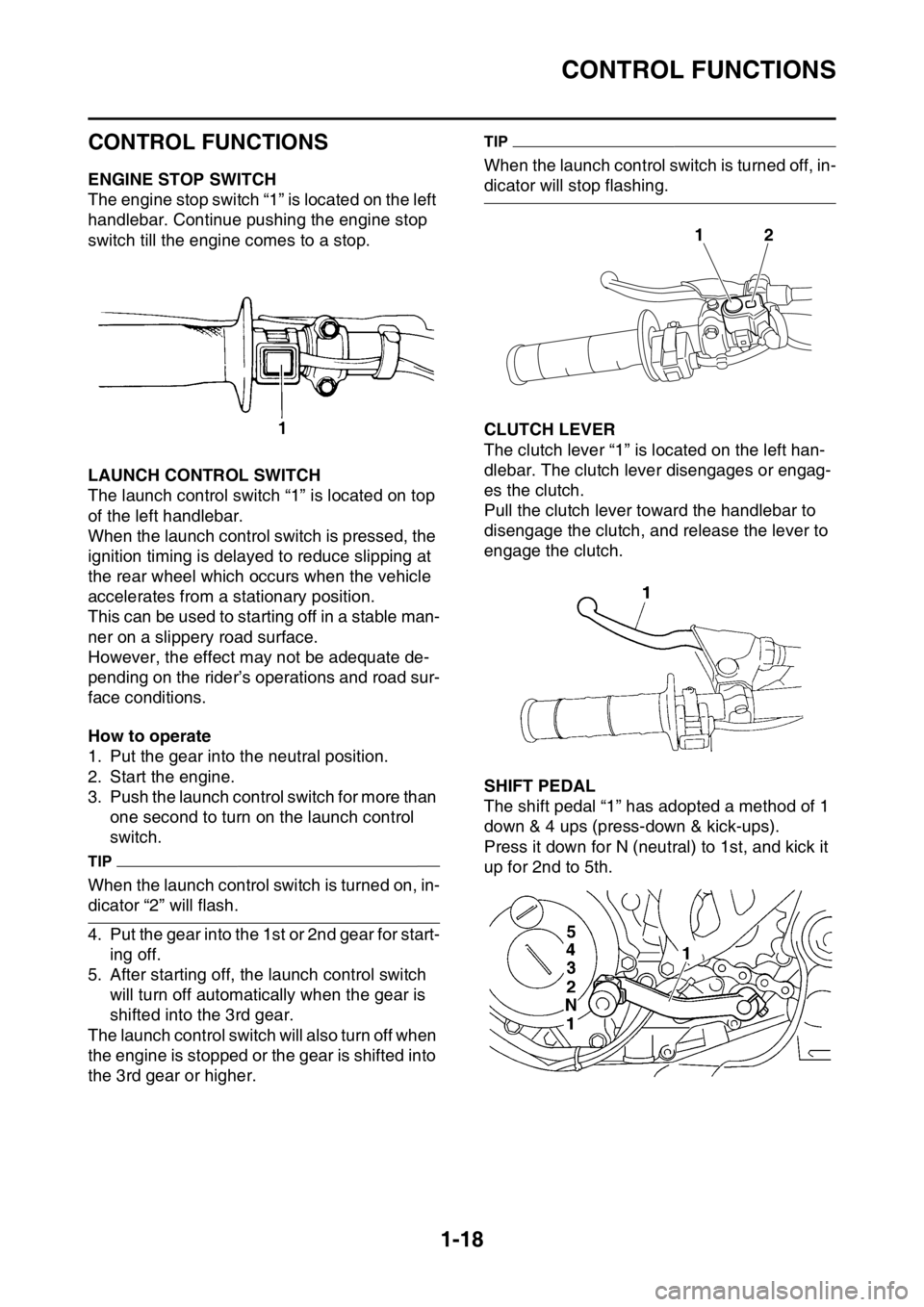
The engine stop switch “1” is located on the left
handlebar. Continue pushing the engine stop
switch till the engine comes to a stop.
EASB111031LAUNCH CONTROL SWITCH
The launch control switch “1” is located on top
of the left handlebar.
When the launch control switch is pressed, the
ignition timing is delayed to reduce slipping at
the rear wheel which occurs when the vehicle
accelerates from a stationary position.
This can be used to starting off in a stable man-
ner on a slippery road surface.
However, the effect may not be adequate de-
pending on the rider’s operations and road sur-
face conditions.
How to operate
1. Put the gear into the neutral position.
2. Start the engine.
3. Push the launch control switch for more than
one second to turn on the launch control
switch.
TIP
When the launch control switch is turned on, in-
dicator “2” will flash.
4. Put the gear into the 1st or 2nd gear for start-
ing off.
5. After starting off, the launch control switch
will turn off automatically when the gear is
shifted into the 3rd gear.
The launch control switch will also turn off when
the engine is stopped or the gear is shifted into
the 3rd gear or higher.
TIP
When the launch control switch is turned off, in-
dicator will stop flashing.
EASB111032CLUTCH LEVER
The clutch lever “1” is located on the left han-
dlebar. The clutch lever disengages or engag-
es the clutch.
Pull the clutch lever toward the handlebar to
disengage the clutch, and release the lever to
engage the clutch.
EASB111033SHIFT PEDAL
The shift pedal “1” has adopted a method of 1
down & 4 ups (press-down & kick-ups).
Press it down for N (neutral) to 1st, and kick it
up for 2nd to 5th.
12
Page 33 of 362
CONTROL FUNCTIONS
1-19
EASB111034KICKSTARTER LEVER
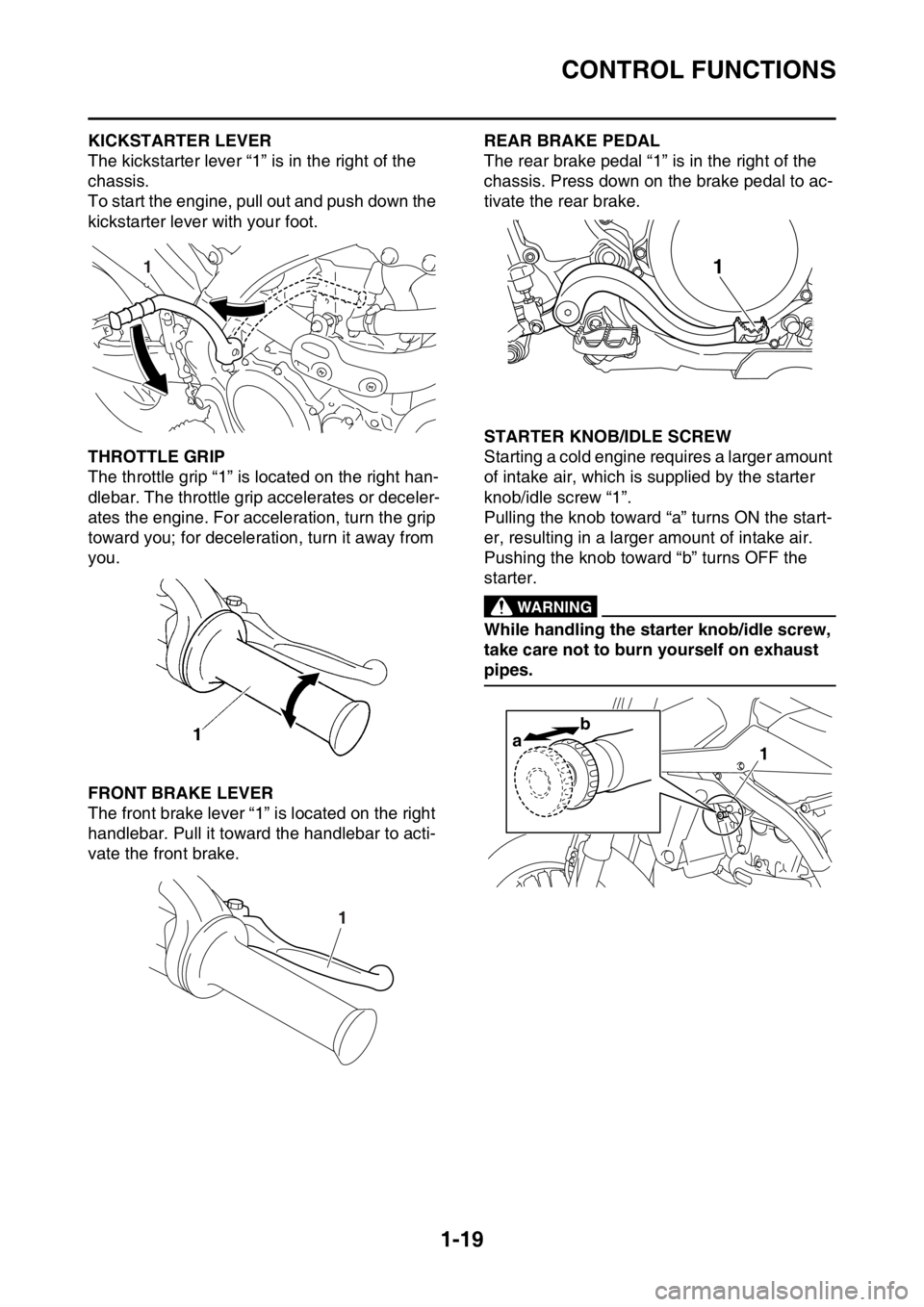
The kickstarter lever “1” is in the right of the
chassis.
To start the engine, pull out and push down the
kickstarter lever with your foot.
EASB111035THROTTLE GRIP
The throttle grip “1” is located on the right han-
dlebar. The throttle grip accelerates or deceler-
ates the engine. For acceleration, turn the grip
toward you; for deceleration, turn it away from
you.
EASB111036FRONT BRAKE LEVER
The front brake lever “1” is located on the right
handlebar. Pull it toward the handlebar to acti-
vate the front brake.
EASB111037REAR BRAKE PEDAL
The rear brake pedal “1” is in the right of the
chassis. Press down on the brake pedal to ac-
tivate the rear brake.
EASB111038STARTER KNOB/IDLE SCREW
Starting a cold engine requires a larger amount
of intake air, which is supplied by the starter
knob/idle screw “1”.
Pulling the knob toward “a” turns ON the start-
er, resulting in a larger amount of intake air.
Pushing the knob toward “b” turns OFF the
starter.
EWA
WARNING
While handling the starter knob/idle screw,
take care not to burn yourself on exhaust
pipes.
1
1
1
ab1
Page 35 of 362
STARTING AND BREAK-IN
1-21
EASB111040
STARTING AND BREAK-IN
EASB111041FUEL
Always use the recommended fuel as stated
below. Also, be sure to use new gasoline the
day of a race.
ECA
NOTICE
Use only unleaded gasoline. The use of
leaded gasoline will cause severe damage
to the engine internal parts such as valves,
piston rings, and exhaust system, etc.
TIP
Your Yamaha engine has been designed to use
premium unleaded gasoline with a pump oc-
tane number [(R+M)/2] of 91 or higher, or a re-
search octane number of 95 or higher. If
knocking (or pinging) occurs, use a gasoline of
a different brand.
EWA
WARNING
• For refueling, be sure to stop the engine
and use enough care not to spill any fuel.
Also be sure to avoid refueling close to a
fire.
• Refuel after the engine, exhaust pipe, etc.
have cooled off.
Gasohol (For USA and Canada)
There are two types of gasohol: gasohol con-
taining ethanol and that containing methanol.
Gasohol containing ethanol can be used if the
ethanol content does not exceed 10%. Gasohol
containing methanol is not recommended by
Yamaha because it can cause damage to the
fuel system or vehicle performance problems.
EASB111042STARTING A COLD ENGINE
1. Press the shift pedal to neutral.
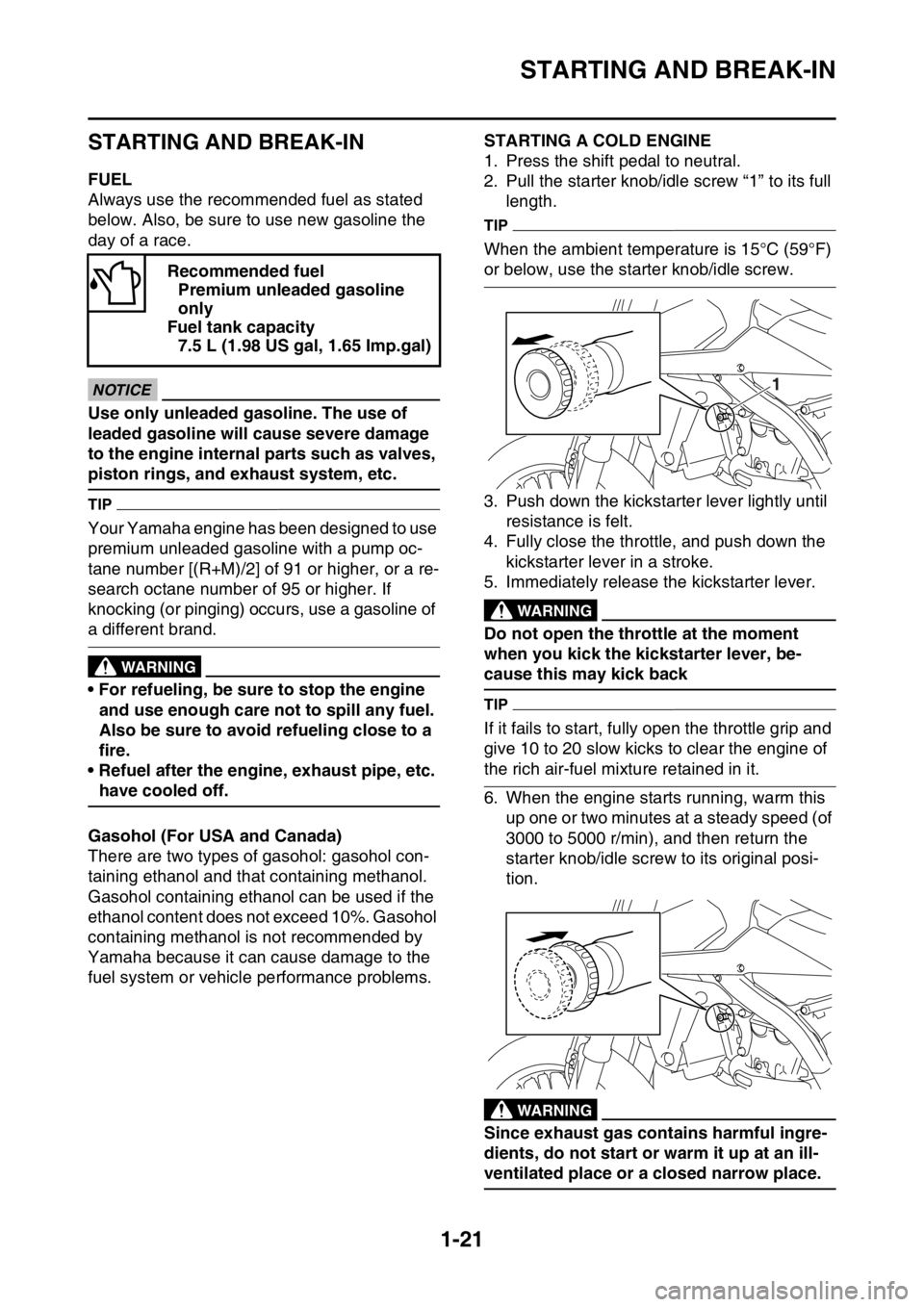
2. Pull the starter knob/idle screw “1” to its full
length.
TIP
When the ambient temperature is 15°C (59°F)
or below, use the starter knob/idle screw.
3. Push down the kickstarter lever lightly until
resistance is felt.
4. Fully close the throttle, and push down the
kickstarter lever in a stroke.
5. Immediately release the kickstarter lever.
EWA
WARNING
Do not open the throttle at the moment
when you kick the kickstarter lever, be-
cause this may kick back
TIP
If it fails to start, fully open the throttle grip and
give 10 to 20 slow kicks to clear the engine of
the rich air-fuel mixture retained in it.
6. When the engine starts running, warm this
up one or two minutes at a steady speed (of
3000 to 5000 r/min), and then return the
starter knob/idle screw to its original posi-
tion.
EWA
WARNING
Since exhaust gas contains harmful ingre-
dients, do not start or warm it up at an ill-
ventilated place or a closed narrow place. Recommended fuel
Premium unleaded gasoline
only
Fuel tank capacity
7.5 L (1.98 US gal, 1.65 Imp.gal)
1
Page 36 of 362
STARTING AND BREAK-IN
1-22
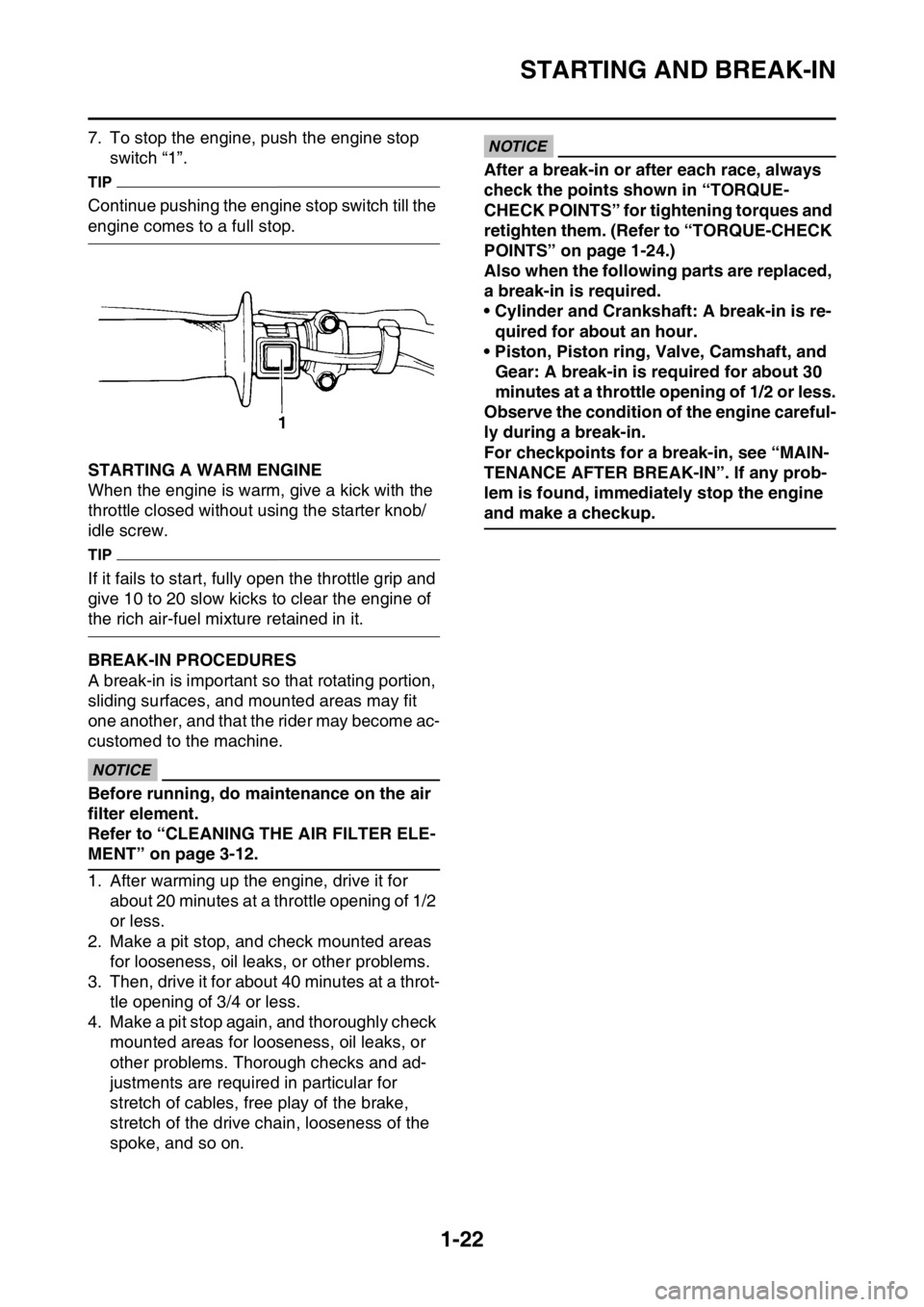
7. To stop the engine, push the engine stop
switch “1”.
TIP
Continue pushing the engine stop switch till the
engine comes to a full stop.
EASB111043STARTING A WARM ENGINE
When the engine is warm, give a kick with the
throttle closed without using the starter knob/
idle screw.
TIP
If it fails to start, fully open the throttle grip and
give 10 to 20 slow kicks to clear the engine of
the rich air-fuel mixture retained in it.
EASB111044BREAK-IN PROCEDURES
A break-in is important so that rotating portion,
sliding surfaces, and mounted areas may fit
one another, and that the rider may become ac-
customed to the machine.
ECA
NOTICE
Before running, do maintenance on the air
filter element.
Refer to “CLEANING THE AIR FILTER ELE-
MENT” on page 3-12.
1. After warming up the engine, drive it for
about 20 minutes at a throttle opening of 1/2
or less.
2. Make a pit stop, and check mounted areas
for looseness, oil leaks, or other problems.
3. Then, drive it for about 40 minutes at a throt-
tle opening of 3/4 or less.
4. Make a pit stop again, and thoroughly check
mounted areas for looseness, oil leaks, or
other problems. Thorough checks and ad-
justments are required in particular for
stretch of cables, free play of the brake,
stretch of the drive chain, looseness of the
spoke, and so on.
ECA
NOTICE
After a break-in or after each race, always
check the points shown in “TORQUE-
CHECK POINTS” for tightening torques and
retighten them. (Refer to “TORQUE-CHECK
POINTS” on page 1-24.)
Also when the following parts are replaced,
a break-in is required.
• Cylinder and Crankshaft: A break-in is re-
quired for about an hour.
• Piston, Piston ring, Valve, Camshaft, and
Gear: A break-in is required for about 30
minutes at a throttle opening of 1/2 or less.
Observe the condition of the engine careful-
ly during a break-in.
For checkpoints for a break-in, see “MAIN-
TENANCE AFTER BREAK-IN”. If any prob-
lem is found, immediately stop the engine
and make a checkup.
Page 37 of 362

MAINTENANCE AFTER BREAK-IN
1-23
EASB111045
MAINTENANCE AFTER BREAK-IN
After a break-in, perform careful maintenance
to get ready for the next practice or race.
Refer to “PRE-OPERATION INSPECTION
AND MAINTENANCE” on page 3-7.
EASB111046MAJOR MAINTENANCE
1. For the engine
• Leaks around the engine
Check for pressure leaks from the cylinder
head or the cylinder, oil leaks from the
crankcase or the case cover, leaks from the
coolant system, and other leaks.
• Check that the valve, the cylinder head, the
cylinder, the piston, and the piston ring fit
one another, and that contact between the
valve and the cylinder head, and that be-
tween the cylinder and the piston are cor-
rect.
• Engine oil change
Drain the oil, and check for dirt and foreign
materials such as metal chips. (If any foreign
material is mixed, disassemble and check
the crankcase.)
Pour the specified amount of the recom-
mended oil.
• AC magneto
Check for looseness in mounted areas of
the rotor and the stator.
Check that the connector is not being dis-
connected.
• Silencer
Check the main body and stay for cracks.
Check for leaks.
• Mounting bolts and nuts
Check for looseness in mounted areas of
parts, as well as engine mounting bolts and
engine brackets.
2. For the chassis
• Check welds and mounted areas of the
frame, the swingarm, the link, the bracket,
and so on, for looseness and cracks.
• Wheel (s)
Check the wheel for runout. Check the
spoke for looseness.
• Brake(s)
Check the brake disc mounting bolt for
looseness.
Check that the reservoir contains the speci-
fied amount of brake fluid. Check for leaks.• Cable
Grease and adjust cables.
•Drive chain
Lubricate the drive chain and adjust its ten-
sion.
• Fuel tank
Clean the inside of the fuel tank. Check for
leaks.
• Suspension
Check for oil leaks in the front fork or the rear
shock absorber. Check that the mounted
conditions are good.
• Sprocket
Check for looseness in the sprocket mount-
ed on the rear wheel.
• Mounting bolts and nuts
Check mounted areas for looseness.
ECA
NOTICE
After a break-in or before each race, always
check the points shown in “TORQUE-
CHECK POINTS” for tightening torques and
retighten them. (Refer to “TORQUE-CHECK
POINTS” on page 1-24.)
• Greasing and oiling
Always grease or oil the specified points.
Page 38 of 362

TORQUE-CHECK POINTS
1-24
EASB111047
TORQUE-CHECK POINTS
Frame construction Frame to rear frame
Frame to engine protector
Combined seat and fuel tank Fuel tank to frame
Engine mounting Frame to engine
Engine bracket to engine
Engine bracket to frame
Seat Seat to frame
Steering Steering stem to handlebar Steering stem to frame
Steering stem to upper bracket
Upper bracket to handlebar
Suspension Front Steering stem to front fork Front fork to upper bracket
Front fork to lower bracket
Rear Link Assembly of links
Link to frame
Link to rear shock absorber
Link to swingarm
Mounting of rear shock absorber Rear shock absorber and frame
Mounting of swingarm Tightening of pivot shaft
Wheel (s) Mounting of wheel Front Tightening of wheel axle
Tightening of axle holder
Tightening of spoke nipple
Rear Tightening of wheel axle
Wheel to rear wheel sprocket
Tightening of spoke nipple
Brake(s) Front Brake caliper to front fork
Brake disc to wheel
Tightening of union bolt
Brake master cylinder to handle-
bar
Tightening of bleed screw
Tightening of brake hose holder
Rear Brake pedal to frame
Brake disc to wheel
Tightening of union bolt
Brake master cylinder to frame
Tightening of bleed screw
Tightening of brake hose holder
Fuel system Fuel pump to fuel tank
Page 40 of 362
CLEANING AND STORAGE
1-26
EASB111048
CLEANING AND STORAGE
EASB111049CLEANING
Frequent cleaning of your vehicle will enhance
its appearance, maintain performance, and ex-
tend the life of parts.
1. Before cleaning, block the silencer outlet to
prevent water from entering. A plastic bag
secured with a rubber band may be used for
this purpose.
2. If the engine is contaminated with oil, apply
some degreaser to it with a brush. Do not
apply degreaser to the drive chain, the
sprockets, or the wheel axles.
3. Hose off dirt. Use only enough water pres-
sure to do the job.
ECA
NOTICE
Do not use high-pressure washers or steam
cleaners. Otherwise, these may cause a fail-
ure because of the entry of water.
4. After hosing off the dirt, wash all surfaces
with a mild detergent and warm water. Use
a toothbrush to clean hard-to-reach places.
5. Rinse the detergent with clean water, and
dry the surfaces with a soft towel or a cloth.
6. Immediately after cleaning, remove any wa-
ter from the drive chain with a paper towel,
and lubricate it to prevent rust.
7. Clean the seat with a vinyl upholstery clean-
er to keep the cover pliable and glossy.
8. Automotive wax may be applied to all paint-
ed or chromed surfaces. Avoid using such
wax as contains abrasives, because it may
scratch surfaces.
9. After completing the above, start the engine
and allow it to warm up for several minutes.
EASB111050STORAGE
If your vehicle is to be stored for 60 days or
more, some preventive measures must be tak-
en to avoid deterioration. After cleaning the ve-
hicle thoroughly, prepare it for storage as
follows:
1. Fill the fuel tank with gasoline.
2. Remove the spark plug, pour a spoonful of
engine oil (SAE 10W-40) into the spark plug
hole, and reinstall the plug. With the engine
stop switch pushed in, by pushing down the
kickstarter lever, crank the engine to coat
the cylinder walls with oil.3. Remove the drive chain, clean it thoroughly
with solvent, and lubricate it Reinstall the
drive chain or store it in a plastic bag tied to
the frame.
4. Lubricate all cables.
5. Lift up the frame of the vehicle to keep the
wheels off the ground.
6. Tie a plastic bag over the muffler outlet to
prevent moisture from entering.
7. If the vehicle is to be stored in a place that is
humid or exposed to the sea breeze, apply a
light coat of oil to metal surfaces. Do not ap-
ply oil to the seat or rubber parts.
TIP
Make any necessary repairs before the vehicle
is stored.
Page 41 of 362

2
SPECIFICATIONS
GENERAL SPECIFICATIONS......................................................................... 2-1
ENGINE SPECIFICATIONS............................................................................. 2-2
CHASSIS SPECIFICATIONS........................................................................... 2-7
ELECTRICAL SPECIFICATIONS.................................................................. 2-11
TIGHTENING TORQUES............................................................................... 2-12
GENERAL TIGHTENING TORQUE SPECIFICATIONS .......................... 2-12
ENGINE TIGHTENING TORQUES .......................................................... 2-13
CHASSIS TIGHTENING TORQUES ........................................................ 2-17
LUBRICATION POINTS AND LUBRICANT TYPES..................................... 2-20
ENGINE .................................................................................................... 2-20
CHASSIS .................................................................................................. 2-21
LUBRICATION SYSTEM CHART AND DIAGRAMS..................................... 2-23
LUBRICATION DIAGRAMS ..................................................................... 2-23
CABLE ROUTING DIAGRAM........................................................................ 2-31
Page 43 of 362

ENGINE SPECIFICATIONS
2-2
EASB111052
ENGINE SPECIFICATIONS
Engine
Engine type Liquid cooled 4-stroke, DOHC
Displacement 450 cm
3
Cylinder arrangement Single cylinder
Bore stroke 97.0 60.8 mm (3.8 2.4 in)
Compression ratio 12.5:1
Starting system Kickstarter
Fuel
Recommended fuel Premium unleaded gasoline only
Fuel tank capacity 7.5 L (1.98 US gal, 1.65 Imp.gal)
Engine oil
Lubrication system Wet sump
Recommended brand YAMALUBE
Type SAE 10W-40, SAE 10W-50, SAE 15W-40,
SAE 20W-40 or SAE 20W-50
Recommended engine oil grade API service SG type or higher, JASO standard
MA
Engine oil quantity
Quantity (disassembled) 0.95 L (1.00 US qt, 0.84 Imp.qt)
With oil filter element replacement 0.69 L (0.73 US qt, 0.61 Imp.qt)
Without oil filter element replacement 0.67 L (0.71 US qt, 0.59 Imp.qt)
Oil filter
Oil filter type Paper
Oil pump
Oil pump type Trochoid
Inner-rotor-to-outer-rotor-tip clearance Less than 0.150 mm (0.0059 in)
Limit 0.20 mm (0.0079 in)
Outer-rotor-to-oil-pump-housing clearance 0.13–0.18 mm (0.0051–0.0071 in)
Limit 0.24 mm (0.0094 in)
Oil-pump-housing-to-inner-and-outer-rotor
clearance 0.06–0.11 mm (0.0024–0.0043 in)
Limit 0.17 mm (0.0067 in)
Cooling system
Radiator (including all routes) 1.04 L (1.10 US qt, 0.92 Imp.qt)
Radiator capacity 0.57 L (0.60 US qt, 0.50 mp.qt)
Radiator cap valve opening pressure 108–137 kPa (1.08–1.37 kg/cm
2, 15.7–19.9
psi)
Radiator core
Width 112.6 mm (4.43 in)
Height 235.0 mm (9.25 in)
Depth 28.0 mm (1.10 in)
Water pump
Water pump type Single suction centrifugal pump
Spark plug(s)
Manufacturer/model NGK/CR8E
Spark plug gap 0.7–0.8 mm (0.028–0.031 in)
Page 44 of 362

ENGINE SPECIFICATIONS
2-3
Cylinder head
Combustion chamber volume 25.98–26.78 cm3 (1.59–1.63 cu.in)
Warpage limit 0.05 mm (0.0020 in)
Camshaft
Drive system Chain drive (left)
Camshaft cap inside diameter 22.000–22.021 mm (0.8661–0.8670 in)
Camshaft journal diameter 21.959–21.972 mm (0.8645–0.8650 in)
Camshaft-journal-to-camshaft-cap clearance 0.028–0.062 mm (0.0011–0.0024 in)
Camshaft lobe dimensions
Lobe height (Intake) 37.630–37.730 mm (1.4815–1.4854 in)
Limit 37.620 mm (1.4811 in)
Base circle diameter (Intake) 27.950–28.050 mm (1.1004–1.1043 in)
Limit 27.940 mm (1.0000 in)
Lobe height (Exhaust) 33.870–33.970 mm (1.3335–1.3374 in)
Limit 33.860 mm (1.3331 in)
Base circle diameter (Exhaust) 24.711–24.811 mm (0.9729–0.9768 in)
Limit 24.701mm (0.9725 in)
Camshaft runout limit 0.030 mm (0.0012 in)
Timing chain
Tensioning system Automatic
Valve, valve seat, valve guide
Valve clearance (cold)
Intake 0.13–0.20 mm (0.0051–0.0079 in)
Exhaust 0.18–0.25 mm (0.0071–0.0098 in)
Valve dimensions
Valve head diameter (intake) 36.90–37.10 mm (1.4528–1.4606 in)
Valve head diameter (exhaust) 30.40–30.60 mm (1.1968–1.2047 in)
Valve face width (intake) 1.697 mm (0.0668 in)
Valve face width (exhaust) 1.768 mm (0.0696 in)
Valve seat contact width (intake) 0.90–1.10 mm (0.0354–0.0433 in)
Valve seat contact width (exhaust) 0.90–1.10 mm (0.0354–0.0433 in)
Valve margin thickness (intake) 1.20 mm (0.0472 in)
Valve margin thickness (exhaust) 0.85 mm (0.0335 in)
Valve stem diameter (intake) 5.475–5.490 mm (0.2156–0.2161 in)
Limit 5.445 mm (0.2144 in)
Valve stem diameter (exhaust) 5.465–5.480 mm (0.2152–0.2157 in)
Limit 5.435 mm (0.2140 in)
Valve guide inside diameter (intake) 5.500–5.512 mm (0.2165–0.2170 in)
Limit 5.550 mm (0.2185 in)
Valve guide inside diameter (exhaust) 5.500–5.512 mm (0.2165–0.2170 in)
Limit 5.550 mm (0.2185 in)
Valve-stem-to-valve-guide clearance (intake) 0.010–0.037 mm (0.0004–0.0015 in)
Limit 0.080 mm (0.0032 in)
Valve-stem-to-valve-guide clearance (exhaust) 0.020–0.047 mm (0.0008–0.0019 in)
Limit 0.100 mm (0.0039 in)
Valve stem runout 0.010 mm (0.0004 in)