check oil YAMAHA YZ85 2002 Owner's Manual
[x] Cancel search | Manufacturer: YAMAHA, Model Year: 2002, Model line: YZ85, Model: YAMAHA YZ85 2002Pages: 504, PDF Size: 40.45 MB
Page 452 of 504
6 - 2
–+ELECIGNITION SYSTEM
EC620000
IGNITION SYSTEM
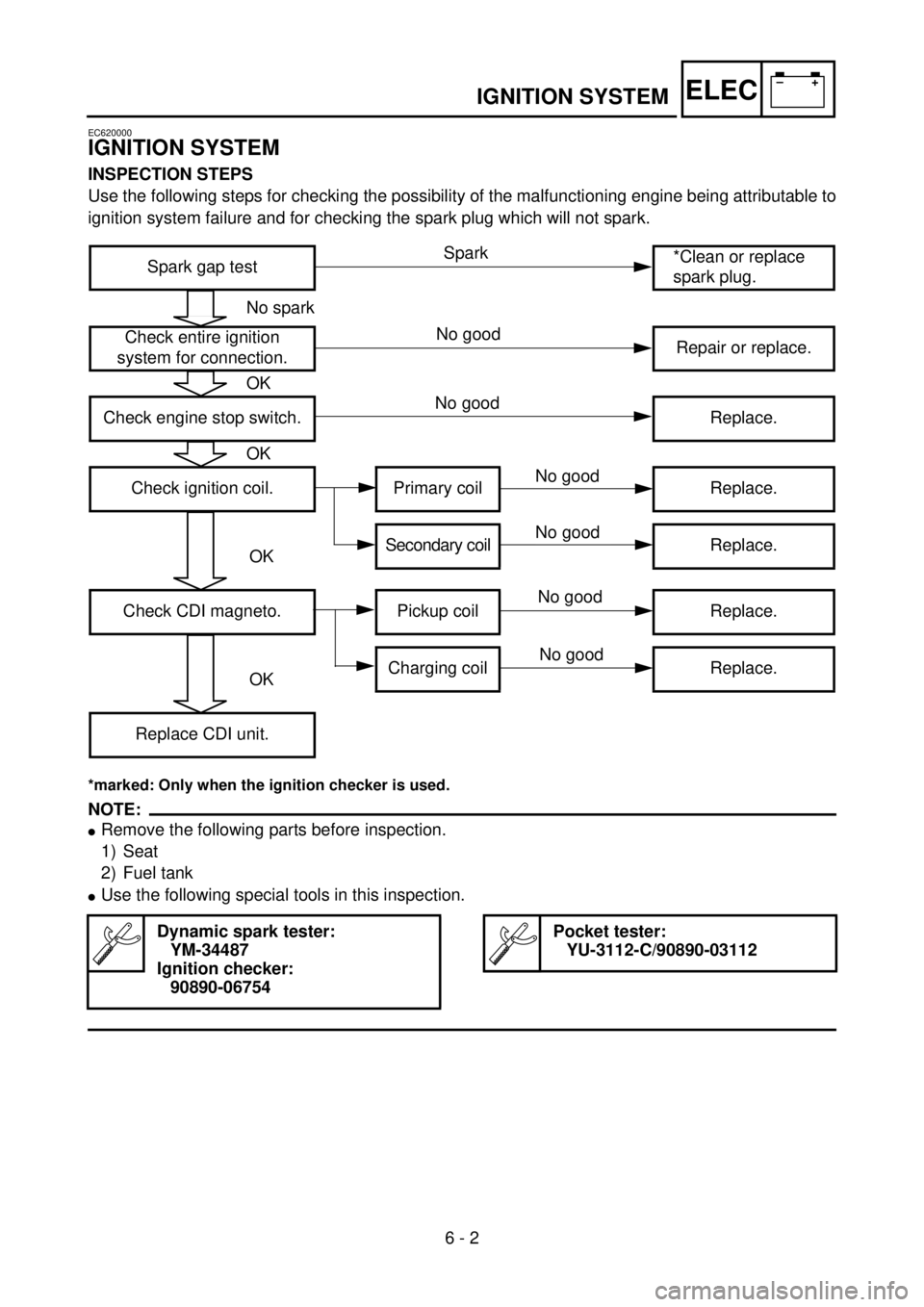
INSPECTION STEPS
Use the following steps for checking the possibility of the malfunctioning engine being attributable to
ignition system failure and for checking the spark plug which will not spark.
*marked: Only when the ignition checker is used.
NOTE:
lRemove the following parts before inspection.
1) Seat
2) Fuel tank
lUse the following special tools in this inspection.
Dynamic spark tester:
YM-34487
Ignition checker:
90890-06754Pocket tester:
YU-3112-C/90890-03112
Spark gap test*Clean or replace
spark plug.
Check entire ignition
system for connection.Repair or replace.
Check engine stop switch. Replace.
Check ignition coil. Primary coil Replace.
Secondary coil Replace.
Check CDI magneto. Pickup coil Replace.
Charging coil Replace.
Replace CDI unit.
No spark
OK
OK
OK
OK
Spark
No good
No good
No good
No good
No good
No good
Page 460 of 504
6 - 5
–+ELECIGNITION SYSTEM
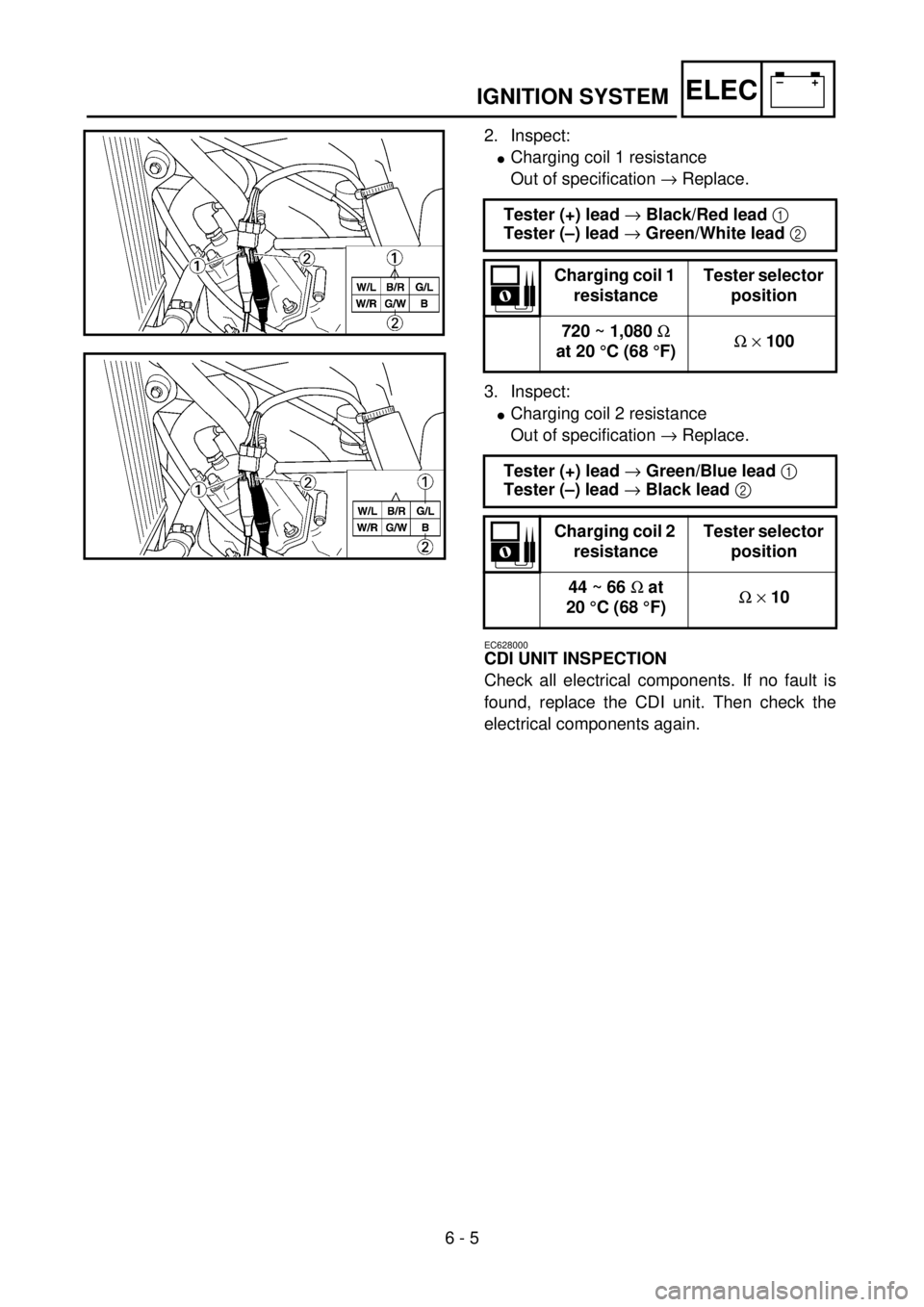
2. Inspect:
lCharging coil 1 resistance
Out of specification ® Replace.
3. Inspect:
lCharging coil 2 resistance
Out of specification ® Replace.
EC628000
CDI UNIT INSPECTION
Check all electrical components. If no fault is
found, replace the CDI unit. Then check the
electrical components again.Tester (+) lead
® Black/Red lead
1
Tester (–) lead
® Green/White lead
2
Charging coil 1
resistanceTester selector
position
720 ~ 1,080
W
at 20 °C (68 °F)W
´ 100
Tester (+) lead
® Green/Blue lead
1
Tester (–) lead
® Black lead
2
Charging coil 2
resistanceTester selector
position
44 ~ 66
W at
20 °C (68 °F)W
´ 10
5PA60090
5PA60100
Page 462 of 504

7 - 1
TUN
EC700000
TUNING
EC710000
ENGINE
Carburetor setting
lThe role of fuel is to cool the engine, and in
the case of a 2-stroke engine, to lubricate the
engine in addition to power generation.
Accordingly, if a mixture of air and fuel is too
lean, abnormal combustion will occur, and
engine seizure may result. If the mixture is
too rich, spark plugs will get wet with oil, thus
making it impossible to bring the engine into
full play or if the worst comes to the worst,
the engine may stall.
lThe richness of the air-fuel mixture required
for the engine will vary with atmospheric con-
ditions of the day and therefore, the settings
of the carburetor must be properly suited to
the atmospheric conditions (air pressure,
humidity and temperature).
lFinally, the rider himself must make a test
run and check his machine for conditions
(pick-up of engine speed, road surface con-
ditions) and for the discoloration of the spark
plug(s).
After taking these into consideration, he must
select the best possible carburetor settings.
* It is advisable to make a note of settings,
atmospheric conditions, road surface condi-
tion, lap-time, etc. so that the memorandum
can be used as a reference useful for future.
Atmospheric conditions and carburetor
settings
The air density (i.e., concentration of oxygen
in the air) determines the richness or lean-
ness of the air/fuel mixture. Therefore, refer
to the above table for mixture settings.
Air temp. HumidityAir
pressure
(altitude)Mixture Setting
High High Low (high) Richer Leaner
Low Low High (low) Leaner Richer
SETTING
7
Page 464 of 504
7 - 2
TUN
That is:
lHigher temperature expands the air with its
resultant reduced density.
lHigher humidity reduces the amount of oxy-
gen in the air by so much of the water vapor
in the same air.
lLower atmospheric pressure (at a high alti-
tude) reduces the density of the air.
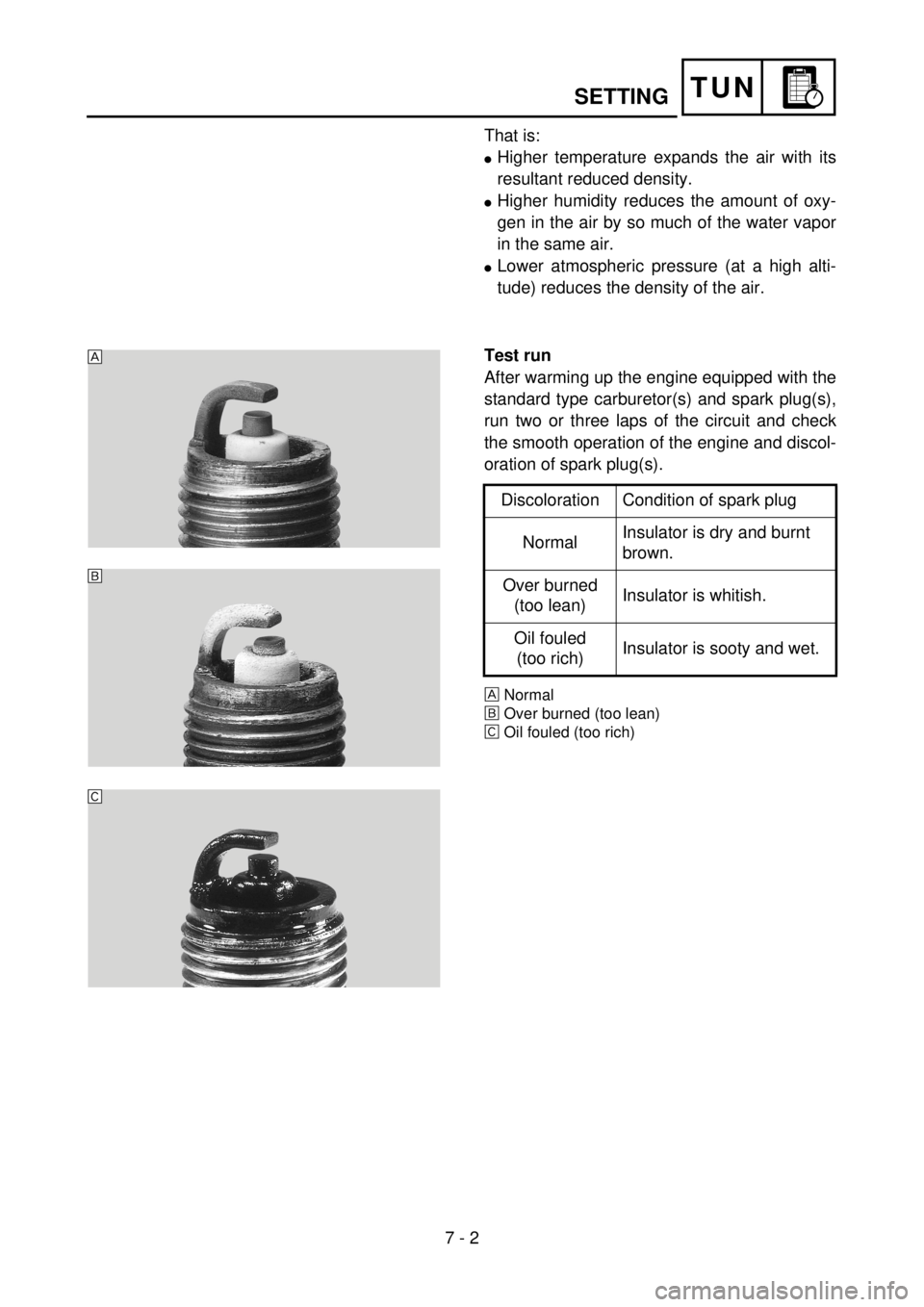
Test run
After warming up the engine equipped with the
standard type carburetor(s) and spark plug(s),
run two or three laps of the circuit and check
the smooth operation of the engine and discol-
oration of spark plug(s).
ÈNormal
ÉOver burned (too lean)
ÊOil fouled (too rich)
Discoloration Condition of spark plug
NormalInsulator is dry and burnt
brown.
Over burned
(too lean)Insulator is whitish.
Oil fouled
(too rich)Insulator is sooty and wet.
5PA70010
È
É
Ê
SETTING
Page 480 of 504
7 - 9
TUNSETTING
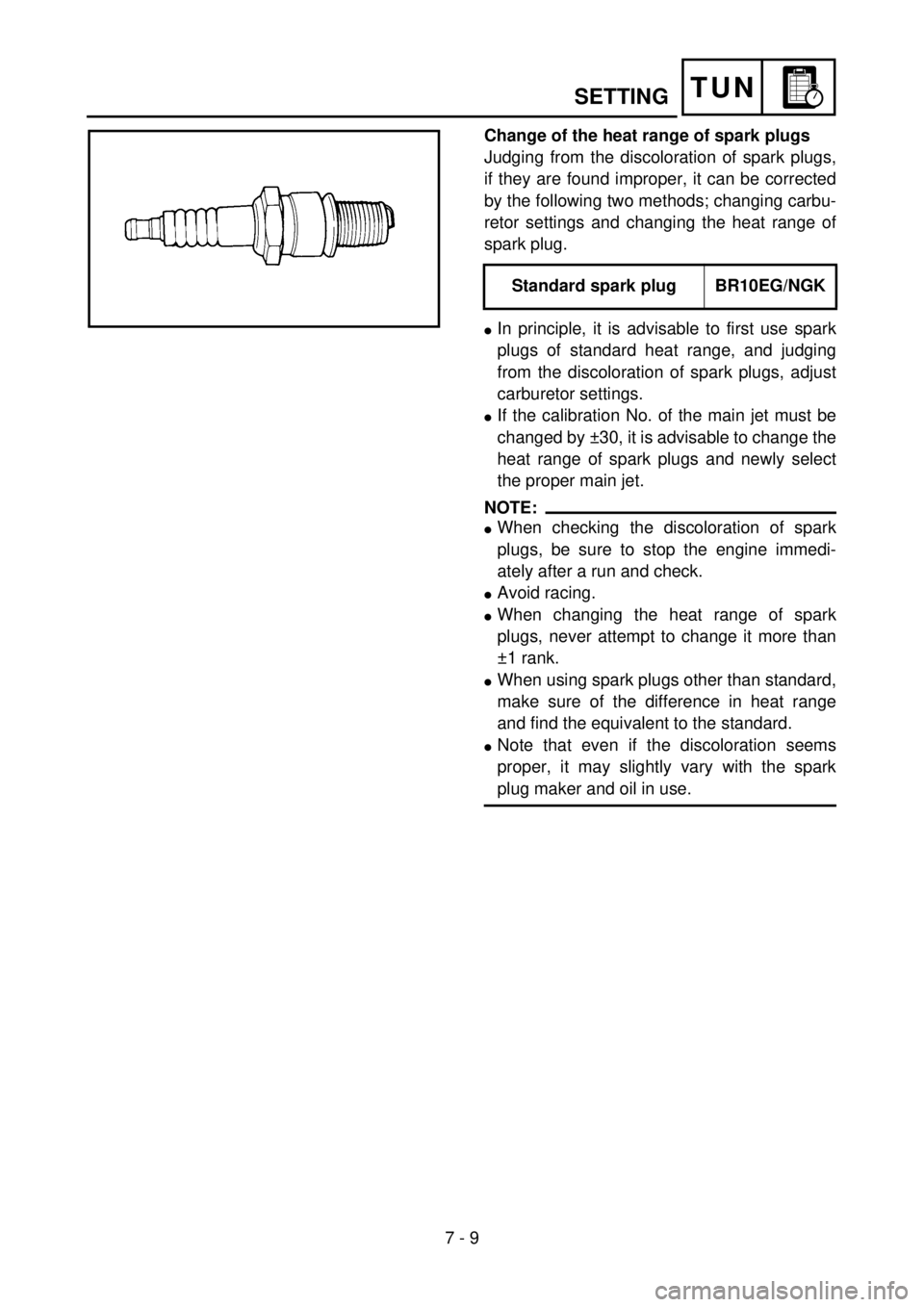
Change of the heat range of spark plugs
Judging from the discoloration of spark plugs,
if they are found improper, it can be corrected
by the following two methods; changing carbu-
retor settings and changing the heat range of
spark plug.
lIn principle, it is advisable to first use spark
plugs of standard heat range, and judging
from the discoloration of spark plugs, adjust
carburetor settings.
lIf the calibration No. of the main jet must be
changed by ±30, it is advisable to change the
heat range of spark plugs and newly select
the proper main jet.
NOTE:
lWhen checking the discoloration of spark
plugs, be sure to stop the engine immedi-
ately after a run and check.
lAvoid racing.
lWhen changing the heat range of spark
plugs, never attempt to change it more than
±1 rank.
lWhen using spark plugs other than standard,
make sure of the difference in heat range
and find the equivalent to the standard.
lNote that even if the discoloration seems
proper, it may slightly vary with the spark
plug maker and oil in use.Standard spark plug BR10EG/NGK
5PA70110
Page 498 of 504

7 - 18
TUNSETTING
Suspension setting
lFront fork
NOTE:
lIf any of the following symptoms is experienced with the standard position as the base, make
resetting by reference to the adjustment procedure given in the same chart.
lBefore any change, set the rear shock absorber sunken length to the standard figure 75 ~ 85 mm
(3.0 ~ 3.3 in).
SymptomSection
Check Adjust
JumpLarge
gapMedium
gapSmall
gap
Stiff over entire range
{{{Compression damping
Oil level (oil amount)
SpringTurn adjuster counterclockwise (about 2 clicks) to
decrease damping.
Decrease oil level by about 5 ~ 10 mm (0.2 ~ 0.4 in).
Replace with soft spring.
Unsmooth movement
over entire range{{{{Outer tube
Inner tube
Under bracket tightening
torqueCheck for any bends, dents, and other noticeable
scars, etc. If any, replace affected parts.
Retighten to specified torque.
Poor initial
movement{Rebound damping
Oil sealTurn adjuster counterclockwise (about 2 clicks) to
decrease damping.
Apply grease in oil seal wall.
Soft over entire range,
bottoming out{{Compression damping
Oil level (oil amount)
SpringTurn adjuster clockwise (about 2 clicks) to increase
damping.
Increase oil level by about 5 ~ 10 mm (0.2 ~ 0.4 in).
Replace with stiff spring.
Stiff toward stroke end{Oil level (oil amount) Decrease oil level by about 5 mm (0.2 in).
Soft toward stroke end,
bottoming out{Oil level (oil amount) Increase oil level by about 5 mm (0.2 in).
Stiff initial movement{{{{Compression dampingTurn adjuster counterclockwise (about 2 clicks) to
decrease damping.
Low front, tending to
lower front posture{{Compression damping
Rebound damping
Balance with rear end
Oil level (oil amount)Turn adjuster clockwise (about 2 clicks) to increase
damping.
Turn adjuster counterclockwise (about 2 clicks) to
decrease damping.
Set sunken length for 80 ~ 85 mm (3.1 ~ 3.3 in) when
one passenger is astride seat (lower rear posture).
Increase oil level by about 5 mm (0.2 in).
“Obtrusive” front, tend-
ing to upper front pos-
ture{{Compression damping
Balance with rear end
Spring
Oil level (oil amount)Turn adjuster counterclockwise (about 2 clicks) to
decrease damping.
Set sunken length for 75 ~ 80 mm (3.0 ~ 3.1 in) when
one passenger is astride seat (upper rear posture).
Replace with soft spring.
Decrease oil level by about 5 ~ 10 mm (0.2 ~ 0.4 in).