warning YAMAHA YZ85 2013 User Guide
[x] Cancel search | Manufacturer: YAMAHA, Model Year: 2013, Model line: YZ85, Model: YAMAHA YZ85 2013Pages: 88, PDF Size: 1.74 MB
Page 37 of 88
INSTRUMENT AND CONTROL FUNCTIONS
4-11
4
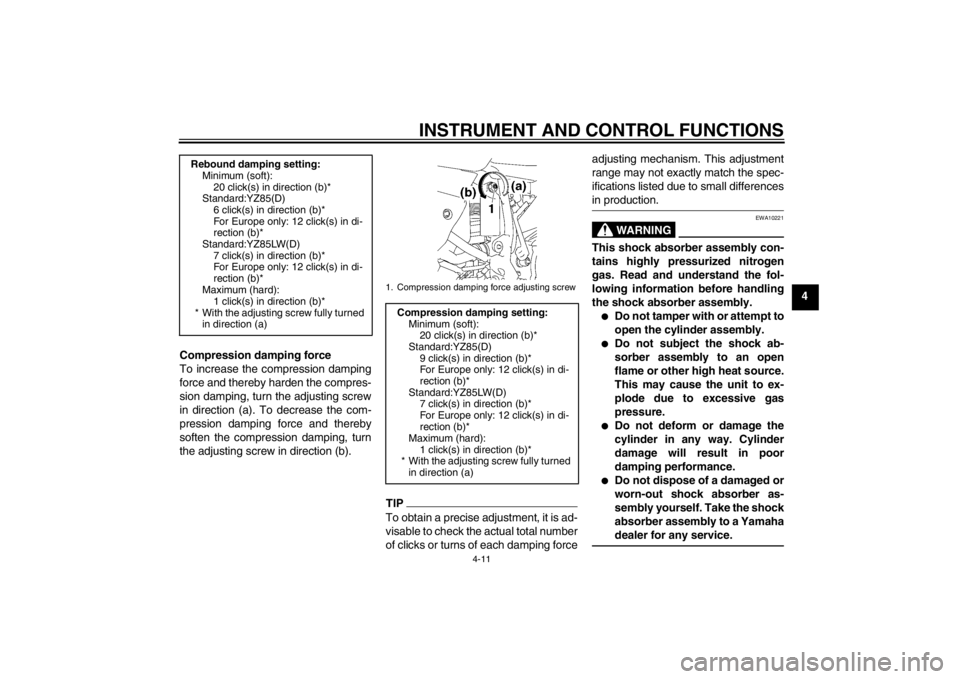
Compression damping force
To increase the compression damping
force and thereby harden the compres-
sion damping, turn the adjusting screw
in direction (a). To decrease the com-
pression damping force and thereby
soften the compression damping, turn
the adjusting screw in direction (b).
TIPTo obtain a precise adjustment, it is ad-
visable to check the actual total number
of clicks or turns of each damping force adjusting mechanism. This adjustment
range may not exactly match the spec-
ifications listed due to small differences
in production.
WARNING
EWA10221
This shock absorber assembly con-
tains highly pressurized nitrogen
gas. Read and understand the fol-
lowing information before handling
the shock absorber assembly.●
Do not tamper with or attempt to
open the cylinder assembly.
●
Do not subject the shock ab-
sorber assembly to an open
flame or other high heat source.
This may cause the unit to ex-
plode due to excessive gas
pressure.
●
Do not deform or damage the
cylinder in any way. Cylinder
damage will result in poor
damping performance.
●
Do not dispose of a damaged or
worn-out shock absorber as-
sembly yourself. Take the shock
absorber assembly to a Yamaha
dealer for any service.
Rebound damping setting:
Minimum (soft):
20 click(s) in direction (b)*
Standard:YZ85(D)
6 click(s) in direction (b)*
For Europe only: 12 click(s) in di-
rection (b)*
Standard:YZ85LW(D) 7 click(s) in direction (b)*
For Europe only: 12 click(s) in di-
rection (b)*
Maximum (hard): 1 click(s) in direction (b)*
* With the adjusting screw fully turned in direction (a)
1. Compression damping force adjusting screw
Compression damping setting: Minimum (soft):20 click(s) in direction (b)*
Standard:YZ85(D) 9 click(s) in direction (b)*
For Europe only: 12 click(s) in di-
rection (b)*
Standard:YZ85LW(D) 7 click(s) in direction (b)*
For Europe only: 12 click(s) in di-
rection (b)*
Maximum (hard):
1 click(s) in direction (b)*
* With the adjusting screw fully turned in direction (a)
U1SN81E0.book Page 11 Tuesday, June 12, 2012 3:17 PM
Page 38 of 88
INSTRUMENT AND CONTROL FUNCTIONS
4-12
4
EAU41381
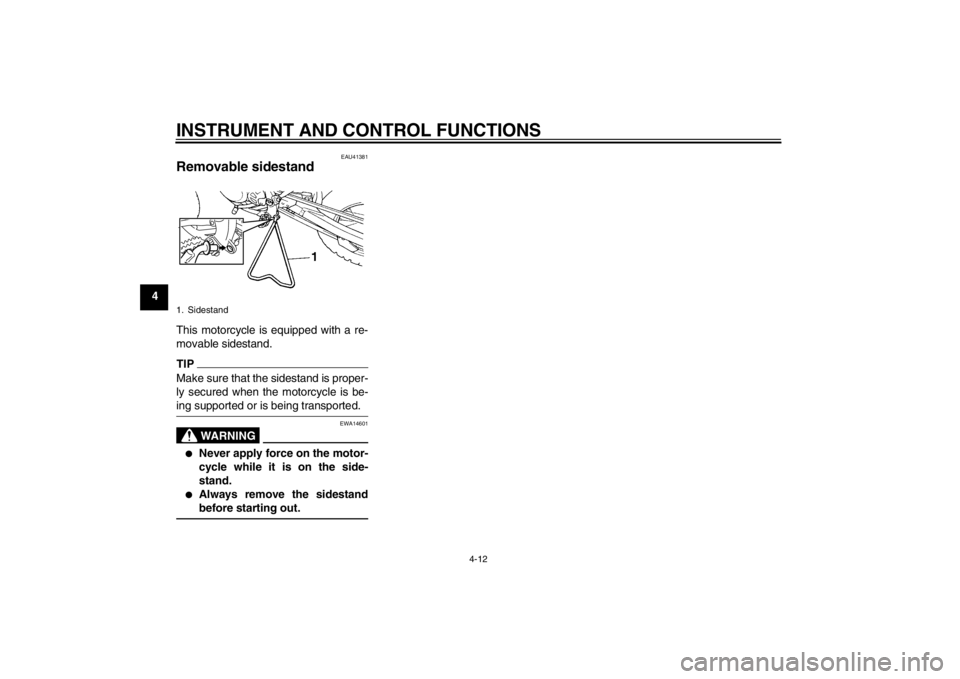
Removable sidestand This motorcycle is equipped with a re-
movable sidestand.TIPMake sure that the sidestand is proper-
ly secured when the motorcycle is be-
ing supported or is being transported.
WARNING
EWA14601
●
Never apply force on the motor-
cycle while it is on the side-
stand.
●
Always remove the sidestand
before starting out.
1. SidestandU1SN81E0.book Page 12 Tuesday, June 12, 2012 3:17 PM
Page 39 of 88
FOR YOUR SAFETY – PRE-OPERATION CHECKS
5-1
5
EAU15596
Inspect your vehicle each time you use it to make sure the vehicle is in safe operating condition. Always follow the inspection
and maintenance procedures and schedules described in the Owner’s Manual.
WARNING
EWA11151
Failure to inspect or maintain the vehicle properly increases the possibility of an accident or equipment damage.
Do not operate the vehicle if you find any problem. If a problem cannot be corrected by the procedures provided in
this manual, have the vehicle inspected by a Yamaha dealer.Before using this vehicle, check the following points:
ITEMCHECKS PAGE
Fuel Check fuel level in fuel tank.
Always use a fresh mixture of gasoline and oil.
Check fuel line for leakage.
Check fuel tank breather hose for ob
structions, cracks or damage, and check
hose connection. 4-3, 4-5
Transmission oil Check oil level in transmission case.
If necessary, add recommended oil to specified level. 7-9
Coolant Check coolant level.
If necessary, add recommended coolant to specified level.
Check cooling system for leakage. 7-10
Front brake Check operation.
If soft or spongy, have Yamaha dealer bleed hydraulic system.
Check brake pads for wear.
Replace if necessary.
Check fluid level in reservoir.
If necessary, add specified brake fluid to specified level.
Check hydraulic system for leakage. 7-20, 7-20
U1SN81E0.book Page 1 Tuesday, June 12, 2012 3:17 PM
Page 42 of 88
OPERATION AND IMPORTANT RIDING POINTS
6-1
6
EAU15951
Read the Owner’s Manual carefully to
become familiar with all controls. If
there is a control or function you do not
understand, ask your Yamaha dealer.
WARNING
EWA10271
Failure to familiarize yourself with
the controls can lead to loss of con-
trol, which could cause an accident
or injury.
EAU41307
Starting and warming up a
cold engine 1. Turn the fuel cock lever to “ON”.
2. Shift the transmission into the neu-tral position.
3. Turn the starter (choke) on and completely close the throttle. (See
page 4-6.)
4. Start the engine by pushing the kickstarter lever down.
5. When the engine is warm, turn the starter (choke) off.TIPThe engine is warm when it responds
quickly to the throttle with the starter
(choke) turned off.NOTICE
ECA11042
For maximum engine life, never ac-
celerate hard when the engine is
cold!
EAU16660
Starting a warm engine Follow the same procedure as for start-
ing a cold engine with the exception
that the starter (choke) is not required
when the engine is warm. Instead, start
the engine with the throttle slightly
open.TIPIf the engine does not start after several
kicks, try again with the throttle 1/4 to
1/2 open.
U1SN81E0.book Page 1 Tuesday, June 12, 2012 3:17 PM
Page 44 of 88
OPERATION AND IMPORTANT RIDING POINTS
6-3
6
EAU41503
Engine break-in
WARNING
EWA10321
Failure to properly maintain the ve-
hicle or performing maintenance ac-
tivities incorrectly may increase
your risk of injury or death during
service or while using the vehicle. If
you are not familiar with vehicle ser-
vice, have a Yamaha dealer perform
service.1. Before starting the engine, fill thefuel tank with a break-in oil-fuel
mixture as follows.
2. Start and warm up the engine. Check the operation of the controls
and the engine stop button. (See
page 4-1.)
3. Operate the motorcycle in the low- er gears at moderate throttle open-
ings for five to eight minutes. Stop
the engine and check the spark plug condition (see page 7-8); it
will show a rich condition during
break-in.
4. Allow the engine to cool. Restart the engine and operate the motor-
cycle as in the step above for five
minutes. Then, very briefly shift to
the higher gears and check the
full-throttle response. Stop the en-
gine and check the spark plug.
5. After again allowing the engine to cool, restart and run the motorcy-
cle for five more minutes. Full
throttle and the higher gears may
be used, but sustained full-throttle
operation should be avoided. Stop
the engine and check the spark
plug again.
6. Allow the engine to cool, remove the cylinder head and cylinder, and
inspect the piston and cylinder.
Remove any high spots on the pis-
ton with #600-grit wet sandpaper.
Clean all components and careful-
ly reassemble the cylinder head
and cylinder.
7. Drain the break-in oil-fuel mixture from the fuel tank and refill with the
specified mix. (See page 4-3.) 8. Start the engine and check the op-
eration of the motorcycle through-
out its entire operating range. Stop
the engine and check the spark
plug condition. Restart the motor-
cycle and ride it for about 10 to 15
more minutes. The motorcycle will
now be ready to ride normally.
After the engine break-in period, thor-
oughly check the motorcycle for loose
parts, oil leakage and any other prob-
lems. Be sure to inspect and make ad-
justments thoroughly, especially cable
and drive chain slack and loose
spokes. In addition, check all fittings
and fasteners for looseness, and tight-
en if necessary.
NOTICE
ECA15560
●
When any of the following parts
have been replaced, they must
be broken in.
Cylinder or crankshaft:
About one hour of break-in op-
eration is necessary.
Piston, rings or transmission
gears:
Recommended 2-stroke engine oil: See page 9-1.
Mixing ratio (gasoline to oil): 15:1
U1SN81E0.book Page 3 Tuesday, June 12, 2012 3:17 PM
Page 45 of 88
OPERATION AND IMPORTANT RIDING POINTS
6-4
6
These parts require about 30
minutes of break-in operation at
half-throttle or less. Observe the
condition of the engine carefully
during operation.
●
If any engine trouble should oc-
cur during the engine break-in
period, immediately have a
Yamaha dealer check the vehi- cle.
EAU17191
Parking When parking, stop the engine, and
then turn the fuel cock lever to “OFF”.
WARNING
EWA10311
●
Since the engine and exhaust
system can become very hot,
park in a place where pedestri-
ans or children are not likely to
touch them and be burned.
●
Do not park on a slope or on soft
ground, otherwise the vehicle
may overturn, increasing the
risk of a fuel leak and fire.
●
Do not park near grass or other
flammable materials which
might catch fire.
U1SN81E0.book Page 4 Tuesday, June 12, 2012 3:17 PM
Page 46 of 88

PERIODIC MAINTENANCE AND ADJUSTMENT
7-1
7
EAU42073
Periodic inspection, adjustment, and lu-
brication will keep your vehicle in the
safest and most efficient condition pos-
sible. Safety is an obligation of the vehi-
cle owner/operator. The most important
points of vehicle inspection, adjust-
ment, and lubrication are explained on
the following pages.
The intervals given in the periodic
maintenance and lubrication chart
should be simply considered as a gen-
eral guide under normal riding condi-
tions. However, depending on the
weather, terrain, geographical location,
and individual use, the maintenance in-
tervals may need to be shortened.
WARNING
EWA10321
Failure to properly maintain the ve-
hicle or performing maintenance ac-
tivities incorrectly may increase
your risk of injury or death during
service or while using the vehicle. If
you are not familiar with vehicle ser-
vice, have a Yamaha dealer perform
service.
WARNING
EWA15122
Turn off the engine when performing
maintenance unless otherwise
specified.●
A running engine has moving
parts that can catch on body
parts or clothing and electrical
parts that can cause shocks or
fires.
●
Running the engine while ser-
vicing can lead to eye injury,
burns, fire, or carbon monoxide
poisoning – possibly leading to
death. See page 2-2 for more in-
formation about carbon monox-
ide.WARNING
EWA15460
Brake discs, calipers, drums, and
linings can become very hot during
use. To avoid possible burns, let
brake components cool before
touching them.
U1SN81E0.book Page 1 Tuesday, June 12, 2012 3:17 PM
Page 55 of 88
PERIODIC MAINTENANCE AND ADJUSTMENT
7-10
7
NOTICE
ECA10452
●
In order to prevent clutch slip-
page (since the transmission oil
also lubricates the clutch), do
not mix any chemical additives.
Do not use oils with a diesel
specification of “CD” or oils of a
higher quality than specified. In
addition, do not use oils labeled
“ENERGY CONSERVING II” or
higher.
●
Make sure that no foreign mate-
rial enters the transmission.
7. Start the engine, and then let it idlefor several minutes while checking
it for oil leakage. If oil is leaking, im-
mediately turn the engine off and
check for the cause.
EAU20070
Coolant The coolant level should be checked
before each ride. In addition, the cool-
ant must be changed at the intervals
specified in the periodic maintenance
and lubrication chart.
EAUM1295
To check the coolant level1. Place the vehicle on a level sur- face and hold it in an upright posi-
tion.TIP●
The coolant level must be checked
on a cold engine since the level
varies with engine temperature.
●
Make sure that the vehicle is posi-
tioned straight up when checking
the coolant level. A slight tilt to the
side can result in a false reading.
2. Remove the radiator cap andcheck the coolant level in the radi-
ator. WARNING! Never attempt
to remove the radiator cap when
the engine is hot.
[EWA10381]
TIPThe coolant should be at the bottom of
the radiator filler neck. The level will
change with variation of engine temper-
ature.1. Radiator cap
1. Correct coolant level
U1SN81E0.book Page 10 Tuesday, June 12, 2012 3:17 PM
Page 56 of 88

PERIODIC MAINTENANCE AND ADJUSTMENT
7-11
73. If the coolant is below the correct
coolant level, add coolant, and
then install the radiator cap.
NOTICE: If coolant is not avail-
able, use distilled water or soft
tap water instead. Do not use
hard water or salt water since it
is harmful to the engine. If water
has been used instead of cool-
ant, replace it with coolant as
soon as possible, otherwise the
cooling system will not be pro-
tected against frost and corro-
sion. If water has been added to
the coolant, have a Yamaha
dealer check the antifreeze con-
tent of the coolant as soon as
possible, otherwise the effec-
tiveness of the coolant will be
reduced.
[ECA10472]
EAUM1315
To change the coolant1. Place the vehicle on a level sur- face and let the engine cool if nec-
essary.
2. Place a container under the engine to collect the used coolant. 3. Remove the coolant drain bolt and
its gasket, and then the radiator
cap to drain the cooling system.
WARNING! Never attempt to re-
move the radiator cap when the
engine is hot.
[EWA10381]
4. After the coolant is completelydrained, thoroughly flush the cool-
ing system with clean tap water.
5. Install the coolant drain bolt and its new gasket, and then tighten the
bolt to the specified torque.
6. Pour the recommended coolant into the radiator until it is full.
7. Install the radiator cap, start the engine, let it idle for several min-
utes, and then turn it off.
8. Remove the radiator cap to check the coolant level in the radiator. If
necessary, add sufficient coolant
1. Coolant drain bolt
2. Gasket
1. Radiator cap
1
2
Tightening torque:Coolant drain bolt:10 Nm (1.0 m·kgf, 7.2 ft·lbf)
Antifreeze/water mixture ratio: 1:1
Recommended antifreeze:
High-quality ethylene glycol anti-
freeze containing corrosion inhibi-
tors for aluminum engines
Coolant quantity: Radiator capacity (including all
routes):
0.54 L (0.57 US qt, 0.48 Imp.qt)
U1SN81E0.book Page 11 Tuesday, June 12, 2012 3:17 PM
Page 60 of 88

PERIODIC MAINTENANCE AND ADJUSTMENT
7-15
7
EAU48432
Adjusting the throttle grip free
play The throttle grip free play should mea-
sure 3.0–5.0 mm (0.12–0.20 in) at the
inner edge of the throttle grip. Periodi-
cally check the throttle grip free play
and, if necessary, adjust it as follows.TIPThe engine idling speed must be cor-
rectly adjusted before checking and ad-
justing the throttle grip free play.1. Slide the rubber cover back.
2. Loosen the locknut.3. To increase the throttle grip free
play, turn the adjusting nut in direc-
tion (a). To decrease the throttle
grip free play, turn the adjusting
nut in direction (b).
4. Tighten the locknut and then slide the rubber cover to its original po-
sition.
EAU41822
Tires Tires are the only contact between the
vehicle and the road. Safety in all con-
ditions of riding depends on a relatively
small area of road contact. Therefore, it
is essential to maintain the tires in good
condition at all times and replace them
at the appropriate time with the speci-
fied tires.
Tire air pressure
The tire air pressure should be checked
and, if necessary, adjusted before each
ride.
WARNING
EWA14381
Operation of this vehicle with im-
proper tire pressure may cause se-
vere injury or death from loss of
control.●
The tire air pressure must be
checked and adjusted on cold
tires (i.e., when the temperature
of the tires equals the ambient
temperature).
1. Throttle grip free play
1. Locknut
2. Throttle grip free play adjusting nut
3. Rubber cover
2
3
(a)
(b)
1
U1SN81E0.book Page 15 Tuesday, June 12, 2012 3:17 PM