clutch YAMAHA YZ85 2013 Owners Manual
[x] Cancel search | Manufacturer: YAMAHA, Model Year: 2013, Model line: YZ85, Model: YAMAHA YZ85 2013Pages: 88, PDF Size: 1.74 MB
Page 9 of 88

TABLE OF CONTENTS
LOCATION OF IMPORTANT
LABELS ............................................1-1
SAFETY INFORMATION .................. 2-1
DESCRIPTION .................................. 3-1
Left view .......................................... 3-1
Right view ........................................ 3-2
Controls and instruments ................3-3
INSTRUMENT AND CONTROL
FUNCTIONS ....................................... 4-1
Handlebar switch ............................ 4-1
Clutch lever .................................... 4-1
Shift pedal ......................................4-1
Brake lever ..................................... 4-2
Brake pedal .................................... 4-2
Fuel tank cap .................................. 4-3
Fuel ................................................ 4-3
Fuel tank breather hose ................. 4-5
Fuel cock ........................................ 4-5
Starter (choke) knob ....................... 4-6
Kickstarter ......................................4-6
Seat ................................................ 4-7
Adjusting the front fork ................... 4-7
Front fork bleeding ......................... 4-9
Adjusting the shock absorber assembly ..................................... 4-9
Removable sidestand ................... 4-12 FOR YOUR SAFETY –
PRE-OPERATION CHECKS
............. 5-1
OPERATION AND IMPORTANT
RIDING POINTS ................................ 6-1
Starting and warming up a cold engine .............................. 6-1
Starting a warm engine .................. 6-1
Shifting ........................................... 6-2
Engine break-in .............................. 6-3
Parking ........................................... 6-4
PERIODIC MAINTENANCE AND
ADJUSTMENT ................................... 7-1
Periodic maintenance and lubrication chart .......................... 7-2
Checking the spark plug ................ 7-8
Transmission oil ............................. 7-9
Coolant ........................................ 7-10
Cleaning the air filter element ...... 7-12
Adjusting the carburetor ............... 7-14
Adjusting the engine idling speed ........................................ 7-14
Adjusting the throttle grip free play ........................................... 7-15
Tires ............................................. 7-15
Spoke wheels .............................. 7-17
Adjusting the clutch lever free play ........................................... 7-18
Checking the brake lever free play ........................................... 7-19 Checking the shift pedal ............... 7-19
Checking the front and rear brake
pads .......................................... 7-20
Checking the brake fluid level ...... 7-20
Changing the brake fluid .............. 7-22
Drive chain slack .......................... 7-22
Cleaning and lubricating the drive chain .......................... 7-23
Checking and lubricating the cables ................................. 7-24
Checking and lubricating
the throttle grip and cable ......... 7-24
Checking and lubricating the brake and clutch levers ....... 7-24
Checking and lubricating the brake pedal ......................... 7-25
Lubricating the rear suspension ... 7-25
Lubricating the swingarm pivots ... 7-26
Checking the front fork ................. 7-26
Checking the steering .................. 7-27
Checking the wheel bearings ....... 7-27
Supporting the motorcycle ........... 7-27
Front wheel .................................. 7-28
Rear wheel ................................... 7-29
Troubleshooting ........................... 7-31
Troubleshooting charts ................. 7-32
MOTORCYCLE CARE AND
STORAGE .......................................... 8-1
Matte color caution ......................... 8-1
Care ............................................... 8-1
U1SN81E0.book Page 1 Tuesday, June 12, 2012 3:17 PM
Page 26 of 88

DESCRIPTION
3-3
3
EAU10430
Controls and instruments
1
2
3
4
5
1. Clutch lever (page 4-1)
2. Engine stop button (page 4-1)
3. Brake lever (page 4-2)
4. Throttle grip (page 7-15)
5. Fuel tank cap (page 4-3)U1SN81E0.book Page 3 Tuesday, June 12, 2012 3:17 PM
Page 27 of 88

INSTRUMENT AND CONTROL FUNCTIONS
4-1
4
EAU40660
Handlebar switch
EAU53960
Engine stop button “ENGINE STOP”
Hold this button pushed until the engine
stops.
EAU12850
Clutch lever The clutch lever is located at the left
handlebar grip. To disengage the
clutch, pull the lever toward the handle-
bar grip. To engage the clutch, release
the lever. The lever should be pulled
rapidly and released slowly for smooth
clutch operation.
EAU12871
Shift pedal The shift pedal is located on the left
side of the motorcycle and is used in
combination with the clutch lever when
shifting the gears of the 6-speed con-
stant-mesh transmission equipped on
this motorcycle.
1. Engine stop button “ENGINE STOP”
1. Clutch lever
1. Shift pedal
U1SN81E0.book Page 1 Tuesday, June 12, 2012 3:17 PM
Page 32 of 88
INSTRUMENT AND CONTROL FUNCTIONS
4-6
4ON
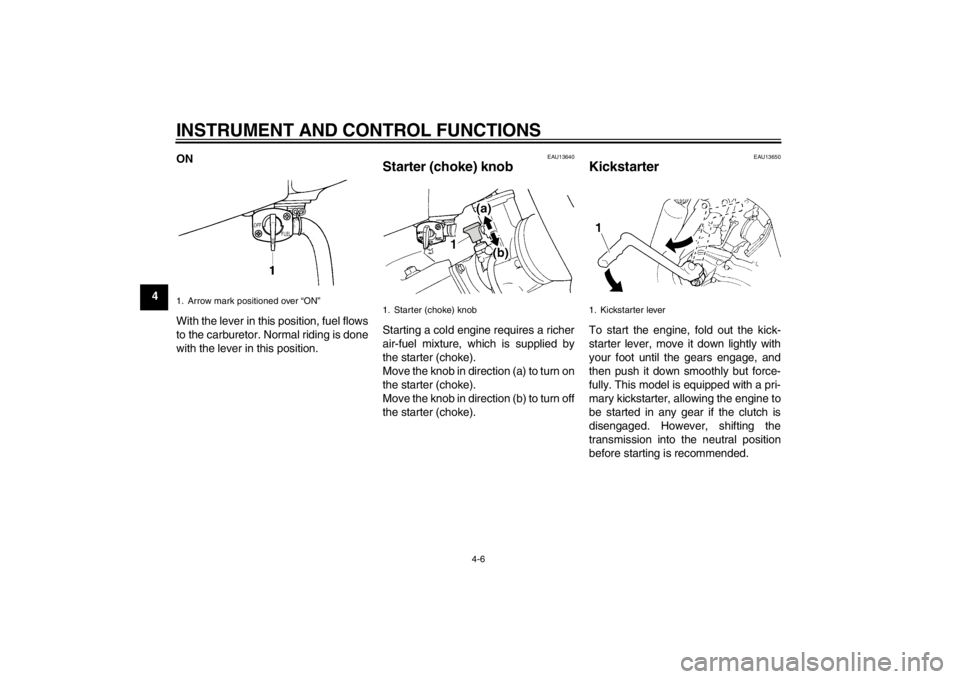
With the lever in this position, fuel flows
to the carburetor. Normal riding is done
with the lever in this position.
EAU13640
Starter (choke) knob Starting a cold engine requires a richer
air-fuel mixture, which is supplied by
the starter (choke).
Move the knob in direction (a) to turn on
the starter (choke).
Move the knob in direction (b) to turn off
the starter (choke).
EAU13650
Kickstarter To start the engine, fold out the kick-
starter lever, move it down lightly with
your foot until the gears engage, and
then push it down smoothly but force-
fully. This model is equipped with a pri-
mary kickstarter, allowing the engine to
be started in any gear if the clutch is
disengaged. However, shifting the
transmission into the neutral position
before starting is recommended.
1. Arrow mark positioned over “ON”
1. Starter (choke) knob
1. Kickstarter lever
U1SN81E0.book Page 6 Tuesday, June 12, 2012 3:17 PM
Page 40 of 88

FOR YOUR SAFETY – PRE-OPERATION CHECKS
5-2
5
Rear brake Check operation.
If soft or spongy, have Yamaha dealer bleed hydraulic system.
Check brake pads for wear.
Replace if necessary.
Check fluid level in reservoir.
If necessary, add specified brake fluid to specified level.
Check hydraulic system for leakage. 7-20, 7-20
Clutch Check operation.
Lubricate cable if necessary.
Check lever free play.
Adjust if necessary.
7-18
Throttle grip Make sure that operation is smooth.
Check throttle grip free play.
If necessary, have Yamaha dealer adjust throttle grip free play and lubricate cable
and grip housing. 7-15, 7-24
Drive chain Check chain slack.
Adjust if necessary.
Check chain condition.
Lubricate if necessary. 7-22, 7-23
Wheels and tires Check for damage.
Check tire condition and tread depth.
Check air pressure.
Correct if necessary.
Check for loose spokes and tighten if necessary. 7-15, 7-17
Shift pedal Make sure that operation is smooth.
Correct if necessary.
7-19
Brake pedal Make sure that operation is smooth.
Lubricate pedal pivoting point if necessary. 7-25
Brake and clutch levers Make sure that operation is smooth.
Lubricate lever pivoting points if necessary.
7-24
Steering Check that the handlebar can be turned smoothly and has no excessive play. 7-27
ITEM CHECKS PAGE
U1SN81E0.book Page 2 Tuesday, June 12, 2012 3:17 PM
Page 43 of 88
OPERATION AND IMPORTANT RIDING POINTS
6-2
6
EAU16671
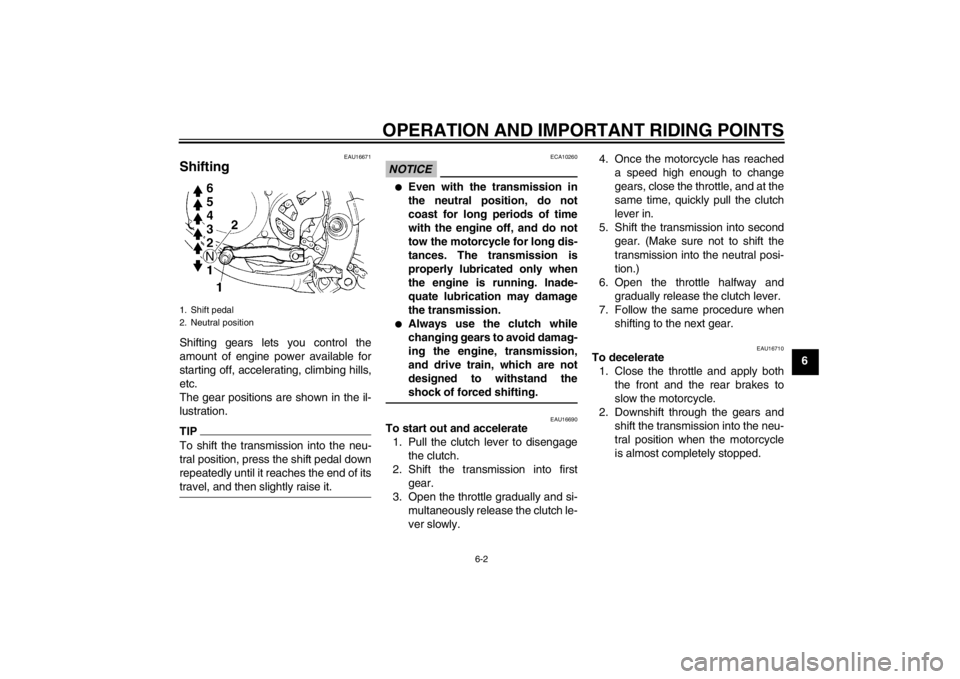
Shifting Shifting gears lets you control the
amount of engine power available for
starting off, accelerating, climbing hills,
etc.
The gear positions are shown in the il-
lustration.TIPTo shift the transmission into the neu-
tral position, press the shift pedal down
repeatedly until it reaches the end of its
travel, and then slightly raise it.
NOTICE
ECA10260
●
Even with the transmission in
the neutral position, do not
coast for long periods of time
with the engine off, and do not
tow the motorcycle for long dis-
tances. The transmission is
properly lubricated only when
the engine is running. Inade-
quate lubrication may damage
the transmission.
●
Always use the clutch while
changing gears to avoid damag-
ing the engine, transmission,
and drive train, which are not
designed to withstand the
shock of forced shifting.
EAU16690
To start out and accelerate1. Pull the clutch lever to disengage the clutch.
2. Shift the transmission into first gear.
3. Open the throttle gradually and si- multaneously release the clutch le-
ver slowly. 4. Once the motorcycle has reached
a speed high enough to change
gears, close the throttle, and at the
same time, quickly pull the clutch
lever in.
5. Shift the transmission into second gear. (Make sure not to shift the
transmission into the neutral posi-
tion.)
6. Open the throttle halfway and gradually release the clutch lever.
7. Follow the same procedure when shifting to the next gear.
EAU16710
To decelerate1. Close the throttle and apply both the front and the rear brakes to
slow the motorcycle.
2. Downshift through the gears and shift the transmission into the neu-
tral position when the motorcycle
is almost completely stopped.
1. Shift pedal
2. Neutral position
U1SN81E0.book Page 2 Tuesday, June 12, 2012 3:17 PM
Page 48 of 88
PERIODIC MAINTENANCE AND ADJUSTMENT
7-3
7
√
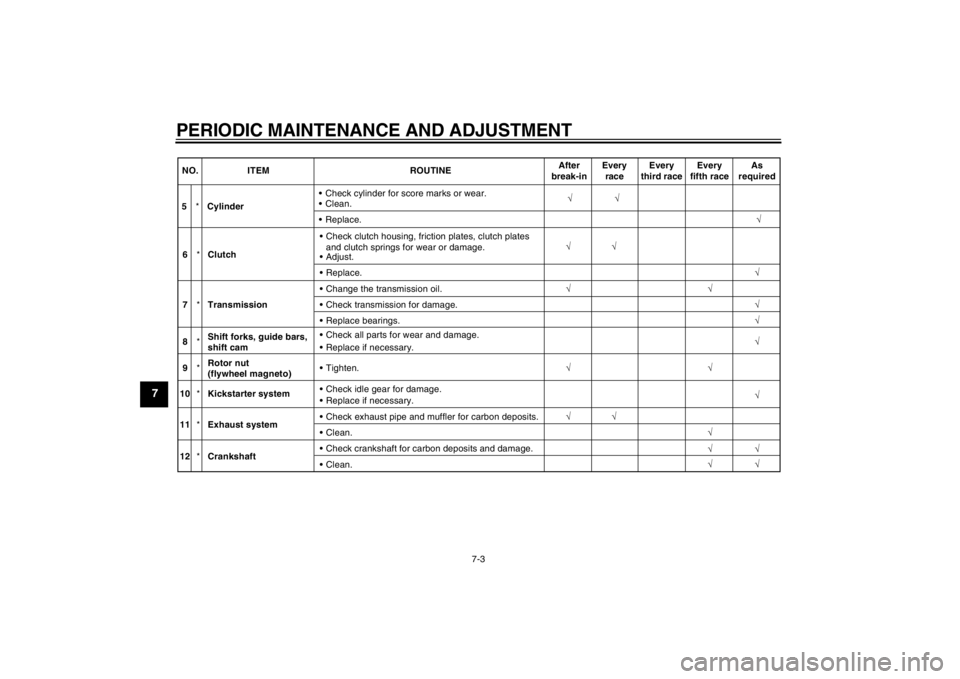
5 *Cylinder Check cylinder for score marks or wear.
Clean.
√
Replace. √
NO. ITEM ROUTINE
After
break-in Every
race Every
third race Every
fifth race As
required
6 *Clutch Check clutch housing, friction plates, clutch plates
and clutch springs for wear or damage.
Adjust. √
√
Replace. √
7 *Transmission Change the transmission oil.
√
Check transmission for damage. √
Replace bearings. √
8 *Shift forks, guide bars,
shift cam
Replace if necessary. Check all parts for wear and damage.
√
9 *Rotor nut
(flywheel
magneto) Tighten.
√√√
10 *Kickstarter system Check idle gear for damage.
√
Replace if necessary.
11 *Exhaust system Check exhaust pipe and muffler for carbon deposits.
√
√
Clean. √
√
√
√
√
12
*Crankshaft Check crankshaft for carbon deposits and damage.
Clean.
U1SN81E0.book Page 3 Tuesday, June 12, 2012 3:17 PM
Page 55 of 88
PERIODIC MAINTENANCE AND ADJUSTMENT
7-10
7
NOTICE
ECA10452
●
In order to prevent clutch slip-
page (since the transmission oil
also lubricates the clutch), do
not mix any chemical additives.
Do not use oils with a diesel
specification of “CD” or oils of a
higher quality than specified. In
addition, do not use oils labeled
“ENERGY CONSERVING II” or
higher.
●
Make sure that no foreign mate-
rial enters the transmission.
7. Start the engine, and then let it idlefor several minutes while checking
it for oil leakage. If oil is leaking, im-
mediately turn the engine off and
check for the cause.
EAU20070
Coolant The coolant level should be checked
before each ride. In addition, the cool-
ant must be changed at the intervals
specified in the periodic maintenance
and lubrication chart.
EAUM1295
To check the coolant level1. Place the vehicle on a level sur- face and hold it in an upright posi-
tion.TIP●
The coolant level must be checked
on a cold engine since the level
varies with engine temperature.
●
Make sure that the vehicle is posi-
tioned straight up when checking
the coolant level. A slight tilt to the
side can result in a false reading.
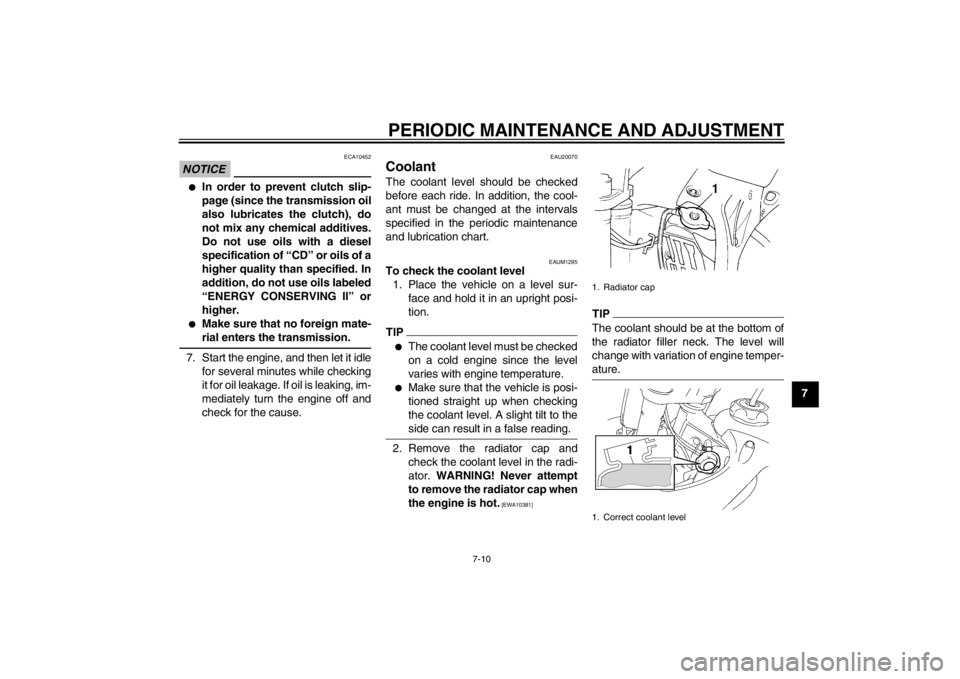
2. Remove the radiator cap andcheck the coolant level in the radi-
ator. WARNING! Never attempt
to remove the radiator cap when
the engine is hot.
[EWA10381]
TIPThe coolant should be at the bottom of
the radiator filler neck. The level will
change with variation of engine temper-
ature.1. Radiator cap
1. Correct coolant level
U1SN81E0.book Page 10 Tuesday, June 12, 2012 3:17 PM
Page 63 of 88
PERIODIC MAINTENANCE AND ADJUSTMENT
7-18
7
EAU48373
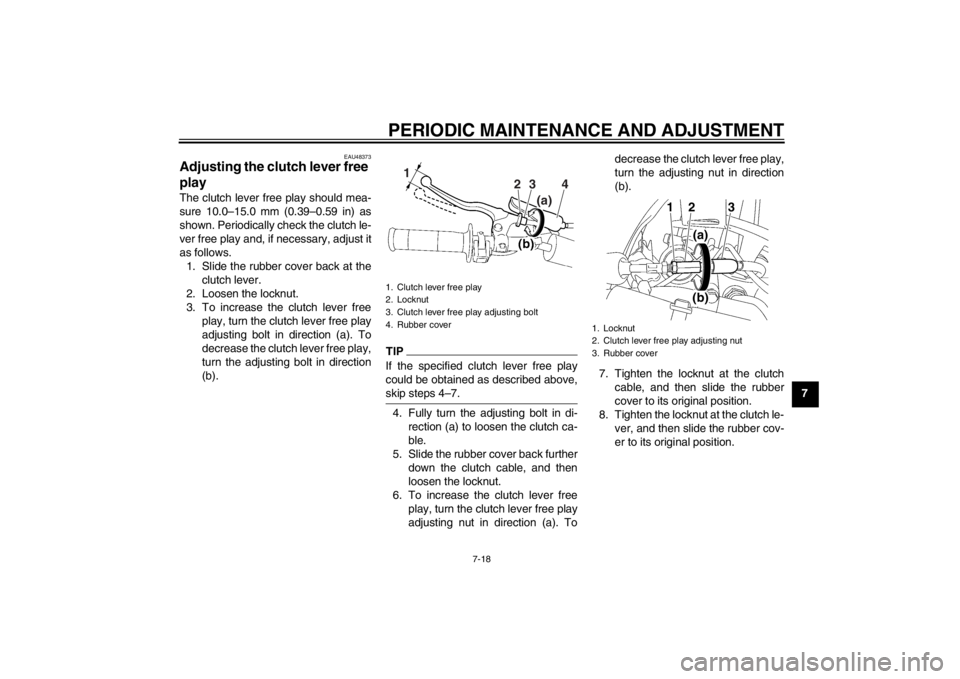
Adjusting the clutch lever free
play The clutch lever free play should mea-
sure 10.0–15.0 mm (0.39–0.59 in) as
shown. Periodically check the clutch le-
ver free play and, if necessary, adjust it
as follows.1. Slide the rubber cover back at the clutch lever.
2. Loosen the locknut.
3. To increase the clutch lever free play, turn the clutch lever free play
adjusting bolt in direction (a). To
decrease the clutch lever free play,
turn the adjusting bolt in direction
(b).
TIPIf the specified clutch lever free play
could be obtained as described above,
skip steps 4–7.4. Fully turn the adjusting bolt in di-rection (a) to loosen the clutch ca-
ble.
5. Slide the rubber cover back further down the clutch cable, and then
loosen the locknut.
6. To increase the clutch lever free play, turn the clutch lever free play
adjusting nut in direction (a). To decrease the clutch lever free play,
turn the adjusting nut in direction
(b).
7. Tighten the locknut at the clutch cable, and then slide the rubber
cover to its original position.
8. Tighten the locknut at the clutch le- ver, and then slide the rubber cov-
er to its original position.1. Clutch lever free play
2. Locknut
3. Clutch lever free play adjusting bolt
4. Rubber cover
1
(a)
23
4
1. Locknut
2. Clutch lever free play adjusting nut
3. Rubber cover
1
2
3
(a)(b)
U1SN81E0.book Page 18 Tuesday, June 12, 2012 3:17 PM
Page 69 of 88
PERIODIC MAINTENANCE AND ADJUSTMENT
7-24
7
EAU50800
Checking and lubricating the
cables The operation of all control cables and
the condition of the cables should be
checked before each ride, and the ca-
bles and cable ends should be lubricat-
ed if necessary. If a cable is damaged
or does not move smoothly, have a
Yamaha dealer check or replace it.
WARNING! Damage to the outer housing of cables may result in in-
ternal rusting and cause interfer-
ence with cable movement. Replace
damaged cables as soon as possi-
ble to prevent unsafe conditions.[EWA10711] EAU23114
Checking and lubricating the
throttle grip and cable The operation of the throttle grip should
be checked before each ride. In addi-
tion, the cable should be lubricated by a
Yamaha dealer at the intervals speci-
fied in the periodic maintenance chart.
The throttle cable is equipped with a
rubber cover. Make sure that the cover
is securely installed. Even though the
cover is installed correctly, it does not
completely protect the cable from water
entry. Therefore, use care not to pour
water directly onto the cover or cable
when washing the vehicle. If the cable
or cover becomes dirty, wipe clean with
a moist cloth.
EAU23143
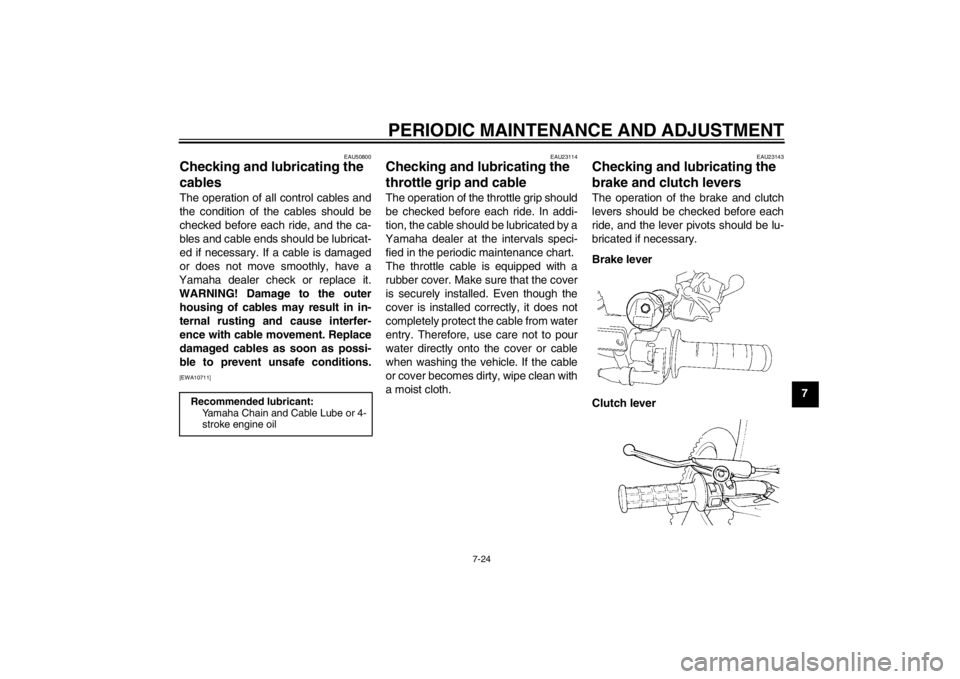
Checking and lubricating the
brake and clutch levers The operation of the brake and clutch
levers should be checked before each
ride, and the lever pivots should be lu-
bricated if necessary.
Brake lever
Clutch lever
Recommended lubricant:
Yamaha Chain and Cable Lube or 4-
stroke engine oil
U1SN81E0.book Page 24 Tuesday, June 12, 2012 3:17 PM