light YAMAHA YZF-R1 2012 Owner's Manual
[x] Cancel search | Manufacturer: YAMAHA, Model Year: 2012, Model line: YZF-R1, Model: YAMAHA YZF-R1 2012Pages: 112, PDF Size: 2.78 MB
Page 35 of 112
INSTRUMENT AND CONTROL FUNCTIONS
3-20
3
NOTICE
ECA10061
Do not use the hazard lights for an
extended length of time with the en-
gine not running, otherwise the bat-
tery may discharge.
EAU47494
Drive mode switch “MODE”
WARNING
EWA15340
Do not change the D-mode while the
vehicle is moving.Using this switch changes the drive
mode to “STD”, “A”, or “B” in the follow-
ing order:
STD → A → B → STD
The throttle grip must be completely
closed in order to change the drive
mode. (See page 3-1 for an explana-
tion of each drive mode.)TIP●
The mode is set to “STD” by de-
fault. The “STD” mode resets
when the key is turned to “OFF”.
●
The selected mode is shown on
the drive mode display. (See page
3-14.)
EAU12820
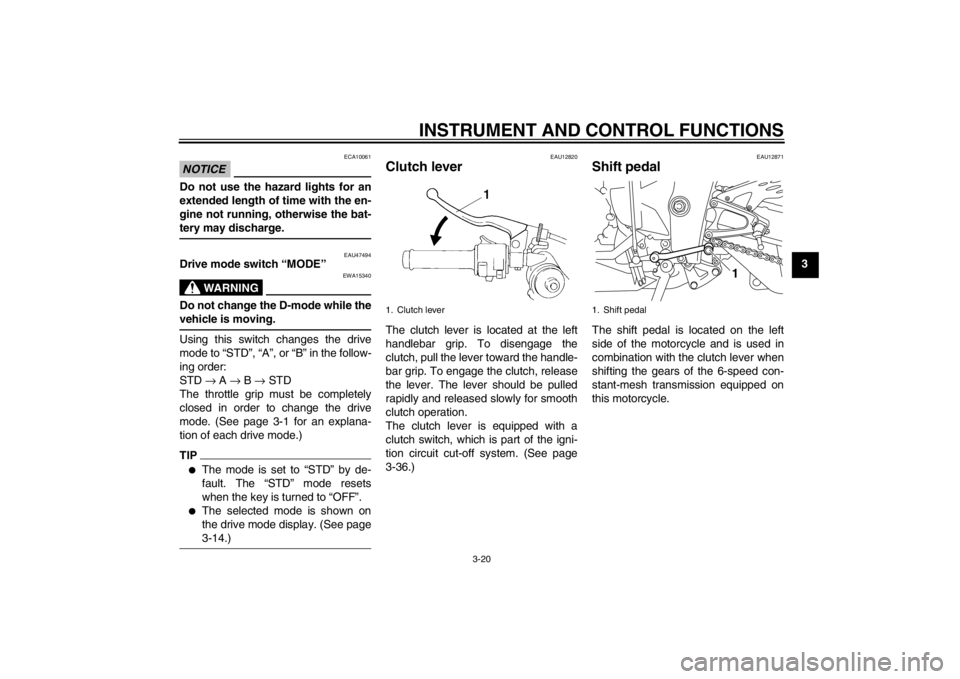
Clutch lever The clutch lever is located at the left
handlebar grip. To disengage the
clutch, pull the lever toward the handle-
bar grip. To engage the clutch, release
the lever. The lever should be pulled
rapidly and released slowly for smooth
clutch operation.
The clutch lever is equipped with a
clutch switch, which is part of the igni-
tion circuit cut-off system. (See page
3-36.)
EAU12871
Shift pedal The shift pedal is located on the left
side of the motorcycle and is used in
combination with the clutch lever when
shifting the gears of the 6-speed con-
stant-mesh transmission equipped on
this motorcycle.
1. Clutch lever
1. Shift pedal
1
U1KBE0E0.book Page 20 Monday, July 25, 2011 5:03 PM
Page 37 of 112
INSTRUMENT AND CONTROL FUNCTIONS
3-22
3
EAU51861
Traction control system The traction control system helps main-
tain traction when accelerating. If sen-
sors detect that the rear wheel is
starting to slip (uncontrolled spinning),
the traction control system assists by
regulating engine power as needed un-
til traction is restored. The traction con-
trol system indicator/warning light
flashes to let the rider know that traction
control has engaged.
WARNING
EWA15431
The traction control system is not a
substitute for riding appropriately
for the conditions. Traction control
cannot prevent loss of traction due
to excessive speed when entering
turns, when accelerating hard at a
sharp lean angle, or while braking,
and cannot prevent front wheel slip-
ping. As with any motorcycle, ap-
proach surfaces that may be
slippery with caution and avoid es-
pecially slippery surfaces.
TIP●
The traction control may engage
when the vehicle travels over a
bump.
●
The rider may notice slight chang-
es in engine and exhaust sounds
when the traction control system is
engaged.
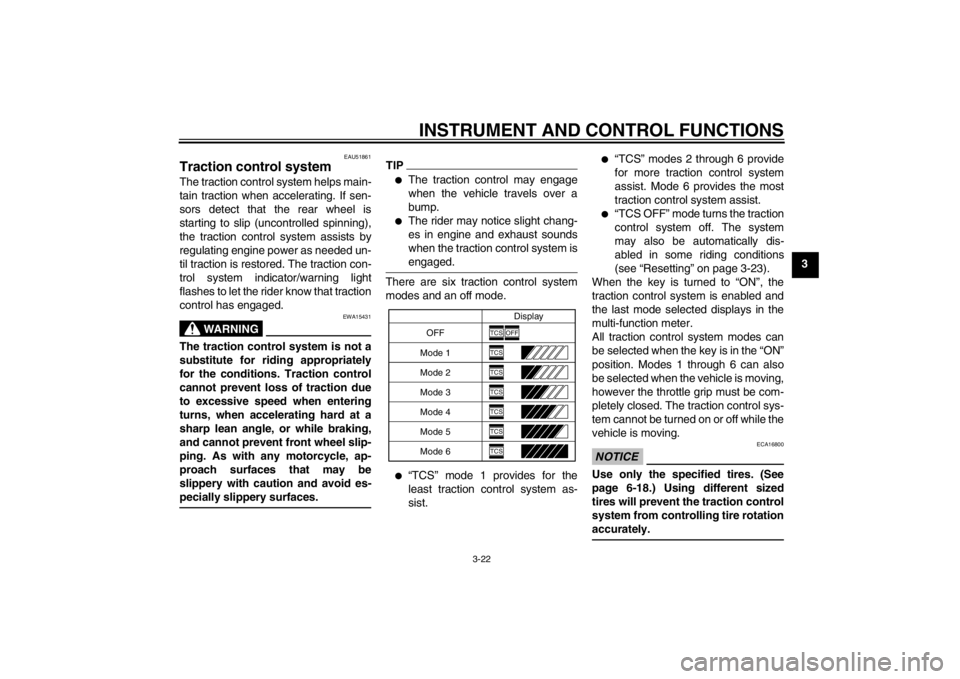
There are six traction control system
modes and an off mode.●
“TCS” mode 1 provides for the
least traction control system as-
sist.
●
“TCS” modes 2 through 6 provide
for more traction control system
assist. Mode 6 provides the most
traction control system assist.
●
“TCS OFF” mode turns the traction
control system off. The system
may also be automatically dis-
abled in some riding conditions
(see “Resetting” on page 3-23).
When the key is turned to “ON”, the
traction control system is enabled and
the last mode selected displays in the
multi-function meter.
All traction control system modes can
be selected when the key is in the “ON”
position. Modes 1 through 6 can also
be selected when the vehicle is moving,
however the throttle grip must be com-
pletely closed. The traction control sys-
tem cannot be turned on or off while the
vehicle is moving.
NOTICE
ECA16800
Use only the specified tires. (See
page 6-18.) Using different sized
tires will prevent the traction control
system from controlling tire rotation
accurately.
OFF Display
Mode 1
Mode 2
Mode 3
Mode 4
Mode 5
Mode 6
TCS
OFF
TCSTCSTCSTCSTCSTCS
U1KBE0E0.book Page 22 Monday, July 25, 2011 5:03 PM
Page 38 of 112
INSTRUMENT AND CONTROL FUNCTIONS
3-23
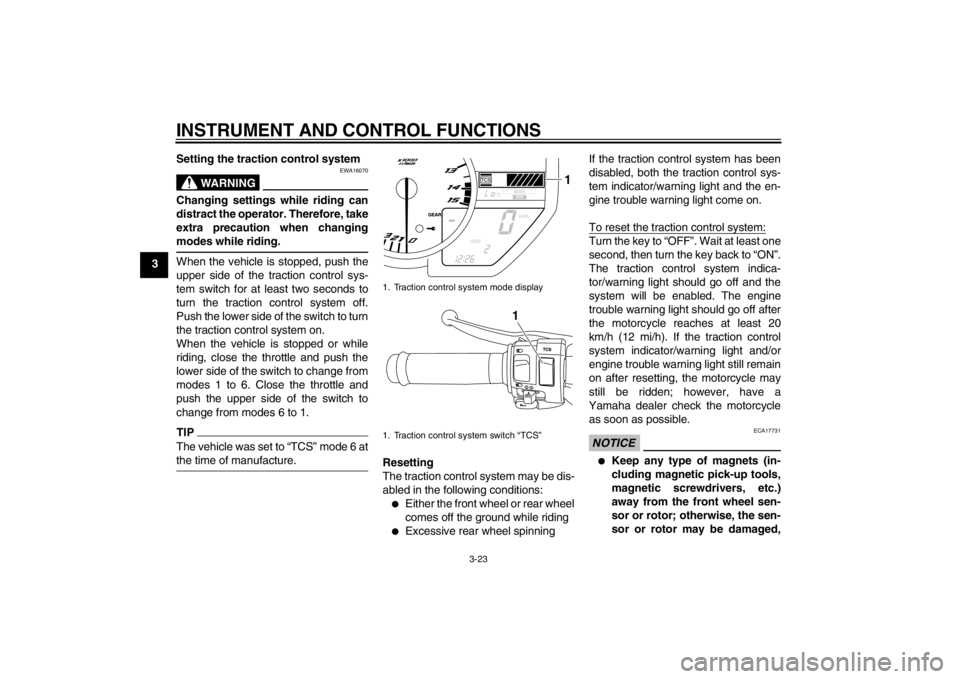
3Setting the traction control system
WARNING
EWA16070
Changing settings while riding can
distract the operator. Therefore, take
extra precaution when changing
modes while riding.When the vehicle is stopped, push the
upper side of the traction control sys-
tem switch for at least two seconds to
turn the traction control system off.
Push the lower side of the switch to turn
the traction control system on.
When the vehicle is stopped or while
riding, close the throttle and push the
lower side of the switch to change from
modes 1 to 6. Close the throttle and
push the upper side of the switch to
change from modes 6 to 1.TIPThe vehicle was set to “TCS” mode 6 at
the time of manufacture.
Resetting
The traction control system may be dis-
abled in the following conditions:●
Either the front wheel or rear wheel
comes off the ground while riding
●
Excessive rear wheel spinning If the traction control system has been
disabled, both the traction control sys-
tem indicator/warning light and the en-
gine trouble warning light come on.
To reset the traction control system:
Turn the key to “OFF”. Wait at least one
second, then turn the key back to “ON”.
The traction control system indica-
tor/warning light should go off and the
system will be enabled. The engine
trouble warning light should go off after
the motorcycle reaches at least 20
km/h (12 mi/h). If the traction control
system indicator/warning light and/or
engine trouble warning light still remain
on after resetting, the motorcycle may
still be ridden; however, have a
Yamaha dealer check the motorcycle as soon as possible.NOTICE
ECA17731
●
Keep any type of magnets (in-
cluding magnetic pick-up tools,
magnetic screwdrivers, etc.)
away from the front wheel sen-
sor or rotor; otherwise, the sen-
sor or rotor may be damaged,
1. Traction control system mode display
1. Traction control system switch “TCS”
1
1
U1KBE0E0.book Page 23 Monday, July 25, 2011 5:03 PM
Page 40 of 112
INSTRUMENT AND CONTROL FUNCTIONS
3-25
3
EAU13221
Fuel Make sure there is sufficient gasoline in
the tank.
WARNING
EWA10881
Gasoline and gasoline vapors are
extremely flammable. To avoid fires
and explosions and to reduce the
risk of injury when refueling, follow
these instructions.1. Before refueling, turn off the en-gine and be sure that no one is sit-
ting on the vehicle. Never refuel
while smoking, or while in the vi-
cinity of sparks, open flames, or
other sources of ignition such as
the pilot lights of water heaters and
clothes dryers.
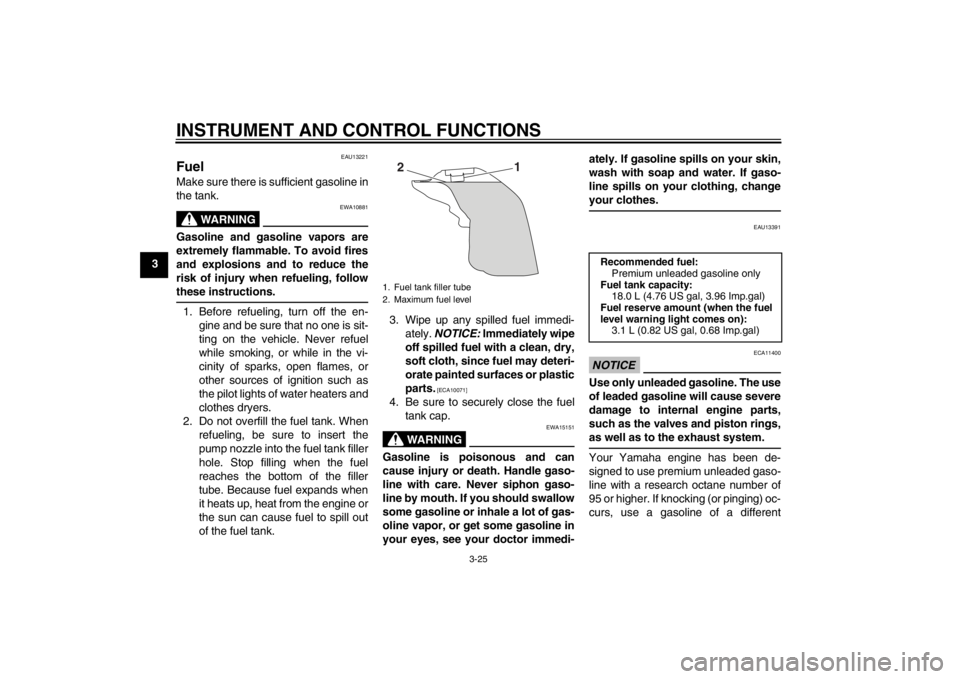
2. Do not overfill the fuel tank. When refueling, be sure to insert the
pump nozzle into the fuel tank filler
hole. Stop filling when the fuel
reaches the bottom of the filler
tube. Because fuel expands when
it heats up, heat from the engine or
the sun can cause fuel to spill out
of the fuel tank. 3. Wipe up any spilled fuel immedi-
ately. NOTICE: Immediately wipe
off spilled fuel with a clean, dry,
soft cloth, since fuel may deteri-
orate painted surfaces or plastic
parts.
[ECA10071]
4. Be sure to securely close the fuel tank cap.
WARNING
EWA15151
Gasoline is poisonous and can
cause injury or death. Handle gaso-
line with care. Never siphon gaso-
line by mouth. If you should swallow
some gasoline or inhale a lot of gas-
oline vapor, or get some gasoline in
your eyes, see your doctor immedi- ately. If gasoline spills on your skin,
wash with soap and water. If gaso-
line spills on your clothing, change
your clothes.
EAU13391
NOTICE
ECA11400
Use only unleaded gasoline. The use
of leaded gasoline will cause severe
damage to internal engine parts,
such as the valves and piston rings,
as well as to the exhaust system.Your Yamaha engine has been de-
signed to use premium unleaded gaso-
line with a research octane number of
95 or higher. If knocking (or pinging) oc-
curs, use a gasoline of a different
1. Fuel tank filler tube
2. Maximum fuel level
2
1
Recommended fuel:
Premium unleaded gasoline only
Fuel tank capacity: 18.0 L (4.76 US gal, 3.96 Imp.gal)
Fuel reserve amount (when the fuel
level warning light comes on): 3.1 L (0.82 US gal, 0.68 Imp.gal)
U1KBE0E0.book Page 25 Monday, July 25, 2011 5:03 PM
Page 55 of 112

FOR YOUR SAFETY – PRE-OPERATION CHECKS
4-3
4
Chassis fasteners Make sure that all nuts, bolts and screws are properly tightened.
Tighten if necessary. —
Instruments, lights, signals
and switches Check operation.
Correct if necessary.
—
Sidestand switch Check operation of ignition circuit cut-off system.
If system is not working correctly, have Yamaha dealer check vehicle. 3-35
ITEM CHECKS PAGE
U1KBE0E0.book Page 3 Monday, July 25, 2011 5:03 PM
Page 56 of 112

OPERATION AND IMPORTANT RIDING POINTS
5-1
5
EAU15951
Read the Owner’s Manual carefully to
become familiar with all controls. If
there is a control or function you do not
understand, ask your Yamaha dealer.
WARNING
EWA10271
Failure to familiarize yourself with
the controls can lead to loss of con-
trol, which could cause an accident
or injury.
EAU48710
TIPThis model is equipped with:●
a lean angle sensor to stop the en-
gine in case of a turnover. In this
case, the multi-function display in-
dicates error code 30, but this is
not a malfunction. Turn the key to
“OFF” and then to “ON” to clear the
error code. Failing to do so will pre-
vent the engine from starting even
though the engine will crank when
pushing the start switch.
●
an engine auto-stop system. The
engine stops automatically if left
idling for 20 minutes. If the engine
stops, simply push the start switch
to restart the engine.
EAU51880
Starting the engine In order for the ignition circuit cut-off
system to enable starting, one of the
following conditions must be met:●
The transmission is in the neutral
position.
●
The transmission is in gear with
the clutch lever pulled and the
sidestand up.
See page 3-36 for more informa-
tion.
1. Turn the key to “ON” and make sure that the engine stop switch is
set to “ ”.
The following warning lights and
indicator lights should come on for
a few seconds, then go off.●
Oil level warning light
●
Fuel level warning light
●
Coolant temperature warning
light
●
Shift timing indicator light
●
Engine trouble warning light
●
Traction control system indi-
cator/warning light
●
Immobilizer system indicator
light
U1KBE0E0.book Page 1 Monday, July 25, 2011 5:03 PM
Page 57 of 112
OPERATION AND IMPORTANT RIDING POINTS
5-2
5
NOTICE
ECA11833
If a warning or indicator light does
not come on initially when the key is
turned to “ON”, or if a warning or in-
dicator light remains on, see page
3-4 for the corresponding warning
and indicator light circuit check.2. Shift the transmission into the neu-tral position. The neutral indicator
light should come on. If not, ask a
Yamaha dealer to check the elec- trical circuit.
3. Start the engine by pushing the start switch.
If the engine fails to start, release
the start switch, wait a few sec-
onds, and then try again. Each
starting attempt should be as short
as possible to preserve the bat-
tery. Do not crank the engine more
than 10 seconds on any one at-
tempt.NOTICE
ECA11042
For maximum engine life, never ac-
celerate hard when the engine is
cold!
EAU16671
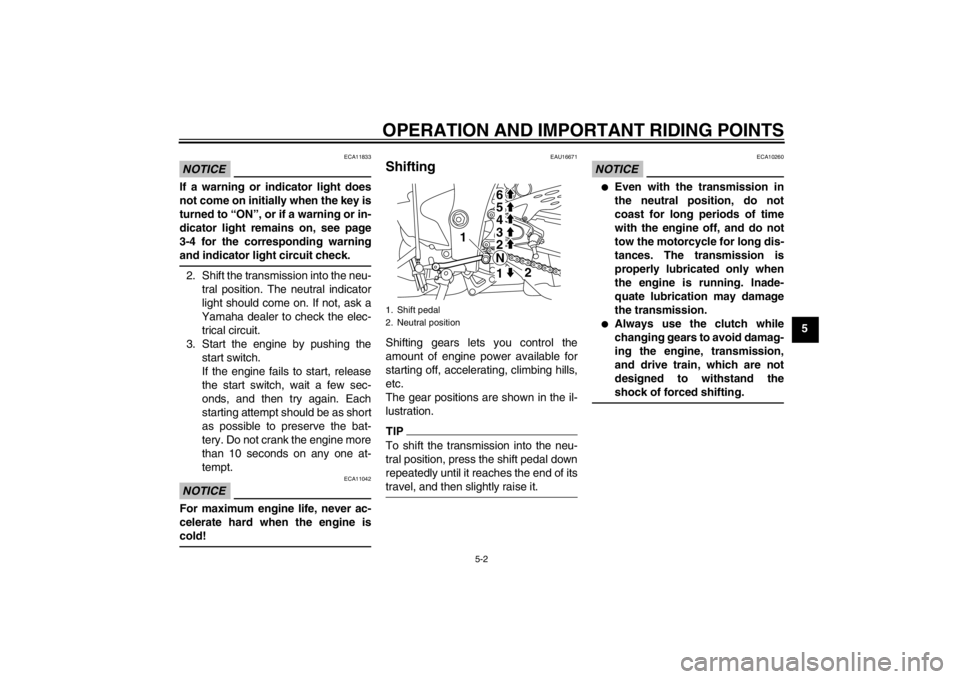
Shifting Shifting gears lets you control the
amount of engine power available for
starting off, accelerating, climbing hills,
etc.
The gear positions are shown in the il-
lustration.TIPTo shift the transmission into the neu-
tral position, press the shift pedal down
repeatedly until it reaches the end of its
travel, and then slightly raise it.
NOTICE
ECA10260
●
Even with the transmission in
the neutral position, do not
coast for long periods of time
with the engine off, and do not
tow the motorcycle for long dis-
tances. The transmission is
properly lubricated only when
the engine is running. Inade-
quate lubrication may damage
the transmission.
●
Always use the clutch while
changing gears to avoid damag-
ing the engine, transmission,
and drive train, which are not
designed to withstand the
shock of forced shifting.
1. Shift pedal
2. Neutral position
1
1
2
2
3 4
5 6
N
U1KBE0E0.book Page 2 Monday, July 25, 2011 5:03 PM
Page 58 of 112
OPERATION AND IMPORTANT RIDING POINTS
5-3
5
EAU16810
Tips for reducing fuel con-
sumption Fuel consumption depends largely on
your riding style. Consider the following
tips to reduce fuel consumption:●
Shift up swiftly, and avoid high en-
gine speeds during acceleration.
●
Do not rev the engine while shifting
down, and avoid high engine
speeds with no load on the engine.
●
Turn the engine off instead of let-
ting it idle for an extended length of
time (e.g., in traffic jams, at traffic
lights or at railroad crossings).
EAU16841
Engine break-in There is never a more important period
in the life of your engine than the period
between 0 and 1600 km (1000 mi). For
this reason, you should read the follow-
ing material carefully.
Since the engine is brand new, do not
put an excessive load on it for the first
1600 km (1000 mi). The various parts in
the engine wear and polish themselves
to the correct operating clearances.
During this period, prolonged full-throt-
tle operation or any condition that might
result in engine overheating must be
avoided.
EAU17083
0–1000 km (0–600 mi)
Avoid prolonged operation above 6900
r/min. NOTICE: After 1000 km (600
mi) of operation, the engine oil must
be changed and the oil filter car-
tridge or element replaced.
[ECA10302]
1000–1600 km (600–1000 mi)
Avoid prolonged operation above 8300
r/min. 1600 km (1000 mi) and beyond
The vehicle can now be operated nor-
mally.
NOTICE
ECA10310
●
Keep the engine speed out of
the tachometer red zone.
●
If any engine trouble should oc-
cur during the engine break-in
period, immediately have a
Yamaha dealer check the vehi-
cle.
TIPDuring and after the engine break-in
period, the exhaust heat may cause
discoloration of the exhaust pipe, but
this is normal.
U1KBE0E0.book Page 3 Monday, July 25, 2011 5:03 PM
Page 66 of 112

PERIODIC MAINTENANCE AND ADJUSTMENT
6-7
6
EAU18680
TIP●
Air filter This model’s air filter is equipped with a disposable oil-coated paper element, which must not be cleaned with com- pressed air to avoid damaging it.
The air filter element needs to be replaced more frequently when riding in unusually wet or dusty areas.
●
Hydraulic brake service Regularly check and, if necessary, correct the brake fluid level.
Every two years replace the internal components of the brake master cylinders and calipers, and change the brake fluid.
Replace the brake hoses every four years and if cracked or damaged.
28 *Throttle grip Check operation.
Check throttle grip free play, and
adjust if necessary.
Lubricate cable and grip housing. √√√√√
29 *Lights, signals and
switches Check operation.
Adjust headlight beam.
√√√√√√
NO. ITEM CHECK OR MAINTENANCE JOB
ODOMETER READING
ANNUAL
CHECK
1000 km
(600 mi) 10000 km
(6000 mi) 20000 km
(12000 mi) 30000 km
(18000 mi) 40000 km
(24000 mi)U1KBE0E0.book Page 7 Monday, July 25, 2011 5:03 PM
Page 67 of 112
PERIODIC MAINTENANCE AND ADJUSTMENT
6-8
6
EAU18781
Removing and installing cowl-
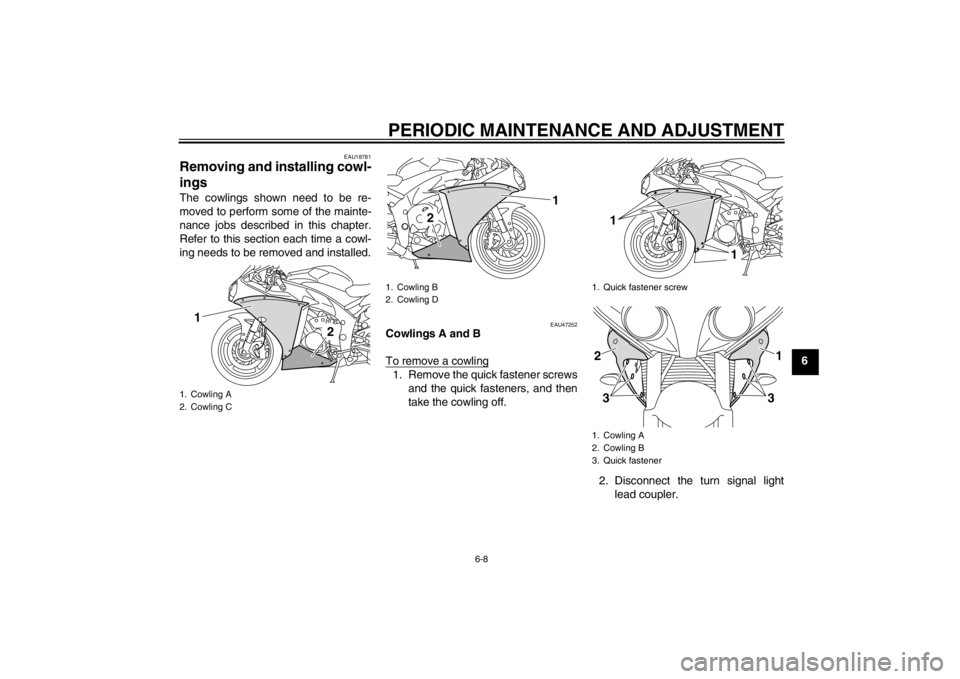
ings The cowlings shown need to be re-
moved to perform some of the mainte-
nance jobs described in this chapter.
Refer to this section each time a cowl-
ing needs to be removed and installed.
EAU47252
Cowlings A and B
To remove a cowling1. Remove the quick fastener screwsand the quick fasteners, and then
take the cowling off.
2. Disconnect the turn signal lightlead coupler.
1. Cowling A
2. Cowling C
1
2
1. Cowling B
2. Cowling D
2
1
1. Quick fastener screw
1. Cowling A
2. Cowling B
3. Quick fastener
1
1
23
1
3
U1KBE0E0.book Page 8 Monday, July 25, 2011 5:03 PM