brake fluid YAMAHA YZF-R1 2018 Owners Manual
[x] Cancel search | Manufacturer: YAMAHA, Model Year: 2018, Model line: YZF-R1, Model: YAMAHA YZF-R1 2018Pages: 130, PDF Size: 10.29 MB
Page 8 of 130

Table of contentsSafety information........................... 1-1
Description ....................................... 2-1
Left view ......................................... 2-1
Right view ....................................... 2-2
Controls and instruments................ 2-3
Special features ............................... 3-1
YRC (Yamaha Ride Control) .......... 3-1
Glossary ......................................... 3-4
YRC functions visual guide............. 3-5
Instrument and co ntrol functions... 4-1
Immobilizer system ..... .................... 4-1
Main switch/steering lock................ 4-2
Handlebar switches ........................ 4-3
Indicator lights and warning lights ............................................ 4-6
Display ............................................ 4-8
MENU screen ............................... 4-14
Clutch lever................................... 4-31
Shift pedal..... ............................ .... 4-31
Brake lever ................................... 4-32
Brake pedal .................................. 4-32
Brake system ..... ....................... .... 4-33
Fuel tank cap ................................ 4-34
Fuel............................................... 4-35
Fuel tank overflow hose................ 4-37
Catalytic converter ........................ 4-37
Seats ............................................ 4-38
CCU (for equipped models) .......... 4-39 Document storage ........................ 4-40
Rear view mirrors ......................... 4-41
Adjusting the front fork ................. 4-41
Adjusting the shock absorber
assembly................................... 4-44
EXUP system ............................... 4-47
Auxiliary DC connector................. 4-48
Sidestand ..................................... 4-48
Ignition circuit cut- off system ........ 4-49
For your safety – pre-operation
checks .............................................. 5-1
Operation and important riding
points ................................................ 6-1
Starting the engine ......................... 6-1
Shifting ........................................... 6-2
Tips for reducing fuel consumption ............................... 6-3
Engine break-in .............................. 6-3
Parking ........................................... 6-4
Periodic maintenance and
adjustment ....................................... 7-1
Tool kit............................................ 7-2
Periodic maintenance charts .......... 7-3
Periodic maintenance chart for the emission control system ............. 7-3
General maintenance and lubrication chart .......................... 7-4 Removing and installing cowlings
and panels .................................. 7-8
Checking the spark plugs ............ 7-11
Canister ....................................... 7-12
Engine oil and oil filt er cartridge... 7-12
Coolant ........................................ 7-15
Air filter element ........................... 7-17
Checking the engine idling speed............ ............................ 7-17
Checking the throttle grip free play ........................................... 7-17
Valve clearance ........................... 7-18
Tires ............................................. 7-18
Cast magnesium wheels.............. 7-20
Adjusting the clutch lever free play ........................................... 7-21
Checking the brake lever free
play ........................................... 7-22
Brake light switches ..................... 7-23
Checking the front and rear
brake pads................................ 7-23
Checking the brake fluid level ...... 7-24
Changing the brake fluid .............. 7-25
Drive chain slack.......................... 7-25
Cleaning and lubricating the
drive chain ................................ 7-26
Checking and lubricating the cables ....................................... 7-27
Checking and lubricating the throttle grip and cable ............... 7-27BX4-9-E1_1.book 1 ページ 2018年4月27日 金曜日 午後4時3分
Page 16 of 130
Description
2-2
12
3
4
5
6
7
8
9
10
11
12
EAU10421
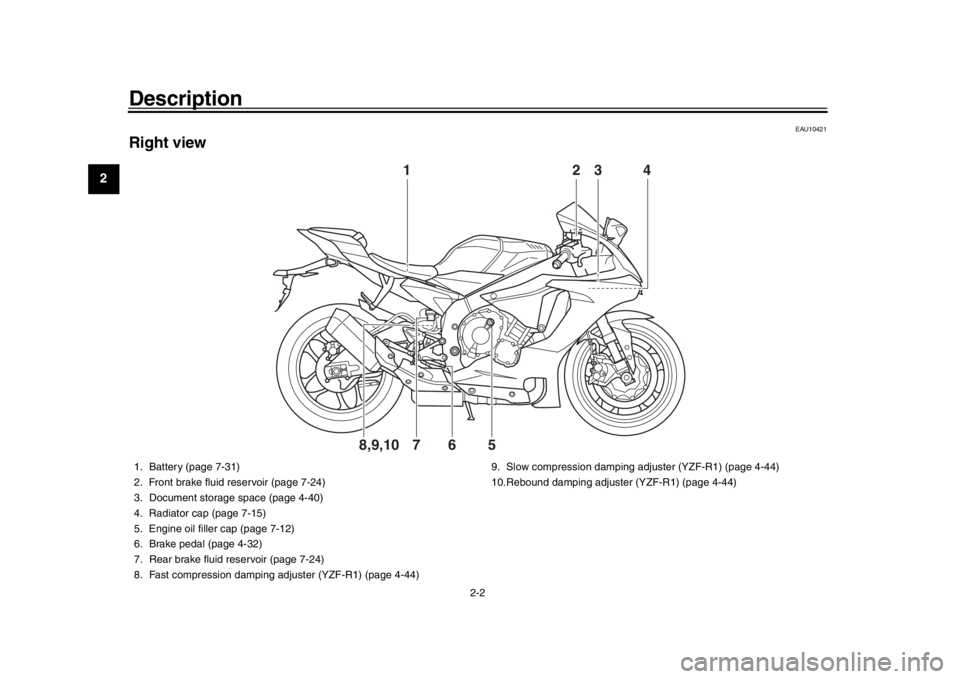
Right view
43
567
2
1
8,9,10
1. Battery (page 7-31)
2. Front brake fluid reservoir (page 7-24)
3. Document storage space (page 4-40)
4. Radiator cap (page 7-15)
5. Engine oil filler cap (page 7-12)
6. Brake pedal (page 4-32)
7. Rear brake fluid reservoir (page 7-24)
8. Fast compression damping adjuster (YZF-R1) (page 4-44) 9. Slow compression damping
adjuster (YZF-R1) (page 4-44)
10.Rebound damping adjuster (YZF-R1) (page 4-44)
BX4-9-E1_1.book 2 ページ 2018年4月27日 金曜日 午後4時3分
Page 17 of 130
Description
2-3
123
4
5
6
7
8
9
10
11
12
EAU10431
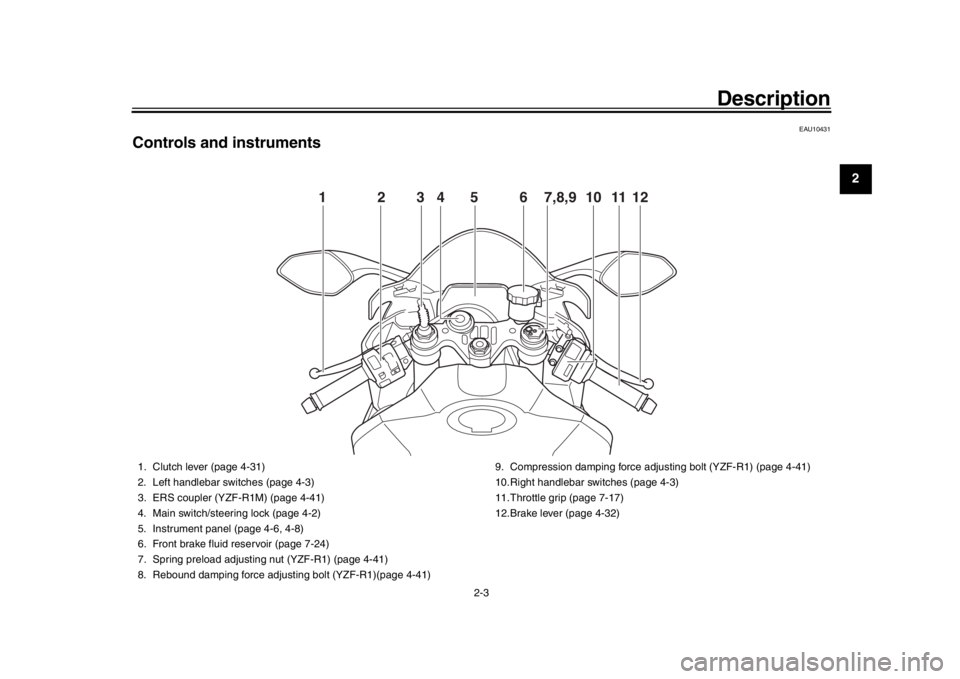
Controls and instruments
12456 101112
3
7,8,9
1. Clutch lever (page 4-31)
2. Left handlebar switches (page 4-3)
3. ERS coupler (YZF-R1M) (page 4-41)
4. Main switch/steering lock (page 4-2)
5. Instrument panel (page 4-6, 4-8)
6. Front brake fluid reservoir (page 7-24)
7. Spring preload adjusting nut (YZF-R1) (page 4-41)
8. Rebound damping force adjusting bolt (YZF-R1)(page 4-41) 9. Compression damping force adjus
ting bolt (YZF-R1) (page 4-41)
10.Right handlebar switches (page 4-3)
11.Throttle grip (page 7-17)
12.Brake lever (page 4-32)
BX4-9-E1_1.book 3 ページ 2018年4月27日 金曜日 午後4時3分
Page 73 of 130

5-1
1
2
3
456
7
8
9
10
11
12
For your safety – pre-operation checks
EAU15599
Inspect your vehicle each time you use it to make sure the vehicle is in safe operating condition. Always follow the inspection
and maintenance procedures and schedules described in the Owner’s Manual.
WARNING
EWA11152
Failure to inspect or maintain the vehicle properly increases the possibility of an accident or equipment damage.
Do not operate the vehicle if you find any problem. If a problem cannot be corrected by the procedures provided inthis manual, have the vehicle inspected by a Yamaha dealer.
Before using this vehicle, check the following points:
ITEM CHECKS PAGE
Fuel Check fuel level in fuel tank.
Refuel if necessary.
Check fuel line for leakage.
Check fuel tank breather hose and overflow hose for obstructions, cracks or
damage, and check hose connections. 4-35, 4-37
Engine oil Check oil level in engine.
If necessary, add recommended oil to specified level.
Check vehicle for oil leakage. 7-12
Coolant Check coolant level in reservoir.
If necessary, add recommended coolant to specified level.
Check cooling system for leakage. 7-15
Front brake Check operation.
If soft or spongy, have Yamaha dealer bleed hydraulic system.
Check brake pads for wear.
Replace if necessary.
Check fluid level in reservoir.
If necessary, add specified brake fluid to specified level.
Check hydraulic system for leakage. 7-23, 7-24
BX4-9-E1_1.book 1 ページ 2018年4月27日 金曜日 午後4時3分
Page 74 of 130
For your safety – pre-operation checks
5-2
1
2
3
45
6
7
8
9
10
11
12
Rear brake Check operation.
If soft or spongy, have Yamaha dealer bleed hydraulic system.
Check brake pads for wear.
Replace if necessary.
Check fluid level in reservoir.
If necessary, add specified brake fluid to specified level.
Check hydraulic system for leakage. 7-23, 7-24
Clutch Check operation.
Lubricate cable if necessary.
Check lever free play.
Adjust if necessary. 7-21
Throttle grip Make sure that operation is smooth.
Check throttle grip free play.
If necessary, have Yamaha dealer adjust throttle grip free play and lubricate cable
and grip housing. 7-17, 7-27
Control cables Make sure that operation is smooth.
Lubricate if necessary. 7-27
Drive chain Check chain slack.
Adjust if necessary.
Check chain condition.
Lubricate if necessary. 7-25, 7-26
Wheels and tires Check for damage.
Check tire condition and tread depth.
Check air pressure.
Correct if necessary. 7-18, 7-20
Brake and shift pedals Make sure that operation is smooth.
Lubricate pedal pivoting points if necessary. 7-28
Brake and clutch levers Make sure that operation is smooth.
Lubricate lever pivoting points if necessary. 7-28
Sidestand Make sure that operation is smooth.
Lubricate pivot if necessary. 7-29
Chassis fasteners Make sure that all nuts, bolts
and screws are properly tightened.
Tighten if necessary. —
ITEM CHECKS PAGE
BX4-9-E1_1.book 2 ページ 2018年4月27日 金曜日 午後4時3分
Page 83 of 130

Periodic maintenance and adjustment
7-4
1
2
3
4
5
678
9
10
11
12
EAU71351
General maintenance an d lubrication chartNO. ITEM CHECK OR MAINTENANCE JOB ODOMETER READING
ANNUAL
CHECK
1000 km
(600 mi) 10000 km
(6000 mi) 20000 km
(12000 mi) 30000 km
(18000 mi) 40000 km
(24000 mi)
1 *Diagnostic system
check Perform dynamic inspection using
Yamaha diagnostic tool.
Check the error codes.
2 *Air filter element Replace. Every 40000 km (24000 mi)
3Clutch Check operation.
Adjust.
4 *Front brake Check operation, fluid level, and
for fluid leakage.
Replace brake pads if necessary.
5 *Rear brake Check operation, fluid level, and
for fluid leakage.
Replace brake pads if necessary.
6 *Brake hoses Check for cracks or damage.
Replace. Every 4 years
7 *Brake fluid Change. Every 2 years
8 *Wheels Check runout and for damage.
Replace if necessary.
9 *Tires Check tread depth and for
damage.
Replace if necessary.
Check air pressure.
Correct if necessary.
10 *Wheel bearings Check bearing for looseness or
damage.
11 *Swingarm pivot
bearings Check operation and for
excessive play.
Lubricate with lithium-soap-based grease. Every 50000 km (30000 mi)
BX4-9-E1_1.book 4 ページ 2018年4月27日 金曜日 午後4時3分
Page 86 of 130

Periodic maintenance and adjustment
7-7
1
2
3
4
5
67
8
9
10
11
12
EAU72811
TIP
Air filter
This model’s air filter uses a disposable oil-coated paper element. This el ement cannot be cleaned with compressed
air, doing so will only damage it.
The air filter element needs to be replaced more fr equently when riding in unusually wet or dusty areas.
Hydraulic brake service
Regularly check the front and rear brake fluid levels. Replenish if necessary.
Every two years replace the rear brake master cylinder, the internal components of the front brake master cylinder, the brake calipers, and change the brake fluid.
Replace the brake hoses every four years or sooner if cracked, damaged, or if any section of the stainless steel brakehose has turned black.
BX4-9-E1_1.book 7 ページ 2018年4月27日 金曜日 午後4時3分
Page 103 of 130

Periodic maintenance and adjustment7-24
1
2
3
4
5
678
9
10
11
12
EAU22583
Checking the br ake fluid levelBefore riding, check that the brake fluid
is above the minimum level mark.
Check the brake fluid level with the res-
ervoir in an upright position. Replenish
the brake fluid if necessary.NOTICE
ECA17641
Brake fluid may damage painted sur-
faces or plastic parts. Always cleanup spilled fluid immediately.
Front brake Rear brake
As the brake pads wear, it is normal for
the brake fluid level to gradually go
down.
A low brake fluid level may indicate
worn brake pads or brake system
leakage; therefore, be sure to
check the brake pads for wear and
the brake system for leakage.
If the brake fluid level goes down
suddenly, have a Yamaha dealer
check the cause before further rid-
ing.WARNING
EWA15991
Improper maintenance can result in
loss of braking ability. Observe
these precautions:
Insufficient brake fluid may al-
low air to enter the brake sys-
tem, reducing braking
performance.
Clean the filler cap before re-
moving. Use only DOT 4 brake
fluid from a sealed container.
Use only the specified brake flu-
id; otherwise, the rubber seals
may deteriorate, causing leak-
age.
Refill with the same type of
brake fluid. Adding a brake fluid
other than DOT 4 may result in a
harmful chemical reaction.
Be careful that water does not
enter the brake fluid reservoir
when refilling. Water will signifi-
cantly lower the boiling point of
the fluid and may result in vaporlock.
Specified brake fluid:
DOT 41. Minimum level mark
1
1. Minimum level mark
1
BX4-9-E1_1.book 24 ページ 2018年4月27日 金曜日 午後4時3分
Page 104 of 130

Periodic maintenance and adjustment
7-25
1
2
3
4
5
67
8
9
10
11
12
EAU22734
Changing the brake fluidHave a Yamaha dealer change the
brake fluid every 2 years. In addition,
have the seals of the master cylinders
and brake calipers, as well as the brake
hoses replaced at the intervals listed
below or sooner if they are damaged or
leaking.
Brake seals: every 2 years
Brake hoses: every 4 years
EAU22762
Drive chain slackThe drive chain slack should be
checked before each ride and adjusted
if necessary.
EAU74251
To check the drive chain slack 1. Place the motorcycle on the sides- tand.TIPWhen checking and adjusting the drive
chain slack, there should be no weighton the motorcycle.
2. Shift the transmission into the neu- tral position.
3. Measure the drive chain slack as shown. 4. If the drive chain slack is incorrect,
adjust it as follows. NOTICE: Im-
proper drive chain slack will
overload the engine as well as
other vital parts of the motorcy-
cle and can lead to chain slip-
page or breakage. To prevent
this from occurring, keep the
drive chain slack within the
specified limits.
[ECA10572]
EAU74260
To adjust the drive chain slack
Consult a Yamaha dealer before ad-
justing the drive chain slack.1. Drive chain slackDrive chain slack:25.0–35.0 mm (0.98–1.38 in)
1
BX4-9-E1_1.book 25 ページ 2018年4月27日 金曜日 午後4時3分
Page 119 of 130
Motorcycle care and storage
8-2
1
2
3
4
5
6
789
10
11
12
water and diluted mild detergent
may be used. Be sure to rinse
off any detergent residue using
plenty of water, as it is harmful
to plastic parts.
Do not use any harsh chemical
products on plastic parts or the
muffler. Be sure to avoid using
cloths or sponges which have
been in contact with strong or
abrasive cleaning products, sol-
vent or thinner, fuel (gasoline),
rust removers or inhibitors,
brake fluid, antifreeze or electro-
lyte.
Do not use high-pressure wash-
ers or steam-jet cleaners since
they cause water seepage and
deterioration in the following ar-
eas: seals (of wheel and swing-
arm bearings, fork and brakes),
storage compartments, electric
components (couplers, connec-
tors, instruments, switches and
lights), breather hoses andvents.
After normal use
Remove dirt with warm water, a mild
detergent, and a soft, clean sponge,
and then rinse thoroughly with clean
water. Use a toothbrush or bottlebrush
for hard-to-reach areas. Stubborn dirt
and insects will come off more easily if
the area is covered with a wet cloth for
a few minutes before cleaning.
After riding in the rain, near the sea oron salt-sprayed roadsSince sea salt or salt sprayed on roads
during winter are extremely corrosive in
combination with water, carry out the
following steps after each ride in the
rain, near the sea or on salt-sprayed
roads.TIPSalt sprayed on roads in the winter mayremain well into spring.
1. Clean the motorcycle with cold wa- ter and a mild detergent, after the
engine has cooled down.
NOTICE: Do not use warm water
since it increases the corrosive
action of the salt.
[ECA10792]
2. After drying the motorcycle, apply a corrosion protection spray on all
metal, including chrome- and nick-
el-plated, surfaces (except the tita-
nium muffler) to prevent corrosion.
Cleaning the windshield
Avoid using any alkaline or strong acid
cleaner, gasoline, brake fluid, or any
other solvent. Clean the windshield with
a cloth or sponge dampened with a
neutral detergent, and after cleaning,
thoroughly wash it off with water. For
additional cleaning, use Yamaha Wind-
shield Cleaner or other quality cleaner.
Some cleaning compounds for plastics
may leave scratches on surfaces of the
windshield. Before using them, make a
test by polishing an area which does
not affect your visibility.
Cleaning the titanium mufflerThis model is equipped with a titanium
muffler, which requires the following
special care.
Use only a soft, clean cloth or
sponge with mild detergent and
water to clean the titanium muffler.
However, if the muffler cannot be
thoroughly cleaned with mild de-
BX4-9-E1_1.book 2 ページ 2018年4月27日 金曜日 午後4時3分