check engine YAMAHA YZF1000 2000 User Guide
[x] Cancel search | Manufacturer: YAMAHA, Model Year: 2000, Model line: YZF1000, Model: YAMAHA YZF1000 2000Pages: 103, PDF Size: 4.73 MB
Page 51 of 103
PERIODIC MAINTENANCE AND MINOR REPAIR
6-3
6
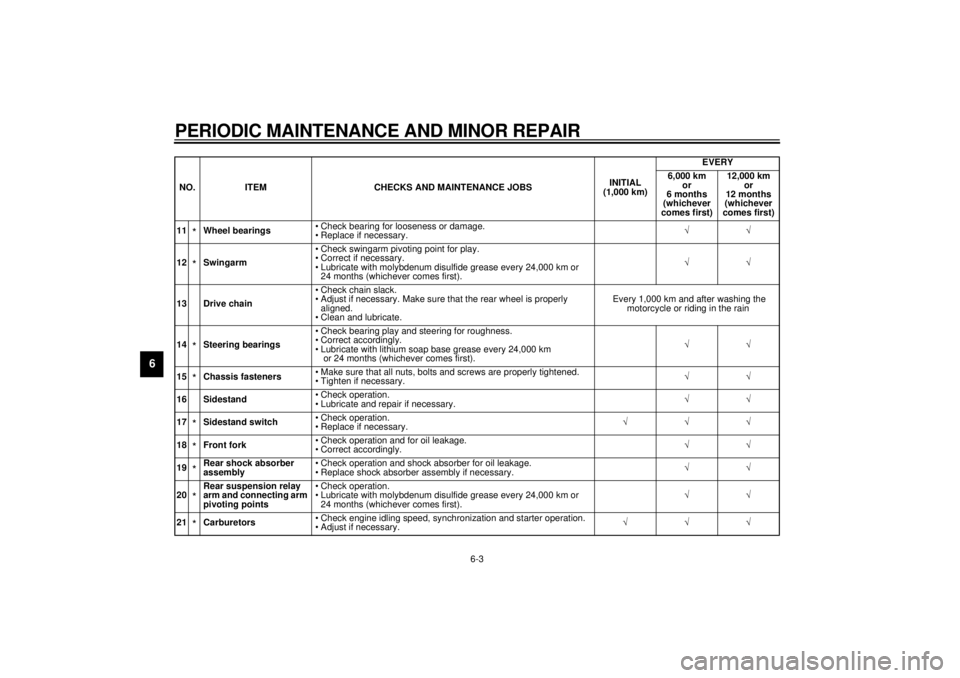
11
*Wheel bearings• Check bearing for looseness or damage.
• Replace if necessary. ÖÖ
12*Swingarm• Check swingarm pivoting point for play.
• Correct if necessary.
• Lubricate with molybdenum disulfide grease every 24,000 km or
24 months (whichever comes first).ÖÖ
13 Drive chain• Check chain slack.
• Adjust if necessary. Make sure that the rear wheel is properly
aligned.
• Clean and lubricate. Every 1,000 km and after washing the
motorcycle or riding in the rain
14*Steering bearings• Check bearing play and steering for roughness.
• Correct accordingly.
• Lubricate with lithium soap base grease every 24,000 km
or 24 months (whichever comes first).ÖÖ
15*Chassis fasteners• Make sure that all nuts, bolts and screws are properly tightened.
• Tighten if necessary.ÖÖ
16 Sidestand• Check operation.
• Lubricate and repair if necessary.ÖÖ
17*Sidestand switch• Check operation.
• Replace if necessary.ÖÖÖ
18*Front fork• Check operation and for oil leakage.
• Correct accordingly.ÖÖ
19*Rear shock absorber
assembly• Check operation and shock absorber for oil leakage.
• Replace shock absorber assembly if necessary. ÖÖ
20*Rear suspension relay
arm and connecting arm
pivoting points• Check operation.
• Lubricate with molybdenum disulfide grease every 24,000 km or
24 months (whichever comes first).ÖÖ
21*Carburetors• Check engine idling speed, synchronization and starter operation.
• Adjust if necessary.ÖÖÖ NO. ITEM CHECKS AND MAINTENANCE JOBSINITIAL
(1,000 km)EVERY
6,000 km
or
6 months
(whichever
comes first)12,000 km
or
12 months
(whichever
comes first)
E_4sv_Periodic.fm Page 3 Tuesday, August 31, 1999 3:45 PM
Page 52 of 103
PERIODIC MAINTENANCE AND MINOR REPAIR
6-4
6
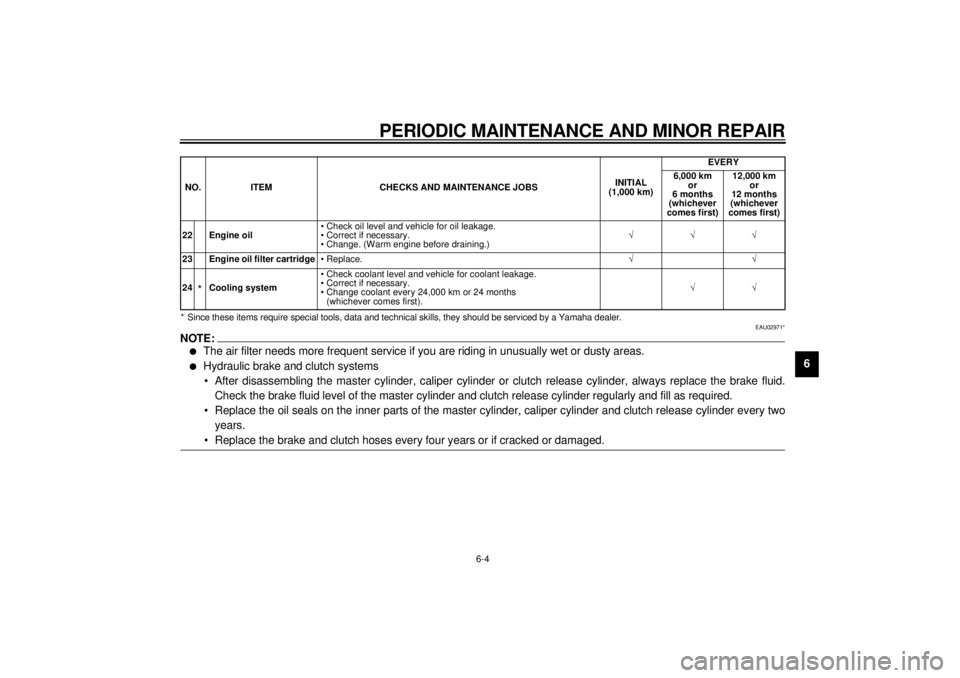
* Since these items require special tools, data and technical skills, they should be serviced by a Yamaha dealer.
EAU02971*
NOTE:@ l
The air filter needs more frequent service if you are riding in unusually wet or dusty areas.
l
Hydraulic brake and clutch systems
• After disassembling the master cylinder, caliper cylinder or clutch release cylinder, always replace the brake fluid.
Check the brake fluid level of the master cylinder and clutch release cylinder regularly and fill as required.
• Replace the oil seals on the inner parts of the master cylinder, caliper cylinder and clutch release cylinder every two
years.
• Replace the brake and clutch hoses every four years or if cracked or damaged.
@22 Engine oil• Check oil level and vehicle for oil leakage.
• Correct if necessary.
• Change. (Warm engine before draining.)ÖÖÖ
23 Engine oil filter cartridge
• Replace.ÖÖ
24
*Cooling system• Check coolant level and vehicle for coolant leakage.
• Correct if necessary.
• Change coolant every 24,000 km or 24 months
(whichever comes first).ÖÖ NO. ITEM CHECKS AND MAINTENANCE JOBSINITIAL
(1,000 km)EVERY
6,000 km
or
6 months
(whichever
comes first)12,000 km
or
12 months
(whichever
comes first)
E_4sv_Periodic.fm Page 4 Tuesday, August 31, 1999 3:45 PM
Page 57 of 103
PERIODIC MAINTENANCE AND MINOR REPAIR
6-9
6
EAU01765*
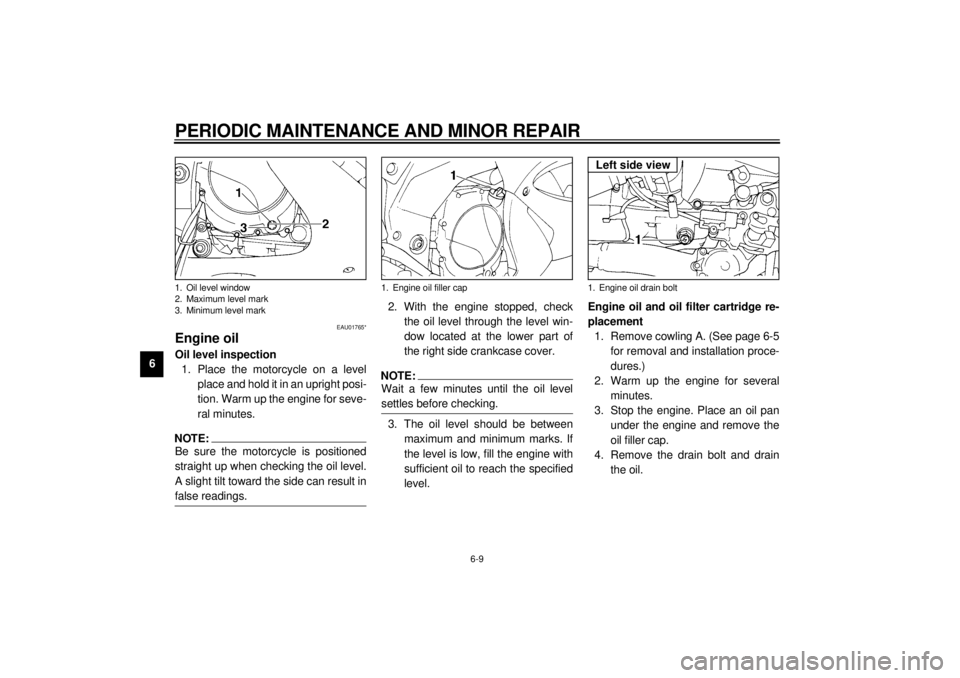
Engine oilOil level inspection
1. Place the motorcycle on a level
place and hold it in an upright posi-
tion. Warm up the engine for seve-
ral minutes.NOTE:@ Be sure the motorcycle is positioned
straight up when checking the oil level.
A slight tilt toward the side can result in
false readings. @
2. With the engine stopped, check
the oil level through the level win-
dow located at the lower part of
the right side crankcase cover.NOTE:@ Wait a few minutes until the oil level
settles before checking. @3. The oil level should be between
maximum and minimum marks. If
the level is low, fill the engine with
sufficient oil to reach the specified
level.Engine oil and oil filter cartridge re-
placement
1. Remove cowling A. (See page 6-5
for removal and installation proce-
dures.)
2. Warm up the engine for several
minutes.
3. Stop the engine. Place an oil pan
under the engine and remove the
oil filler cap.
4. Remove the drain bolt and drain
the oil.
1. Oil level window
2. Maximum level mark
3. Minimum level mark
1. Engine oil filler cap
1. Engine oil drain boltLeft side view
E_4sv_Periodic.fm Page 9 Tuesday, August 31, 1999 3:45 PM
Page 59 of 103
PERIODIC MAINTENANCE AND MINOR REPAIR
6-11
6
EC000066
CAUTION:@ l
Do not put in any chemical addi-
tives. Engine oil also lubricates
the clutch and additives could
cause clutch slippage.
l
Be sure no foreign material en-
ters the crankcase.
@
10. Start the engine and warm it up for
several minutes. While warming
up, check for oil leakage. If oil
leakage is found, stop the engine
immediately and check for the
cause.NOTE:@ After the engine is started, the oil level
indicator light should go off if the oil is at
the specified level. @
EC000067
CAUTION:@ If the indicator light flickers or re-
mains on, immediately stop the en-
gine and consult with a Yamaha
dealer. @11. Install the cowling stay and cowl-
ing.
EAU01594
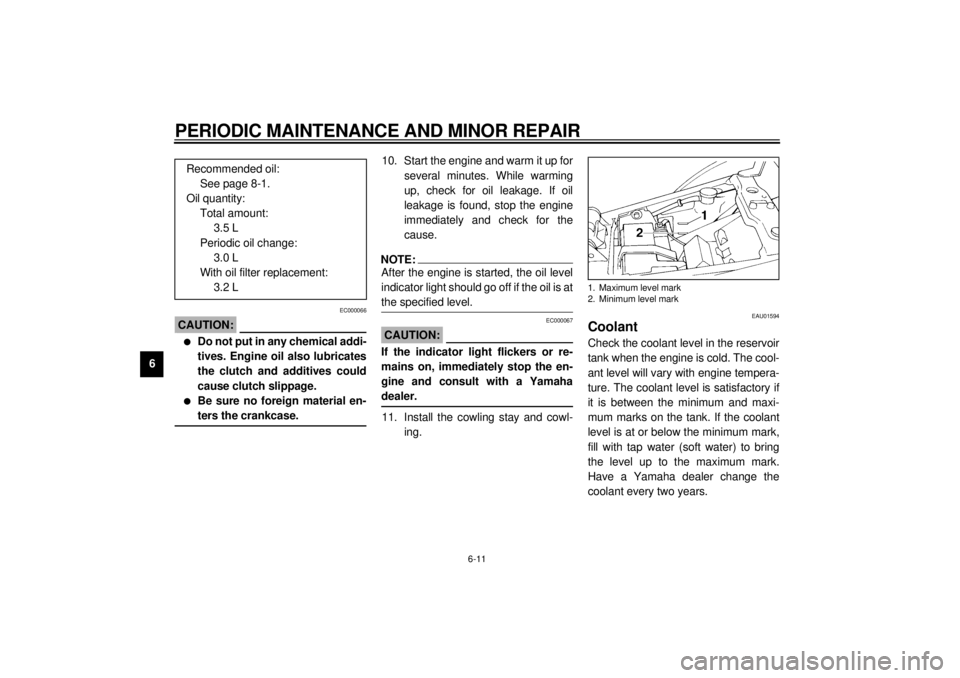
CoolantCheck the coolant level in the reservoir
tank when the engine is cold. The cool-
ant level will vary with engine tempera-
ture. The coolant level is satisfactory if
it is between the minimum and maxi-
mum marks on the tank. If the coolant
level is at or below the minimum mark,
fill with tap water (soft water) to bring
the level up to the maximum mark.
Have a Yamaha dealer change the
coolant every two years. Recommended oil:
See page 8-1.
Oil quantity:
Total amount:
3.5 L
Periodic oil change:
3.0 L
With oil filter replacement:
3.2 L1. Maximum level mark
2. Minimum level mark
E_4sv_Periodic.fm Page 11 Tuesday, August 31, 1999 3:45 PM
Page 64 of 103
PERIODIC MAINTENANCE AND MINOR REPAIR
6-16
6
EAU00637
Valve clearance adjustmentThe correct valve clearance changes
with use, resulting in improper fuel/air
supply or engine noise. To prevent this,
the valve clearance must be adjusted
regularly. This adjustment however,
should be left to a professional
Yamaha service technician.
EAU00658
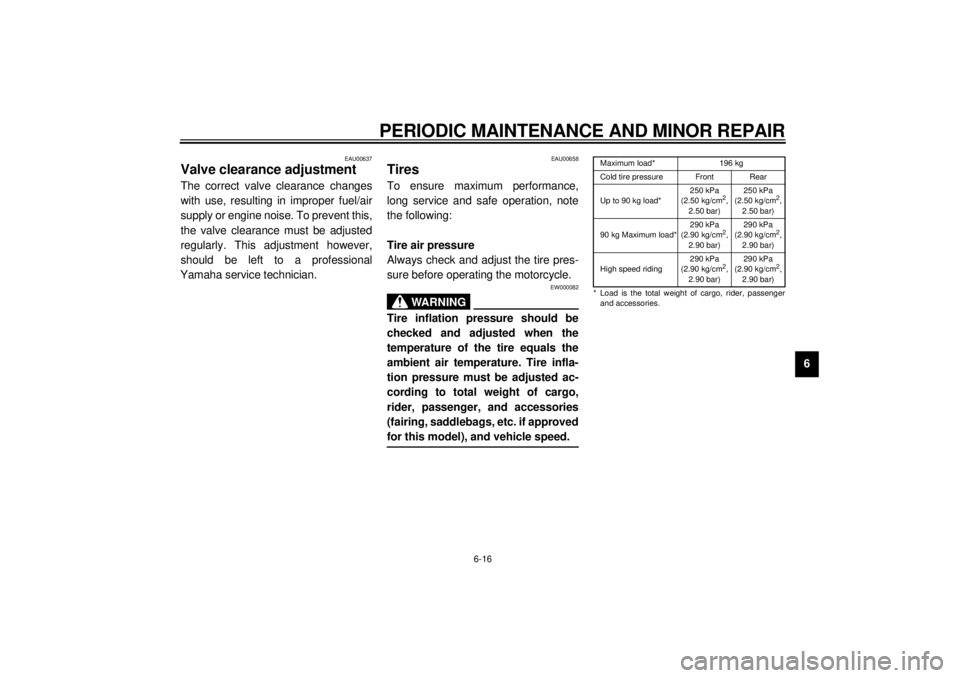
TiresTo ensure maximum performance,
long service and safe operation, note
the following:
Tire air pressure
Always check and adjust the tire pres-
sure before operating the motorcycle.
EW000082
WA R N I N G
@ Tire inflation pressure should be
checked and adjusted when the
temperature of the tire equals the
ambient air temperature. Tire infla-
tion pressure must be adjusted ac-
cording to total weight of cargo,
rider, passenger, and accessories
(fairing, saddlebags, etc. if approved
for this model), and vehicle speed. @
CE-33EMaximum load* 196 kg
Cold tire pressure Front Rear
Up to 90 kg load*250 kPa
(2.50 kg/cm
2,
2.50 bar)250 kPa
(2.50 kg/cm
2,
2.50 bar)
90 kg Maximum load*290 kPa
(2.90 kg/cm
2,
2.90 bar)290 kPa
(2.90 kg/cm
2,
2.90 bar)
High speed riding290 kPa
(2.90 kg/cm
2,
2.90 bar)290 kPa
(2.90 kg/cm
2,
2.90 bar)
* Load is the total weight of cargo, rider, passenger
and accessories.
E_4sv_Periodic.fm Page 16 Tuesday, August 31, 1999 3:45 PM
Page 71 of 103
PERIODIC MAINTENANCE AND MINOR REPAIR
6-23
6
EAU00744
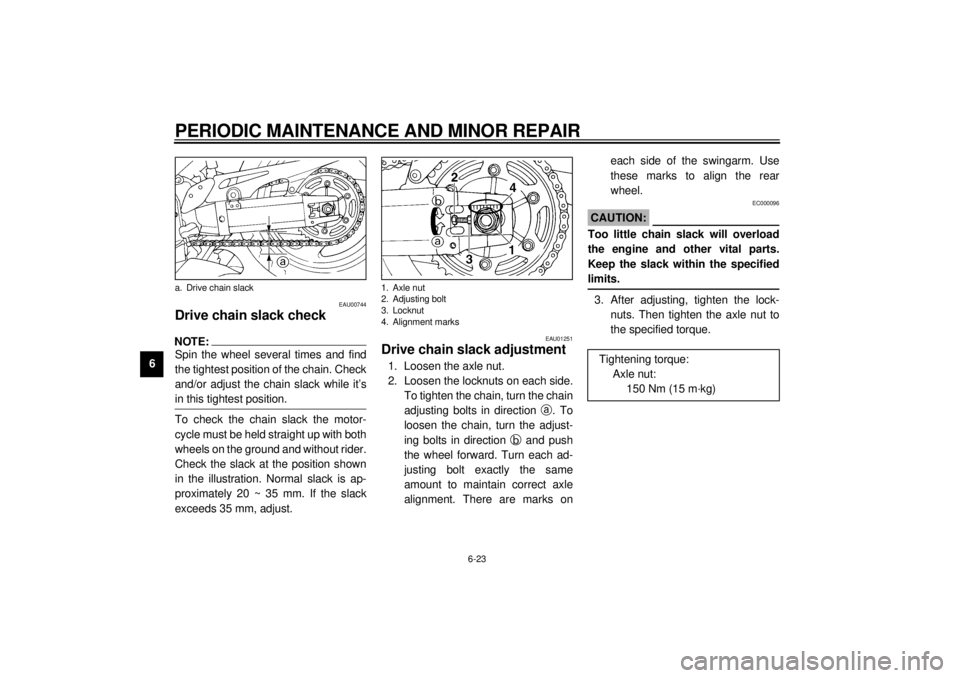
Drive chain slack checkNOTE:@ Spin the wheel several times and find
the tightest position of the chain. Check
and/or adjust the chain slack while it’s
in this tightest position. @To check the chain slack the motor-
cycle must be held straight up with both
wheels on the ground and without rider.
Check the slack at the position shown
in the illustration. Normal slack is ap-
proximately 20 ~ 35 mm. If the slack
exceeds 35 mm, adjust.
EAU01251
Drive chain slack adjustment1. Loosen the axle nut.
2. Loosen the locknuts on each side.
To tighten the chain, turn the chain
adjusting bolts in direction a
. To
loosen the chain, turn the adjust-
ing bolts in direction b
and push
the wheel forward. Turn each ad-
justing bolt exactly the same
amount to maintain correct axle
alignment. There are marks oneach side of the swingarm. Use
these marks to align the rear
wheel.
EC000096
CAUTION:@ Too little chain slack will overload
the engine and other vital parts.
Keep the slack within the specified
limits. @3. After adjusting, tighten the lock-
nuts. Then tighten the axle nut to
the specified torque.
a. Drive chain slack
1. Axle nut
2. Adjusting bolt
3. Locknut
4. Alignment marks
Tightening torque:
Axle nut:
150 Nm (15 m·kg)
E_4sv_Periodic.fm Page 23 Tuesday, August 31, 1999 3:45 PM
Page 73 of 103
PERIODIC MAINTENANCE AND MINOR REPAIR
6-25
6
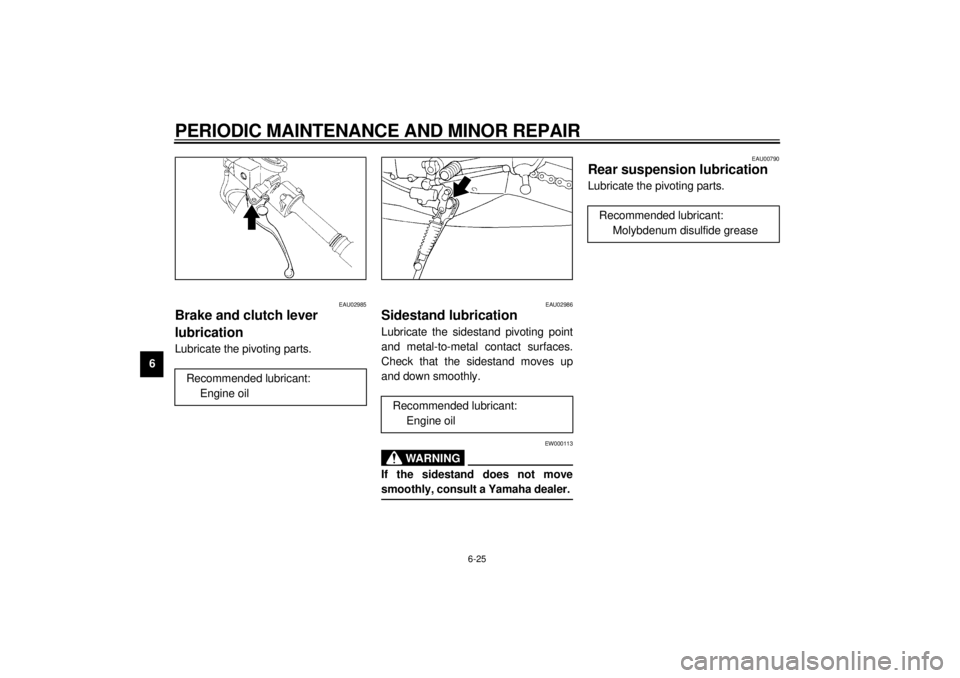
EAU02985
Brake and clutch lever
lubricationLubricate the pivoting parts.
EAU02986
Sidestand lubricationLubricate the sidestand pivoting point
and metal-to-metal contact surfaces.
Check that the sidestand moves up
and down smoothly.
EW000113
WARNING
@ If the sidestand does not move
smoothly, consult a Yamaha dealer. @
EAU00790
Rear suspension lubricationLubricate the pivoting parts.
Recommended lubricant:
Engine oil
Recommended lubricant:
Engine oil
Recommended lubricant:
Molybdenum disulfide grease
E_4sv_Periodic.fm Page 25 Tuesday, August 31, 1999 3:45 PM
Page 74 of 103
PERIODIC MAINTENANCE AND MINOR REPAIR
6-26
6
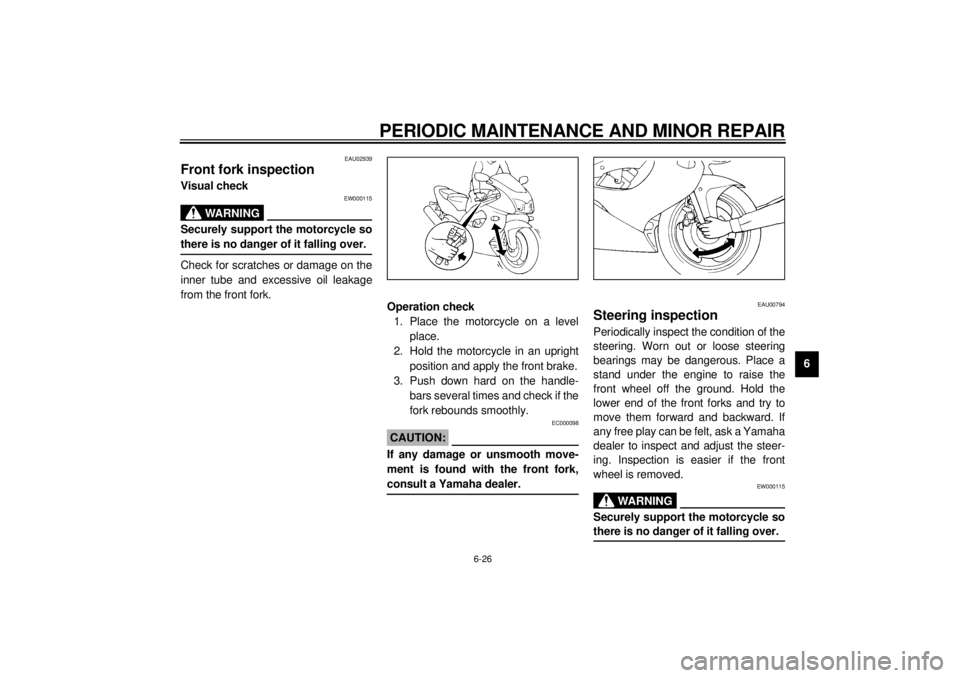
EAU02939
Front fork inspectionVisual check
EW000115
WARNING
@ Securely support the motorcycle so
there is no danger of it falling over. @Check for scratches or damage on the
inner tube and excessive oil leakage
from the front fork.
Operation check
1. Place the motorcycle on a level
place.
2. Hold the motorcycle in an upright
position and apply the front brake.
3. Push down hard on the handle-
bars several times and check if the
fork rebounds smoothly.
EC000098
CAUTION:@ If any damage or unsmooth move-
ment is found with the front fork,
consult a Yamaha dealer. @
EAU00794
Steering inspectionPeriodically inspect the condition of the
steering. Worn out or loose steering
bearings may be dangerous. Place a
stand under the engine to raise the
front wheel off the ground. Hold the
lower end of the front forks and try to
move them forward and backward. If
any free play can be felt, ask a Yamaha
dealer to inspect and adjust the steer-
ing. Inspection is easier if the front
wheel is removed.
EW000115
WA R N I N G
@ Securely support the motorcycle so
there is no danger of it falling over. @
E_4sv_Periodic.fm Page 26 Tuesday, August 31, 1999 3:45 PM
Page 83 of 103

PERIODIC MAINTENANCE AND MINOR REPAIR
6-35
6
EAU02990*
Troubleshooting chart
EW000125
WARNING
@ Never check the fuel system while smoking or in the vicinity of an open flame. @
Check if there is fuel
in the fuel tank.1. Fuel
Enough fuel.
No fuel.
Go to compression check.
Supply fuel.
Engine doesn’t start, go to compression check.
Use the electric starter.2. Compression
There is compression.
No compression.
Go to ignition check.
Ask a Yamaha dealer to
inspect.
Remove spark plugs
and check electrodes.3. Ignition
Wet.
Dry.
Wipe clean with dry cloth and correct
spark gap or replace spark plugs.
Ask a Yamaha dealer to inspect.
Engine doesn’t start, ask a Yamaha
dealer to inspect.Engine doesn’t start, go to battery
check.Open throttle half-way and start
the engine.
Use the electric starter.4. Battery
Engine turns over
quickly.
Engine turns over
slowly.
Battery good.Check connections or
recharge.
E_4sv_Periodic.fm Page 35 Tuesday, August 31, 1999 3:45 PM
Page 84 of 103
PERIODIC MAINTENANCE AND MINOR REPAIR
6-36
6
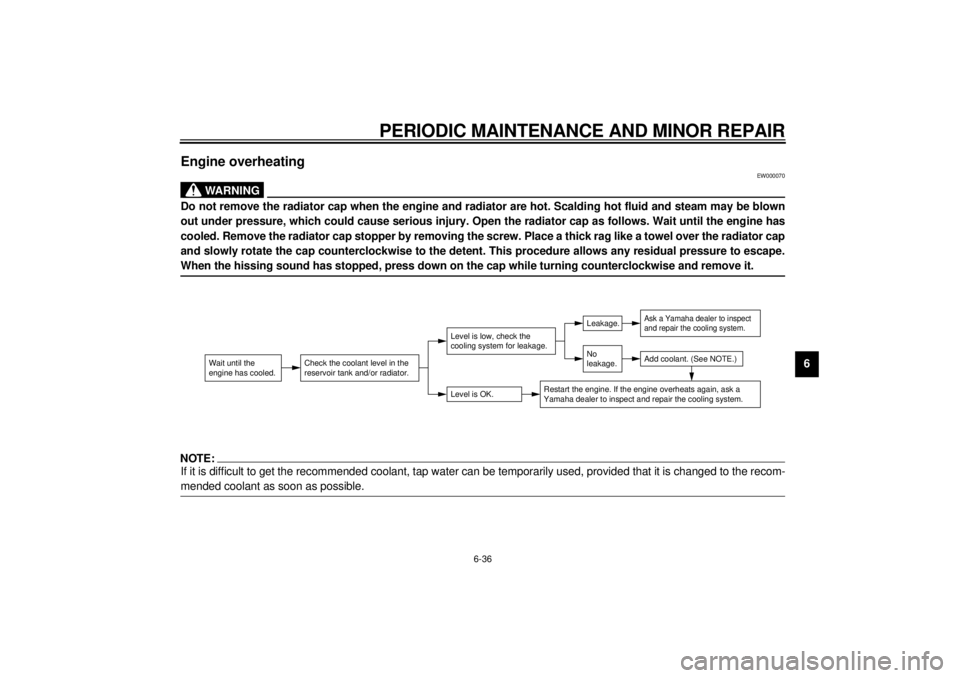
Engine overheating
EW000070
WARNING
@ Do not remove the radiator cap when the engine and radiator are hot. Scalding hot fluid and steam may be blown
out under pressure, which could cause serious injury. Open the radiator cap as follows. Wait until the engine has
cooled. Remove the radiator cap stopper by removing the screw. Place a thick rag like a towel over the radiator cap
and slowly rotate the cap counterclockwise to the detent. This procedure allows any residual pressure to escape.
When the hissing sound has stopped, press down on the cap while turning counterclockwise and remove it. @NOTE:@ If it is difficult to get the recommended coolant, tap water can be temporarily used, provided that it is changed to the recom-
mended coolant as soon as possible. @
Wait until the
engine has cooled.
Check the coolant level in the
reservoir tank and/or radiator.
Level is OK.Level is low, check the
cooling system for leakage.
No
leakage.Leakage.
Ask a Yamaha dealer to inspect
and repair the cooling system.Add coolant. (See NOTE.)
Restart the engine. If the engine overheats again, ask a
Yamaha dealer to inspect and repair the cooling system.
E_4sv_Periodic.fm Page 36 Tuesday, August 31, 1999 3:45 PM