check oil YAMAHA YZF1000 2000 Owners Manual
[x] Cancel search | Manufacturer: YAMAHA, Model Year: 2000, Model line: YZF1000, Model: YAMAHA YZF1000 2000Pages: 103, PDF Size: 4.73 MB
Page 14 of 103
3
INSTRUMENT AND CONTROL FUNCTIONS
Main switch/steering lock ...................................... 3-1
Indicator lights ...................................................... 3-2
Oil level indicator circuit check .............................. 3-3
Fuel indicator circuit check ................................... 3-5
Speedometer ........................................................ 3-6
Tachometer ........................................................... 3-6
Diagnosis device................................................... 3-7
Coolant temperature gauge .................................. 3-7
Handlebar switches .............................................. 3-8
Clutch lever ........................................................... 3-9
Shift pedal ........................................................... 3-10
Front brake lever ................................................. 3-10
Rear brake pedal ................................................ 3-11Fuel tank cap ..................................................... 3-11
Fuel .................................................................... 3-12
Fuel tank breather hose (for Germany only) ...... 3-13
Starter (choke) “ ” .......................................... 3-13
Seats .................................................................. 3-13
Helmet holder..................................................... 3-14
Storage compartment ........................................ 3-15
Front fork adjustment ......................................... 3-15
Rear shock absorber adjustment ....................... 3-17
Luggage strap holders ....................................... 3-19
EXUP (EXhaust Ultimate Powervalve) ............... 3-19
Sidestand ........................................................... 3-19
Sidestand/clutch switch operation check............ 3-20
E_4sv_FunctionsTOC.fm Page 1 Tuesday, August 31, 1999 3:42 PM
Page 16 of 103
INSTRUMENT AND CONTROL FUNCTIONS
3-2
3
EAU00048
P (Parking)
The steering is locked in this position,
and the taillight and auxiliary light come
on but all other circuits are off. The key
can be removed in this position.
To use the parking position, first lock
the steering, then turn the key to “P”.
Do not use this position for an extend-
ed length of time as the battery may
discharge.
EAU00056
Indicator lights
EAU00057
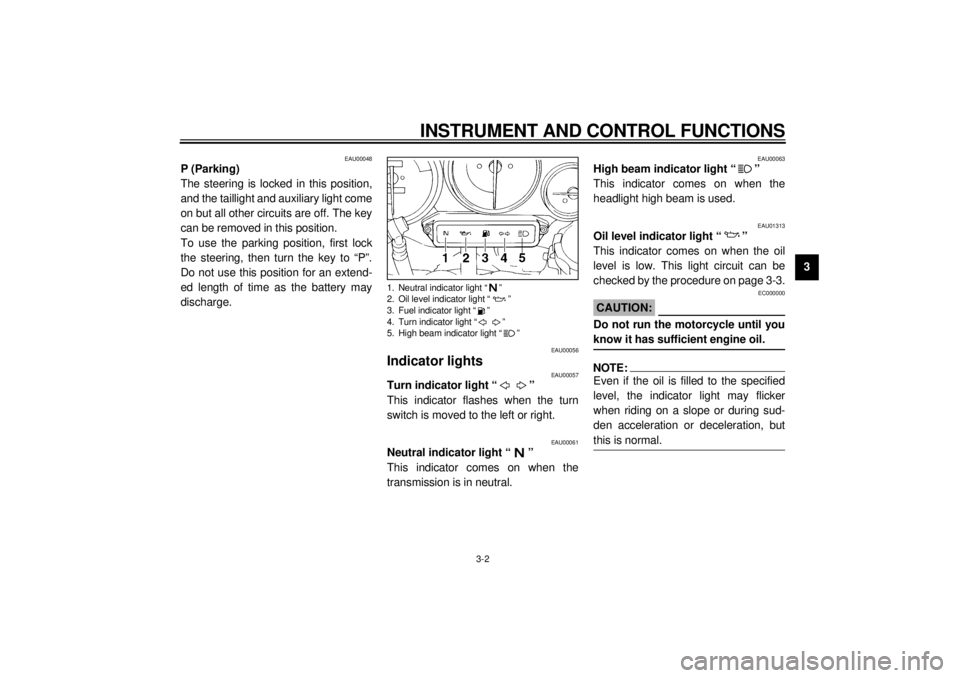
Turn indicator light “ ”
This indicator flashes when the turn
switch is moved to the left or right.
EAU00061
Neutral indicator light “ ”
This indicator comes on when the
transmission is in neutral.
EAU00063
High beam indicator light “ ”
This indicator comes on when the
headlight high beam is used.
EAU01313
Oil level indicator light “ ”
This indicator comes on when the oil
level is low. This light circuit can be
checked by the procedure on page 3-3.
EC000000
CAUTION:@ Do not run the motorcycle until you
know it has sufficient engine oil. @NOTE:@ Even if the oil is filled to the specified
level, the indicator light may flicker
when riding on a slope or during sud-
den acceleration or deceleration, but
this is normal. @
1. Neutral indicator light “ ”
2. Oil level indicator light “ ”
3. Fuel indicator light “ ”
4. Turn indicator light “ ”
5. High beam indicator light “ ”
E_4sv_Functions.fm Page 2 Tuesday, August 31, 1999 3:42 PM
Page 17 of 103
INSTRUMENT AND CONTROL FUNCTIONS
3-3
3
EAU00071
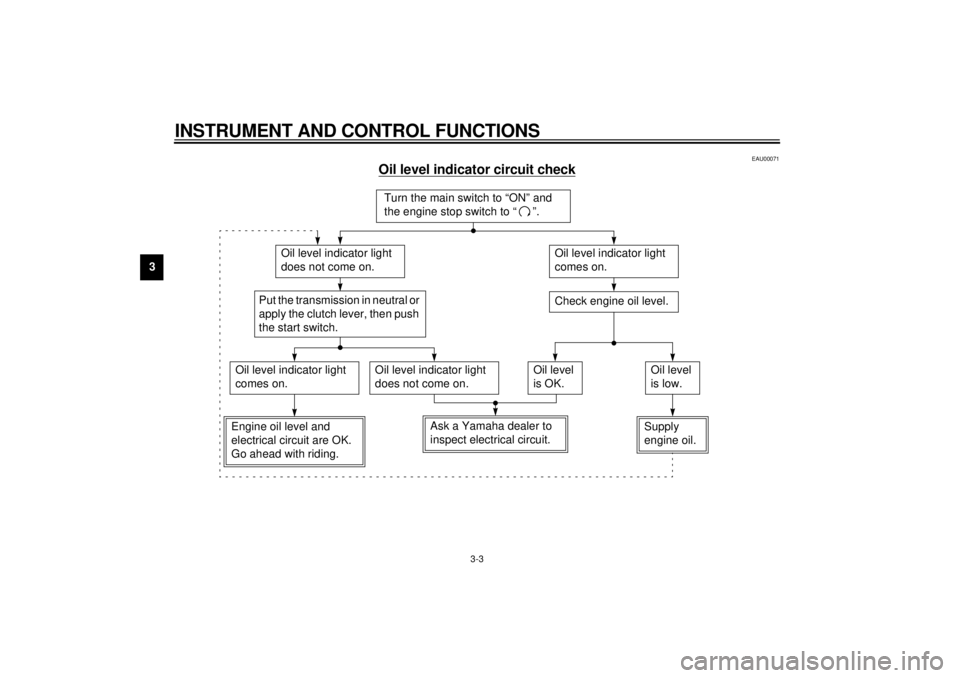
Oil level indicator circuit check
CB-48E
Turn the main switch to “ON” and
the engine stop switch to “ ”.
Oil level indicator light
does not come on.
Oil level indicator light
comes on.Check engine oil level.
Oil level indicator light
comes on.
Oil level indicator light
does not come on.
Engine oil level and
electrical circuit are OK.
Go ahead with riding.
Put the transmission in neutral or
apply the clutch lever, then push
the start switch.
Oil level
is OK.
Supply
engine oil.Oil level
is low.
Ask a Yamaha dealer to
inspect electrical circuit.
E_4sv_Functions.fm Page 3 Tuesday, August 31, 1999 3:42 PM
Page 37 of 103
4-1
4
EAU01114
4-PRE-OPERATION CHECKSOwners are personally responsible for their vehicle’s condition. Your motorcycle’s vital functions can start to deteriorate
quickly and unexpectedly, even if it remains unused (for instance, if it is exposed to the elements). Any damage, fluid leak or
loss of tire pressure could have serious consequences. Therefore, it is very important that, in addition to a thorough visual in-
spection, you check the following points before each ride.
EAU00340
PRE-OPERATION CHECK LIST
ITEM CHECKS PAGE
Front brake
• Check operation, free play, fluid level and fluid leakage.
• Fill with DOT 4 brake fluid if necessary.6-19 ~ 6-22
Rear brake
6-19 ~ 6-22
Clutch• Check operation, fluid level and fluid leakage.
• Fill with DOT 4 brake fluid if necessary.6-21 ~ 6-22
Throttle grip and housing• Check for smooth operation.
• Lubricate if necessary.6-15
Engine oil• Check oil level.
• Fill with oil if necessary.6-9 ~ 6-11
Coolant reservoir tank• Check coolant level.
• Fill with coolant if necessary.6-11 ~ 6-12
Drive chain• Check chain slack and condition.
• Adjust if necessary.6-23 ~ 6-24
Wheels and tires
• Check tire pressure, wear and damage. 6-16 ~ 6-19
Control and meter cable• Check for smooth operation.
• Lubricate if necessary.6-24
Brake and shift pedal
shafts• Check for smooth operation.
• Lubricate if necessary.6-24
Brake and clutch lever
pivots• Check for smooth operation.
• Lubricate if necessary.6-25
E_4sv_Preop.fm Page 1 Tuesday, August 31, 1999 3:44 PM
Page 43 of 103
OPERATION AND IMPORTANT RIDING POINTS
5-3
51. Turn the main switch to “ON” and
the engine stop switch to “ ”.
EC000035
CAUTION:@ If the fuel indicator light comes on,
check the fuel level. If necessary, fill
the tank with fuel. @2. Shift the transmission into neutral.NOTE:@ When the transmission is in neutral, the
neutral indicator light should be on. If
the light does not come on, ask a
Yamaha dealer to inspect it. @3. Turn on the starter (choke) and
completely close the throttle grip.
4. Start the engine by pushing the
start switch.
NOTE:@ If the engine fails to start, release the
start switch, wait a few seconds, then
try again. Each attempt should be as
short as possible to preserve the bat-
tery. Do not crank the engine more
than 10 seconds on any one attempt. @
EC000036
CAUTION:@ The oil level indicator light and fuel
indicator light should come on when
the start switch is pushed and
should go off when the start switch
is released. If the oil level indicator
light flickers or remains on, immedi-
ately stop the engine and check the
engine oil level and for oil leakage. If
necessary, fill the engine with oil
and check to see that the oil level in-
dicator light goes off. If not, consult
a Yamaha dealer. @
5. After starting the engine, move the
starter (choke) to the halfway posi-
tion.NOTE:@ For maximum engine life, never accel-
erate hard with a cold engine! @6. After the engine is warm, turn off
the starter (choke) completely.NOTE:@ The engine is warm when it responds
normally to the throttle with the starter
(choke) turned off. @
E_4sv_Operation.fm Page 3 Tuesday, August 31, 1999 3:45 PM
Page 48 of 103

6
PERIODIC MAINTENANCE AND MINOR REPAIR
Tool kit................................................................... 6-1
Periodic maintenance and lubrication ................... 6-2
Cowling removal and installation .......................... 6-5
Cowling A.............................................................. 6-5
Cowling B.............................................................. 6-5
Cowling C ............................................................. 6-6
Spark plugs........................................................... 6-7
Engine oil .............................................................. 6-9
Coolant ............................................................... 6-11
Air filter ............................................................... 6-12
Carburetor adjustment ........................................ 6-14
Idle speed adjustment ........................................ 6-15
Throttle cable free play inspection ...................... 6-15
Valve clearance adjustment ................................ 6-16
Tires .................................................................... 6-16
Wheels................................................................ 6-19
Brake light switch adjustment ............................. 6-19
Checking the front and rear brake pads.............. 6-20
Inspecting the brake fluid level............................ 6-21
Brake fluid replacement ...................................... 6-22
Drive chain slack check ...................................... 6-23Drive chain slack adjustment ............................. 6-23
Drive chain lubrication........................................ 6-24
Cable inspection and lubrication ........................ 6-24
Brake and shift pedal lubrication ........................ 6-24
Brake and clutch lever lubrication ...................... 6-25
Sidestand lubrication.......................................... 6-25
Rear suspension lubrication............................... 6-25
Front fork inspection ........................................... 6-26
Steering inspection ............................................ 6-26
Wheel bearings .................................................. 6-27
Battery................................................................ 6-27
Fuse replacement .............................................. 6-28
Headlight bulb replacement ............................... 6-29
Tail/brake light bulb replacement ........................ 6-30
Turn signal light bulb replacement...................... 6-30
Front wheel removal ........................................... 6-31
Front wheel installation ...................................... 6-31
Rear wheel removal ........................................... 6-32
Rear wheel installation ....................................... 6-33
Troubleshooting .................................................. 6-34
Troubleshooting chart......................................... 6-35
E_4sv_PeriodicTOC.fm Page 1 Tuesday, August 31, 1999 3:45 PM
Page 51 of 103
PERIODIC MAINTENANCE AND MINOR REPAIR
6-3
6
11
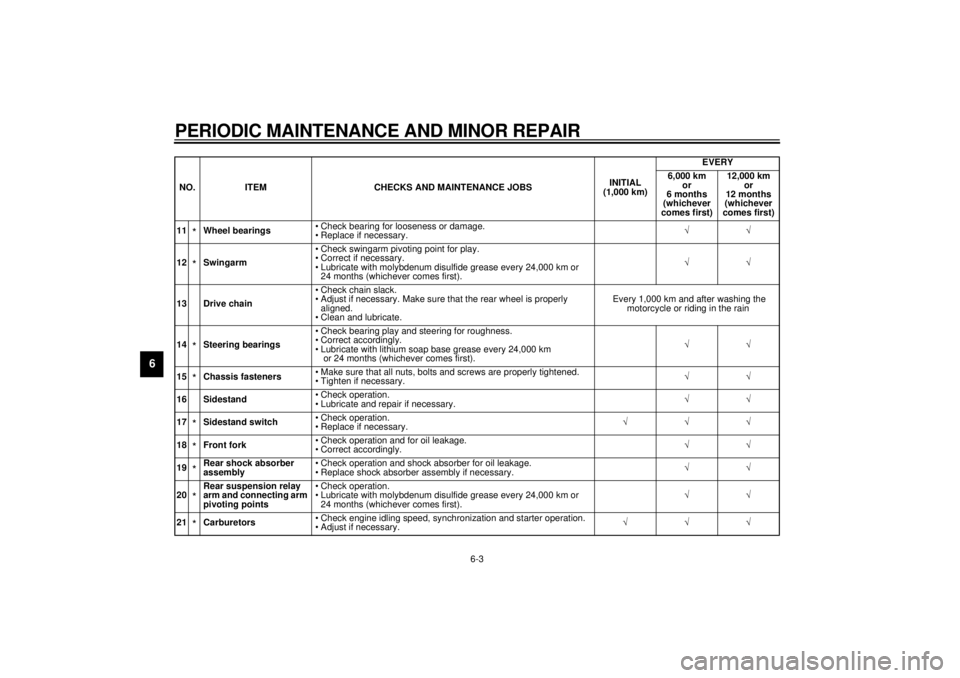
*Wheel bearings• Check bearing for looseness or damage.
• Replace if necessary. ÖÖ
12*Swingarm• Check swingarm pivoting point for play.
• Correct if necessary.
• Lubricate with molybdenum disulfide grease every 24,000 km or
24 months (whichever comes first).ÖÖ
13 Drive chain• Check chain slack.
• Adjust if necessary. Make sure that the rear wheel is properly
aligned.
• Clean and lubricate. Every 1,000 km and after washing the
motorcycle or riding in the rain
14*Steering bearings• Check bearing play and steering for roughness.
• Correct accordingly.
• Lubricate with lithium soap base grease every 24,000 km
or 24 months (whichever comes first).ÖÖ
15*Chassis fasteners• Make sure that all nuts, bolts and screws are properly tightened.
• Tighten if necessary.ÖÖ
16 Sidestand• Check operation.
• Lubricate and repair if necessary.ÖÖ
17*Sidestand switch• Check operation.
• Replace if necessary.ÖÖÖ
18*Front fork• Check operation and for oil leakage.
• Correct accordingly.ÖÖ
19*Rear shock absorber
assembly• Check operation and shock absorber for oil leakage.
• Replace shock absorber assembly if necessary. ÖÖ
20*Rear suspension relay
arm and connecting arm
pivoting points• Check operation.
• Lubricate with molybdenum disulfide grease every 24,000 km or
24 months (whichever comes first).ÖÖ
21*Carburetors• Check engine idling speed, synchronization and starter operation.
• Adjust if necessary.ÖÖÖ NO. ITEM CHECKS AND MAINTENANCE JOBSINITIAL
(1,000 km)EVERY
6,000 km
or
6 months
(whichever
comes first)12,000 km
or
12 months
(whichever
comes first)
E_4sv_Periodic.fm Page 3 Tuesday, August 31, 1999 3:45 PM
Page 52 of 103
PERIODIC MAINTENANCE AND MINOR REPAIR
6-4
6
* Since these items require special tools, data and technical skills, they should be serviced by a Yamaha dealer.
EAU02971*
NOTE:@ l
The air filter needs more frequent service if you are riding in unusually wet or dusty areas.
l
Hydraulic brake and clutch systems
• After disassembling the master cylinder, caliper cylinder or clutch release cylinder, always replace the brake fluid.
Check the brake fluid level of the master cylinder and clutch release cylinder regularly and fill as required.
• Replace the oil seals on the inner parts of the master cylinder, caliper cylinder and clutch release cylinder every two
years.
• Replace the brake and clutch hoses every four years or if cracked or damaged.
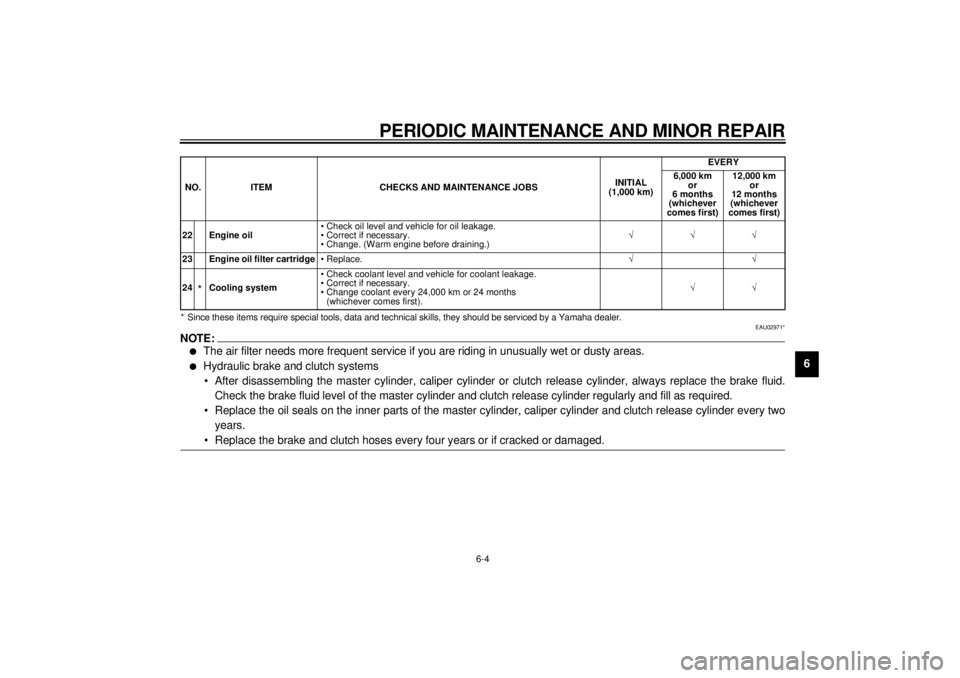
@22 Engine oil• Check oil level and vehicle for oil leakage.
• Correct if necessary.
• Change. (Warm engine before draining.)ÖÖÖ
23 Engine oil filter cartridge
• Replace.ÖÖ
24
*Cooling system• Check coolant level and vehicle for coolant leakage.
• Correct if necessary.
• Change coolant every 24,000 km or 24 months
(whichever comes first).ÖÖ NO. ITEM CHECKS AND MAINTENANCE JOBSINITIAL
(1,000 km)EVERY
6,000 km
or
6 months
(whichever
comes first)12,000 km
or
12 months
(whichever
comes first)
E_4sv_Periodic.fm Page 4 Tuesday, August 31, 1999 3:45 PM
Page 57 of 103
PERIODIC MAINTENANCE AND MINOR REPAIR
6-9
6
EAU01765*
Engine oilOil level inspection
1. Place the motorcycle on a level
place and hold it in an upright posi-
tion. Warm up the engine for seve-
ral minutes.NOTE:@ Be sure the motorcycle is positioned
straight up when checking the oil level.
A slight tilt toward the side can result in
false readings. @
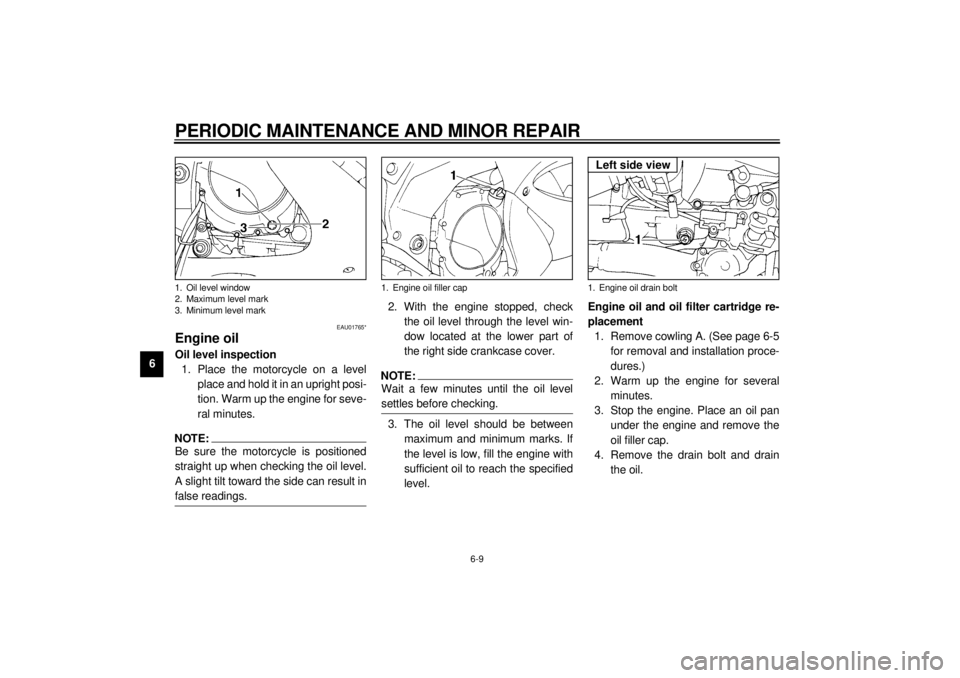
2. With the engine stopped, check
the oil level through the level win-
dow located at the lower part of
the right side crankcase cover.NOTE:@ Wait a few minutes until the oil level
settles before checking. @3. The oil level should be between
maximum and minimum marks. If
the level is low, fill the engine with
sufficient oil to reach the specified
level.Engine oil and oil filter cartridge re-
placement
1. Remove cowling A. (See page 6-5
for removal and installation proce-
dures.)
2. Warm up the engine for several
minutes.
3. Stop the engine. Place an oil pan
under the engine and remove the
oil filler cap.
4. Remove the drain bolt and drain
the oil.
1. Oil level window
2. Maximum level mark
3. Minimum level mark
1. Engine oil filler cap
1. Engine oil drain boltLeft side view
E_4sv_Periodic.fm Page 9 Tuesday, August 31, 1999 3:45 PM
Page 59 of 103
PERIODIC MAINTENANCE AND MINOR REPAIR
6-11
6
EC000066
CAUTION:@ l
Do not put in any chemical addi-
tives. Engine oil also lubricates
the clutch and additives could
cause clutch slippage.
l
Be sure no foreign material en-
ters the crankcase.
@
10. Start the engine and warm it up for
several minutes. While warming
up, check for oil leakage. If oil
leakage is found, stop the engine
immediately and check for the
cause.NOTE:@ After the engine is started, the oil level
indicator light should go off if the oil is at
the specified level. @
EC000067
CAUTION:@ If the indicator light flickers or re-
mains on, immediately stop the en-
gine and consult with a Yamaha
dealer. @11. Install the cowling stay and cowl-
ing.
EAU01594
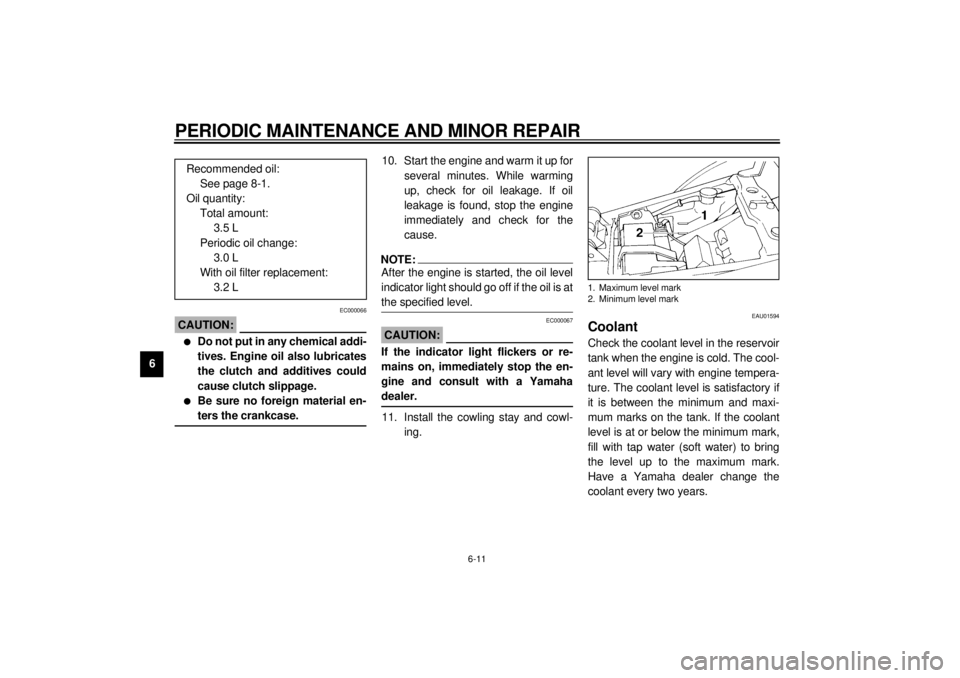
CoolantCheck the coolant level in the reservoir
tank when the engine is cold. The cool-
ant level will vary with engine tempera-
ture. The coolant level is satisfactory if
it is between the minimum and maxi-
mum marks on the tank. If the coolant
level is at or below the minimum mark,
fill with tap water (soft water) to bring
the level up to the maximum mark.
Have a Yamaha dealer change the
coolant every two years. Recommended oil:
See page 8-1.
Oil quantity:
Total amount:
3.5 L
Periodic oil change:
3.0 L
With oil filter replacement:
3.2 L1. Maximum level mark
2. Minimum level mark
E_4sv_Periodic.fm Page 11 Tuesday, August 31, 1999 3:45 PM