brake Abarth 500 2015 Owner handbook (in English)
[x] Cancel search | Manufacturer: ABARTH, Model Year: 2015, Model line: 500, Model: Abarth 500 2015Pages: 215, PDF Size: 19.08 MB
Page 136 of 215

❒switch on the compressor, bringing
the switch G to position1(on);
❒inflate the tyre to the pressure
specified (see the "Cold tyre inflation
pressure" paragraph in the "Technical
specifications" chapter).IMPORTANT To get a more precise
reading, it is advisable to check the
value with compressor off.
❒if the pressure does not reach at least
1.5 bar in 5 minutes, switch the
compressor off and disconnect the
filling pipe B from the tyre valve, then
remove the plug H;
❒move the car by about 10 m, to
distribute the sealant inside the tyre,
then inflate again.
IMPORTANT If after this operation it is
still impossible after 5 minutes to reach
at least 1.5 bar, do not start driving
since the tyre is excessively damaged
and the Fix&Go kit cannot guarantee
proper seal; contact an Abarth
Dealership.
❒If the tyre was inflated to the
prescribed pressure, start driving
immediately.
111)
❒after having driven for about 10
minutes, stop, apply the handbrake
and recheck the tyre pressure.
112) 113)
100AB0A0083
101AB0A0084
102AB0A0085
132
IN AN EMERGENCY
Page 138 of 215

109) The spray bottle contains
ethylene glycol. It contains latex
that might cause allergic
reactions. It is harmful if
swallowed. Eye irritant. It may
cause sensitisation if inhaled or
on contact. Avoid contact with
eyes, skin and clothes. In the case
of contact, wash immediately
with plenty of water. In the event
that it is swallowed, do not induce
vomiting. Rinse out your mouth,
drink large quantities of water and
seek immediate medical attention.
Keep out of the reach of children.
The product must not be used
by asthmatics. Do not inhale the
vapours during insertion and
suction. Call a doctor immediately
if allergic reactions are noted.
Store the spray bottle away from
heat sources. The sealant has
an expiry date.
110) Wear the protective gloves
provided with the Fix&Go kit.
111) Apply the adhesive label where
it can be easily seen by the driver
as a reminder that the tyre has
been treated with the Fix&Go kit.
Drive carefully, particularly on
bends. Do not exceed 80 km/h. Do
not accelerate or brake suddenly.112) If the pressure falls below 1.5
bar, do not drive any further: the
kit cannot guarantee proper seal
because the tyre is too damaged.
Contact an Abarth Dealership. If
instead a pressure value of at
least 1.5 bar is detected, restore
the correct pressure (with the
engine running and the
handbrake engaged), resume
driving and drive with great care
to the nearest Abarth Dealership.
113) You must always indicate that
the tyre was repaired using the
kit. Give the booklet to the
technicians who will be handling
the tyre that was treated using
the kit.
IMPORTANT
2) Replace the spray bottle
containing the sealant after the
expiry date. Dispose of the bottle
and the sealant properly. Have
them disposed of in compliance
with national and local
regulations.
134
IN AN EMERGENCY
Page 141 of 215

Bulbs
Use Type Power Ref. Figure
Main beam headlights HI 55 W D
Dipped headlights H7 55 W D
Dipped headlights with gas discharge bulbs
(Xenon) (for versions/markets, where provided)DIS 35 W F
Front side lights/daytime running lights W2I/5W 5/2IW A
Front direction indicators WY2IW 21 W B
Front direction indicators (with xenon gas
discharge bulbs)PY24W 24 W B
Side direction indicators W5W 5 W A
Rear direction indicators PY2IW 2IW B
Rear side lights RI0W I0W B
Brake lights P2IW 2IW B
Reversing light P2IW 2IW B
Rear fog light P2IW 2IW B
Roof light C5W 5 W C
Luggage compartment light W5W 5 W A
Number plate light C5W 5 W C
Fog lights HI 55 W E
Third brake lights W5W 5 W A
137
Page 145 of 215
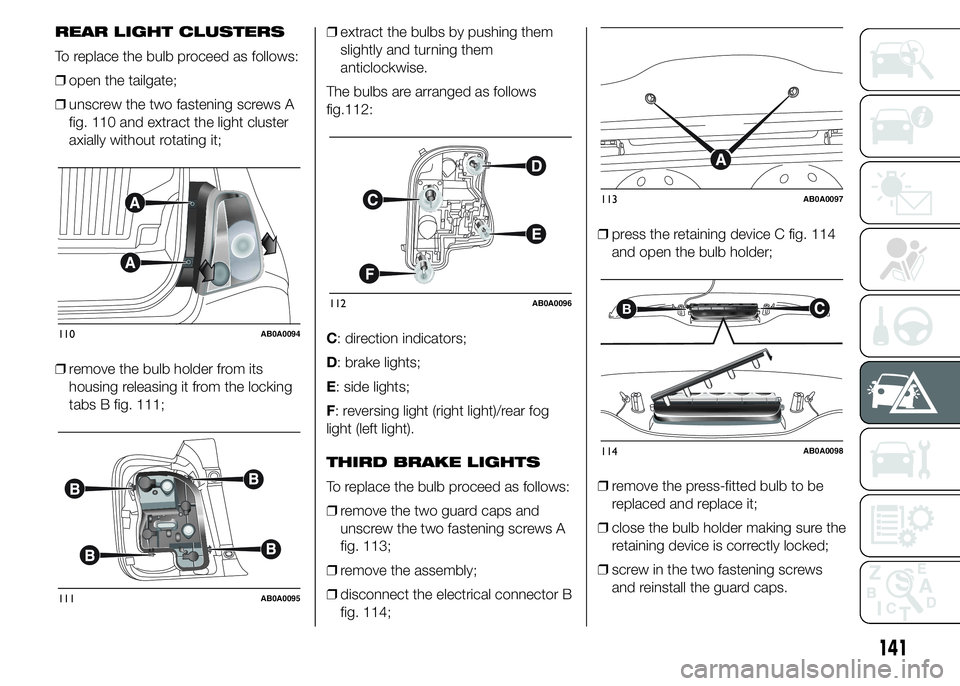
REAR LIGHT CLUSTERS
To replace the bulb proceed as follows:
❒open the tailgate;
❒unscrew the two fastening screws A
fig. 110 and extract the light cluster
axially without rotating it;
❒remove the bulb holder from its
housing releasing it from the locking
tabs B fig. 111;❒extract the bulbs by pushing them
slightly and turning them
anticlockwise.
The bulbs are arranged as follows
fig. 112:
C: direction indicators;
D: brake lights;
E: side lights;
F: reversing light (right light)/rear fog
light (left light).
THIRD BRAKE LIGHTS
To replace the bulb proceed as follows:
❒remove the two guard caps and
unscrew the two fastening screws A
fig. 113;
❒remove the assembly;
❒disconnect the electrical connector B
fig. 114;❒press the retaining device C fig. 114
and open the bulb holder;
❒remove the press-fitted bulb to be
replaced and replace it;
❒close the bulb holder making sure the
retaining device is correctly locked;
❒screw in the two fastening screws
and reinstall the guard caps.
110AB0A0094
111AB0A0095
112AB0A0096
113AB0A0097
B
114AB0A0098
141
Page 150 of 215
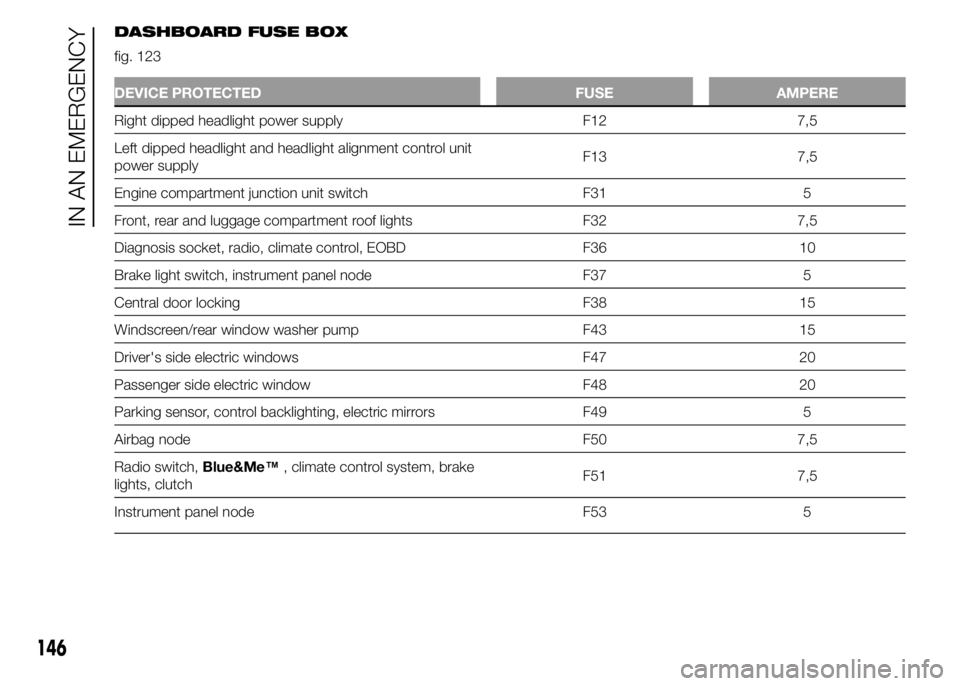
DASHBOARD FUSE BOX
fig. 123
DEVICE PROTECTED FUSE AMPERE
Right dipped headlight power supply F12 7,5
Left dipped headlight and headlight alignment control unit
power supplyF13 7,5
Engine compartment junction unit switch F31 5
Front, rear and luggage compartment roof lights F32 7,5
Diagnosis socket, radio, climate control, EOBD F36 10
Brake light switch, instrument panel node F37 5
Central door locking F38 15
Windscreen/rear window washer pump F43 15
Driver's side electric windows F47 20
Passenger side electric window F48 20
Parking sensor, control backlighting, electric mirrors F49 5
Airbag node F50 7,5
Radio switch,Blue&Me™, climate control system, brake
lights, clutchF51 7,5
Instrument panel node F53 5
146
IN AN EMERGENCY
Page 155 of 215

127) The front and rear tow hooks
should be used only for
emergencies on the road. You are
allowed to tow the vehicle for
short distances using an
appropriate device in accordance
with the highway code (a rigid
bar), to move the vehicle on the
road in readiness for towing or
transport via a breakdown vehicle.
Tow hooks MUST NOT be used
to tow vehicles off the road or
where there are obstacles and/or
for towing operations using cables
or other non-rigid devices.
Respecting the above conditions,
towing must take place with two
vehicles (one towing, the other
towed) aligned as much as
possible along the same centre
line.128) Whilst towing, remember that
as the assistance of the brake
servo and the electric power
steering is not available, greater
force needs to be exerted on
the brake pedal and more effort is
required on the steering wheel.
Do not use flexible cables when
towing and avoid jerky
movements. While towing, make
sure that the trailer hitch does not
damage any components it is
touching. When towing the car,
you must comply with all specific
traffic regulations, both in terms
of the towing device and
behaviour on the road. Do not
start the engine while towing the
car.
129) Because of its conformation,
the car cannot be loaded onto
railway carriages and transported.
151
Page 159 of 215
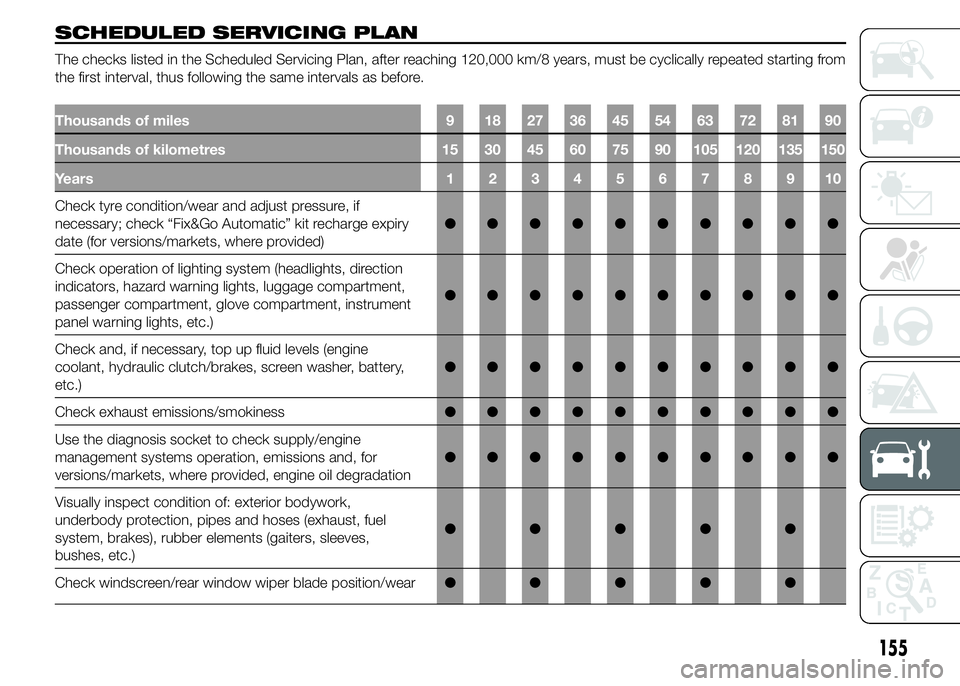
SCHEDULED SERVICING PLAN
The checks listed in the Scheduled Servicing Plan, after reaching 120,000 km/8 years, must be cyclically repeated starting from
the first interval, thus following the same intervals as before.
Thousands of miles 9 18 27 36 45 54 63 72 81 90
Thousands of kilometres 15 30 45 60 75 90 105 120 135 150
Years12345678910
Check tyre condition/wear and adjust pressure, if
necessary; check “Fix&Go Automatic” kit recharge expiry
date (for versions/markets, where provided)●●●●●●●●●●
Check operation of lighting system (headlights, direction
indicators, hazard warning lights, luggage compartment,
passenger compartment, glove compartment, instrument
panel warning lights, etc.)●●●●●●●●●●
Check and, if necessary, top up fluid levels (engine
coolant, hydraulic clutch/brakes, screen washer, battery,
etc.)●●●●●●●●●●
Check exhaust emissions/smokiness●●●●●●●●●●
Use the diagnosis socket to check supply/engine
management systems operation, emissions and, for
versions/markets, where provided, engine oil degradation●●●●●●●●●●
Visually inspect condition of: exterior bodywork,
underbody protection, pipes and hoses (exhaust, fuel
system, brakes), rubber elements (gaiters, sleeves,
bushes, etc.)●●●●●
Check windscreen/rear window wiper blade position/wear●●●●●
155
Page 160 of 215
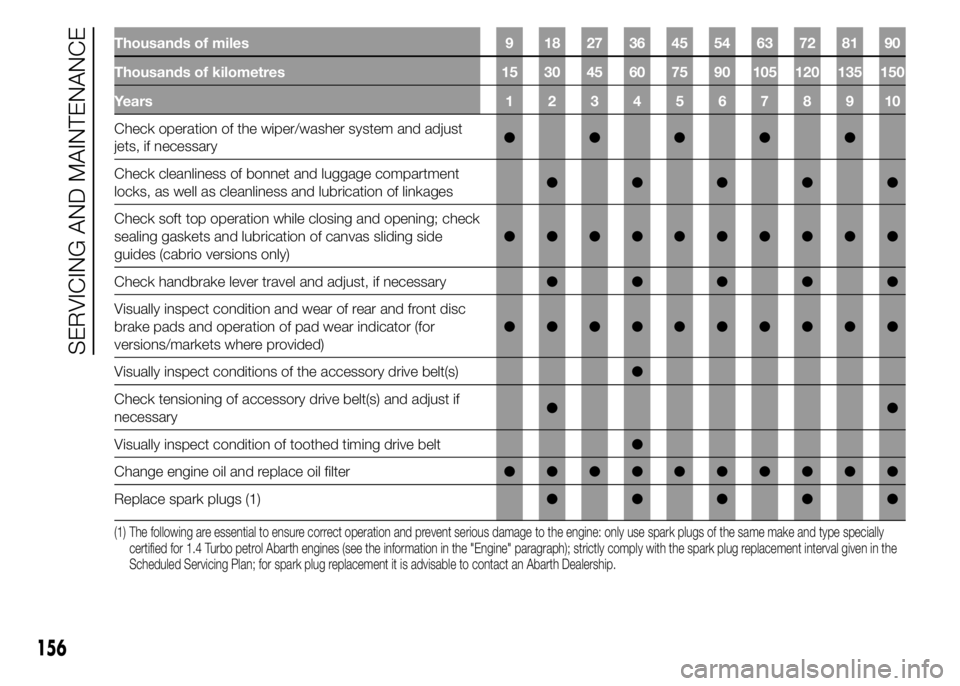
Thousands of miles 9 18 27 36 45 54 63 72 81 90
Thousands of kilometres 15 30 45 60 75 90 105 120 135 150
Years12345678910
Check operation of the wiper/washer system and adjust
jets, if necessary●●●●●
Check cleanliness of bonnet and luggage compartment
locks, as well as cleanliness and lubrication of linkages●●●●●
Check soft top operation while closing and opening; check
sealing gaskets and lubrication of canvas sliding side
guides (cabrio versions only)●●●●●●●●●●
Check handbrake lever travel and adjust, if necessary●●●●●
Visually inspect condition and wear of rear and front disc
brake pads and operation of pad wear indicator (for
versions/markets where provided)●●●●●●●●●●
Visually inspect conditions of the accessory drive belt(s)●
Check tensioning of accessory drive belt(s) and adjust if
necessary●●
Visually inspect condition of toothed timing drive belt●
Change engine oil and replace oil filter●●●●●●●●●●
Replace spark plugs (1)●●●●●
(1) The following are essential to ensure correct operation and prevent serious damage to the engine: only use spark plugs of the same make and type specially
certified for 1.4 Turbo petrol Abarth engines (see the information in the "Engine" paragraph); strictly comply with the spark plug replacement interval given in the
Scheduled Servicing Plan; for spark plug replacement it is advisable to contact an Abarth Dealership.
156
SERVICING AND MAINTENANCE
Page 161 of 215

Thousands of miles 9 18 27 36 45 54 63 72 81 90
Thousands of kilometres 15 30 45 60 75 90 105 120 135 150
Years12345678910
Replace the toothed timing drive belt(2)
Replace accessory drive belt(s)(2)
Replace air cleaner cartridge (3)●●●●●
Change the brake fluid●●●●●
Replace passenger compartment cleaner (3) (O) (●)O●O●O●O●O●
(2) Areas that are not dusty: advised maximum mileage 120,000 km. Regardless of the mileage, the belt must be replaced every 6 years.
Dusty areas and/or demanding use (cold climates, town use, long periods of idling): advised maximum mileage 60,000 km. Regardless of the mileage,
the belt
must be replaced every 4 years.
(3) If the car is used in dusty areas, this cleaner must be replaced every 15,000 km
(O) Recommended operations
(●) Mandatory operations
157
Page 162 of 215
PERIODIC CHECKS
Every 1,000 km or before long
journeys, check and, if necessary, top
up the following:
❒engine coolant level;
❒brake fluid level;
❒windscreen washer fluid level;
❒tyre inflation pressure and condition;
❒operation of lighting system
(headlights, direction indicators,
hazard warning lights, etc.);
❒operation of screen washer/wiper
system and positioning/wear of
windscreen/rear window wiper
blades.
Every 3,000 km check and, if
necessary, top up: engine oil level.
You are advised to use PETRONAS
LUBRICANTS products, which have
been designed and produced
specifically for Abarth cars (see table
"Capacities" in the "Technical
specifications" chapter).
HEAVY-DUTY USE OF
THE CAR
If the car is used mainly under one of
the following conditions:
❒towing a trailer or caravan;
❒dusty roads;
❒short, repeated journeys (less than
7-8 km) at sub-zero outside
temperatures;
❒engine often idling or driving long
distances at low speeds or long
periods of inactivity;
the following checks must be carried
out more often than indicated in the
Scheduled Servicing Plan:
❒check front disc brake pad condition
and wear;
❒check cleanliness of bonnet and
luggage compartment locks,
cleanliness and lubrication of linkage;
❒visually inspect condition of: engine,
gearbox, transmission, pipes and
hoses (exhaust - fuel system -
brakes) and rubber elements (boots -
sleeves - bushes - etc.);
❒check battery charge and battery
fluid level (electrolyte);
❒visually inspect condition of the
accessory drive belts;❒check and, if necessary, change
engine oil and replace oil filter;
❒check and, if necessary, replace
pollen filter;
❒check and, if necessary, replace air
cleaner.
158
SERVICING AND MAINTENANCE