child Abarth 500 2016 Owner handbook (in English)
[x] Cancel search | Manufacturer: ABARTH, Model Year: 2016, Model line: 500, Model: Abarth 500 2016Pages: 215, PDF Size: 19.08 MB
Page 17 of 215

REPLACING THE
BATTERY IN THE KEY
WITH REMOTE CONTROL
Procedure
1)
❒press button A fig. 8 and open the
metal insert B;
❒turn screw C to
using a fine bit
screwdriver;
❒take out the battery case D and
replace the battery E making sure
that polarities are correct;
❒refit the case D inside the key and
lock it, turning the screw C to
.REPLACING THE REMOTE
CONTROL COVER
Proceed as shown in fig. 9 to replace
the cover of the key with remote
control.
WARNING
1) Press button B fig. 7 only with the
key away from your body,
especially your eyes and from
objects which could get damaged
(e.g. your clothes). Do not leave
the key unattended, to prevent
people, especially children, from
inadvertently pressing the button.
IMPORTANT
1) Used batteries may be harmful to
the environment if not disposed of
correctly. They must be disposed
of as specified by law in the
special containers or taken to an
Abarth Dealership, which will take
care of their disposal.
8AB0A00079AB0A0008
13
Page 18 of 215
IGNITION SWITCH
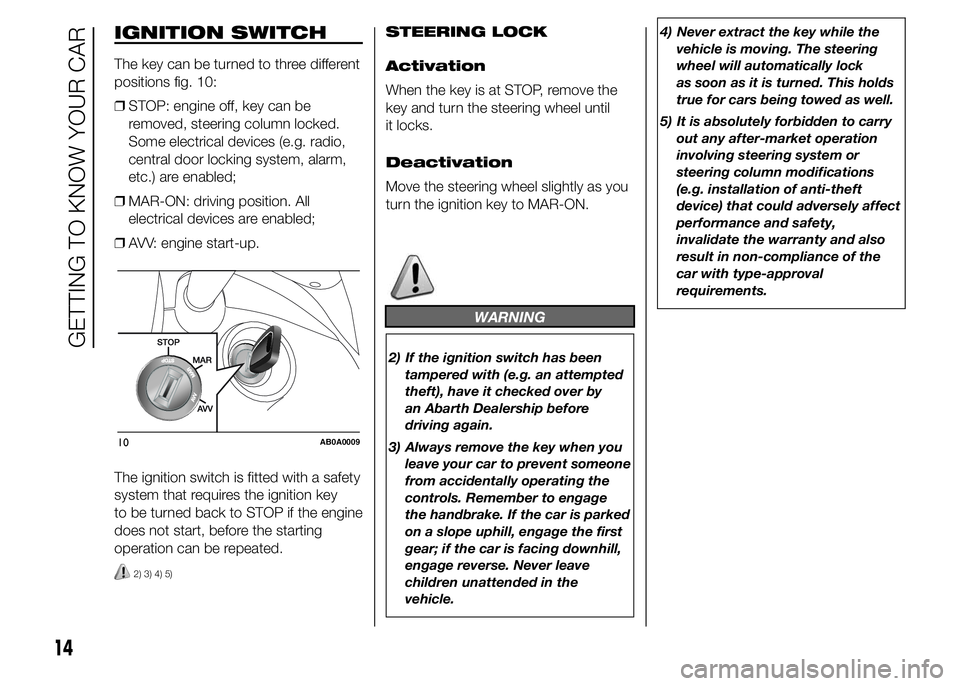
The key can be turned to three different
positions fig. 10:
❒STOP: engine off, key can be
removed, steering column locked.
Some electrical devices (e.g. radio,
central door locking system, alarm,
etc.) are enabled;
❒MAR-ON: driving position. All
electrical devices are enabled;
❒AVV: engine start-up.
The ignition switch is fitted with a safety
system that requires the ignition key
to be turned back to STOP if the engine
does not start, before the starting
operation can be repeated.
2) 3) 4) 5)
STEERING LOCK
Activation
When the key is at STOP, remove the
key and turn the steering wheel until
it locks.
Deactivation
Move the steering wheel slightly as you
turn the ignition key to MAR-ON.
WARNING
2) If the ignition switch has been
tampered with (e.g. an attempted
theft), have it checked over by
an Abarth Dealership before
driving again.
3) Always remove the key when you
leave your car to prevent someone
from accidentally operating the
controls. Remember to engage
the handbrake. If the car is parked
on a slope uphill, engage the first
gear; if the car is facing downhill,
engage reverse. Never leave
children unattended in the
vehicle.4) Never extract the key while the
vehicle is moving. The steering
wheel will automatically lock
as soon as it is turned. This holds
true for cars being towed as well.
5) It is absolutely forbidden to carry
out any after-market operation
involving steering system or
steering column modifications
(e.g. installation of anti-theft
device) that could adversely affect
performance and safety,
invalidate the warranty and also
result in non-compliance of the
car with type-approval
requirements.
10AB0A0009
14
GETTING TO KNOW YOUR CAR
Page 43 of 215
PREPARATION TO
INSTALL A PORTABLE
NAVIGATION SYSTEM
(for versions/markets, where provided)
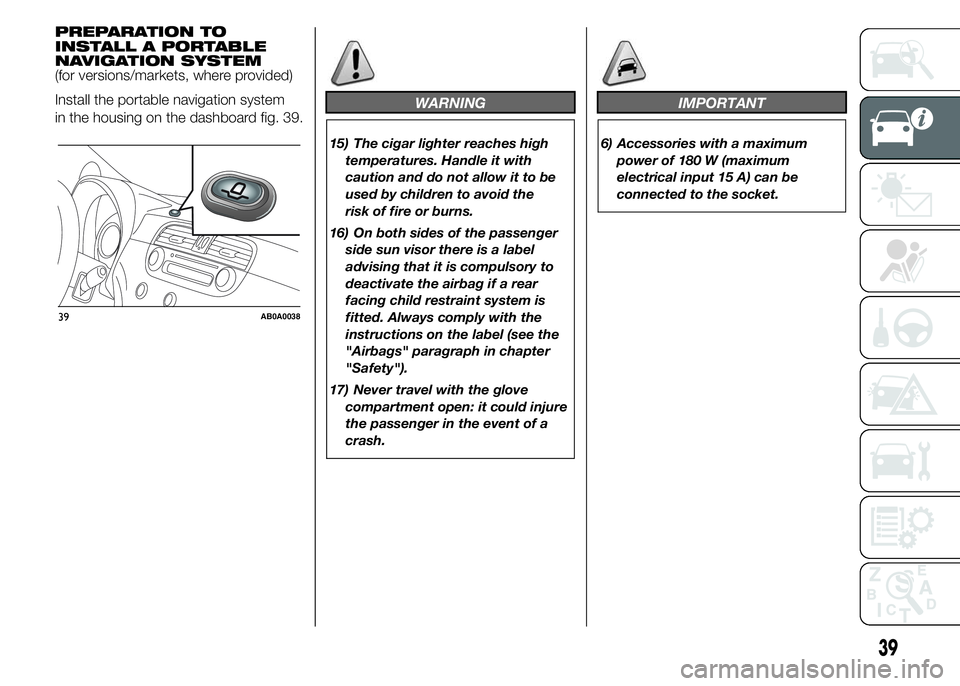
Install the portable navigation system
in the housing on the dashboard fig. 39.
WARNING
15) The cigar lighter reaches high
temperatures. Handle it with
caution and do not allow it to be
used by children to avoid the
risk of fire or burns.
16) On both sides of the passenger
side sun visor there is a label
advising that it is compulsory to
deactivate the airbag if a rear
facing child restraint system is
fitted. Always comply with the
instructions on the label (see the
"Airbags" paragraph in chapter
"Safety").
17) Never travel with the glove
compartment open: it could injure
the passenger in the event of a
crash.
IMPORTANT
6) Accessories with a maximum
power of 180 W (maximum
electrical input 15 A) can be
connected to the socket.
39AB0A0038
39
Page 68 of 215
IMPORTANT
11) The sensors must be clean of
mud, dirt, snow or ice in order
for the system to operate
correctly. Be careful not to
scratch or damage the sensors
while cleaning them. Avoid using
dry, rough or hard cloths. The
sensors must be washed using
clean water, with the addition of
car shampoo if necessary. When
using special washing equipment
such as high pressure jets or
steam cleaning, clean the sensors
very quickly keeping the jet more
than 10 cm away.
WARNING
57) Parking and other dangerous
manoeuvres are, however, always
the driver’s responsibility. While
carrying out these manoeuvres,
always make sure that no people
(especially children) or animals are
in the area concerned. The
parking sensors are an aid for the
driver, but the driver must never
allow their attention to lapse
during potentially dangerous
manoeuvres, even those executed
at low speeds.
REFUELLING THE
CAR
IN BRIEF
Stop the engine before refuelling.
Only refuel with unleaded petrol with
octane rating (RON) not less than
95, in compliance with the European
specification EN 228.
In order to prevent damage to the
catalytic converter never introduce
even the smallest amount of leaded
petrol, even in the event of an
emergency.
IMPORTANT An inefficient catalytic
converter leads to harmful exhaust
emissions, thus contributing to air
pollution.
IMPORTANT Never use leaded petrol,
even in small amounts or in an
emergency, as this would damage the
catalytic converter beyond repair.
64
GETTING TO KNOW YOUR CAR
Page 105 of 215

SAFETY
The chapter that you are about to read
is very important: it describes the
safety systems with which the car is
equipped and provides instructions on
how to use them correctly.SEAT BELTS ...................................102
SBR (SEAT BELT REMINDER)
SYSTEM .........................................102
PRETENSIONERS...........................103
CARRYING CHILDREN SAFELY ......105
FITTING "UNIVERSAL" CHILD
RESTRAINT SYSTEM (WITH SEAT
BELTS) ............................................107
ISOFIX CHILD RESTRAINT
SYSTEM SETUP .............................110
FRONT AIRBAGS............................114
SIDE AIRBAGS (SIDE BAGS -
WINDOW BAGS) .............................118
101
Page 107 of 215

PRETENSIONERS
The car is equipped with front seat
belts pretensioners, that reduce slack in
the belts in the event of a severe frontal
impact. This guarantees the perfect
adherence of the seat belts to the
occupants' bodies before the
restraining action begins.
The retractors lock to indicate that the
pretensioner has intervened.
This car is also equipped with a second
pretensioner (fitted in the kick plate
area). Its activation is signalled by the
shortening of the metal cable.
A slight discharge of smoke may be
produced during the activation of the
pretensioner which is not harmful and
does not indicate any fire hazard.
IMPORTANT To obtain the highest
degree of protection from the action of
the pretensioner, wear the seat belt
tight to the chest and pelvis.
The pretensioner does not require any
maintenance or lubrication: any
changes to its original conditions will
invalidate its efficiency. If, due to
unusual natural events (floods, sea
storms, etc.), the device has been
affected by water and mud, it must be
replaced.
67)
15)
LOAD LIMITERS
To increase passenger safety, the front
seat belt retractors contain a load
limiter which allows the force acting on
the chest and shoulders to be
modulated during the belt restraining
action in the event of a frontal impact.
GENERAL
INSTRUCTIONS FOR
USING THE SEAT BELTS
The driver must comply with (and have
all car passengers follow) any local
regulations in force concerning the use
of seat belts. Always fasten the seat
belts before setting off.
68) 69) 70)
Seat belts are also to be worn by
pregnant women: the risk of injury in
the case of accident is greatly reduced
for them and the unborn child if they
are wearing a seat belt.Pregnant women must position the
lower part of the belt very low down so
that it passes over the pelvis and under
the abdomen (see fig. 76 ). The best
way to protect the unborn child is
to protect the mother. When a seat belt
is worn properly, it is more likely that
the unborn child will not be hurt in
a crash. For pregnant women, as for
anyone, the key to making seat belts
effective is wearing them properly.76AB0A0060
103
Page 108 of 215

The belt must not be twisted. The
upper part must pass over the shoulder
and cross the chest diagonally. The
lower part must adhere to the pelvis
fig. 77, not to the abdomen of the
occupant. Never use devices (clips,
clamps, etc.) that hold the seat belt
away from your body.
IMPORTANT Each seat belt must be
used by only one person. Never travel
with a child sitting on the passenger's
lap and a single belt to protect them
both fig. 78. In general, do not place
any objects between the person and
the belt.SEAT BELTS
MAINTENANCE
For keeping the seat belts in efficient
conditions, observe the following:
❒always use the seat belt well
stretched and never twisted; make
sure that it is free to run without
obstructions;
❒replace the belt after an accident of a
certain severity even if it does not
appear to be damaged. Always
replace the belt if the pretensioners
were deployed;
❒hand wash the seat belts with water
and mild soap, rinse and leave to dry
in the shade. Never use strong
detergents, bleach, paints or any
other substance which could
damage the belt fibres;❒prevent the retractors from getting
wet: their correct operation is only
guaranteed if water does not get
inside;
❒replace the seat belt when there is
wear or cuts.
WARNING
67) The pretensioner may be used
only once. Contact an Abarth
Dealership to have it replaced
after it has been deployed.
68) For maximum safety, keep the
back of your seat upright, lean
back into it and make sure the
seat belt fits closely across your
chest and pelvis. Always fasten
the seat belts on both the front
and the rear seats! Travelling
without wearing seat belts will
increase the risk of serious injury
or even death in the event of an
accident.
77AB0A0061
78AB0A0062
104
SAFETY
Page 109 of 215
69) Removing or otherwise
tampering with seat belt and
pretensioner components is
strictly prohibited. Any operations
on these components must be
performed by qualified and
authorised technicians. Always
contact an Abarth Dealership.
70) If the belt has been subjected to
a high level of stress, for example
after an accident, it must be
completely replaced together with
the attachments, attachment
fixing screws and the
pretensioner. In fact, even if the
belt has no visible defects, it could
have lost its resilience.
IMPORTANT
15) Operations which lead to
impacts, vibrations or localised
heating (over 100°C for a
maximum of six hours) in the area
around the pretensioner may
damage or deploy it. Contact an
Abarth Dealership should
intervention be necessary on
these components.
CARRYING
CHILDREN SAFELY
For optimal protection in the event of an
impact, all occupants must be seated
and wearing adequate restraint
systems, including newborn and
children!
This prescription is compulsory in all EC
countries according to EC Directive
2003/20/EC.
Compared with an adult, a child's head
is larger and heavier in proportion to
their body and the child's muscular and
bone structures are not fully developed.
Therefore, correct restraint systems
other than adult seat belts are
necessary to reduce as much as
possible the risk of injuries in case of
accident, braking or sudden
manoeuvre.
Children must be seated safely and
comfortably. Depending on the
characteristics of the child restraint
systems used, you are advised to keep
children in rear facing child restraint
systems for as long as possible (at least
until 3–4 years old), since this is the
most protected position in the event of
an impact.
71) 72) 73)
16)
The choice of the most suitable child
restraint device depends on the weight
of the child; there are various types of
child restraint systems and you are
advised always to choose the one that
is most suitable for the child.
When over 1.50 m in height, from the
point of view of restraint systems,
children are considered as adults and
wear seat belts normally.
In Europe the characteristics of child
restraint systems are ruled by the
regulation ECE-R44, dividing them into
five weight groups:
Group Weight range
Group0 upto10kg
Group 0+ up to 13 kg
Group 1 9-18 kg
Group 2 15-25 kg
Group 3 22-36 kg
105
Page 110 of 215
All restraint devices must bear the
certification data, together with the
control mark, on a label solidly fixed to
the child restraint system which must
never be removed.
Lineaccessori Abarth offers child
restraint systems for each weight
group. These devices are
recommended having been specifically
designed for Abarth cars.
WARNING
71) SEVERE DANGER. When an
active passenger airbag is fitted,
DO NOT install rear facing child
restraint systems on the front
seat. Deployment of the airbag in
an accident could cause fatal
injuries to the child regardless of
the severity of the impact. It is
advisable to always carry children
in a child restraint system on the
rear seat, which is the most
protected position in the event of
an impact.72) On the sun visor there is a label
with suitable symbols reminding
the user that it is compulsory
to deactivate the airbag if a rear
facing child restraint system is
fitted. Always comply with the
instructions on the passenger side
sun visor (see the "Front airbags"
paragraph).
73) On the sun visor there is a label
with suitable symbols
remembering that it is compulsory
to deactivate the airbag if a rear
facing child restraint system is
fitted. Always comply with the
instructions on the passenger side
sun visor (see the "Front airbags"
paragraph).
IMPORTANT
16) If necessary, children can stay
on the front seat, only if the
passenger's front airbag can be
disabled. In this case, check that
the airbag is actually deactivated
by making sure the warning light
appears on the instrument panel
(see "Passenger side front airbag"
in the "Front airbags" paragraph).
The passenger seat must also
be positioned back as far as
possible in order to avoid the child
restraint system from coming
into contact with the dashboard.
106
SAFETY
Page 111 of 215
FITTING
"UNIVERSAL" CHILD
RESTRAINT SYSTEM
(with seat belts)
GROUP 0 and 0+
75)
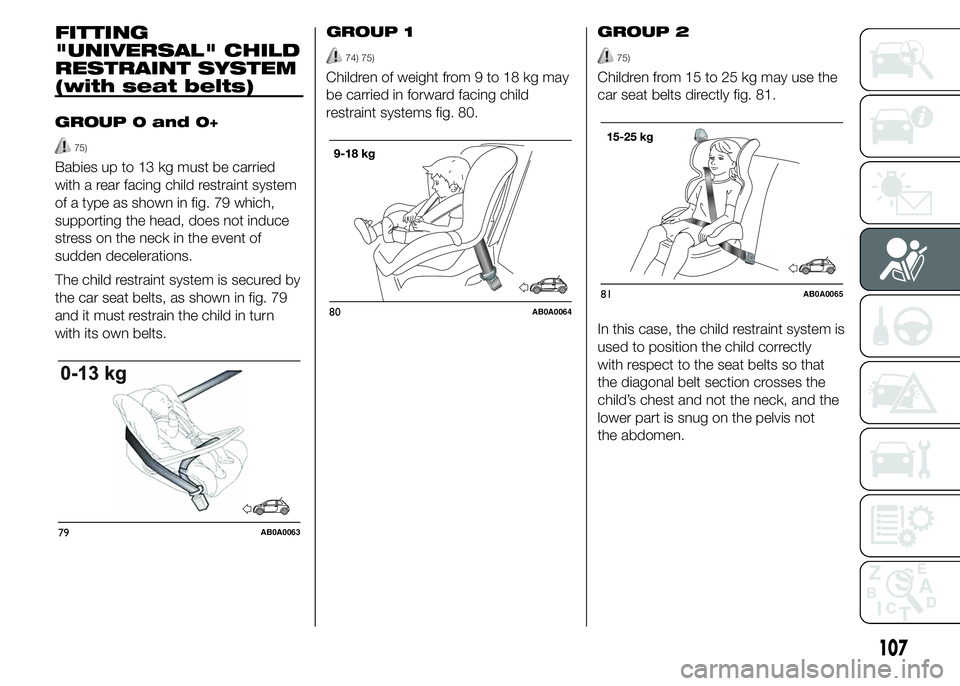
Babies up to 13 kg must be carried
with a rear facing child restraint system
of a type as shown in fig. 79 which,
supporting the head, does not induce
stress on the neck in the event of
sudden decelerations.
The child restraint system is secured by
the car seat belts, as shown in fig. 79
and it must restrain the child in turn
with its own belts.GROUP 1
74) 75)
Children of weight from 9 to 18 kg may
be carried in forward facing child
restraint systems fig. 80.GROUP 2
75)
Children from 15 to 25 kg may use the
car seat belts directly fig. 81.
In this case, the child restraint system is
used to position the child correctly
with respect to the seat belts so that
the diagonal belt section crosses the
child’s chest and not the neck, and the
lower part is snug on the pelvis not
the abdomen.
79AB0A0063
80AB0A0064
81AB0A0065
107