belt Abarth 500 2017 Owner handbook (in English)
[x] Cancel search | Manufacturer: ABARTH, Model Year: 2017, Model line: 500, Model: Abarth 500 2017Pages: 192, PDF Size: 6.46 MB
Page 70 of 192

Group Weight groups
Group 1 9 - 18 kg
Group 2 15 - 25 kg
Group 3 22 - 36 kg
All restraint devices must bear the
certification data, together with the
control mark, on a label solidly fixed to
the child restraint system which must
never be removed.
Lineaccessori Abarth offers child
restraint systems for each weight
group. These devices are
recommended having been specifically
designed for Abarth cars.
FITTING A CHILD
RESTRAINT SYSTEM
WITH SEAT BELTS
82) 83) 84) 85)
The Universal child restraint systems
installed with the seat belts only are
type-approved on the basis of the ECE
R44 standard and are divided into
various weight groups.
WARNING The figures are indicative
and provided for assembly purposes
only. Fit the child restraint system
according to the instructions, which
must be included.WARNING Following an accident of a
certain gravity, it is recommended to
replace both the child restraint system
and the seat belt to which it was
bound.
GROUP 0 and 0+
Babies up to 13 kg must be carried
with a rear facing child restraint system
of a type as shown in fig. 57 which,
supporting the head, does not induce
stress on the neck in the event of
sudden decelerations.
The child restraint system is secured by
the vehicle seat belts, as shown in fig.
57 and it must restrain the child in
turn with its own belts.
GROUP 1
Children of weight from 9 to 18 kg may
be transported in forward facing child
restraint systems fig. 58.GROUP 2
Children from 15 to 25 kg may be
restrained directly by the car seat belts
fig. 59.
In this case, the child restraint system is
used to position the child correctly
with respect to the seat belts so that
the diagonal belt section crosses the
child’s chest and not the neck, and the
lower part is snug on the pelvis not
the abdomen.
57AB0A0063C
9-18 kg
58AB0A0064C
59AB0A0065C
68
SAFETY
Page 71 of 192
GROUP 3
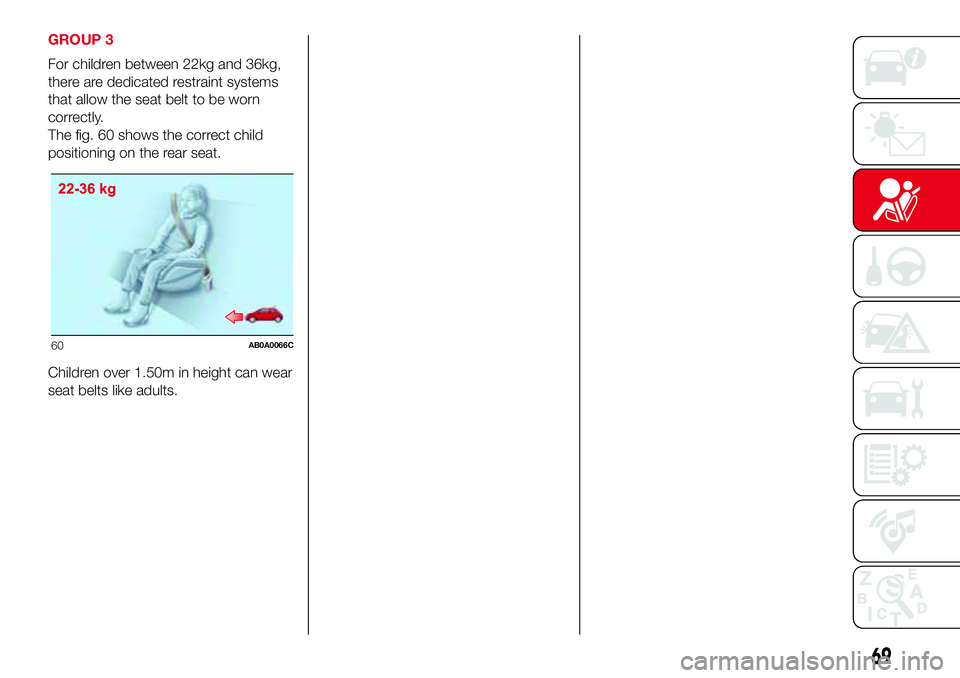
For children between 22kg and 36kg,
there are dedicated restraint systems
that allow the seat belt to be worn
correctly.
The fig. 60 shows the correct child
positioning on the rear seat.
Children over 1.50m in height can wear
seat belts like adults.
60AB0A0066C
69
Page 73 of 192
INSTALLING AN ISOFIX
CHILD CARSEAT
86) 87) 88) 89) 90)
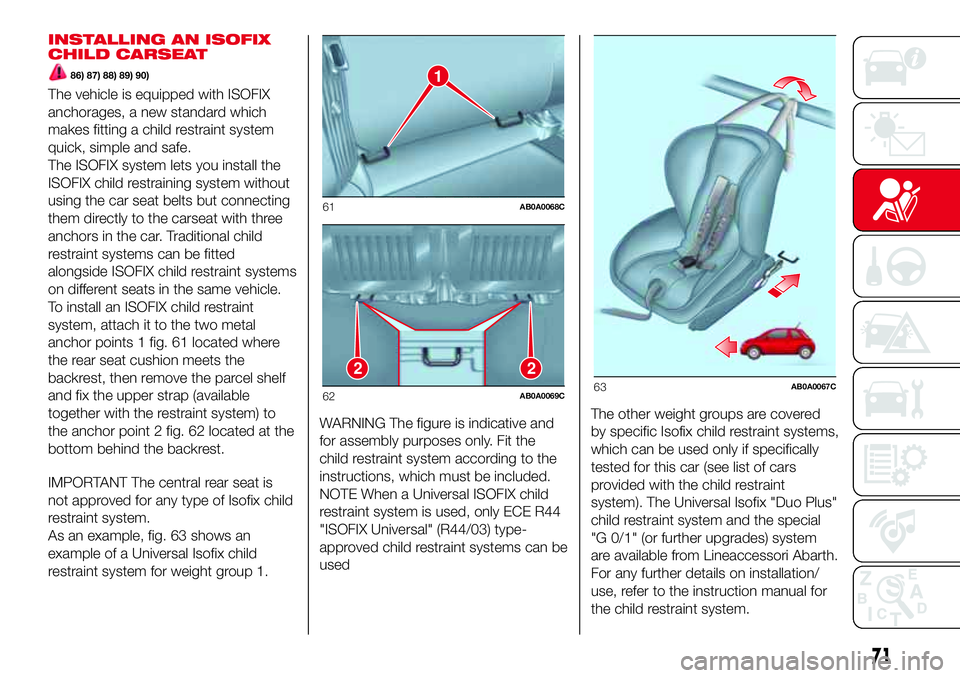
The vehicle is equipped with ISOFIX
anchorages, a new standard which
makes fitting a child restraint system
quick, simple and safe.
The ISOFIX system lets you install the
ISOFIX child restraining system without
using the car seat belts but connecting
them directly to the carseat with three
anchors in the car. Traditional child
restraint systems can be fitted
alongside ISOFIX child restraint systems
on different seats in the same vehicle.
To install an ISOFIX child restraint
system, attach it to the two metal
anchor points 1 fig. 61 located where
the rear seat cushion meets the
backrest, then remove the parcel shelf
and fix the upper strap (available
together with the restraint system) to
the anchor point 2 fig. 62 located at the
bottom behind the backrest.
IMPORTANT The central rear seat is
not approved for any type of Isofix child
restraint system.
As an example, fig. 63 shows an
example of a Universal Isofix child
restraint system for weight group 1.WARNING The figure is indicative and
for assembly purposes only. Fit the
child restraint system according to the
instructions, which must be included.
NOTE When a Universal ISOFIX child
restraint system is used, only ECE R44
"ISOFIX Universal" (R44/03) type-
approved child restraint systems can be
usedThe other weight groups are covered
by specific Isofix child restraint systems,
which can be used only if specifically
tested for this car (see list of cars
provided with the child restraint
system). The Universal Isofix "Duo Plus"
child restraint system and the special
"G 0/1" (or further upgrades) system
are available from Lineaccessori Abarth.
For any further details on installation/
use, refer to the instruction manual for
the child restraint system.
1
61AB0A0068C
22
62AB0A0069C63AB0A0067C
71
Page 75 of 192
Main recommendations to carry
children safely
Install the child restraint systems on
the rear seat, which is the most
protected position in the event of an
impact.
Keep children in rear facing child
restraint systems for as long as
possible, at least until 2 years old.
Should a rearward facing child
restraint system be installed on the rear
seats, it is advisable to position it as
far forward as the position of the front
seat allows.
If the passenger's front airbag is
deactivated always check the
permanent switching on of the
warning light to make sure that it
has actually been deactivated.
Carefully follow the instructions
supplied with the child restraint system.
Keep the instructions in the vehicle
along with the other documents and
this handbook. Do not use second-
hand child restraint systems without
instructions.
Only one child is to be strapped into
each restraint system; never carry two
children simultaneously.
Always check that the seat belts do
not rest on the child’s neck.
Always check that the seat belt is
well fastened by pulling on it.
While travelling, do not let the child
sit incorrectly or unfasten the belts.
Never allow a child to put the belt's
diagonal section under an arm or
behind their back.
Never carry children on your lap,
even newborns. No one can hold
a child in the case of an accident.
In the event of an accident, replace
the child restraint system with a new
one. In addition, and depending on the
type of child restraint system installed,
replace the isofix anchorages or the
seat belt with which the child restraint
system was connected.
WARNING
78)SEVERE DANGER. When an active
passenger airbag is fitted, DO NOT install
rear facing child restraint systems on
the front seat. Deployment of the airbag in
an accident could cause fatal injuries to
the child regardless of the severity of
the impact. It is advisable to always carry
children in a child restraint system on
the rear seat, which is the most protected
position in the event of a collision.
79)On the sun visor there is a label with
suitable symbols reminding the user that it
is compulsory to deactivate the airbag if
a rearward facing child restraint system is
fitted. Always comply with the instructions
on the passenger side sun visor (see the
"Front airbags" paragraph).80)Should it be necessary to carry a child
on the passenger side front seat in a rear
facing child restraint system, the passenger
side front and side airbags must be
deactivated through the display main
menu, verifying deactivation by checking
that the
warning light located in the
central part of the dashboard has switched
on. Move the passenger's seat as far
back as possible to avoid contact between
the child seat and the dashboard.
81)Do not move the front or rear seat if a
child is seated on it or on the dedicated
child restraint system.
82)Child restraint systems with ISOFIX
attachments are available for safely
anchoring to the seat without using the car
seat belts. See paragraph "Installing an
Isofix child carseat" for the fitting
instructions.
83)Incorrect fitting of the child restraint
system may result in an inefficient
protection system. In the event of an
accident the child restraint system may
become loose and the child may be
injured, even fatally. When fitting a restraint
system for newborns or children, strictly
comply with the instructions provided
by the Manufacturer.
84)When the child restraint system is not
used, secure it with the seat belt or with
the ISOFIX anchorages, or remove it from
the vehicle. Do not leave it unsecured
inside the passenger compartment. In this
way, in the event of sudden braking or
an accident, it will not cause injuries to the
occupants.
73
Page 76 of 192
85)After installing a child restraint system,
do not move the seat: always remove
the child restraint system before making
any adjustment.
86)If a Universal Isofix child seat is not
fixed to all three anchorages, the child seat
will not be able to protect the child
correctly. In a crash, the child could be
seriously or fatally injured.
87)Fit the child restraint system when the
car is stationary. The child restraint system
is correctly fixed to the brackets when
you hear the click. Follow the instructions
for assembly, disassembly and positioning
that the Manufacturer must supply with
the child restraint system.
88)Always make sure that the chest
section of the seat belt does not pass
under the arms or behind the back of the
child. In the event of an accident the seat
belt will not be able to secure the child,
with the risk of injury, including fatal injury.
Therefore the child must always wear
the seat belt correctly.
89)Do not use the same lower anchorage
to install more than one child restraint
system.
90)If the vehicle was involved in an
accident of a certain severity, have the
ISOFIX anchorages and the child restraint
system replaced.
91)If the vehicle was involved in an
accident of a certain severity, have both the
child restraint system and the seat belt it
was attached to replaced.SUPPLEMENTARY
RESTRAINT SYSTEM
(SRS) – AIRBAG
The vehicle may be equipped with:
front driver airbag;
front passenger airbag;
driver's side knee bag;
driver and passenger front side bags
for pelvis, chest and shoulder
protection (Side bags);
side bags for head protection of
front seat passengers and rear side
seat passengers (window bag).
FRONT AIRBAGS
92) 109)
The front driver/passenger airbags and
the driver's knee bag (where provided)
protect the front seat occupants in
the event of frontal impacts of
medium/high severity, by placing the
bag between the occupant and the
steering wheel or dashboard.
Therefore non-activation of airbags in
other types of collisions (side impacts,
rear shunts, roll-overs, etc.) does not
indicate a system malfunction.
An electronic control unit will make the
bag inflate in the event of a frontal
impact.The bag will inflate instantaneously
placing itself between the front
occupants body and the structures
which could cause injury. It will deflate
immediately afterwards.
Front airbags are not a replacement of
but complementary to the seat belts,
which you are recommended to always
wear, as specified by law in Europe
and most non-European countries.
In the event of an impact, someone not
wearing a seat belt will move forward
and come into contact with the bag
which is still in the opening stage. The
protection offered by the bag is
compromised in these circumstances.
Front airbags may not activate in the
following situations:frontal impacts against highly
deformable objects not involving the
front surface of the car (e.g. wing
collision against guard rail);
vehicle wedging under other vehicles
or protective barriers (e.g. trucks or
guard rails).
Failure to activate in the conditions
described above is due to the fact that
they may not provide any additional
protection compared with seat belts, so
their activation would be inappropriate.
In these cases, non-deployment does
not indicate a system malfunction.
74
SAFETY
Page 77 of 192
The front airbags (driver, passenger,
driver's knee bags) are designed and
calibrated to protect front seat
passengers wearing seat belts.
Their volume at the moment of
maximum inflation fills most of the
space between the steering wheel and
the driver, between the lower post
guard and the knees on passenger side
and between the dashboard and the
passenger.
The airbags are not deployed in the
event of minor frontal impacts (for
which the restraining action of the seat
belts is sufficient). Seat belts must
always be worn. In the event of frontal
impacts they guarantee correct
positioning of the passenger.
Front airbag driver's side
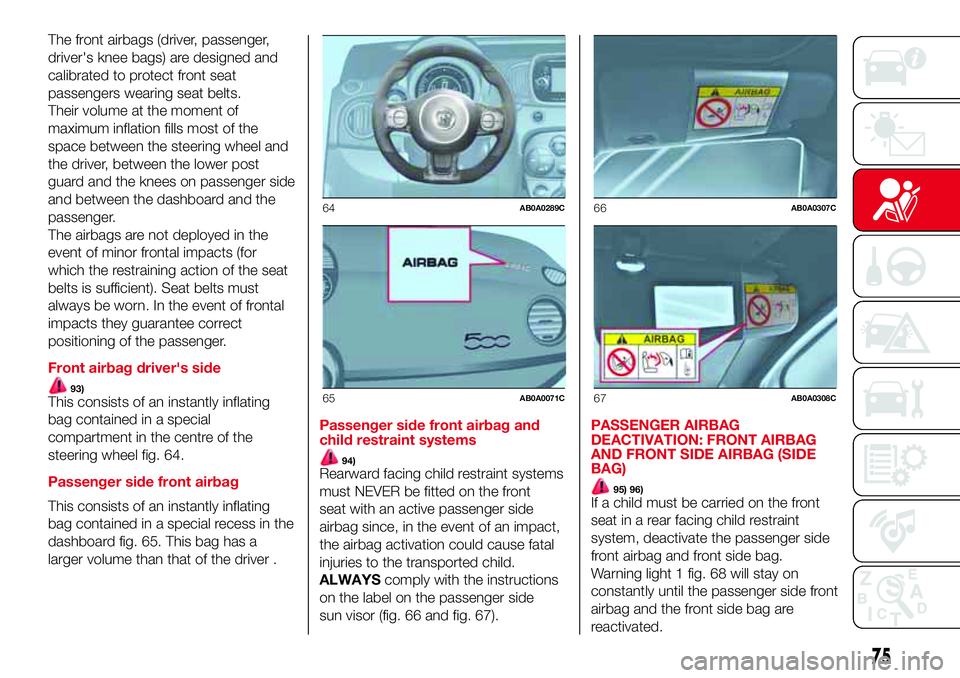
93)This consists of an instantly inflating
bag contained in a special
compartment in the centre of the
steering wheel fig. 64.
Passenger side front airbag
This consists of an instantly inflating
bag contained in a special recess in the
dashboard fig. 65. This bag has a
larger volume than that of the driver .Passenger side front airbag and
child restraint systems
94)Rearward facing child restraint systems
must NEVER be fitted on the front
seat with an active passenger side
airbag since, in the event of an impact,
the airbag activation could cause fatal
injuries to the transported child.
ALWAYScomply with the instructions
on the label on the passenger side
sun visor (fig. 66 and fig. 67).PASSENGER AIRBAG
DEACTIVATION: FRONT AIRBAG
AND FRONT SIDE AIRBAG (SIDE
BAG)95) 96)If a child must be carried on the front
seat in a rear facing child restraint
system, deactivate the passenger side
front airbag and front side bag.
Warning light 1 fig. 68 will stay on
constantly until the passenger side front
airbag and the front side bag are
reactivated.
64AB0A0289C
65AB0A0071C
66AB0A0307C
67AB0A0308C
75
Page 82 of 192

102)When the ignition key is turned to
MAR, thewarning light switches for few
seconds, then if the passenger airbag
protection is active it should switch off.
103)Do not wash the seats with water or
pressurised steam (wash by hand or at
automatic seat washing stations).
104)The airbag deployment threshold is
higher than that of the pretensioners.
For collisions in the range between the two
thresholds, it is normal for only the
pretensioners to be activated.
105)Do not affix rigid objects to the
garment hooks or support handles.
106)The airbag does not replace seat
belts but increases their efficiency.
Furthermore, since front airbags are not
deployed in low-speed frontal impacts,
side impacts, rear shunts or roll-overs, the
passengers are protected only by the
seat belts which must therefore be
fastened at all times.
107)Do not rest your head, arms or
elbows on the door, on the windows or in
the window bag area to prevent injury
during deployment.
108)Never lean your head, arms or elbows
out of the window.
109)Do not travel carrying objects in your
lap, in front of your chest or between
your lips (pipe, pencils, etc.): they could
cause severe injury if the airbag is
deployed.
80
SAFETY
Page 117 of 192
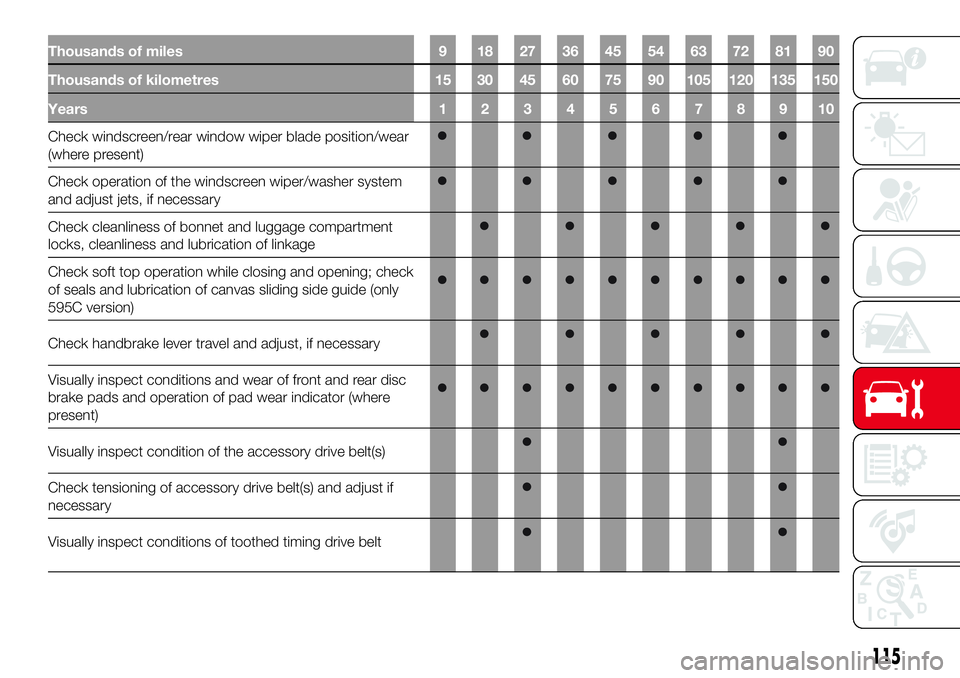
Thousands of miles 9 18 27 36 45 54 63 72 81 90
Thousands of kilometres 15 30 45 60 75 90 105 120 135 150
Years 1 2 3 4 5 6 7 8 9 10
Check windscreen/rear window wiper blade position/wear
(where present)
Check operation of the windscreen wiper/washer system
and adjust jets, if necessary
Check cleanliness of bonnet and luggage compartment
locks, cleanliness and lubrication of linkage
Check soft top operation while closing and opening; check
of seals and lubrication of canvas sliding side guide (only
595C version)
Check handbrake lever travel and adjust, if necessary
Visually inspect conditions and wear of front and rear disc
brake pads and operation of pad wear indicator (where
present)
Visually inspect condition of the accessory drive belt(s)
Check tensioning of accessory drive belt(s) and adjust if
necessary
Visually inspect conditions of toothed timing drive belt
115
Page 119 of 192
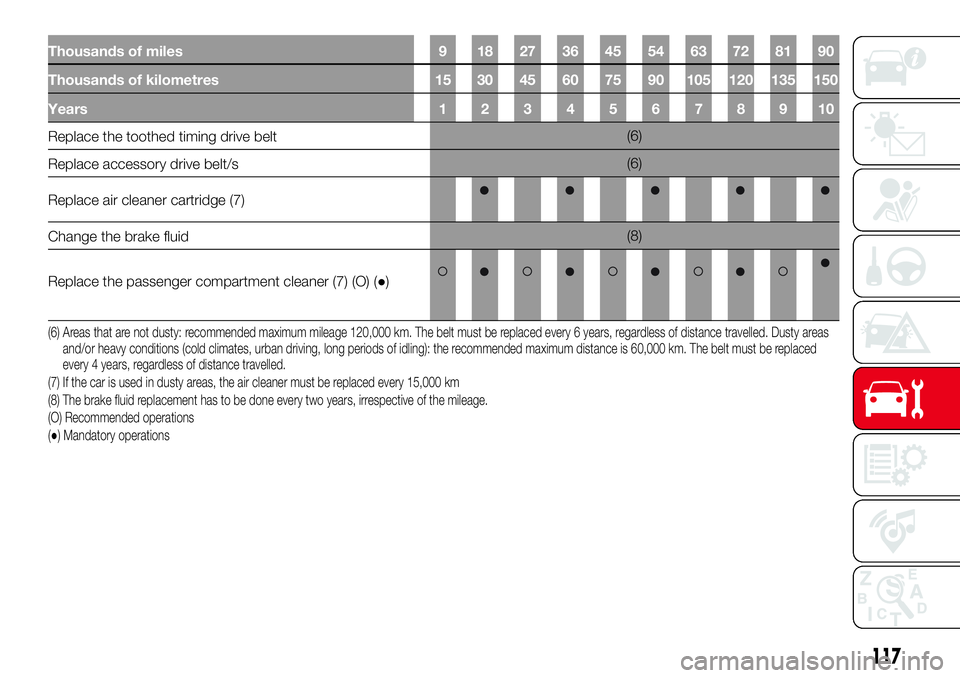
Thousands of miles 9 18 27 36 45 54 63 72 81 90
Thousands of kilometres 15 30 45 60 75 90 105 120 135 150
Years 1 2 3 4 5 6 7 8 9 10
Replace the toothed timing drive belt(6)
Replace accessory drive belt/s(6)
Replace air cleaner cartridge (7)
Change the brake fluid(8)
Replace the passenger compartment cleaner (7) (O) (●)
(6) Areas that are not dusty: recommended maximum mileage 120,000 km. The belt must be replaced every 6 years, regardless of distance travelled. Dustyareas
and/or heavy conditions (cold climates, urban driving, long periods of idling): the recommended maximum distance is 60,000 km. The belt must be replaced
every 4 years, regardless of distance travelled.
(7) If the car is used in dusty areas, the air cleaner must be replaced every 15,000 km
(8) The brake fluid replacement has to be done every two years, irrespective of the mileage.
(O) Recommended operations
(●) Mandatory operations
117
Page 120 of 192
PERIODIC CHECKS
Every 1,000 km or before long
journeys, check and, if necessary, top
up the following:
engine coolant level;
brake fluid level;
windscreen washer fluid level;
tyre inflation pressure and condition;
operation of lighting system
(headlights, direction indicators, hazard
warning lights, etc.);
operation of screen washer/wiper
system and positioning/wear of
windscreen/rear window wiper blades.
Every 3,000 km check and top up if
required: engine oil level.
You are advised to use PETRONAS
LUBRICANTS products, which have
been designed and produced
specifically for Abarth cars (see table
"Capacities" in the "Technical
specifications" chapter).
DEMANDING USE OF
THE CAR
If the vehicle is used mainly under one
of the following conditions:
if the car is used under demanding
conditions, e.g. on track;
towing a trailer or caravan;
dusty roads;
short, repeated journeys (less than
7-8 km) at sub-zero outside
temperatures;
engine often idling or driving long
distances at low speeds or long periods
of inactivity;
the following checks must be carried
out more often than indicated in the
Scheduled Servicing Plan:
check front disc brake pad condition
and wear;
check cleanliness of bonnet and
luggage compartment locks,
cleanliness and lubrication of linkage;
visually inspect condition of: engine,
gearbox, transmission, pipes and
hoses (exhaust - fuel system - brakes)
and rubber elements (boots - sleeves
- bushes - etc.);
check battery charge and battery
fluid level (electrolyte);
visually inspect conditions of the
accessory drive belts;
check and, if necessary, change
engine oil and replace oil filter;
check and, if necessary, replace
pollen filter;
check and, if necessary, replace air
cleaner.
118
SERVICING AND CARE