belt Abarth 500 2017 Owner handbook (in English)
[x] Cancel search | Manufacturer: ABARTH, Model Year: 2017, Model line: 500, Model: Abarth 500 2017Pages: 192, PDF Size: 6.46 MB
Page 19 of 192
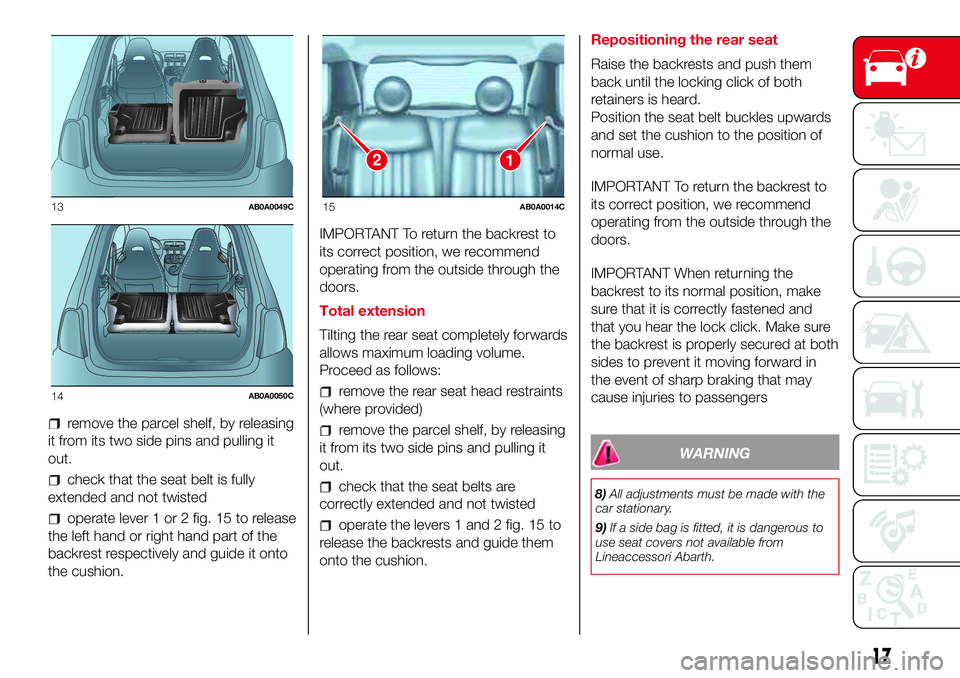
remove the parcel shelf, by releasing
it from its two side pins and pulling it
out.
check that the seat belt is fully
extended and not twisted
operate lever 1 or 2 fig. 15 to release
the left hand or right hand part of the
backrest respectively and guide it onto
the cushion.IMPORTANT To return the backrest to
its correct position, we recommend
operating from the outside through the
doors.
Total extension
Tilting the rear seat completely forwards
allows maximum loading volume.
Proceed as follows:
remove the rear seat head restraints
(where provided)
remove the parcel shelf, by releasing
it from its two side pins and pulling it
out.
check that the seat belts are
correctly extended and not twisted
operate the levers 1 and 2 fig. 15 to
release the backrests and guide them
onto the cushion.Repositioning the rear seat
Raise the backrests and push them
back until the locking click of both
retainers is heard.
Position the seat belt buckles upwards
and set the cushion to the position of
normal use.
IMPORTANT To return the backrest to
its correct position, we recommend
operating from the outside through the
doors.
IMPORTANT When returning the
backrest to its normal position, make
sure that it is correctly fastened and
that you hear the lock click. Make sure
the backrest is properly secured at both
sides to prevent it moving forward in
the event of sharp braking that may
cause injuries to passengers
WARNING
8)All adjustments must be made with the
car stationary.
9)If a side bag is fitted, it is dangerous to
use seat covers not available from
Lineaccessori Abarth.
13AB0A0049C
14AB0A0050C
12
15AB0A0014C
17
Page 40 of 192
KNOWING THE INSTRUMENT PANEL
This section of the handbook gives you
all the information you need to
understand, interpret and use the
instrument panel correctly.CONTROL PANEL AND
ON-BOARD INSTRUMENTS ........... 39
MENU OPTIONS ............................. 41
TRIP COMPUTER ........................... 42
WARNING LIGHTS AND
MESSAGES .................................... 45
-SEAT BELTS NOT FASTENED ........... 45
-EBD FAILURE .................................... 45
-AIRBAG FAILURE ............................... 46
-LOW BRAKE FLUID/HANDBRAKE
ENGAGED........................................... 46
-“DUALDRIVE” ELECTRIC POWER
STEERING FAILURE ............................ 47
-BRAKE PAD WEAR ............................ 47
-ESC SYSTEM .................................... 48
-INJECTION / EOBD SYSTEM
FAILURE .............................................. 48
-REAR FOG LIGHT .............................. 49
-ABS FAILURE..................................... 49
-iTPMS ................................................ 49
-SIDE LIGHTS AND DIPPED BEAM
HEADLIGHTS/FOLLOW ME HOME ..... 50
-FRONT FOG LIGHTS ......................... 50
- LEFT DIRECTION INDICATOR ........... 50
-RIGHT DIRECTION INDICATOR ......... 50
-MAIN BEAM HEADLIGHTS ................ 50
-DOORS/BONNET/LUGGAGE
COMPARTMENT OPEN ...................... 51
- LOW BATTERY CHARGE .................. 51
-INSUFFICIENT ENGINE OIL
PRESSURE/ENGINE OIL
DETERIORATED .................................. 51
-ENGINE COOLANT TEMPERATURE
TOO HIGH........................................... 52
- ROBOTISED SEQUENTIAL
GEARBOX FAILURE ............................ 52
-SPEED LIMIT EXCEEDED .................. 52- POSSIBLE ICE ON ROAD ................. 53
-PARKING SENSOR FAILURE ............. 53
-SERVICE (SCHEDULED SERVICING)
EXPIRED ............................................. 53
-ASR SYSTEM .................................... 53
-HILL HOLDER FAILURE ..................... 53
-FUEL CUT-OFF SYSTEM.................... 53
-FUEL CUT-OFF SYSTEM FAILURE ..... 54
-EXTERIOR LIGHTS FAILURE .............. 54
-BRAKE LIGHT FAILURE ..................... 54
-FIAT CODE SYSTEM FAILURE ........... 54
- FUEL RESERVE - LIMITED RANGE ... 55
-ENGINE OIL PRESSURE SENSOR
FAILURE INDICATOR........................... 55
-OIL CHANGE ..................................... 55
-PRESS THE CLUTCH PEDAL TO
START ................................................. 55
-FUEL LEVEL SENSOR FAILURE......... 55
-HEADLIGHT ALIGNMENT
CORRECTOR ...................................... 55
38
KNOWING THE INSTRUMENT PANEL
Page 44 of 192
NoteButtons+and–activate different
functions according to the following
situations:
within the menu, they allow you to
scroll up or down through the options;
during setting operations, they
increase or decrease values.
The menu comprises the following
functions:
LIGHTING: adjusts the dashboard
and instrument panel lighting
SPEED BEEP: sets the vehicle
speed limit (km/h or mph). The driver is
alerted when this speed is exceeded.
TRIP B ACTIVATION/DATA: activates
(”On”) and deactivates (”Off”) the Trip
B display (partial trip counter)
SET TIME: set the display clock
SET DATE: sets the display date
AUTOCLOSE: enables or disables
automatic door locking on exceeding a
speed of 20 km/h
MEASUREMENT UNITS: sets the
measurement units for distance and
fuel consumption
LANGUAGE: sets the display
language
WARNING VOLUME: sets the
volume (on 8 levels) of the audible
warning (buzzer) that accompanies the
failure/warning display
SEAT BELT BUZZER: reactivation of
the SBR buzzer (displayed only if the
SBR system was disabled by the
Abarth Dealership)
SERVICE: displays mileage intervals
for scheduled servicing
AIRBAG/PASSENGER BAG:
enables/disables the passenger side
airbag
DAYTIME RUNNING LIGHTS:
enables/disables daytime running lights
ITPMS RESET: resets the iTPMS
system (”self-learning”, see the “iTPMS
System” paragraph)
SEE RADIO (if present): enables/
disables duplicating some of the radio
information shown on theUconnect™
system display on the instrument panel
display.
SEE PHONE (if present): enables/
disables duplicating some of the call
information shown on theUconnect™
system display on the instrument panel
display.
SEE NAVIGATION (if present):
enables/disables duplicating some of
the navigation information shown on
theUconnect™system display on the
instrument panel display.
EXIT MENU
TRIP COMPUTER
The Trip computer is used to display
information on car operation when the
key is turned to MAR.
This function is characterised by two
separate memories, called "Trip A" and
"Trip B", where the car's "complete
missions" (journeys) are recorded in a
reciprocally independent manner, as
well as, for versions where present,
"Instant info" and "Best average
consumption".
Both memories can be reset: i.e. start
of a new journey.
"Trip A" can be used to display the
values relating to:
Range (where present)
Distance travelled A
Average consumption A
Instantaneous fuel consumption
(where present)
Average speed A
Trip time A (driving time)
Reset Trip A.
“Trip B” may be used to display the
figures relating to:
Distance travelled B
Average consumption B
Average speed B
Trip time B (driving time)
Reset Trip B.
42
KNOWING THE INSTRUMENT PANEL
Page 47 of 192
WARNING LIGHTS AND MESSAGES
IMPORTANT The warning light switches on in the instrument panel together with a dedicated message and/or acoustic signal
when applicable. These indications are indicative and precautionary and as such must not be considered as exhaustive and/or
alternative to the information contained in the Owner Handbook, which you are advised to read carefully in all cases. Always
refer to the information in this section in the event of a failure indication.
IMPORTANT Failure indications displayed are divided into two categories: very serious and less serious failures. Serious faults
are indicated by a repeated and prolonged warning "cycle". Less serious faults are indicated by a warning "cycle" with a shorter
duration. The display cycle of both categories can be interrupted. The instrument panel warning light will stay on until the
cause of the malfunction is eliminated.
WARNING LIGHTS ON INSTRUMENT PANEL
Warning light What it means
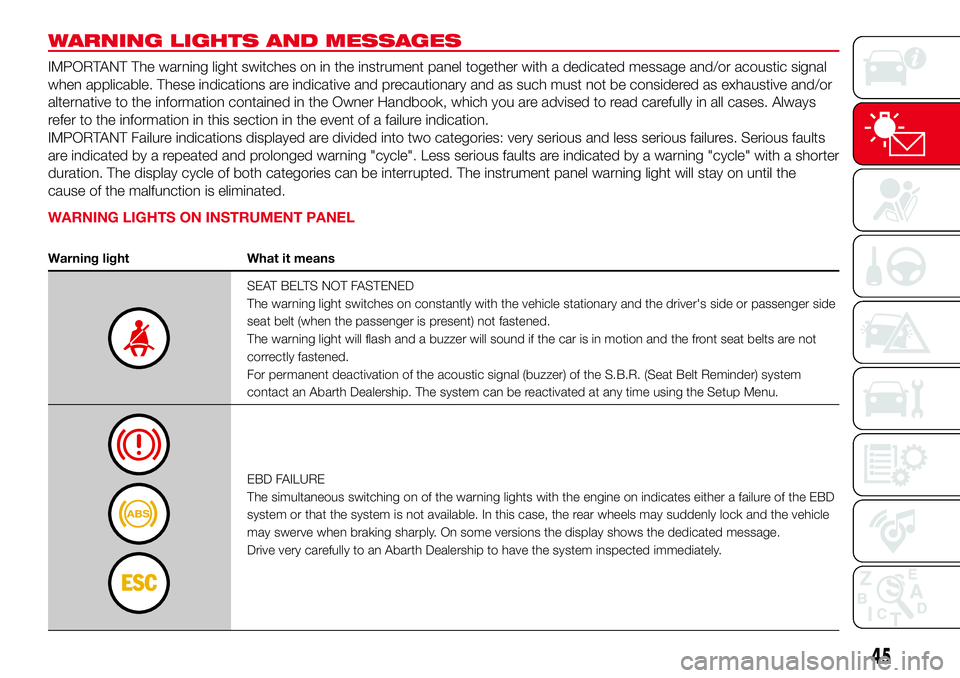
SEAT BELTS NOT FASTENED
The warning light switches on constantly with the vehicle stationary and the driver's side or passenger side
seat belt (when the passenger is present) not fastened.
The warning light will flash and a buzzer will sound if the car is in motion and the front seat belts are not
correctly fastened.
For permanent deactivation of the acoustic signal (buzzer) of the S.B.R. (Seat Belt Reminder) system
contact an Abarth Dealership. The system can be reactivated at any time using the Setup Menu.
EBD FAILURE
The simultaneous switching on of the warning lights with the engine on indicates either a failure of the EBD
system or that the system is not available. In this case, the rear wheels may suddenly lock and the vehicle
may swerve when braking sharply. On some versions the display shows the dedicated message.
Drive very carefully to an Abarth Dealership to have the system inspected immediately.
45
Page 59 of 192

SAFETY
The chapter that you are about to read
is very important: it describes the
safety systems with which the vehicle is
equipped and provides instructions on
how to use them correctly.ACTIVE SAFETY SYSTEMS ............ 58
ITPMS SYSTEM (INDIRECT TYRE
PRESSURE MONITORING
SYSTEM) ........................................ 61
OCCUPANT PROTECTION
SYSTEMS ....................................... 63
SEAT BELTS ................................... 64
SBR SYSTEM (SEAT BELT
REMINDER) .................................... 65
PRE-TENSIONERS ......................... 65
CHILD PROTECTION SYSTEMS ..... 67
SUPPLEMENTARY RESTRAINT
SYSTEM (SRS) – AIRBAG ............... 74
57
Page 65 of 192
In the case of abnormal signals, it is
recommended to perform the RESET
procedure. If the signals reappear once
the RESET procedure has started,
check that the type of tyres used are
the same on all four wheels and that
the tyres are not damaged; if the
space-saver wheel is being used, refit
the wheel with a tire with normal
dimensions instead of the space-saver
wheel as soon as possible; if possible
remove the snow chains; make sure
that the load is distributed correctly and
repeat the RESET procedure, driving
on a clean and surfaced road. If the
signals persist, contact an Abarth
Dealership.
WARNING
66)If the system signals a pressure
decrease on one or more tyres, it is
recommended to always check the
pressure on all four tyres.
67)The iTPMS does not relieve the driver
from the obligation to check the tyre
pressure every month; it is not to
be considered a system to replace
maintenance or a safety system.68)Tyre pressure must be checked with
tyres cold. Should it become necessary for
whatever reason to check pressure with
warm tyres, do not reduce pressure even
though it is higher than the prescribed
value, but repeat the check when tyres are
cold.
69)The iTPMS cannot indicate sudden
tyre pressure drops (for example when
a tyre bursts). In this case, stop the vehicle,
braking with caution and avoiding abrupt
steering.
70)The system only warns that the tyre
pressure is low: it is not able to inflate
them.
71)Insufficient tyre inflation increases fuel
consumption, reduces the tread duration
and may affect the capacity to drive safely.
OCCUPANT
PROTECTION
SYSTEMS
Some of the most important safety
equipment of the vehicle comprise the
following protection systems:
seat belts;
SBR (Seat Belt Reminder) system;
head restraints;
child restraint systems;
Front airbags and side bags (where
present).
Read the information given the
following pages with the utmost care. It
is of fundamental importance that the
protection systems are used in the
correct way to guarantee the maximum
possible safety level for the driver and
the passengers.
For the description of the head restraint
adjustment see the "Head restraints"
paragraph in the "Knowing your
vehicle" chapter.
63
Page 66 of 192

SEAT BELTS
USING THE SEAT BELTS
All vehicle seats are equipped with seat
belts with three anchor points and a
retractor.
The driver is responsible for respecting,
and ensuring that all the other
occupants of the vehicle also respect,
the local laws in force in relation to
the use of the seat belts.
Always fasten the seat belts before
setting off.
The belt should be worn keeping the
torso straight and rested against the
backrest.
To fasten the seat belts, hold the tab 1
fig. 52 and insert it into the buckle 2
fig. 52, until it clicks into place.
On removal, if the belt jams, let it rewind
for a short stretch, then pull it out
again without jerking.
Press button 3 fig. 52 to release the
belt.
Guide the belt while it is rewinding to
prevent it from twisting.The retractor mechanism operates
locking the belt in the event of sharp
braking or strong deceleration due
to an impact. This allows the belt strap
to slide freely and to adapt to the body
of the occupant. In the event of an
accident, the belt will lock reducing the
risk of impact inside the passenger
compartment and of being projected
outside the vehicle.
The retractor may lock when the vehicle
is parked on a steep slope: this is
perfectly normal. Furthermore, the reel
mechanism locks the belt if it is pulled
sharply or in the event of sudden
braking, collisions and high-speed
bends.
72) 73)
The rear seat is fitted with inertia seat
belts with three anchor points and a
retractor.Wear the rear seat belts as shown in
fig. 53.
IMPORTANT When putting the seats
back to their normal position, make
sure the seat belts are positioned
so they are ready to use.
WARNING
72)Never press button 3 when travelling.
73)Remember that in the event of an
accident, the rear seat passengers not
wearing seat belts are exposed to a very
serious risk and also represent a serious
danger for the front seat occupants.
1
32
52AB0A0059C
53AB0A0354C
64
SAFETY
Page 67 of 192

SBR SYSTEM (Seat
Belt Reminder)
The SBR system warns the front seat
occupants if their seat belt is not
fastened.
The system signals unfastened seat
belts with visual warnings (warning
lights on in the instrument panel and
icons on the display) and an acoustic
signal (see the following paragraphs).
NOTE Contact an Abarth Dealership to
deactivate this acoustic warning
permanently. The acoustic warning can
be reactivated at any time through the
display Setup Menu.
Seat belts warning light operation
The system warns the driver and the
front passenger if their seat belt is
not fastened, as follows:
flashingwarning light and
intermittent acoustic warning for about
100 seconds;
once the cycle has finished, the
warning light remains on constantly until
the seat belts are fastened.
PRE-TENSIONERS
The car is equipped with front seat
belts pretensioners, that reduce slack in
the belts in the event of a severe frontal
impact. This guarantees the perfect
adherence of the seat belts to the
occupants' bodies before the
restraining action begins.
The retractors lock to indicate that the
pretensioner has intervened.
This car is also equipped with a second
pretensioner (fitted in the kick plate
area). Its activation is signalled by the
shortening of the metal cable.
A slight discharge of smoke may be
produced during the activation of the
pretensioner which is not harmful and
does not involve any fire hazard.
IMPORTANT To obtain the highest
degree of protection from the action of
the pretensioner, wear the seat belt
tight to the chest and pelvis.
The pretensioner does not require any
maintenance or lubrication: any
changes to its original conditions will
invalidate its efficiency. If, due to
unusual natural events (floods, sea
storms, etc.), the device has been
affected by water and mud, it must be
replaced.
74)
14)
LOAD LIMITERS
To increase passenger safety, the front
seat belt reels contain a load limiter
which allows the force acting on the
chest and shoulders to be modulated
during the belt restraining action in
the event of a frontal impact.
GENERAL
INSTRUCTIONS FOR
USING THE SEAT BELTS
The driver must comply with (and have
all car passengers follow) any local
regulations in force concerning the use
of seat belts. Always fasten the seat
belts before setting off.
75) 76) 77)
Seat belts are also to be worn by
pregnant women: the risk of injury in
the case of accident is greatly reduced
for them and the unborn child if they
are wearing a seat belt.
Pregnant women must position the
lower part of the belt very low down so
that it passes over the pelvis and under
the abdomen (see fig. 54). While
pregnancy increases, the driver must
adjust both seat and steering wheel to
have full control over the vehicle (pedals
and steering wheel should be easily
accessed). The maximum clearance
should be kept between the abdomen
and the steering wheel.
65
Page 68 of 192

The belt must not be twisted. The
upper part must pass over the shoulder
and cross the chest diagonally. The
lower part must adhere to the pelvis fig.
55, not to the abdomen of the
occupant. Never use devices (clips,
clamps, etc.) that hold the seat belt
away from your body.IMPORTANT Each seat belt must be
used by only one person. Never travel
with a child sitting on the passenger's
lap and a single belt to protect them
both fig. 56. In general, do not place
any objects between the person and
the belt.
SEAT BELTS
MAINTENANCE
For keeping the seat belts in efficient
conditions, carefully observe the
following warnings:
always use the seat belt well
stretched and never twisted; make sure
that it is free to run without
obstructions;
check seat belt operation as follows:
attach the seat belt and pull it hard;
replace the belt after an accident of
a certain severity even if it does not
appear to be damaged. Always replace
the belt if the pretensioners were
deployed;
prevent the retractors from getting
wet: their correct operation is only
guaranteed if water does not get inside;
replace the seat belt when there is
wear or cuts.
WARNING
74)The pretensioner may be used only
once. Contact an Abarth Dealership to
have it replaced after it has been deployed.
75)For maximum safety, keep the back
of your seat upright, lean back into it and
make sure the seat belt fits closely across
your chest and pelvis. Always fasten the
seat belts on both the front and the rear
seats! Travelling without wearing seat belts
will increase the risk of serious injury or
even death in the event of an accident.
76)Removing or tampering with seat belt
and pretensioner components is strictly
prohibited. Any intervention on these
components must be performed by
qualified and authorised technicians.
Always contact an Abarth Dealership.
54AB0A0347C
55AB0A0348C
56AB0A0062C
66
SAFETY
Page 69 of 192

77)If the seat belt has been subjected to a
high level of stress, for example after an
accident, it must be completely replaced
together with the anchorages, anchorage
fixing screws and pretensioner. In fact,
even if the seat belt has no visible defects,
it could have lost its resilience.
WARNING
14)Operations which lead to impacts,
vibrations or localised heating (over 100°C
for a maximum of six hours) in the area
around the pretensioner may damage or
deploy it. Contact an Abarth Dealership
should intervention be necessary on these
components.
CHILD PROTECTION
SYSTEMS
CARRYING CHILDREN
SAFELY
78) 79) 80) 81) 91)
For optimal protection in the event of an
impact, all occupants must be seated
and wearing adequate restraint
systems, including newborn and
children!
This prescription is compulsory in all EC
countries according to EC Directive
2003/20/EC.
Children below the height of 1.50
metres and up to 12 years must be
protected with suitable restraint
systems and be seated on the rear
seats.
Statistics on accidents indicate that the
rear seats offer greater safety for
children.
Compared with an adult, a child's head
is larger and heavier in proportion to
their body and the child's muscular and
bone structures are not fully developed.
Therefore, correct restraint systems
other than adult seat belts are
necessary to reduce as much as
possible the risk of injuries in case of
accident, braking or sudden
manoeuvre.Children must be seated safely and
comfortably. Depending on the
characteristics of the child restraint
systems used, you are advised to keep
children in rearward facing child
restraint systems for as long as
possible (at least until 3-4 years old),
since this is the most protected position
in the event of an impact.
The choice of the most suitable child
restraint system depends on the weight
and size of the child. There are various
types of child restraint systems, which
can be secured to the vehicle by means
of the seat belts or with the ISOFIX
anchorages.
It is recommended to always choose
the restraint system most suitable
for the child; for this reason always refer
to the Owner Handbook provided with
the child restraint system, to be sure
that it is of the right type for the children
it is intended for.
In Europe the characteristics of child
restraint systems are ruled by the
regulation ECE-R44, dividing them into
five weight groups:
Group Weight groups
Group 0up to 10 kg in
weight
Group 0+up to 13 kg in
weight
67