check oil Abarth 500 2018 Owner handbook (in English)
[x] Cancel search | Manufacturer: ABARTH, Model Year: 2018, Model line: 500, Model: Abarth 500 2018Pages: 192, PDF Size: 5.86 MB
Page 6 of 192
VEHICLE CHANGES/ALTERATIONS
WARNING
Any change or alteration of the vehicle might seriously affect its safety and road holding, thus causing accidents, in which the
occupants could even be fatally injured
ACCESSORIES PURCHASED BY THE OWNER
If after buying the vehicle, you decide to install electrical accessories that require a permanent electrical supply (e.g. radio,
satellite anti-theft system, etc.) or accessories that in any case burden the electrical supply, contact an Abarth Dealership,
whose personnel will check whether the vehicle’s electrical system is able to withstand the load required, or whether it needs to
be integrated with a more powerful battery.
IMPORTANT Take care when fitting additional spoilers, alloy wheel rims or non-standard wheel hubs: they could reduce the
ventilation of the brakes and affect efficiency under sharp, repeated braking or on long descents. Make sure that nothing
obstructs the pedal stroke (mats, etc.).
INSTALLING ELECTRICAL/ELECTRONIC DEVICES
Electrical and electronic devices installed after buying the car in the context of after-sales service must carry the following label
.
FCA Italy S.p.A. authorises the installation of transceivers provided that installation is carried out at a specialised centre, in a
workmanlike fashion and in compliance with manufacturer's specifications.
IMPORTANT Traffic police may not allow the vehicle on the road if devices have been installed which modify the features of the
vehicle. This may also cause invalidation of warranty in relation to faults caused by the change either directly or indirectly related
to it.
FCA Italy S.p.A. shall not be liable for damage caused by the installation of accessories either not supplied or recommended by
FCA Italy S.p.A. and/or not installed in compliance with the provided instructions.
RADIO TRANSMITTERS AND MOBILE PHONES
Radio transmitter equipment (vehicle mobile phones, CB radios, amateur radio etc.) cannot be used inside the vehicle unless a
separate aerial is mounted externally.
Page 32 of 192
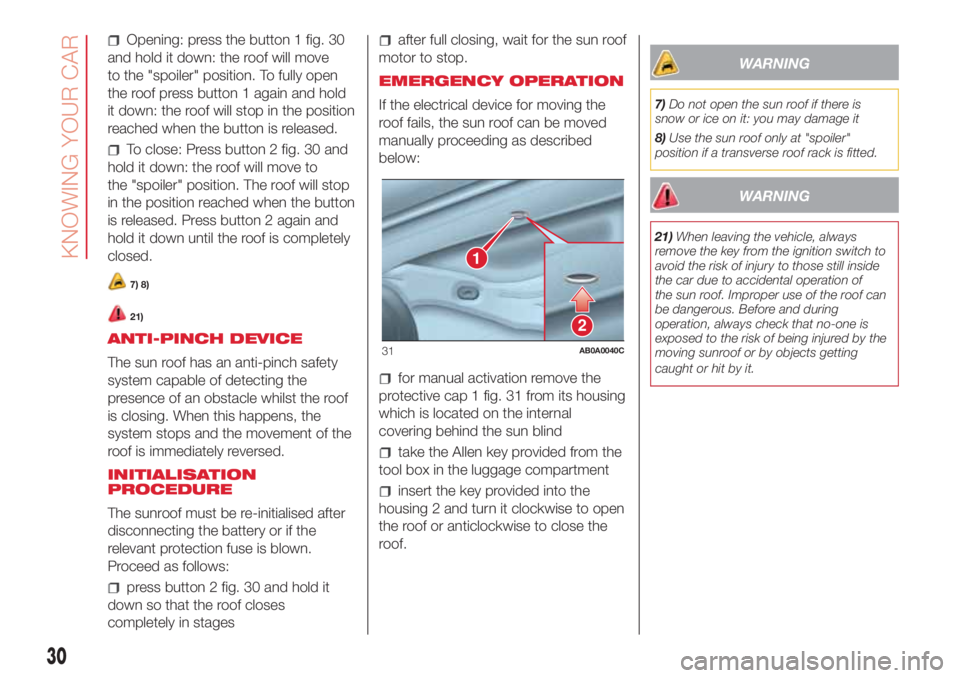
Opening: press the button 1 fig. 30
and hold it down: the roof will move
to the "spoiler" position. To fully open
the roof press button 1 again and hold
it down: the roof will stop in the position
reached when the button is released.
To close: Press button 2 fig. 30 and
hold it down: the roof will move to
the "spoiler" position. The roof will stop
in the position reached when the button
is released. Press button 2 again and
hold it down until the roof is completely
closed.
7) 8)
21)
ANTI-PINCH DEVICE
The sun roof has an anti-pinch safety
system capable of detecting the
presence of an obstacle whilst the roof
is closing. When this happens, the
system stops and the movement of the
roof is immediately reversed.
INITIALISATION
PROCEDURE
The sunroof must be re-initialised after
disconnecting the battery or if the
relevant protection fuse is blown.
Proceed as follows:
press button 2 fig. 30 and hold it
down so that the roof closes
completely in stages
after full closing, wait for the sun roof
motor to stop.
EMERGENCY OPERATION
If the electrical device for moving the
roof fails, the sun roof can be moved
manually proceeding as described
below:
for manual activation remove the
protective cap 1 fig. 31 from its housing
which is located on the internal
covering behind the sun blind
take the Allen key provided from the
tool box in the luggage compartment
insert the key provided into the
housing 2 and turn it clockwise to open
the roof or anticlockwise to close the
roof.
WARNING
7)Do not open the sun roof if there is
snow or ice on it: you may damage it
8)Use the sun roof only at "spoiler"
position if a transverse roof rack is fitted.
WARNING
21)When leaving the vehicle, always
remove the key from the ignition switch to
avoid the risk of injury to those still inside
the car due to accidental operation of
the sun roof. Improper use of the roof can
be dangerous. Before and during
operation, always check that no-one is
exposed to the risk of being injured by the
moving sunroof or by objects getting
caught or hit by it.
2
1
31AB0A0040C
30
KNOWING YOUR CAR
Page 36 of 192
FRONT SPOILER
The car is provided with a front spoiler
which can be raised to improve
aerodynamic comfort inside the
passenger compartment.
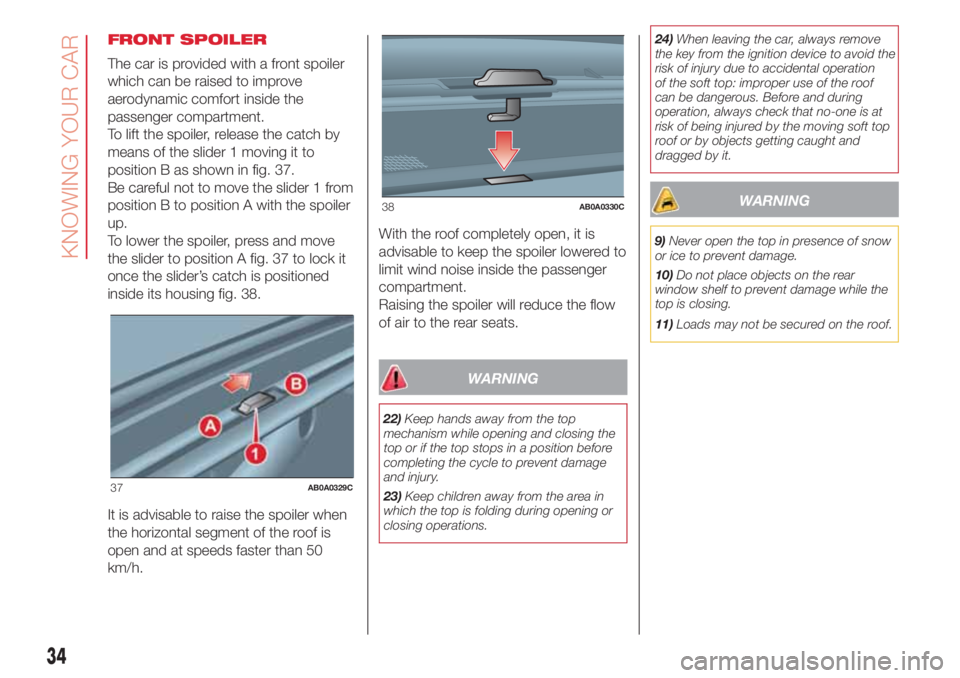
To lift the spoiler, release the catch by
means of the slider 1 moving it to
position B as shown in fig. 37.
Be careful not to move the slider 1 from
position B to position A with the spoiler
up.
To lower the spoiler, press and move
the slider to position A fig. 37 to lock it
once the slider’s catch is positioned
inside its housing fig. 38.
It is advisable to raise the spoiler when
the horizontal segment of the roof is
open and at speeds faster than 50
km/h.With the roof completely open, it is
advisable to keep the spoiler lowered to
limit wind noise inside the passenger
compartment.
Raising the spoiler will reduce the flow
of air to the rear seats.
WARNING
22)Keep hands away from the top
mechanism while opening and closing the
top or if the top stops in a position before
completing the cycle to prevent damage
and injury.
23)Keep children away from the area in
which the top is folding during opening or
closing operations.24)When leaving the car, always remove
the key from the ignition device to avoid the
risk of injury due to accidental operation
of the soft top: improper use of the roof
can be dangerous. Before and during
operation, always check that no-one is at
risk of being injured by the moving soft top
roof or by objects getting caught and
dragged by it.
WARNING
9)Never open the top in presence of snow
or ice to prevent damage.
10)Do not place objects on the rear
window shelf to prevent damage while the
top is closing.
11)Loads may not be secured on the roof.
37AB0A0329C
38AB0A0330C
34
KNOWING YOUR CAR
Page 57 of 192
Symbol What it means
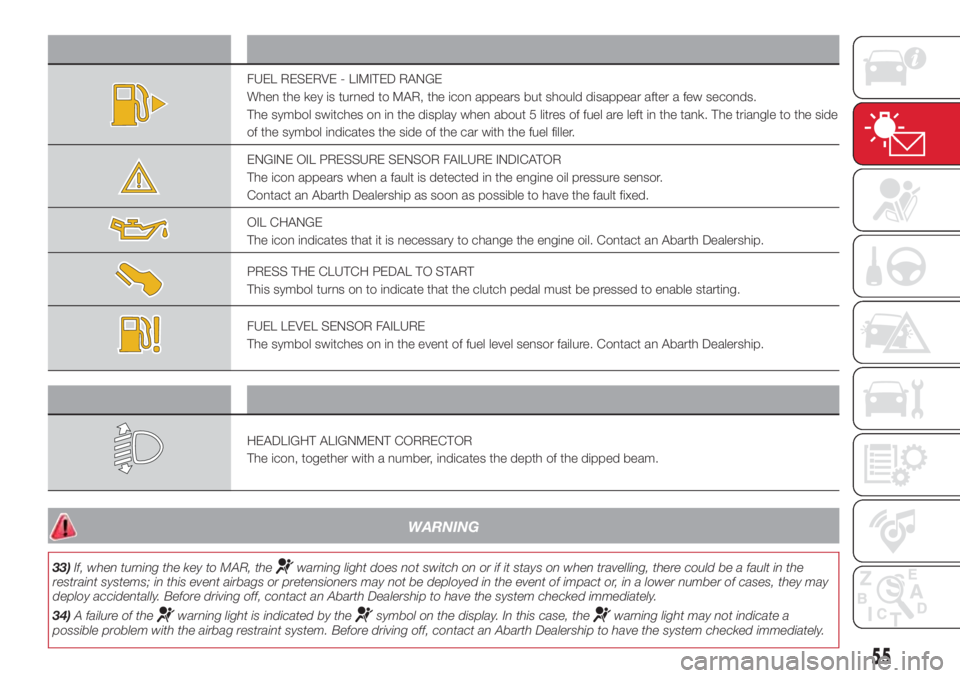
FUEL RESERVE - LIMITED RANGE
When the key is turned to MAR, the icon appears but should disappear after a few seconds.
The symbol switches on in the display when about 5 litres of fuel are left in the tank. The triangle to the side
of the symbol indicates the side of the car with the fuel filler.
ENGINE OIL PRESSURE SENSOR FAILURE INDICATOR
The icon appears when a fault is detected in the engine oil pressure sensor.
Contact an Abarth Dealership as soon as possible to have the fault fixed.
OIL CHANGE
The icon indicates that it is necessary to change the engine oil. Contact an Abarth Dealership.
PRESS THE CLUTCH PEDAL TO START
This symbol turns on to indicate that the clutch pedal must be pressed to enable starting.
FUEL LEVEL SENSOR FAILURE
The symbol switches on in the event of fuel level sensor failure. Contact an Abarth Dealership.
Symbol What it means
HEADLIGHT ALIGNMENT CORRECTOR
The icon, together with a number, indicates the depth of the dipped beam.
WARNING
33)If, when turning the key to MAR, thewarning light does not switch on or if it stays on when travelling, there could be a fault in the
restraint systems; in this event airbags or pretensioners may not be deployed in the event of impact or, in a lower number of cases, they may
deploy accidentally. Before driving off, contact an Abarth Dealership to have the system checked immediately.
34)A failure of the
warning light is indicated by thesymbol on the display. In this case, thewarning light may not indicate a
possible problem with the airbag restraint system. Before driving off, contact an Abarth Dealership to have the system checked immediately.
55
Page 114 of 192

SERVICE SCHEDULE
WARNING: Once you have carried out the last intervention in the table, continue with the scheduled servicing, maintaining the
frequency indicated in the plan by marking each operation with a dot or dedicated note.
Warning: simply restarting the maintenance from the start of the plan may cause the allowed interval to be exceeded for some
operations!
Thousands of miles 9 18 27 36 45 54 63 72 81 90
Thousands of kilometres 15 30 45 60 75 90 105 120 135 150
Years 1 2 3 4 5 6 7 8 9 10
Check the tyre condition/wear and, if necessary, adjust the
pressure. Check the "Fix&Go” kit condition/expiry (where
provided)
Check operation of lighting system (headlights, direction
indicators, hazard warning lights, boot, passenger
compartment, glove compartment, instrument panel
warning lights, etc.)
Check and, if necessary, top up fluid levels (1)
Check exhaust emissions
Use the diagnosis socket to check supply/engine
management system operation, emissions and, where
present, engine oil degradation
(1) Always only use the liquids shown in the handbook for topping up after having checked that the system is not damaged.
112
SERVICING AND CARE
Page 116 of 192

Thousands of miles 9 18 27 36 45 54 63 72 81 90
Thousands of kilometres 15 30 45 60 75 90 105 120 135 150
Years 1 2 3 4 5 6 7 8 9 10
Visually inspect conditions of toothed timing drive belt
Check the oil level in the robotised sequential gearbox
activation system (2)
Check and, if necessary, restore the self-locking differential
pre-loading (where present) (3)
Change the oil of the transmission equipped with limited
slip differential (where present)(3) (4)
Change engine oil and replace oil filter
Spark plug replacement (5)
(2) Only for cars on the road in countries with particularly severe climates (cold countries).
(3) It is recommended to carry out this operation immediately after each time the car has undergone demanding use
(4) The first transmission oil change must be done on reaching the first 10,000 km, independently of the time passed
(5) The following are essential to ensure correct operation and prevent serious damage to the engine: only use spark plugs of the same make and type specially
certified for 1.4 Turbo petrol Abarth engines (see the information in the "Engine" paragraph); strictly comply with the spark plug replacement interval given in the
Scheduled Servicing Plan; for spark plug replacement it is advisable to contact an Abarth Dealership.
114
SERVICING AND CARE
Page 118 of 192
PERIODIC CHECKS
Every 1,000 km or before long
journeys, check and, if necessary, top
up the following:
engine coolant level;
brake fluid level;
windscreen washer fluid level;
tyre inflation pressure and condition;
operation of lighting system
(headlights, direction indicators, hazard
warning lights, etc.);
operation of screen washer/wiper
system and positioning/wear of
windscreen/rear window wiper blades.
Every 3,000 km check and top up if
required: engine oil level.
You are advised to use PETRONAS
LUBRICANTS products, which have
been designed and produced
specifically for Abarth cars (see table
"Capacities" in the "Technical
specifications" chapter).
DEMANDING USE OF
THE CAR
If the car is used mainly under one of
the following conditions:
if the car is used under demanding
conditions, e.g. on track;
dusty roads;
short, repeated journeys (less than
7-8 Km) at sub-zero outdoor
temperatures;
engine often idling or driving long
distances at low speeds or long periods
of inactivity;
the following checks must be carried
out more often than indicated in the
Scheduled Servicing Plan:
check front disc brake pad condition
and wear;
check cleanliness of bonnet and
luggage compartment locks,
cleanliness and lubrication of linkage;
visually inspect conditions of:
engine, gearbox, transmission, pipes
and hoses (exhaust/fuel system/brakes)
and rubber elements (gaiters/sleeves/
bushes, etc.);
check battery charge and battery
fluid level (electrolyte);
visually inspect conditions of the
accessory drive belts;
check and, if necessary, change
engine oil and replace oil filter;
check and, if necessary, replace
pollen filter;
check and, if necessary, replace air
cleaner.
116
SERVICING AND CARE
Page 119 of 192
CHECKING LEVELS
29)
28) 133) 134).
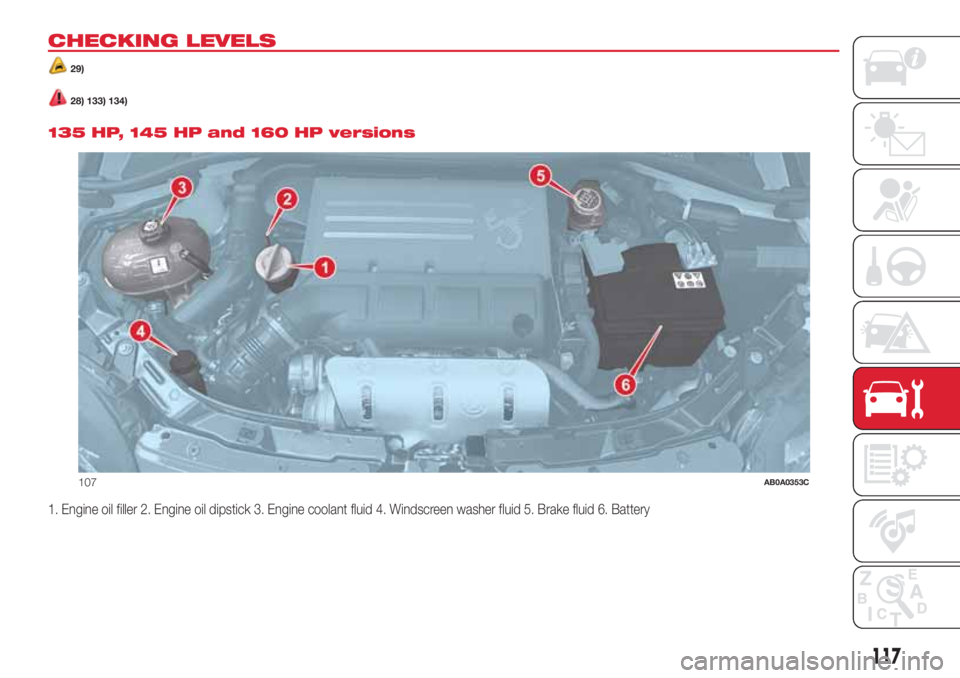
135 HP, 145 HP and 160 HP versions
1. Engine oil filler 2. Engine oil dipstick 3. Engine coolant fluid 4. Windscreen washer fluid 5. Brake fluid 6. Battery
107AB0A0353C
117
Page 121 of 192
ENGINE OIL
30)
4)
Check the oil level a few minutes (about
5) after the engine has stopped, with
the vehicle parked on level ground.
Take out the engine oil dipstick 2 fig.
107 or fig. 108, clean it with a lint-free
cloth and reinsert it. Extract the engine
oil dipstick again and check that the
level is between the MIN and MAX
marks on the dipstick.
The range between the MIN. and MAX.
marks corresponds to about 1 litre of
oil.
If the level of the oil is close to or below
the MIN mark, add oil via filler 1 fig.
107 or fig. 108 until the MAX mark is
reached.
The oil level must never exceed the
MAX reference.
Engine oil consumption
The maximum engine oil consumption
is usually 400 grams every 1000 km.
When the car is new, the engine needs
to run in, therefore the engine oil
consumption can only be considered
stabilised after the first 5000 - 6000
km.IMPORTANT The oil consumption
depends on driving style and the
conditions under which the car is used.
IMPORTANT After adding or changing
the oil, let the engine turn over for a few
seconds and wait a few minutes after
turning it off before you check the level.
ENGINE COOLANT FLUID
The coolant level must be checked
when the engine is cold and must
range between the MIN and MAX
marks on the reservoir.
If the level is too low, unscrew the cap 3
fig. 107 or fig. 108 of reservoir and
add the fluid described in the "Technical
Specifications" chapter.
31)
135)
WINDSCREEN/REAR
WINDOW WASHER FLUID
Check fluid level through the reservoir.
If the fluid level is too low, unscrew
the reservoir cap 4 fig. 107 or fig. 108
and add the fluid described in the
"Technical Specifications" chapter.
After topping up, close cap 4, making
sure it is correctly locked.BRAKE FLUID
Check that the fluid is at the maximum
level (the fluid level in the reservoir
must not exceed the MAX mark).
If the fluid level in the reservoir is too
low, undo the reservoir cap 5 fig. 107 or
fig. 108 and add the fluid described in
the "Technical Specifications" chapter.
137) 138)
32)
IMPORTANT Carefully clean reservoir
cap 5 and the surrounding surface.
Take great care to ensure that
impurities do not enter the reservoir
when the cap is opened.
Always use a funnel with a built-in filter
with a mesh of 0.12 mm or less.
IMPORTANT Brake fluid is hygroscopic
(i.e. it absorbs moisture). For this
reason, if the car is mainly used in areas
with a high degree of atmospheric
humidity, the fluid must be replaced at
more frequent intervals than specified in
the "Scheduled Servicing Plan".
119
Page 126 of 192
Rear window washer
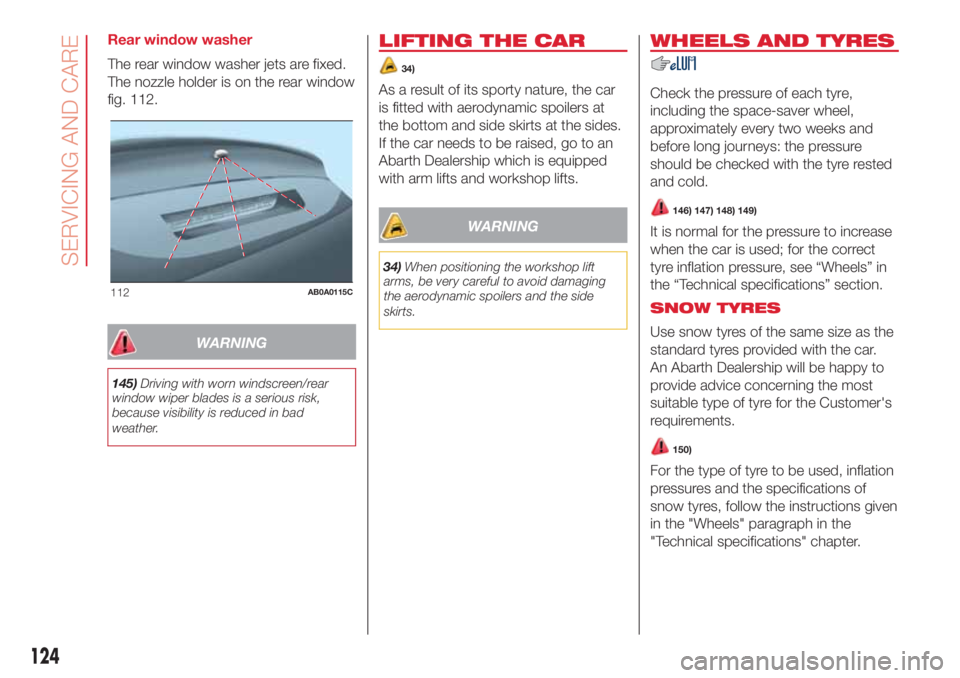
The rear window washer jets are fixed.
The nozzle holder is on the rear window
fig. 112.
WARNING
145)Driving with worn windscreen/rear
window wiper blades is a serious risk,
because visibility is reduced in bad
weather.
LIFTING THE CAR
34)
As a result of its sporty nature, the car
is fitted with aerodynamic spoilers at
the bottom and side skirts at the sides.
If the car needs to be raised, go to an
Abarth Dealership which is equipped
with arm lifts and workshop lifts.
WARNING
34)When positioning the workshop lift
arms, be very careful to avoid damaging
the aerodynamic spoilers and the side
skirts.
WHEELS AND TYRES
Check the pressure of each tyre,
including the space-saver wheel,
approximately every two weeks and
before long journeys: the pressure
should be checked with the tyre rested
and cold.
146) 147) 148) 149)
It is normal for the pressure to increase
when the car is used; for the correct
tyre inflation pressure, see “Wheels” in
the “Technical specifications” section.
SNOW TYRES
Use snow tyres of the same size as the
standard tyres provided with the car.
An Abarth Dealership will be happy to
provide advice concerning the most
suitable type of tyre for the Customer's
requirements.
150)
For the type of tyre to be used, inflation
pressures and the specifications of
snow tyres, follow the instructions given
in the "Wheels" paragraph in the
"Technical specifications" chapter.
112AB0A0115C
124
SERVICING AND CARE