fuel pressure Abarth Grande Punto 2009 Owner handbook (in English)
[x] Cancel search | Manufacturer: ABARTH, Model Year: 2009, Model line: Grande Punto, Model: Abarth Grande Punto 2009Pages: 207, PDF Size: 3.01 MB
Page 6 of 207
4
SAFETY
DEVICES
CORRECT USE
OF THE CAR
WARNING
LIGHTS AND
MESSAGES
IN AN
EMERGENCY
CAR
MAINTENANCE
TECHNICAL
SPECIFICATIONS
INDEX
DASHBOARD
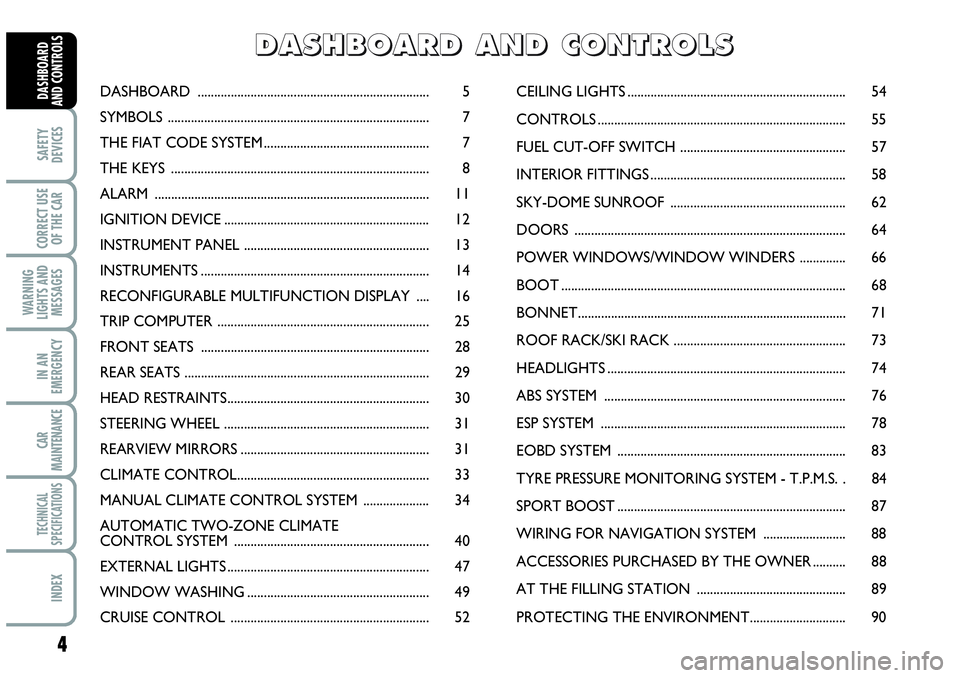
AND CONTROLSDASHBOARD ...................................................................... 5
SYMBOLS ............................................................................... 7
THE FIAT CODE SYSTEM.................................................. 7
THE KEYS .............................................................................. 8
ALARM ................................................................................... 11
IGNITION DEVICE .............................................................. 12
INSTRUMENT PANEL ........................................................ 13
INSTRUMENTS..................................................................... 14
RECONFIGURABLE MULTIFUNCTION DISPLAY .... 16
TRIP COMPUTER ................................................................ 25
FRONT SEATS ..................................................................... 28
REAR SEATS .......................................................................... 29
HEAD RESTRAINTS............................................................. 30
STEERING WHEEL .............................................................. 31
REARVIEW MIRRORS......................................................... 31
CLIMATE CONTROL.......................................................... 33
MANUAL CLIMATE CONTROL SYSTEM .................... 34
AUTOMATIC TWO-ZONE CLIMATE
CONTROL SYSTEM ........................................................... 40
EXTERNAL LIGHTS............................................................. 47
WINDOW WASHING....................................................... 49
CRUISE CONTROL ............................................................ 52CEILING LIGHTS.................................................................. 54
CONTROLS ........................................................................... 55
FUEL CUT-OFF SWITCH .................................................. 57
INTERIOR FITTINGS........................................................... 58
SKY-DOME SUNROOF ..................................................... 62
DOORS .................................................................................. 64
POWER WINDOWS/WINDOW WINDERS .............. 66
BOOT ...................................................................................... 68
BONNET................................................................................. 71
ROOF RACK/SKI RACK .................................................... 73
HEADLIGHTS........................................................................ 74
ABS SYSTEM ......................................................................... 76
ESP SYSTEM .......................................................................... 78
EOBD SYSTEM ..................................................................... 83
TYRE PRESSURE MONITORING SYSTEM - T.P.M.S. . 84
SPORT BOOST..................................................................... 87
WIRING FOR NAVIGATION SYSTEM ......................... 88
ACCESSORIES PURCHASED BY THE OWNER .......... 88
AT THE FILLING STATION ............................................. 89
PROTECTING THE ENVIRONMENT............................. 90
D D
A A
S S
H H
B B
O O
A A
R R
D D
A A
N N
D D
C C
O O
N N
T T
R R
O O
L L
S S
Page 28 of 207

26
SAFETY
DEVICES
CORRECT USE
OF THE CAR
WARNING
LIGHTS AND
MESSAGES
IN AN
EMERGENCY
CAR
MAINTENANCE
TECHNICAL
SPECIFICATIONS
INDEX
DASHBOARD
AND CONTROLS
“Trip B”, available on multifunction display
only, shall be used to display the figures
relating to:
– Trip distance B
– Average consumption B
– Average speed B
– Travel time B (driving time).
Note“Trip B” function can be excluded
(see paragraph “Trip B On/Off”). “Range”
and “Instant consumption” cannot be re-
set.Average consumption
This value shows the average consump-
tion from the start of the new mission.
Instant consumption
This value shows instant fuel consumption
(this value is updated second by second).
If parking the car with engine on,
the display will show “----”.
Average speed
This value shows the car average speed as
a function of the overall time elapsed since
the start of the new mission.
Travel time
This value shows the time elapsed since
the start of the new mission.
IMPORTANT Lacking information, Trip
computer values are displayed with “----”.
When normal operating condition is re-
set, calculation of different units will
restart regularly. Values displayed before
the failure will not be reset. Values displayed
Range
This value shows the distance in km (or
mi) that the car can still cover before
needing fuel, assuming that driving condi-
tions are kept unvaried. The display will
show “----” in the following cases:
– value lower than 50 km (or 30 mi)
– car left parked with engine running for
long.
IMPORTANT The variation of the auton-
omy value can be influenced by different
factors: driving style (see what is described
in paragraph “Driving style” in the chap-
ter “Start-up and driving”), type of route
(highways, urban, mountain, etc…), use
conditions of the car (load transported,
tire pressure, etc…). What was described
previously must be taken in consideration
when planning a trip.
Trip distance
This value shows the distance covered
from the start of the new mission.
Page 116 of 207
114
WARNING
LIGHTS AND
MESSAGES
IN AN
EMERGENCY
CAR
MAINTENANCE
TECHNICAL
SPECIFICATIONS
INDEX
DASHBOARD
AND CONTROLS
SAFETY
DEVICES
CORRECT USE
OF THE CAR
CONTAINING
RUNNING COSTS
Here are some suggestions which may
help you to keep the running costs of your
car down and lower the amount of toxic
emissions released into the atmosphere.
GENERAL CONSIDERATIONS
Car maintenance
Have checks and adjustments carried out
in accordance with the “Service schedule”.Tyres
Check the pressure of the tyres routine-
ly at an interval of no more than 4 weeks:
if the pressure is too low, consumption
levels increase as resistance to rolling is
higher.
Unnecessary loads
Do not travel with too much luggage
stowed in the boot. The weight of the car
(especially when driving in town) and its
trim greatly affects consumption and sta-
bility.
Roof rack/ski rack
Remove the roof rack or the ski rack from
the roof as soon as they are no longer
used. These accessories lower air pene-
tration and adversely affect consumption
levels. When needing to carry particular-
ly voluminous objects, preferably use a
trailer.Electric devices
Use electric devices only for the amount
of time needed. Rear heated window, ad-
ditional headlights, windscreen wipers and
heater fan need a considerable amount of
energy, therefore increasing the require-
ment of current increases fuel consump-
tion (up to +25% in the urban cycle).
Climate control
The air conditioner is an additional load
which greatly affects the engine leading to
higher consumption (on average up to
+20%). When the temperature outside
the car permits it, use the air vents where
possible.
Spoilers
The use of non-certified aerodynamic
items may adversely affect air drag and
consumption levels.
Page 123 of 207
121
IN AN
EMERGENCY
CAR
MAINTENANCE
TECHNICAL
SPECIFICATIONS
INDEX
DASHBOARD
AND CONTROLS
SAFETY
DEVICES
CORRECT USE
OF THE CAR
WARNING
LIGHTS AND
MESSAGES
GENERAL WARNINGS ..................................................... 122
LOW BRAKE FLUID............................................................ 122
HANDBRAKE ON................................................................ 122
AIR BAG FAILURE ................................................................ 123
ENGINE COOLANT HIGH TEMPERATURE ................ 123
LOW ENGINE OIL PRESSURE.......................................... 124
SEAT BELTS NOT FASTENED .......................................... 124
EBD SYSTEM FAILURE ........................................................ 124
ENGINE CONTROL SYSTEM FAILURE (EOBD) ........ 125
FRONT PASSENGER AIR BAG DEACTIVATED.......... 126
ABS SYSTEM FAILURE......................................................... 126
FUEL RESERVE ....................................................................... 126
EXTERNAL LIGHTS FAILURE........................................... 127
REAR FOG LIGHTS.............................................................. 127
ESP SYSTEM FAILURE ........................................................ 127
SIDE LIGHTS AND LOW BEAMS.................................... 128
FOLLOW ME HOME ........................................................... 128
LEFT-HAND DIRECTION INDICATOR ........................ 128
RIGHT-HAND DIRECTION INDICATOR .................... 128
FRONT FOG LIGHTS.......................................................... 128ACTIVATION OF THE SPORT BOOST FUNCTION 128
MAIN BEAM HEADLIGHTS............................................... 128
CHECK TIRE PRESSARE .................................................... 129
INSUFFICIENT TYRE PRESSURE ..................................... 129
TIRE PRESSURE NOT SUITABLE FOR THE SPEED .... 129
POSSIBILITY OF ICE ON THE ROAD ........................... 130
LIMITED FUEL DISTANCE ................................................ 130
ASR SYSTEM.......................................................................... 130
SET SPEED LIMIT EXCEEDED .......................................... 130
INSUFFICIENT BATTERY CHARGE .............................. 131
INCOMPLETE CAR DOOR CLOSURE .......................... 131
VEHICLE PROTECTION SYSTEM -
FIAT CODE - FAILURE ...................................................... 131
BRAKE PAD WEAR ............................................................. 132
CRUISE CONTROL ............................................................ 132
GENERIC SIGNAL ............................................................... 132
W W
A A
R R
N N
I I
N N
G G
L L
I I
G G
H H
T T
S S
A A
N N
D D
M M
E E
S S
S S
A A
G G
E E
S S
Page 132 of 207
130
IN AN
EMERGENCY
CAR
MAINTENANCE
TECHNICAL
SPECIFICATIONS
INDEX
DASHBOARD
AND CONTROLS
SAFETY
DEVICES
CORRECT USE
OF THE CAR
WARNING
LIGHTS AND
MESSAGES
POSSIBILITY OF ICE
ON THE ROAD
When the outside temperature reaches
or goes under 3°C the outside tempera-
ture indicator flashes to signal the possi-
bility of ice on the road.
The display visualizes the specific message.
LIMITED FUEL DISTANCE
The display shows this message in order
to inform the user that the amount of fu-
el left in the tank will last for less than
50km.SET SPEED LIMIT EXCEEDED
The display shows the specific message
when the vehicle exceeds the set speed
limit ( see “Multifunctional resettable dis-
play” in the “Instrument panel and con-
trols” chapter). ASR SYSTEM
The ASR system can be disconnected by
the pressure of the ASR OFFbutton.
The display shows this specific message to
inform the driver of the system discon-
nection; simultaneously the led on the
push button lights up.
If you push the ASR OFFbutton again
the led turns off and the display shows a
specific message in order to inform the
driver that the system has been reinstat-
ed.
Page 134 of 207
132
IN AN
EMERGENCY
CAR
MAINTENANCE
TECHNICAL
SPECIFICATIONS
INDEX
DASHBOARD
AND CONTROLS
SAFETY
DEVICES
CORRECT USE
OF THE CAR
WARNING
LIGHTS AND
MESSAGES
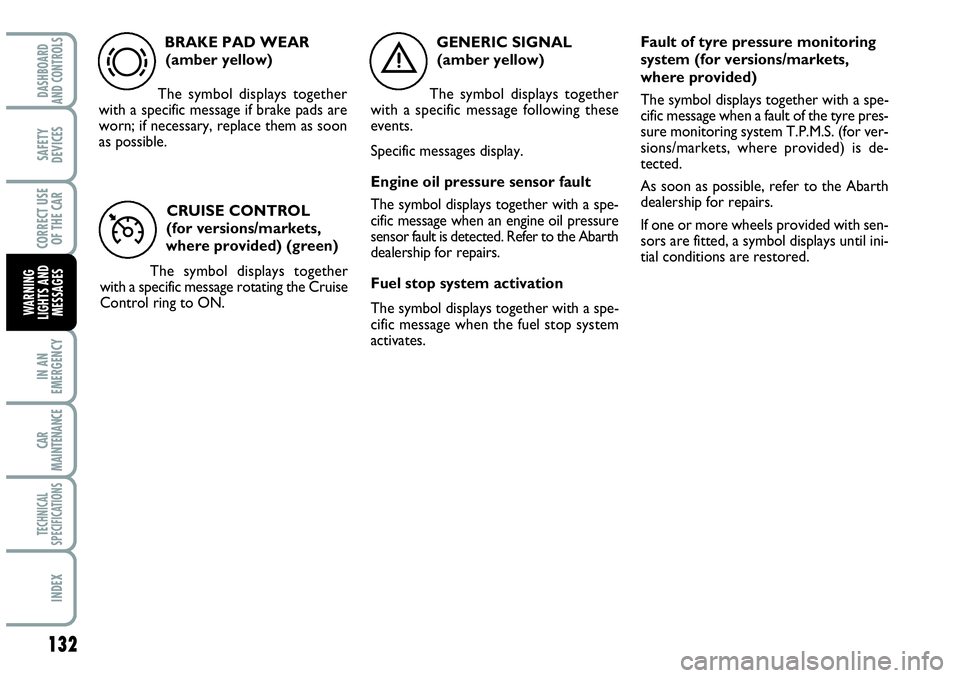
BRAKE PAD WEAR
(amber yellow)
The symbol displays together
with a specific message if brake pads are
worn; if necessary, replace them as soon
as possible.
d
CRUISE CONTROL
(for versions/markets,
where provided) (green)
The symbol displays together
with a specific message rotating the Cruise
Control ring to ON.
Ü
GENERIC SIGNAL
(amber yellow)
The symbol displays together
with a specific message following these
events.
Specific messages display.
Engine oil pressure sensor fault
The symbol displays together with a spe-
cific message when an engine oil pressure
sensor fault is detected. Refer to the Abarth
dealership for repairs.
Fuel stop system activation
The symbol displays together with a spe-
cific message when the fuel stop system
activates.
è
Fault of tyre pressure monitoring
system (for versions/markets,
where provided)
The symbol displays together with a spe-
cific message when a fault of the tyre pres-
sure monitoring system T.P.M.S. (for ver-
sions/markets, where provided) is de-
tected.
As soon as possible, refer to the Abarth
dealership for repairs.
If one or more wheels provided with sen-
sors are fitted, a symbol displays until ini-
tial conditions are restored.
Page 165 of 207

163
WARNING
LIGHTS AND
MESSAGES
TECHNICAL
SPECIFICATIONS
INDEX
DASHBOARD
AND CONTROLS
SAFETY
DEVICES
CORRECT USE
OF THE CAR
IN AN
EMERGENCY
CAR
MAINTENANCE
30 60 90 120 150 180
●●●●● ●
●●●●● ●
●●●●● ●
●●●●● ●
●●●●● ●
●●●●● ●
●●
●
●●●●● ●
●●●●● ●
●●
●● ●
SERVICE SCHEDULE
Service coupons shall be performed every 30,000 km
Thousands of km
Check tyre conditions/wear and adjust pressure if required
Check light system operation (headlights, direction indicators,
hazard lights, boot lights, passenger compartment lights,
instrument panel warning lights, etc.)
Check windscreen wiper/washer operation
Check front disk brake pad conditions and wear front and rear
Sight inspect the conditions of: bodywork,
underbody protection, pipes and hoses
(exhaust - fuel - brakes), rubber parts
(boots, sleeves, bushes, etc.)
Check cleanness of locks, bonnet and boot and lever
cleanness and lubrication
Sight inspect accessory drive belt conditions
Replace accessory drive belt/s
Check and adjust handbrake lever stroke, if required
Check exhaust emissions
Check antievaporation system
Replace air cleaner cartridge
Page 167 of 207
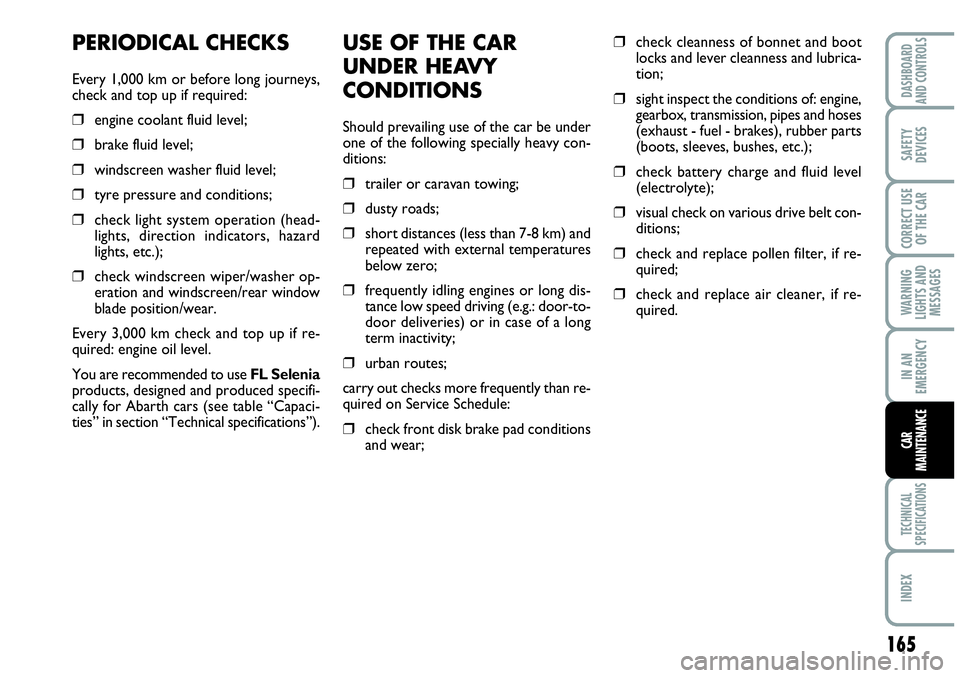
USE OF THE CAR
UNDER HEAVY
CONDITIONS
Should prevailing use of the car be under
one of the following specially heavy con-
ditions:
❒trailer or caravan towing;
❒dusty roads;
❒short distances (less than 7-8 km) and
repeated with external temperatures
below zero;
❒frequently idling engines or long dis-
tance low speed driving (e.g.: door-to-
door deliveries) or in case of a long
term inactivity;
❒urban routes;
carry out checks more frequently than re-
quired on Service Schedule:
❒check front disk brake pad conditions
and wear;
❒check cleanness of bonnet and boot
locks and lever cleanness and lubrica-
tion;
❒sight inspect the conditions of: engine,
gearbox, transmission, pipes and hoses
(exhaust - fuel - brakes), rubber parts
(boots, sleeves, bushes, etc.);
❒check battery charge and fluid level
(electrolyte);
❒visual check on various drive belt con-
ditions;
❒check and replace pollen filter, if re-
quired;
❒check and replace air cleaner, if re-
quired.
PERIODICAL CHECKS
Every 1,000 km or before long journeys,
check and top up if required:
❒engine coolant fluid level;
❒brake fluid level;
❒windscreen washer fluid level;
❒tyre pressure and conditions;
❒check light system operation (head-
lights, direction indicators, hazard
lights, etc.);
❒check windscreen wiper/washer op-
eration and windscreen/rear window
blade position/wear.
Every 3,000 km check and top up if re-
quired: engine oil level.
You are recommended to use FL Selenia
products, designed and produced specifi-
cally for Abarth cars (see table “Capaci-
ties” in section “Technical specifications”).
165
WARNING
LIGHTS AND
MESSAGES
TECHNICAL
SPECIFICATIONS
INDEX
DASHBOARD
AND CONTROLS
SAFETY
DEVICES
CORRECT USE
OF THE CAR
IN AN
EMERGENCY
CAR
MAINTENANCE
Page 176 of 207

174
WARNING
LIGHTS AND
MESSAGES
TECHNICAL
SPECIFICATIONS
INDEX
DASHBOARD
AND CONTROLS
SAFETY
DEVICES
CORRECT USE
OF THE CAR
IN AN
EMERGENCY
CAR
MAINTENANCE
WINDSCREEN/REAR
WINDOW WIPERS
BLADES
Periodically clean the rubber part using
special products; TUTELA PROFES-
SIONAL SC 35is recommended.
If the rubber blades are bent or worn they
should be replaced. In any case they
should be changed once a year.
A few simple notions can reduce the pos-
sibility of damage to the blades:
❒ if the temperature fall below zero,
make sure that ice has not frozen the
rubber against glass. If necessary, thaw
using an antifreeze product;
❒ remove any snow from the glass: in ad-
dition to protecting the blades, this pre-
vents effort on the motor and over-
heating;
❒do not operate the windscreen wipers
on dry glass.
RUBBER HOSES
As far as the brake system and fuel rubber
hoses are concerned, carefully follow the
“Service schedule” in this section.
Indeed ozone, high temperatures and pro-
longed lack of fluid in the system may
cause hardening and cracking of the hoses,
with possible leaks. Careful control is
therefore necessary.If the pressure is too low the
tyre overheats and this can
cause it serious damage.
WARNING
Do not cross switch the
tyres, moving them from the
right of the car to the left and vice
versa.
WARNING
Never submit alloy rims to
repainting treatments re-
quiring to use temperatures exceed-
ing 150°C. The mechanical properties
of the wheels could be impaired.
WARNING
Driving with worn wiper
blades is a serious hazard,
because visibility is reduced in bad
weather.
WARNING
Page 201 of 207
199
WARNING
LIGHTS AND
MESSAGES
DASHBOARD
AND CONTROLS
SAFETY
DEVICES
CORRECT USE
OF THE CAR
IN AN
EMERGENCY
CAR
MAINTENANCE
TECHNICAL
SPECIFICATIONS
INDEX
Rear window washer
– control ............................................ 49
– fluid level ........................................ 168
Rear window wiper............................. 174
Rearview mirrors
– door mirrors ................................. 32
– driving mirror ................................ 31
Refuelling............................................... 89
Rev counter .......................................... 14
Roof rack/ski rack .............................. 73
Rubber hoses ....................................... 174
Safety devices ..................................... 91
Seat adjustment ................................... 28
Seat belts
– general instructions ..................... 95
– load limiters ................................... 94
– maintenance .................................. 97
– use ................................................... 92
Seats
– adjustment ..................................... 28
– cleaning ........................................... 179
– tilting (rear seats).......................... 29
Snow chains ......................................... 119
Sound system ...................................... 121Speedometer ....................................... 14
Starting the engine
– emergency start-up ...................... 134
– ignition switch ............................... 13
– stopping the engine....................... 111
– warming up the engine ................ 111
Steering.................................................. 186
Steering column lock ......................... 12
Steering wheel (adjustment) ............ 31
Sunroof.................................................. 62
Sun visors ............................................. 61
Suspensions .......................................... 186
Symbols ................................................. 7
Tailgate ................................................ 68
Technical specifications ..................... 181
Third brake light ................................. 145
Top speeds ........................................... 191
Towing the car .................................... 159
Towing trailers
– tow hook installation ................... 118
T.P.M.S. system.................................... 84
Transmission ........................................ 185
Tyre pressure ...................................... 189
Oddment compartments .................. 60
Paint ..................................................... 177
Performance ........................................ 191
Plates
– bodywork paint
identification plate ....................... 183
– model plate ................................... 182
Pollen filter ........................................... 170
Power socket ...................................... 60
Pretensioners ...................................... 94
Protecting the environment ............. 90
Puddle/door light................................. 55
Radio transmitters and cellular
telephones ......................................... 89
Rain sensor............................................ 50
Rear ceiling lights
– bulb replacement ........................... 143
– control ............................................ 56
Rear doors emergency lock device . 81
Rear fog lights
– bulb replacement .......................... 143
– control button .............................. 55