exhaust Abarth Punto Evo 2011 Owner handbook (in English)
[x] Cancel search | Manufacturer: ABARTH, Model Year: 2011, Model line: Punto Evo, Model: Abarth Punto Evo 2011Pages: 270, PDF Size: 3.53 MB
Page 108 of 270

107
KNOWING
YOUR VEHICLE
SAFETY
STARTING
AND DRIVING
WARNING LIGHTS
AND MESSAGES
IN AN
EMERGENCY
MAINTENANCE
AND CARE
TECHNICAL
SPECIFICATIONS
CONTENTS
REFUELLING THE CAR
Use only unleaded petrol.
To avoid mistakes, the diameter of the fuel filler is too
small to introduce the nozzle of a leaded petrol pumps.
The petrol octane rating (RON) must not be lower
than 95.
IMPORTANT An inefficient catalytic converter leads to
harmful exhaust emissions, thus contributing to air
pollution.
IMPORTANT Never use leaded petrol, even in small
amounts or in an emergency, as this would damage the
catalytic converter beyond repair.
F0U105Abfig. 105
FUEL FILLER CAP fig. 105
To carry out refuelling, open flap A and unscrew cap B.
The cap is fitted with a device C which fastens it to the
lid so it cannot be mislaid.
In some versions, cap B has a lock and key: open flap A,
insert the ignition key then turn it anticlockwise and
unscrew the cap itself.
The sealing may cause a slight pressure increase in the
tank. A suction noise when you release the cap is
therefore entirely normal.
When refuelling, fasten the cap to the device inside the
flap as shown in the
figure.
Page 142 of 270

141
WARNING LIGHTS AND MESSAGES
GENERAL WARNINGS
Switching on of some warning lights/symbols is
associated to a specific message and/or warning buzzer.
These indications are indicative and precautionary and
as such must not be considered as exhaustive and/or
alternative to the information contained in the Owner
Handbook, which you are recommended to read
carefully in all cases. Always refer to the information in
this chapter in the event of a failure indication.
IMPORTANT The fault indicators appearing on the
reconfigurable multifunction display are divided into two
categories: very serious and less serious faults.
Very serious faults prompt a prolonged cycle of signals.
Less serious faults prompt a shorter cycle of signals.
Press MENU ESC to stop the warning cycle in both
cases.
The instrument panel warning lights will stay on until the
causes of the fault are eliminated.
KNOWING
YOUR VEHICLE
SAFETY
STARTING
AND DRIVING
WARNING LIGHTS
AND MESSAGES
IN AN
EMERGENCY
MAINTENANCE
AND CARE
TECHNICAL
SPECIFICATIONS
CONTENTS
WARNING LIGHTS AND MESSAGES
If the warning light xturns on when
travelling (with the message on the
display) stop the car immediately and contact
an Abarth Dealership.
WARNING
BRAKE FLUID
LOW (red)
HANDBRAKE ENGAGED (red)
When the key is turned to the MAR position the
warning light comes on but should go out after a few
seconds.
Low brake fluid level
The warning light comes on when the level of the brake
fluid in the reservoir falls below the minimum level due
to a possible leak in the circuit.
The display will show a dedicated message.
x
Handbrake on
The warning light turns on when the handbrake is
engaged.
On some versions there is also an associated warning
buzzer if the car is moving.
IMPORTANT If the warning light turns on when
travelling, check that the handbrake is not engaged.
Page 145 of 270

144
KNOWING
YOUR VEHICLE
SAFETY
STARTING
AND DRIVING
WARNING LIGHTS
AND MESSAGES
IN AN
EMERGENCY
MAINTENANCE
AND CARE
TECHNICAL
SPECIFICATIONS
CONTENTS
LOW ENGINE OIL PRESSURE (red)
When the ignition key is moved to MAR, the
warning light switches on, and should go out
as soon as the engine is started.
The warning light switches on constantly together with
the message in the display when the system detects that
the engine oil pressure is insufficient.
v
If the warning light vturns on when
travelling (with the message on the
display) stop the car immediately and contact
an Abarth Dealership.
WARNING
EOBD SYSTEM FAILURE
(amber)
In normal conditions, when the ignition key is
moved to MAR, the warning light turns on and
should go off after engine start-up. The initial switching-
on indicates that the warning light is working properly.
If the warning light stays on or turns on when travelling:
❒on permanently: this means there is a fault in the
supply/ignition system which could cause high
exhaust emissions, loss of performance, poor
handling and high fuel consumption levels.
The display shows the dedicated message.
Under these conditions, you may continue travelling at a
moderate speed without demanding excessive effort
from the engine. Prolonged use of the car with the
warning light on may cause damage. Contact an Abarth
Dealership as soon as possible.
The warning light switches off if the failure disappears,
but it is still stored by the system.
❒flashing: this indicates possible damage to the
catalytic converter (see “EOBD system” in the
“Knowing your car” section).
U
Page 185 of 270
184
KNOWING
YOUR VEHICLE
SAFETY
STARTING
AND DRIVING
WARNING LIGHTS
AND MESSAGES
IN AN
EMERGENCY
MAINTENANCE
AND CARE
TECHNICAL
SPECIFICATIONS
CONTENTS
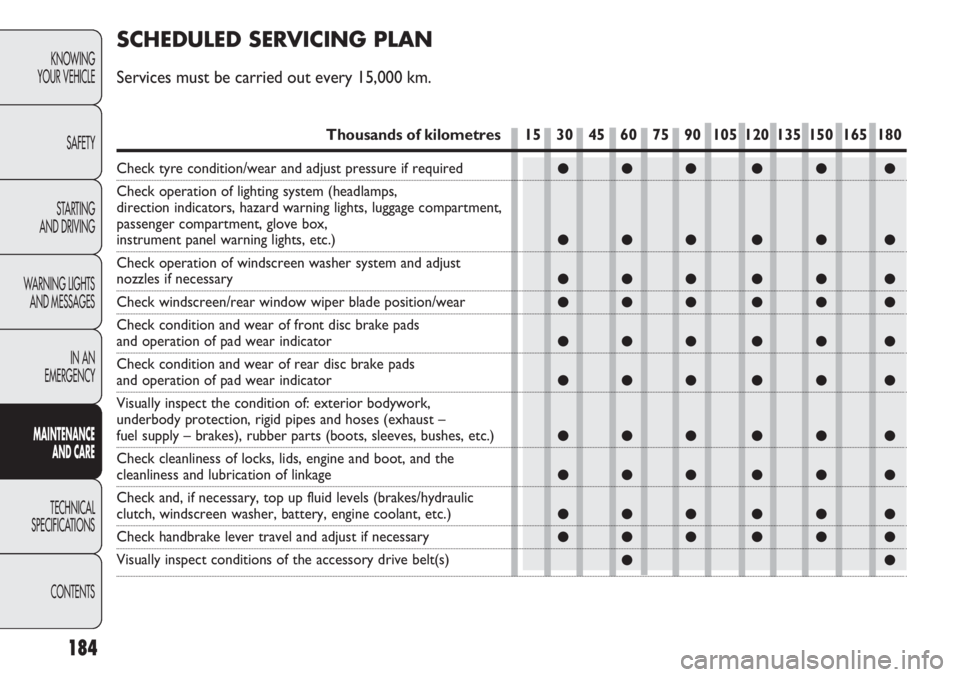
●●● ●● ●
●●● ●● ●
●●● ●● ●
●●● ●● ●
●●● ●● ●
●●● ●● ●
●●● ●● ●
●●● ●● ●
●●● ●● ●
●●● ●● ●
●●
SCHEDULED SERVICING PLAN
Services must be carried out every 15,000 km.
Thousands of kilometres 15 30 45 60 75 90 105 120 135 150 165 180
Check tyre condition/wear and adjust pressure if required
Check operation of lighting system (headlamps,
direction indicators, hazard warning lights, luggage compartment,
passenger compartment, glove box,
instrument panel warning lights, etc.)
Check operation of windscreen washer system and adjust
nozzles if necessary
Check windscreen/rear window wiper blade position/wear
Check condition and wear of front disc brake pads
and operation of pad wear indicator
Check condition and wear of rear disc brake pads
and operation of pad wear indicator
Visually inspect the condition of: exterior bodywork,
underbody protection, rigid pipes and hoses (exhaust –
fuel supply – brakes), rubber parts (boots, sleeves, bushes, etc.)
Check cleanliness of locks, lids, engine and boot, and the
cleanliness and lubrication of linkage
Check and, if necessary, top up fluid levels (brakes/hydraulic
clutch, windscreen washer, battery, engine coolant, etc.)
Check handbrake lever travel and adjust if necessary
Visually inspect conditions of the accessory drive belt(s)
Page 186 of 270
185
KNOWING
YOUR VEHICLE
SAFETY
STARTING
AND DRIVING
WARNING LIGHTS
AND MESSAGES
IN AN
EMERGENCY
MAINTENANCE
AND CARE
TECHNICAL
SPECIFICATIONS
CONTENTS
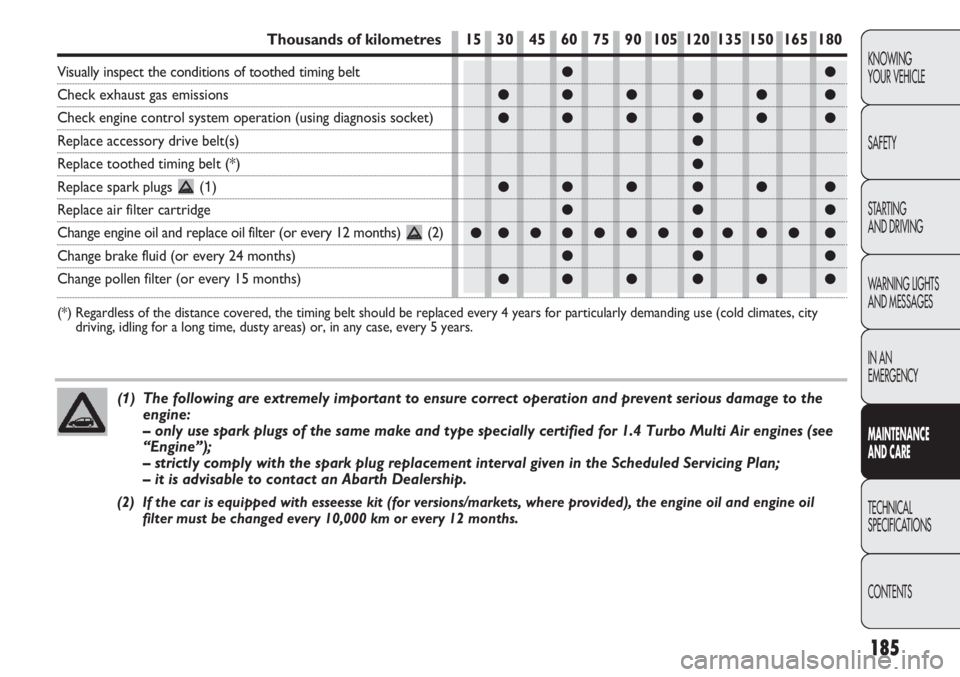
●●
●●● ●● ●
●●● ●● ●
●
●
●●● ●● ●
●● ●
●●●●●●● ●● ●● ●
●● ●
●●● ●● ●
Thousands of kilometres 15 30 45 60 75 90 105 120 135 150 165 180
Visually inspect the conditions of toothed timing belt
Check exhaust gas emissions
Check engine control system operation (using diagnosis socket)
Replace accessory drive belt(s)
Replace toothed timing belt (*)
Replace spark plugs (1)
Replace air filter cartridge
Change engine oil and replace oil filter (or every 12 months) (2)
Change brake fluid (or every 24 months)
Change pollen filter (or every 15 months)
(*) Regardless of the distance covered, the timing belt should be replaced every 4 years for particularly demanding use (cold climates, city
driving, idling for a long time, dusty areas) or, in any case, every 5 years.
(1)The following are extremely important to ensure correct operation and prevent serious damage to the
engine:
– only use spark plugs of the same make and type specially certified for 1.4 Turbo Multi Air engines (see
“Engine”);
– strictly comply with the spark plug replacement interval given in the Scheduled Servicing Plan;
– it is advisable to contact an Abarth Dealership.
(2) If the car is equipped with esseesse kit (for versions/markets, where provided), the engine oil and engine oil
filter must be changed every 10,000 km or every 12 months.
Page 187 of 270
186
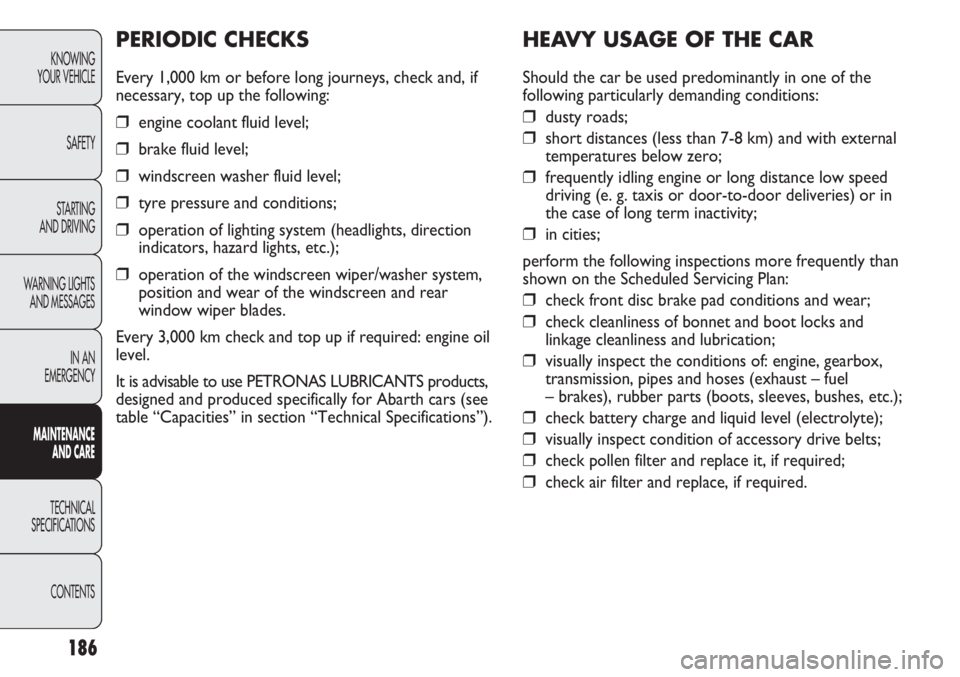
HEAVY USAGE OF THE CAR
Should the car be used predominantly in one of the
following particularly demanding conditions:
❒dusty roads;
❒short distances (less than 7-8 km) and with external
temperatures below zero;
❒frequently idling engine or long distance low speed
driving (e. g. taxis or door-to-door deliveries) or in
the case of long term inactivity;
❒in cities;
perform the following inspections more frequently than
shown on the Scheduled Servicing Plan:
❒check front disc brake pad conditions and wear;
❒check cleanliness of bonnet and boot locks and
linkage cleanliness and lubrication;
❒visually inspect the conditions of: engine, gearbox,
transmission, pipes and hoses (exhaust – fuel
– brakes), rubber parts (boots, sleeves, bushes, etc.);
❒check battery charge and liquid level (electrolyte);
❒visually inspect condition of accessory drive belts;
❒check pollen filter and replace it, if required;
❒check air filter and replace, if required.
PERIODIC CHECKS
Every 1,000 km or before long journeys, check and, if
necessary, top up the following:
❒engine coolant fluid level;
❒brake fluid level;
❒windscreen washer fluid level;
❒tyre pressure and conditions;
❒operation of lighting system (headlights, direction
indicators, hazard lights, etc.);
❒operation of the windscreen wiper/washer system,
position and wear of the windscreen and rear
window wiper blades.
Every 3,000 km check and top up if required: engine oil
level.
It is advisable to use PETRONAS LUBRICANTS products,
designed and produced specifically for Abarth cars (see
table “Capacities” in section “Technical Specifications”).
KNOWING
YOUR VEHICLE
SAFETY
STARTING
AND DRIVING
WARNING LIGHTS
AND MESSAGES
IN AN
EMERGENCY
MAINTENANCE
AND CARE
TECHNICAL
SPECIFICATIONS
CONTENTS
Page 261 of 270
260
KNOWING
YOUR VEHICLE
SAFETY
STARTING
AND DRIVING
WARNING LIGHTS
AND MESSAGES
IN AN
EMERGENCY
MAINTENANCE
AND CARE
TECHNICAL
SPECIFICATIONS
CONTENTS
Brakes
– brake fluid (type) .................... 218
– checking levels and
topping up .................................... 191
– handbrake ................................. 134
– technical specifications .......... 209
Bulbs
– bulb types ..........................159-160
– external bulb replacement .... 161
– general information
on replacement ........................... 158
– internal bulb replacement ..... 168
– replacement ............................. 158
Can holder .................................... 64
Capability for child seat ............... 115
Card holder ................................... 64
Carrying children safely ............... 115
– passenger seat compliance
with regulations on isofix
child seat use ............................... 122
– passenger seat compliance
with regulations on universal
child seat use ............................... 118– universal Isofix child seat
capability ...................................... 120
Carrying children safely ............... 115
– passenger seat compliance
with regulations on isofix
child seat use ............................... 122
– passenger seat compliance
with regulations on universal
child seat use ............................... 118
– universal Isofix child seat
capability ...................................... 120
Catalytic converter ...................... 108
CD Changer (capability) ............. 104
Central locking .............................. 59
Central locking .............................. 71
Chassis (marking) ......................... 206
Chassis marking ............................ 206
Checking levels ............................. 187
– brake fluid ................................ 191
– engine coolant ......................... 189
– engine oil .................................. 188
– windscreen/rear window
washer fluid ................................. 190Child seats ...................................... 115
– passenger seat compliance
with regulations on Isofix
child seat use ............................... 122
– passenger seat compliance
with regulations on universal
child seat use ............................... 118
– universal Isofix child seat
capability ...................................... 120
Cigarette lighter ............................ 64
Cleaning and maintenance
– bodywork ................................. 200
– engine compartment .............. 202
– front headlights ........................ 202
– interiors .................................... 202
– leather seats ............................. 203
– plastic parts .............................. 204
– seats and fabric parts ............. 203
– windows ................................... 202
Climate control vents .................. 38
Clutch
– technical specifications .......... 208
CO
2at exhaust ............................. 220
CO
2emissions .............................. 220