lock Acura Integra 2000 Sedan Service Manual
[x] Cancel search | Manufacturer: ACURA, Model Year: 2000, Model line: Integra, Model: Acura Integra 2000Pages: 273, PDF Size: 4.4 MB
Page 145 of 273

Th
e Brakin g Syste m
Brak e Syste m Desig n
The hydraulic system that operates the brakes has two separate circuits.
Each circuit works diagonally across
the vehicle (the left-front brake is
connected with the right-rear brake,etc.). If one circuit should develop a
problem, you will still have braking at two wheels.
Anti-loc
k Brake s
Your car has an Anti-lock Brake System (ABS) as standard
equipment. ABS helps to prevent the
wheels from locking up and skidding during hard braking, allowing you to
retain steering control.
When the front tires skid, you lose steering control; the car continues
straight ahead even though you turn
the steering wheel. The ABS helps to
prevent lock-up and helps you retain steering control by pumping the
brakes rapidly; much faster than a
person can do it. Yo
u shoul d neve r pum p th e
brak e pedal , this defeats the
purpose of the ABS. Let the ABS
work for you by always keeping firm, steady pressure on the brake pedal
as you steer away from the hazard.
This is sometimes referred to as
"stomp and steer."
Drivin g
Fron
t
Page 146 of 273

Th
e Brakin g Syste m
You will feel a pulsation in the brake pedal when the ABS activates, and
you may hear some noise. This is normal, it is the ABS rapidly
pumping the brakes.
Activation varies with the amount of
traction your tires have. On dry
pavement, you will need to press on the brake pedal very hard before you
activate the ABS. However, you may feel the ABS activate immediately if
you are trying to stop on snow or ice.
Important Safety Reminders
AB S doe s no t reduc e th e tim e o r
distanc e i t take s t o sto p th e car , it
only helps with steering control during braking. You should always
maintain a safe following distance
from other vehicles.
AB S wil l no t preven t a ski d tha t
result s fro m changin g directio n
abruptly , such as trying to take a
corner too fast or making a sudden
lane change. Always drive at a safe,
prudent speed for the road and
weather conditions.
AB S canno t preven t a los s o f
stability . Always steer moderately
when you are braking hard. Severe or sharp steering wheel movement
can still cause your car to veer into
oncoming traffic or off the road. A
vehicl e wit h AB S ma y requir e a
longe r distanc e t o sto p on loose or
uneven surfaces, such as gravel or snow, than a vehicle without anti-
lock. Slow down and allow a greater distance between vehicles under
those conditions.
CONTINUED
Drivin g
Page 147 of 273

Th
e Brakin g Syste m
ABS Indicator
The ABS is self-checking. If anything goes wrong, the ABS indicator on
the instrument panel comes on (see
page 55 ). This means the anti-lock
function of the braking system has shut down. The brakes still work like
a conventional system without anti-
lock, providing normal stopping ability. You should have the dealer
inspect your car as soon as possible.
Driving
AB
S INDICATO R
Page 149 of 273

Drivin
g in Ba d Weathe r
Tractio n — Check your tires
frequently for wear and proper
pressure. Both are important in
preventing "hydroplaning" (loss of
traction on a wet surface). In the
winter, mount snow tires on all four
wheels for the best handling.
Watch road conditions carefully, they can change from moment to
moment. Wet leaves can be as slip- pery as ice. "Clear" roads can have
patches of ice. Driving conditions can be very hazardous when theoutside temperature is near freezing.
The road surface can become covered with areas of water puddles
mixed with areas of ice, so your
traction can change without warning.
Be careful when downshifting. If
traction is low, you can lock up thedrive wheels for a moment and cause
a skid.
Be very cautious when passing, or
being passed by other vehicles. The
spray from large vehicles reduces your visibility, and the wind buffeting
can cause you to lose control.
Drivin g
Page 176 of 273

Coolin
g Syste m
1. Make sure the engine and radiator are cool.
2. Turn the radiator cap counter- clockwise, without pressing down
on it, until it stops. This relieves
any pressure remaining in the
cooling system.
3. Remove the radiator cap by pushing down and turning
counterclockwise.
4. The coolant level should be up tothe base of the filler neck. Add
coolant if it is low.
5. Put the radiator cap back on. Tighten it fully. 6. Pour coolant into the reserve tank.
Fill it to halfway between the MAX
and MIN marks. Put the cap back
on the reserve tank.
CONTINUED
Maintenanc e
RADIATO
R CA P
RESERVE TAN K
Page 177 of 273

Coolin
g Syste m
Do not add any rust inhibitors or other additives to your car's coolingsystem. They may not be compatible
with the coolant or engine compo-
nents.
Replacin g Engin e Coolan t
The cooling system should be completely drained and refilled with
new coolant according to the time
and distance recommendations in
the maintenance schedule. Only use Genuine Honda Antifreeze/Coolant.
Draining the coolant requires access to the underside of the car. Unless
you have the tools and knowledge,
you should have this maintenance done by a skilled mechanic. 1. Turn the ignition ON (II). Slide
the heater temperature controllever to maximum heat. Turn theignition off.
2. Open the hood. Make sure the engine and radiator are cool to the
touch.
3. Remove the radiator cap. 4. Loosen the drain plug on the
bottom of the radiator. Thecoolant will drain through thesplash guard. Remove the drain
bolt and washer from the engine
block.
Maintenanc e DRAI
N
BOL T
DRAIN PLU G
Page 178 of 273

Coolin
g Syste m
5. Remove the reserve tank from its holder by pulling it straight up.
Drain the coolant, then put the
tank back in its holder.
6. When the coolant stops draining,
tighten the drain plug at the
bottom of the radiator. Put a new
washer on the drain bolt, then reinstall the drain bolt in theengine block. Tighten it securely.Tightening torque:
58 Ibf .
ft (78 N .
m , 8.0 kgf .
m)
7. Mix the recommended antifreeze
with an equal amount of purifiedor distilled water in a clean
container. The cooling system
capacity is:
With 5-speed manual transmission:
(LS,
GS)
1.16 US gal (4.4 l ,0.97 Imp gal)
(GS-R)
1.24 US gal (4.7 l ,1.03 Imp gal)
With automatic transmission:
1.24 US gal (4.7 l ,1.03 Imp gal)
8. Pour coolant into the radiator up to the base of the filler neck.
9. Start the engine and let it run for about 30 seconds. Then turn off
the engine.
CONTINUED
Maintenanc e
RESERV
E TAN K
RESERVE
TAN K CA P
HOLDE R
FILLE
R NEC K
Fill u p t o her e
Page 184 of 273
Brak
e an d Clutc h Fluid , Powe r Steerin g
Clutc h Syste m
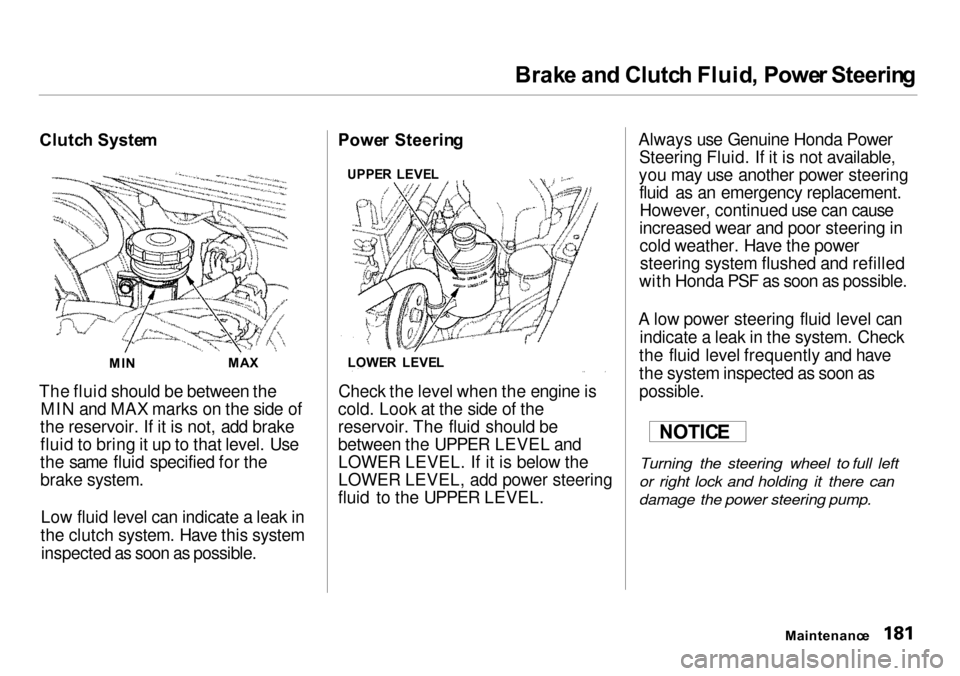
The fluid should be between the MIN and MAX marks on the side of
the reservoir. If it is not, add brake
fluid to bring it up to that level. Use
the same fluid specified for the
brake system.
Low fluid level can indicate a leak in
the clutch system. Have this system inspected as soon as possible. Powe
r Steerin g
Check the level when the engine is
cold. Look at the side of the
reservoir. The fluid should be
between the UPPER LEVEL and LOWER LEVEL. If it is below the
LOWER LEVEL, add power steering
fluid to the UPPER LEVEL. Always use Genuine Honda Power
Steering Fluid. If it is not available,
you may use another power steering fluid as an emergency replacement.However, continued use can cause
increased wear and poor steering in cold weather. Have the powersteering system flushed and refilled
with Honda PSF as soon as possible.
A low power steering fluid level can indicate a leak in the system. Check
the fluid level frequently and have
the system inspected as soon as
possible.
Turning the steering wheel to full left
or right lock and holding it there can
damage the power steering pump.
Maintenance
NOTIC
E
MI
N MA
X UPPE
R LEVE L
LOWE R LEVE L
Page 191 of 273
Wipe
r Blade s
Check the condition of the wiper
blades at least every six months.
Look for signs of cracking in the
rubber, or areas that are getting
hard. Replace the blades if you find
these signs, or they leave streaks and unwiped areas when used.
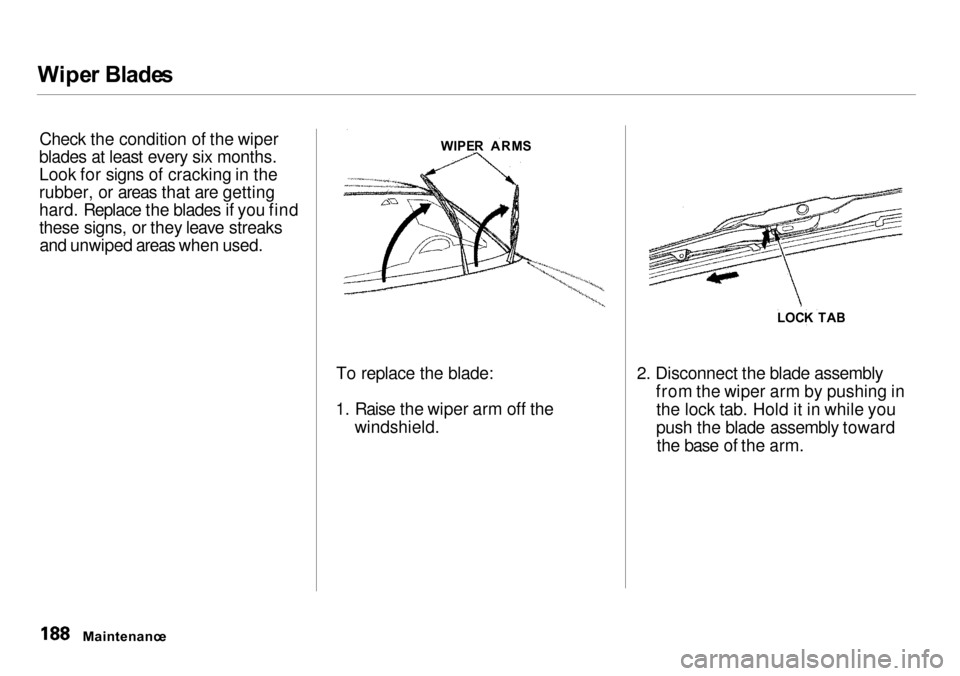
To replace the blade:
1. Raise the wiper arm off the windshield. 2. Disconnect the blade assembly
from the wiper arm by pushing inthe lock tab. Hold it in while you
push the blade assembly towardthe base of the arm.
Maintenanc e
WIPE
R ARM S
LOCK TA B
Page 192 of 273
Wipe
r Blade s
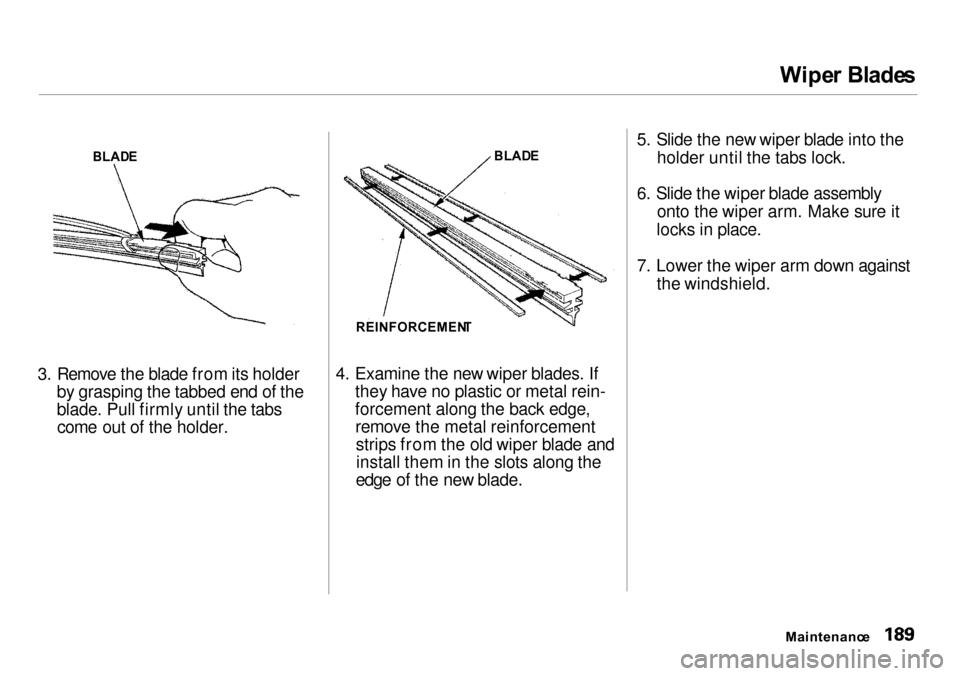
3. Remove the blade from its holder by grasping the tabbed end of the
blade. Pull firmly until the tabscome out of the holder. 4. Examine the new wiper blades. If
they have no plastic or metal rein-
forcement along the back edge,remove the metal reinforcementstrips from the old wiper blade andinstall them in the slots along the
edge of the new blade. 5. Slide the new wiper blade into the
holder until the tabs lock.
6. Slide the wiper blade assembly onto the wiper arm. Make sure it
locks in place.
7. Lower the wiper arm down against the windshield.
Maintenance
BLAD
E
BLAD
E
REINFORCEMEN T