airbag Acura Integra 2001 Owner's Guide
[x] Cancel search | Manufacturer: ACURA, Model Year: 2001, Model line: Integra, Model: Acura Integra 2001Pages: 285, PDF Size: 3.79 MB
Page 38 of 285

Protectin
g Childre n
If it is necessary to put a forward-
facing child seat in the front, move the vehicle seat as far to the rear as
possible, be sure the child seat is
firmly secured to the car, and thechild is properly strapped in the seat.
Child Seat Installation
The lap/shoulder belts in the back and front passenger seating positions
have a locking mechanism that must
be activated to secure a child seat.
The following pages provide instructions on how to secure a
forward-facing child seat with this
type of seat belt.
1. With the child seat in the desiredseating position, route the belt
through the child seat according
to the seat maker's instructions,
then insert the latch plate into the
buckle.
CONTINUED
Drive r an d Passenge r Safet y
Improperly placing a forward-
facing child seat in the front seat can result in serious injuryor death if the airbags inflate.
If you must place a forward-
facing child seat in front, move the vehicle seat as far back as
possible and properly restrain
the child.
Page 41 of 285
Protectin
g Childre n
Protectin g Large r Childre n
When a child reaches the recommended weight or height limit
for a forward-facing child seat, thechild should sit in one of the backseats and wear a lap/shoulder belt.
If a child is too short for the shoulder
part of the belt to properly fit, we recommend that the child use a
booster seat until the child is tall enough to use the seat belt without a
booster.
The following pages give instructions on how to check proper
seat belt fit, what kind of boosterseat to use if one is needed, and
important precautions for a child
who must sit in the front seat.
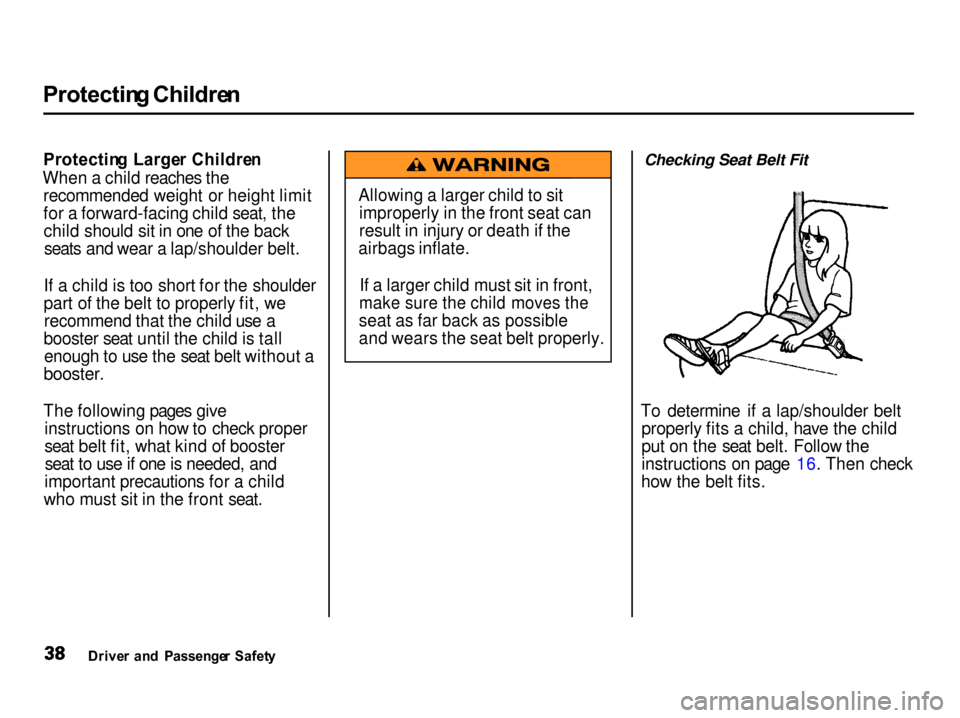
Checking Seat Belt Fit
To determine if a lap/shoulder belt properly fits a child, have the child
put on the seat belt. Follow the
instructions on page 16. Then check
how the belt fits.
Drive r an d Passenge r Safet y Allowing a larger child to sit
improperly in the front seat can
result in injury or death if the
airbags inflate.
If a larger child must sit in front,
make sure the child moves the
seat as far back as possible
and wears the seat belt properly.
Page 43 of 285
Protectin
g Childre n
A child may continue using a booster seat until the tops of the ears are
even with the top of the seat-back. A
child of this height should be tall
enough to use the lap/shoulder belt
without a booster.
When Can a Larger Child Sit in Front
The National Highway Traffic Safety
Administration and Transport Canada recommend that all children
ages 12 and under be properly
restrained in a back seat.
The back seat is the safest place for a child of any age or size.
In addition, the passenger's airbag
poses serious risks to children. If the seat is too far forward, or the child's
head is thrown forward during a collision, or the child is unrestrainedor out of position, an inflating airbag
can kill or seriously injure the child. Of course, children vary widely. And
while age may be one indicator of
when a child can safely ride in the front, there are other important
factors you should consider.
Physical Size
Physically, a child must be large enough for the lap/shoulder belt to
properly fit over the hips, chest, and shoulder (see pages 16 and38). If
the seat belt does not fit properly,
the child should not sit in the front.
Maturity
To safely ride in front, a child must be able to follow the rules, including sitting properly and wearing the seat
belt properly throughout a ride. If you decide that a child can safely
ride up front, be sure to: Carefully read the owner's manual
and make sure you understand all seat belt instructions and all safety
information. Move the vehicle seat to the rear-
most position. Have the child sit up straight, back
against the seat, and feet on or
near the floor. Check that the child's seat belt is
properly positioned and secured. Supervise the child. Even mature
children sometimes need to be
reminded to fasten the seat belts or sit properly.
Drive r an d Passenge r Safet y
Page 48 of 285
Additiona
l Informatio n Abou t You r SR S
SR S Component s
Your Supplemental Restraint System (SRS) includes: Two front airbags. The driver's
airbag is stored in the center of
the steering wheel; the front
passenger's airbag is stored in the dashboard. Both are marked "SRS
AIRBAG." Sensors that can detect a
moderate to severe frontal
collision.
A sophisticated electronic system
that continually monitors
information about the sensors, the
control unit, and the airbagactivators when the ignition is ON (II). An indicator light on the
instrument panel that alerts you toa possible problem with thesystem (see page 47). Emergency backup power in case
your car's electrical system is disconnected in a crash.
Ho
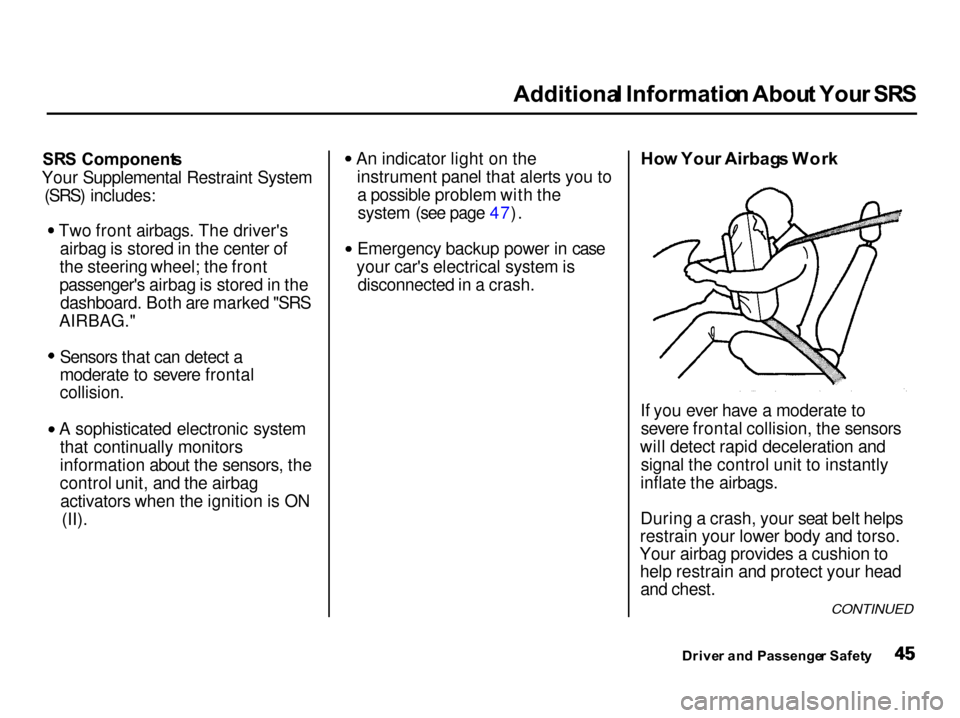
w You r Airbag s Wor k
If you ever have a moderate to severe frontal collision, the sensors
will detect rapid deceleration and signal the control unit to instantly
inflate the airbags.
During a crash, your seat belt helps
restrain your lower body and torso.
Your airbag provides a cushion to help restrain and protect your headand chest.
Driver an d Passenge r Safet y
CONTINUED
Page 49 of 285

Additiona
l Informatio n Abou t You r SR S
Since both airbags use the same
sensors, both airbags normally
inflate at the same time. However, it
is possible for only one airbag to
inflate.
This can occur when the severity of a collision is at the margin, or
threshold, that determines whetheror not the airbags will deploy. In
such cases, the seat belt will providesufficient protection, and the
supplemental protection offered by
the airbag would be minimal.
After inflating, the airbagsimmediately deflate, so they won't
interfere with the driver's visibility,or the ability to steer or operate
other controls.
The total time for inflation and deflation is approximately one-tenth
of a second, so fast that most
occupants are not aware that the
airbags deployed until they see them
lying in their laps. After a crash, you may see what
looks like smoke. This is actually
powder from the airbag's surface.
Although the powder is not harmful, people with respiratory problems
may experience some temporarydiscomfort. If this occurs, get out of
the car as soon as it is safe to do so.
U.S. Owners
For additional information on how
your airbags work, see the booklet
titled SRS: What You Need to Know About Airbags that came with your
owner's manual.
Canadian Owners
For additional information on how
your airbags work, ask your dealer
for a copy of the booklet titled SRS:
What You Need to Know About Airbags.
Drive r an d Passenge r Safet y
Page 50 of 285

Additiona
l Informatio n Abou t You r SR S
Ho w th e SR S Indicato r Ligh t
Work s
The purpose of the SRSlight is to alert you to a
potential problem with your Supplemental Restraint System.
When you turn the ignition ON (II), this indicator will light briefly then
go out. This tells you that the systemis working properly.
If the light comes on at any other
time, or does not come on at all, you should have the system checked by
your dealer. For example:
If the SRS indicator light does not
come on after you turn the ignitionON (II). If the light stays on after the
engine starts. If the light comes on or flashes on
and off while you drive.
If you see any of these indications,
your airbags may not deploy when
you need them. See your Acura dealer as soon as possible. SR
S Servic e
Your Supplemental Restraint System is virtually maintenance-free, and
there are no parts you can safelyservice. However, you must have
your car serviced if:
Your airbags ever inflate. The
airbags and the control unit must
be replaced. Do not try to remove or replace the airbags yourself.
This must be done by an Acura dealer or a knowledgeable body
shop.
The SRS indicator light alerts you
to a problem. Take your car to an
authorized Acura dealer as soon as
possible. If you ignore this
indication, the airbags might not
inflate when you need them.
Drive r an d Passenge r Safet y
S
R
S
Ignoring the SRS indicator light
can result in serious injury or
death if the airbags do not
inflate when needed.
Have your vehicle checked by a
dealer as soon as possible if
the SRS light alerts you to a
potential problem.
Page 51 of 285

Additiona
l Informatio n Abou t You r SR S
Additiona l Safet y Precaution sDo not attempt to deactivate your
airbags. Together, airbags andseat belts provide the best
protection in a moderate to severe
frontal collision. Do not tamper with SRS
components or wiring for any
reason. Tampering could cause
the airbags to deploy, possibly causing very serious injury.
See page 131 for further information and precautions relating to your SRS.
Driver an d Passenge r Safet y
Page 133 of 285

Accessorie
s an d Modification s
Modifying your car, or installing some non-Acura accessories, can
make your car unsafe. Before you
make any modifications or add any accessories, be sure to read the
following information.
Accessorie s
Your dealer has Genuine Acura accessories that allow you to
personalize your car. These accessories have been designed and
approved for your car, and are
covered by warranty.
Non-Acura accessories are usuallydesigned for universal applications.
Although aftermarket accessories may fit on your car, they may not
meet factory specifications, andcould adversely affect your car's
handling and stability. (See "Modifications" on the page 131 for
additional information.) When properly installed, cellular
phones, alarms, two-way radios, and
low-powered audio systems shouldnot interfere with your car's
computer-controlled systems, suchas the SRS and anti-lock brake
system.
However, if electronic accessories are improperly installed, or exceed
your car's electrical system capacity, they can interfere with the operation of your car, or even cause the
airbags to deploy.
Before installing any accessory: Make sure the accessory does not
obscure any lights, or interfere
with proper car operation or performance. Be sure electronic accessories do
not overload electrical circuits (see page 243). Have the installer contact your
Acura dealer for assistance before installing any electronic accessory.
If possible, have your dealer inspect
the final installation.
Befor e Drivin g
Improper accessories or
modifications can affect your
car's handling, stability and performance, and cause a
crash in which you can be hurt
or killed.
Follow all instructions in this
owner's manual regarding
accessories and modifications.
Page 134 of 285

Accessorie
s an d Modification s
Modification s
Do not remove any original
equipment or modify your car in any
way that would alter its design or operation. This could make your car
unsafe and illegal to drive.
For example, do not make any
modifications that would change theride height of your car, or install
wheels and tires with a different overall diameter.
Such modifications can adversely
affect handling, and interfere with
the operation of the car's anti-lock
brakes and other systems. In addition, any modifications that
decrease ground clearance increase
the chance of undercarriage parts striking a curb, speed bump, or other
raised object, which could cause
your airbags to deploy.
Do not modify your steering wheel
or any other part of your
Supplemental Restraint System.
Modifications could make thesystem ineffective. Additiona
l Safet y Precautio n
Do not attach or place objects on the
airbag covers. Any object attached to
or placed on the covers marked "SRS
AIRBAG," in the center of the steering wheel and on top of the
dashboard, could interfere with the
proper operation of the airbags. Or,
if the airbags inflate, the objects
could be propelled inside the car and
hurt someone.
Before Drivin g
Page 276 of 285
Inde
x
Accessories and Modifications.... 130 Accessories................................. 130Additional Safety Precaution.... 131
Modifications............................. 131
ACCESSORY (Ignition Key Position)........................................ 74
Additives, Engine Oil..................... 175
Airbag (SRS)............................... 9, 45Ai
r Cleane
r Element...................... 188
Air Conditioning System................. 94
Maintenance............................... 196Usage............................................. 94
Air Outlets (Vents).......................... 96
Air Pressure, Tires........................ 198
Alcohol in Gasoline........................ 258
Antifreeze....................................... 178 Anti-lock Brakes (ABS) Indicator................................ 55
, 148
Operation.................................... 14
6
Anti-theft Steering Column
Lock............................................... 74
Appearance Care........................... 217
Ashtrays............................................ 91
Audio System................................. 102
Automatic Speed Control................ 67
Automatic Transmission............... 140
Capacity, Fluid........................... 255
Checking Fluid Level................ 183
Shifting........................................ 140
Shift Lever Position Indicator.. 140
Shift Lever Positions................. 140
Shift Lock Release..................... 143
Battery Charging SystemIndicator............................ 55,
239
Jump Starting............................
. 233
Maintenance............................... 191
Specifications............................. 255
Before Driving............................... 121
Belts, Seat.................................... 8, 42
Beverage Holder.............................. 89
Body Repair.................................... 224
Brakes Anti-lock System (ABS)............ 146
Break-in, New Linings.............. 123
Bulb Replacement..................... 212
Fluid............................................ 185
Parking.......................................... 87
System Indicator................. 54,
241
Wear Indicators........................
. 145
Braking System.............................. 145
Break-in, New Car......................... 123
Brightness Control, Instruments... 63
Brights, Headlights......................... 62
Bulb Replacement Back-up Lights........................... 212
Brake Lights............................... 212 Cargo Area Light....................... 215
Ceiling Light............................... 215
Front Parking Lights................. 210
Front Side Marker Lights......... 210
Headlights.................................. 209
High-mount Brake Light.......... 211
License Plate Light.................... 214
Rear Side Marker Lights.......... 212
Specifications............................. 255
Spotlights.................................... 215
Turn Signal Lights..................... 210
Bulbs, Halogen............................... 209
CONTINUED