engine oil Acura Integra 2001 Owner's Manual
[x] Cancel search | Manufacturer: ACURA, Model Year: 2001, Model line: Integra, Model: Acura Integra 2001Pages: 285, PDF Size: 3.79 MB
Page 52 of 285

Carbo
n Monoxid e Hazar d
Your car's exhaust contains carbon monoxide gas. You should have no
problem with carbon monoxideentering the car in normal driving if
you maintain your car properly.
Have the exhaust system inspected
for leaks whenever: The car is raised for an oil change.
You notice a change in the sound
of the exhaust. The car was in an accident that
may have damaged the underside. High levels of carbon monoxide can
collect rapidly in enclosed areas,
such as a garage. Do not run the
engine with the garage door closed.
Even with the door open, run the
engine only long enough to move the
vehicle out of the garage. With the hatch open, air flow can
pull exhaust gas into your car's
interior and create a hazardouscondition. If you must drive with the
hatch open, open all the windows and set the heating and coolingsystem as shown below.
If you must sit in your parked car,
even in an unconfined area, with the
engine running, adjust the heating
and cooling system as follows:
1. Select the Fresh Air mode. 2. Select the mode.
3. Turn the fan on high speed.
4. Set the temperature control to a comfortable setting.
Drive r an d Passenge r Safet y
Carbon monoxide gas is toxic.
Breathing it can cause
unconsciousness and even kill
you.
Avoid any enclosed areas or
activities that expose you to
carbon monoxide.
Page 124 of 285
Befor
e Drivin g
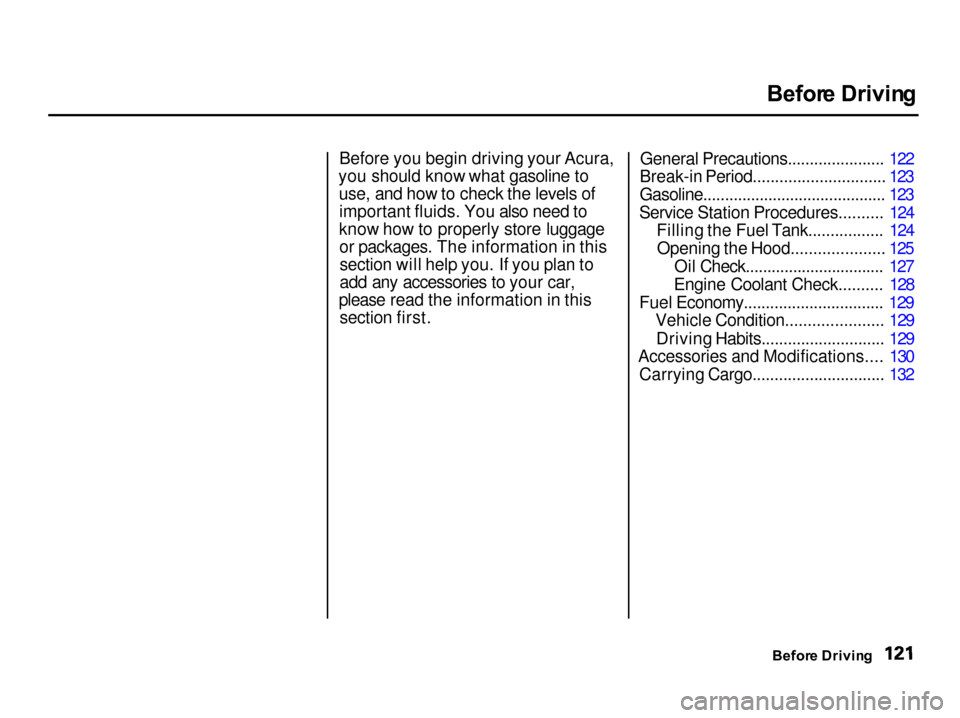
Before you begin driving your Acura,
you should know what gasoline to use, and how to check the levels ofimportant fluids. You also need to
know how to properly store luggage or packages. The information in thissection will help you. If you plan to
add any accessories to your car,
please read the information in this section first. General Precautions...................... 122
Break-in Period.............................. 123
Gasoline.......................................... 123
Service Station Procedures.......... 124 Filling the Fuel Tank................. 124
Opening the Hood..................... 125 Oil Check................................ 127
Engine Coolant Check.......... 128
Fuel Economy................................ 129 Vehicle Condition...................... 129
Driving Habits............................ 129
Accessories and Modifications.... 130
Carrying Cargo.............................. 132
Before Drivin g
Page 126 of 285
Break-i
n Period , Gasolin e
Break-i n Perio d
Help assure your car's future
reliability and performance by paying extra attention to how you drive
during the first 600 miles (1,000 km).
During this period: Avoid full-throttle starts and rapid
acceleration.
Avoid hard braking. New brakes
need to be broken-in by moderate
use for the first 200 miles (300
km).
Do not change the oil until the
recommended time or mileage
interval shown in the maintenance
schedule.
You should follow these same re-
commendations with an overhauled
or exchanged engine, or when the
brakes are relined.
Gasolin
e
Your Acura is designed to operate on
unleaded gasoline.
We recommend gasolines containing detergent additives that help prevent
fuel system and engine deposits.
Using gasoline containing lead will damage your car's emissions
controls. This contributes to air
pollution.
In Canada, some gasolines contain an octane-enhancing additive called
MMT. If you use such gasolines,
your emissions control system performance may deteriorate and
the Malfunction Indicator Lamp on
your instrument panel may turn on. If this happens, contact yourauthorized Acura dealer for service. (SE, LS and GS models)
Use an unleaded gasoline with a
pump octane number of 86 or higher.
Use of a lower octane gasoline can
cause a persistent, heavy metallic
rapping noise in the engine that can
lead to mechanical damage.
(GS-R and Type-R models)
Use a premium unleaded gasoline
with a pump octane number of 91 or higher.
If you are unable to find premium
unleaded gasoline, you may substi-
tute an unleaded regular gasoline.
The engine will compensate for the lower octane, but you may notice aslight decrease in power as a result.
Before Drivin g
Page 130 of 285
Servic
e Statio n Procedure s
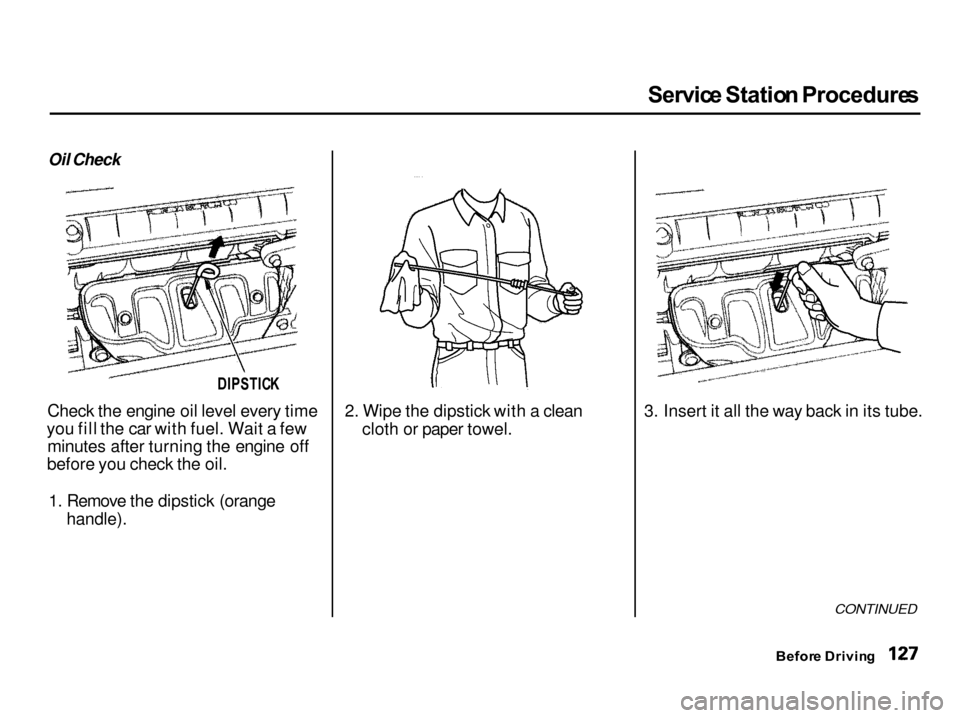
Oil Check
DIPSTICK
Check the engine oil level every time
you fill the car with fuel. Wait a few minutes after turning the engine off
before you check the oil.
1. Remove the dipstick (orange
handle).
2. Wipe the dipstick with a clean
cloth or paper towel. 3. Insert it all the way back in its tube.
CONTINUED
Befor e Drivin g
Page 162 of 285
Maintenanc
e
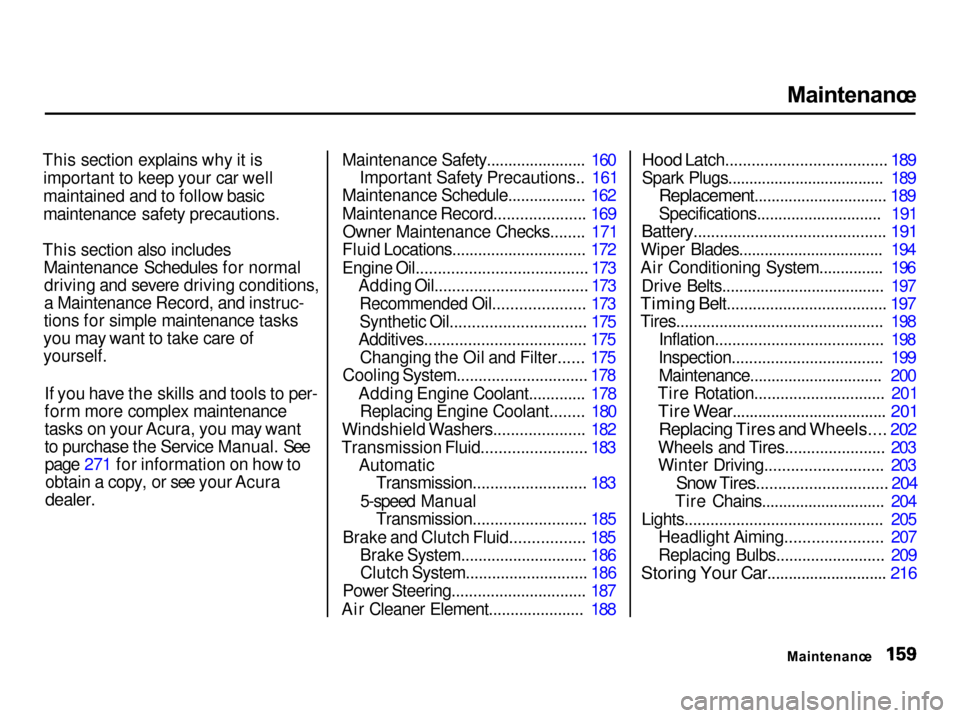
This section explains why it is important to keep your car well
maintained and to follow basic
maintenance safety precautions.
This section also includes Maintenance Schedules for normaldriving and severe driving conditions,
a Maintenance Record, and instruc-
tions for simple maintenance tasks
you may want to take care of
yourself.
If you have the skills and tools to per-
form more complex maintenance
tasks on your Acura, you may want
to purchase the Service Manual. Seepage 271 for information on how toobtain a copy, or see your Acura
dealer.
Maintenance Safety....................... 160
Important Safety Precautions.. 161
Maintenance Schedule.................. 162
Maintenance Record..................... 169
Owner Maintenance Checks........ 171
Fluid Locations............................... 172
Engine Oil....................................... 173 Adding Oil................................... 173
Recommended Oil..................... 173
Synthetic Oil............................... 175
Additives..................................... 175
Changing the Oil and Filter...... 175
Cooling System.............................. 178
Adding Engine Coolant............. 178Replacing Engine Coolant........ 180
Windshield Washers..................... 182
Transmission Fluid........................ 183 AutomaticTransmission.......................... 183
5-speed Manual Transmission.......................... 185
Brake and Clutch Fluid................. 185 Brake System............................. 186Clutch System............................ 186
Power Steering............................... 187
Air Cleaner Element...................... 188
Hood Latch..................................... 189
Spark Plugs..................................... 189
Replacement............................... 189
Specifications............................. 191
Battery............................................ 191
Wiper Blades.................................. 194
Air Conditioning System............... 196
Drive Belts...................................... 197
Timing Belt..................................... 197
Tires................................................ 198
Inflation....................................... 198
Inspection................................... 199 Maintenance............................... 200
Tire Rotation.............................. 201
Tire Wear.................................... 201
Replacing Tires and Wheels.... 202
Wheels and Tires....................... 203
Winter Driving........................... 203
Snow Tires.............................. 204
Tire Chains............................. 204
Lights.............................................. 205 Headlight Aiming...................... 207
Replacing Bulbs......................... 209
Storing Your Car............................ 216
Maintenance
Page 168 of 285
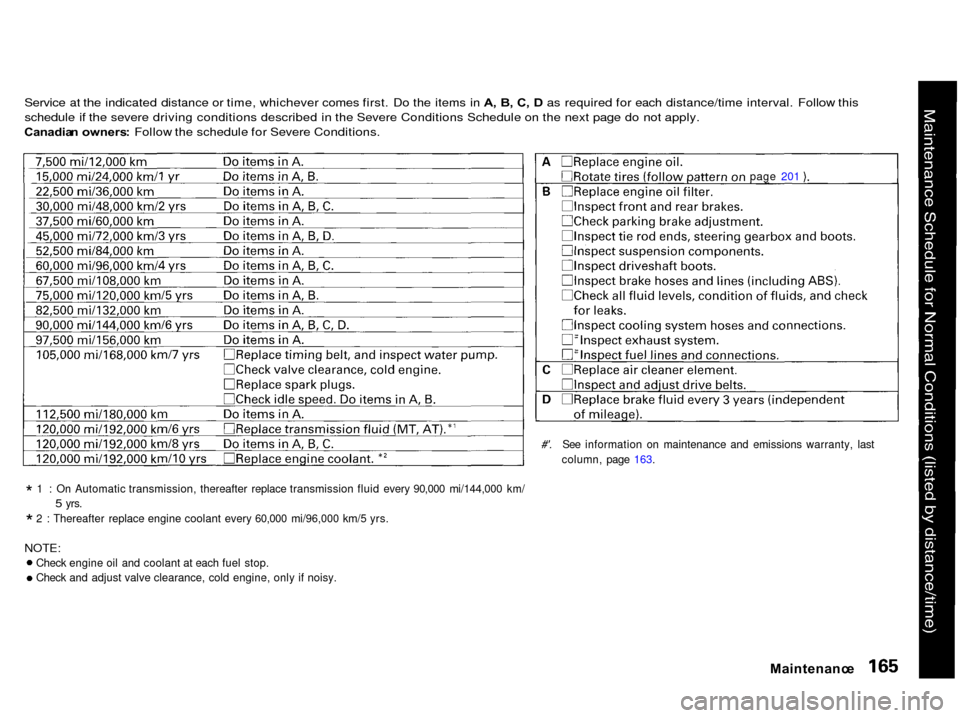
Service at the indicated distance or time, whichever comes first. Do the items in A
, B , C , D as required for each distance/time interval. Follow this
schedule if the severe driving conditions described in the Severe Conditions Schedule on the next page do not apply.
Canadia n owners : Follow the schedule for Severe Conditions.
#'. See information on maintenance and emissions warranty, lastcolumn, page 163.
* 1 : On Automatic transmission, thereafter replace transmission fluid every 90,000 mi/144,000 km/
5
yrs.
* 2 : Thereafter replace engine coolant every 60,000 mi/96,000 km/5 yrs.
NOTE:
Check engine oil and coolant at each fuel stop.
Check and adjust valve clearance, cold engine, only if noisy.
Maintenanc
e
page 201
Page 170 of 285
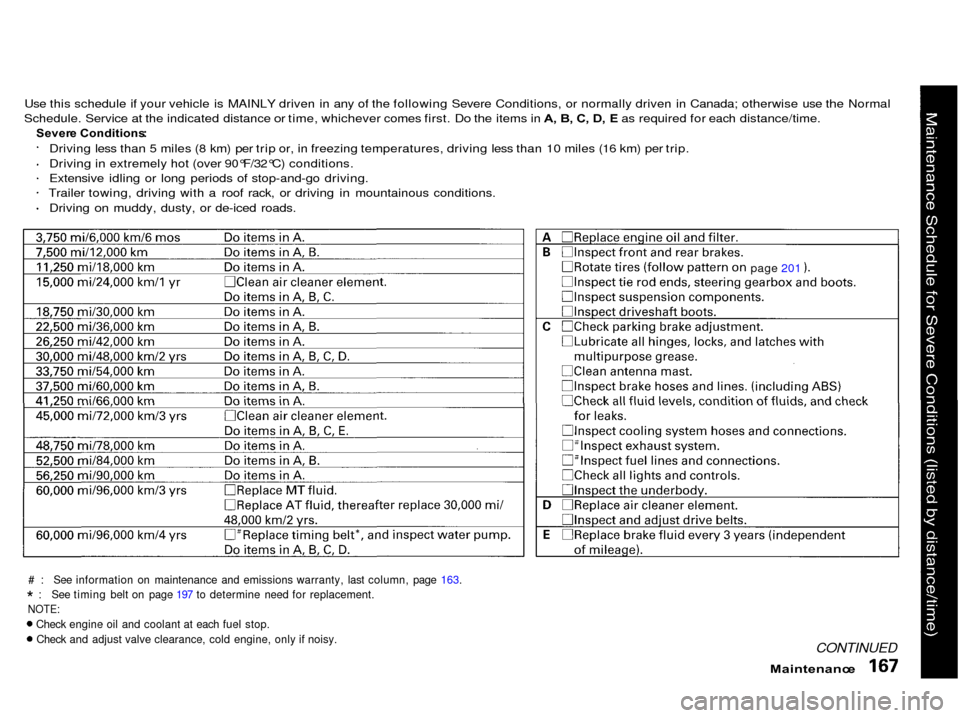
Use this schedule if your vehicle is MAINLY driven in any of the following Severe Conditions, or normally driven in Canada; otherwise use the Normal
Schedule. Service at the indicated distance or time, whichever comes first. Do the items in A , B , C , D , E as required for each distance/time.
Sever e Conditions :
Driving less than 5 miles (8 km) per trip or, in freezing temperatures, driving less than 10 miles (16 km) per trip.
Driving in extremely hot (over 90°F/32°C) conditions.
Extensive idling or long periods of stop-and-go driving.
Trailer towing, driving with a roof rack, or driving in mountainous conditions.
Driving on muddy, dusty, or de-iced roads.
# : See information on maintenance and emissions warranty, last column, page 163.
* : See timing belt on page 197 to determine need for replacement.
NOTE:
Check engine oil and coolant at each fuel stop.
Check and adjust valve clearance, cold engine, only if noisy.
CONTINUED
page
201
Maintenanc
e
Page 171 of 285
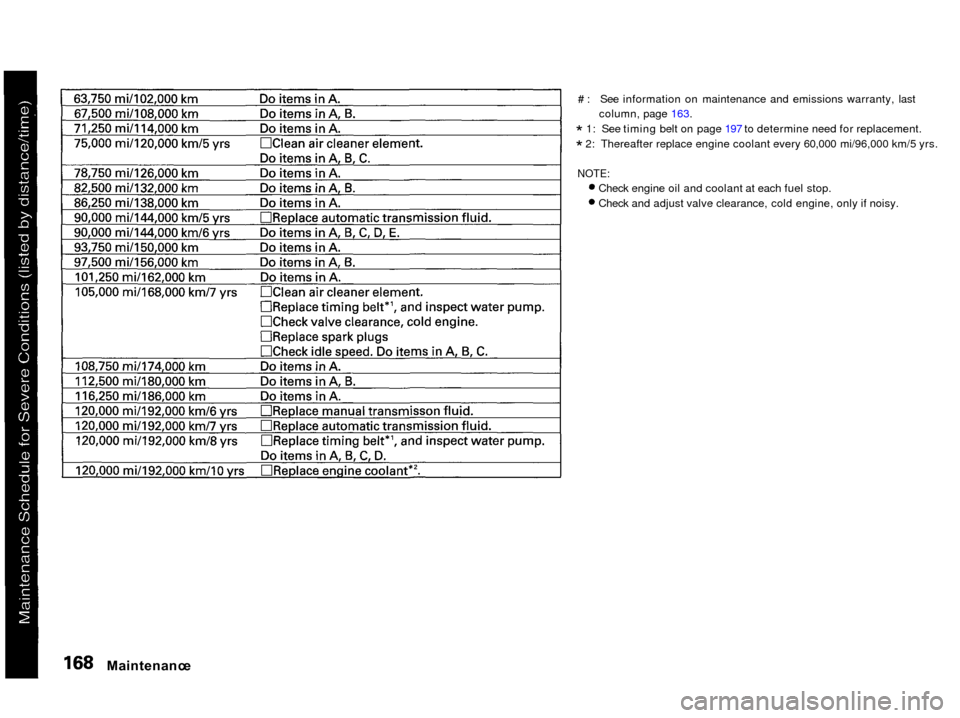
# : See information on maintenance and emissions warranty, last
column, page 163.
* 1: See timing belt on page 197 to determine need for replacement.
* 2: Thereafter replace engine coolant every 60,000 mi/96,000 km/5 yrs.
NOTE:
Check engine oil and coolant at each fuel stop.
Check and adjust valve clearance, cold engine, only if noisy.
Maintenanc
e
Page 174 of 285
Owne
r Maintenanc e Check s
You should check the following items at the specified intervals. If
you are unsure of how to perform any check, turn to the page given. Engine oil level — Check every
time you fill the fuel tank. See page 127. Engine coolant level — Check the
radiator reserve tank every time
you fill the fuel tank. See page 128. Windshield washer fluid — Check
the level in the reservoir monthly.If weather conditions cause you to
use the washers frequently, check
the reservoir each time you stop
for fuel. See page 182. Automatic transmission — Check
the fluid level monthly. See page
183.
Brakes — Check the fluid level
monthly. See page 185. Tires — Check the tire pressure
monthly. Examine the tread for
wear and foreign objects. See page
198.
Lights — Check the operation of
the headlights, parking lights,
taillights, high-mount brake light,
turn signals, brake lights, and
license plate lights monthly. See
page 205.
Maintenance
Page 176 of 285
Engin
e Oi l
Addin g Oi l
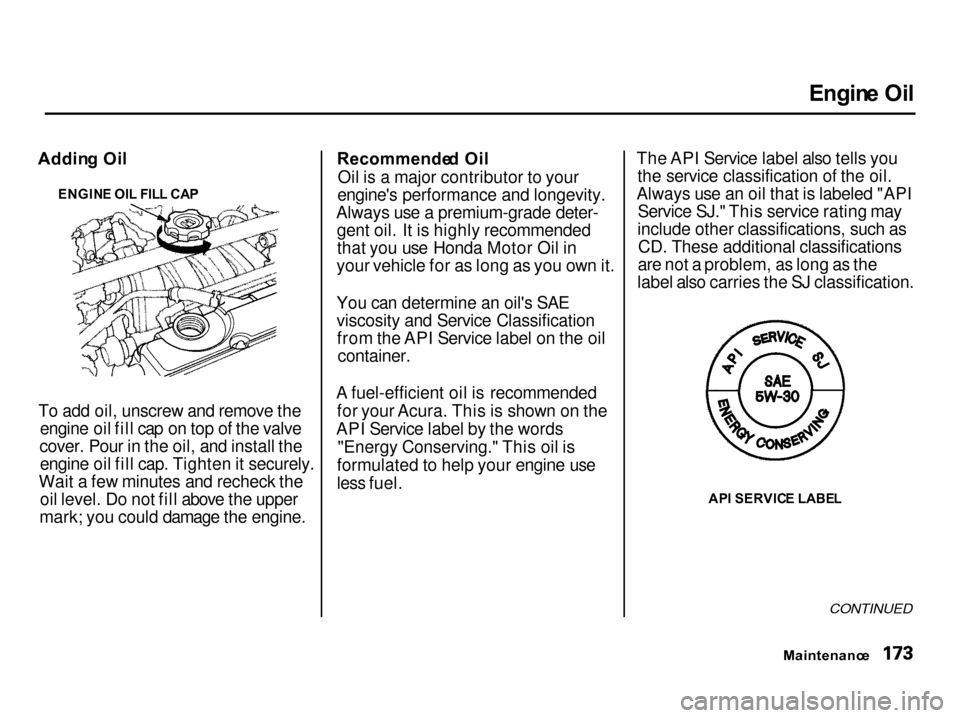
To add oil, unscrew and remove the engine oil fill cap on top of the valve
cover. Pour in the oil, and install the engine oil fill cap. Tighten it securely.
Wait a few minutes and recheck the oil level. Do not fill above the upper
mark; you could damage the engine. Recommende
d Oi l
Oil is a major contributor to your
engine's performance and longevity.
Always use a premium-grade deter- gent oil. It is highly recommended
that you use Honda Motor Oil in
your vehicle for as long as you own it.
You can determine an oil's SAE
viscosity and Service Classification from the API Service label on the oil container.
A fuel-efficient oil is recommended for your Acura. This is shown on the
API Service label by the words "Energy Conserving." This oil is
formulated to help your engine use
less fuel. The API Service label also tells you
the service classification of the oil.
Always use an oil that is labeled "API Service SJ." This service rating may
include other classifications, such as CD. These additional classifications
are not a problem, as long as the
label also carries the SJ classification.
API SERVIC E LABE L
CONTINUED
Maintenanc e
ENGIN
E OI L FIL L CA P