ECU Acura MDX 2003 Owner's Manua
[x] Cancel search | Manufacturer: ACURA, Model Year: 2003, Model line: MDX, Model: Acura MDX 2003Pages: 420, PDF Size: 5.46 MB
Page 251 of 420

If you use an accessory roof rack,
the roof rack weight limit may be
lower. Ref er to the inf ormation that
came with your roof rack.If you carry any items on a roof
rack,besurethetotalweightof
the rack and the items on it does
not exceed 165 lb (75 kg).
Distribute cargo evenly on the
f loor of the cargo area, placing the
heaviest items on the bottom and
as f ar f orward as possible. Tie
down items that could be thrown
about the vehicle during a crash or
sudden stop.
If you carry large items that
prevent you f rom closing the
tailgate, exhaust gas can enter the
passenger area. To avoid the
possibility of carbon monoxide
poisoning, f ollow the instructions
on page .
Store or secure all items that could
be thrown around and hurt
someone during a crash.
Be sure items placed on the f loor
behind the f ront seats cannot roll
under the seats and interf ere with
the driver’s ability to operate the
pedals, or with the proper
operation of the seats.
Keep the glove box closed while
driving. If it is open, a passenger
could injure their knees during a
crash or sudden stop.
62
Carrying Cargo
Bef ore Driving
Carrying Cargo in the Cargo A rea
or on a Roof Rack
Carrying Items in the Passenger
Compartment
247
Page 252 of 420

Theseparationnetcanbeusedto
hold back sof t, lightweight items
stored in the cargo area. Heavy
items should be properly secured on
the f loor of the cargo area. The net
may not prevent heavy items f rom
being thrown f orward in a crash or a
sudden stop.
The cargo cover can be used to
cover the cargo area behind the third
row seats. When the third row seats
are folded down, the cargo cover can
be installed in a f orward position and
extended over the larger cargo area.
Do not install the cargo cover in the
f orward position if the third row
seats are not f olded down. Optional Separation Net
Optional Cargo Cover
Bef ore Driving
Carrying Cargo
248
Page 255 of 420

Youshoulddothefollowingchecks
and adjustments every day bef ore
you drive your vehicle.Make sure all windows, mirrors,
and outside lights are clean and
unobstructed. Remove f rost, snow,
or ice. Check the adjustment of the seat
(see page ).
Check the adjustment of the
inside and outside mirrors (see
page ).
Check the adjustment of the
steering wheel (see page ).
Fasten your seat belt. Check that
your passengers have f astened
their seat belts (see page ).Turn the ignition switch ON (II).
Check the indicator lights in the
instrument panel.
Start the engine (see page ).
Check the gauges and indicator
lights in the instrument panel (see
page ).
Check that any items you may be
carrying with you inside are stored
properly or f astened down
securely. Visually check the tires. If a tire
looks low, use a gauge to check its
pressure. Check that the hood and tailgate
arefullyclosed. Makesurethedoorsandtailgate
are securely closed and locked.
3. 2.
1.
4. 5.
6.
7.
8.
9. 11.
12. 10.
15
115
89 252
67
101
Preparing to Drive
Driving251
Page 281 of 420

Discuss any additional needs with
your trailer sales or rental agency,
and make sure all equipment is
properly installed and maintained.
Since local requirements may vary,
check with appropriate state
authorities to be sure that your
equipment will meet all regulations
in the areas where you plan to tow. Towing generally requires a variety
of supplemental equipment. To
ensure the best quality, we
recommend that you purchase Acura
equipment whenever possible. Your
dealer offers a trailer package that
includes a hitch, a ball mount, a
wiring harness, a transmission f luid
cooler and a heavy-duty power
steering f luid cooler.We strongly recommend that you
have your Acura dealer install a
genuine Acura hitch and the
required f luid coolers. Using non-
Acura equipment may result in
serious damage to your vehicle.
A weight distributing hitch is not
recommended f or use with your
MDX as an improperly adjusted
weight distributing hitch may reduce
handling stability and braking
perf ormance.
Always use saf ety chains when you
tow a trailer. Make sure the chains
are secured to the trailer and hitch,
and that they cross under the tongue
so they can catch the trailer if it
becomes unhitched. Leave enough
slack to allow the trailer to turn
corners easily, but to do not let the
chains drag on the ground.This device is recommended if your
trailer tends to sway. Your trailer
maker can tell you what kind of sway
control you need and how to install it.
To help prevent overheating, a
heavy-duty transmission f luid cooler
and a heavy-duty power steering
f luid cooler are required f or trailer
towing. These coolers are available
only f rom your Acura dealer.
CONT INUED
T owing Equipment and
A ccessoriesHitch
Weight Distributing HitchSaf et y Chains Sway Cont rol
T ransmission Fluid Cooler andPower St eering Fluid Cooler
Towing a Trailer
Driving277
Page 284 of 420

Many states and provinces require
special exterior mirrors when towing
a trailer. Even if they don’t, you
should install special mirrors if you
cannot clearly see behind you, or if
the trailer creates a blind spot.
When towing a trailer, we
recommend that you carry a f ull-size
spare wheel and tire f or your vehicle.
Using the compact spare that came
with the MDX may adversely affect
vehicle handling.
We also recommend that you carry a
f ull-size spare wheel and tire f or your
trailer. Ask your trailer sales or
rental agency where and how to
store the spare. See page f or proper tire size,
page f or how to store a f ull-sized
wheel and tire, and page for
inf ormation on changing a f lat tire.
Remember to unhitch the trailer
bef ore changing a f lat.When preparing to tow, and bef ore
driving away, be sure to check the
f ollowing:
The vehicle has been properly
serviced, and the brakes,
suspension, and cooling system
are in good operating condition. If
you tow f requently, f ollow the
Severe Conditions maintenance
schedule. The lights and brakes on your
vehicle and the trailer are working
properly.
Your vehicle tires and spare are in
good condition and properly
inf lated (see page ).
The trailer tires and spare are in
good condition and inf lated as
recommended by the trailer
maker.
Allitemsonandinthetrailerare
properly secured and cannot shif t
while you drive. Thehitch,safetychains,andany
other attachments are secure. All weights and loads are within
limits (see pages and ). The trailer has been properly
serviced and is in good condition.
337
366 361 271 273 333
Trailer Mirrors
Spare TiresPre-T ow Checklist
Towing a Trailer
Driving280
Page 286 of 420

When climbing hills, closely watch
your temperature gauge. If it nears
the red (Hot) mark, turn the air
conditioning of f , reduce speed and, if
necessary, pull to the side of the
road to let the engine cool.
If the transmission shif ts f requently
while going up a hill, shif t down one
gear.
If you must stop when f acing uphill,
use the f oot brake or parking brake.
Do not try to hold the vehicle in
placebypressingontheaccelerator,
as this can cause the automatic
transmission to overheat.
When driving down hills, reduce
your speed and shif t down to D . Do
not ‘‘ride’’ the brakes, and remember
it will take longer to slow down and
stop when towing a trailer.Crosswinds and air turbulence
caused by passing trucks can disrupt
your steering and cause your trailer
to sway. When being passed by a
truck or other large vehicle, keep a
constant speed and steer straight
ahead. Do not try to make quick
steering or braking corrections.
Always drive slowly and have
someone guide you when backing up.
Grip the of the steering
wheel; then turn the wheel to the lef t
to get the trailer to move to the lef t,
andturnthewheelrighttomovethe
trailer to the right.
Follow all normal precautions when
parking, including putting the
transmission in PARK and f irmly
setting the parking brake when you
have f inished parking.
Donotparkonaninclineunlessitis
unavoidable. If you must park on an
incline, turn the vehicle wheels
toward the curb on a downhill and
awayfromthecurbonanuphill.
After parking, place wheel chocks at
each trailer tire, on the downhill side.
If the vehicle wheels slip when
retrieving a boat f rom the water,
shifttofirstgearandturnonVTM-4
Lock (see page ).
Disengage VTM-4 Lock as soon as
the boat is out of the water to
prevent damage to the VTM-4
system.
259
3
bottom
Driving on Hills
Handling Crosswinds and
T urbulence
Backing Up Parking
Ret rieving a Boat
Towing a Trailer
Driving282
Page 290 of 420

The route presents limits (some
roads are too steep and bumpy f or
example). You have limits (in driving
skills and comf ort). And your vehicle
also has limits (traction, stability, and
power, f or instance).
Driving of f -highway can be
hazardous if you f ail to recognize
limits and take proper precautions.
For example, you can have an
accident or rollover during
maneuvers such as turning, driving
on hills, or over large obstacles.
Utility vehicles have a signif icantly
higher rollover rate than other types
of vehicles. To avoid loss of control
or rollover, be sure to f ollow all
recommendations and precautions
on page and in this section.
Seat belts are just as important of f -
road as on paved roads. Wherever
you drive, make sure you and your
passengers always wear seat belts. If
children or inf ants are along f or the
ride, see that they are properly
secured. In a rollover crash, an
unbelted person is more likely to die
than a person wearing a seat belt. On many unpaved roads, you won’t
f ind lane markers, traf f ic signals, or
signs to warn you of possible trouble
ahead. It’s up to you to continually
assess the situation and drive within
limits.
Remember that your MDX has
higher ground clearance and a
higher center of gravity than
passenger vehicles designed f or use
only on pavement. This means your
vehicle can more easily tip or roll
over if you make abrupt turns or
drive on slopes.
Be sure to store cargo properly, and
do not exceed your MDX’s cargo
load limits (see pages and ).
250
246 271
Important Saf ety Precautions
Off-Highway Guidelines
Driving286
Improperly operating this
vehicle on or off-pavement can
cause an accident or rollover in
which you and your passengers
could be seriously injured or
killed.
Follow all instructions and
guidelines in the owner’s
manual.
Keep your speed low and
don’t drive faster than
conditions permit.
Page 311 of 420
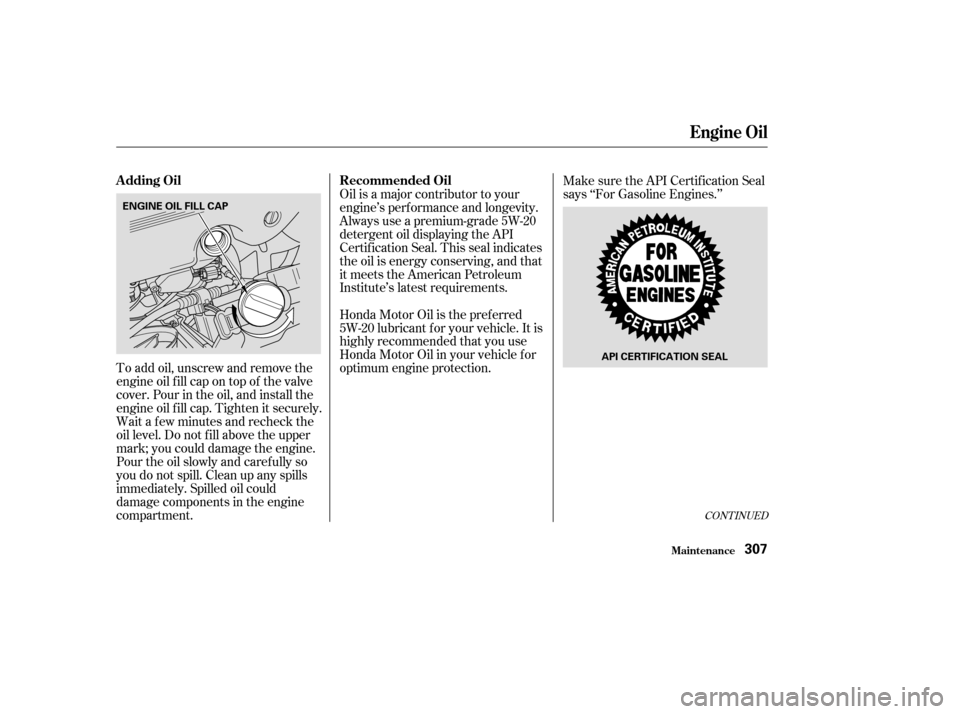
To add oil, unscrew and remove the
engine oil f ill cap on top of the valve
cover. Pour in the oil, and install the
engine oil f ill cap. Tighten it securely.
Wait a f ew minutes and recheck the
oil level. Do not f ill above the upper
mark; you could damage the engine.Make sure the API Certif ication Seal
says ‘‘For Gasoline Engines.’’
Oil is a major contributor to your
engine’s perf ormance and longevity.
Always use a premium-grade 5W-20
detergent oil displaying the API
Certif ication Seal. This seal indicates
the oil is energy conserving, and that
it meets the American Petroleum
Institute’s latest requirements.
Pour the oil slowly and caref ully so
you do not spill. Clean up any spills
immediately. Spilled oil could
damage components in the engine
compartment. Honda Motor Oil is the pref erred
5W-20 lubricant f or your vehicle. It is
highly recommended that you use
Honda Motor Oil in your vehicle f or
optimum engine protection.
CONT INUED
Recommended Oil
A dding Oil
Engine Oil
Maint enance307
ENGINE OIL FILL CAP
API CERTIFICATION SEAL
Page 318 of 420
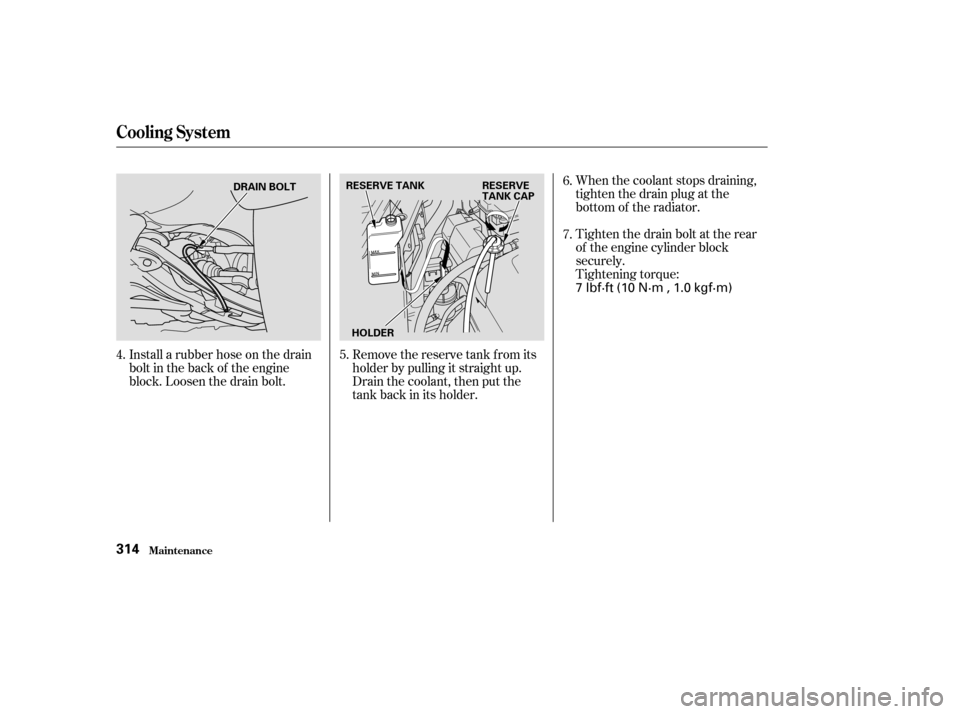
When the coolant stops draining,
tightenthedrainplugatthe
bottom of the radiator.
Tighten the drain bolt at the rear
of the engine cylinder block
securely.
Tightening torque:
Remove the reserve tank f rom its
holder by pulling it straight up.
Drain the coolant, then put the
tank back in its holder.
Install a rubber hose on the drain
bolt in the back of the engine
block. Loosen the drain bolt. 6.
4. 5. 7.
Cooling Syst em
Maint enance314
DRAIN BOLT
RESERVE TANK
RESERVE
TANK CAP
HOLDER
7 lbf·ft (10 N·m , 1.0 kgf·m)
Page 322 of 420
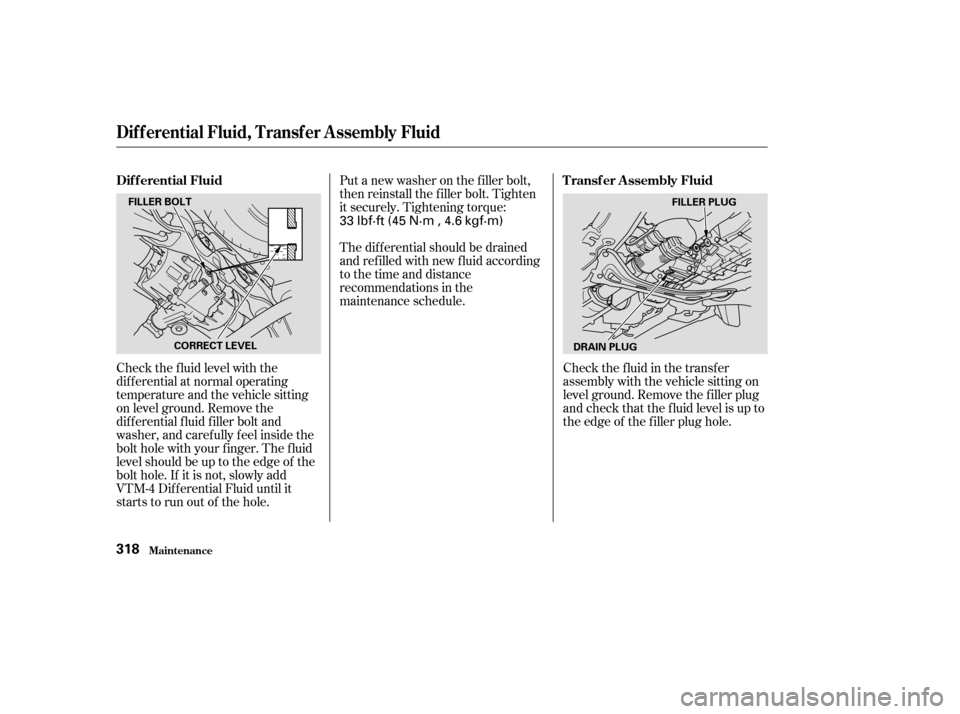
Put a new washer on the f iller bolt,
then reinstall the f iller bolt. Tighten
it securely. Tightening torque:
The dif f erential should be drained
and ref illed with new f luid according
to the time and distance
recommendations in the
maintenance schedule.
Check the f luid level with the
dif f erential at normal operating
temperature and the vehicle sitting
on level ground. Remove the
dif f erential f luid f iller bolt and
washer, and caref ully f eel inside the
bolt hole with your f inger. The f luid
level should be up to the edge of the
bolt hole. If it is not, slowly add
VTM-4 Dif f erential Fluid until it
starts to run out of the hole. Checkthefluidinthetransfer
assembly with the vehicle sitting on
level ground. Remove the f iller plug
and check that the f luid level is up to
the edge of the f iller plug hole.
Maint enance
Dif f erential Fluid
Transf er Assembly Fluid
Differential Fluid, Transfer Assembly Fluid
318
FILLER BOLT
CORRECT LEVEL FILLER PLUG
DRAIN PLUG
33 lbf·ft (45 N·m , 4.6 kgf·m)