brake Acura MDX 2015 User Guide
[x] Cancel search | Manufacturer: ACURA, Model Year: 2015, Model line: MDX, Model: Acura MDX 2015Pages: 79, PDF Size: 16.44 MB
Page 55 of 79
102 || 103
DrIvING
DrIvING
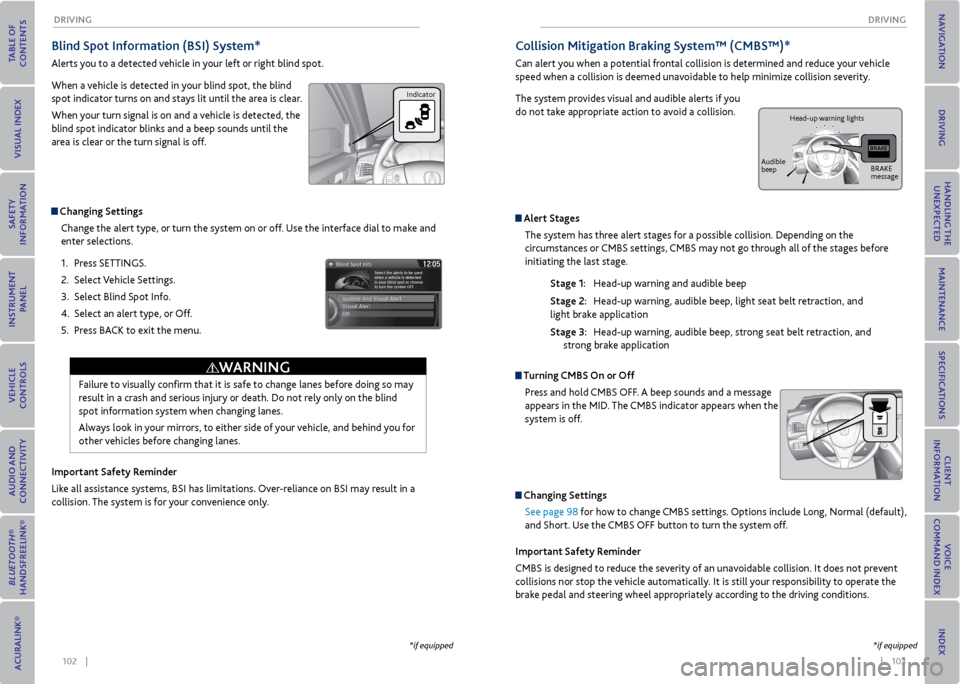
Blind Spot Information (BSI) System*
Alerts you to a detected vehicle in your left or right blind spot.
When a vehicle is detected in your blind spot, the blind
spot indicator turns on and stays lit until the area is clear.
When your turn signal is on and a vehicle is detected, the
blind spot indicator blinks and a beep sounds until the
area is clear or the turn signal is off.
Changing Settings
Change the alert type, or turn the system on or off. Use the interface dial to make and
enter selections.
1. Press SETTINGS.
2. Select Vehicle Settings.
3. Select Blind Spot Info.
4. Select an alert type, or Off.
5. Press BACK to exit the menu.
Important Safety reminder
Like all assistance systems, BSI has limitations. Over-reliance on BSI may result in a
collision. The system is for your convenience only.
Failure to visually confirm that it is safe to change lanes before doing so may
result in a crash and serious injury or death. Do not rely only on the blind
spot information system when changing lanes.
Always look in your mirrors, to either side of your vehicle, and behind you for
other vehicles before changing lanes.
WArNING
*if equipped
Indicator
Collision mitigation Braking System™ (CmBS™)*
Can alert you when a potential frontal collision is determined and reduce your vehicle
speed when a collision is deemed unavoidable to help minimize collision severity.
The system provides visual and audible alerts if you
do not take appropriate action to avoid a collision.
Alert Stages The system has three alert stages for a possible collision. Depending on the
circumstances or CMBS settings, CMBS may not go through all of the stages before
initiating the last stage.
Stage 1: Head-up warning and audible beep
Stage 2: Head-up warning, audible beep, light seat belt retraction, and
light brake application
Stage 3: Head-up warning, audible beep, strong seat belt retraction, and
strong brake application
Turning CmBS on or off
Press and hold CMBS OFF. A beep sounds and a message
appears in the MID. The CMBS indicator appears when the
system is off.
Changing SettingsSee page 98 for how to change CMBS settings. Options include Long, Normal (default),
and Short. Use the CMBS OFF button to turn the system off.
Important Safety reminder
CMBS is designed to reduce the severity of an unavoidable collision. It does not prevent
collisions nor stop the vehicle automatically. It is still your responsibility to operate the
brake pedal and steering wheel appropriately according to the driving conditions.
*if equipped
BRAKE
message
Audible
beep Head-up warning lights
Page 58 of 79
108 || 109
HANDLING THe UNexPeCTeD
HANDLING THe UNexPeCTeD
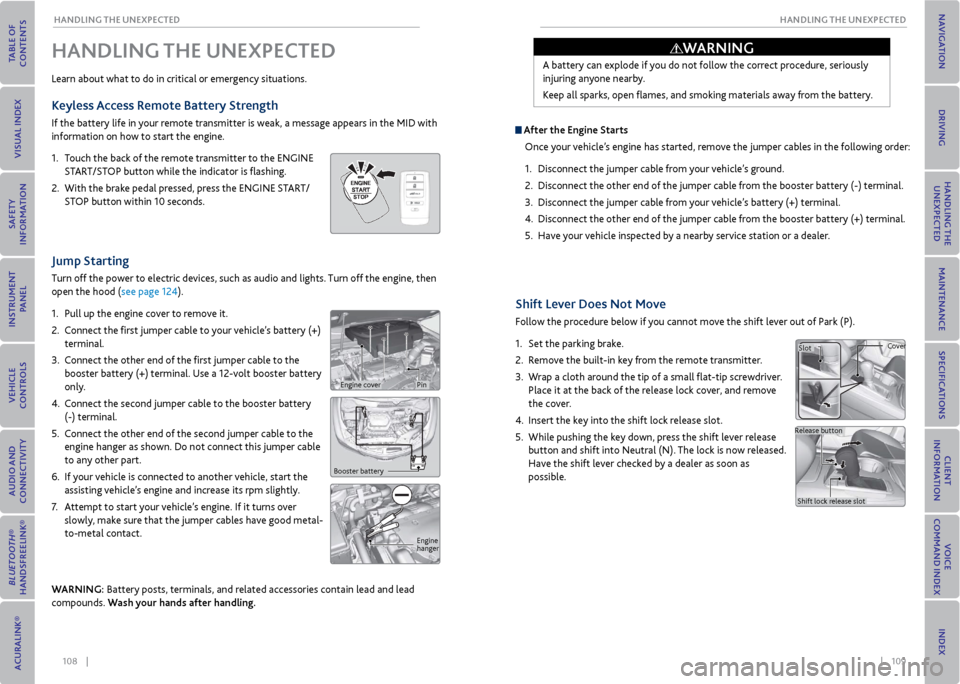
Shift Lever Does Not move
Follow the procedure below if you cannot move the shift lever out of Park (P).
1. Set the parking brake.
2. Remove the built-in key from the remote transmitter.
3. Wrap a cloth around the tip of a small flat-tip screwdriver.
Place it at the back of the release lock cover, and remove
the cover.
4. Insert the key into the shift lock release slot.
5. While pushing the key down, press the shift lever release
button and shift into Neutral (N). The lock is now released.
Have the shift lever checked by a dealer as soon as
possible.
Jump Starting
Turn off the power to electric devices, such as audio and lights. Turn off the engine, then
open the hood (see page 124).
1. Pull up the engine cover to remove it.
2. Connect the first jumper cable to your vehicle’s battery (+)
terminal.
3. Connect the other end of the first jumper cable to the
booster battery (+) terminal. Use a 12-volt booster battery
only.
4. Connect the second jumper cable to the booster battery
(-) terminal.
5. Connect the other end of the second jumper cable to the
engine hanger as shown. Do not connect this jumper cable
to any other part.
6. If your vehicle is connected to another vehicle, start the
assisting vehicle’s engine and increase its rpm slightly.
7. Attempt to start your vehicle’s engine. If it turns over
slowly, make sure that the jumper cables have good metal-
to-metal contact.
WArNING: Battery posts, terminals, and related accessories contain lead and lead
compounds. Wash your hands after handling.
HANDLING THe UNexPeCTeD
Learn about what to do in critical or emergency situations.
Keyless Access remote Battery Strength
If the battery life in your remote transmitter is weak, a message appears in the MID with
information on how to start the engine.
1. Touch the back of the remote transmitter to the ENGINE
START/STOP button while the indicator is flashing.
2. With the brake pedal pressed, press the ENGINE START/
STOP button within 10 seconds.
Booster battery
Engine
hanger
A battery can explode if you do not follow the correct procedure, seriously
injuring anyone nearby.
Keep all sparks, open flames, and smoking materials away from the battery.
After the engine Starts
Once your vehicle’s engine has started, remove the jumper cables in the following order:
1. Disconnect the jumper cable from your vehicle’s ground.
2. Disconnect the other end of the jumper cable from the booster battery (-) terminal.
3. Disconnect the jumper cable from your vehicle’s battery (+) terminal.
4. Disconnect the other end of the jumper cable from the booster battery (+) terminal.
5. Have your vehicle inspected by a nearby service station or a dealer.
Slot Cover
Release button Shift lock release slot
WArNING
Engine coverPin
Page 59 of 79
110 || 111
HANDLING THe UNexPeCTeD
HANDLING THe UNexPeCTeD
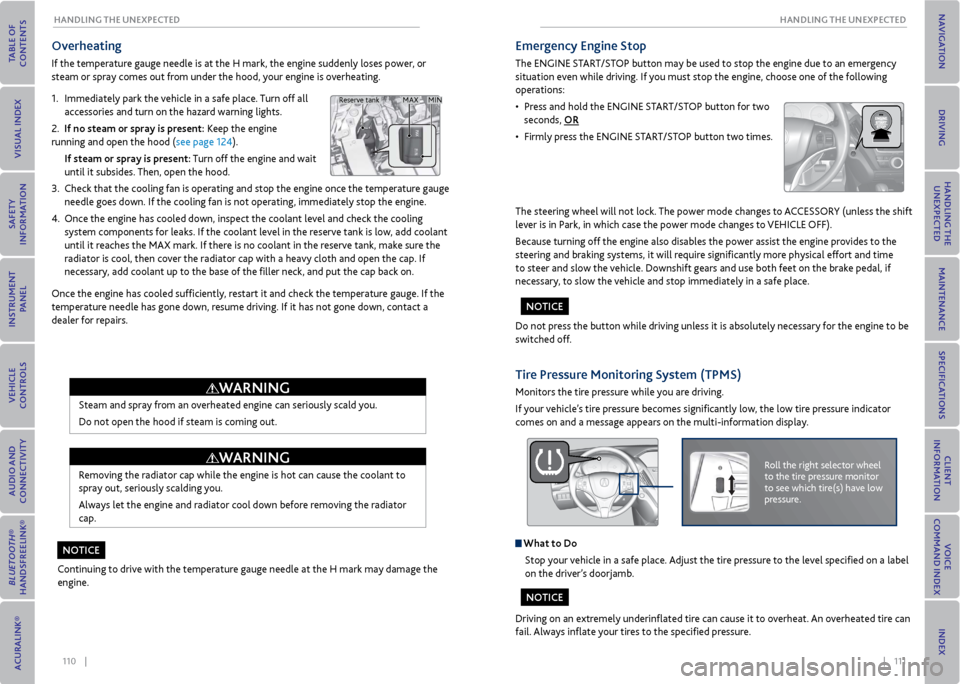
overheating
If the temperature gauge needle is at the H mark, the engine suddenly loses power, or
steam or spray comes out from under the hood, your engine is overheating.
1. Immediately park the vehicle in a safe place. Turn off all
accessories and turn on the hazard warning lights.
2. If no steam or spray is present: Keep the engine
running and open the hood (see page 124).
If steam or spray is present: Turn off the engine and wait
until it subsides. Then, open the hood.
3. Check that the cooling fan is operating and stop the engine once the temperature gauge
needle goes down. If the cooling fan is not operating, immediately stop the engine.
4. Once the engine has cooled down, inspect the coolant level and check the cooling
system components for leaks. If the coolant level in the reserve tank is low, add coolant
until it reaches the MAX mark. If there is no coolant in the reserve tank, make sure the
radiator is cool, then cover the radiator cap with a heavy cloth and open the cap. If
necessary, add coolant up to the base of the filler neck, and put the cap back on.
Once the engine has cooled sufficiently, restart it and check the temperature gauge. If the
temperature needle has gone down, resume driving. If it has not gone down, contact a
dealer for repairs.
Steam and spray from an overheated engine can seriously scald you.
Do not open the hood if steam is coming out.
Removing the radiator cap while the engine is hot can cause the coolant to
spray out, seriously scalding you.
Always let the engine and radiator cool down before removing the radiator
cap.
Continuing to drive with the temperature gauge needle at the H mark may damage the
engine.
MAX MIN
Reserve tank
WArNING
WArNING
No TICe
emergency engine Stop
The ENGINE START/STOP button may be used to stop the engine due to an emergency
situation even while driving. If you must stop the engine, choose one of the following
operations:
• Press and hold the ENGINE START/STOP button for two
seconds, or
• Firmly press the ENGINE START/STOP button two times.
The steering wheel will not lock. The power mode changes to ACCESSORY (unless the shift
lever is in Park, in which case the power mode changes to VEHICLE OFF).
Because turning off the engine also disables the power assist the engine provides to the
steering and braking systems, it will require significantly more physical effort and time
to steer and slow the vehicle. Downshift gears and use both feet on the brake pedal, if
necessary, to slow the vehicle and stop immediately in a safe place.
Do not press the button while driving unless it is absolutely necessary for the engine to be
switched off.
Tire Pressure monitoring System (TPmS)
Monitors the tire pressure while you are driving.
If your vehicle’s tire pressure becomes significantly low, the low tire pressure indicator
comes on and a message appears on the multi-information display.
Roll the right selector wheel
to the tire pressure monitor
to see which tire(s) have low
pressure.
What to Do Stop your vehicle in a safe place. Adjust the tire pressure to the level specified on a label
on the driver’s doorjamb.
Driving on an extremely underinflated tire can cause it to overheat. An overheated tire can
fail. Always inflate your tires to the specified pressure.
No TICe
NoTICe
Page 60 of 79
112 || 113
HANDLING THe UNexPeCTeD
HANDLING THe UNexPeCTeD
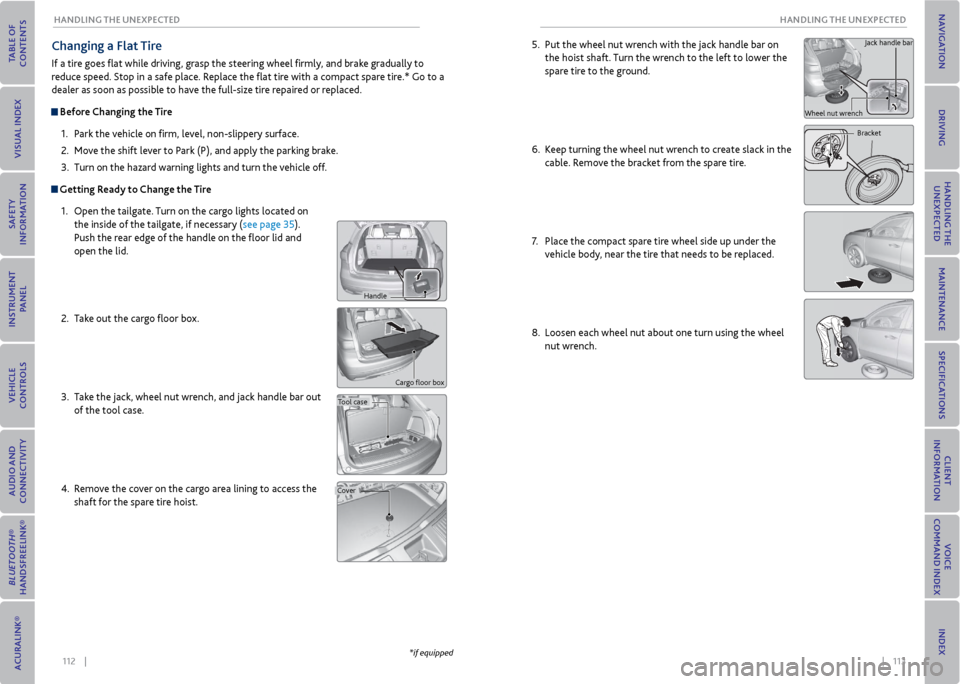
Changing a Flat Tire
If a tire goes flat while driving, grasp the steering wheel firmly, and brake gradually to
reduce speed. Stop in a safe place. Replace the flat tire with a compact spare tire.* Go to a
dealer as soon as possible to have the full-size tire repaired or replaced.
Before Changing the Tire
1. Park the vehicle on firm, level, non-slippery surface.
2. Move the shift lever to Park (P), and apply the parking brake.
3. Turn on the hazard warning lights and turn the vehicle off.
Getting ready to Change the Tire
1. Open the tailgate. Turn on the cargo lights located on
the inside of the tailgate, if necessary (see page 35).
Push the rear edge of the handle on the floor lid and
open the lid.
2. Take out the cargo floor box.
3. Take the jack, wheel nut wrench, and jack handle bar out
of the tool case.
4. Remove the cover on the cargo area lining to access the
shaft for the spare tire hoist.
Cargo floor box
Tool case
Cover
*if equipped
5. Put the wheel nut wrench with the jack handle bar on
the hoist shaft. Turn the wrench to the left to lower the
spare tire to the ground.
6. Keep turning the wheel nut wrench to create slack in the
cable. Remove the bracket from the spare tire.
7. Place the compact spare tire wheel side up under the
vehicle body, near the tire that needs to be replaced.
8. Loosen each wheel nut about one turn using the wheel
nut wrench.
Bracket
Wheel nut wrench Jack handle bar
Handle
Page 62 of 79
116 || 117
HANDLING THe UNexPeCTeD
HANDLING THe UNexPeCTeD
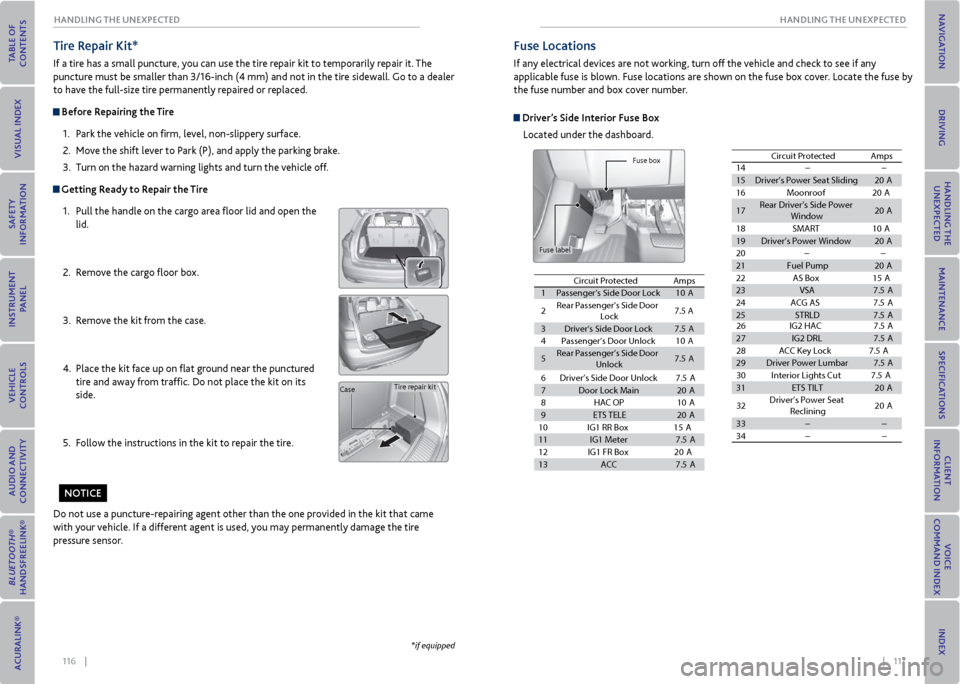
Tire r epair Kit*
If a tire has a small puncture, you can use the tire repair kit to temporarily repair it. The
puncture must be smaller than 3/16-inch (4 mm) and not in the tire sidewall. Go to a dealer
to have the full-size tire permanently repaired or replaced.
Before r epairing the Tire
1. Park the vehicle on firm, level, non-slippery surface.
2. Move the shift lever to Park (P), and apply the parking brake.
3. Turn on the hazard warning lights and turn the vehicle off.
Getting ready to repair the Tire
1. Pull the handle on the cargo area floor lid and open the
lid.
2. Remove the cargo floor box.
3. Remove the kit from the case.
4. Place the kit face up on flat ground near the punctured
tire and away from traffic. Do not place the kit on its
side.
5. Follow the instructions in the kit to repair the tire.
Do not use a puncture-repairing agent other than the one provided in the kit that came
with your vehicle. If a different agent is used, you may permanently damage the tire
pressure sensor.
Tire repair kit
Case
*if equipped
No TICe
Fuse Locations
If any electrical devices are not working, turn off the vehicle and check to see if any
applicable fuse is blown. Fuse locations are shown on the fuse box cover. Locate the fuse by
the fuse number and box cover number.
Driver’s Side Interior Fuse Box
Located under the dashboard.
Fuse box
Fuse label
Circuit ProtectedAmps
1Passenger’s Side Door Lock10 A
2Rear Passenger’s Side Door
Lock7.5 A
3Driver’s Side Door Lock7.5A
4Passenger’s Door Unloc k10A
5Rear Passenger’s Side Door Unlock7.5A
6 Driver’s Side Door Unlock 7.5A
7 Door Lock Main 20A
8 HAC OP 10A
9 ETS TELE 20A
10 IG1 RR Box1 5A
11 IG1 Meter 7.5A
12 IG1 FR Box2 0A
13 ACC 7.5A
14
15 Driver’s Power Seat Sliding 20A
16 Moonroof 20A
17 Rear Driver’s Side Power
Window 20
A
18 SMART 10A
19 Driver’s Power Windo w20A
20
21 Fuel Pump 20A
22 AS Box 15A
23 VSA 7.5A
24 ACG AS 7.5A
25 STRLD 7.5A
Circuit Protecte
dAmps
26 IG2 HAC 7.5A
27 IG2 DRL 7.5A
28 ACC Key Lock 7.5A
29 Driver Power Lumbar 7.5A
30 Interior Lights Cut 7.5A
31 ETS TILT 20A
32 Driver’s Power Seat
Reclining 20
A
33
34
Circuit Protected
Amps
Circuit Protected Amps
1 Passenger’s Side Door Lock 10A
2 Rear
Passenger’s Side Door
Lock 7.5
A
3 Driver’s Side Door Lock 7.5A
4 Passenger’s Door Unloc k10A
5 Rear
Passenger’s Side Door
Unlock 7.
5A
6Driver’s Side Door Unlock7.5A
7Door Lock Main20 A
8HAC OP10A
9ETS TELE20A
10 IG1 RR Bo
x15A
11IG1 Meter7.5A
12 IG1 FR Bo
x20A
13ACC7.5A
14
15 Driver’s Power Seat Sliding 20A
16 Moonroof 20A
17 Rear Driver’s Side Power
Window 20
A
18 SMART 10A
19 Driver’s Power Windo w20A
20
21 Fuel Pump 20A
22 AS Box 15A
23 VSA 7.5A
24 ACG AS 7.5A
25 STRLD 7.5A
Circuit Protecte dAmps
26IG2 HAC 7.5A
27 IG2 DRL 7.5A
28 ACC Key Lock 7.5A
29 Driver Power Lumbar 7.5A
30 Interior Lights Cut 7.5A
31 ETS TILT 20A
32 Driver’s Power Seat
Reclining 20
A
33
34
Circuit Protected
Amps
Circuit Protected Amps
1 Passenger’s Side Door Lock 10A
2 Rear
Passenger’s Side Door
Lock 7.5
A
3 Driver’s Side Door Lock 7.5A
4 Passenger’s Door Unloc k10A
5 Rear
Passenger’s Side Door
Unlock 7.
5A 6
Driver’s Side Door Unlock 7.5A
7 Door Lock Main 20A
8 HAC OP 10A
9 ETS TELE 20A
10 IG1 RR Box1 5A
11 IG1 Meter 7.5A
12 IG1 FR Box2 0A
13 ACC 7.5A
14
15 Driver’s Power Seat Sliding 20A
16 Moonroof 20A
17 Rear Driver’s Side Power
Window 20
A
18 SMART 10A
19 Driver’s Power Windo w20A
20
21 Fuel Pump 20A
22 AS Box 15A
23 VSA 7.5A
24 ACG AS 7.5A
25 STRLD 7.5A
Circuit Protecte
dAmps
26 IG2 HAC 7.5A
27IG2 DR L7.5A
28 ACC Key Lock 7.5A
29Driver Power Lumbar7.5A
30 Interior Lights Cut 7.5A
31ETS TILT20 A
32 Driver’s Power Seat
Reclining 20
A
33
34
Circuit ProtectedAmps
Circuit Protected Amps
1 Passenger’s Side Door Lock 10A
2 Rear
Passenger’s Side Door
Lock 7.5
A
3 Driver’s Side Door Lock 7.5A
4 Passenger’s Door Unloc k10A
5 Rear
Passenger’s Side Door
Unlock 7.
5A 6
Driver’s Side Door Unlock 7.5A
7 Door Lock Main 20A
8 HAC OP 10A
9 ETS TELE 20A
10 IG1 RR Box1 5A
11 IG1 Meter 7.5A
12 IG1 FR Box2 0A
13ACC7.5A
14
15Driver’s Power Seat Sliding20A
16 Moonroof 20A
17Rear Driver’s Side Power
Window20A
18 SMART 10A
19Driver’s Power Windo w20A
20
21Fuel Pump20 A
22 AS Box 15A
23VSA7.5A
24 ACG AS 7.5A
25STRLD7.5A
Circuit Protecte
dAmps
26 IG2 HAC 7.5A
27 IG2 DRL 7.5A
28 ACC Key Lock 7.5A
29 Driver Power Lumbar 7.5A
30 Interior Lights Cut 7.5A
31 ETS TILT 20A
32 Driver’s Power Seat
Reclining 20
A
33
34
Circuit Protected
Amps
Circuit ProtectedAmps
1Passenger’s Side Door Lock10A
2 Rear
Passenger’s Side Door
Lock 7.5
A
3 Driver’s Side Door Lock 7.5A
4 Passenger’s Door Unloc k10A
5 Rear
Passenger’s Side Door
Unlock 7.
5A6 Driver’s Side Door Unlock 7.5A
7 Door Lock Main 20A
8 HAC OP 10A
9 ETS TELE 20A
10 IG1 RR Box1 5A
11 IG1 Meter 7.5A
12 IG1 FR Box2 0A
13 ACC 7.5A
14
15 Driver’s Power Seat Sliding 20A
16 Moonroof 20A
17 Rear Driver’s Side Power
Window 20
A
18 SMART 10A
19 Driver’s Power Windo w20A
20
21 Fuel Pump 20A
22 AS Box 15A
23 VSA 7.5A
24 ACG AS 7.5A
25 STRLD 7.5A
Circuit Protecte
dAmps
26 IG2 HAC 7.5A
27 IG2 DRL 7.5A
28 ACC Key Lock 7.5A
29 Driver Power Lumbar 7.5A
30 Interior Lights Cut 7.5A
31 ETS TILT 20A
32 Driver’s Power Seat
Reclining 20
A
33
34
Circuit Protected
Amps
Page 63 of 79
118 || 119
HANDLING THe UNexPeCTeD
HANDLING THe UNexPeCTeD
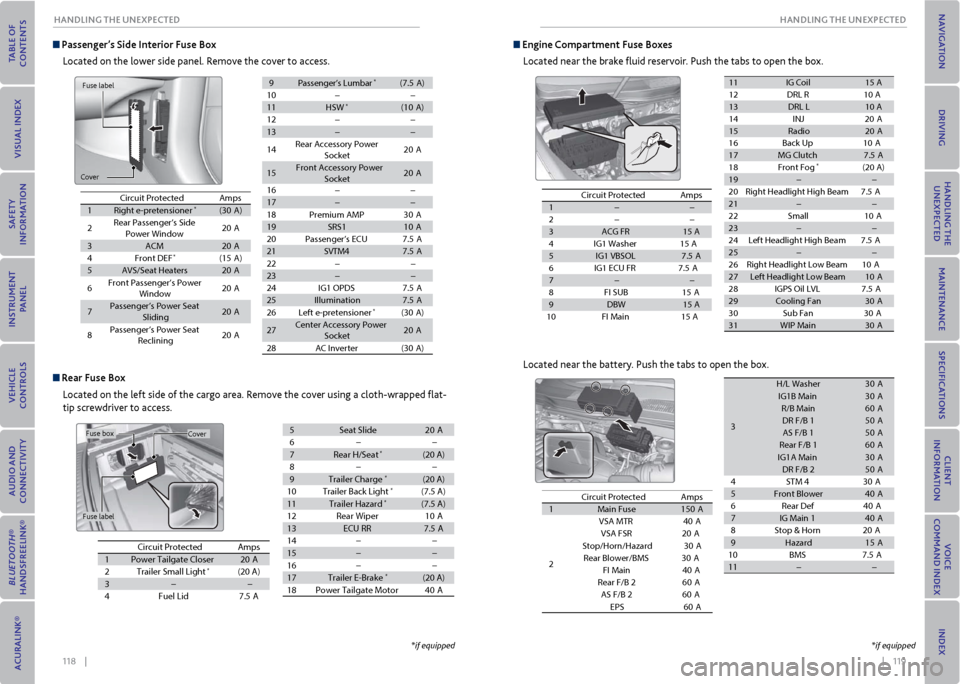
Passenger’s Side Interior Fuse Box
Located on the lower side panel. Remove the cover to access.
Circuit Protecte dAmps
1Right e-pretensione r*(30A)
2Rear Passenger’s Side
Power Window20 A
3ACM20A
4Front DEF*(15A )
5AVS/Seat Heaters20A
6Front Passenger’s Power
Windo w20A
7Passenger’s Power Seat
Slidin g20A
8Passenger’s Power Seat
Reclinin g20A
9Passenger’s Lumbar*(7.5 A)
10
11HSW*(10A )
12
13
14Rear Accessory Power
Socket20A
15Front Accessory Power
Socke t20A
16
17
18Premium AMP30 A
19SRS110A
20Passenger’s ECU7.5 A
21SVTM47.5A
22
23
24IG1 OPD S7.5A
25Illumination7.5A
26Left e-pretensioner*(30A )
27 Center Accessory Power
Socket20A
28AC Inverter(30A )
rear Fuse Box
Located on the left side of the cargo area. Remove the cover using a cloth-wrapped flat-
tip screwdriver to access.
Circuit Protecte dAmps
1Power Tailgate Closer20A
2Trailer Small Ligh t*(20 A)
3
4Fuel Lid7.5A
5Seat Slid e20A
6
7Rear H/Seat*(20 A)
8
9Trailer Charge*(20 A)
10Trailer Back Ligh t*(7.5 A)
11Trailer Hazard*(7.5 A)
12Rear Wiper10A
13ECU RR7.5A
14
15
16
17Trailer E-Brake*(20 A)
18Power Tailgate Motor40A
Fuse label
Cover
Cover
Fuse label
Fuse box
*if equipped
Circuit Protecte dAmps
1
2
3ACG FR15 A
4I G1 Washer1 5 A
5IG1 VBSO L7.5A
6I G1 ECU FR 7.5A
7
8F I SUB1 5A
9DBW15 A
10 FI Main 15 A
11IG Coil15 A
12 DRL R10 A
13DRL L10 A
14 IN
J20A
15Radio20A
16 Back Up 10A
17MG Clutch7.5A
18 Front Fog*(20 A)
19
20 Right Headlight High Beam 7.5A
21
22 Smal
l10A
23
24 Left Headlight High Bea m7.5A
25
26 Right Headlight Low Beam 10A
27Left Headlight Low Beam10A
28 IGPS Oil LVL 7.5A
29Cooling Fan30 A
30 Sub Fan 30A
31WIP Mai n30A
Located near the battery. Push the tabs to open the box.
Circuit Protecte dAmps
1Main Fuse150A
2
VSA MT R40A
VSA FSR 20A
Stop/Horn/Hazard 30A
Rear Blower/BMS 30A
FI Main 40A
Rear F/B 26 0A
AS F/B 26 0A
EPS 60A
3
H/L Washer30A
IG1B Main30A
R/B Main60A
DR F/B 150A
AS F/B 150A
Rear F/B 160A
IG1A Main30A
DR F/B 250A
4S TM
430A
5Front Blower40A
6R ear De
f40A
7IG Main 140A
8S top & Horn 20A
9Hazar d15A
10 BMS 7.5A
11
engine Compartment Fuse Boxes
Located near the brake fluid reservoir. Push the tabs to open the box.
*if equipped
Page 64 of 79
120 || 121
mAINTeNANCe
HANDLING THe UNexPeCTeD
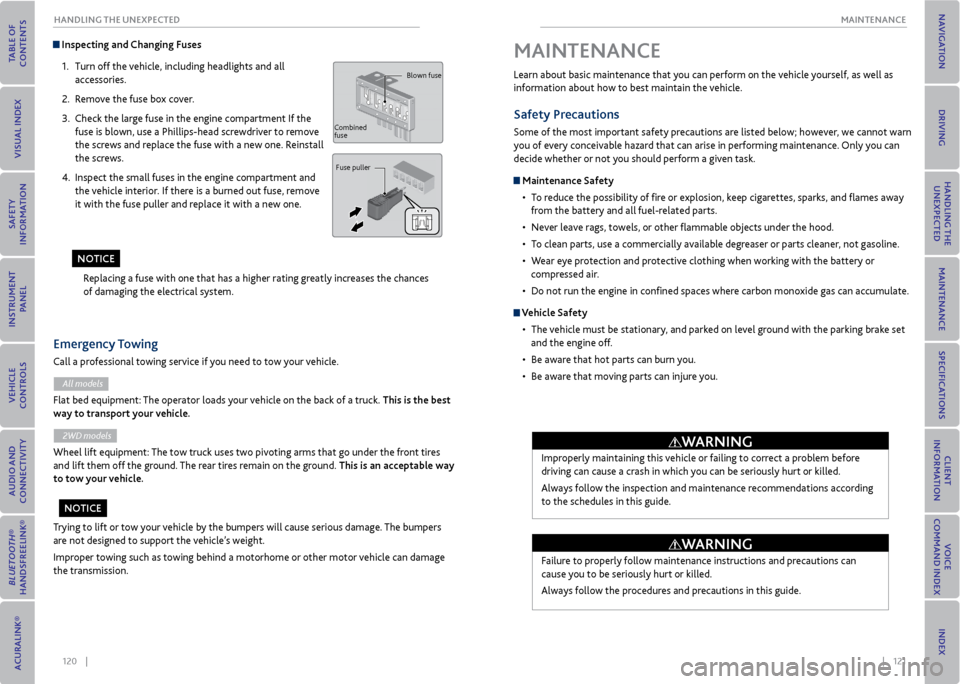
Inspecting and Changing Fuses
1. Turn off the vehicle, including headlights and all
accessories.
2. Remove the fuse box cover.
3. Check the large fuse in the engine compartment If the
fuse is blown, use a Phillips-head screwdriver to remove
the screws and replace the fuse with a new one. Reinstall
the screws.
4. Inspect the small fuses in the engine compartment and
the vehicle interior. If there is a burned out fuse, remove
it with the fuse puller and replace it with a new one.
Replacing a fuse with one that has a higher rating greatly increases the chances
of damaging the electrical system.
Blown fuse
Combined
fuse Fuse puller
Trying to lift or tow your vehicle by the bumpers will cause serious damage. The bumpers
are not designed to support the vehicle’s weight.
Improper towing such as towing behind a motorhome or other motor vehicle can damage
the transmission.
emergency Towing
Call a professional towing service if you need to tow your vehicle.
All models
Flat bed equipment: The operator loads your vehicle on the back of a truck. This is the best
way to transport your vehicle.
2WD models
Wheel lift equipment: The tow truck uses two pivoting arms that go under the front tires
and lift them off the ground. The rear tires remain on the ground. This is an acceptable way
to tow your vehicle.
No TICe
NoTICe Learn about basic maintenance that you can perform on the vehicle yourself, as well as
information about how to best maintain the vehicle.
Safety Precautions
Some of the most important safety precautions are listed below; however, we cannot warn
you of every conceivable hazard that can arise in performing maintenance. Only you can
decide whether or not you should perform a given task.
maintenance Safety
• To reduce the possibility of fire or explosion, keep cigarettes, sparks, and flames away
from the battery and all fuel-related parts.
• Never leave rags, towels, or other flammable objects under the hood.
• To clean parts, use a commercially available degreaser or parts cleaner, not gasoline.
• Wear eye protection and protective clothing when working with the battery or
compressed air.
• Do not run the engine in confined spaces where carbon monoxide gas can accumulate.
vehicle Safety
• The vehicle must be stationary, and parked on level ground with the parking brake set
and the engine off.
• Be aware that hot parts can burn you.
• Be aware that moving parts can injure you.
mAINTeNANCe
Improperly maintaining this vehicle or failing to correct a problem before
driving can cause a crash in which you can be seriously hurt or killed.
Always follow the inspection and maintenance recommendations according
to the schedules in this guide.
Failure to properly follow maintenance instructions and precautions can
cause you to be seriously hurt or killed.
Always follow the procedures and precautions in this guide.
WArNING
WArNING
Page 65 of 79
122 || 123
mAINTeNANCe
mAINTeNANCe
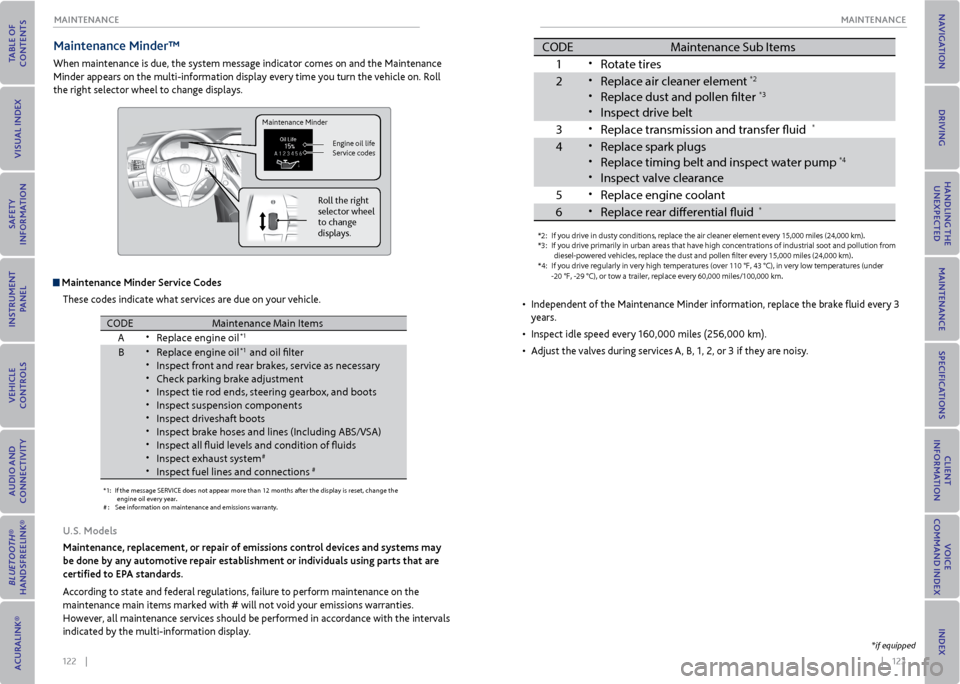
maintenance minder™
When maintenance is due, the system message indicator comes on and the Maintenance
Minder appears on the multi-information display every time you turn the vehicle on. Roll
the right selector wheel to change displays.
maintenance minder Service Codes
These codes indicate what services are due on your vehicle.
*1: If the message SERVICE does not appear more than 12 months after the display is\
reset, change the
engine oil every year .
#: See information on maintenance and emissions warranty.
CODEMaintenance Main Items
A
•Replace engine oi l*1
B•Replace engine oil*1 and oil flter•Inspect front and rear brakes, service as necessar y•Check parking brake adjustment•Inspect tie rod ends, steering gearbox, and boot s•Inspect suspension components•Inspect driveshaft boots•Inspect brake hoses and lines (Including ABS/VSA)•Inspect all fuid levels and condition of fuid s•Inspect exhaust system#
•Inspect fuel lines and connections#
*4:If you drive regularly in very high temperatures (over 110 °F, 43 °\
C), in very low temperatures (unde r
-20 °F, -29 °C), or tow a trai ler, repl ace ever y 60,000 mi les/100,000 km .
CODE Maintenance Sub Items
1
•Rotate tires
2
•Replace air cleaner element*2
•Replace dust and pollen flte r*3
•Inspect drive belt
3
•Replace transmission and transfer fuid*
4•Replace spark plug s•Replace timing belt an d inspect water pump*4
•Inspect valve clearanc
e
5
•Replace engine coolan t
6
•Replace rear diferential fuid*
*2:I f you drive in dusty condi tion s, replac e the air cleaner element every 15,000 miles (24,000 km).
*3: If you drive primarily in urban areas that have high concentrations of i\
ndustrial soot and pollution from
diesel-powered vehicles, replace the dust and pollen flter every 15,000 miles (24,000 km).
U.S. models
maintenance, replacement, or repair of emissions control devices and systems may
be done by any automotive repair establishment or individuals using parts that are
certified to ePA standards.
According to state and federal regulations, failure to perform maintenance on the
maintenance main items marked with # will not void your emissions warranties.
However, all maintenance services should be performed in accordance with the intervals
indicated by the multi-information display.
Maintenance Minder
Engine oil life
Service codes
Roll the right
selector wheel
to change
displays.
*1: If the message SERVICE does not appear more than 12 months after the display is\
reset, change the
engine oil every year .
#: See information on maintenance and emissions warranty.
CODEMaintenance Main Item s
A
•Replace engine oi l*1
B•Replace engine oil*1 and oil flter
•Inspect front and rear brakes, service as necessar y
•Check parking brake adjustment
•Inspect tie rod ends, steering gearbox, and boot s
•Inspect suspension components
•Inspect driveshaft boots
•Inspect brake hoses and lines (Including ABS/VSA)
•Inspect all fuid levels and condition of fuid s
•Inspect exhaust system#
•Inspect fuel lines and connections#
*4:If you drive regularly in very high temperatures (over 110 °F, 43 °\
C), in very low temperatures (unde r
-20 °F, -29 °C), or tow a trai ler, repl ace ever y 60,000 mi les/100,000 km .
CODEMaintenance Sub Item s
1
•Rotate tires
2•Replace air cleaner element*2
•Replace dust and pollen flte r*3
•Inspect drive belt
3
•Replace transmission and transfer fuid*
4•Replace spark plug s
•Replace timing belt an d inspect water pump*4
•Inspect valve clearanc
e
5
•Replace engine coolan t
6•Replace rear diferential fuid*
*2:If you drive in dusty condi tion s, replac e the air cleaner element every 15,000 miles (24,000 km).
*3: If you drive primarily in urban areas that have high concentrations of i\
ndustrial soot and pollution from
diesel-powered vehicles, replace the dust and pollen flter every 15,000 miles (24,000 km).
• Independent of the Maintenance Minder information, replace the brake fluid every 3
years.
• Inspect idle speed every 160,000 miles (256,000 km).
• Adjust the valves during services A, B, 1, 2, or 3 if they are noisy.
*if equipped
Page 66 of 79
124 || 125
mAINTeNANCe
mAINTeNANCe
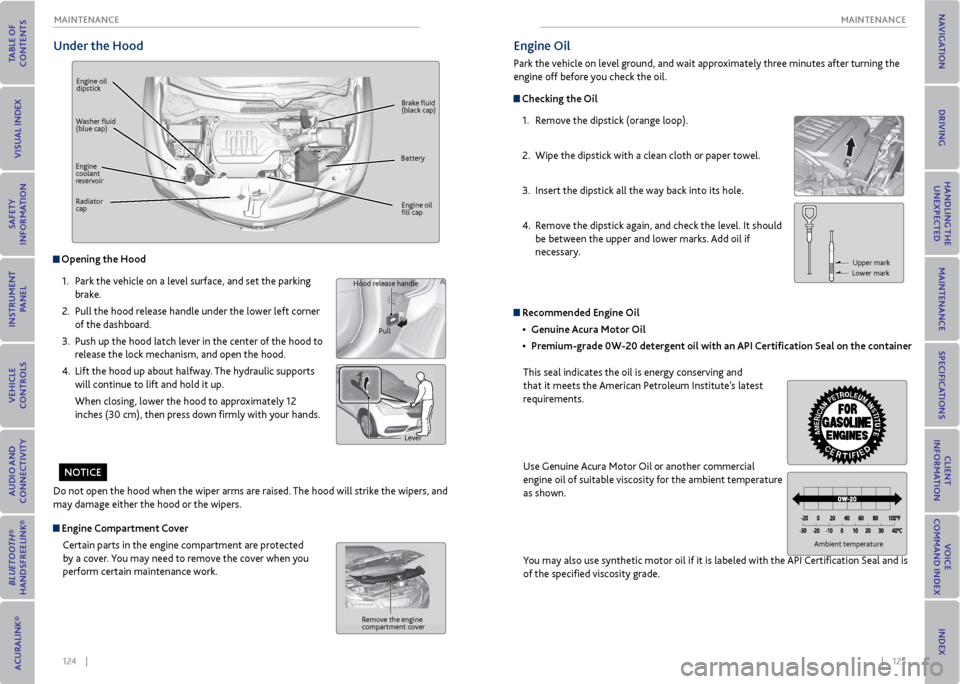
Under the Hood
Engine oil
dipstick
Brake fluid
(black cap)
Engine oil
fill cap
Washer fluid
(blue cap)
Battery
Engine
coolant
reservoir
Radiator
cap
opening the Hood
1. Park the vehicle on a level surface, and set the parking
brake.
2. Pull the hood release handle under the lower left corner
of the dashboard.
3. Push up the hood latch lever in the center of the hood to
release the lock mechanism, and open the hood.
4. Lift the hood up about halfway. The hydraulic supports
will continue to lift and hold it up.
When closing, lower the hood to approximately 12
inches (30 cm), then press down firmly with your hands.
Do not open the hood when the wiper arms are raised. The hood will strike the wipers, and
may damage either the hood or the wipers.
Hood release handle
Pull
Lever
engine Compartment CoverCertain parts in the engine compartment are protected
by a cover. You may need to remove the cover when you
perform certain maintenance work.
Remove the engine
compartment cover
No TICe
engine oil
Park the vehicle on level ground, and wait approximately three minutes after turning the
engine off before you check the oil.
Checking the oil
1. Remove the dipstick (orange loop).
2. Wipe the dipstick with a clean cloth or paper towel.
3. Insert the dipstick all the way back into its hole.
4. Remove the dipstick again, and check the level. It should
be between the upper and lower marks. Add oil if
necessary.
Upper mark
Lower mark
Ambient temperature
r ecommended engine oil
• Genuine Acura motor oil
• Premium-grade 0W-20 detergent oil with an API Certification Seal on the container
This seal indicates the oil is energy conserving and
that it meets the American Petroleum Institute’s latest
requirements.
Use Genuine Acura Motor Oil or another commercial
engine oil of suitable viscosity for the ambient temperature
as shown.
You may also use synthetic motor oil if it is labeled with the API Certification Seal and is
of the specified viscosity grade.
Page 70 of 79
132 || 133
mAINTeNANCe
mAINTeNANCe
Tire Service Life
The life of your tires is dependent on many factors, including driving habits, road
conditions, vehicle loading, inflation pressure, maintenance history, speed, and
environmental conditions (even when the tires are not in use).
In addition to regular inspections and inflation pressure maintenance, it is recommended
that you have annual inspections performed once the tires reach five years old. All tires,
including the spare, should be removed from service after 10 years from the date of
manufacture, regardless of their condition or state of wear.
Winter Tires
If driving on snowy or frozen roads, mount all season tires marked “M+S”, snow tires, or
tire chains; reduce speed; and maintain sufficient distance between vehicles when driving.
For winter tires, select the size and load ranges that are the same as the original tires, and
mount them to all four wheels.
Tire Chains
Install tire chains on the front tires only. Because your vehicle has limited tire clearance,
we strongly recommend using the following chains: Cable type: SCC Cable Chain ZT735.
Mount chains as tightly as you can, and make sure that they do not touch the brake lines
or suspension.
Using the wrong chains, or not properly installing chains, can damage the
brake lines and cause a crash in which you can be seriously injured or killed.
Follow all instructions in this guide regarding the selection and use of tire
chains.
Traction devices that are the wrong size or improperly installed can damage your
vehicle’s brake lines, suspension, body, and wheels. Stop driving if they are hitting
any part of the vehicle.
WArNING
NoTICe
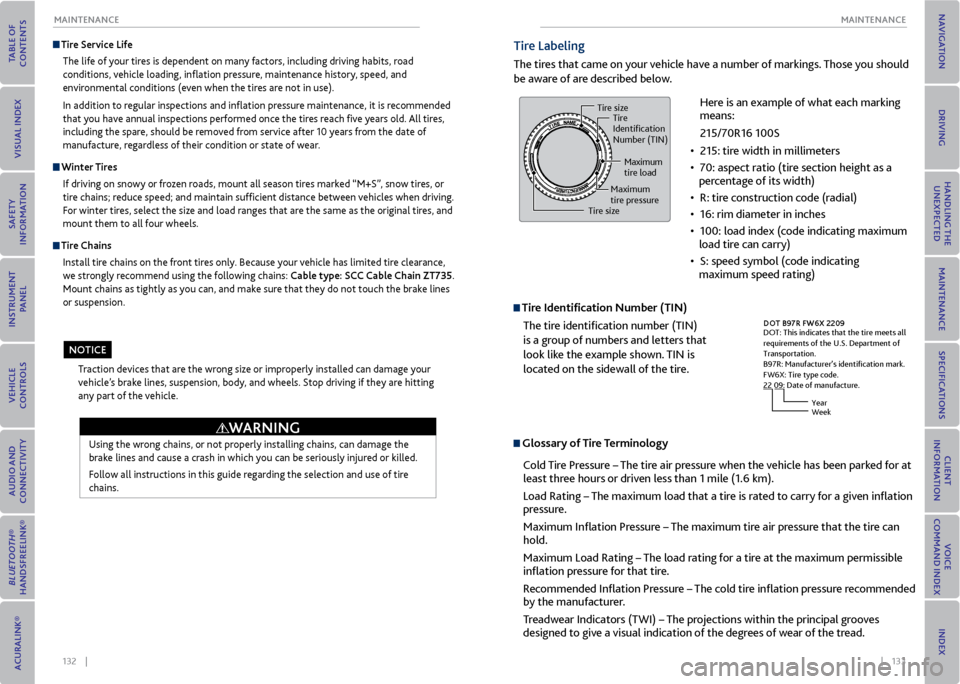
Tire Labeling
The tires that came on your vehicle have a number of markings. Those you should
be aware of are described below.
Tire Identification Number (TIN)
The tire identification number (TIN)
is a group of numbers and letters that
look like the example shown. TIN is
located on the sidewall of the tire.
Glossary of Tire Terminology
Cold Tire Pressure – The tire air pressure when the vehicle has been parked for at
least three hours or driven less than 1 mile (1.6 km).
Load Rating – The maximum load that a tire is rated to carry for a given inflation
pressure.
Maximum Inflation Pressure – The maximum tire air pressure that the tire can
hold.
Maximum Load Rating – The load rating for a tire at the maximum permissible
inflation pressure for that tire.
Recommended Inflation Pressure – The cold tire inflation pressure recommended
by the manufacturer.
Treadwear Indicators (TWI) – The projections within the principal grooves
designed to give a visual indication of the degrees of wear of the tread.
DO T B97R FW6X 2209
DOT: This indicates that the tire meets all
requirements of the
U.S. Department of Transportation.
B97R: Manufacturer’s identication mark.
FW6X: Tire type code.
22 09: Date of manufacture.
YearWeek
Here is an example of what each marking
means:
215/70R16 100S
• 215: tire width in millimeters
• 70: aspect ratio (tire section height as a
percentage of its width)
• R: tire construction code (radial)
• 16: rim diameter in inches
• 100: load index (code indicating maximum
load tire can carry)
• S: speed symbol (code indicating
maximum speed rating)Tire size Tire
Identication
Number (TIN)
Maximum
tire load
Maximum
tire pressure
Tire size