check engine ACURA NSX 1991 Service Repair Manual
[x] Cancel search | Manufacturer: ACURA, Model Year: 1991, Model line: NSX, Model: ACURA NSX 1991Pages: 1640, PDF Size: 60.48 MB
Page 1497 of 1640
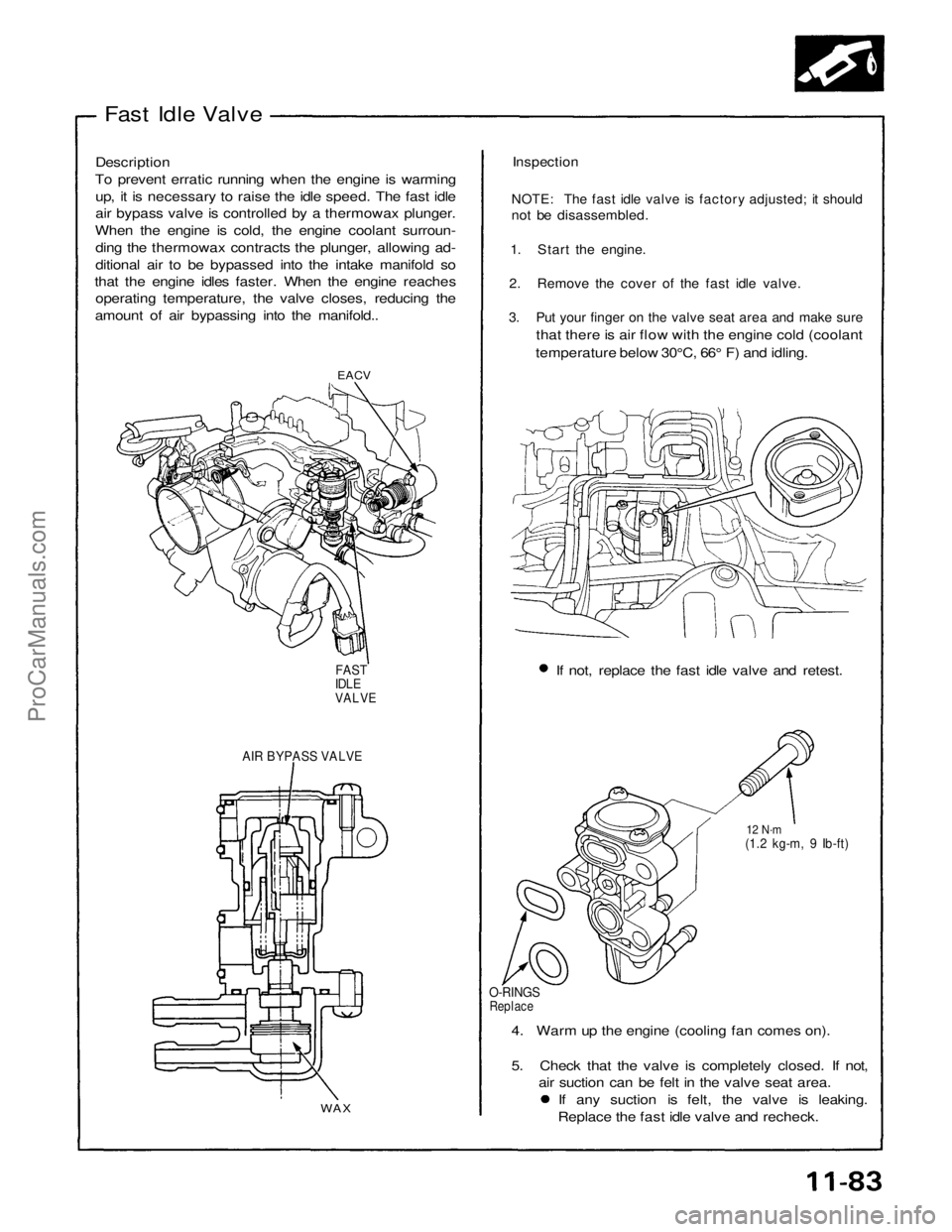
Fast Idle Valve
Description
To prevent erratic running when the engine is warming up, it is necessary to raise the idle speed. The fast idle
air bypass valve is controlled by a thermowax plunger.
When the engine is cold, the engine coolant surroun- ding the thermowax contracts the plunger, allowing ad-
ditional air to be bypassed into the intake manifold so
that the engine idles faster. When the engine reaches operating temperature, the valve closes, reducing the
amount of air bypassing into the manifold..
Inspection
NOTE: The fast idle valve is factory adjusted; it should
not be disassembled.
1. Start the engine.
2. Remove the cover of the fast idle valve.
3. Put your finger on the valve seat area and make sure
that there is air flow with the engine cold (coolant
temperature below 30°C, 66° F) and idling.
EACV
If not, replace the fast idle valve and retest.
FAST
IDLE
VALVE
AIR BYPASS VALVE
12 N·m
(1.2 kg-m, 9 Ib-ft)
O-RINGS
Replace
4. Warm up the engine (cooling fan comes on).
5. Check that the valve is completely closed. If not, air suction can be felt in the valve seat area. If any suction is felt, the valve is leaking.
Replace the fast idle valve and recheck.
WAXProCarManuals.com
Page 1498 of 1640
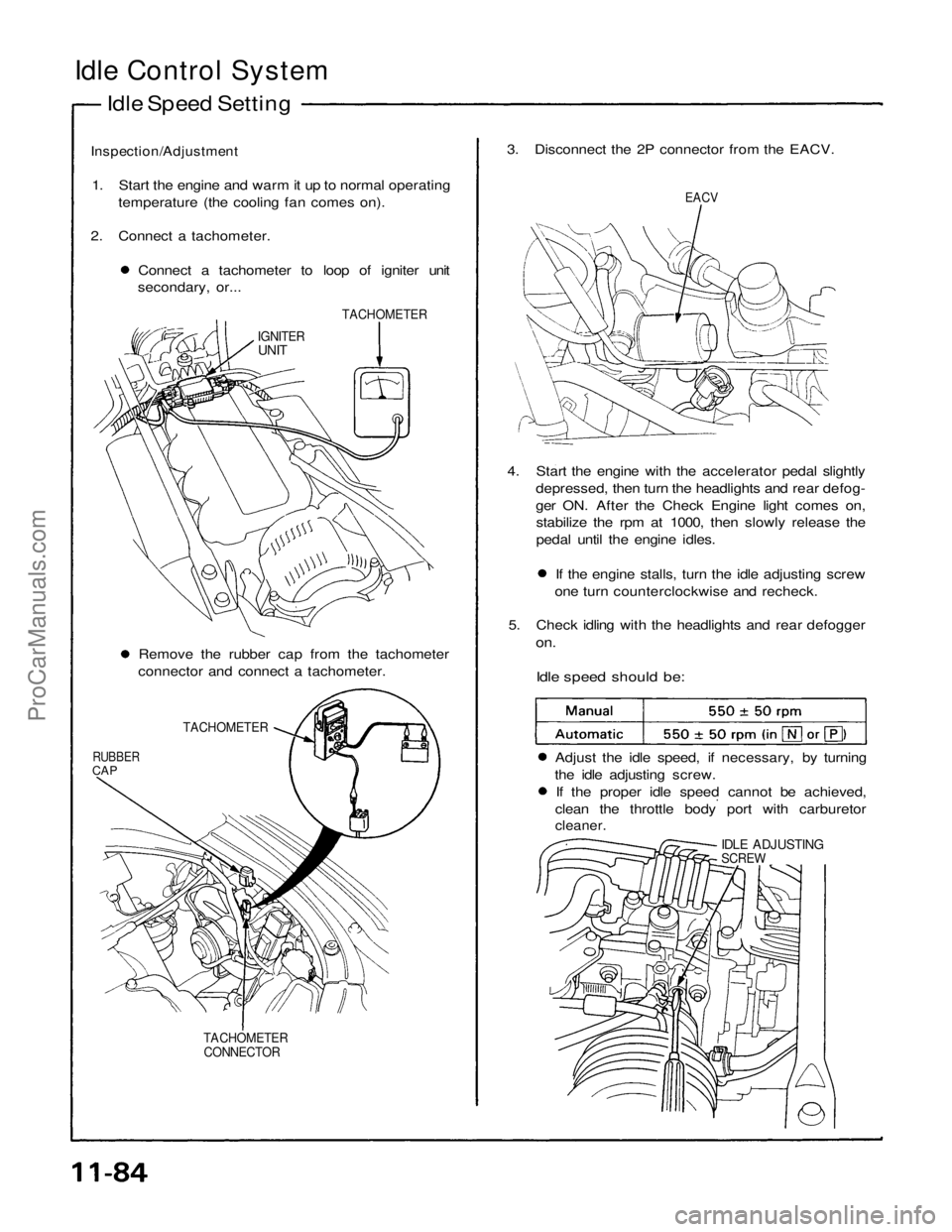
Idle Control System
Idle Speed Setting
Inspection/Adjustment
1. Start the engine and warm it up to normal operating temperature (the cooling fan comes on).
2. Connect a tachometer. Connect a tachometer to loop of igniter unit
secondary, or... 3. Disconnect the 2P connector from the EACV.
EACV
TACHOMETER
IGNITER
UNIT
4. Start the engine with the accelerator pedal slightlydepressed, then turn the headlights and rear defog-
ger ON. After the Check Engine light comes on,stabilize the rpm at 1000, then slowly release the
pedal until the engine idles. If the engine stalls, turn the idle adjusting screw
one turn counterclockwise and recheck.
5. Check idling with the headlights and rear defogger
on.
Idle speed should be:
Remove the rubber cap from the tachometer
connector and connect a tachometer.
TACHOMETER
RUBBER
CAP
Adjust the idle speed, if necessary, by turning
the idle adjusting screw. If the proper idle speed cannot be achieved,
clean the throttle body port with carburetor
cleaner.
IDLE ADJUSTING
SCREW
TACHOMETER CONNECTORProCarManuals.com
Page 1499 of 1640
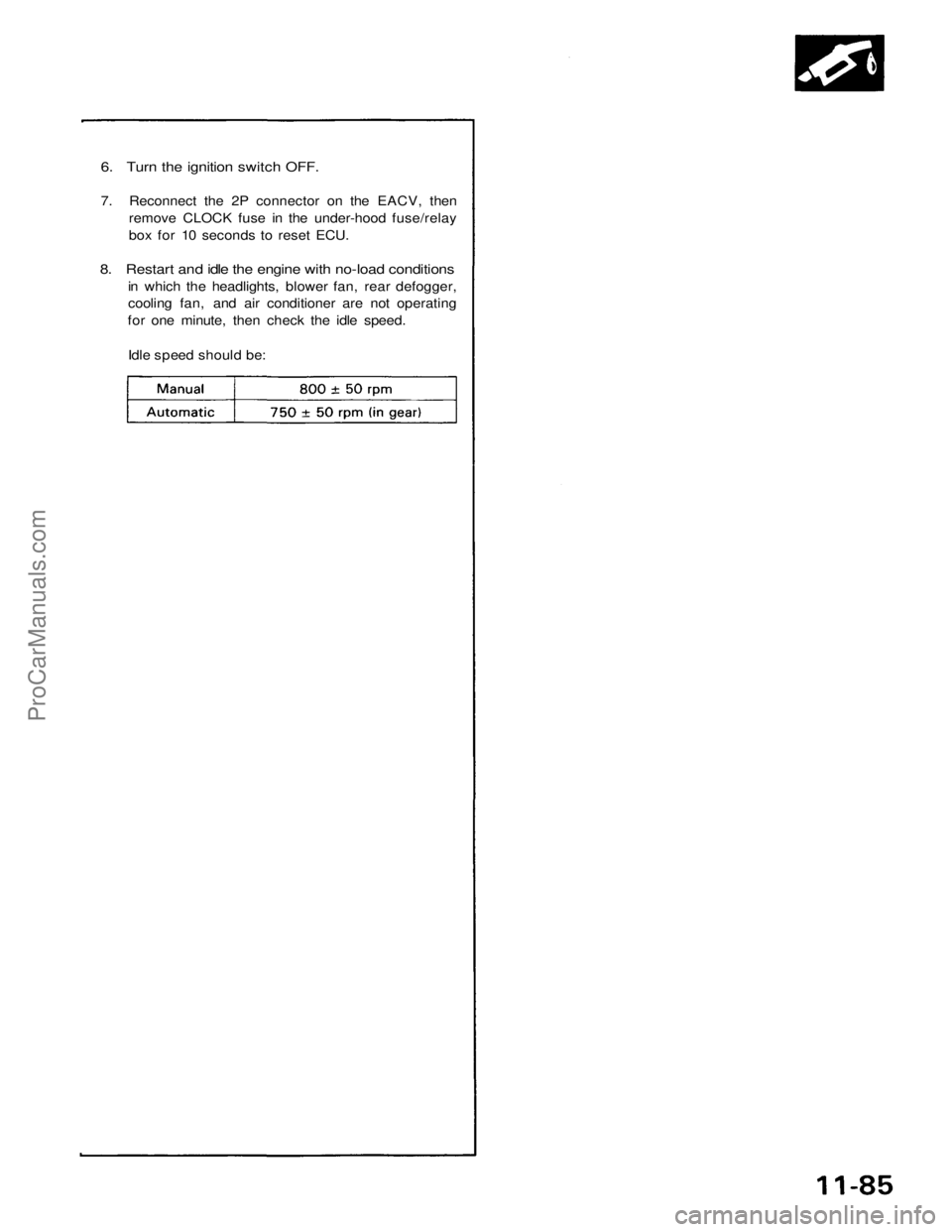
6. Turn the ignition switch OFF.
7. Reconnect the 2P connector on the EACV, then
remove CLOCK fuse in the under-hood fuse/relay
box for 10 seconds to reset ECU.
8. Restart and idle the engine with no-load conditions
in which the headlights, blower fan, rear defogger,
cooling fan, and air conditioner are not operating
for one minute, then check the idle speed.
Idle speed should be:ProCarManuals.com
Page 1506 of 1640
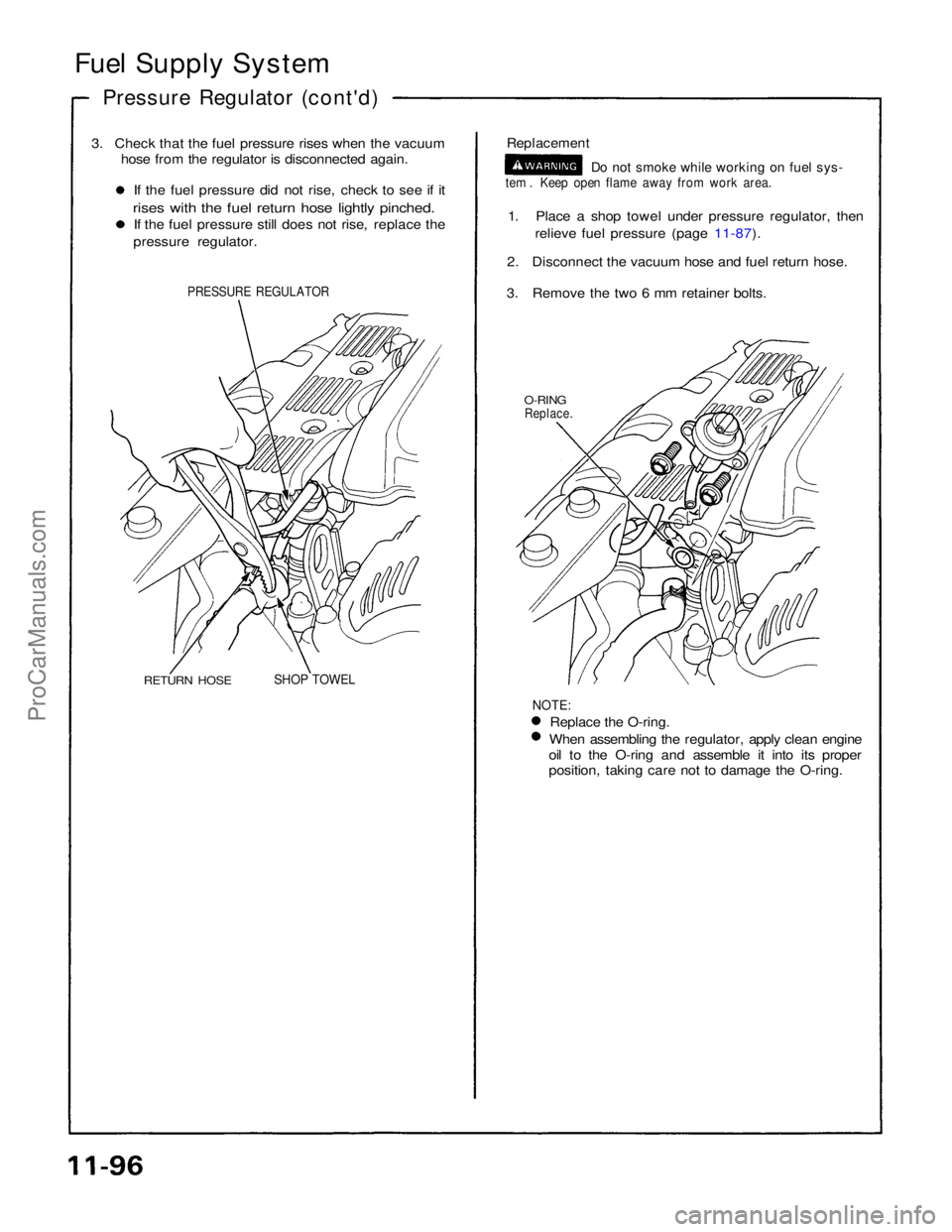
Fuel Supply System
Pressure Regulator (cont'd)
3. Check that the fuel pressure rises when the vacuum hose from the regulator is disconnected again.
If the fuel pressure did not rise, check to see if it
rises with the fuel return hose lightly pinched.
If the fuel pressure still does not rise, replace the
pressure regulator.
Replacement
Do not smoke while working on fuel sys-
tem . Keep open flame away from work area.
1. Place a shop towel under pressure regulator, then
relieve fuel pressure (page
11-87).
2. Disconnect the vacuum hose and fuel return hose.
3. Remove the two 6 mm retainer bolts.
O-RING
Replace.
PRESSURE REGULATOR
RETURN HOSE
SHOP TOWEL
NOTE:
Replace the O-ring. When assembling the regulator, apply clean engine
oil to the O-ring and assemble it into its proper
position, taking care not to damage the O-ring.ProCarManuals.com
Page 1508 of 1640
Fuel Supply System
Fuel Pump
Description
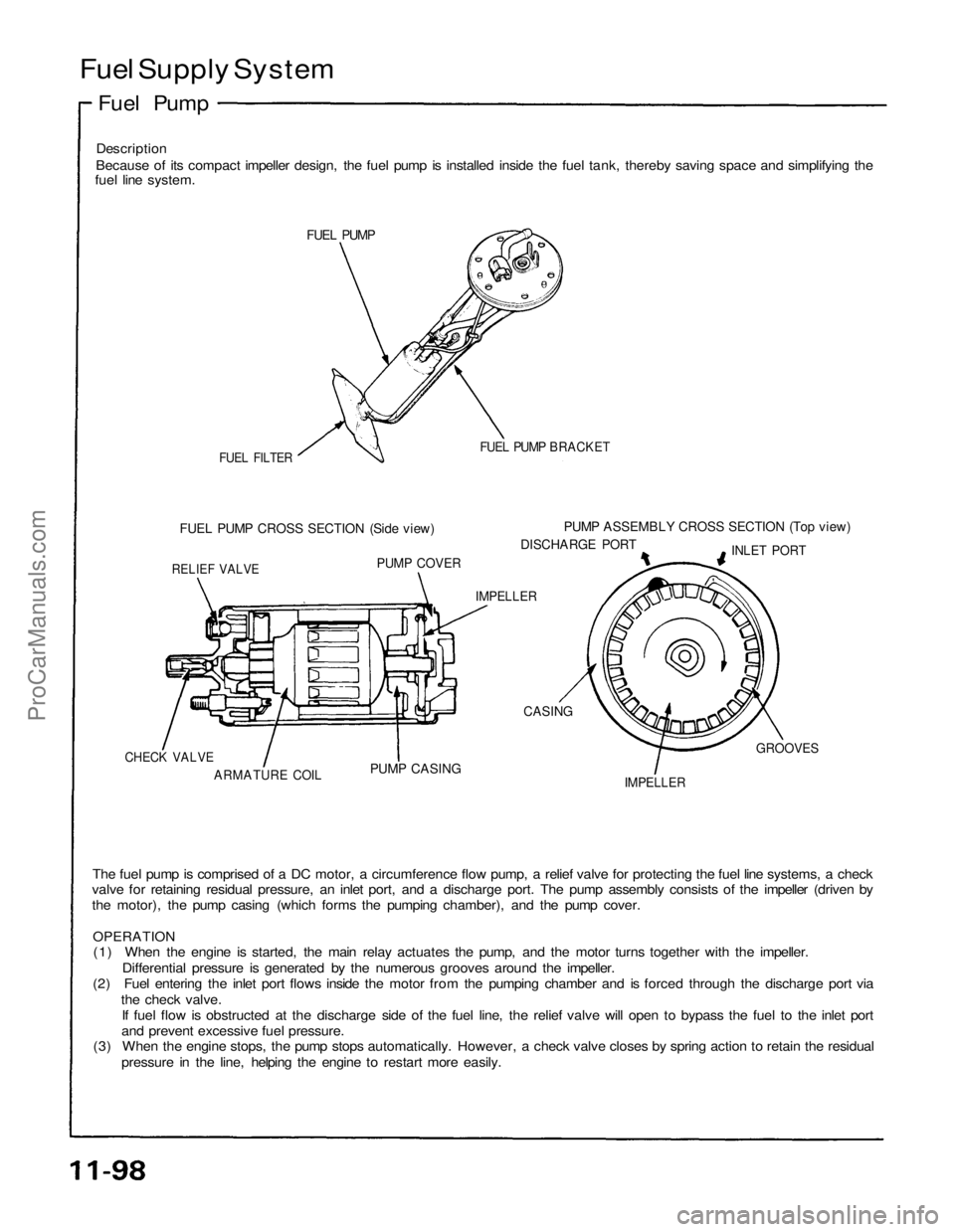
Because of its compact impeller design, the fuel pump is installed inside the fuel tank, thereby saving space and simplifying the
fuel line system.
FUEL PUMP
FUEL FILTER
FUEL PUMP BRACKET
FUEL PUMP CROSS SECTION (Side view)
PUMP ASSEMBLY CROSS SECTION (Top view)
DISCHARGE PORT
INLET PORT
RELIEF VALVE
PUMP COVER
IMPELLER
CASING
IMPELLER
GROOVES
PUMP CASING
ARMATURE COIL
CHECK VALVE
The fuel pump is comprised of a DC motor, a circumference flow pump, a relief valve for protecting the fuel line systems, a check
valve for retaining residual pressure, an inlet port, and a discharge port. The pump assembly consists of the impeller (driven by
the motor), the pump casing (which forms the pumping chamber), and the pump cover.
OPERATION
(1) When the engine is started, the main relay actuates the pump, and the motor turns together with the impeller.
Differential pressure is generated by the numerous grooves around the impeller.
(2) Fuel entering the inlet port flows inside the motor from the pumping chamber and is forced through the discharge port via
the check valve.
If fuel flow is obstructed at the discharge side of the fuel line, the relief valve will open to bypass the fuel to the inlet port
and prevent excessive fuel pressure.
(3) When the engine stops, the pump stops automatically. However, a check valve closes by spring action to retain the residual
pressure in the line, helping the engine to restart more easily.ProCarManuals.com
Page 1510 of 1640
Main Relay
Description
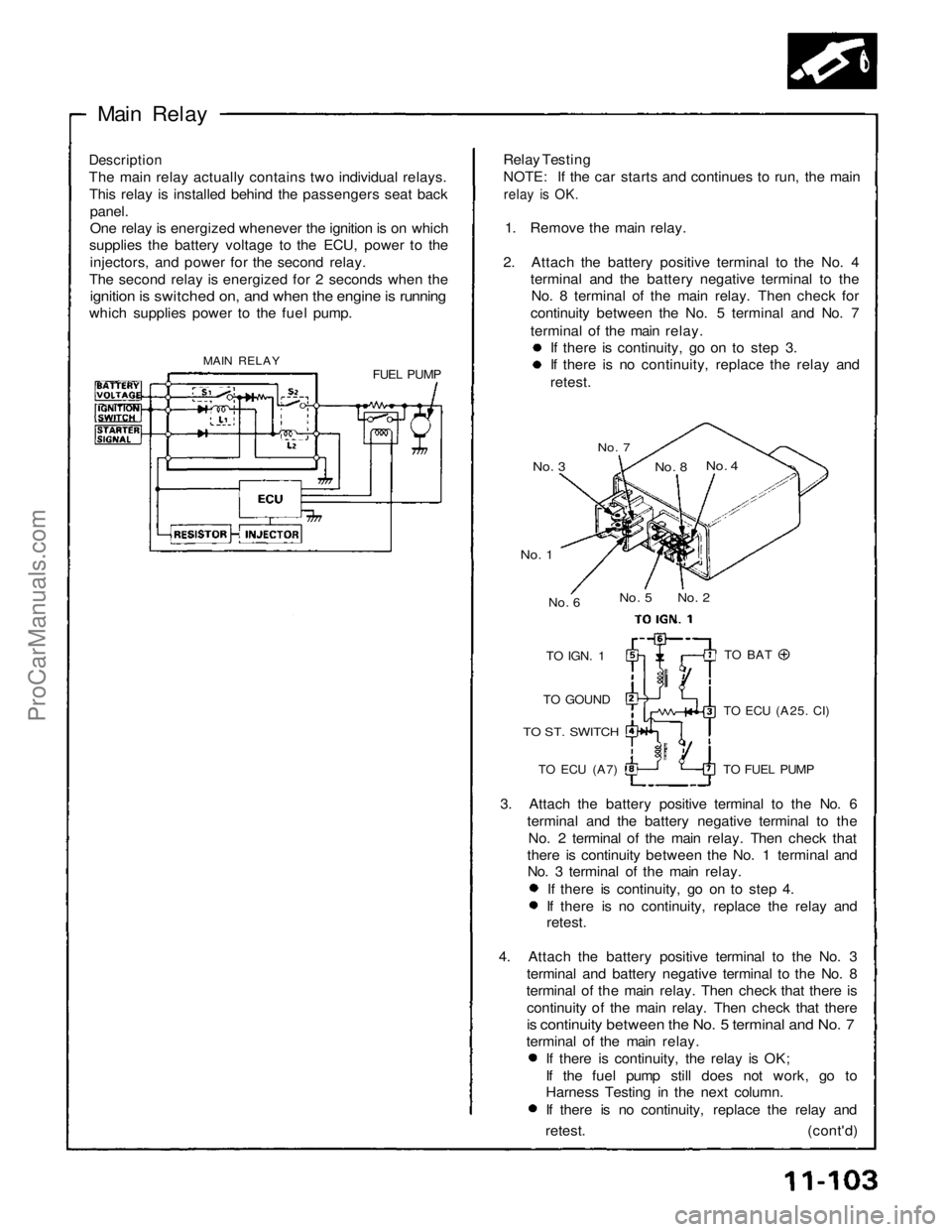
The main relay actually contains two individual relays. This relay is installed behind the passengers seat back
panel.
One relay is energized whenever the ignition is on which
supplies the battery voltage to the ECU, power to the
injectors, and power for the second relay.
The second relay is energized for 2 seconds when the
ignition is switched on, and when the engine is running
which supplies power to the fuel pump.
MAIN RELAY FUEL PUMPRelay Testing
NOTE: If the car starts and continues to run, the main
relay is OK.
1. Remove the main relay.
2. Attach the battery positive terminal to the No. 4 terminal and the battery negative terminal to theNo. 8 terminal of the main relay. Then check for
continuity between the No. 5 terminal and No. 7
terminal of the main relay. If there is continuity, go on to step 3. If there is no continuity, replace the relay and
retest.
No. 7
No. 3
No. 4
No. 8
No. 2
No. 5
No. 6
No. 1
TO
IGN.
1
TO GOUND
TO ST. SWITCH
TO ECU
(A7)
TO BAT
TO ECU
(A25.
CI)
TO FUEL PUMP
3. Attach the battery positive terminal to the No. 6 terminal and the battery negative terminal to theNo. 2 terminal of the main relay. Then check that
there is continuity between the No. 1 terminal and No. 3 terminal of the main relay.
If there is continuity, go on to step 4. If there is no continuity, replace the relay and
retest.
4. Attach the battery positive terminal to the No. 3 terminal and battery negative terminal to the No. 8
terminal of the main relay. Then check that there is
continuity of the main relay. Then check that there
is continuity between the No. 5 terminal and No. 7
terminal of the main relay. If there is continuity, the relay is OK;
If the fuel pump still does not work, go to
Harness Testing in the next column.
If there is no continuity, replace the relay and
retest. (cont'd)ProCarManuals.com
Page 1517 of 1640
System Description
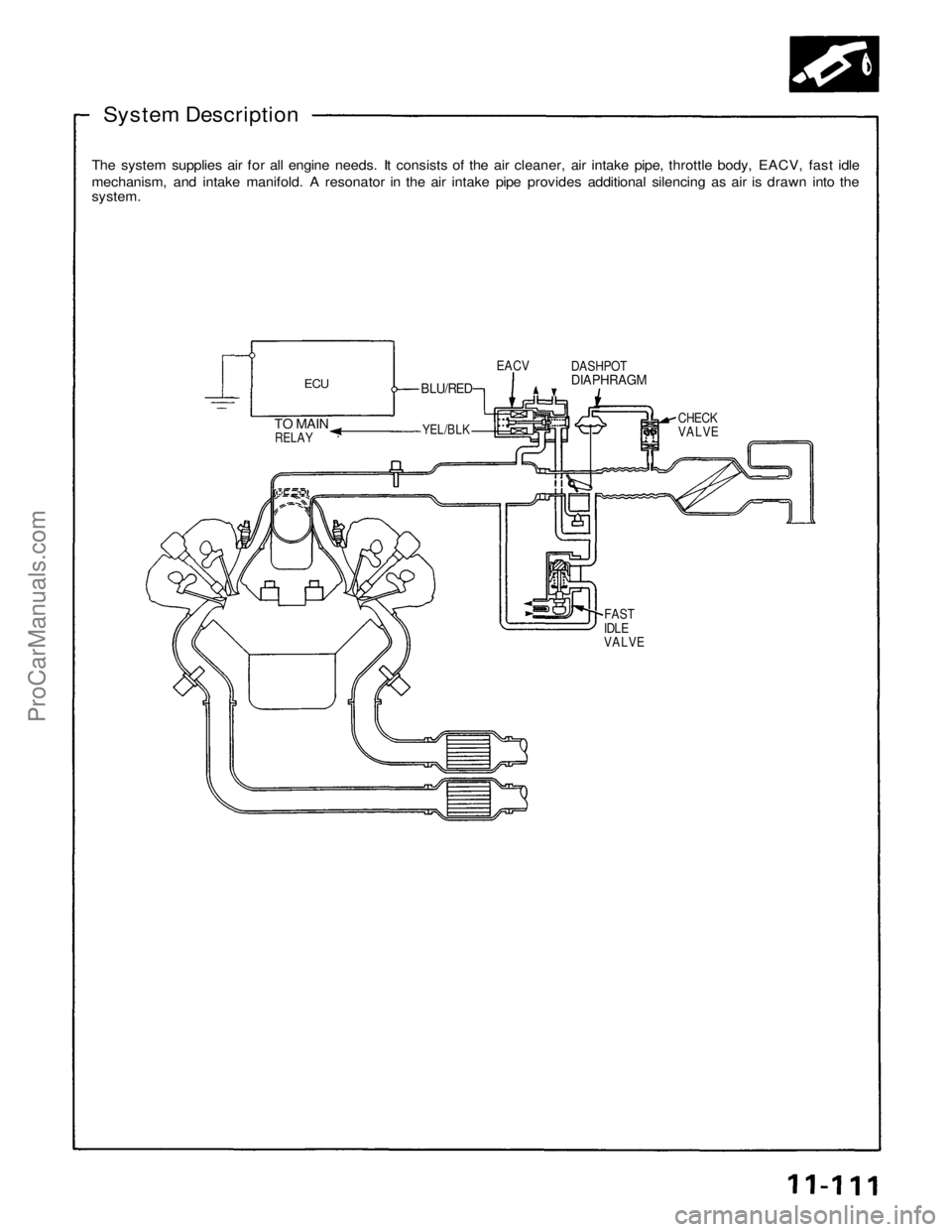
The system supplies air for all engine needs. It consists of the air cleaner, air intake pipe, throttle body, EACV, fast idle
mechanism, and intake manifold. A resonator in the air intake pipe provides additional silencing as air is drawn into the
system.
ECU
EACV
TO MAIN
RELAY
BLU/RED
CHECK
VALVE
DASHPOT
DIAPHRAGM
YEL/BLK
FAST
IDLE
VALVEProCarManuals.com
Page 1519 of 1640
Throttle Cable
Inspection/Adjustment
1. Warm up the engine to normal operating tem-
perature (cooling fan comes on).
2. Check that the throttle cable operates smoothly with no binding or sticking. Repair as necessary.
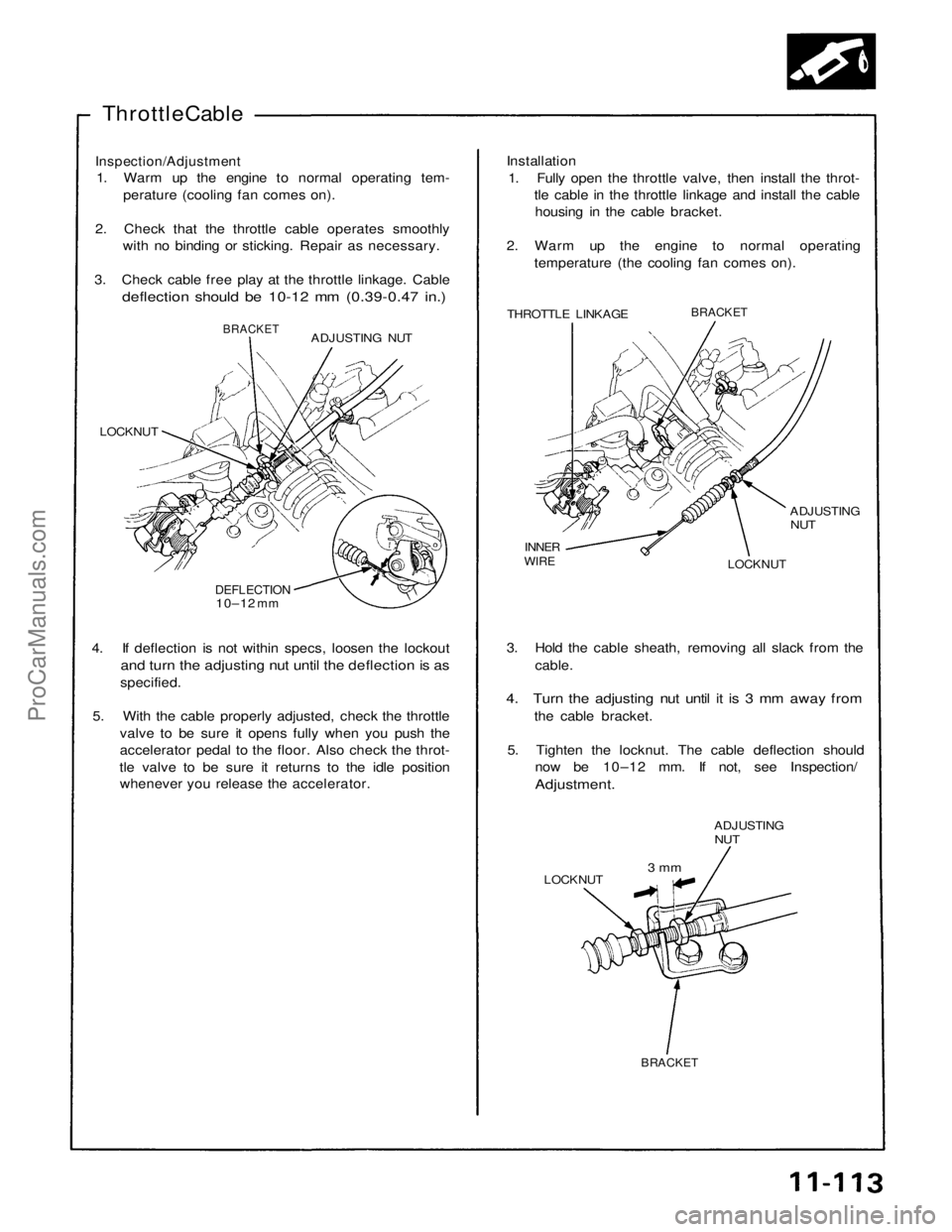
3. Check cable free play at the throttle linkage. Cable
deflection should be 10-12 mm (0.39-0.47 in.)
Installation
1. Fully open the throttle valve, then install the throt- tle cable in the throttle linkage and install the cablehousing in the cable bracket.
2. Warm up the engine to normal operating temperature (the cooling fan comes on).
THROTTLE LINKAGE
BRACKET
ADJUSTING
NUT
LOCKNUT
INNER
WIRE
ADJUSTING NUT
BRACKET
LOCKNUT
DEFLECTION
10–12
mm
4. If deflection is not within specs, loosen the lockout
and turn the adjusting nut until the deflection is as
specified.
5. With the cable properly adjusted, check the throttle valve to be sure it opens fully when you push the
accelerator pedal to the floor. Also check the throt-
tle valve to be sure it returns to the idle position whenever you release the accelerator. 3. Hold the cable sheath, removing all slack from the
cable.
4. Turn the adjusting nut until it is 3 mm away from
the cable bracket.
5. Tighten the locknut. The cable deflection should now be 10–12 mm. If not, see Inspection/
Adjustment.
ADJUSTING
NUT
LOCKNUT
3 mm
BRACKETProCarManuals.com
Page 1520 of 1640
Air Intake System
Throttle Body
Description
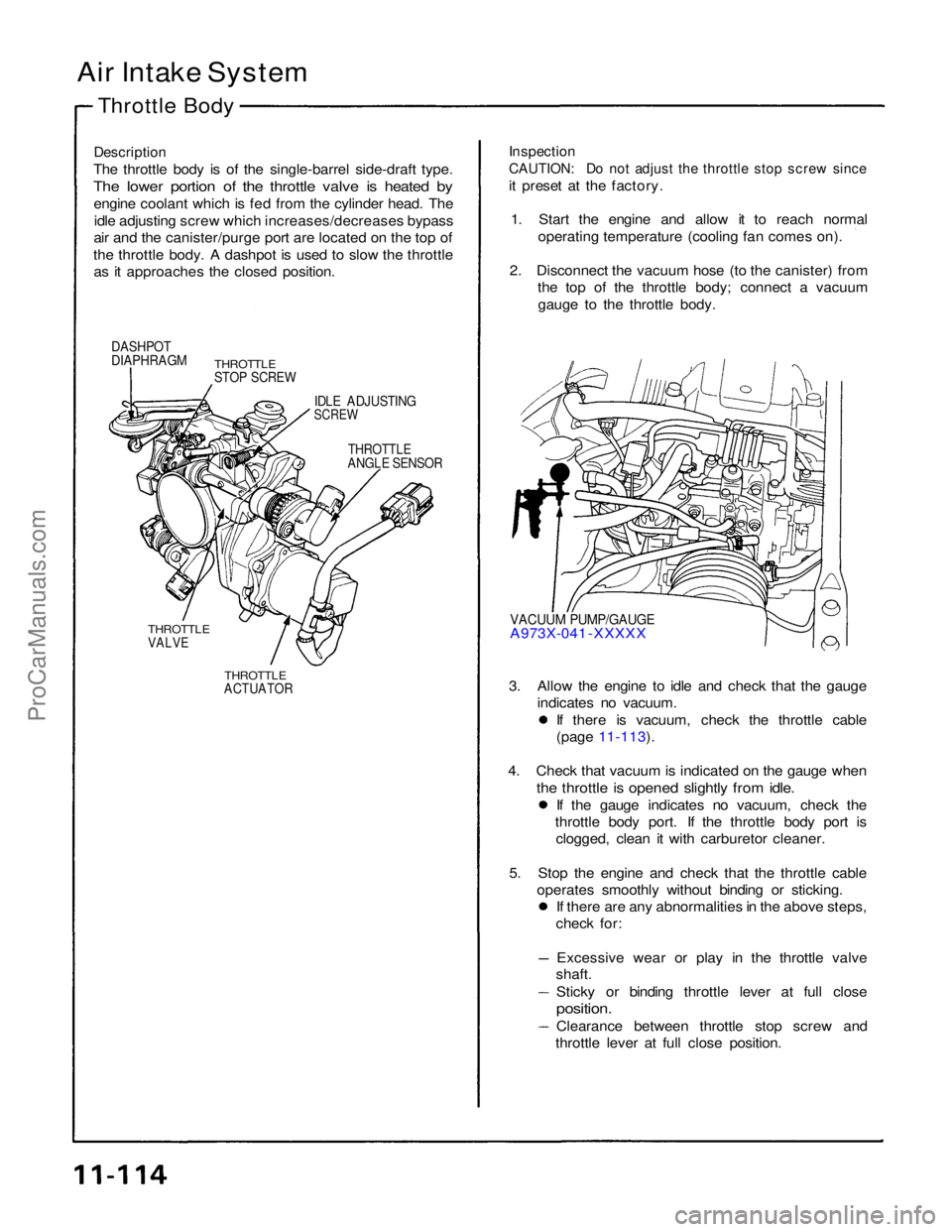
The throttle body is of the single-barrel side-draft type.
The lower portion of the throttle valve is heated by
engine coolant which is fed from the cylinder head. Theidle adjusting screw which increases/decreases bypass
air and the canister/purge port are located on the top of
the throttle body. A dashpot is used to slow the throttle as it approaches the closed position.
Inspection
CAUTION: Do not adjust the throttle stop screw since
it preset at the factory.
1. Start the engine and allow it to reach normal operating temperature (cooling fan comes on).
2. Disconnect the vacuum hose (to the canister) from the top of the throttle body; connect a vacuum
gauge to the throttle body.
DASHPOT
DIAPHRAGM
THROTTLE
STOP SCREW
IDLE ADJUSTING
SCREW
THROTTLE
ANGLE SENSOR
VACUUM PUMP/GAUGE
A973X-041 -XXXXX
THROTTLE
VALVE
THROTTLE
ACTUATOR
3. Allow the engine to idle and check that the gauge
indicates no vacuum. If there is vacuum, check the throttle cable
(page 11-113).
4. Check that vacuum is indicated on the gauge when
the throttle is opened slightly from idle.
If the gauge indicates no vacuum, check the
throttle body port. If the throttle body port is clogged, clean it with carburetor cleaner.
5. Stop the engine and check that the throttle cable operates smoothly without binding or sticking. If there are any abnormalities in the above steps,
check for:
Excessive wear or play in the throttle valve
shaft.
Sticky or binding throttle lever at full close
position.
Clearance between throttle stop screw and
throttle lever at full close position.ProCarManuals.com
Page 1524 of 1640
Chamber Volume Control System
Description
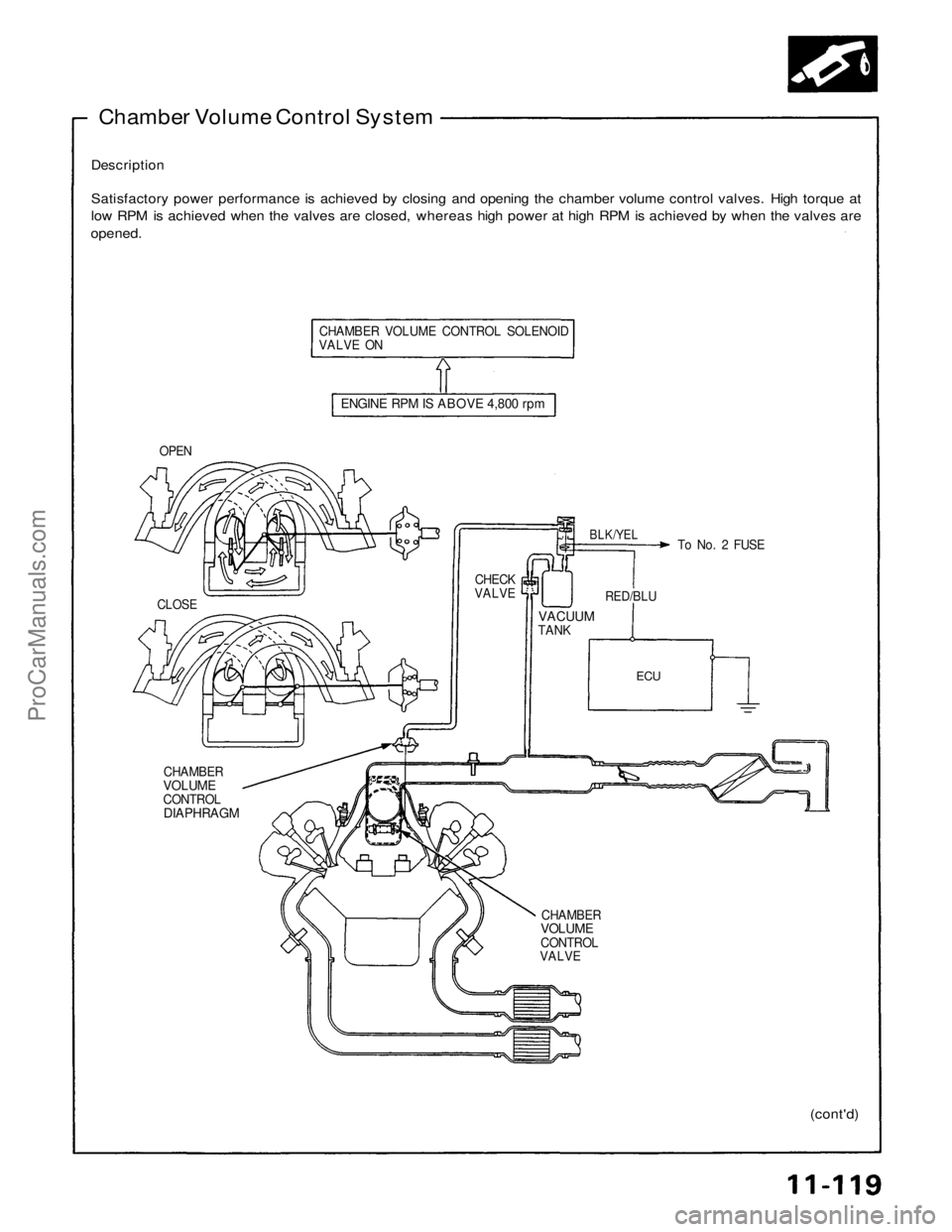
Satisfactory power performance is achieved by closing and opening the chamber volume control valves. High torque at
low RPM is achieved when the valves are closed, whereas high power at high RPM is achieved by when the valves are
opened.
CHAMBER VOLUME CONTROL SOLENOID
VALVE ON
ENGINE RPM IS ABOVE 4,800 rpm
OPEN
BLK/YEL
To No. 2 FUSE
CLOSE
CHECK
VALVE
VACUUM
TANK
RED/BLU
ECU
CHAMBER
VOLUME
CONTROL
DIAPHRAGM
CHAMBER
VOLUME
CONTROL
VALVE
(cont'd)ProCarManuals.com