I stop Acura NSX 2017 Workshop Manual
[x] Cancel search | Manufacturer: ACURA, Model Year: 2017, Model line: NSX, Model: Acura NSX 2017Pages: 473, PDF Size: 16.01 MB
Page 313 of 473
312
uuWhen Driving uPrecautions While Driving
Driving
Precautions While Driving
Avoid driving in deep water and on flooded roads. This can damage the power
system or driveline, or cause electrical component failure.
The vehicle is equipped with ultra high performance summer tires that, due to their
decreased tread depth, are at greater risk of hydroplaning on wet roads compared
to regular tires. Exercise caution when driving on wet surfaces.
The vehicle is equipped with ultra high performance summer tires. These tires are
designed for optimum performance and handling in warm climates, and are not
suitable for below freezing, snowy or ic y weather conditions. If you drive under
these circumstances, use of winter tires is recommended and may be mandatory,
depending on your region, province or territory.
2 Winter Tires P. 401
2 Cold Weather Driving P. 402
Due to limitations of the Lithium-ion Hi gh Voltage battery, the minimum starting
temperature for the vehicle is -4°F (-20°C).
Inability to start the vehicle and/or decrea sed performance is expected if the vehicle
is operated at temperatures below -4°F (-20°C).
■In Rain
■In Snow and Ice
1 Precautions While Driving
NOTICE
Do not select a shift button while pressing the
accelerator pedal.
NOTICE
The following can damage the under spoiler, under
covers, front bumper, rear diffuser, brake cooling
components, and side sill:
•Parking the vehicle by a parking block•Parallel pa rking along the road shoulder•Driving toward the bottom of a hill•Driving up or down to a different surface level
(such as a road shoulder)
•Driving on a rutted or bumpy road•Driving on a road with potholes•Driving over speed bump
NOTICE
If you repeatedly turn the steering wheel at an
extremely low speed, or hold the steering wheel on
the full left or right position for a while, the electric
power steering (EPS) system heats up. The system
goes into a protective mode, and limits its
performance. The steering wheel becomes harder
and harder to operate. Once the system cools down,
the EPS system is restored.
Repeated operation under these conditions can
eventually damage the system.
If the power mode is set to ACCESSORY while
driving, the power system will shut down and all
steering and brake power a ssist functions will stop,
making it difficult to control the vehicle.
Driving in snow or icy c onditions may accumulate ice
on the brake disk surface, reducing braking power.
17 NSX-31T6N6000.book 312 ページ 2016年4月22日 金曜日 午後3時44分
Page 314 of 473

313
uuWhen Driving uDual Clutch Transmission
Driving
If there is a strong impact with something under the vehicle, stop in a safe location.
Check the underside of the vehicle for damage or any fluid leaks.
If any of these components are damaged or loose, the stability, handling, and
powertrain cooling performance of the vehicle may be adversely affected.
Dual Clutch Transmission
As with a conventional gasoline-powered ve hicle with an automatic transmission,
this vehicle will creep.
Keep the brake pedal firmly depressed when stopped.
The accelerator pedal features a kick down switch. Quickly depressing the
accelerator pedal while driving may cause the transmission to drop to a lower gear,
subsequently increasing vehicle speed. De press the accelerator pedal carefully,
especially when driving uphill, on slippery roads, and curves.
■Other Precautions
■Creeping
■Kickdown
1 Precautions While Driving
Do not press the
(N button, as you will lose
regenerative braking (and ac celeration) performance.
Avoid hard braking for the first 200 miles (300 km).
You should also follow this recommendation when
the brake pads are replaced.
Models with iron brake discs
1 Dual Clutch Transmission
The DCT will not operate when it is extremely cold. If
the vehicle has been parked in extremely cold
conditions, after you start th e engine, wait until it
gets warm. Keep your ve hicle parked until the
READY indicator comes on.
17 NSX-31T6N6000.book 313 ページ 2016年4月22日 金曜日 午後3時44分
Page 317 of 473
uuWhen Driving uShifting
316
Driving
■Shift Operation1Shift Operation
NOTICE
Before you change to (R and vice versa, come
to a complete stop and keep the brake pedal
depressed.
Operating the shift button before the vehicle has
come to a complete standstill may damage the
transmission.
Use the gear position indicator and the shift button
indicator to check the gear position before selecting
a shift button.
If the indicator of the curren tly selected gear position,
or all gear position in dicators, are blinking
simultaneously, there is a problem with the
transmission.
Avoid sudden acceleration and have the transmission
checked by an authorized Acura NSX dealer as soon
as possible.
The fuel supply may be cut of f if you drive at engine
speeds in or over the tac hometer’s red zone (engine
speed limit). If this happe ns, you may experience a
slight jolt.
When the engine speed is increased while the
transmission is in
( N, (P or (R, the fuel supply may
be cut off even without the engine speed entering
the tachometer’s red zone.
The beeper sounds once when you change to
( R.
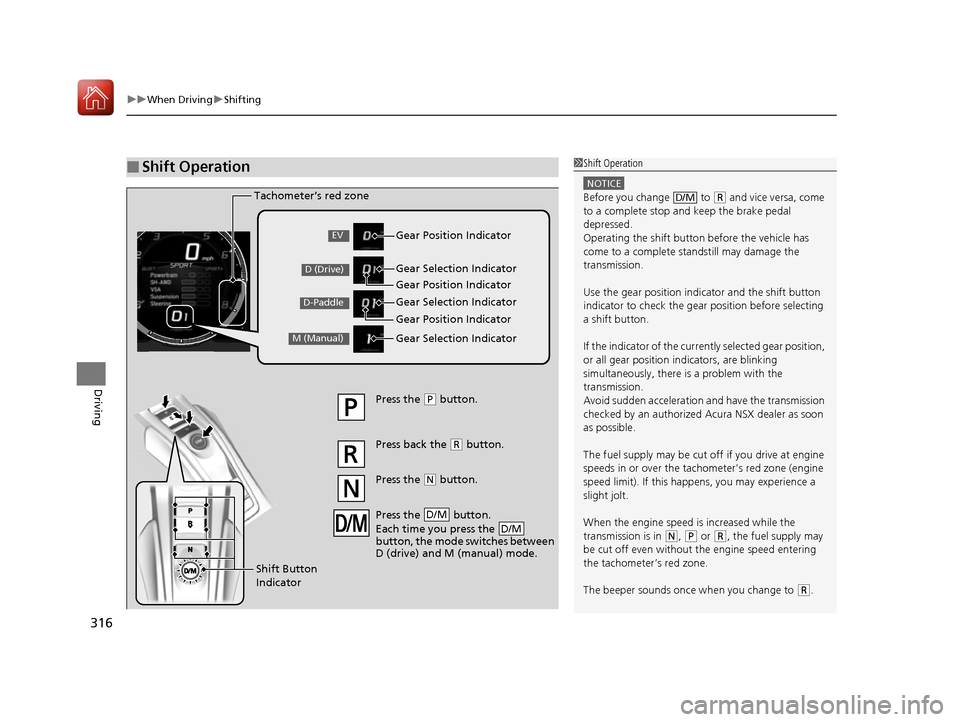
D/M
Gear Position Indicator
Tachometer’s red zone
Press the (
P button.
Press back the ( R button.
Press the
( N button.
Press the button.
Each time you press the
button, the mode switches between
D (drive) and M (manual) mode.
D/M
D/M
Shift Button
Indicator Gear Selection Indicator
Gear Position Indicator
Gear Selection Indicator
Gear Position Indicator
Gear Selection IndicatorEV
D (Drive)
D-Paddle
M (Manual)
17 NSX-31T6N6000.book 316 ページ 2016年4月22日 金曜日 午後3時44分
Page 318 of 473

Continued317
uuWhen Driving uShifting
Driving
■When opening the driver’s door
If you open the driver’s door under the following conditions, the gear position
automatically changes to
(P.
• The vehicle is in stationary with the power mode in ON, or moving at 1 mph (2
km/h) or slower.
• The transmission is in other than
(P.
• You have unfastened the driver side seat belt.
u If you manually change the gear position from
(P with the brake pedal
depressed, the gear position will automatically return to
(P once you release
the brake pedal.
■When turning off the power mode
If you turn the power system off while the vehicle is stationary, and the transmission
is in other than
(P, the gear position automatically changes to (P.
■If you want to keep the transmission in (N position (car wash mode)
With the engine running:
1. Press and hold the brake pedal.
2. Press
(N. Within two seconds press and hold (N for two seconds.
3. Within five seconds press the ENGINE START/STOP button.
u This puts the vehicle in car wash mode which must be used when your vehicle
is pulled through a conveyor type automatic car wash where you or an
attendant do not remain in the vehicle.
u The gear position remains in
(N with the power mode in ACCESSORY for 15
minutes, then, it auto matically changes to
(P and the power mode changes to
OFF.
Manually changing to
(P cancels ACCESSORY mode. The (P indicator comes on
and the power mode changes to OFF.
1 When opening the driver’s door
While the system is designed to automatically change
the gear position to
(P under the described
conditions, in the interest of safety you should always
select
( P before opening the driver's door.
Make sure to park the vehicle in a safe place.
2 When Stopped P. 351
If you want to drive the ve hicle after the gear position
has automatically changed to
( P under the described
conditions, close the door, fasten the seat belt,
depress the brake pedal, then change the gear
position.
If you leave the vehicle, turn off the power system
and lock the doors.
17 NSX-31T6N6000.book 317 ページ 2016年4月22日 金曜日 午後3時44分
Page 320 of 473

Continued319
uuWhen Driving uShifting
Driving
Use the paddle shifters to change between 1st and 9th gears without removing your
hands from the steering wheel. The transmission will switch to the sequential mode.
■When the transmission is in (D (D-paddle shift mode):
The vehicle will go into the sequential m ode momentarily, and the gear selection
indicator becomes more prominent.
The sequential mode is automatically canc eled and the gear selection indicator
returns to ordinary display under the following conditions.
• Hold the
(+ paddle shifter for a few seconds.
• Once you start traveling at a constant speed.
• The vehicle comes to a complete stop.
• When you change to another IDS mode.
The sequential mode automatically shifts under following condition
• Accelerator pedal depressed beyond the click.
• Engine speed reaches near the tachometer’s red zone.
• Engine speed reaches idle speed while deceleration.
■Sequential Mode1Sequential Mode
When sequential mode is selected, the gasoline
engine powers the vehicle.
17 NSX-31T6N6000.book 319 ページ 2016年4月22日 金曜日 午後3時44分
Page 322 of 473
![Acura NSX 2017 Workshop Manual 321
uuWhen Driving uShifting
Continued
Driving
Transmission Control Mode
[Displayed on Instrument Panel] (Y = Yes/N= No)Auto ModeD-Paddle ModeManual Mode
Activation Method Initial Startup Use Shift](/img/32/9760/w960_9760-321.png "Acura NSX 2017 Workshop Manual 321
uuWhen Driving uShifting
Continued
Driving
Transmission Control Mode
[Displayed on Instrument Panel] (Y = Yes/N= No)Auto ModeD-Paddle ModeManual Mode
Activation Method Initial Startup Use Shift")
321
uuWhen Driving uShifting
Continued
Driving
Transmission Control Mode
[Displayed on Instrument Panel] (Y = Yes/N= No)Auto ModeD-Paddle ModeManual Mode
Activation Method Initial Startup Use Shift Paddle While in EV
or Auto Mode Press Button
Automatically Upshift Y
NN
Automatically Downshift Y
NN
Kickdown Shift beyond click Y Y
N
Deceleration Downshift Y Y Y
Automatic Upshift at Redline Y Y
N
Transmission Control Mode
[Displayed on Instrument Panel] (Y = Yes/N= No)D-Paddle ModeManual Mode
Activation Method Use Shift Paddle While in EV
or Auto Mode Press Button
To return to Auto Mode Automatically after
cruising Y
N
Pull & hold
(+ Shift
paddle for a few seconds YY
Vehicle come to complete stop Y
N
IDS mode change to other mode YReturn to Auto mode only
when QUIET mode is
selected.
D/M
D/M
17 NSX-31T6N6000.book 321 ページ 2016年4月22日 金曜日 午後3時44分
Page 336 of 473
Continued335
uuWhen Driving uVehicle Stability Assist (VSA ®), aka Electronic Stability Control (ESC), System
Driving
■When the IDS mode is in TRACK mode
When you set the IDS mode to TRACK, the VSA ® system switches to Track mode
and the VSA ® OFF indicator comes on. The VSA ® features do not stop, but the
thresholds for them to activate become hi gher. Additional care should be used while
driving in TRACK mode, and TRACK mode should only be used while driving on
closed circuits.
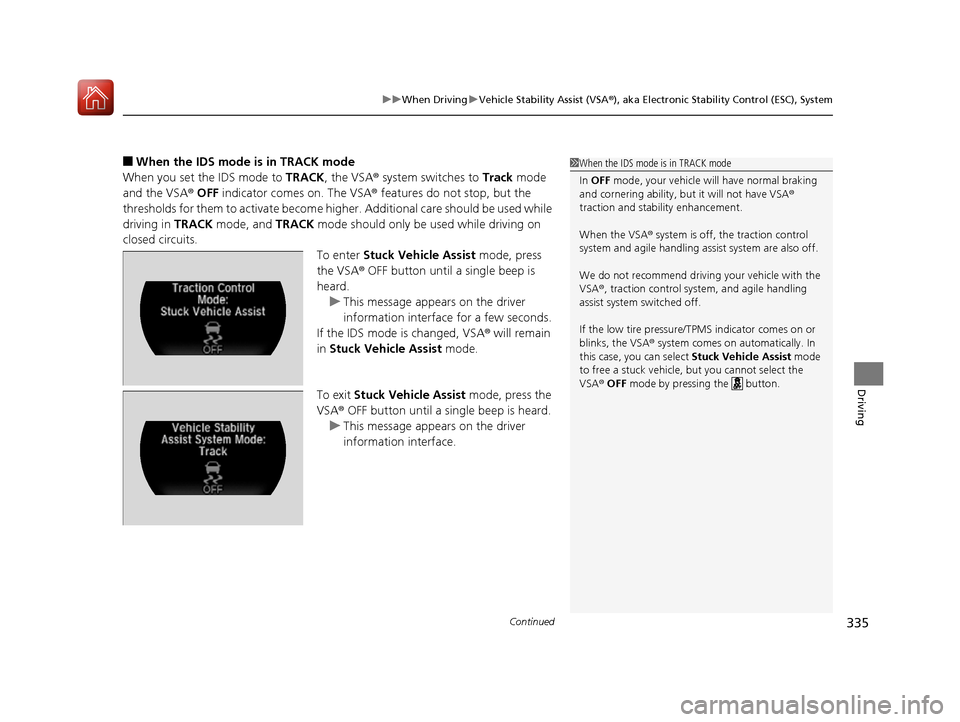
To enter Stuck Vehicle Assist mode, press
the VSA® OFF button until a single beep is
heard.
u This message appears on the driver
information interface for a few seconds.
If the IDS mode is changed, VSA ® will remain
in Stuck Vehicle Assist mode.
To exit Stuck Vehicle Assist mode, press the
VSA ® OFF button until a single beep is heard.
u This message appears on the driver
information interface.1When the IDS mode is in TRACK mode
In OFF mode, your vehicle wi ll have normal braking
and cornering ability, bu t it will not have VSA®
traction and stability enhancement.
When the VSA ® system is off, the traction control
system and agile handling assist system are also off.
We do not recommend driving your vehicle with the
VSA ®, traction control syst em, and agile handling
assist system switched off.
If the low tire pressure/TPMS indicator comes on or
blinks, the VSA® system comes on automatically. In
this case, you can select Stuck Vehicle Assist mode
to free a stuck vehicle, but you cannot select the
VSA ® OFF mode by pressing the button.
17 NSX-31T6N6000.book 335 ページ 2016年4月22日 金曜日 午後3時44分
Page 342 of 473

341
uuWhen Driving uTire Pressure Monitoring System (TPMS) - Required Federal Explanation
Continued
Driving
Tire Pressure Monitoring System (TPMS) - Required
Federal Explanation
Each tire, including the spare (if provided), should be checked
monthly when cold and inflated to the inflation pressure
recommended by the vehicle manufa cturer on the vehicle placard
or tire inflation pressure label.
(If your vehicle has tires of a diff erent size than the size indicated
on the vehicle placard or tire inflation pressure label, you should
determine the proper tire inflat ion pressure for those tires.)
As an added safety feature, your vehicle has been equipped with
a tire pressure monitoring system (TPMS) that illuminates a low
tire pressure telltale
when one or more of your tires is significantly under-inflated.
Accordingly, when the low tire pressure telltale illuminates, you
should stop and check your tires as soon as possible, and inflate
them to the proper pressure.
Driving on a significantly under-inf lated tire causes the tire to
overheat and can lead to tire fail ure. Under-inflation also reduces
fuel efficiency and tire tread life, and may affect the vehicle’s
handling and stopping ability.
17 NSX-31T6N6000.book 341 ページ 2016年4月22日 金曜日 午後3時44分
Page 345 of 473

344
Driving
Braking
Brake System
Use the parking brake to keep the vehicle stationary when parked. You can
manually apply and release, or automatically release it.
■Manual operations
Use the electric parking brake switch to apply or release the brake. Manually
releasing the parking brake using the switch helps your vehicle start slowly and
smoothly when facing down hill on steep hills.
■To apply manually
Pull the electric parkin g brake switch up gently
and securely. u The electric parking brake indicator
comes on.
■To release manually
1. Depress the brake pedal.
2. Press the electric parking brake switch.
u The electric parking brake indicator goes
off.
■Parking Brake1Brake System
When you depress the brak e pedal, you may hear a
whirring sound from the engine compartment. This is
because the brake system is in operation, and it is
normal.
1 Parking Brake
You may hear the electric parking brake system
motor operating from the re ar wheel area when you
apply or release the parki ng brake, or set the power
mode to OFF. This is normal.
You cannot apply or release the parking brake if the
battery goes dead. 2 Jump Starting P. 434
If you pull and hold the elec tric parking brake switch
while driving, the brakes on all four wheels are
applied (by the VSA system) until the vehicle comes to
a stop (at which point the el ectric parking brake is
applied) or the switch is released.
Electric Parking
Brake Switch
Electric Parking
Brake Switch
17 NSX-31T6N6000.book 344 ページ 2016年4月22日 金曜日 午後3時44分
Page 346 of 473

Continued345
uuBraking uBrake System
Driving
■To release automatically
Depressing the accelerator pedal releases the parking brake.
Use the accelerator pedal to release the brake when you are starting the vehicle
facing uphill, or in a traffic jam.
Gently depress the accelerator pedal.
When on a hill, it may require more
accelerator input to release.u The electric parking brake indicator goes
off.
You can release the parking brake automatically when:
• You are wearing the driver’s seat belt.
• The power system is on.
• The transmission is not in
(P or (N.
1Parking Brake
In the following situations, the parking brake
automatically operates.
•When the vehicle stops with the automatic brake
hold system activated for more than 10 minutes.
•When the driver’s seat belt is unfastened while
your vehicle is stopped and brake hold is applied.
•When the power system is turned off while brake
hold is applied.
•When there is a problem with the Brake Hold
System.
If the parking brake cannot be released
automatically, release it manually.
The parking brake cannot be released automatically
while the following indicators are on:
•Malfunction indicator lamp
•Transmission system indicator
The parking brake may not be released automatically
while the following indicators are on:
•Electric parking brak e system indicator
•VSA® system indicator•ABS indicator
•Supplemental restraint system indicator
Accelerator Pedal
17 NSX-31T6N6000.book 345 ページ 2016年4月22日 金曜日 午後3時44分