engine Acura RDX 2011 Manual Online
[x] Cancel search | Manufacturer: ACURA, Model Year: 2011, Model line: RDX, Model: Acura RDX 2011Pages: 517, PDF Size: 27.89 MB
Page 473 of 517

Brake System Indicator
(Amber)U.S. CanadaYour vehicle has an electric vacuum
pump located in the engine
compartment. It enhances the
effectiveness of your vehicle's brake
system more frequently when you
drive in cold weather or thinner air at
high altitude after the engine is
started.
When the electric vacuum pump is in
operation, it makes some mechanical
noises come from the engine
compartment. This is normal.The brake system indicator (amber)
on the instrument panel normally
comes on when you turn the ignition
switch to the ON (II) position and
goes off after the engine starts. If it
comes on at any other time, press on
the brake pedal with your foot
several times until the indicator turns
off. If the indicator is still on or
comes on again after this procedure,
there is a problem in the brake
system including the electric vacuum
pump. If this happens, the brake
pedal might feel heavy when you
press it. Have your vehicle checked
by your dealer.
You will also see a
‘‘CHECK BRAKE
SYSTEM ’’message on the multi-
information display (see page 79).Brake System Indicator46810/06/08 17:42:32 11 ACURA RDX MMC North America Owner's M 50 31STK640 enu
Page 474 of 517
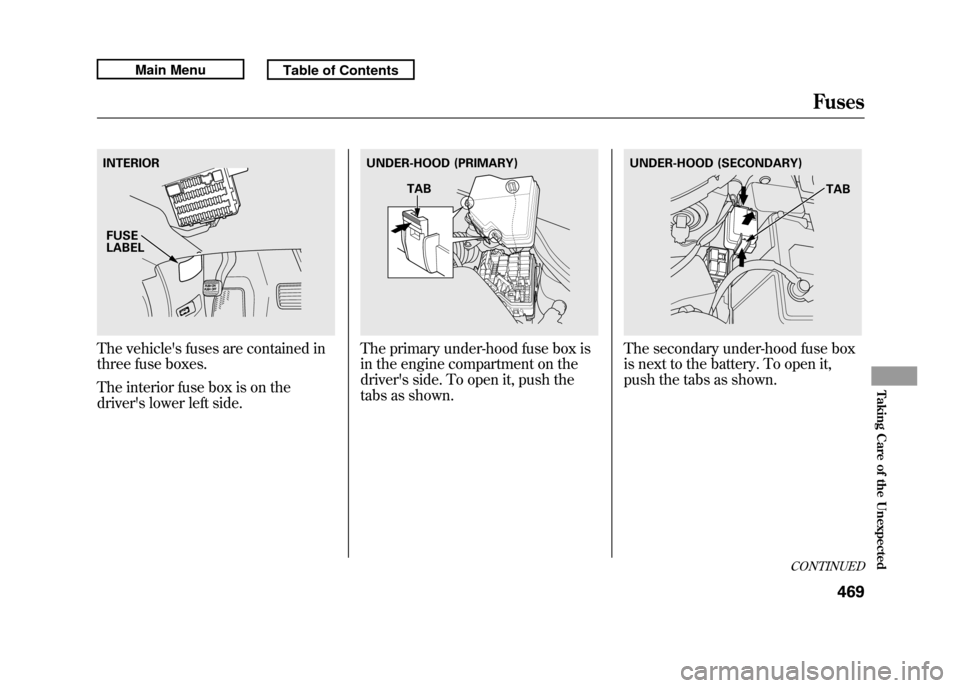
The vehicle's fuses are contained in
three fuse boxes.
The interior fuse box is on the
driver's lower left side.
The primary under-hood fuse box is
in the engine compartment on the
driver's side. To open it, push the
tabs as shown.
The secondary under-hood fuse box
is next to the battery. To open it,
push the tabs as shown.
INTERIORFUSE
LABEL
UNDER-HOOD (PRIMARY) TAB
UNDER-HOOD (SECONDARY)
TAB
CONTINUED
Fuses
469
Taking Care of the Unexpected
10/06/08 17:42:32 11 ACURA RDX MMC North America Owner's M 50 31STK640 enu
Page 480 of 517
If your vehicle needs to be towed,
call a professional towing service or
organization. Never tow your vehicle
with just a rope or chain. It is very
dangerous.(On SH-AWD models)The only way you can safely tow
your vehicle is with flat-bed
equipment.The operator will load
your vehicle on the back of a truck.
Any other method of towing will
damage the drive system. When you
contact the towing agency, inform
them a flat-bed is required.Towing with only two tires on the
ground will damage parts of the all-
wheel-drive system. Your vehicle should
be transported on a flat-bed truck or
trailer.
(Execpt SH-AWD models)There are two ways to tow your
vehicle:Flat-bed Equipment
- The operator
loads your vehicle on the back of a
truck. This is the best way to
transport your vehicle.
Wheel-lift Equipment
- The tow
truck uses two pivoting arms that go
under the front tires and lift them off
the ground. The rear tires remain on
the ground. This is an acceptable
way to tow your vehicle. If, due to damage, your vehicle must
be towed with the front wheels on
the ground, do this:
●Start the engine.●Shift to the D position and hold for
5 seconds, then to N.●Turn off the engine.●Leave the ignition switch in the
ACCESSORY (I) position so the
steering wheel does not lock.●Release the parking brake.
CONTINUED
Emergency Towing
475
Taking Care of the Unexpected
10/06/08 17:42:32 11 ACURA RDX MMC North America Owner's M 50 31STK640 enu
Page 481 of 517
Improper towing preparation will
damage the transmission. Follow the
above procedure exactly. If you cannot
shift the transmission or start the
engine, your vehicle must be
transported with the front wheels off the
ground.
With the front wheels on the ground,
do not tow the vehicle more than 50
miles (80 km), and keep the speed
below 35 mph (55 km/h).
Trying to lift or tow your vehicle by the
bumpers will cause serious damage.
The bumpers are not designed to
support the vehicle's weight.
The steering system can be damaged if
the steering wheel is locked. Leave the
ignition switch in the ACCESSORY (I)
position, and make sure the steering
wheel turns freely before you begin
towing.
Emergency Towing47610/06/08 17:42:32 11 ACURA RDX MMC North America Owner's M 50 31STK640 enu
Page 483 of 517
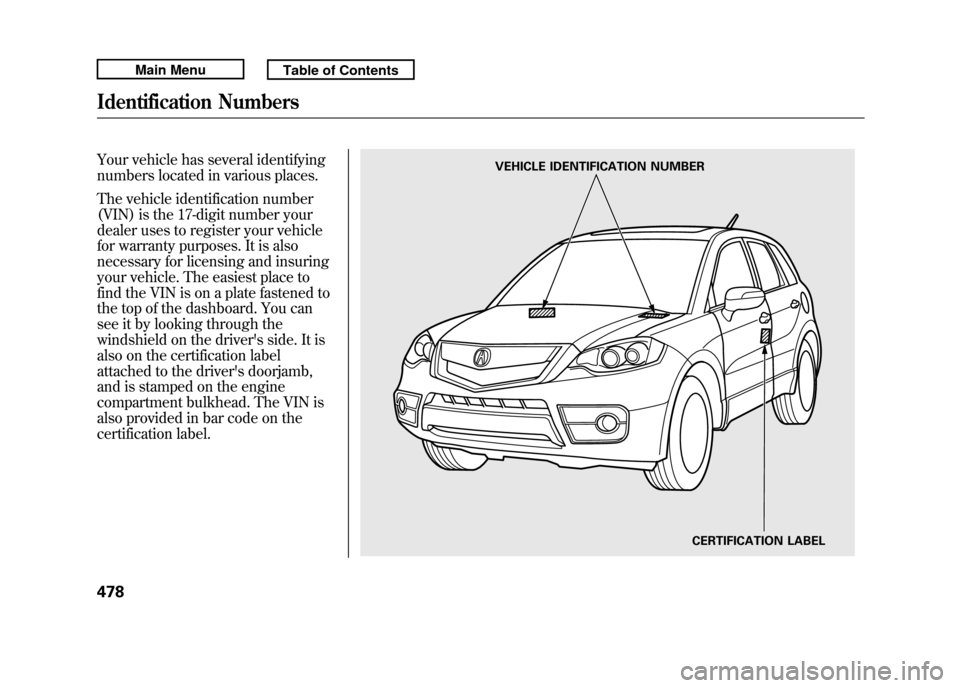
Your vehicle has several identifying
numbers located in various places.
The vehicle identification number
(VIN) is the 17-digit number your
dealer uses to register your vehicle
for warranty purposes. It is also
necessary for licensing and insuring
your vehicle. The easiest place to
find the VIN is on a plate fastened to
the top of the dashboard. You can
see it by looking through the
windshield on the driver's side. It is
also on the certification label
attached to the driver's doorjamb,
and is stamped on the engine
compartment bulkhead. The VIN is
also provided in bar code on the
certification label.
VEHICLE IDENTIFICATION NUMBERCERTIFICATION LABEL
Identification Numbers47810/06/08 17:42:32 11 ACURA RDX MMC North America Owner's M 50 31STK640 enu
Page 484 of 517
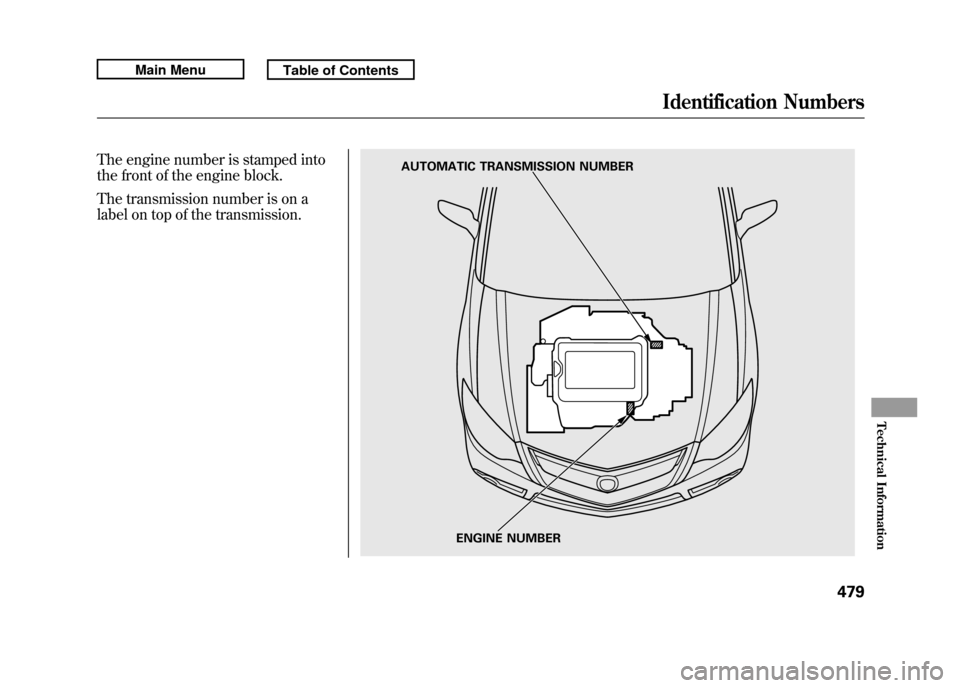
The engine number is stamped into
the front of the engine block.
The transmission number is on a
label on top of the transmission.
AUTOMATIC TRANSMISSION NUMBERENGINE NUMBER
Identification Numbers
479
Technical Information
10/06/08 17:42:32 11 ACURA RDX MMC North America Owner's M 50 31STK640 enu
Page 485 of 517

DimensionsLength182.5 in (4,635 mm)
Width 73.6 in (1,870 mm)
Height 65.2 in (1,655 mm)
Wheelbase 104.3 in (2,650 mm)
Track Front 61.9 in (1,572 mm)
Rear 62.6 in (1,590 mm)WeightsGross vehicle weight rating See the certification label attached to
the driver's doorjamb.EngineType Water cooled 4-stroke DOHC i-VTEC
4 cylinder gasoline engine with turbo charger, intercooler
Bore x Stroke 3.39 x 3.90 in (86.0 x 99.0 mm)
Displacement 140.3 cu-in (2,300 cm
3)
Compression ratio 8.8
Spark plugs SILKR8A-S (NGK)
Seating CapacitiesTotal 5
Front 2
Rear 3
CapacitiesFuel tankApprox.
18.0 US gal (68 L)
Engine oil Change
ꭧ 1
Including
filter 5.0 US qt (4.7 L)
Without filter 4.8 US qt (4.5 L)
Total 6.1 US qt (5.8 L)
Engine coolant Change
ꭧ 2
1.85 US gal (7.0 L)
Total 2.22 US gal (8.4 L)
Automatic
transmission fluid Change
2WD 3.0 US qt (2.8 L)
4WD 3.1 US qt (2.9 L)
Total 2WD 8.8 US qt (8.3 L)
4WD 8.2 US qt (7.8 L)
Rear differential
fluid (4WD) Change
2.67 US qt (2.53 L)
Total 2.93 US qt (2.77 L)
Transfer assembly
fluid (4WD) Change
0.45 US qt (0.43 L)
Total 0.48 US qt (0.45 L)
Windshield
washer reservoir U.S. Vehicles 2.6 US qt (2.5 L)
Canada
Vehicles 4.8 US qt (4.5 L)
ꭧ1: Excluding the oil remaining in the engine
ꭧ2: Including the coolant in the reserve tank and that remaining in the engine Reserve tank capacity:
0.18 US gal (0.7 L)
Specifications48010/06/08 17:42:32 11 ACURA RDX MMC North America Owner's M 50 31STK640 enu
Page 492 of 517

The burning of gasoline in your
vehicle's engine produces several by-
products. Some of these are carbon
monoxide (CO), oxides of nitrogen
(NOx), and hydrocarbons (HC).
Gasoline evaporating from the tank
also produces hydrocarbons.
Controlling the production of NOx,
CO, and HC is important to the
environment. Under certain
conditions of sunlight and climate,
NOx and HC react to form
photochemical‘‘smog. ’’Carbon
monoxide does not contribute to
smog creation, but it is a poisonous
gas. The Clean Air Act
The United States Clean Air Act
ꭧ
sets standards for automobile
emissions. It also requires that
automobile manufacturers explain to
owners how their emissions controls
work and what to do to maintain
them. This section summarizes how
the emissions controls work.
Scheduled maintenance is on page
418.ꭧIn Canada, Acura vehicles comply
with the Canadian emission
requirements, as specified in an
agreement with Environment
Canada, at the time they are
manufactured. Crankcase Emissions Control
System
Your vehicle has a positive crankcase
ventilation system. This keeps
gasses that build up in the engine's
crankcase from going into the
atmosphere. The positive crankcase
ventilation valve routes them from
the crankcase back to the intake
manifold. They are then drawn into
the engine and burned.
Evaporative Emissions Control
System
As gasoline evaporates in the fuel
tank, an evaporative emissions
control canister filled with charcoal
adsorbs the vapor. It is stored in this
canister while the engine is off. After
the engine is started and warmed up,
the vapor is drawn into the engine
and burned during driving.
Emissions Controls
487
Technical Information
10/06/08 17:42:32 11 ACURA RDX MMC North America Owner's M 50 31STK640 enu
Page 493 of 517

Onboard Refueling Vapor
Recovery
The onboard refueling vapor
recovery (ORVR) system captures
the fuel vapors during refueling. The
vapors are adsorbed in a canister
filled with activated carbon. While
driving, the fuel vapors are drawn
into the engine and burned off.
Exhaust Emissions Controls
The exhaust emissions controls
include three systems: PGM-FI,
ignition timing control, and three
way catalytic converter. These three
systems work together to control the
engine's combustion and minimize
the amount of HC, CO, and NOx that
come out the tailpipe. The exhaust
emissions control systems are
separate from the crankcase and
evaporative emissions control
systems.
PGM-FI SystemThe PGM-FI system uses sequential
multiport fuel injection.
It has three subsystems: air intake,
engine control, and fuel control. The
powertrain control module (PCM)
uses various sensors to determine
how much air is going into the
engine. It then controls how much
fuel to inject under all operating
conditions.Ignition Timing Control SystemThis system constantly adjusts the
ignition timing, reducing the amount
of HC, CO, and NOx produced.Three Way Catalytic ConverterThe three way catalytic converter is
in the exhaust system. Through
chemical reactions, it converts HC,
CO, and NOx in the engine's exhaust
to carbon dioxide (CO
2), nitrogen
(N
2), and water vapor. Replacement Parts
The emissions control systems are
designed and certified to work
together in reducing emissions to
levels that comply with the Clean Air
Act. To make sure the emissions
remain low, you should use only new
Acura replacement parts or their
equivalent for repairs. Using lower
quality parts may increase the
emissions from your vehicle.
The emissions control systems are
covered by warranties separate from
the rest of your vehicle. Read your
warranty manual for more
information.
Emissions Controls48810/06/08 17:42:32 11 ACURA RDX MMC North America Owner's M 50 31STK640 enu
Page 494 of 517
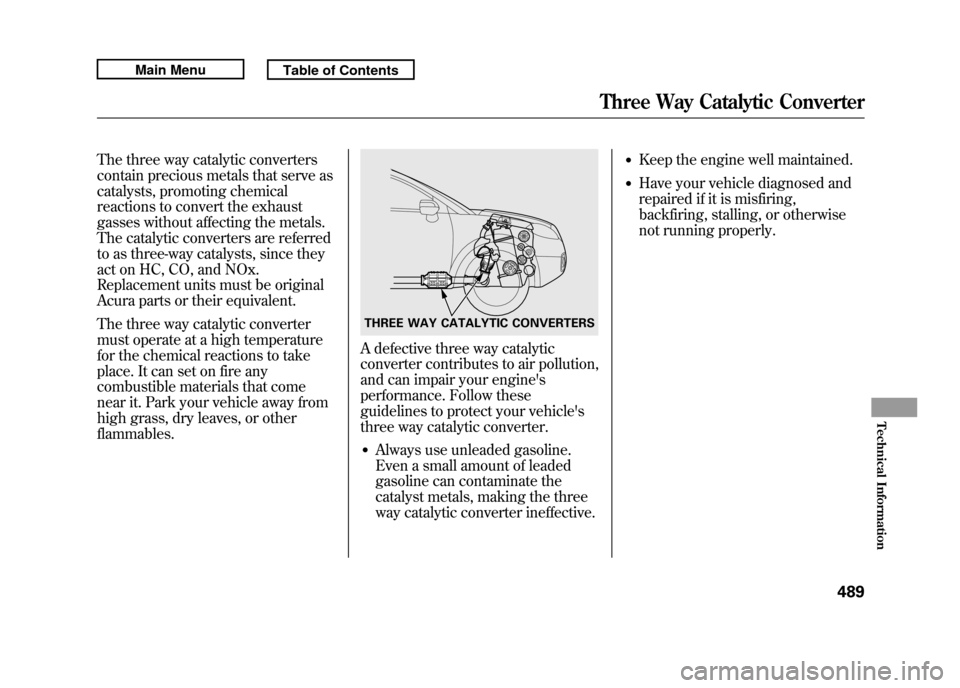
The three way catalytic converters
contain precious metals that serve as
catalysts, promoting chemical
reactions to convert the exhaust
gasses without affecting the metals.
The catalytic converters are referred
to as three-way catalysts, since they
act on HC, CO, and NOx.
Replacement units must be original
Acura parts or their equivalent.
The three way catalytic converter
must operate at a high temperature
for the chemical reactions to take
place. It can set on fire any
combustible materials that come
near it. Park your vehicle away from
high grass, dry leaves, or other
flammables.
A defective three way catalytic
converter contributes to air pollution,
and can impair your engine's
performance. Follow these
guidelines to protect your vehicle's
three way catalytic converter.●Always use unleaded gasoline.
Even a small amount of leaded
gasoline can contaminate the
catalyst metals, making the three
way catalytic converter ineffective.
●Keep the engine well maintained.●Have your vehicle diagnosed and
repaired if it is misfiring,
backfiring, stalling, or otherwise
not running properly.
THREE WAY CATALYTIC CONVERTERS
Three Way Catalytic Converter
489
Technical Information
10/06/08 17:42:32 11 ACURA RDX MMC North America Owner's M 50 31STK640 enu