engine ACURA TL 1995 Service Repair Manual
[x] Cancel search | Manufacturer: ACURA, Model Year: 1995, Model line: TL, Model: ACURA TL 1995Pages: 1771, PDF Size: 62.49 MB
Page 1536 of 1771
Troubleshooting
Tips and Precautions
Before Troubleshooting
Check applicable fuses in the appropriate fuse/relay
box.
Check the battery for damage, state of charge, and
clean and tight connections.
Check the alternator belt tension.
CAUTION:
Do not quick-charge a battery unless the battery
ground cable has been disconnected, otherwise you
will damage the alternator diodes.
Do not attempt to crank the engine with the battery
ground cable loosely connected or you will severely
damage the wiring.
Handling Connectors
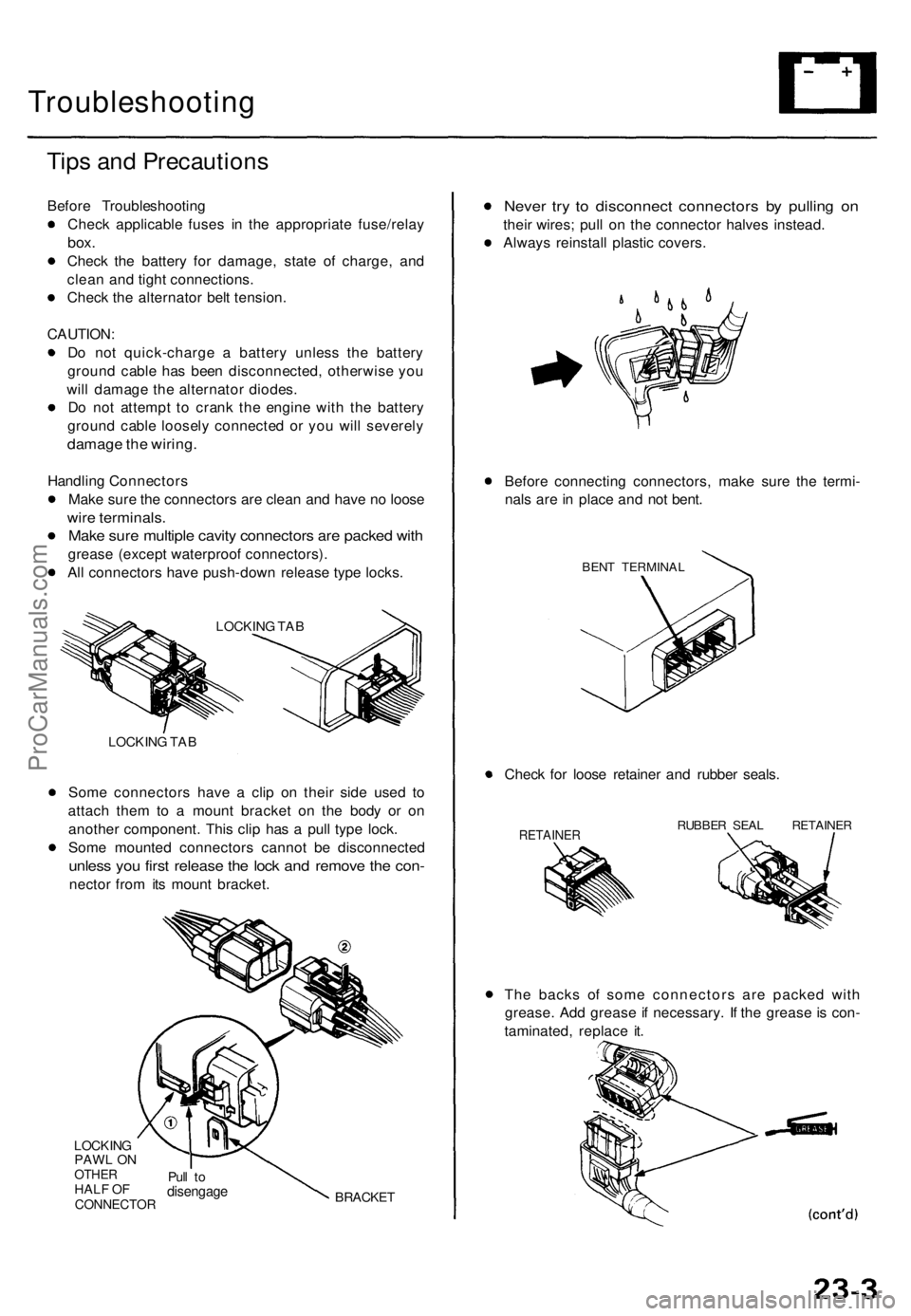
Make sure the connectors are clean and have no loose
wire terminals.
Make sure multiple cavity connectors are packed with
grease (except waterproof connectors).
All connectors have push-down release type locks.
LOCKING TAB
Some connectors have a clip on their side used to
attach them to a mount bracket on the body or on
another component. This clip has a pull type lock.
Some mounted connectors cannot be disconnected
unless you first release the lock and remove the con-
nector from its mount bracket.
LOCKING
PAWL ON
OTHER
HALF OF
CONNECTOR
Pull to
disengage
BRACKET
Never try to disconnect connectors by pulling on
their wires; pull on the connector halves instead.
Always reinstall plastic covers.
Before connecting connectors, make sure the termi-
nals are in place and not bent.
BENT TERMINAL
Check for loose retainer and rubber seals.
RETAINER
RUBBER SEAL RETAINER
The backs of some connectors are packed with
grease. Add grease if necessary. If the grease is con-
taminated, replace it.
LOCKING TABProCarManuals.com
Page 1539 of 1771
Relay and Control Unit Locations
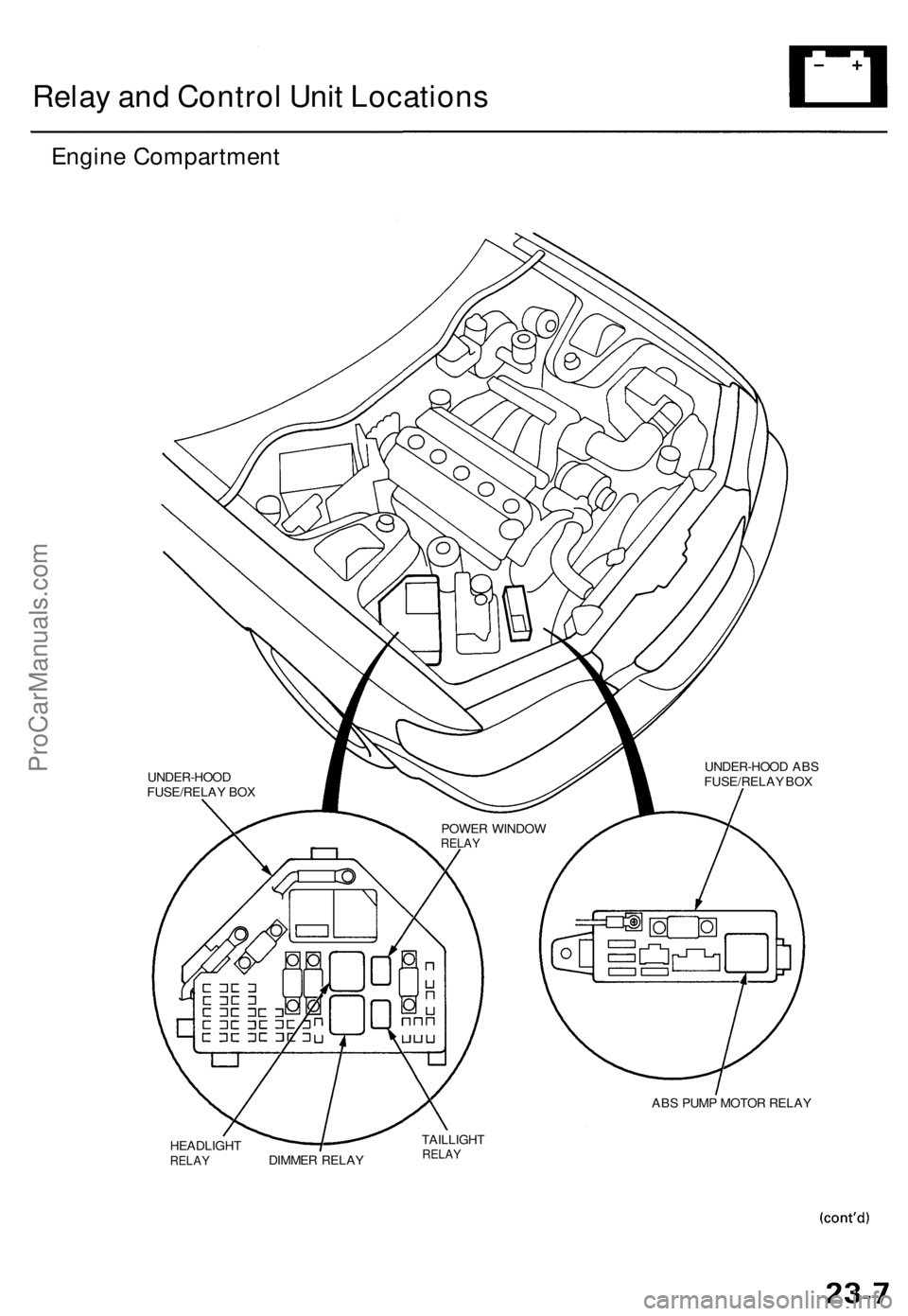
Engine Compartment
UNDER-HOOD ABS
FUSE/RELAY BOX
ABS PUMP MOTOR RELAY
HEADLIGHT
RELAY
DIMMER RELAY
TAILLIGHT
RELAY
POWER WINDOW
RELAY
UNDER-HOOD
FUSE/RELAY BOXProCarManuals.com
Page 1540 of 1771
Relay and Control Unit Locations
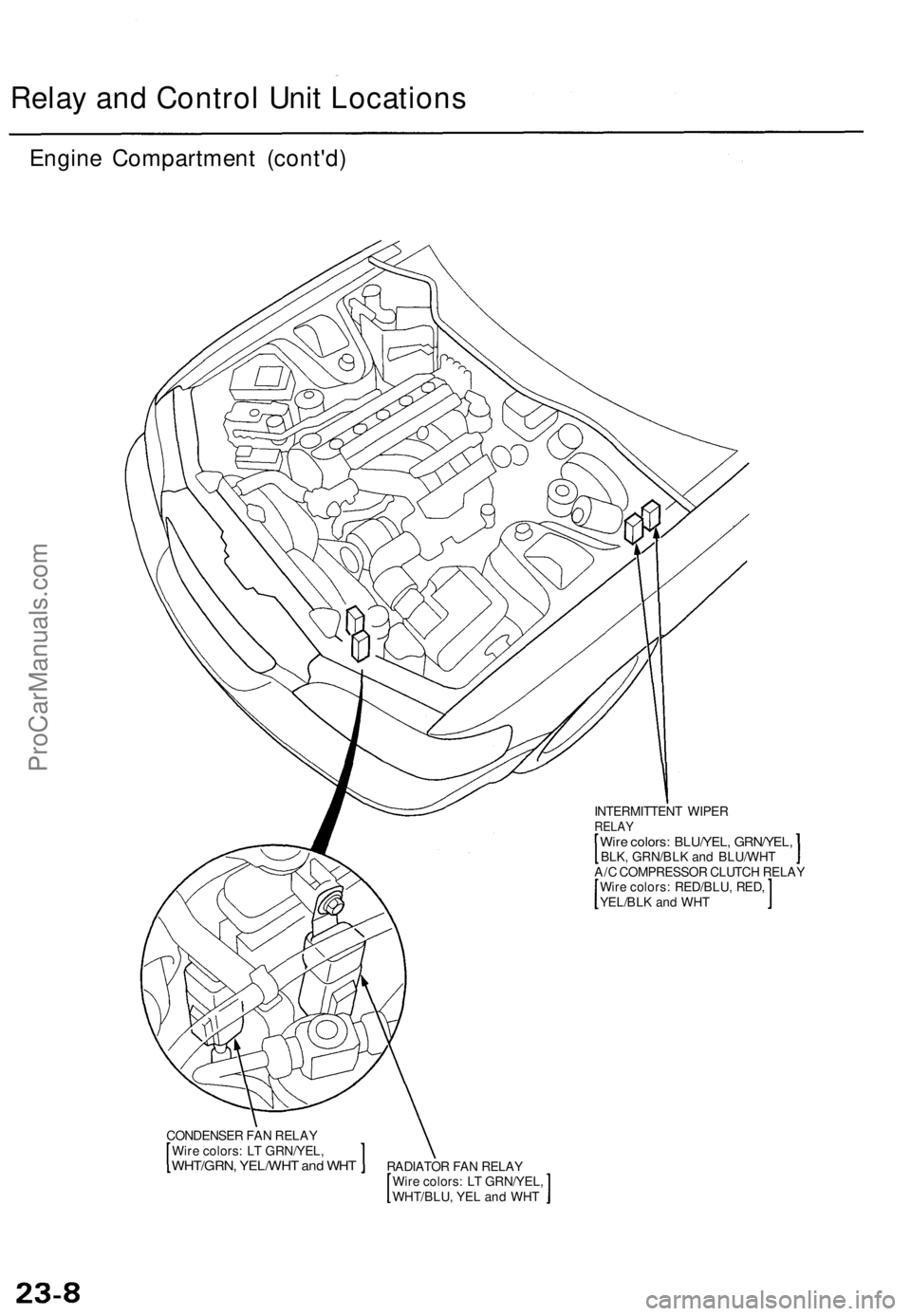
Engine Compartment (cont'd)
INTERMITTENT WIPER
RELAY
Wire colors: BLU/YEL, GRN/YEL,
BLK, GRN/BLK and BLU/WHT
A/C COMPRESSOR CLUTCH RELAY
Wire colors: RED/BLU, RED,
YEL/BLK and WHT
CONDENSER FAN RELAY
Wire colors: LT GRN/YEL,
WHT/GRN, YEL/WHT and WHT
RADIATOR FAN RELAY
Wire colors: LT GRN/YEL,
WHT/BLU, YEL and WHTProCarManuals.com
Page 1556 of 1771
Starting Syste m
Starter Tes t
NOTE : Th e ai r temperatur e mus t b e betwee n 5 9 an d
100° F (1 5 an d 38°C ) befor e testing .
Recommende d Procedure :
Use a starte r syste m tester .
Connec t an d operat e th e equipmen t i n accordanc e
wit h th e manufacturer' s instructions .
Tes t an d troubleshoo t a s described .
Alternate Procedure :
Use followin g equipment :
— Ammeter , 0 - 400 A
— Voltmeter , 0 - 20 V (accurat e withi n 0. 1 volt )
— Tachometer , 0 - 1,20 0 rp m
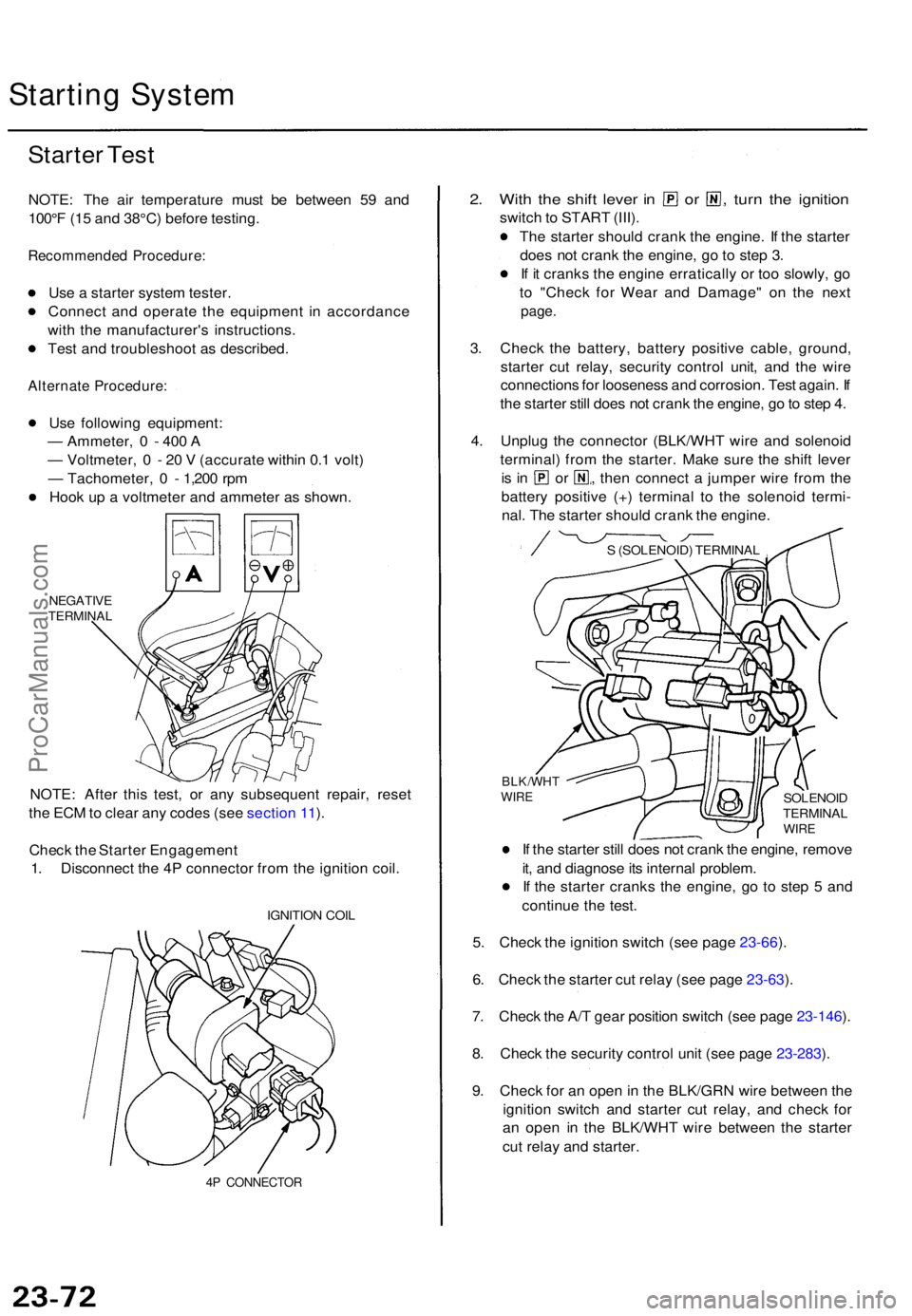
Hoo k u p a voltmete r an d ammete r a s shown .
NEGATIV ETERMINA L
NOTE: Afte r thi s test , o r an y subsequen t repair , rese t
th e EC M to clea r an y code s (se e sectio n 11 ).
Chec k th e Starte r Engagemen t
1 . Disconnec t th e 4 P connecto r fro m th e ignitio n coil .
IGNITIO N COI L
4P CONNECTO R
2. Wit h th e shif t leve r i n o r , turn th e ignitio n
switch to STAR T (III) .
Th e starte r shoul d cran k th e engine . I f th e starte r
doe s no t cran k th e engine , g o to ste p 3 .
I f i t crank s th e engin e erraticall y o r to o slowly , g o
t o "Chec k fo r Wea r an d Damage " o n th e nex t
page .
3. Chec k th e battery , batter y positiv e cable , ground ,
starte r cu t relay , securit y contro l unit , an d th e wir e
connection s fo r loosenes s an d corrosion . Tes t again . I f
th e starte r stil l doe s no t cran k th e engine , g o to ste p 4 .
4 . Unplu g th e connecto r (BLK/WH T wir e an d solenoi d
terminal ) fro m th e starter . Mak e sur e th e shif t leve r
is i n o r , then connec t a jumpe r wir e fro m th e
batter y positiv e (+ ) termina l t o th e solenoi d termi -
nal . Th e starte r shoul d cran k th e engine .
I f th e starte r stil l doe s no t cran k th e engine , remov e
it , an d diagnos e it s interna l problem .
I f th e starte r crank s th e engine , g o t o ste p 5 an d
continu e th e test .
5 . Chec k th e ignitio n switc h (se e pag e 23-66 ).
6 . Chec k th e starte r cu t rela y (se e pag e 23-63 ).
7 . Chec k th e A/ T gea r positio n switc h (se e pag e 23-146 ).
8 . Chec k th e securit y contro l uni t (se e pag e 23-283 ).
9 . Chec k fo r a n ope n in th e BLK/GR N wir e betwee n th e
ignitio n switc h an d starte r cu t relay , an d chec k fo r
a n ope n i n th e BLK/WH T wir e betwee n th e starte r
cu t rela y an d starter .
SOLENOI DTERMINA LWIRE
BLK/WH TWIRE
S (SOLENOID ) TERMINA L
ProCarManuals.com
Page 1557 of 1771
Check for Wear and Damage
The starter should crank the engine smoothly and steadily.
If the starter engages, but cranks the engine erratically,
remove it, and inspect the starter drive gear and torque
converter ring gear for damage.
Check the drive gear overrunning clutch for binding or
slipping when the armature is rotated with the drive
gear held. If the clutch is damaged, replace the clutch
assembly.
Check Cranking Voltage and Current Draw
Cranking voltage should be no less than 8.5 volts.
Current draw should be no more than 380 amperes.
If cranking voltage is too low, or current draw too high,
check for:
Dead or low battery
Open circuit in starter armature commutator segments
Starter armature dragging
Shorted armature winding
Excessive drag in engine
Check Cranking rpm
Engine speed during cranking should be above 100 rpm.
If speed is too low, check for:
Loose battery or starter terminals
Excessively worn starter brushes
Open circuit in commutator segments
Dirty or damaged helical spline or drive gear
Defective drive gear overrunning clutch
Check Starter Disengagement
With the shift lever in turn the ignition switch to
"START (III)", and release to "ON (II)". The starter drive
gear should disengage from the drive plate/ring gear
when you release the key.
If the drive gear hangs up on the drive plate/ring gear,
check for:
• Solenoid plunger and switch malfunction
• Dirty drive gear assembly or damaged overrunning
clutchProCarManuals.com
Page 1567 of 1771
Ignition Syste m
Descriptio n
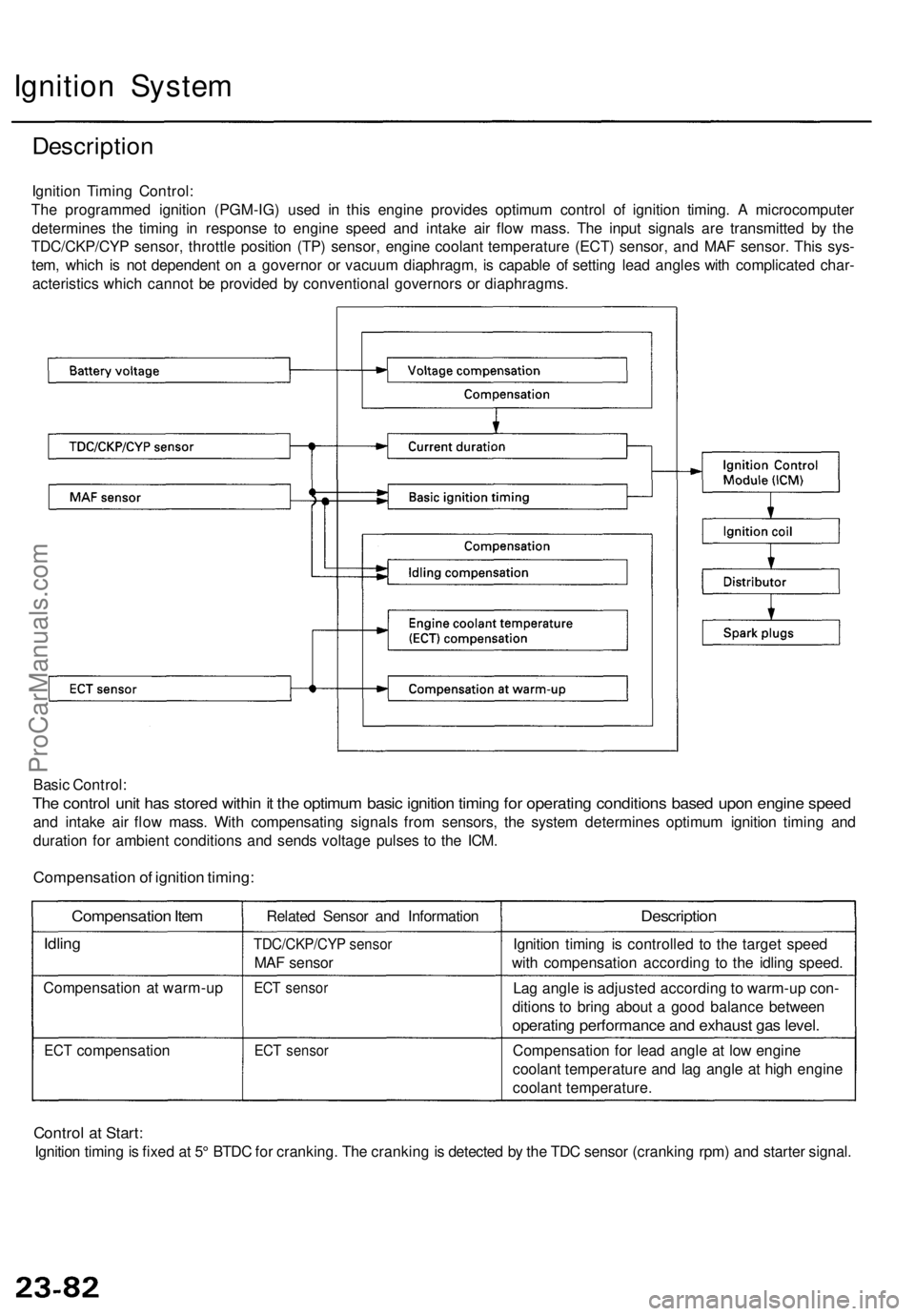
Ignition Timin g Control :
Th e programme d ignitio n (PGM-IG ) use d i n thi s engin e provide s optimu m contro l o f ignitio n timing . A microcompute r
determine s th e timin g i n respons e t o engin e spee d an d intak e ai r flo w mass . Th e inpu t signal s ar e transmitte d b y th e
TDC/CKP/CY P sensor , throttl e positio n (TP ) sensor , engine coolant temperatur e (ECT ) sensor , an d MA F sensor . Thi s sys -
tem , whic h i s no t dependen t o n a governo r o r vacuu m diaphragm , i s capabl e o f settin g lea d angle s wit h complicate d char -
acteristic s whic h canno t b e provide d b y conventiona l governor s o r diaphragms .
Basi c Control :
The contro l uni t ha s store d withi n it th e optimu m basi c ignitio n timin g fo r operatin g condition s base d upo n engin e spee d
and intak e ai r flo w mass . Wit h compensatin g signal s fro m sensors , th e syste m determine s optimu m ignitio n timin g an d
duratio n fo r ambien t condition s an d send s voltag e pulse s t o th e ICM .
Compensatio n of ignitio n timing :
Compensatio n Ite m
Idlin g
Compensatio n a t warm-u p
ECT compensatio n Relate
d Senso r an d Informatio n
TDC/CKP/CY P senso r
MAF senso r
ECT senso r
ECT senso r
Descriptio n
Ignition timin g i s controlle d t o th e targe t spee d
wit h compensatio n accordin g t o th e idlin g speed .
La g angl e is adjuste d accordin g t o warm-u p con -
dition s t o brin g abou t a goo d balanc e betwee n
operating performanc e an d exhaus t ga s level .
Compensatio n fo r lea d angl e a t lo w engin e
coolan t temperatur e an d la g angl e a t hig h engin e
coolan t temperature .
Control a t Start :
Ignitio n timin g is fixe d a t 5 ° BTD C fo r cranking . Th e crankin g is detecte d b y th e TD C senso r (crankin g rpm ) an d starte r signal .
ProCarManuals.com
Page 1568 of 1771
Ignition Syste m
Ignition Timin g Inspectio n
SRS component s ar e locate d in thi s area . Revie w th e SR S
componen t locations , precautions , an d procedure s i n th e
SR S (sectio n 24 ) befor e performin g repair s o r service .
1.
2 .
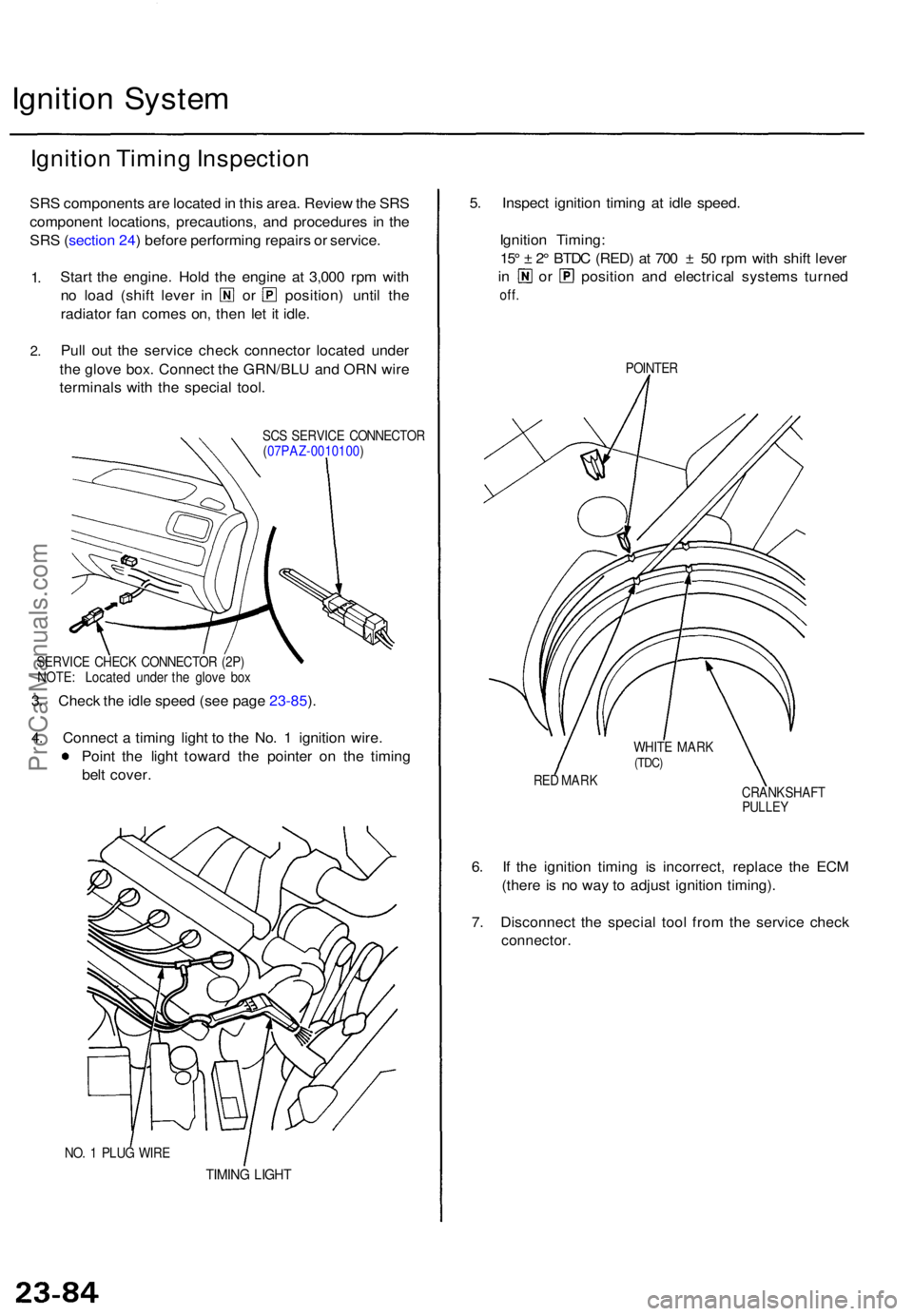
Star t th e engine . Hol d th e engine at 3,00 0 rp m wit h
no loa d (shif t leve r i n o r position ) unti l th e
radiato r fa n come s on , the n le t i t idle .
Pul l ou t th e servic e chec k connecto r locate d unde r
th e glov e box . Connec t th e GRN/BL U an d OR N wir e
terminal s wit h th e specia l tool .
SCS SERVIC E CONNECTO R
( 07PAZ-0010100 )
SERVIC E CHEC K CONNECTO R (2P)
NOTE : Locate d unde r th e glov e bo x
3. Chec k th e idl e spee d (se e pag e 23-85 ).
4 . Connec t a timin g ligh t t o th e No . 1 ignitio n wire .
Poin t th e ligh t towar d th e pointe r o n th e timin g
bel t cover .
NO. 1 PLU G WIR E
TIMIN G LIGH T
5. Inspec t ignitio n timin g a t idl e speed .
Ignitio n Timing :
15 ° ± 2° BTD C (RED ) a t 70 0 ± 50 rp m wit h shif t leve r
in o r positio n an d electrica l system s turne d
off.
POINTE R
RE D MAR K
CRANKSHAFT
PULLEY
6. I f th e ignitio n timin g i s incorrect , replac e th e EC M
(ther e is n o wa y t o adjus t ignitio n timing) .
7 . Disconnec t th e specia l too l fro m th e servic e chec k
connector .
WHITE MAR K(TDC)
ProCarManuals.com
Page 1569 of 1771
Idle Spee d Chec k
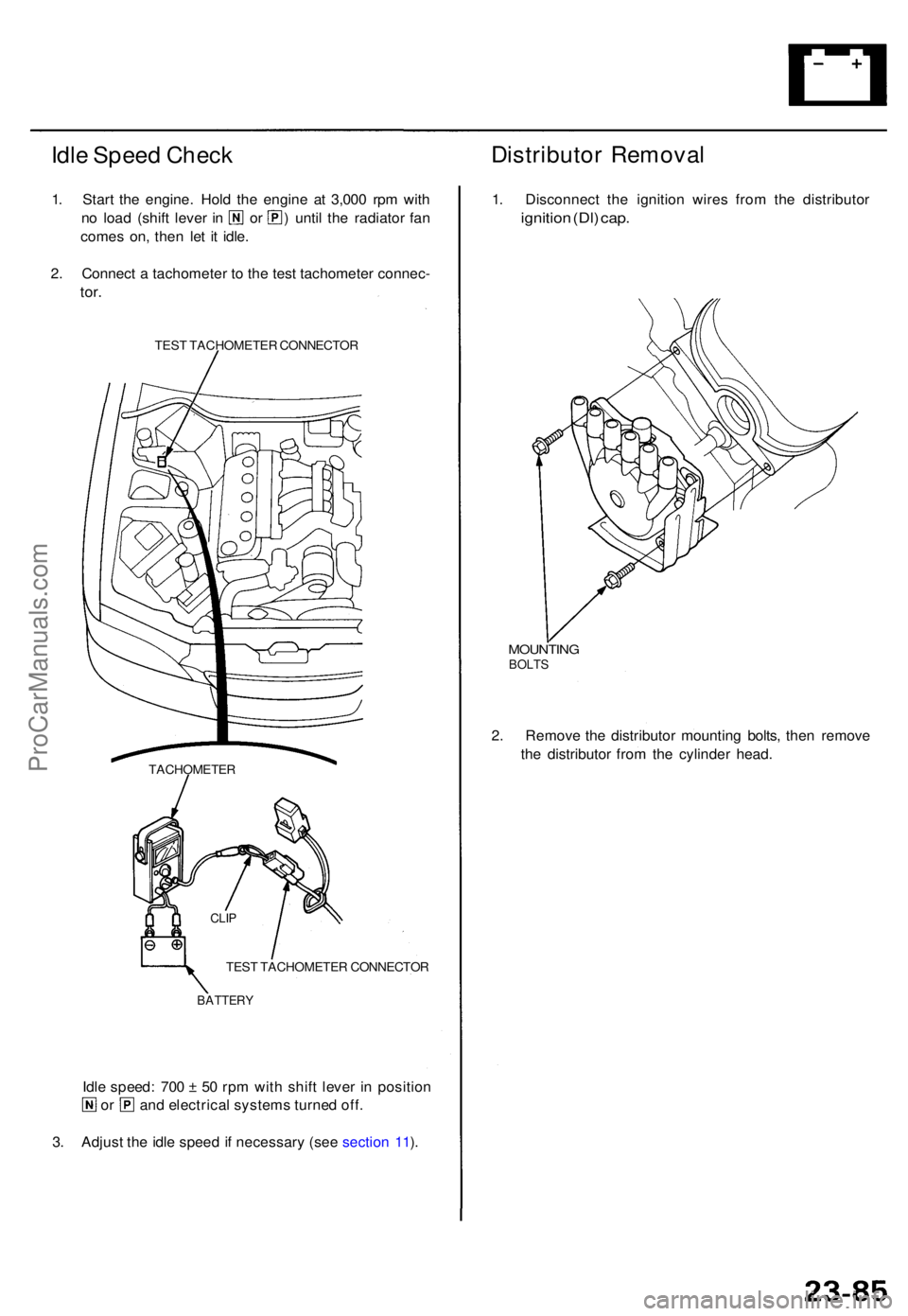
1. Star t th e engine . Hol d th e engin e a t 3,00 0 rp m wit h
no loa d (shif t leve r i n o r ) unti l th e radiato r fa n
come s on , the n le t i t idle .
2 . Connec t a tachomete r t o th e tes t tachomete r connec -
tor.
TES T TACHOMETE R CONNECTO R
TES T TACHOMETE R CONNECTO R
BATTERY
Idle speed : 70 0 ± 5 0 rp m wit h shif t leve r i n positio n
or an d electrica l system s turne d off .
3 . Adjus t th e idl e spee d if necessar y (se e sectio n 11 ).
Distributo r Remova l
1. Disconnec t th e ignitio n wire s fro m th e distributo r
ignition (Dl ) cap .
MOUNTIN GBOLTS
2. Remov e th e distributo r mountin g bolts , the n remov e
th e distributo r fro m th e cylinde r head .
CLIP
TACHOMETE R
ProCarManuals.com
Page 1571 of 1771
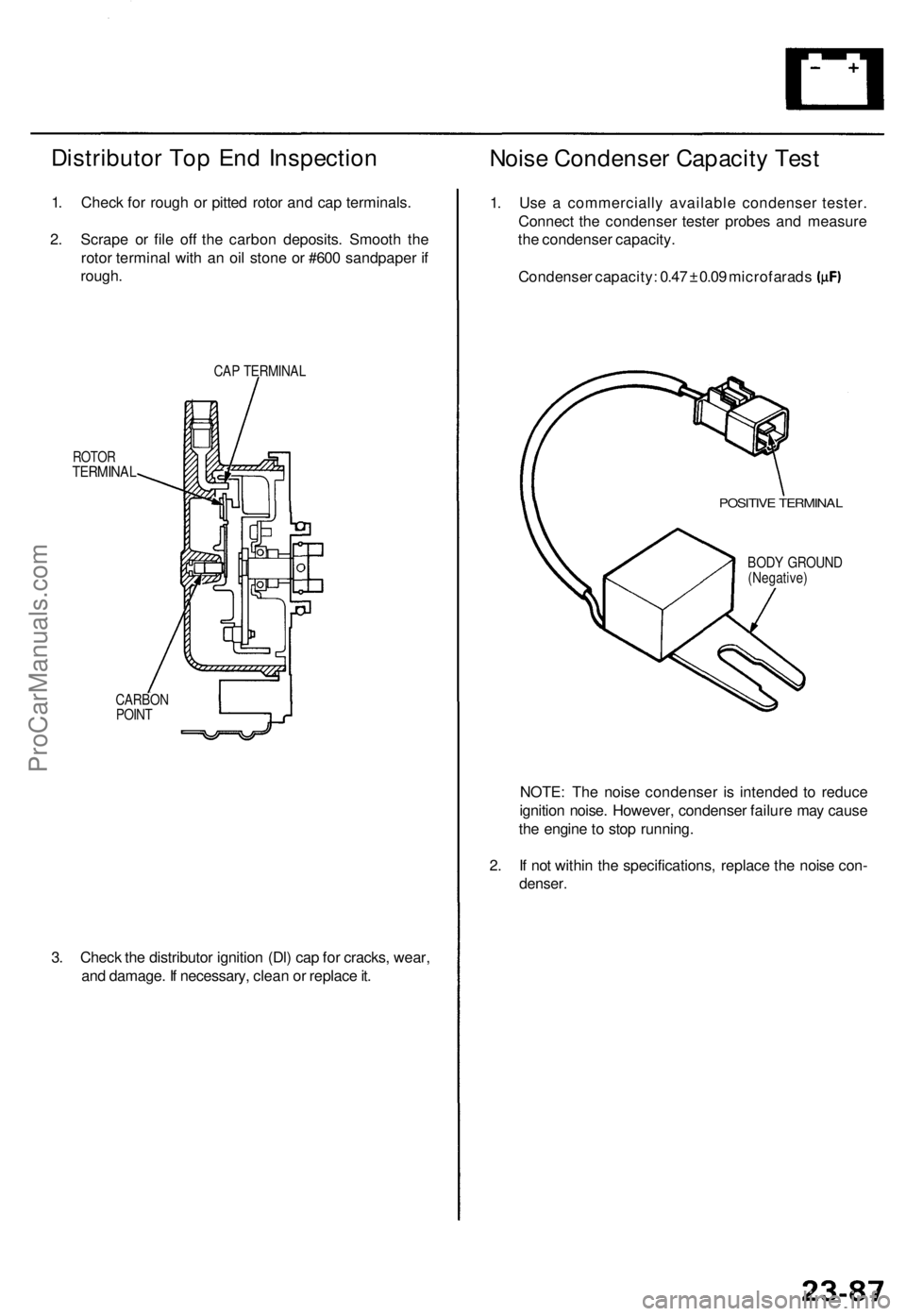
Distributor Top End Inspection
1. Check for rough or pitted rotor and cap terminals.
2. Scrape or file off the carbon deposits. Smooth the
rotor terminal with an oil stone or #600 sandpaper if
rough.
ROTOR
TERMINAL
CAP TERMINAL
CARBON
POINT
3. Check the distributor ignition (Dl) cap for cracks, wear,
and damage. If necessary, clean or replace it.
Noise Condenser Capacity Test
1. Use a commercially available condenser tester.
Connect the condenser tester probes and measure
the condenser capacity.
Condenser capacity: 0.47 ± 0.09 microfarads
POSITIVE TERMINAL
BODY GROUND
(Negative)
NOTE: The noise condenser is intended to reduce
ignition noise. However, condenser failure may cause
the engine to stop running.
2. If not within the specifications, replace the noise con-
denser.ProCarManuals.com
Page 1578 of 1771
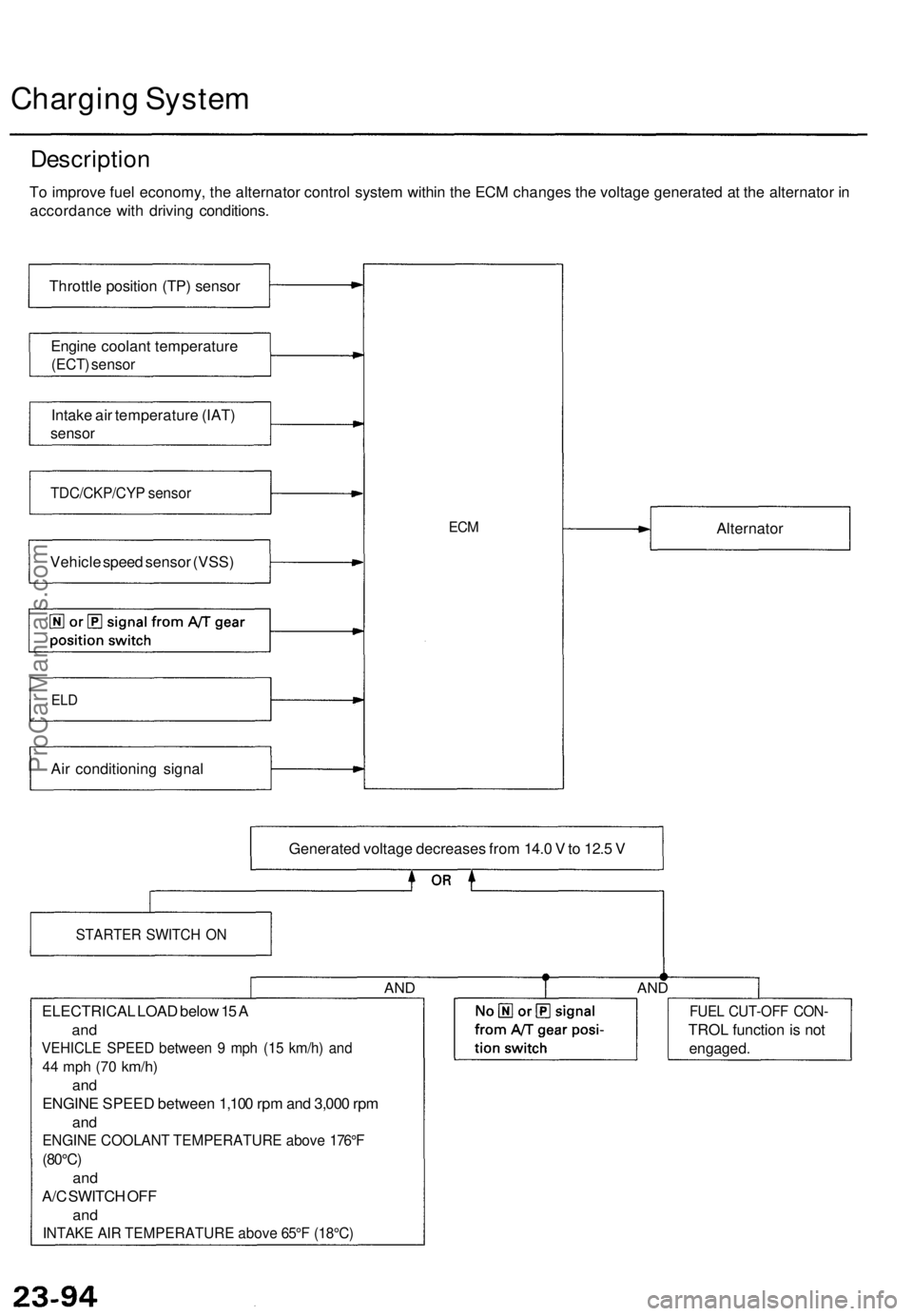
Charging System
Description
To improve fuel economy, the alternator control system within the ECM changes the voltage generated at the alternator in
accordance with driving conditions.
Throttle position (TP) sensor
Engine coolant temperature
(ECT) sensor
Intake air temperature (IAT)
sensor
TDC/CKP/CYP sensor
Vehicle speed sensor (VSS)
ELD
Air conditioning signal
ECM
Alternator
STARTER SWITCH ON
Generated voltage decreases from 14.0 V to 12.5 V
AND
ELECTRICAL LOAD below 15 A
and
VEHICLE SPEED between 9 mph (15 km/h) and
44 mph (70
km/h)
and
ENGINE SPEED between 1,100 rpm and 3,000 rpm
and
ENGINE COOLANT TEMPERATURE above 176°F
(80°C)
and
A/C SWITCH OFF
and
INTAKE AIR TEMPERATURE above 65°F (18°C)
AND
FUEL CUT-OFF CON-
TROL function is not
engaged.ProCarManuals.com