ignition Acura TL 2000 3.2 Workshop Manual
[x] Cancel search | Manufacturer: ACURA, Model Year: 2000, Model line: TL, Model: Acura TL 2000Pages: 311, PDF Size: 3.05 MB
Page 264 of 311

If Your Engine Won't Start
Nothing Happens or the Starter
Motor Operates Very Slowly
When you turn the ignition switch to START (III), you do not hear the
normal noise of the engine trying tostart. You may hear a clicking sound
or series of clicks, or nothing at all.
Check these things:• Check the transmission interlock. The transmission must be in Parkor Neutral or the starter will not
operate.
• Turn the ignition switch to ON (II).
Turn on the headlights and check their brightness. If the headlightsare very dim or don't light at all,
the battery is discharged. See
Jump Starting on page 262.
• Turn the ignition switch to START (III). If the headlights do not dim,
check the condition of the fuses. If
the fuses are OK, there is proba-
bly something wrong with the electrical circuit for the ignitionswitch or starter motor. You will
need a qualified technician to determine the problem. (See
Emergency Towing on page 277.)
If the headlights dim noticeably or
go out when you try to start the engine, either the battery is dis-
charged or the connections are
corroded. Check the condition of
the battery and terminal connec- tions (see page 220). You can
then try jump starting the car froma booster battery (see page 262).
Taking Care of the Unexpected
Page 265 of 311

If Your Engine Won't Start, Jump Starting
The Starter Operates NormallyIn this case, the starter motor's
speed sounds normal, or even faster
than normal, when you turn the
ignition switch to START (III), but
the engine does not run.
• Your car has the Immobilizer System. You should use a
properly-coded master or valet key
to start the engine (see page 74).
A key that is not properly coded will cause the immobilizer systemindicator in the dash panel to blink
rapidly.
• Are you using the proper starting procedure? Refer to Starting theEngine on page 161.
• Do you have fuel? Turn the
ignition switch to ON (II) for a
minute and watch the fuel gauge.
The low fuel level warning light may not be working, so you were
not reminded to fill the tank.
• There may be an electrical problem, such as no power to the
fuel pump. Check all the fuses (see page 273).
If you find nothing wrong, you will
need a qualified technician to find
the problem. See Emergency
Towing on page 277. Jump Starting
If your car's battery has run down,
you may be able to start the engine by using a booster battery. Although
this seems like a simple procedure,
you should take several precautions.
A battery can explode if you donot follow the correct procedure,
seriously injuring anyone nearby.
Keep all sparks, open flames,
and smoking materials away
from the battery.
You cannot start your Acura by pushing or pulling it.
Taking Care of the Unexpected
Page 270 of 311
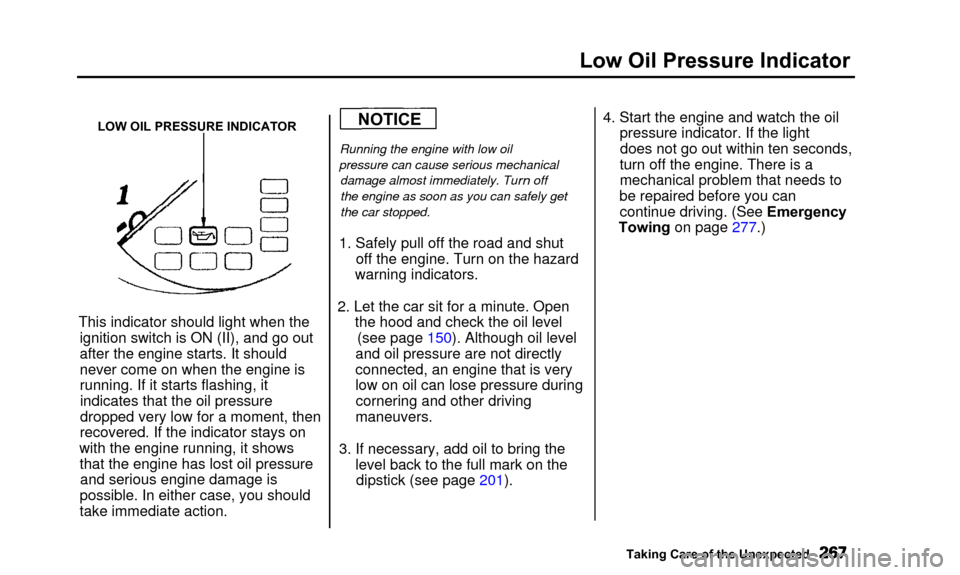
Low Oil Pressure Indicator
LOW OIL PRESSURE INDICATOR
This indicator should light when theignition switch is ON (II), and go out
after the engine starts. It should
never come on when the engine is
running. If it starts flashing, itindicates that the oil pressure
dropped very low for a moment, then
recovered. If the indicator stays on
with the engine running, it shows that the engine has lost oil pressureand serious engine damage is
possible. In either case, you should
take immediate action.
Running the engine with low oil
pressure can cause serious mechanical damage almost immediately. Tu
rn off
the engine as soon as you can safely get
the car stopped.
1. Safely pull off the road and shut off the engine. Turn on the hazard
warning indicators.
2. Let the car sit for a minute. Open the hood and check the oil level(see page 150). Although oil level
and oil pressure are not directly
connected, an engine that is very
low on oil can lose pressure during cornering and other driving
maneuvers.
3. If necessary, add oil to bring the level back to the full mark on thedipstick (see page 201). 4. Start the engine and watch the oil
pressure indicator. If the lightdoes not go out within ten seconds,
turn off the engine. There is a
mechanical problem that needs to
be repaired before you can continue driving. (See Emergency
Towing on page 277.)
Taking Care of the Unexpected
NOTICE
Page 271 of 311

Charging System Indicator
CHARGING SYSTEM INDICATOR
This indicator should come on whenthe ignition switch is ON (II), and goout after the engine starts. If it
comes on brightly when the engine
is running, it indicates that thecharging system has stopped
charging the battery. Immediately turn off all electrical
accessories: radio, heater, A/C, rear
defogger, cruise control, etc. Try not
to use other electrically-operated
controls such as the power windows.
Keep the engine running and take
extra care not to stall it. Starting the
engine will discharge the battery
rapidly. By eliminating as much of the
electrical load as possible, you can
drive several miles (kilometers)
before the battery is too discharged
to keep the engine running. Drive to a service station or garage where
you can get technical assistance.
Taking Care of the Unexpected
Page 272 of 311
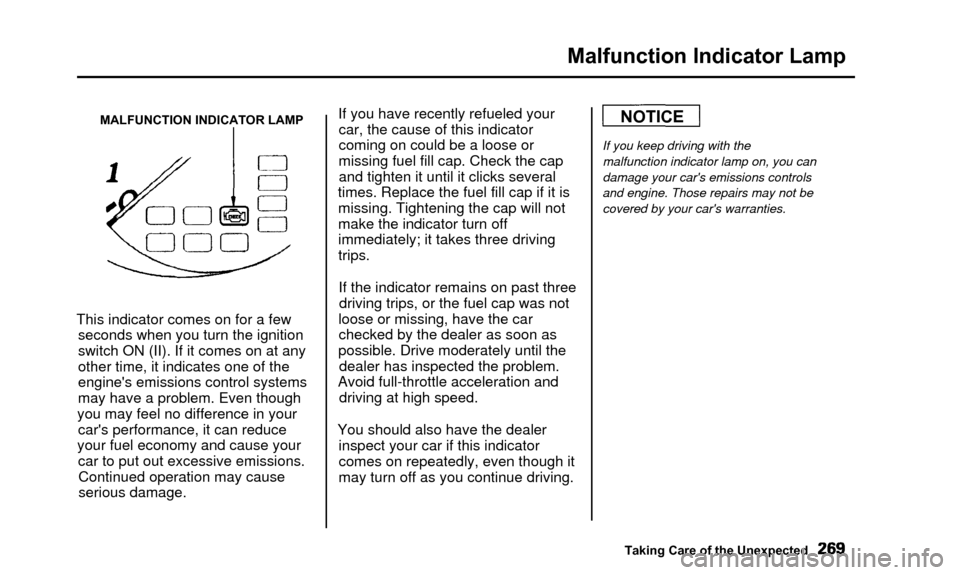
Malfunction Indicator Lamp
MALFUNCTION INDICATOR LAMP
This indicator comes on for a fewseconds when you turn the ignition
switch ON (II). If it comes on at any
other time, it indicates one of the
engine's emissions control systems
may have a problem. Even though
you may feel no difference in your car's performance, it can reduce
your fuel economy and cause your car to put out excessive emissions.Continued operation may causeserious damage. If you have recently refueled your
car, the cause of this indicator
coming on could be a loose or
missing fuel fill cap. Check the cap
and tighten it until it clicks several
times. Replace the fuel fill cap if it is missing. Tightening the cap will not
make the indicator turn off
immediately; it takes three driving
trips.
If the indicator remains on past threedriving trips, or the fuel cap was not
loose or missing, have the car checked by the dealer as soon as
possible. Drive moderately until the dealer has inspected the problem.
Avoid full-throttle acceleration and driving at high speed.
You should also have the dealer inspect your car if this indicator
comes on repeatedly, even though it
may turn off as you continue driving.
If you keep driving with the
malfunction indicator lamp on, you can
damage your car's emissions controls
and engine. Those repairs may not be
covered by your car's warranties.
Taking Care of the Unexpected
NOTICE
Page 273 of 311

Brake System Indicator
BRAKE SYSTEM INDICATOR
The Brake System Indicator lightcomes on when you turn the ignitionON (II). If the parking brake is not
set, it goes off after you start the
engine. If the parking brake is set, it
goes off when you fully release the parking brake with the engine
running. If it comes on at any other time, it
indicates a problem with the car's
brake system. In most cases, the problem is a low fluid level in the
brake fluid reservoir. Press lightly on
the brake pedal to see if it feels normal. If it does, check the brake
fluid level the next time you stop at a service station (see page 214). If the
fluid level is low, take the car to your dealer and have the brake system
inspected for leaks or worn brake
pads.
However, if the brake pedal does not
feel normal, you should take immediate action. Because of the
brake system's dual-circuit design, a
problem in one part of the system will still give you braking at two
wheels. You will feel the brake pedal
go down much farther before the car
begins to slow down, and you will
have to press harder on the pedal.
The distance needed to stop will be much longer. Slow down by shifting to a lower
gear, and pull to the side of the road
when it is safe. Because of the longer distance needed to stop, it is
hazardous to drive the car. Youshould have it towed, and repaired as
soon as possible. (See Emergency
Towing on page 277.)
If you must drive the car a shortdistance in this condition, driveslowly and cautiously.
Taking Care of the Unexpected
Page 276 of 311
Fuses
Checking and Replacing Fuses
If something electrical in your car stops working, the first thing you
should check for is a blown fuse.
Determine from the chart on pages 275 and 276, or the diagram on the
fuse box lid, which fuse or fuses control that component. Check those
fuses first, but check all the fuses
before deciding that a blown fuse is not the cause. Replace any blown
fuses and check the component's operation.
1. Turn the ignition switch to LOCK (0). Make sure the headlights and
all other accessories are off.
2. Remove the cover from the fuse box.
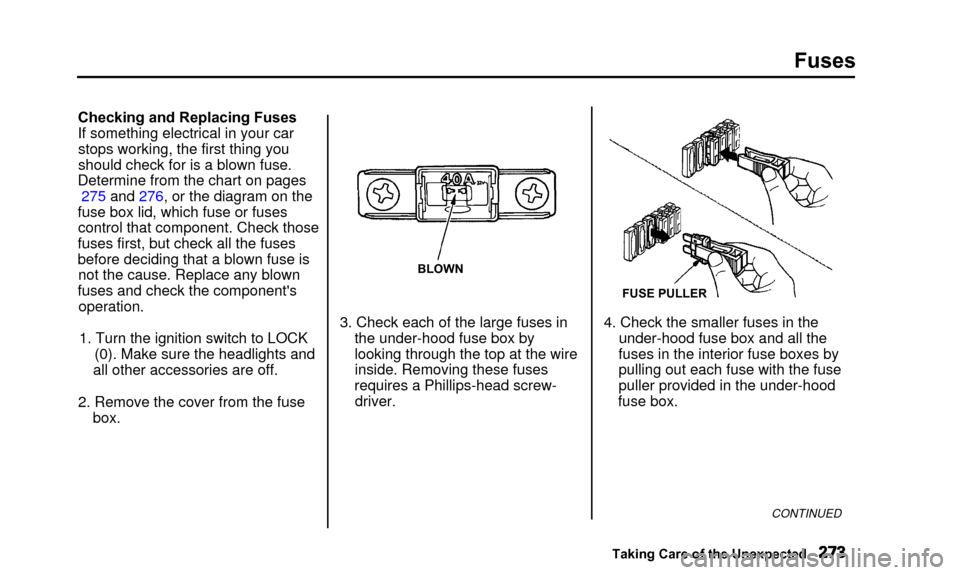
BLOWN
3. Check each of the large fuses inthe under-hood fuse box by
looking through the top at the wireinside. Removing these fuses
requires a Phillips-head screw- driver.
FUSE PULLER
4. Check the smaller fuses in the under-hood fuse box and all the
fuses in the interior fuse boxes by
pulling out each fuse with the fuse
puller provided in the under-hood
fuse box.
CONTINUED
Taking Care of the Unexpected
Page 281 of 311

Emergency Towing
If you decide to tow your car with all
four wheels on the ground, make sure you use a properly-designed and
attached tow bar. Prepare the car for
towing as described above, and leave
the ignition switch in Accessory (I) so the steering wheel does not lock.
Make sure the radio and any items
plugged into the accessory power socket are turned off so they do not
run down the battery.
The steering system can be damaged if
the steering wheel is locked. Leave the ignition switch in Accessory (I), and
make sure the steering wheel turns
freely before you begin towing. Trying to lift or tow your car by the
bumpers will cause serious damage. The bumpers are not designed to
support the car's weight.
Taking Care of the Unexpected
NOTICE
NOTICE
Page 282 of 311
Technical Information
The diagrams in this section giveyou the dimensions and capacities of
your Acura, and the locations of the identification numbers. The explana-
tions of several electronic and mechanical systems on your Acuraare for the more technically-orientedowner. Identification Numbers
.............. 280
Specifications ................................ 282
DOT Tire Quality Grading ............ 284
Treadwear................................ 284
Traction................................... 284
Temperature................................ 285 Oxygenated Fuels
...................... 286
Driving in Foreign Countries ................ 287
Emissions Controls...................... 288 The Clean Air Act ...................... 288
Crankcase Emissions Control System................................ 288
Evaporative Emissions Control System................................ 288
Onboard Refueling Vapor
Recovery.............................. 288
Exhaust Emissions Controls.... 289 PGM-FI System...................... 289
Ignition Timing Control System................................ 289
Exhaust Gas Recirculation (EGR) System.................... 289
Three Way Catalytic Converter.............................. 289
Replacement Parts .................... 289
Three Way Catalytic Converter... 290
Technical Information
Page 292 of 311

Emissions Controls
Exhaust Emissions Controls
The exhaust emissions controls include four systems: PGM-FI,
Ignition Timing Control, ExhaustGas Recirculation and Three Way
Catalytic Converter. These foursystems work together to control the
engine's combustion and minimize
the amount of HC, CO, and NOx that comes out the tailpipe. The exhaust
emissions control systems areseparate from the crankcase and
evaporative emissions control systems.
PGM-FI System
The PGM-FI System uses sequential multiport fuel injection.
It has three subsystems: Air Intake,
Engine Control, and Fuel Control.
The Engine Control Module (ECM) or the Powertrain Control Module (PCM) uses various sensors to
determine how much air is going
into the engine. It then controls how
much fuel to inject under all operat- ing conditions.
Ignition Timing Control System
This system constantly adjusts the ignition timing, reducing the amountof HC, CO and NOx produced.
Exhaust Gas Recirculation (EGR)System
The Exhaust Gas Recirculation (EGR) system takes some of the
exhaust gas and routes it back into
the intake manifold. Adding exhaust gas to the air/fuel mixture reduces
the amount of NOx produced when
the fuel is burned.
Three Way Catalytic Converter
The three way catalytic converter is in the exhaust system. Through
chemical reactions, it converts HC,CO, and NOx in the engine's exhaust
to carbon dioxide (CO
2), dinitrogen
(N
2), and water vapor. Replacement Parts
The emissions control systems are designed and certified to work to-
gether in reducing emissions to
levels that comply with the Clean Air
Act. To make sure the emissions remain low, you should use only newGenuine Honda replacement parts or
their equivalent for repairs. Using
lower quality parts may increase the emissions from your vehicle.
The emissions control systems are covered by warranties separate from
the rest of your car. Read your
warranty manual for more informa-
tion.
Technical Information