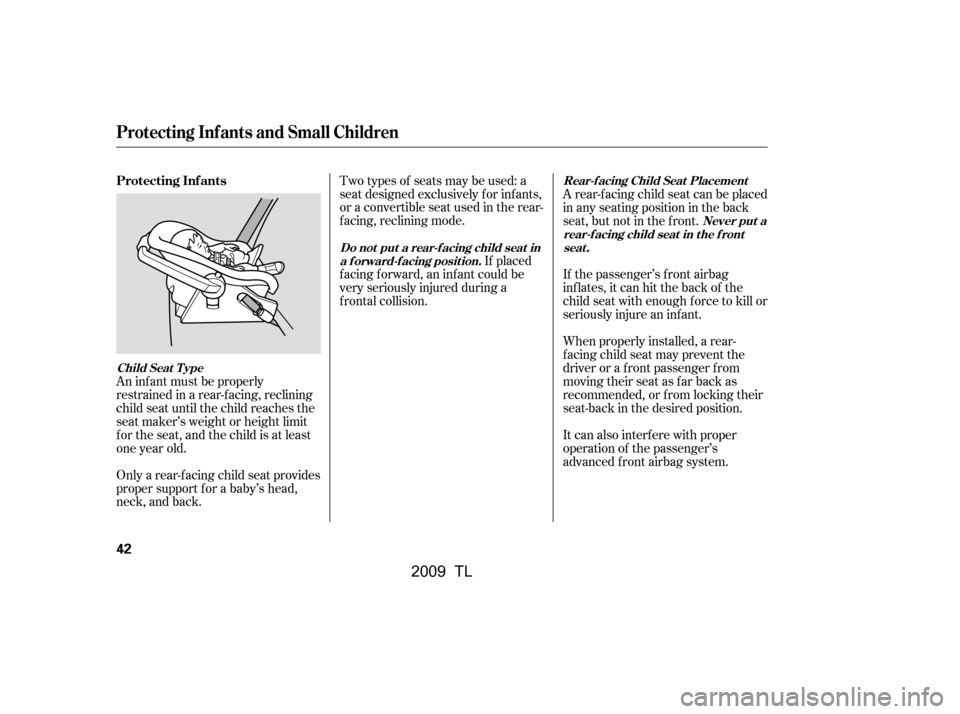
An inf ant must be properly
restrained in a rear-f acing, reclining
child seat until the child reaches the
seat maker’s weight or height limit
f or the seat, and the child is at least
one year old.
Only a rear-f acing child seat provides
proper support f or a baby’s head,
neck, and back.Two types of seats may be used: a
seat designed exclusively f or inf ants,
or a convertible seat used in the rear-
f acing, reclining mode.
If placed
f acing f orward, an inf ant could be
very seriously injured during a
f rontal collision. A rear-f acing child seat can be placed
in any seating position in the back
seat, but not in the f ront.
If the passenger’s front airbag
inflates, it can hit the back of the
child seat with enough f orce to kill or
seriously injure an inf ant.
When properly installed, a rear-
f acing child seat may prevent the
driver or a f ront passenger f rom
moving their seat as far back as
recommended, or f rom locking their
seat-back in the desired position.
It can also interf ere with proper
operation of the passenger’s
advanced front airbag system.
Protecting Inf ants
Child Seat T ype
Do not put a rear-f acing child seat in
a f orward-f acing position. Never put a
rear-f acing child seat in t he f ront seat .
Rear-f acing Child Seat Placement
Protecting Inf ants and Small Children
42
�\f���—�\f���—�����y�
�������������y���
�)� �����\f�\f�y�\f�\f�����y
2009 TL