light Acura TLX 2017 Owner's Manual
[x] Cancel search | Manufacturer: ACURA, Model Year: 2017, Model line: TLX, Model: Acura TLX 2017Pages: 75, PDF Size: 10.99 MB
Page 55 of 75

102 || 103
HANDLING THE UNEXPECTED
HANDLING THE UNEXPECTED
Emergency Engine Stop
The ENGINE START/STOP button may be used to stop the engine due to an
emergency situation even while driving. If you must stop the engine, choose one of
the following operations:
•
Pr
ess and hold the ENGINE START/STOP button for
two seconds, or
•
Firml
y press the ENGINE START/STOP button two
times.
The steering wheel will not lock. The power mode changes to ACCESSORY, unless
the shift lever is in Park, in which case the power mode changes to VEHICLE OFF.
Because turning off the engine also disables the power assist the engine provides to
the steering and braking systems, it will require significantly more physical effort
and time to steer and slow the vehicle. Downshift gears and use both feet on the
brake pedal, if necessary, to slow the vehicle and stop immediately in a safe place.
Do not press the button while driving unless it is absolutely necessary for the
engine to be switched off.
Emergency Towing
Call a professional towing service if you need to tow your vehicle.
All models
Flat bed equipment: The operator loads your vehicle on the back of a truck. This is
the best way to transport your vehicle.
2WD models
Wheel lift equipment: The tow truck uses two pivoting arms that go under the front
tires and lift them off the ground. The rear tires remain on the ground. This is an
acceptable way to tow your vehicle.
NOTICE
Trying to lift or tow your vehicle by the bumpers will cause serious damage. The
bumpers are not designed to support the vehicle’s weight.
Improper towing such as towing behind a motorhome or other motor vehicle can
damage the transmission.
NOTICE
Overheating
Signs your engine is overheating: •
The
temperature gauge needle is at the H mark
•
The engine suddenl
y loses power
•
Steam
or spray comes out from under the hood
•
The message
Engine Temperature Too Hot appears on the display.
1.
Immediatel
y park the vehicle in a safe place. Turn
off all accessories and turn on the hazard warning
lights.
2.
If no steam
or spray is present: Keep the
engine running and open the hood (see page
118).
If steam or spray is present: Turn off the engine
and wait until it subsides. Then, open the hood
(see page 118).
3.
Check that the
cooling fan is operating and stop the engine once the
temperature gauge needle goes down. If the cooling fan is not operating,
immediately stop the engine.
4.
Once
the engine has cooled down, inspect the coolant level and check the
cooling system components for leaks. If the coolant level in the reserve tank
is low, add coolant until it reaches the MAX mark. If there is no coolant in the
reserve tank, make sure the radiator is cool, then cover the radiator cap with a
heavy cloth and open the cap. If necessary, add coolant up to the base of the
filler neck, and put the cap back on.
Once the engine has cooled sufficiently, restart it and check the temperature
gauge. If the temperature needle has gone down, resume driving. If it has not gone
down, contact a dealer for repairs.
Reserve tank MAX
MIN
Steam and spray from an overheated engine can seriously scald you.
Do not open the hood if steam is coming out.
WARNING
Removing the radiator cap while the engine is hot can cause the coolant to
spray out, seriously scalding you.
Always let the engine and radiator cool down before removing the radiator
cap.
WARNING
Continuing to drive with the temperature gauge needle at the H mark may
damage the engine.
NOTICE
Page 56 of 75
104 || 105
HANDLING THE UNEXPECTED
HANDLING THE UNEXPECTED
Tire Pressure Monitoring System (TPMS) — Required Federal
Explanation
Each tire, including the spare (if provided), should be checked monthly
when cold and inflated to the inflation pressure recommended by the
vehicle manufacturer on the vehicle placard or tire inflation pressure
label.
(If your vehicle has tires of a different size than the size indicated on the
vehicle placard or tire inflation pressure label, you should determine the
proper tire inflation pressure for those tires.)
As an added safety feature, your vehicle has been equipped
with a tire pressure monitoring system (TPMS) that
illuminates a low tire pressure telltale when one or more of
your tires is significantly under-inflated.
Accordingly, when the low tire pressure telltale illuminates, you should
stop and check your tires as soon as possible, and inflate them to the
proper pressure.
Driving on a significantly under-inflated tire causes the tire to overheat
and can lead to tire failure. Under-inflation also reduces fuel efficiency
and tire tread life, and may affect the vehicle’s handling and stopping
ability.
Please note that the TPMS is not a substitute for proper tire
maintenance, and it is the driver’s responsibility to maintain correct
tire pressure, even if under-inflation has not reached the level to trigger
illumination of the TPMS low tire pressure telltale.
Your vehicle has also been equipped with a TPMS malfunction indicator
to indicate when the system is not operating properly. The TPMS
malfunction indicator is combined with the low tire pressure telltale.
When the system detects a malfunction, the telltale will flash for
approximately one minute and then remain continuously illuminated.
This sequence will continue upon subsequent vehicle start-ups as long as
the malfunction exists.
When the malfunction indicator is illuminated, the system may not be
able to detect or signal low tire pressure as intended.
TPMS malfunctions may occur for a variety of reasons, including the
installation of replacement or alternate tires or wheels on the vehicle
that prevent the TPMS from functioning properly.
Always check the TPMS malfunction telltale after replacing one or
more tires or wheels on your vehicle to ensure that the replacement
or alternate tires and wheels allow the TPMS to continue to function
properly.Tire Pressure Monitoring System (TPMS)
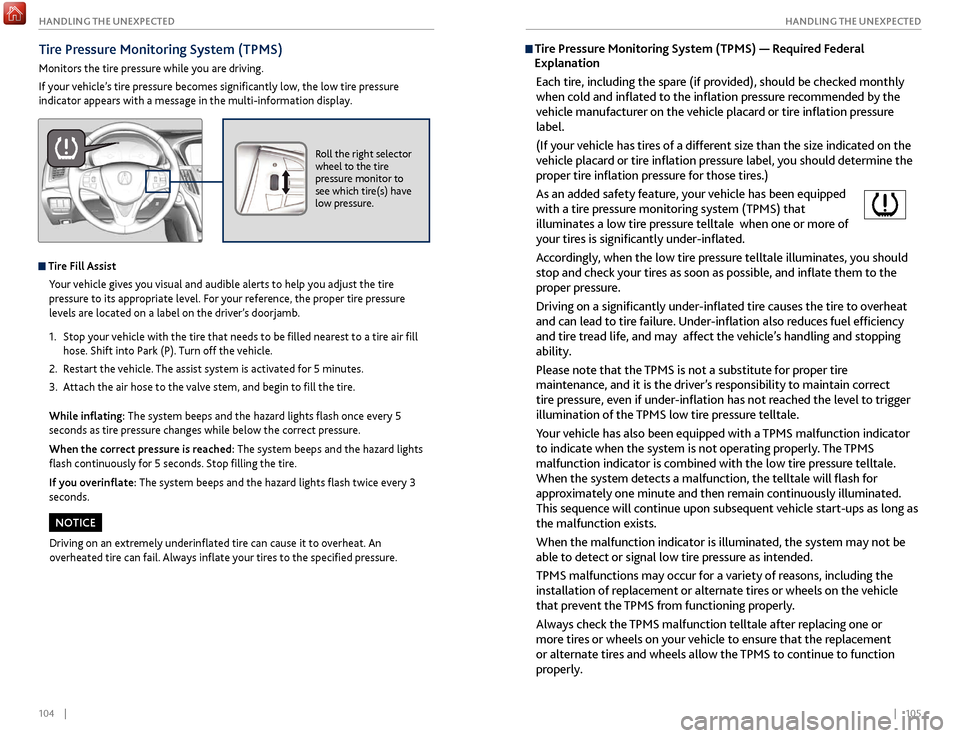
Monitors the tire pressure while you are driving.
If your vehicle’s tire pressure becomes significantly low, the low tire pressure
indicator appears with a message in the multi-information display.
Roll the right selector
wheel to the tire
pressure monitor to
see which tire(s) have
low pressure.
Tire Fill Assist
Your vehicle gives you visual and audible alerts to help you adjust the tire
pressure to its appropriate level. For your reference, the proper tire pressure
levels are located on a label on the driver’s doorjamb.
1.
Stop y
our vehicle with the tire that needs to be filled nearest to a tire air fill
hose. Shift into Park (P). Turn off the vehicle.
2.
R
estart the vehicle. The assist system is activated for 5 minutes.
3.
A
ttach the air hose to the valve stem, and begin to fill the tire.
While inflating: The system beeps and the hazard lights flash once every 5
seconds as tire pressure changes while below the correct pressure.
When the correct pressure is reached: The system beeps and the hazard lights
flash continuously for 5 seconds. Stop filling the tire.
If you overinflate: The system beeps and the hazard lights flash twice every 3
seconds.
Driving on an extremely underinflated tire can cause it to overheat. An
overheated tire can fail. Always inflate your tires to the specified pressure.
NOTICE
Page 57 of 75
106 || 107
HANDLING THE UNEXPECTED
HANDLING THE UNEXPECTED
Handling a Flat Tire
If a tire goes flat while driving, grasp the steering wheel firmly and brake gradually
to reduce speed. Stop in a safe place. After repairing or changing the flat as
appropriate, go to a dealer as soon as possible to have the damaged tire repaired or
replaced.
Tire Repair Kit*
If a tire has a small puncture, you can use the tire repair kit to temporarily repair it.
The puncture must be smaller than 3/16-inch (4 mm) and not in the tire sidewall.
Go to a dealer to have the full-size tire permanently repaired or replaced.
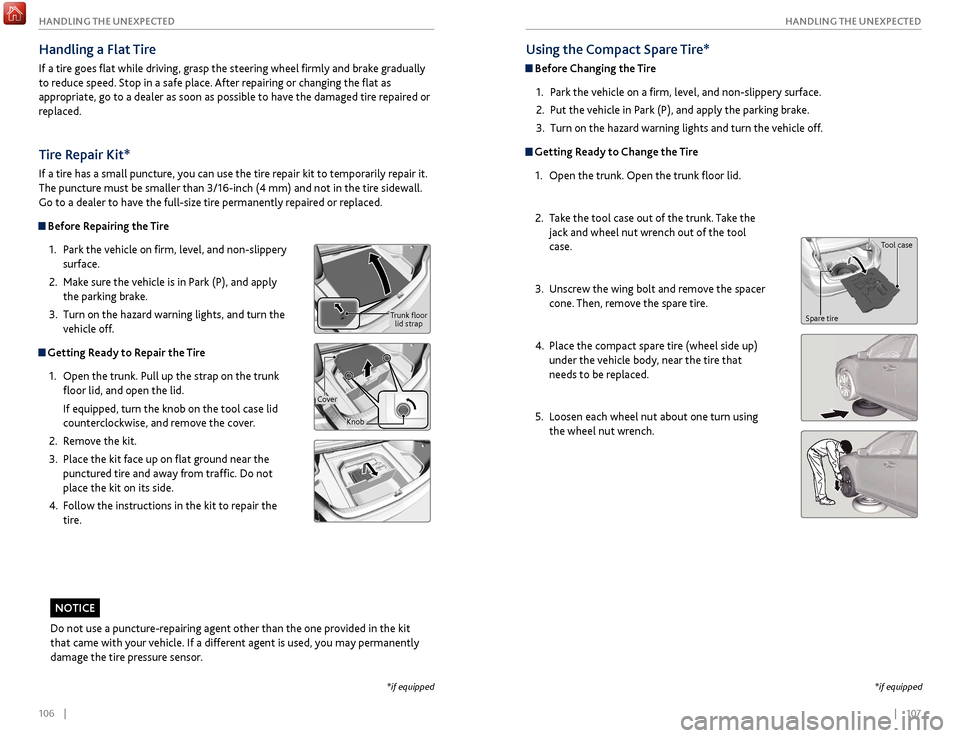
Before Repairing the Tire
1.
P
ark the vehicle on firm, level, and non-slippery
surface.
2.
Mak
e sure the vehicle is in Park (P), and apply
the parking brake.
3.
Turn on the
hazard warning lights, and turn the
vehicle off.
Getting Ready to Repair the Tire
1.
Open the trunk.
Pull up the strap on the trunk
floor lid, and open the lid.
If equipped, turn the knob on the tool case lid
counterclockwise, and remove the cover.
2.
R
emove the kit.
3.
Place
the kit face up on flat ground near the
punctured tire and away from traffic. Do not
place the kit on its side.
4.
F
ollow the instructions in the kit to repair the
tire.
Using the Compact Spare Tire*
Before Changing the Tire
1.
P
ark the vehicle on a firm, level, and non-slippery surface.
2.
Put
the vehicle in Park (P), and apply the parking brake.
3.
Turn on the
hazard warning lights and turn the vehicle off.
Getting Ready to Change the Tire1.
Open the trunk.
Open the trunk floor lid.
2.
T
ake the tool case out of the trunk. Take the
jack and wheel nut wrench out of the tool
case.
3.
Unscr
ew the wing bolt and remove the spacer
cone. Then, remove the spare tire.
4.
Place
the compact spare tire (wheel side up)
under the vehicle body, near the tire that
needs to be replaced.
5.
Loosen each
wheel nut about one turn using
the wheel nut wrench.
*if equipped
Tool case
Spare tire
*if equipped
Do not use a puncture-repairing agent other than the one provided in the kit
that came with your vehicle. If a different agent is used, you may permanently
damage the tire pressure sensor.
NOTICE
Trunk floor lid strap
Cover Knob
Page 58 of 75

108 || 109
HANDLING THE UNEXPECTED
HANDLING THE UNEXPECTED
Replacing the Flat Tire
1.
R
emove the wheel nuts and flat tire.
2.
Mount the
compact spare tire. Replace the
wheel nuts, and lightly tighten them.
3.
Lower
the vehicle and remove the jack. Tighten
the wheel nuts in the order indicated in the
image. Go around, tightening the nuts, two to
three times in this order. Do not over tighten the
wheel nuts.
Storing the Flat Tire
1.
R
emove the center cap, and place the flat tire
face down in the spare tire well.
2.
R
emove the spacer cone from the wing bolt, flip
it over, and insert it back on to the bolt. Secure
the flat tire with the wing bolt.
3.
R
eturn the jack and wheel nut wrench to the
tool case. Store the case in the trunk, and close
the trunk.
Loose items can fly around the interior in a crash and can seriously injure the
occupants.
Store the wheel, jack, and tools securely before driving.
WARNING
Wing bolt
Spacer cone
Center cap
Setting Up the Jack
1.
Place
the jack under the jacking point closest to
the tire to be changed.
2.
Turn
the end bracket clockwise (as shown in
the image) until the top of the jack contacts
the jacking point. Make sure that the jacking
point tab is resting in the jack notch. Do not
overextend the jack.
3.
Raise
the vehicle, using the jack handle bar and
the jack handle, until the tire is off the ground.
The following instructions must be followed to use the jack safely:
•
Do not use
the jack with people or luggage in the vehicle.
•
Use
the jack provided in your vehicle. Other jacks may not support the weight
(“load”) or fit the jacking point.
•
Do not use
while the engine is running.
•
Use
only where the ground is firm and level.
•
Use
only at the jacking points.
•
Do not get in
the vehicle while using the jack.
•
Do
not put anything on top of or underneath the jack.
The vehicle can easily roll off the jack, seriously injuring anyone underneath.
Follow the directions for changing a tire exactly, and never get under the
vehicle when it is supported only by the jack.
WARNING
Do not use the jack if it doesn’t work properly. Call your dealer or a professional
towing service.
NOTICE
Jack
handle bar
Wheel nut wrench
as jack handle
Jacking points
Page 59 of 75
110 || 111
HANDLING THE UNEXPECTED
HANDLING THE UNEXPECTED
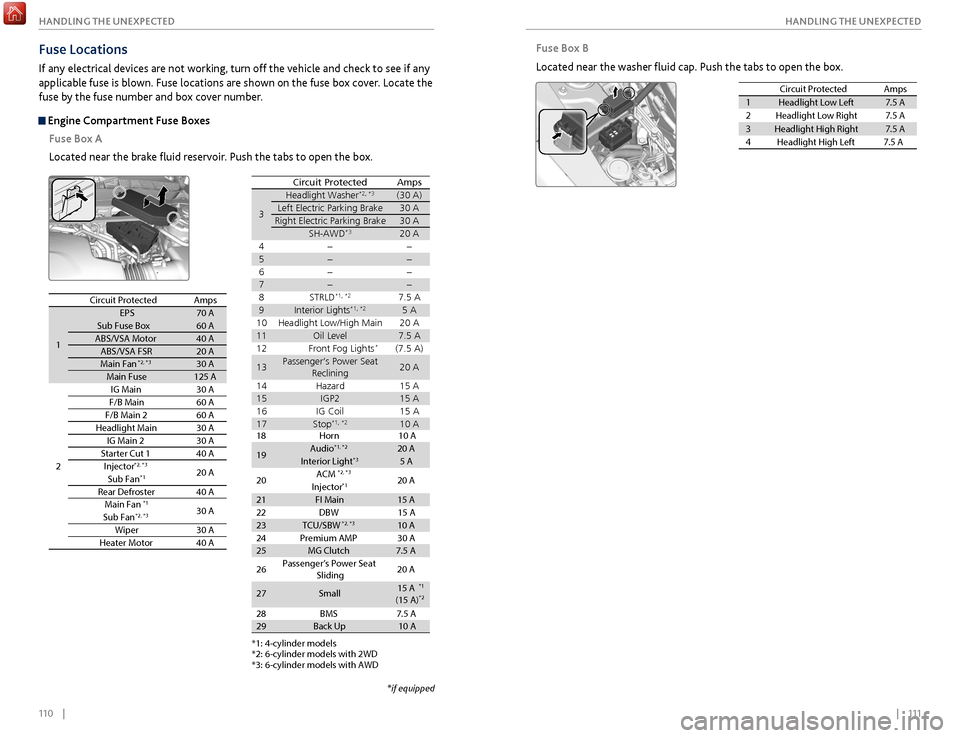
Fuse Box B
Located near the washer fluid cap. Push the tabs to open the box.
Circuit Protecte dAmps
1Headlight Low Left7.5 A
2Headlight Low Right7.5 A
3Headlight High Right7.5 A
4H eadlight High Left 7.5 A
Fuse Locations
If any electrical devices are not working, turn off the vehicle and check to see if any
applicable fuse is blown. Fuse locations are shown on the fuse box cover. Locate the
fuse by the fuse number and box cover number.
Engine Compartment Fuse Boxes
Fuse Box A
Located near the brake fluid reservoir. Push the tabs to open the box.
Circuit ProtectedAmps
1
EPS70 ASub Fuse Bo x60 AABS/VSA Motor40 AABS/VSA FSR20 AMain Fa n*2, *330 AMain Fuse125 A
2
IG Main30 AF/B Main60 AF/B Main 260 AHeadlight Main30 AIG Main 230 AStarter Cut 140 AInjector*2, *320 ASub Fan*1
Rear Defroster40 AMain Fan*130 ASub Fa n*2, *3
Wiper30 AHeater Motor40 A
*1: 4-cylinder model s
*2: 6-cylinder models with 2WD
*3: 6-cylinder models with AWD
3
Headlight Washer*2, *3(30 A)Left Electric Parking Brake30 ARight Electric Parking Brake30 ASH-AWD*3
4 5
6
7
8S TRLD*1, *27.5 A9Interior Lights*1, *25 A
10 Headlight Low/High Main 20 A
11Oil Level7.5 A
12 Front Fog Lights*(7.5 A)
13Passenger’s Power Seat
Reclinin g20 A
14 Hazard 15 A
15IGP215 A
16 IG Coil 15 A
17Stop*1, *210 A
Circuit ProtectedAmps
20 A
*if equipped
*1: 4-cylinder model s*2: 6-cylinder models with 2W D*3: 6-cylinder models with AW D
Circuit ProtectedAmps
18 Horn 10 A
19Audi o*1, *220 AInterior Light*35 A
20 ACM
20 A
Injecto r
*1
21FI Main15 A
22 DBW15 A23TCU/SBW*2, *310 A
24 Premium AMP 30 A
25MG Clutch7.5 A
26 Passenger’s Power Seat
Sliding 20
A
27Small15 A
28 BMS 7.5 A
29Back Up10 A
*2, *3
(15 A)
*1
*2
Page 60 of 75
112 || 113
HANDLING THE UNEXPECTED
HANDLING THE UNEXPECTED
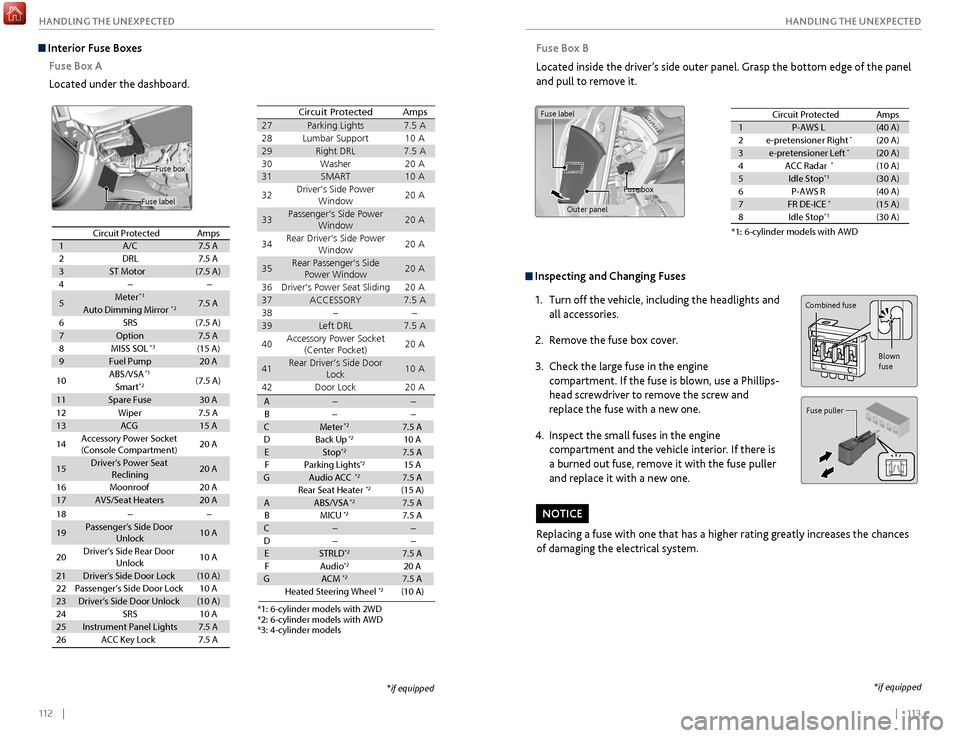
Inspecting and Changing Fuses
1.
Turn off the
vehicle, including the headlights and
all accessories.
2.
R
emove the fuse box cover.
3.
Check
the large fuse in the engine
compartment. If the fuse is blown, use a Phillips-
head screwdriver to remove the screw and
replace the fuse with a new one.
4.
Inspect
the small fuses in the engine
compartment and the vehicle interior. If there is
a burned out fuse, remove it with the fuse puller
and replace it with a new one.
Replacing a fuse with one that has a higher rating greatly increases the chances
of damaging the electrical system.
NOTICE
Combined fuse
Blown
fuse
Fuse puller
Fuse Box B
Located inside the driver’s side outer panel. Grasp the bottom edge of the panel
and pull to remove it.
Circuit protected and fuse rating
Circuit ProtectedAmps1P-AWS L(40 A)2e-pretensioner Right*(20 A)3e-pretensioner Left*(20 A)4ACC Radar*(10 A)5Idle Stop*1(30 A)6P-AWS R(40 A)7FR DE-ICE*(15 A)8Idle Stop*1(30 A)
*1: 6-cylinder models with AW D
Fuse label
Fuse box
Outer panel
*if equipped
Interior Fuse Boxes Fuse Box A
Located under the dashboard.
Fuse label
Fuse box
Circuit ProtectedAmps1A/C7.5 A2DRL7.5 A3ST Motor(7.5 A)4
5Meter*17.5 AAuto Dimming Mirror*2
6SRS(7.5 A)
7Option7.5 A8MISS SOL(15 A)9Fuel Pump20 A
10ABS/VSA*1(7.5 A)Smart*2
11Spare Fuse30 A
18
19Passenger’s Side Door
Unlock10 A
20Driver’s Side Rear Door
Unlock10 A
21Driver’s Side Door Lock(10 A)22Passenger’s Side Door Lock10 A23Driver’s Side Door Unlock(10 A)24SRS10 A25Instrument Panel Lights7.5 A26ACC Key Lock7.5 A
12Wiper7.5 A13ACG15 A
14Accessory Power Socket
(Console Compartment)20 A
15Driver’s Power Seat
Reclinin g20 A
16Moonroo f20 A17AVS/Seat Heaters20 A
*3
Circuit ProtectedAmps
27Parking Light s7.5 A28Lumbar Support10 A29Right DR L7.5 A30Washer20 A31SMART10 A
32Driver’s Side Power
Window20 A
33Passenger’s Side Power
Window20 A
34Rear Driver’s Side Power
Window20 A
35Rear Passenger’s Side
Power Window20 A
36Driver’s Power Seat Sliding20 A37ACCESSORY7.5 A3839Left DRL7.5 A
40Accessory Power Socket
(Center Pocket)20 A
41Rear Driver’s Side Door
Lock10 A
42Door Loc k20 A
AB CMeter*27.5 A
DB ack Up*210 AEStop*27.5 A
FP arking Lights*215 AGAudio ACC*27.5 A
Rear Seat Heater*2(15 A)AABS/VSA*27.5 A
BM ICU*27.5 AC
D
ESTRLD*27.5 A
FA udio*220 AGACM*27.5 A
Heated Steering Wheel*2(10 A)
*3: 4 -cylinder model s
*1: 6-cylinder models with 2W D*2: 6-cylinder models with AW D
*if equipped
Page 69 of 75
130 || 131
S PECIFICATIONS
MAINTENANCE
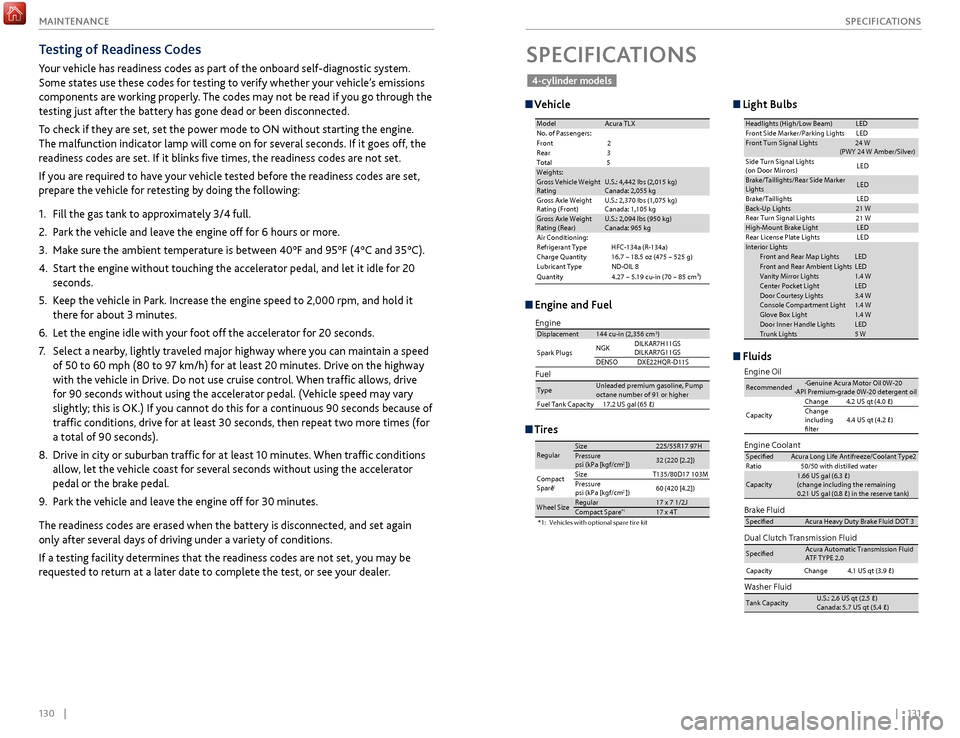
Vehicle
Engine and Fuel
Light Bulbs
Fluids
SPECIFICATIONS
Tires
ModelAcura TLX
No. of Passengers:
Front 2
Rear 3
Tota l5
Weights :Gross Vehicle Weight
Rating U.S.: 4,442 lbs (2,015 kg )
Canada: 2,055 kg
Gross Axle Weight
Rating (Front)U.S.: 2,370 lbs (1,075 kg )
Canada: 1,105 kg
Gross Axle Weight
Rating (Rear )U.S.: 2,094 lbs (950 kg )
Canada: 965 kg
Air Conditioning:
Refrigerant Type HFC-134a (R-134a)
Charge Quantity 16.7 – 18.5 oz (475 – 525 g)
Lubricant Type ND-OIL 8
Quantity 4.27 – 5.19 cu-in (70 – 85 cm)
Headlights (High/Low Beam )LED
Front Side Marker/Parking Lights LED
Front Turn Signal Lights 24 W
(PWY 24 W Amber/Silver)
Side Turn Signal Lights
(on Door Mirrors) LE
D
Brake/Taillights/Rear Side Marker
Lights LE
D
Brake/Taillights
Back-Up Lights21 W
Rear Turn Signal Lights
High-M ount Brake Ligh tLED
Rear License Plate Lights
In terior Light sFront and Rear Map LightsLEDFront and Rear Ambient Light sLEDVanity Mirror Lights1.4 WCenter Pocket LightLEDDoor Courtesy Lights3.4 WConsole Compartment Ligh t1.4 WGlove Box Ligh t1.4 WDoor Inner Handle LightsLEDTrunk Lights5 W
LE D
LE D
21
W
Brake Fluid
Dual Clutch Transmission Fluid
SpecifedAcura Heavy Duty B\krake \fluid DOT \b
SpecifedAcura Automatic Tra\knsmission \fluid
AT\f TYPE 2.0
Engine Oi l
Engine Coolan
t
Recommended·Genuine Acura Mot\kor Oil 0W-2 0
·API Premium-grade\k 0W-20 detergent oi\k l
Capacity Change 4.2 US qt (4.0 )
Change
including
flter
4.4 US qt (4.2
)
SpecifedAcura Long Life An\ktifreeze/Coolant Ty\kpe2
Ratio 50/50 with distill\ked water
Capacity \k Change \k 4.1 US\k qt (\b.9 )
Capacity
1.66 US gal (6.\b )\k
(change including \kthe remaining
0.21 US gal (0.8 )\k in the reserve ta\knk)
Washer Fluid
Tank Capacit yU.S.: 2.6 US qt (2.5\k )
Canada: 5.7 US qt \k(5.4 )
Fuel
Displacement144 cu-in (2,356 cm3)
Spark Plugs NG
K DILKAR7H11GS
DILKAR7G11GS
DENSO DXE22HQR-D11 S
TypeUnleaded premium gasoline, Pump
octane number of 91 or higher
Fuel Tank Capacity 17.2 US gal (65 )
Engine
*1: Vehicles with optional spare tire kit
RegularSize225/55R 17 97HPressure
psi (kPa [kgf/cm2])32 (220 [2.2])
Compact
Spar e*1SizeT135/80D17 103M
Pressure
psi (kPa [kgf/cm
2]) 60
(420 [4.2])
Wheel SizeRegular17 x 7 1/2 JCompact Spar e*117 x 4T
4-cylinder models
Testing of Readiness Codes
Your vehicle has readiness codes as part of the onboard self-diagnostic system.
Some states use these codes for testing to verify whether your vehicle’s emissions
components are working properly. The codes may not be read if you go through the
testing just after the battery has gone dead or been disconnected.
To check if they are set, set the power mode to ON without starting the engine.
The malfunction indicator lamp will come on for several seconds. If it goes off, the
readiness codes are set. If it blinks five times, the readiness codes are not set.
If you are required to have your vehicle tested before the readiness codes are set,
prepare the vehicle for retesting by doing the following:
1.
Fill the
gas tank to approximately 3/4 full.
2.
P
ark the vehicle and leave the engine off for 6 hours or more.
3.
Mak
e sure the ambient temperature is between 40°F and 95°F (4°C and 35°C).
4.
Start
the engine without touching the accelerator pedal, and let it idle for 20
seconds.
5.
K
eep the vehicle in Park. Increase the engine speed to 2,000 rpm, and hold it
there for about 3 minutes.
6.
Let
the engine idle with your foot off the accelerator for 20 seconds.
7.
Select a nearb
y, lightly traveled major highway where you can maintain a speed
of 50 to 60 mph (80 to 97 km/h) for at least 20 minutes. Drive on the highway
with the vehicle in Drive. Do not use cruise control. When traffic allows, drive
for 90 seconds without using the accelerator pedal. (Vehicle speed may vary
slightly; this is OK.) If you cannot do this for a continuous 90 seconds because of
traffic conditions, drive for at least 30 seconds, then repeat two more times (for
a total of 90 seconds).
8.
Driv
e in city or suburban traffic for at least 10 minutes. When traffic conditions
allow, let the vehicle coast for several seconds without using the accelerator
pedal or the brake pedal.
9.
P
ark the vehicle and leave the engine off for 30 minutes.
The readiness codes are erased when the battery is disconnected, and set again
only after several days of driving under a variety of conditions.
If a testing facility determines that the readiness codes are not set, you may be
requested to return at a later date to complete the test, or see your dealer.
Page 70 of 75
132 || 133
C LIENT I NFORMATION
S
PECIFICATIONS
CLIENT INFORMATION
*if equipped
Learn about information specific to you as an Acura client and how to get help.
Frequently Asked Questions/Troubleshooting
Below are some frequently asked questions and troubleshooting items that you
may have about the vehicle.
Q: How do I set the vehicle clock?
A:
For vehicles without navigation, see page 40. For vehicles with navigation, the
time is automatically set using GPS signals.
Q: Why doesn’t the vehicle start when I press the ENGINE START/STOP button?
A: The brake pedal must be pressed to start the engine.
Q: What is the AUTO setting on my headlight lever?
A: When in the AUTO position, the vehicle’s exterior lights will automatically turn
on or off depending on the ambient lighting.
Q: Why won’t the driver’s door unlock when I grab the door handle, even though the
keyless access remote is within range?
A: If you pull the handle too quickly, the system may not have time to confirm the
door is unlocked. Wait to hear a beep to confirm the door is unlocked. If you are
wearing gloves, the system may be slow to respond.
Q: After my battery was disconnected or went dead, the audio system is asking for a
code. Where do I find this?
A: In most cases, you do not need to enter a code. Turn on the vehicle and the audio
system, and press and hold the power button until the system reactivates.
Q: Why can’t I select an item using the interface dial?*
A: To prevent driver distraction, certain items are limited or inoperable while the
vehicle is moving. Use voice commands or pull over to select the items.
Q: Where can I find the vehicle identification number (VIN)?
A: Check the label on the driver’s doorjamb.
Q: Why can’t I operate Pandora through the audio system?
A: Audio may be streaming through Bluetooth® Audio. Make sure Pandora mode
is selected and the phone cable is properly connected to the USB adapter. Some
phones may prompt you to “Allow” a connection.
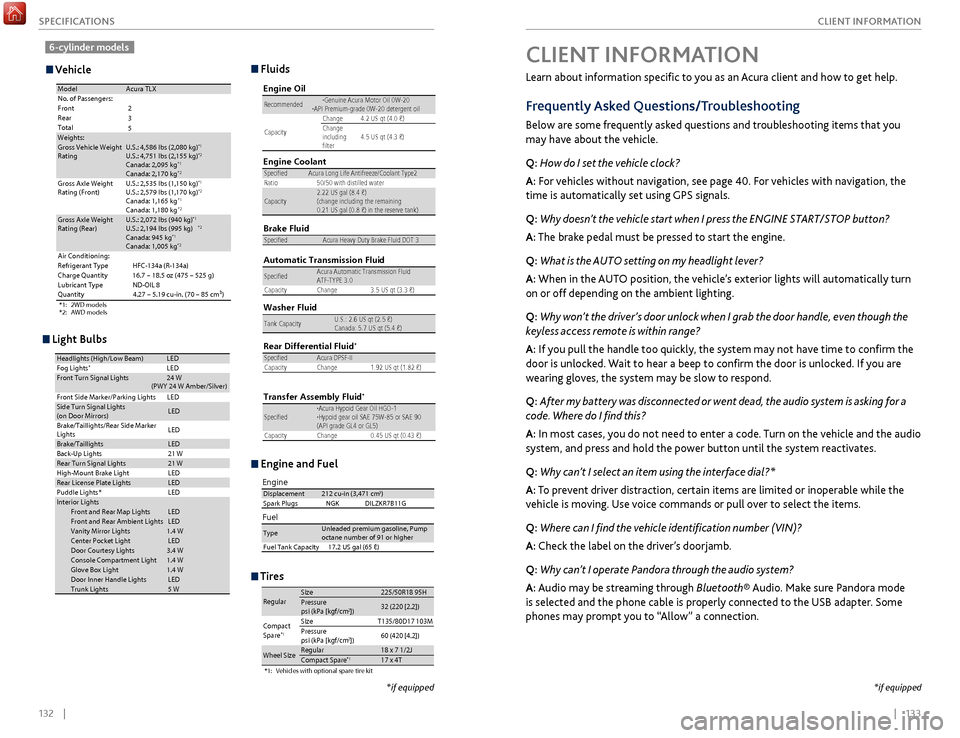
Vehicle
Engine and Fuel
Light Bulbs
Fluids
Tires
*1: 2WD models
*2: AWD models
ModelAcura TL XNo. of Passengers:
Front
Rear
Total
Weights:Gross Vehicle Weight
Rating U.S.: 4,586 lbs (2,080 kg)*1U.S.: 4,751 lbs (2,155 kg)*2Canada: 2,095 kg*1Canada: 2,170 kg*2Gross Axle Weight
Rating (Front)U.S.: 2,535 lbs (1,150 kg)*1U.S.: 2,579 lbs (1,170 kg)*2Canada: 1,165 kg*1Canada: 1,180 kg*2Gross Axle Weight
Rating (Rear)U.S.: 2,072 lbs (940 kg)*1U.S.: 2,194 lbs (995 kg)*2Canada: 945 kg*1Canada: 1,005 kg*2Air Conditioning:
Refrigerant Type HFC-134a (R-134a)
Charge Quantity 16.7 – 18.5 oz (475 – 525 g)
Lubricant Type ND-OIL 8
2
3
5
Quantity 4.27 – 5.19 cu-in. (70 – 85 cm ³)
Headlights (High/Low Beam )LEDFog Lights*LEDFront Turn Signal Lights
Front Side Marker/Parking Lights LEDSide Turn Signal Lights
(on Door Mirrors)LE D
Brake/Taillights/Rear Side Marker
Lights LE
D
Brake/TaillightsLED
Back-Up Lights
Rear Turn Signal Lights21 W
High-M ount Brake Ligh t
Rear License Plate LightsLED
Puddle Lights * LED
In terior Light s
Front and Rear Map Lights LED
Front and Rear Ambient Lights LED
Vanity Mirror Lights 1.4 W
Center Pocket Light LED
Door Courtesy Light s3.4 W
Console Compartment Light 1.4 W
Glove Box Ligh t1 .4 W
Door Inner Handle Lights LED
Trunk Lights 5 W
21 W
LE D
24
W
(PWY 24 W Amber/Silver)
Brake Flui d
Automatic Transmission Flui dSpecifedAcura Heavy Duty B\krake \fluid DOT \b
SpecifedAcura Automatic Tra\knsmission \flui d
AT\f-TYPE \b.0
Capacity Change \b.5 US qt (\b.\b )
Engine Oi l
Engine Coolan t
Recommended·Genuine Acura Mot\kor Oil 0W-2 0
·API Premium-grade\k 0W-20 detergent o\kil
Capacity Change 4.2 US qt (4.0 )
Change
including
flter 4.5 US qt (4.\b )
SpecifedAcura Long Life An\ktifreeze/Coolant Ty\kpe
2
Ratio 50/50 with distill\ked water
Capacity2.22 US gal (8.4 \k)
(change including \kthe remaining
0.21 US gal (0.8 \k) in the reserve t\kank)
Washer Flui d
Tank CapacityU.S.: 2.6 US qt (2\k.5 )
Canada: 5.7 US qt \k(5.4 )
Rear Differential Flui d*
Transfer Assembly Flui d*
SpecifedAcura DPS\f-II
Capacity Change 1.92 US qt (1.82 \k)
Specife d·Acura Hypoid Gear\k Oil HGO-1
·Hypoid gear oil S\kAE 75W-85 or SAE 9 0
(API grade GL4 or \kGL5)
Capacity Change 0.45 US qt (0.4\b )
Engine
FuelDisplacement212 cu-in (3,471 cm3)
Spark Plugs NGKD ILZKR7B11G
TypeUnleaded premium gasoline, Pump
octane number of 91 or higher
Fuel Tank Capacity 17.2 US gal (65 )
*1: Vehicles with optional spare tire kit
RegularSize225/50R 18 95HPressure
psi (kPa [kgf/cm2])32 (220 [2.2])
Compact
Spar e*1SizeT135/80D17 103M
Pressure
psi (kPa [kgf/cm
2]) 60
(420 [4.2])
Wheel SizeRegular18 x 7 1/2 JCompact Spar e*117 x 4T
*if equipped
6-cylinder models
Page 71 of 75

134 || 135
C LIENT I NFORMATION
C
LIENT I NFORMATION
Acura Total Luxury Care
Roadside Assistance
Your Acura TLC Roadside Assistance representative is here to help you 24 hours a
day, 7 days a week by calling (800) 594-8500 (U.S.) or (800) 565-7587 (Canada).
Under your 4-year/50,000-mile (80,000-km) warranty, the following benefits are
available:
•
T
owing services — full cost of towing to the closest Acura dealer
•
R
oadside assistance — jump starting, fuel delivery, lockout, and flat tire
•
T
rip planning — detailed trip routing, emergency services, and more
Warranty Coverages
Below is a brief summary of the warranties covering your new vehicle.
New Vehicle Limited Warranty: Covers your new vehicle, except for the emissions
control system and accessories, against defects in materials and workmanship.
Emissions Control Systems Defects Warranty and Emissions Performance
Warranty: Covers your vehicle’s emissions control systems. Time, mileage, and
coverage are conditional.
Seat Belt Limited Warranty: Covers seat belts that fail to function properly.
Rust Perforation Limited Warranty: Covers all exterior body panels that rust
through from the inside.
Accessory Limited Warranty: Covers Acura accessories.
Replacement Parts Limited Warranty: Covers all Acura replacement parts against
defects in materials and workmanship.
Replacement Battery Limited Warranty: Provides prorated coverage for a
replacement battery purchased from an Acura dealer.
Replacement Muffler Lifetime Limited Warranty: Covers a replacement muffler
for the duration of the ownership.
Restrictions and exclusions apply to all these warranties. See the Owner
Information CD or visit owners.acura.com (U.S.) or www.myacura.ca (Canada)
for complete descriptions of each warranty, including time, mileage, and other
conditional limitations.
Your vehicle’s original tires are covered by their manufacturer. Tire warranty
information can be found on the Owner Information CD or owners.acura.com (U.S.)
or www.myacura.ca (Canada).
Q: Is my phone compatible with Bluetooth features?
A:
Visit www.acura.com/handsfreelink (U.S) or www.handsfreelink.ca (Canada) to
check phone compatibility for Bluetooth® Audio, Bluetooth® HandsFreeLink®, and
SMS text messaging.
Q: Every time I press the Talk button, the system gives me voice prompts. Can I turn
these off?*
A: Press the SETTINGS button. Use the interface dial to select System Settings then
Voice Prompt. Select Off.Contact Us
Acura dealer personnel are trained professionals. They should be able to answer
all your questions. If you encounter a problem that your dealership does not solve
to your satisfaction, please discuss it with the dealership’s service manager or
general manager. If you are dissatisfied with the decision made by the dealership’s
management, contact Acura Client Relations/Services.
U.S. owners
American Honda Motor Co., Inc.
Acura Client Relations
1919 Torrance Blvd.
Mail Stop 500-2N-7E
Torrance, CA 90501-2746
Tel: (800) 382-2238
In Puerto Rico and
the U.S. Virgin Islands
Bella International
P.O. Box 190816
San Juan, PR 00919-0816
Tel: (787) 620-7546
When you call or write, please give us the following information:
• Vehicle Identification Number
• Date of purchase
• Odometer reading of your vehicle
• Your name, address, and telephone number
• A detailed description of the problem
• Name of the dealer who sold the vehicle to you Canadian owners
Honda Canada, Inc.
Acura Client Services
180 Honda Blvd.
Markham, ON
L6C 0H9
Tel: (888) 922-8729
Fax: (877) 939-0909
E-mail: [email protected]
*if equipped
EPA Contact Information
An owner may obtain further
information concerning emission
warranties or report violations of the
terms of the emission warranties by
contacting:
U.S. Environmental Protection Agency
Office of Transportation and Air Quality
Compliance Division,
Light-Duty Vehicles Group
Attn: Warranty Complaints
2000 Traverwood Drive
Ann Arbor, MI 48105
Email: [email protected]
Page 73 of 75
138 || 139
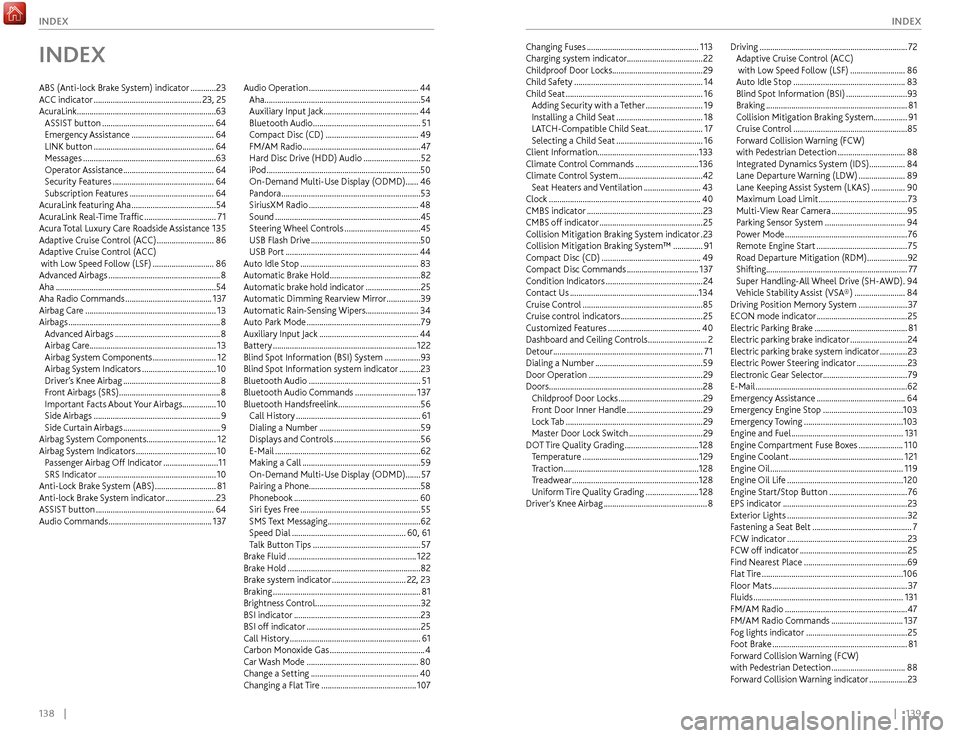
INDEX
INDEX
Changing Fuses ..................................................... 113
Char ging system indicator....................................22
Childproof Door Locks
........................................... 29
Child Safety
............................................................. 14
Child Seat
................................................................. 16
Adding Security with a Tether
...........................19
Installing a Child Seat
.........................................18
LATCH-Compatible Child Seat .......................... 17
Selecting a Child Seat
.........................................16
Client Information................................................133
Climate Control Commands
..............................136
Climate C
ontrol System
........................................42
Seat Heaters and
Ventilation
...........................43
Clock
........................................................................\
40
CMBS indicator
....................................................... 23
CMBS off indicator
................................................. 25
Collision Mitigation Braking System indicator
.23
Collision Mitigation Braking System™
..............91
Compact Disc (CD)
............................................... 49
Compact Disc Commands
..................................1
37
Condition Indicators
.............................................. 24
Contact Us
............................................................. 134
Cruise Control
......................................................... 85
Cruise control indicators
.......................................25
Customized Features
............................................ 40
Dashboard and Ceiling Controls
............................2
Detour
....................................................................... 71
Dialing a Number
................................................... 59
Door Operation
...................................................... 29
Doors........................................................................\
.28 Childproof Door Locks
........................................29
Front Door Inner Handle
....................................29
Lock Tab
................................................................. 29
Master Door Lock Switch
...................................29
DOT Tire Quality Grading
...................................128
T
emperature ....................................................... 129
Traction
................................................................ 128
Treadwear
............................................................ 128
Uniform Tire Quality Grading
.........................128
Driv
er’s Knee Airbag ................................................. 8Driving
......................................................................72
Adaptive Cruise Control (ACC)
with Low
Speed Follow (LSF)
..........................86
Auto
Idle Stop .....................................................83
Blind Spot Information (BSI)
.............................93
Braking
...................................................................81
Collision Mitigation Braking System................ 91
Cruise Control
......................................................85
Forward Collision Warning (FCW)
with Pedestrian Detection
................................88
Integrated Dynamics
System (IDS) .................84
Lane Departure Warning (LDW)
......................89
Lane Keeping Assist System (LKAS)
................90
Maximum Load Limit
..........................................73
Multi-View Rear Camera
....................................95
P
arking Sensor System
......................................94
P
ower Mode ..........................................................76
Remote Engine Start
...........................................75
R
oad Departure Mitigation (RDM) ...................92
Shifting................................................................... 77
Super Handling-All Wheel Drive (SH-AWD)
.94
Vehicle Stability Assist (VSA®)
........................84
Driving Position Memory System
.......................37
ECON mode indicator
...........................................25
Electric Parking Brake
............................................81
Electric parking brake indicator
...........................24
Electric parking brak
e system indicator .............23
Electric Power Steering indicator
........................23
Electr
onic Gear Selector........................................ 79
E-Mail
........................................................................\
62
Emergency Assistance
..........................................64
Emergency Engine Stop
......................................103
Emergency Towing
...............................................103
Engine and Fuel
.....................................................131
Engine Compartment Fuse Boxes
.....................110
Engine Coolant
......................................................121
Engine Oil
...............................................................119
Engine Oil Life
.......................................................120
Engine Start/Stop Button
.....................................76
EPS indicator
...........................................................23
Exterior Lights
.........................................................32
Fastening a Seat Belt
...............................................7
FCW indicator
.........................................................23
FCW off indicator
...................................................25
Find Nearest Place
.................................................69
Flat Tire
...................................................................106
Floor Mats
................................................................37
Fluids
.......................................................................131
FM/AM Radio
..........................................................47
FM/AM Radio Commands
..................................1
37
Fog lights indicator
................................................25
Foot Brake
................................................................81
Forward Collision Warning (FCW)
with Pedestrian Detection
...................................88
Forward Collision Warning indicator
..................23INDEX
ABS (Anti-lock Brake System) indicator ............23
A CC indicator ................................................... 23, 25
AcuraLink
.................................................................. 63
ASSIST button
..................................................... 64
Emergency Assistance
.......................................64
LINK button
......................................................... 64
Messages
............................................................... 63
Operator Assistance
........................................... 64
Security Features
................................................ 64
Subscription Features
........................................64
AcuraLink featuring Aha
........................................54
A
curaLink Real-Time Traffic ..................................71
Acura Total Luxury Care Roadside Assistance
135
A
daptive Cruise Control (ACC) ...........................86
Adaptive Cruise Control (ACC)
with Low
Speed Follow (LSF)
.............................86
A
dvanced Airbags ..................................................... 8
Aha
........................................................................\
.... 54
Aha Radio Commands
......................................... 137
Airbag Care
.............................................................. 13
Airbags
........................................................................\
8
Advanced Airbags
.................................................. 8
Airbag Care ............................................................ 13
Airbag System Components
..............................12
Airbag System Indicators
...................................10
Driver’s Knee Airbag
.............................................. 8
Front Airbags (SRS) ................................................ 8
Important Facts About Your Airbags
................10
Side Airbags
............................................................ 9
Side Curtain Airbags
.............................................. 9
Airbag System Components
.................................12
Airbag S
ystem Indicators ......................................10
Passenger Airbag Off Indicator
..........................11
SRS Indicator
........................................................ 10
Anti-Lock Brake System (ABS)
.............................81
Anti-lock Brak
e System indicator
........................23
ASSIST button
........................................................ 64
Audio Commands
................................................. 137Audio Operation
....................................................44
Aha
........................................................................\
.. 54
Auxiliary Input Jack ............................................. 44
Bluetooth Audio
................................................... 51
Compact Disc (CD)
............................................ 49
FM/AM Radio
........................................................ 47
Hard Disc Drive (HDD) Audio
........................... 52
iP
od
........................................................................\
. 50
On-Demand Multi-Use Display (ODMD)
...... 46
Pandora
.................................................................. 53
SiriusXM Radio
.................................................... 48
Sound
..................................................................... 45
Steering Wheel Controls
.................................... 45
USB Flash Driv
e
.................................................... 50
USB Port
............................................................... 44
Auto Idle Stop
........................................................ 83
Automatic Brake Hold
........................................... 82
Automatic brake hold indicator
.......................... 25
Automatic Dimming R
earview Mirror
................ 39
Automatic Rain-Sensing Wipers ......................... 34
Auto Park Mode
...................................................... 79
Auxiliary Input Jack
............................................... 44
Battery
.................................................................... 122
Blind Spot Information (BSI) System
................. 93
Blind Spot Information system indicator
.......... 23
Bluetooth Audio
..................................................... 51
Bluetooth Audio Commands
............................. 1
37
Bluetooth Handsfreelink
....................................... 56
Call History
........................................................... 61
Dialing a Number
................................................ 59
Displays and Controls
......................................... 56
E-Mail
..................................................................... 62
Making a Call
........................................................ 59
On-Demand Multi-Use Display (ODMD)
....... 57
Pairing a Phone.....................................................58
Phonebook
........................................................... 60
Siri Eyes Free
......................................................... 55
SMS Text Messaging
............................................ 62
Speed Dial
...................................................... 60, 61
Talk Button Tips
................................................... 57
Brake Fluid
............................................................. 122
Brake Hold
............................................................... 82
Brake system indicator
................................... 22, 23
Braking
...................................................................... 81
Brightness Control .................................................. 32
BSI indicator
............................................................ 23
BSI off indicator
...................................................... 25
Call History
.............................................................. 61
Carbon Monoxide Gas
............................................. 4
Car Wash Mode
..................................................... 80
Change a Setting
................................................... 40
Changing a Flat Tire
............................................. 107