brakes ACURA ZDX 2010 User Guide
[x] Cancel search | Manufacturer: ACURA, Model Year: 2010, Model line: ZDX, Model: ACURA ZDX 2010Pages: 645, PDF Size: 17.13 MB
Page 500 of 645
Your vehicle is equipped with disc
brakes at all four wheels. A power
assist helps reduce the effort needed
on the brake pedal. The emergency
brake assist system increases the
stopping force when you depress the
brake pedal hard in an emergency
situation. The anti-lock brake system
(ABS) helps you retain steering
control when braking very hard.
Resting your foot on the pedal keeps
the brakes applied lightly, builds up
heat, and reduces their effectiveness
and reduces brake pad life. In
addition, fuel economy can be
reduced. It also keeps your brake
lights on all the time, confusing
drivers behind you.Constant application of the brakes
when going down a long hill builds
up heat and reduces their
effectiveness. Use the engine to
assist the brakes by taking your foot
off the accelerator and downshifting
to a lower gear.
Check the brakes after driving
through deep water. Apply the
brakes moderately to see if they feel
normal. If not, apply them gently and
frequently until they do. Be extra
cautious in your driving.
Braking System Design
The hydraulic system that operates
the brakes has two separate circuits.
Each circuit works diagonally across
the vehicle (the left-front brake is
connected with the right-rear brake,
etc.). If one circuit should develop a
problem, you will still have braking
at two wheels.
Brake Wear Indicators
All four brakes have audible brake
wear indicators.
If the brake pads need replacing, you
will hear a distinctive, metallic
screeching sound when you apply
the brake pedal. If you do not have
the brake pads replaced, they will
screech all the time. It is normal for
the brakes to occasionally squeal or
squeak when you apply them.
Braking System
495
Driving
09/10/28 17:15:37 10 ACURA ZDX KA KC New North America Own 50 31SZN600 enu
ProCarManuals.com
Page 501 of 645
The anti-lock brake system (ABS)
helps prevent the wheels from
locking up, and helps you retain
steering control by pumping the
brakes rapidly, much faster than a
person can do it.
The electronic brake distribution
(EBD) system, which is part of the
ABS, also balances the front-to-rear
braking distribution according to
vehicle loading.You should never pump the brake pedal.Let the ABS work for you by always
keeping firm, steady pressure on the
brake pedal. This is sometimes
referred to as‘‘stomp and steer. ’’You will feel a pulsation in the brake
pedal when the ABS activates, and
may hear some noise. This is normal:
it is the ABS rapidly pumping the
brakes. On dry pavement, you will
need to press on the brake pedal
very hard before the ABS activates.
However, you may feel the ABS
activate immediately if you are trying
to stop on snow or ice.
ABS Indicator
If this indicator comes on, the anti-
lock function of the braking system
has shut down. The brakes still work
like a conventional system, but
without anti-lock. You should have
your dealer inspect your vehicle as
soon as possible.
You will also see a ‘‘CHECK ABS
SYSTEM ’’message on the multi-
information display (see page 90).
If the indicator comes on while
driving, test the brakes as instructed
on page 594.
Anti-lock Brakes (ABS)49609/10/28 17:15:37 10 ACURA ZDX KA KC New North America Own 50 31SZN600 enu
ProCarManuals.com
Page 502 of 645
If the ABS indicator and the brake
system indicator come on together,
and the parking brake is fully
released, the EBD system may also
be shut down.
Test your brakes as instructed on
page 594. If the brakes feel normal,
drive slowly and have your vehicle
repaired by your dealer as soon as
possible. Avoid sudden hard braking
which could cause the rear wheels to
lock up and possibly lead to a loss of
control.Important Safety Reminders
ABS does not reduce the time or
distance it takes to stop the
vehicle.
It only helps with steering
control during braking.
ABS will not prevent a skid that
results from changing direction
abruptly, such as trying to take a
corner too fast or making a sudden
lane change. Always drive at a safe
speed for the road and weather
conditions. ABS cannot prevent a loss of
stability.
Always steer moderately
when you are braking hard. Severe
or sharp steering wheel movement
can still cause your vehicle to veer
into oncoming traffic or off the road.
A vehicle with ABS may require a
longer distance to stop on loose or
uneven surfaces, such as gravel or
snow, than a vehicle without anti-
lock.
Anti-lock Brakes (ABS)
497
Driving
09/10/28 17:15:37 10 ACURA ZDX KA KC New North America Own 50 31SZN600 enu
ProCarManuals.com
Page 503 of 645
OverviewIf equippedThe collision mitigation braking
system™(CMBS ™) can assist you
when there is a possibility of your
vehicle hitting the vehicle in front of
you. It is designed to reduce the
speed of your vehicle before an
unavoidable collision occurs and, if
possible, to alert you to a potential
collision while there is time to
prevent it. Here is a brief description
of what the CMBS can do:●When your speed is above 10 mph
(16 km/h), the CMBS radar
sensor in the front grille can sense
a vehicle ahead of you. When your
vehicle gets too close to the
vehicle ahead of you, the system
may activate a warning beep,
causing automatic application of
the brakes, and causing the e-
pretensioners to tighten the front
seat belts (see page 24).
●The CMBS does not activate if the
speed difference between the two
vehicles is less than 10 mph (16
km/h). CMBS may also not
activate if you turn the steering
wheel to avoid the collision.
When the CMBS activates, the brake
lights also come on.
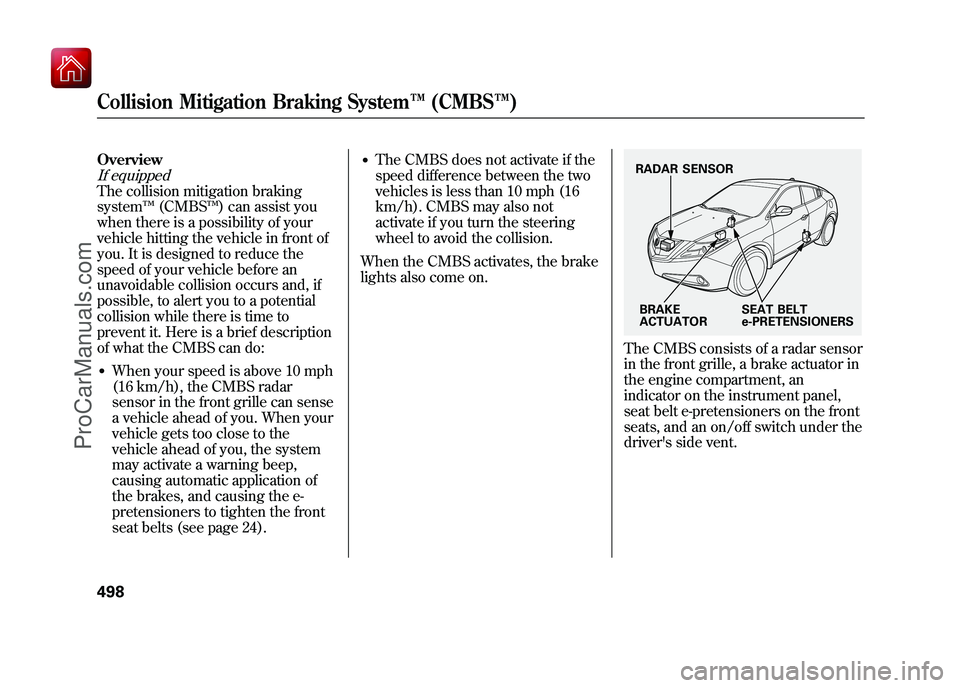
The CMBS consists of a radar sensor
in the front grille, a brake actuator in
the engine compartment, an
indicator on the instrument panel,
seat belt e-pretensioners on the front
seats, and an on/off switch under the
driver's side vent.RADAR SENSOR
BRAKE
ACTUATOR SEAT BELT
e-PRETENSIONERS
Collision Mitigation Braking System
™(CMBS™ )49809/10/28 17:15:37 10 ACURA ZDX KA KC New North America Own 50 31SZN600 enu
ProCarManuals.com
Page 505 of 645
The radar sensor may not always
scan as intended. Here are two
examples:●Your vehicle is tilted because of a
heavy load in the rear or from
modifications to the suspension.
Do not overload your vehicle (see
Carrying Cargoon page 465), and
do not make any modifications to
the suspension (see Accessories
and Modifications on page 463).●The tires are not correctly
maintained. Always make sure the
tire pressures are correct (see
page 568), and that the tires are
the correct size and in good
condition (see Tires on page 567). Collision Alarm
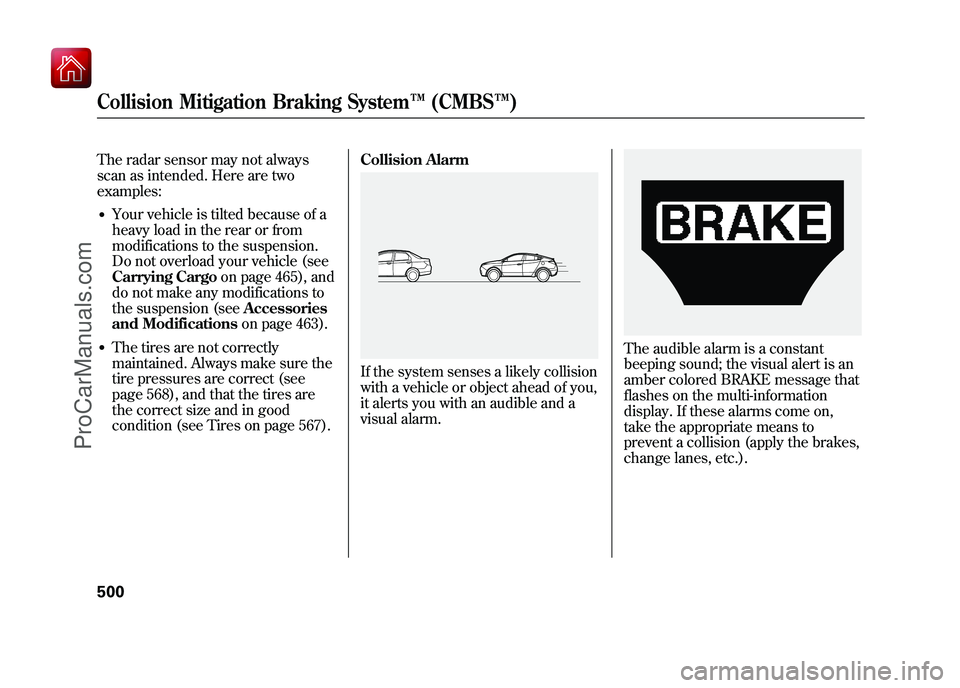
If the system senses a likely collision
with a vehicle or object ahead of you,
it alerts you with an audible and a
visual alarm.
The audible alarm is a constant
beeping sound; the visual alert is an
amber colored BRAKE message that
flashes on the multi-information
display. If these alarms come on,
take the appropriate means to
prevent a collision (apply the brakes,
change lanes, etc.).
Collision Mitigation Braking System
™(CMBS™ )50009/10/28 17:15:37 10 ACURA ZDX KA KC New North America Own 50 31SZN600 enu
ProCarManuals.com
Page 509 of 645
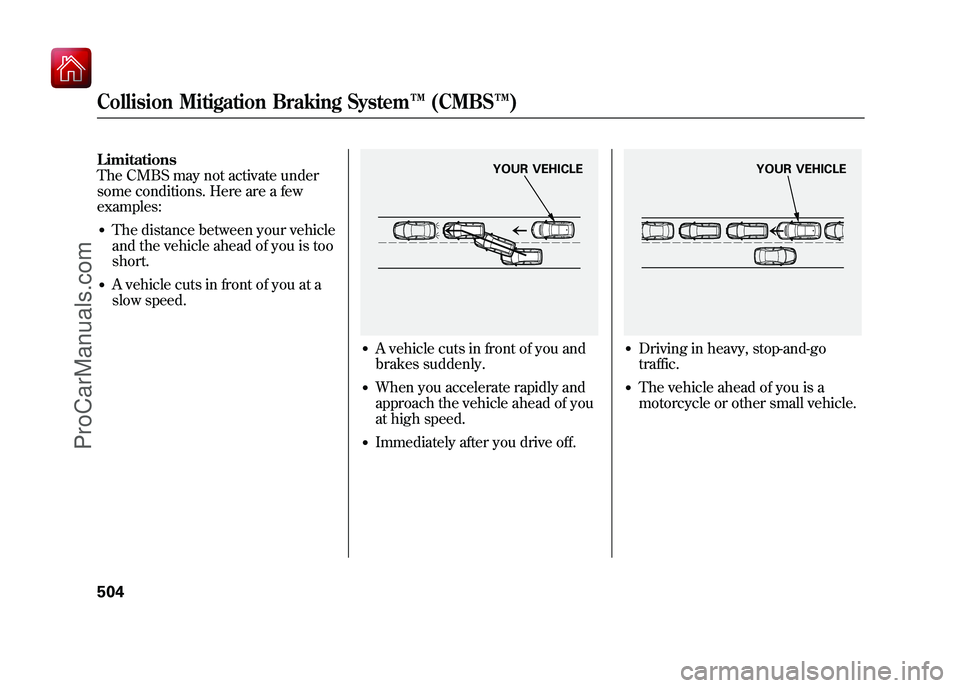
Limitations
The CMBS may not activate under
some conditions. Here are a few
examples:●The distance between your vehicle
and the vehicle ahead of you is too
short.●A vehicle cuts in front of you at a
slow speed.
●A vehicle cuts in front of you and
brakes suddenly.●When you accelerate rapidly and
approach the vehicle ahead of you
at high speed.●Immediately after you drive off.
●Driving in heavy, stop-and-go
traffic.●The vehicle ahead of you is a
motorcycle or other small vehicle.
YOUR VEHICLE
YOUR VEHICLE
Collision Mitigation Braking System™(CMBS™ )50409/10/28 17:15:37 10 ACURA ZDX KA KC New North America Own 50 31SZN600 enu
ProCarManuals.com
Page 511 of 645
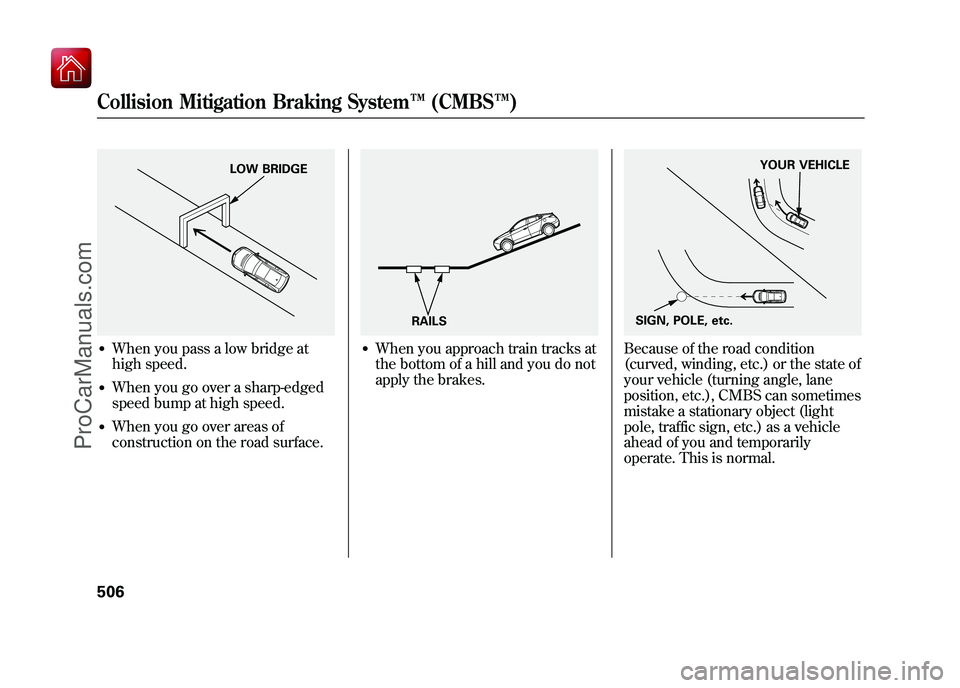
●When you pass a low bridge at
high speed.●When you go over a sharp-edged
speed bump at high speed.●When you go over areas of
construction on the road surface.
●When you approach train tracks at
the bottom of a hill and you do not
apply the brakes.
Because of the road condition
(curved, winding, etc.) or the state of
your vehicle (turning angle, lane
position, etc.), CMBS can sometimes
mistake a stationary object (light
pole, traffic sign, etc.) as a vehicle
ahead of you and temporarily
operate. This is normal.
LOW BRIDGE
RAILS
YOUR VEHICLE
SIGN, POLE, etc.
Collision Mitigation Braking System ™(CMBS™ )50609/10/28 17:15:37 10 ACURA ZDX KA KC New North America Own 50 31SZN600 enu
ProCarManuals.com
Page 513 of 645
The vehicle stability assist (VSA)
system helps to stabilize the vehicle
during cornering if the vehicle turns
more or less than desired. It also
assists you in maintaining traction
while accelerating on loose or
slippery road surfaces. It does this by
regulating the engine's output and by
selectively applying the brakes.
When VSA activates, you may notice
that the engine does not respond to
the accelerator in the same way it
does at other times. There may also
be some noise from the VSA
hydraulic system. You will also see
the VSA activation indicator blink.
The VSA system cannot enhance the
vehicle's driving stability in all
situations and does not control your
vehicle's entire braking system. It is
still your responsibility to drive and
corner at reasonable speeds and to
leave a sufficient margin of safety.
VSA OFF Indicator
When VSA is off, the VSA OFF
indicator comes on as a reminder.Vehicle Stability Assist
(VSA) System Indicator
When VSA activates, you will see the
VSA system indicator blink.
If this indicator comes on while
driving, pull to the side of the road
when it is safe, and turn off the
engine. Reset the system by
restarting the engine. If the VSA
system indicator stays on or comes
back on while driving, have the VSA
system inspected by your dealer.
NOTE: The main function of the VSA
system is generally known as
Electronic Stability Control (ESC).
The system also includes a traction
control function. If the indicator does not come on
when the power mode is set to ON,
there may be a problem with the VSA
system. Have your dealer inspect
your vehicle as soon as possible.
Vehicle Stability Assist (VSA
®), aka Electronic Stability Control (ESC), System
50809/10/28 17:15:37 10 ACURA ZDX KA KC New North America Own 50 31SZN600 enu
ProCarManuals.com
Page 515 of 645
VSA and Tire Sizes
Driving with varying tire or wheel
sizes may cause the VSA to
malfunction. When replacing tires,
make sure they are of the same size
and type as your original tires (see
page 571).
If you install winter tires, make sure
they are the same size as those that
were originally supplied with your
vehicle. Exercise the same caution
during winter driving as you would if
your vehicle was not equipped with
VSA.Hill Start Assist
Your vehicle is equipped with a hill
start assist feature to help prevent
the vehicle from rolling on inclines as
you move your foot from the brake
pedal to the accelerator.
To activate hill start assist, you must
come to a complete stop and make
sure the shift lever is either in D or S
when facing uphill, or reverse when
facing downhill.
This feature begins working a few
seconds after you are in the correct
gear position. Release the brake
pedal. The brakes remain engaged
briefly to keep the vehicle from
rolling forward or backward. Gently
apply the accelerator pedal as in
normal driving. Hill start assist will
release brake pressure gradually as
you accelerate.Hill start assist may not prevent your
vehicle from rolling downhill on a
very steep or slippery slope, and will
not operate on small inclines.
Hill start assist is not a replacement
for the parking brake. If parking your
vehicle, ensure that the transmission
is in park, and/or the parking brake
is fully applied before exiting the
vehicle.
If the VSA system indicator comes on
with a
‘‘CHECK HILL START
ASSIST SYSTEM ’’message on the
multi-information display, there may
be a problem with the hill start assist.
The VSA also may not function. Have
your vehicle inspected by your
dealer.
Hill start assist will still operate even
when VSA is switched off.Vehicle Stability Assist (VSA
®), aka Electronic Stability Control (ESC), System
51009/10/28 17:15:37 10 ACURA ZDX KA KC New North America Own 50 31SZN600 enu
ProCarManuals.com
Page 531 of 645
●The lights and brakes on your
vehicle and the trailer are working
properly.●Your vehicle tires and spare are
properly inflated, and the trailer
tires and spare are inflated as
recommended by the trailer
maker.●You may want to fill the fuel tank
with premium fuel. Premium fuel
provides improved performance.Driving Safely With a Trailer
The added weight, length, and
height of a trailer will affect your
vehicle's handling and performance,
so driving with a trailer requires
some special driving skills and
techniques.
For your safety and the safety of
others, take time to practice driving
maneuvers before heading for the
open road, and follow the guidelines
in this section.
Towing Speeds and GearsDrive slower than normal in all
driving situations, and obey posted
speed limits for vehicles with trailers.
Use the D position when towing a
trailer on level roads. See
‘‘
Driving on
Hills
’’ in the next column for
additional gear information. Do not
exceed 55 mph (88 km/h). At higher
speeds, the trailer may sway or affect
vehicle handling.
Making Turns and BrakingMake turns more slowly and wider
than normal. The trailer tracks a
smaller arc than your vehicle, and it
can hit or run over something the
vehicle misses.
Allow more time and distance for
braking. Do not brake or turn
suddenly as this could cause the
trailer to jackknife or turn over.
Towing a Trailer52609/10/28 17:15:37 10 ACURA ZDX KA KC New North America Own 50 31SZN600 enu
ProCarManuals.com