airbag off Acura ZDX 2012 Owner's Manual
[x] Cancel search | Manufacturer: ACURA, Model Year: 2012, Model line: ZDX, Model: Acura ZDX 2012Pages: 370, PDF Size: 10.06 MB
Page 10 of 370
8
Quick Reference Guide
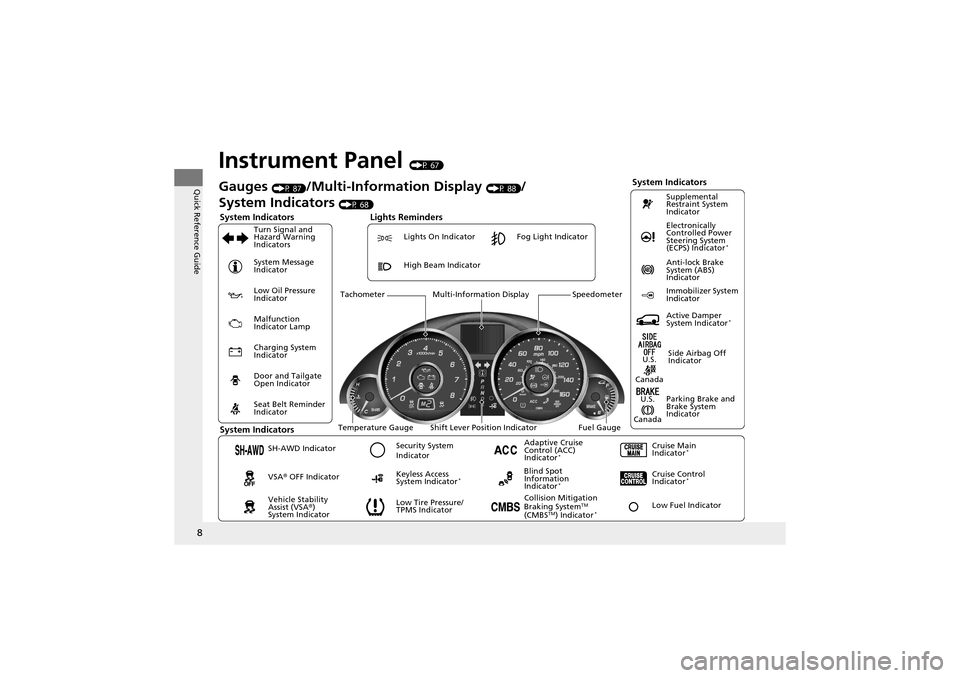
Instrument Panel (P 67)
System Indicators
Malfunction
Indicator Lamp Low Oil Pressure
Indicator
Charging System
IndicatorAnti-lock Brake
System (ABS)
Indicator
Vehicle Stability
Assist (VSA ®)
System Indicator VSA ® OFF Indicator
Low Tire Pressure/
TPMS Indicator Electronically
Controlled Power
Steering System
(ECPS) Indicator
*
Lights Reminders
Lights On Indicator
High Beam Indicator
Fog Light Indicator
Immobilizer System
Indicator
Seat Belt Reminder
Indicator
System Indicators
Cruise Control
Indicator*
System Message
Indicator
Parking Brake and
Brake System
Indicator Supplemental
Restraint System
Indicator
Side Airbag Off
Indicator
Door and Tailgate
Open Indicator
Cruise Main
Indicator
*
TachometerSpeedometer
Fuel Gauge
Security System
Indicator Shift Lever Position Indicator
Low Fuel Indicator
Gauges (P 87)/Multi-Information Display (P 88)/
System Indicators
(P 68)
Turn Signal and
Hazard Warning
Indicators
Temperature Gauge
SH-AWD Indicator
Keyless Access
System Indicator
*
Active Damper
System Indicator*
Blind Spot
Information
Indicator
*
Collision Mitigation
Braking SystemTM
(CMBSTM) Indicator*
Adaptive Cruise
Control (ACC)
Indicator
*
System Indicators
Multi-Information Display
U.S.
Canada Canada
U.S.
Page 28 of 370
uuFor Safe Driving uYour Vehicle’s Safety Features
26
Safe DrivingFor the safety of you and your passengers, make a habit of checking these items
each time before you drive.
• After everyone has entered the vehicle, be sure all doors and the tailgate are
closed and locked. Locking the doors and the tailgate helps prevent an occupant
from being ejected and an outsider fro m unexpectedly opening a door or the
tailgate.
2 Locking/Unlocking the Doors from the Inside P. 111
•Adjust your seat to a position suitable for driving. Be sure the front seats are
adjusted as far to the rear as possible while allowing the driver to control the
vehicle. Sitting too close to a front airbag can result in serious or fatal injury in a
crash.
2 Adjusting the Seats P. 143
•Adjust head restraints to the proper position. Head re straints are most effective
when the center of the head restraint aligns with the center of your head. Taller
persons should adjust their head restraint to the highest position.
2Adjusting the Head Restraints P. 145
•Always wear your seat belt, and make sure you wear it properly. Confirm that any
passengers are properly belted as well.
2 Fastening a Seat Belt P. 31
•Protect children by using seat belts or child seats according to a child’s age, height
and weight.
2 Child Safety P. 50
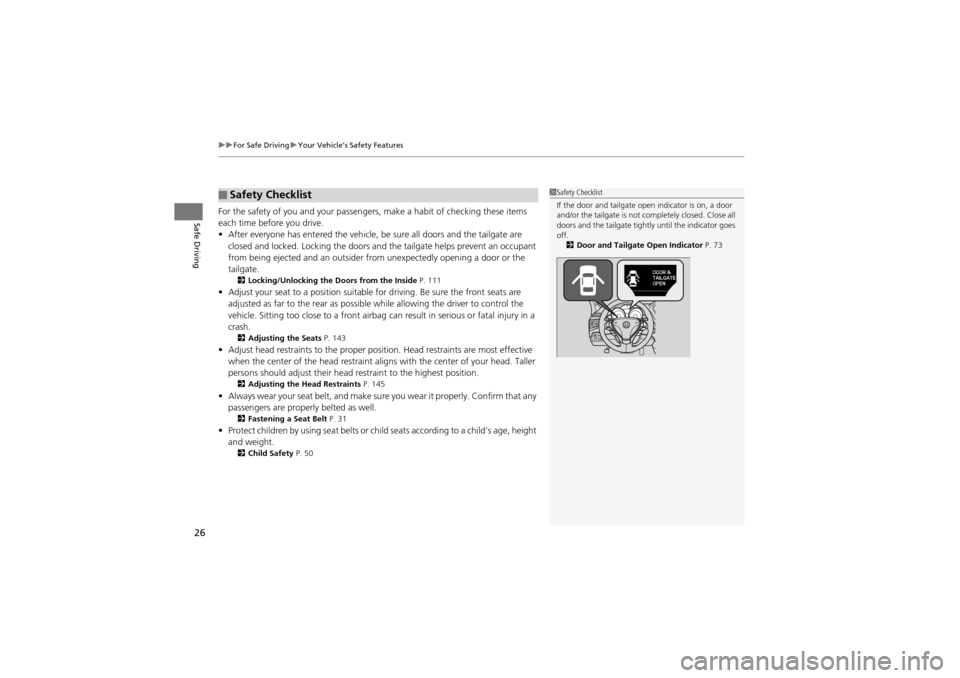
■Safety Checklist1Safety Checklist
If the door and tailgate open indicator is on, a door
and/or the tailgate is not co mpletely closed. Close all
doors and the tailgate tightly until the indicator goes
off.
2 Door and Tailgate Open Indicator P. 73
Page 31 of 370
Continued29
uuSeat Belts uAbout Your Seat Belts
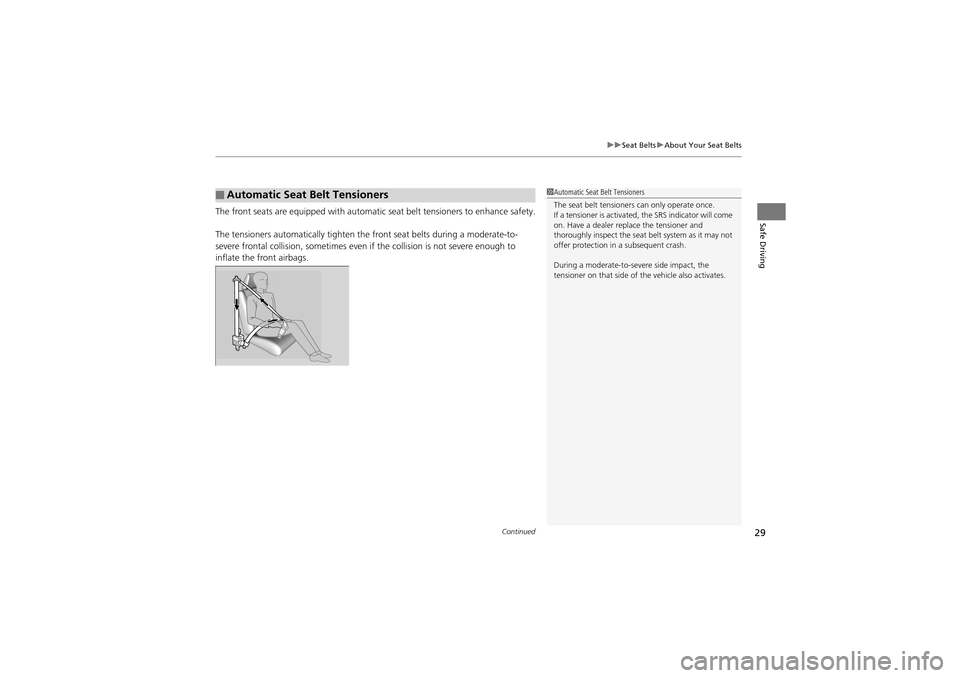
Safe DrivingThe front seats are equipped with automatic seat belt tensioners to enhance safety.
The tensioners automatically tighten th e front seat belts during a moderate-to-
severe frontal collision, some times even if the collision is not severe enough to
inflate the front airbags.
■Automatic Seat Belt Tensioners1 Automatic Seat Belt Tensioners
The seat belt tensioners can only operate once.
If a tensioner is activated, the SRS indicator will come
on. Have a dealer replace the tensioner and
thoroughly inspect the seat belt system as it may not
offer protection in a subsequent crash.
During a moderate-to-severe side impact, the
tensioner on that side of the vehicle also activates.
Page 32 of 370
uuSeat Belts uAbout Your Seat Belts
30
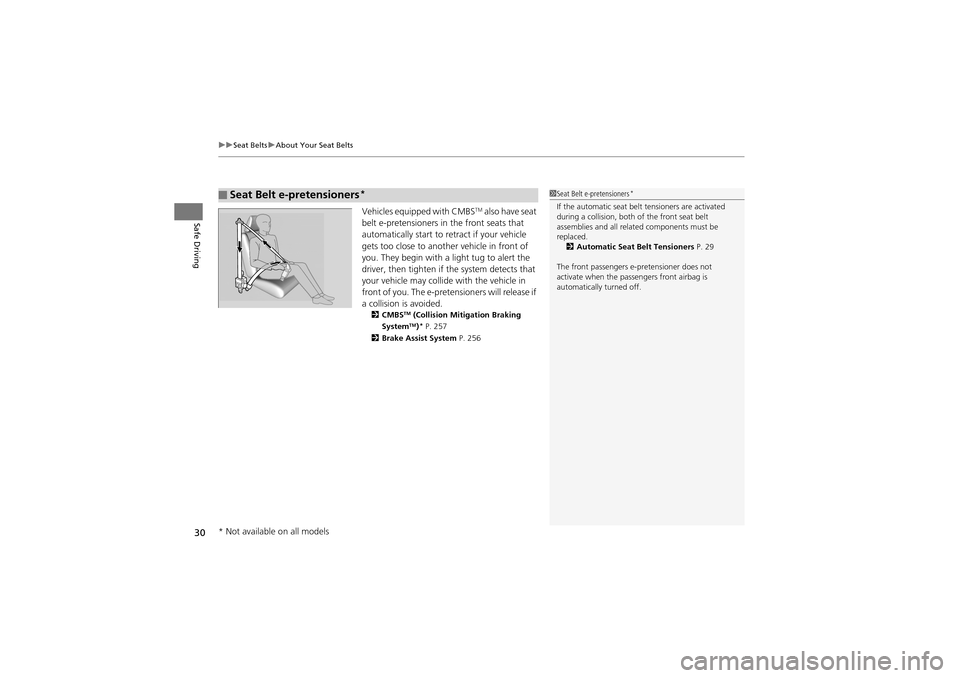
Safe DrivingVehicles equipped with CMBSTM also have seat
belt e-pretensioners in the front seats that
automatically start to retract if your vehicle
gets too close to another vehicle in front of
you. They begin with a light tug to alert the
driver, then tighten if the system detects that
your vehicle may collide with the vehicle in
front of you. The e-pretensioners will release if
a collision is avoided.
2 CMBSTM (Collision Mitigation Braking
SystemTM)* P. 257
2 Brake Assist System P. 256
■Seat Belt e-pretensioners*1Seat Belt e-pretensioners*
If the automatic seat belt tensioners are activated
during a collision, both of the front seat belt
assemblies and all relate d components must be
replaced. 2 Automatic Seat Belt Tensioners P. 29
The front passengers e-pretensioner does not
activate when the passe ngers front airbag is
automatically turned off.
* Not available on all models
Page 38 of 370
36
uuAirbags uAirbag System Components
Safe Driving
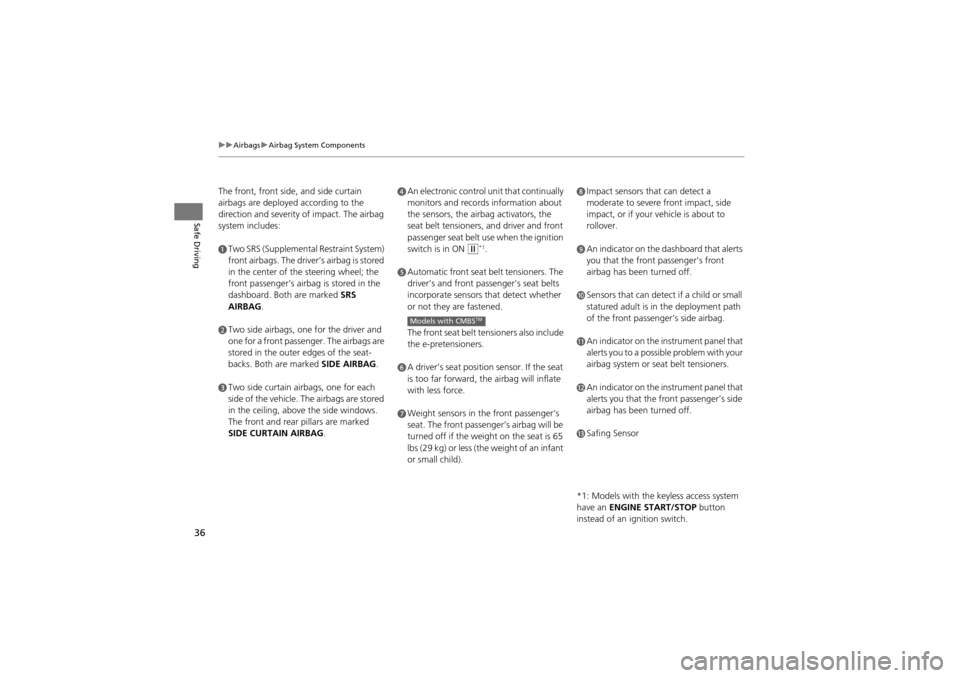
The front, front side, and side curtain
airbags are deployed according to the
direction and severity of impact. The airbag
system includes:
aTwo SRS (Supplemental Restraint System)
front airbags. The driver’s airbag is stored
in the center of the steering wheel; the
front passenger’s airbag is stored in the
dashboard. Both are marked SRS
AIRBAG.
bTwo side airbags, one for the driver and
one for a front passen ger. The airbags are
stored in the outer edges of the seat-
backs. Both are marked SIDE AIRBAG.
cTwo side curtain airbags, one for each
side of the vehicle. The airbags are stored
in the ceiling, above the side windows.
The front and rear pillars are marked
SIDE CURTAIN AIRBAG .
dAn electronic control unit that continually
monitors and records information about
the sensors, the airbag activators, the
seat belt tensioners, and driver and front
passenger seat belt use when the ignition
switch is in ON
w*1.
eAutomatic front seat belt tensioners. The
driver’s and front passenger’s seat belts
incorporate sensors that detect whether
or not they are fastened.
The front seat belt tensioners also include
the e-pretensioners.
fA driver’s seat position sensor. If the seat
is too far forward, the airbag will inflate
with less force.
gWeight sensors in the front passenger’s
seat. The front passenger’s airbag will be
turned off if the weight on the seat is 65
lbs (29 kg) or less (the weight of an infant
or small child).
Models with CMBSTM
hImpact sensors that can detect a
moderate to severe front impact, side
impact, or if your vehicle is about to
rollover.
iAn indicator on the dashboard that alerts
you that the front passenger’s front
airbag has been turned off.
jSensors that can detect if a child or small
statured adult is in the deployment path
of the front passenger’s side airbag.
kAn indicator on the instrument panel that
alerts you to a possible problem with your
airbag system or seat belt tensioners.
lAn indicator on the instrument panel that
alerts you that the fro nt passenger’s side
airbag has been turned off.
mSafing Sensor
*1: Models with the keyless access system
have an ENGINE START/STOP button
instead of an ignition switch.
Page 41 of 370
Continued39
uuAirbags uFront Airbags (SRS)
Safe DrivingFront airbags are designed to inflate during moderate-to-severe frontal collisions.
When the vehicle decelerates suddenly, the sensors send information to the control
unit which signals one or both front airbags to inflate.
A frontal collision can be either head-on or angled between two vehicles, or when a
vehicle crashes into a stationary object, such as a concrete wall.
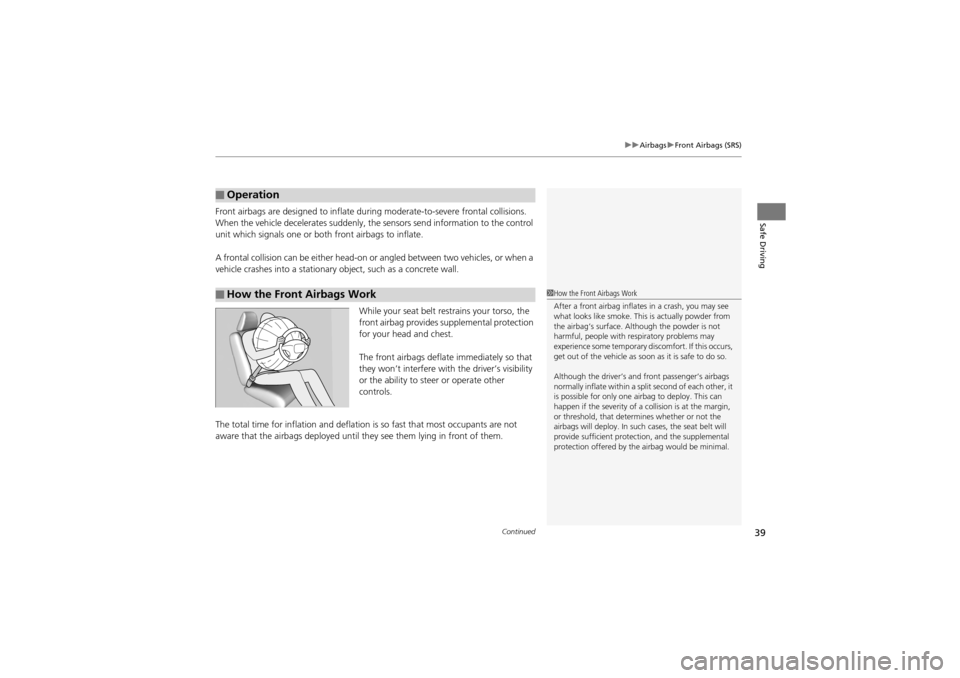
While your seat belt restrains your torso, the
front airbag provides supplemental protection
for your head and chest.
The front airbags deflate immediately so that
they won’t interfere with the driver’s visibility
or the ability to steer or operate other
controls.
The total time for inflation and deflation is so fast that most occupants are not
aware that the airbags deployed until th ey see them lying in front of them.
■Operation
■How the Front Airbags Work1How the Front Airbags Work
After a front airbag inflates in a crash, you may see
what looks like smoke. This is actually powder from
the airbag’s surface. Although the powder is not
harmful, people with re spiratory problems may
experience some temporary di scomfort. If this occurs,
get out of the vehicle as soon as it is safe to do so.
Although the driver’s and front passenger’s airbags
normally inflate within a split second of each other, it
is possible for only one airbag to deploy. This can
happen if the severity of a collision is at the margin,
or threshold, that determines whether or not the
airbags will deploy. In such cases, the seat belt will
provide sufficient protection, and the supplemental
protection offered by the airbag would be minimal.
Page 42 of 370
40
uuAirbags uFront Airbags (SRS)
Safe Driving
■When front airbags should not deploy
Minor frontal crashes: Front airbags were designed to supplement seat belts and
help save lives, not to prevent minor scrapes, or even broken bones that might occur
during a less than modera te-to-severe frontal crash.
Side impacts: Front airbags can provide protection when a sudden deceleration
causes a driver or front passenger to move towards the front of the vehicle. Side
airbags and side curtain airbags have been specifically designed to help reduce the
severity of injuries that can occur during a moderate-to -severe side impact which
can cause the driver or passenger to move towards the side of the vehicle.
Rear impacts: Head restraints and seat belts are your best protection during a rear
impact. Front airbags cannot provide any si gnificant protection and are not designed
to deploy in such collisions.
Rollovers: Seat belts and, in vehicles equipped with a rollover sensor, side airbags
and side curtain airbag s offer the best protection in a rollover. Because front airbags
could provide little if any protection, they are not designed to deploy during a
rollover.
■When front airbags deploy with little or no visible damage
Because the airbag system senses sudden deceleration, a strong impact to the
vehicle framework or suspension might cause one or more of the airbags to deploy.
Examples include running into a curb, the edge of a hole, or other low fixed object
that causes a sudden deceleration in th e vehicle chassis. Since the impact is
underneath the vehicle, damage may not be readily apparent.
■When front airbags may not deploy, even though exterior damage
appears severe
Since crushable body parts absorb crash energy during an impact, the amount of
visible damage does not always indicate proper airbag operation. In fact, some
collisions can result in severe damage but no airbag deployment because the airbags
would not have been needed or would not have provided protection even if they
had deployed.
Page 43 of 370
41
uuAirbags uFront Airbags (SRS)
Safe DrivingYour front airbags have advanced features to help reduce the likelihood of airbag
related injuries to smaller occupants.
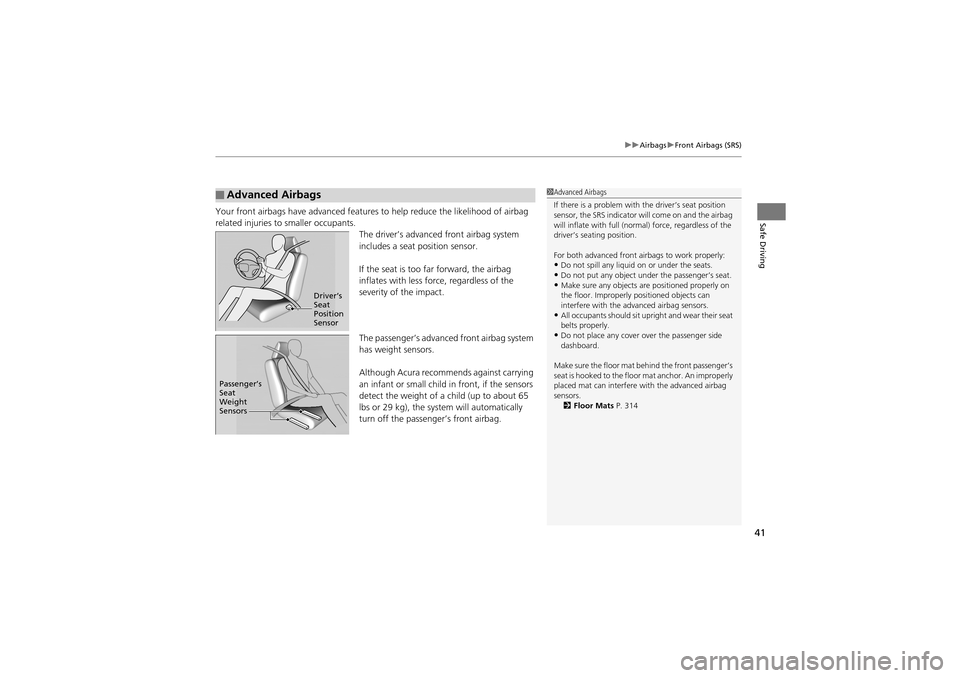
The driver’s advanced front airbag system
includes a seat position sensor.
If the seat is too far forward, the airbag
inflates with less force, regardless of the
severity of the impact.
The passenger’s advanced front airbag system
has weight sensors.
Although Acura recommends against carrying
an infant or small child in front, if the sensors
detect the weight of a child (up to about 65
lbs or 29 kg), the system will automatically
turn off the passenger’s front airbag.
■Advanced Airbags1 Advanced Airbags
If there is a problem with the driver’s seat position
sensor, the SRS indicator will come on and the airbag
will inflate with full (normal) force, regardless of the
driver’s seating position.
For both advanced front airbags to work properly:
•Do not spill any liquid on or under the seats.•Do not put any object un der the passenger’s seat.•Make sure any objects are positioned properly on
the floor. Improperly positioned objects can
interfere with the advanced airbag sensors.
•All occupants should sit upright and wear their seat
belts properly.
•Do not place any cover ov er the passenger side
dashboard.
Make sure the floor mat behind the front passenger’s
seat is hooked to the floor mat anchor. An improperly
placed mat can interfere wi th the advanced airbag
sensors. 2 Floor Mats P. 314
Driver’s
Seat
Position
Sensor
Passenger’s
Seat
Weight
Sensors
Page 46 of 370
uuAirbags uSide Airbags
44
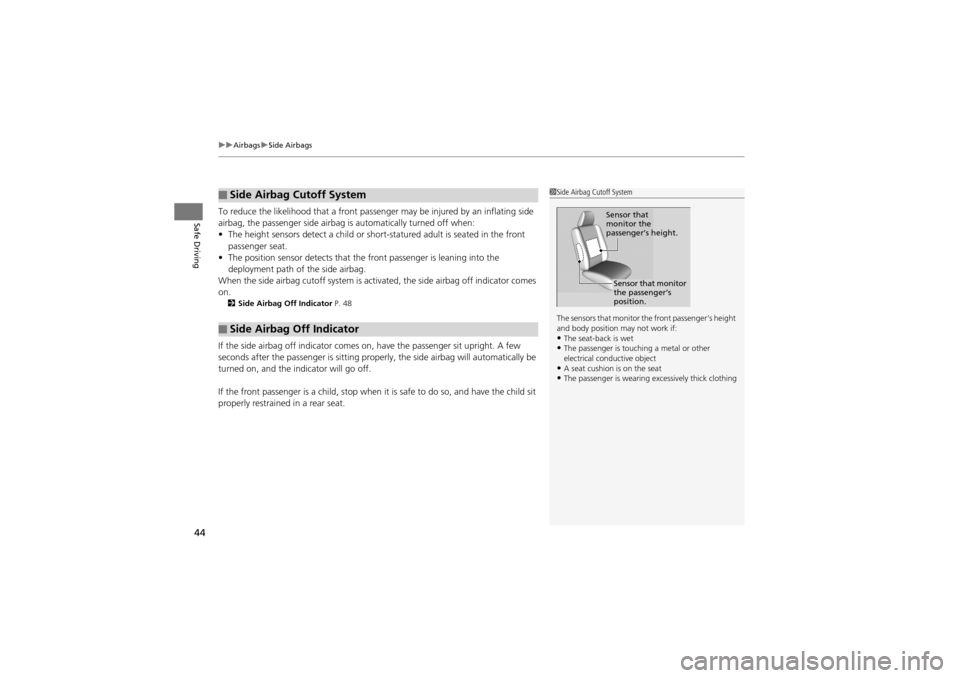
Safe DrivingTo reduce the likelihood that a front passenger may be injured by an inflating side
airbag, the passenger side airbag is automatically turned off when:
• The height sensors detect a child or sho rt-statured adult is seated in the front
passenger seat.
• The position sensor detects that the front passenger is leaning into the
deployment path of the side airbag.
When the side airbag cutoff system is activated, the side airbag off indicator comes
on.
2 Side Airbag Off Indicator P. 48
If the side airbag off indicator comes on, have the passenger sit upright. A few
seconds after the passenger is sitting proper ly, the side airbag will automatically be
turned on, and the indicator will go off.
If the front passenger is a child, stop when it is safe to do so, and have the child sit
properly restrained in a rear seat.
■Side Airbag Cutoff System
■Side Airbag Off Indicator
1 Side Airbag Cutoff System
The sensors that monitor the front passenger’s height
and body position may not work if:
•The seat-back is wet•The passenger is touchi ng a metal or other
electrical conductive object
•A seat cushion is on the seat•The passenger is wearing excessively thick clothing
Sensor that
monitor the
passenger’s height.
Sensor that monitor
the passenger’s
position.
Page 48 of 370
46
uuAirbags uAirbag System Indicators
Safe Driving
Airbag System Indicators
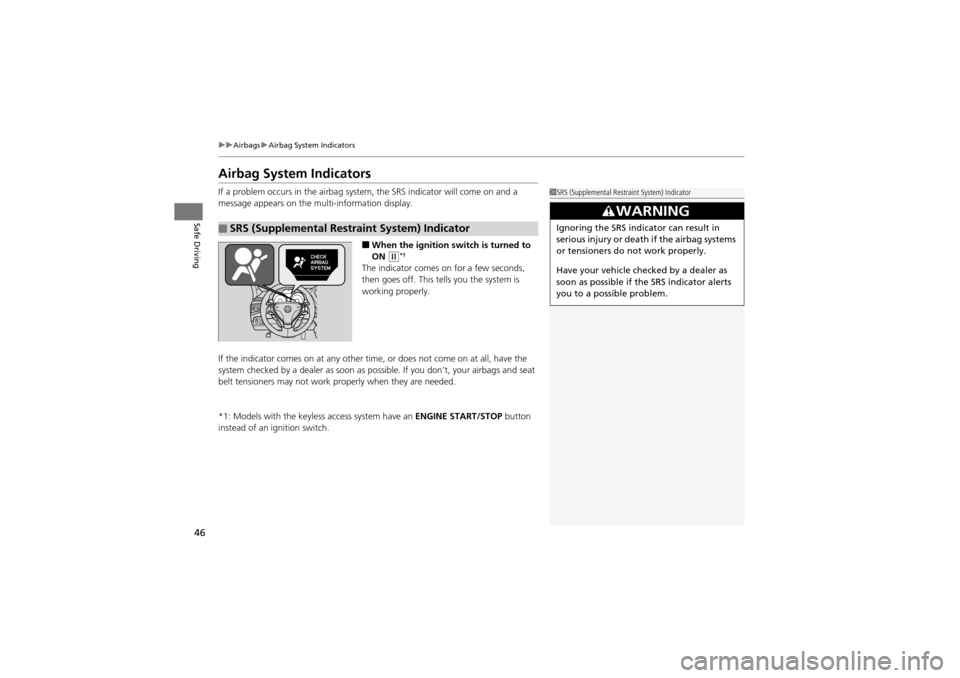
If a problem occurs in the airbag syst em, the SRS indicator will come on and a
message appears on the mu lti-information display.
■When the ignition switch is turned to
ON
w*1
The indicator comes on for a few seconds,
then goes off. This tells you the system is
working properly.
If the indicator comes on at any other time , or does not come on at all, have the
system checked by a dealer as soon as possible. If you don’t, your airbags and seat
belt tensioners may not work properly when they are needed.
*1: Models with the keyless access system have an ENGINE START/STOP button
instead of an ignition switch.
■SRS (Supplemental Restraint System) Indicator
1 SRS (Supplemental Restraint System) Indicator
3WARNING
Ignoring the SRS indicator can result in
serious injury or death if the airbag systems
or tensioners do not work properly.
Have your vehicle checked by a dealer as
soon as possible if the SRS indicator alerts
you to a possible problem.