belt Acura ZDX 2013 Service Manual
[x] Cancel search | Manufacturer: ACURA, Model Year: 2013, Model line: ZDX, Model: Acura ZDX 2013Pages: 324, PDF Size: 8.58 MB
Page 150 of 324
149
uuAdjusting the SeatsuAdjusting the Seat Positions
Controls
After all occupants have adjusted their seats and head restraints, and put on their seat
belts, it is very important that they continue to sit upright, well back in their seats, with
their feet on the floor, until the vehicle is safely parked and the engine is off.
Sitting improperly can increase the chance of injury during a crash. For example, if an
occupant slouches, lies down, turns sideways, sits forward, leans forward or sideways,
or puts one or both feet up, the chance of injury during a crash is greatly increased.
In addition, an occupant who is out of position in the front seat can be seriously or
fatally injured in a crash by striking interior parts of the vehicle or being struck by an
inflating front airbag.
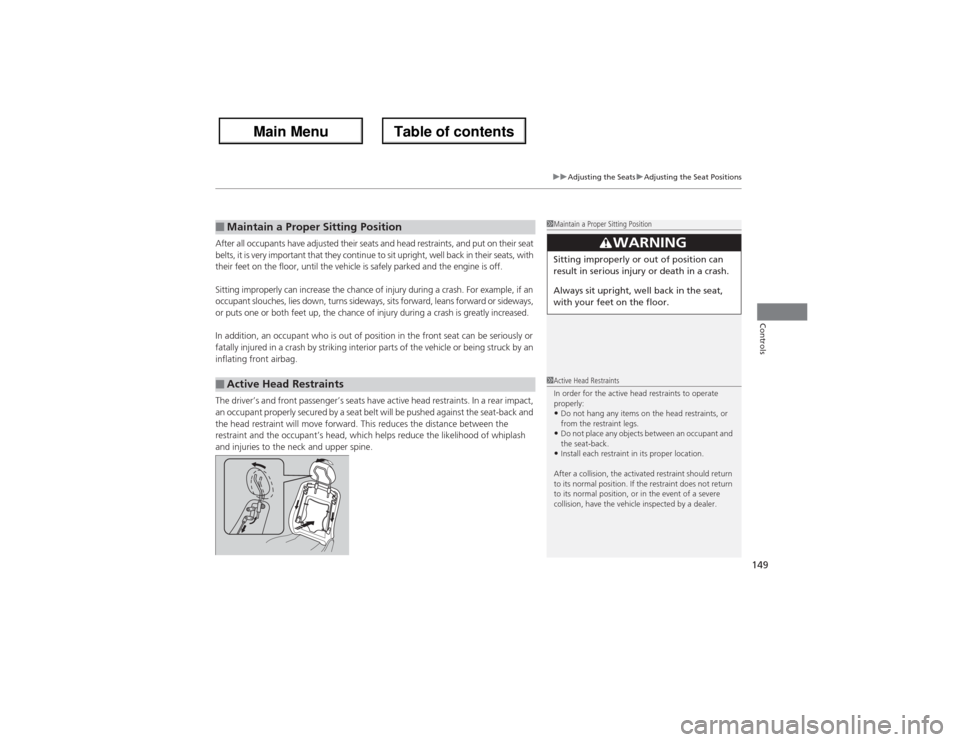
The driver’s and front passenger’s seats have active head restraints. In a rear impact,
an occupant properly secured by a seat belt will be pushed against the seat-back and
the head restraint will move forward. This reduces the distance between the
restraint and the occupant’s head, which helps reduce the likelihood of whiplash
and injuries to the neck and upper spine.■Maintain a Proper Sitting Position■Active Head Restraints
1Maintain a Proper Sitting Position
3
WARNING
Sitting improperly or out of position can
result in serious injury or death in a crash.
Always sit upright, well back in the seat,
with your feet on the floor.1Active Head Restraints
In order for the active head restraints to operate
properly:•Do not hang any items on the head restraints, or
from the restraint legs.•Do not place any objects between an occupant and
the seat-back.•Install each restraint in its proper location.
After a collision, the activated restraint should return
to its normal position. If the restraint does not return
to its normal position, or in the event of a severe
collision, have the vehicle inspected by a dealer.
Page 151 of 324
150
uuAdjusting the SeatsuRear Seats
Controls
Rear Seats
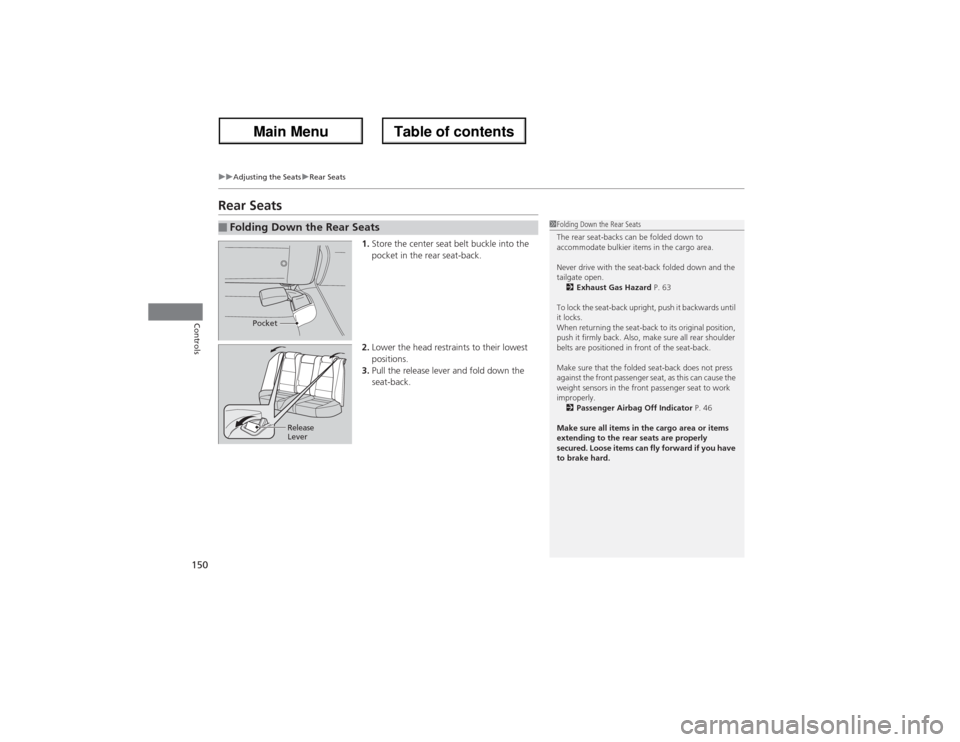
1.Store the center seat belt buckle into the
pocket in the rear seat-back.
2.Lower the head restraints to their lowest
positions.
3.Pull the release lever and fold down the
seat-back.
■Folding Down the Rear Seats
1Folding Down the Rear Seats
The rear seat-backs can be folded down to
accommodate bulkier items in the cargo area.
Never drive with the seat-back folded down and the
tailgate open.
2Exhaust Gas Hazard P. 63
To lock the seat-back upright, push it backwards until
it locks.
When returning the seat-back to its original position,
push it firmly back. Also, make sure all rear shoulder
belts are positioned in front of the seat-back.
Make sure that the folded seat-back does not press
against the front passenger seat, as this can cause the
weight sensors in the front passenger seat to work
improperly.
2Passenger Airbag Off Indicator P. 46
Make sure all items in the cargo area or items
extending to the rear seats are properly
secured. Loose items can fly forward if you have
to brake hard.
Pocket
Release
Lever
Page 155 of 324
154
uuInterior Lights/Interior Convenience ItemsuInterior Convenience Items
Controls
Interior Convenience Items
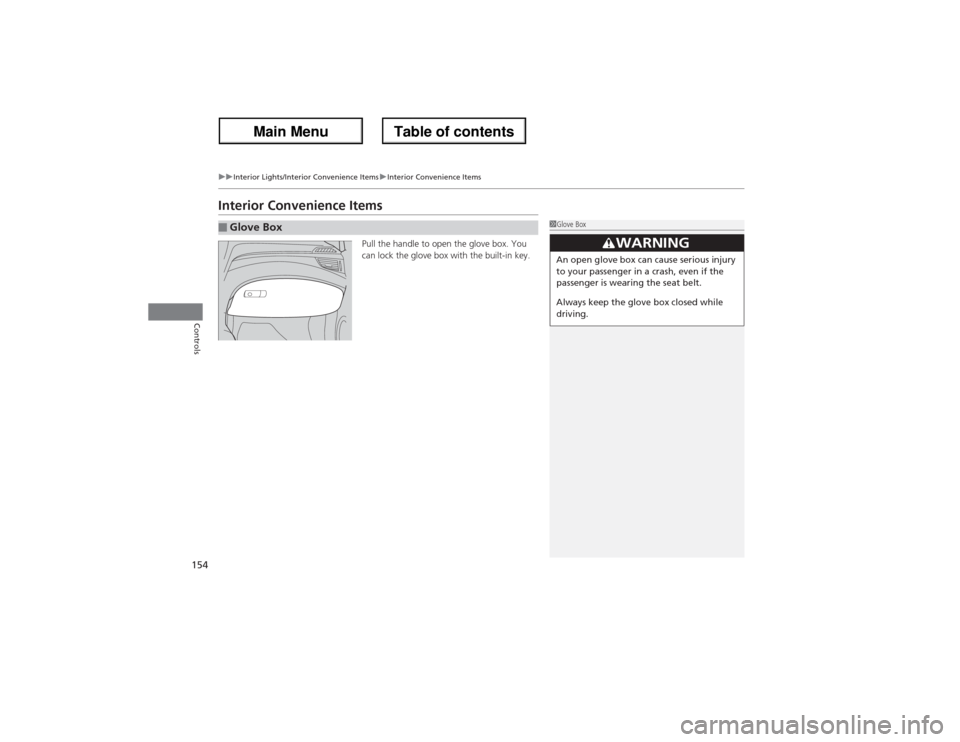
Pull the handle to open the glove box. You
can lock the glove box with the built-in key.
■Glove Box
1Glove Box
3
WARNING
An open glove box can cause serious injury
to your passenger in a crash, even if the
passenger is wearing the seat belt.
Always keep the glove box closed while
driving.
Page 175 of 324
174
uuBefore DrivinguDriving Preparation
Driving
•Be sure items placed on the floor behind the front seats cannot roll under the
seats.
uThey can interfere with the driver’s ability to operate the pedals, the operation
of the seats, or the operation of the sensors under the seats.
•Everyone in the vehicle must fasten their seat belt.
2Fastening a Seat Belt P. 30
•Make sure that the indicators in the instrument panel come on when you start the
vehicle, and go off soon after.
uAlways have a dealer check the vehicle if a problem is indicated.
2Indicators P. 66
Page 183 of 324
182Driving
Off-Highway Driving GuidelinesGeneral InformationYour vehicle has been designed primarily for use on pavement, however, its higher
ground clearance allows you to occasionally travel on unpaved roads.
It is not designed for trail-blazing, or other challenging off-road activities.
If you decide to drive on unpaved roads, you will find that it requires somewhat
different driving skills and that your vehicle will handle somewhat differently than it
does on pavement. Pay attention to the precautions and tips in this section, and get
acquainted with your vehicle before leaving the pavement.Important Safety PrecautionsTo avoid loss of control or rollover, be sure to follow all precautions and
recommendations:
•Be sure to store cargo properly and do not exceed your cargo load limits.
2Maximum Load Limit P. 175
•Whenever you drive, make sure you and your passengers always wear seat belts.
•Keep your speed low, and never go faster than the conditions allow.
•It’s up to you to continually assess the situation and drive within the limits.
1Off-Highway Driving Guidelines
Failure to operate your vehicle correctly might result
in a crash or a roll over.
2Important Handling Information P. 24
2Precautions While Driving P. 187
3
WARNING
Improperly operating this vehicle on or
off-pavement can cause a crash or
rollover in which you and your
passengers can be seriously injured or
killed.
•Follow all instructions and guidelines
in this owner’s manual.
•Keep your speed low, and don’t drive
faster than conditions permit.
Page 234 of 324
233
uuMaintenance Minder
TMuTo Use Maintenance Minder
TM
Continued
Maintenance
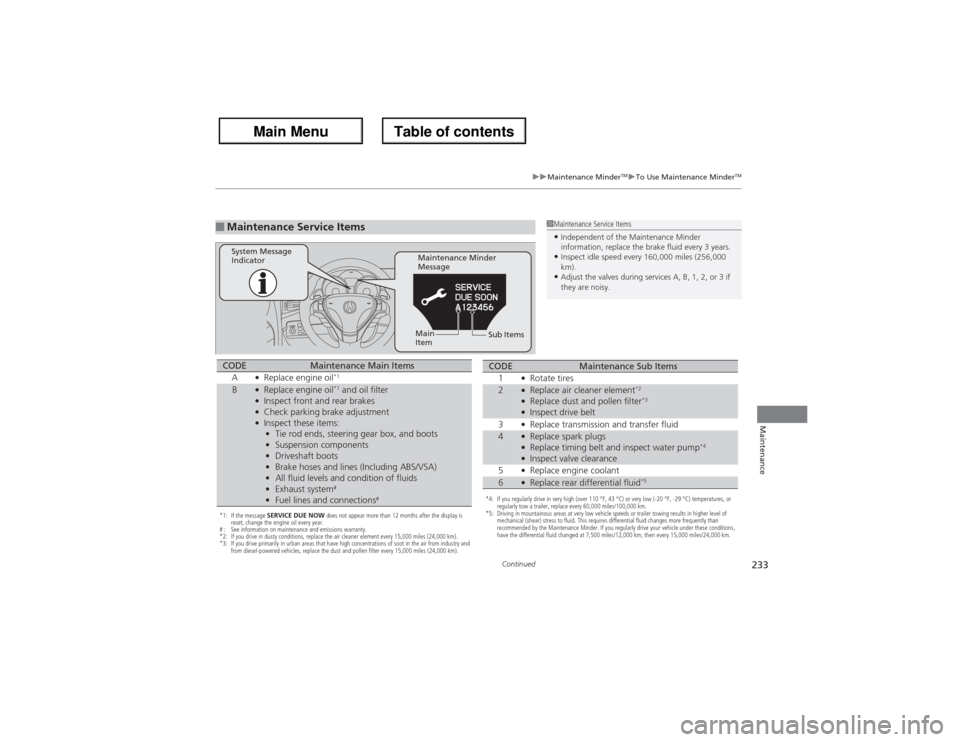
■Maintenance Service Items
1Maintenance Service Items•Independent of the Maintenance Minder
information, replace the brake fluid every 3 years.•Inspect idle speed every 160,000 miles (256,000
km).•Adjust the valves during services A, B, 1, 2, or 3 if
they are noisy.
Maintenance Minder
Message System Message
Indicator
Sub Items Main
Item
*1: If the message SERVICE DUE NOW does not appear more than 12 months after the display is
reset, change the engine oil every year.
# : See information on maintenance and emissions warranty.
*2: If you drive in dusty conditions, replace the air cleaner element every 15,000 miles (24,000 km).
*3: If you drive primarily in urban areas that have high concentrations of soot in the air from industry and
from diesel-powered vehicles, replace the dust and pollen filter every 15,000 miles (24,000 km).CODE
Maintenance Main Items
A
●Replace engine oil
*1
B
●Replace engine oil
*1 and oil filter
●Inspect front and rear brakes●Check parking brake adjustment●Inspect these items:
•Tie rod ends, steering gear box, and boots
•Suspension components
•Driveshaft boots
•Brake hoses and lines (Including ABS/VSA)
•All fluid levels and condition of fluids
•Exhaust system
#
•Fuel lines and connections
#
*4: If you regularly drive in very high (over 110 °F, 43 °C) or very low (-20 °F, -29 °C) temperatures, or
regularly tow a trailer, replace every 60,000 miles/100,000 km.
*5: Driving in mountainous areas at very low vehicle speeds or trailer towing results in higher level of
mechanical (shear) stress to fluid. This requires differential fluid changes more frequently than
recommended by the Maintenance Minder. If you regularly drive your vehicle under these conditions,
have the differential fluid changed at 7,500 miles/12,000 km, then every 15,000 miles/24,000 km.CODE
Maintenance Sub Items
1
●Rotate tires
2
●Replace air cleaner element
*2
●Replace dust and pollen filter
*3
●Inspect drive belt
3●Replace transmission and transfer fluid
4
●Replace spark plugs●Replace timing belt and inspect water pump
*4
●Inspect valve clearance
5●Replace engine coolant
6
●Replace rear differential fluid
*5
Page 260 of 324
259
uuChecking and Maintaining TiresuTire and Loading Information Label
Continued
Maintenance
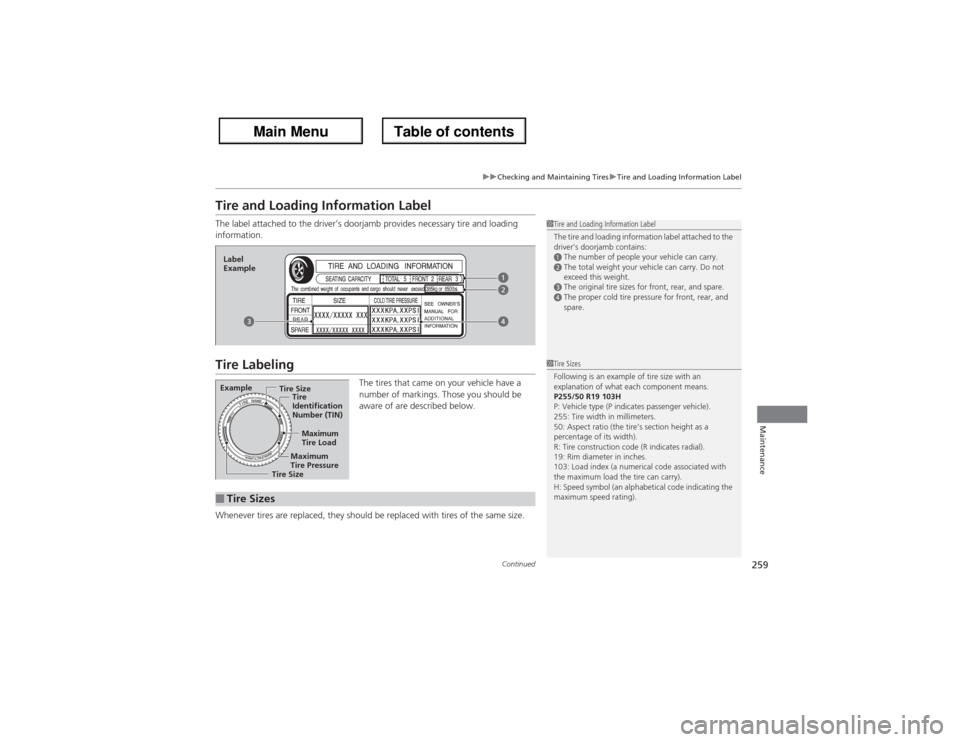
Tire and Loading Information LabelThe label attached to the driver’s doorjamb provides necessary tire and loading
information.Tire Labeling
The tires that came on your vehicle have a
number of markings. Those you should be
aware of are described below.
Whenever tires are replaced, they should be replaced with tires of the same size.
1Tire and Loading Information Label
The tire and loading information label attached to the
driver’s doorjamb contains:aThe number of people your vehicle can carry.bThe total weight your vehicle can carry. Do not
exceed this weight.cThe original tire sizes for front, rear, and spare.dThe proper cold tire pressure for front, rear, and
spare.
Label
ExampleExample
Tire Size
Tire
Identification
Number (TIN)
Maximum
Tire Load
Maximum
Tire Pressure
Tire Size■Tire Sizes
1Tire Sizes
Following is an example of tire size with an
explanation of what each component means.
P255/50 R19 103H
P: Vehicle type (P indicates passenger vehicle).
255: Tire width in millimeters.
50: Aspect ratio (the tire’s section height as a
percentage of its width).
R: Tire construction code (R indicates radial).
19: Rim diameter in inches.
103: Load index (a numerical code associated with
the maximum load the tire can carry).
H: Speed symbol (an alphabetical code indicating the
maximum speed rating).
Page 271 of 324
270Maintenance
CleaningInterior CareUse a damp cloth with a mixture of mild detergent and warm water to remove dirt.
Use a clean cloth to remove detergent residue.
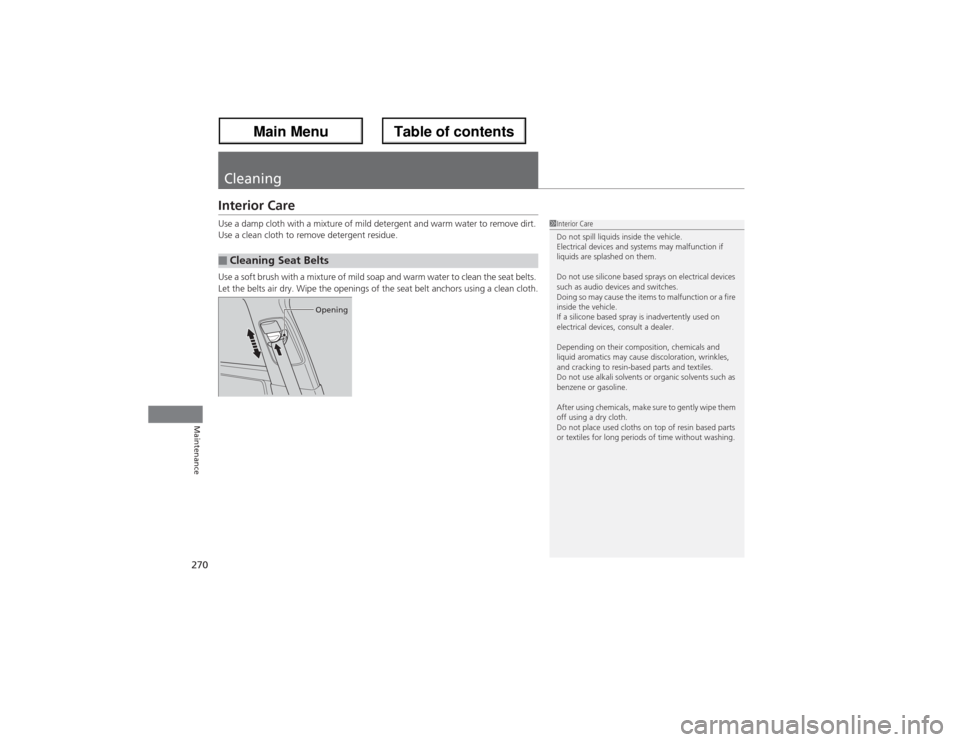
Use a soft brush with a mixture of mild soap and warm water to clean the seat belts.
Let the belts air dry. Wipe the openings of the seat belt anchors using a clean cloth.■Cleaning Seat Belts
1Interior Care
Do not spill liquids inside the vehicle.
Electrical devices and systems may malfunction if
liquids are splashed on them.
Do not use silicone based sprays on electrical devices
such as audio devices and switches.
Doing so may cause the items to malfunction or a fire
inside the vehicle.
If a silicone based spray is inadvertently used on
electrical devices, consult a dealer.
Depending on their composition, chemicals and
liquid aromatics may cause discoloration, wrinkles,
and cracking to resin-based parts and textiles.
Do not use alkali solvents or organic solvents such as
benzene or gasoline.
After using chemicals, make sure to gently wipe them
off using a dry cloth.
Do not place used cloths on top of resin based parts
or textiles for long periods of time without washing.
Opening
Page 313 of 324
312Information
Warranty CoveragesYour new vehicle is covered by these warranties:
New Vehicle Limited Warranty – covers your new vehicle, except for the
emissions control systems and accessories, against defects in materials and
workmanship.
Emissions Control Systems Defects Warranty and Emissions Performance
Warranty – these two warranties cover your vehicle’s emissions control systems.
Time, mileage, and coverage are conditional. Please read your warranty booklet for
exact information.
Seat Belt Limited Warranty – a seat belt that fails to function properly is covered
by a limited warranty. Please read your warranty booklet for details.
Rust Perforation Limited Warranty – all exterior body panels are covered for
rust-through from the inside for the specified time period with no mileage limit.
Accessory Limited Warranty – Acura accessories are covered under this warranty.
Time and mileage limits depend on the type of accessory and other factors. Please
read your warranty booklet for details.
Replacement Parts Limited Warranty – covers all Acura replacement parts
against defects in materials and workmanship.U.S. Owners
Page 317 of 324
Index
316Index
Index
AABS (Anti-lock Brake System)................... 214
Accessories and Modifications................. 225
Accessory Power Sockets.......................... 158
Active Head Restraints............................. 149
Additives
Coolant ................................................... 243
Engine Oil ................................................ 238
Washer .................................................... 248
Additives, Engine Oil................................ 238
Adjusting
Armrest ................................................... 151
Front Seats .............................................. 144
Head Restraints........................................ 146
Mirrors .................................................... 142
Rear Seats................................................ 150
Steering Wheel ........................................ 141
Temperature .............................................. 89
Air Conditioning System (Climate Control
System).................................................... 163
Changing the Mode ................................ 163
Defrosting the Windshield and
Windows ............................................... 164
Dust and Pollen Filter ............................... 269
Recirculation/Fresh Air Mode ................... 163
Sensor ..................................................... 166
Synchronized Mode ................................. 165
Using Automatic Climate Control ............ 163
Air Pressure....................................... 259, 306Airbags........................................................ 34
Advanced Airbags ..................................... 40
After a Collision ........................................ 38
Airbag Care............................................... 48
Event Data Recorder .................................. 18
Front Airbags (SRS) .................................... 37
Indicator........................................ 45, 70, 74
Passenger Airbag Off Indicator .................. 46
Sensors ..................................................... 34
Side Airbag Cutoff System......................... 43
Side Airbag Off Indicator ........................... 47
Side Airbags .............................................. 41
Side Curtain Airbags.................................. 44
Anti-lock Brake System (ABS).................. 214
Indicator.................................................... 70
Armrest..................................................... 151
Audio System............................................ 168
Authorized Manuals................................ 314
Auto Door Locking/Unlocking................. 115
Automatic Lighting.................................. 133
Automatic Transmission........................... 188
Creeping ................................................. 188
Fluid ........................................................ 245
Kickdown ................................................ 188
Operating the Shift Lever........... 12, 190, 192
Sequential Shift Mode ............................. 191
Shift Lever Does Not Move ...................... 289
Shifting ................................................... 189
Average Fuel Economy.............................. 89
Average Speed........................................... 90
BBattery...................................................... 267
Charging System Indicator ................ 67, 292
Jump Starting ......................................... 287
Maintenance (Checking the Battery) ....... 267
Maintenance (Replacing) ......................... 268
Belts (Seat).................................................. 27
Beverage Holders..................................... 157
Blind Spot Information (BSI)................... 205
Booster Seats (For Children)...................... 62
Brake System............................................ 212
Anti-lock Brake System (ABS) .................. 214
Brake Assist System................................. 215
Fluid ....................................................... 246
Foot Brake .............................................. 213
Indicator ........................................... 66, 294
Parking Brake.......................................... 212
Brightness Control (Instrument Panel)... 137
Bulb Replacement.................................... 249
Back-Up Lights ........................................ 254
Daytime Running Light............................ 252
Fog Lights ............................................... 250
Front Side Marker Lights ......................... 251
Front Turn Signal/Parking Lights .............. 251
Headlights .............................................. 249
High-Mount Brake Light.......................... 255
Rear License Plate Light ........................... 255
Side Turn Signal/
Emergency Indicator Lights.................... 252
Stop Light, Taillight, Rear Turn Signal Light and
Rear Side Marker Lights......................... 253