wheel Alfa Romeo 147 2010 Owner handbook (in English)
[x] Cancel search | Manufacturer: ALFA ROMEO, Model Year: 2010, Model line: 147, Model: Alfa Romeo 147 2010Pages: 291, PDF Size: 5.52 MB
Page 137 of 291
GETTING TO KNOW YOUR CAR
135
Always take due car when braking on
bends, even with the help of the ABS.
The most important advice of all, howev-
er, is this:
Following these instruction you will be in
the best braking condition under all circum-
stances.
IMPORTANTCars fitted with ABS may
only be fitted with the wheel rims, tyres and
brake linings of type and brand approved by
the Manufacturer.
The system is completed by the EBD (Elec-
tronic Brake Distributor) which distributes
the braking action through the control unit
and the ABS system sensors.IMPORTANTIf the battery is run down
the
>andxwarning lights might turn
on when starting the engine and go off af-
ter starting. This should not be considered
as a fault but as a warning that during start-
ing the ABS is not active. The turning off
of the warning lights ensures normal system
operation.
When the ABS cuts in, and
you feel the pulsing on the
pedal, do not lighten the pressure,
but keep the pedal firmly pressed
with no fear; this way you will
stop in the least space possible,
compatibly with the conditions of
the road surface.
WARNING
The car is fitted with an
electronic braking distribu-
tor (EBD). If the
>andxwarn-
ing lights turn on simultaneously
with the engine running, this indi-
cates an EBD system failure; in this
case with sharp braking the rear
wheels might lock too early, with
the possibility of skidding. Driving
extremely carefully, go to the near-
est Alfa Romeo Authorised Service
to have the system checked.
WARNING
The turning on of only the
>warning light with the
engine running normally indicates a
fault to the ABS system only. In this
case the braking system is still ef-
ficient, though without the aid of
the anti-lock device. Under these
conditions performance of the EBD
system may be reduced. In this case
too, you areadvised to go immedi-
ately to the nearest Alfa Romeo
Authorised Service to have the sys-
tem checked over, driving in such
a way as to avoid sharp braking.
WARNING
If the low brake fluid lev-
el
xwarning light turns
on, stop the car immediately and
contact the nearest Alfa Romeo
Authorised Service. Any loss of
fluid from the hydraulic system
will negatively affect the opera-
tion of the braking system be it of
the conventional type or of the
type with ABS.
WARNING
Page 138 of 291
GETTING TO KNOW YOUR CAR
136
VDC SYSTEM
(Vehicle Dynamics Control)
The VDC is an electronic system that con-
trols vehicle stability, intervening on the dri-
ving torque and braking the wheels in a dif-
ferentiated manner, in the lack of grip, it
helps to bring the car back to the correct
direction.
When travelling the car is subjected to lat-
eral and longitudinal forces which can be
controlled by the driver as long as the tyres
offer adequate roadholding; when this falls
below the minimum level, the car begins
to divert from the course required by the dri-
ver.
Especially when travelling on an uneven
surface (such as paving, or due to the pres-
ence of water, ice or soil), changes in speed
(acceleration or braking) and/or course
(bends or the need to avoid obstacles) may
cause the tyres to lose grip.
When the sensors detect the conditions
that would lead to skidding, the VDC system
intervenes on the engine and on the brakes
producing a stabilising torque.
HOW THE VDC
SYSTEM WORKS
The VDC system is engaged automatical-
ly when the car is started and cannot be
switched off.
The basic components of the VDC system
are:
– an electronic control unit that process-
es the signals received from the various sen-
sors and brings about the most appropriate
strategy;
– a sensor that detects the position of the
steering wheel;
– four sensors that detect the turning
speed of each wheel;
– a sensor that detects rotation of the car
around its vertical axis;
– a sensor that detects lateral acceleration
(centrifugal force).
The heart of the VDC system is the VDC
control unit, which with the data supplied
by the sensors installed on the car calculates
the centrifugal forces generated when the
car is cornering. The yawing sensor, which
originates from the aeronautical industry, de-
tects the rotations of the car around its own
vertical axis. The centrifugal forces gener-
ated when the car is cornering are detect-
ed by a highly sensitive lateral acceleration
sensor. The VDC system helps the driver to keep
the car under control in the event of a loss
of tyre grip.
The forced induced by the VDC system to
control the loss of vehicle stability always
depend on the grip between the tyre and
the road surface.
The performance of the
system, in terms of active
safety should not induce the driver
to take pointless and unnecessary
risks. The style of driving must in
any case always be adapted to the
conditions of the road surface, vis-
ibility and traffic. The responsibil-
ity for road safety is always and
in any case the driver’s.
WARNING
Page 139 of 291
GETTING TO KNOW YOUR CAR
137
The stabilising action of the VDC system is
based on the calculations of the system elec-
tronic control unit, which processes the sig-
nals received from the steering wheel rota-
tion sensor, acceleration sensor and rotation
speed sensor of ech wheel.These signals al-
low the control unit to recognise the ma-
noeuvre the driver intends to do when the
steering wheel is turned.
The control unit processes the information
received from the sensors and therefore able
to know the position of the car instant by in-
stant and compare it with the course the dri-
ver would like to follow. In the event of a
discrepancy, in a fraction of a second the
control unit chooses and commands the
most suitable intervention to bring the car
immediately back to the required course:
braking one or more wheels at different in-
tensity and, if necessary, reducing the pow-
er transmitted by the engine.
The corrective actions are modified and
controlled continuously in seeking the course
required by the driver.
The action of the VDC system considerably
enhances the active safety of the car in very
critical situations and it is particularly help-
ful when the grip conditions of the road sur-
face change.CUTTING IN
OF THE VDC SYSTEM
The cutting in of the VDC system is indi-
cated by the flashing of the
áwarning light
on the instrument cluster, to inform the dri-
ver that the car is in critical conditions of sta-
bility and grip.
VDC system failure warning
In the event of a failure the VDC system
disengages automatically and the
áwarn-
ing light on the instrument cluster turns on
glowing steadily, together with the message
on the reconfigurable multifunction display.
In the event of a VDC system failure the
car behaves like a vehicle not fitted with this
system: in any case it is advisable to con-
tact Alfa Romeo Authorised Services as soon
as possible.
For the VDC system to
work correctly, the tyres
must be of the same brand and
type on all wheels, in perfect con-
ditions and above all of the speci-
fied type, brand and size.
WARNING
Page 140 of 291
GETTING TO KNOW YOUR CAR
138
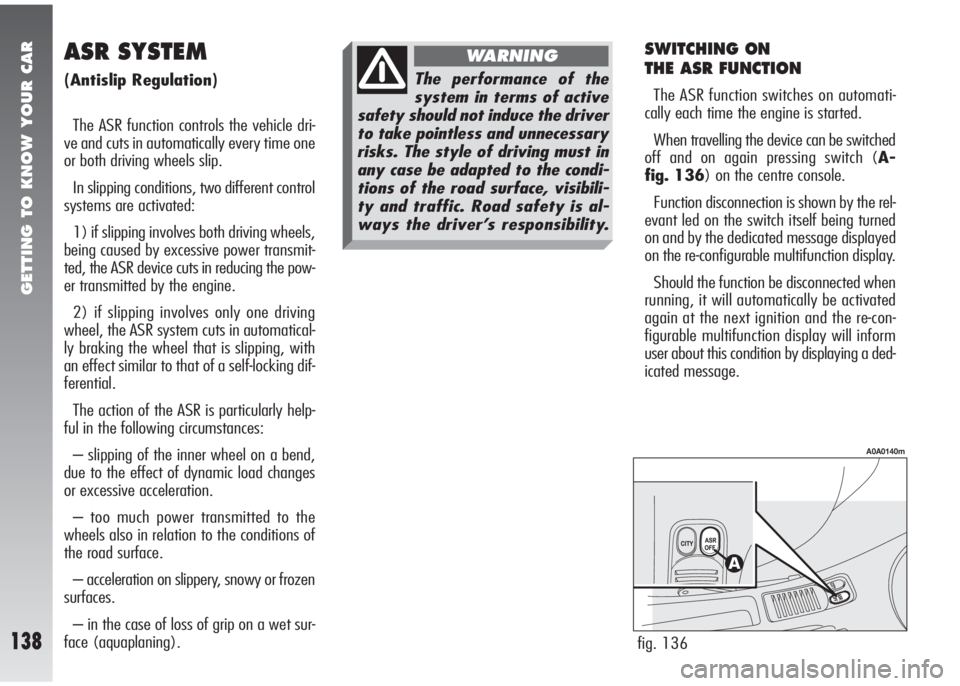
SWITCHING ON
THE ASR FUNCTION
The ASR function switches on automati-
cally each time the engine is started.
When travelling the device can be switched
off and on again pressing switch (A-
fig. 136) on the centre console.
Function disconnection is shown by the rel-
evant led on the switch itself being turned
on and by the dedicated message displayed
on the re-configurable multifunction display.
Should the function be disconnected when
running, it will automatically be activated
again at the next ignition and the re-con-
figurable multifunction display will inform
user about this condition by displaying a ded-
icated message.
fig. 136
A0A0140m
ASR SYSTEM
(Antislip Regulation)
The ASR function controls the vehicle dri-
ve and cuts in automatically every time one
or both driving wheels slip.
In slipping conditions, two different control
systems are activated:
1) if slipping involves both driving wheels,
being caused by excessive power transmit-
ted, the ASR device cuts in reducing the pow-
er transmitted by the engine.
2) if slipping involves only one driving
wheel, the ASR system cuts in automatical-
ly braking the wheel that is slipping, with
an effect similar to that of a self-locking dif-
ferential.
The action of the ASR is particularly help-
ful in the following circumstances:
– slipping of the inner wheel on a bend,
due to the effect of dynamic load changes
or excessive acceleration.
– too much power transmitted to the
wheels also in relation to the conditions of
the road surface.
– acceleration on slippery, snowy or frozen
surfaces.
– in the case of loss of grip on a wet sur-
face (aquaplaning).The performance of the
system in terms of active
safety should not induce the driver
to take pointless and unnecessary
risks. The style of driving must in
any case be adapted to the condi-
tions of the road surface, visibili-
ty and traffic. Road safety is al-
ways the driver’s responsibility.
WARNING
Page 141 of 291
GETTING TO KNOW YOUR CAR
139
IMPORTANTWhen travelling on snow
with snow chains, it may be helpful to turn
the ASR device off: in fact, in these condi-
tions, slipping of the driving wheels when
moving off makes it possible to obtain bet-
ter drive.
ASR system failure warning
Should a defect arise, the ASR system is
automatically disconnected and the re-con-
figurable multifunction display informs user
about this condition by displaying a dedi-
cated message.
In the event of an ASR system operating
failure, the car behaves in the same way
as a car that is not fitted with this system:
in any case, it is advisable to contact Alfa
Romeo Authorised Services as soon as pos-
sible.
EOBD SYSTEM
The EOBD system (European On Board Di-
agnosis) installed on the car meets Directive
98/69/CE (EURO 3).
This system allows continuous diagnosis
of the components on the car correlated with
emissions; it also alerts the driver, by turn-
ing on the warning light
U(on some ver-
sions together with the message + symbol
on the reconfigurable multifunction display)
on the instrument panel when these com-
ponents are no longer in peak conditions.
The objective is:
– to keep system efficiency under control;
– warn when a fault causes emission lev-
els to increase over the threshold established
by European law;
– warn of the need to replace deteriorat-
ed components.
The system also has a diagnostic connec-
tor that can be interfaced with appropriate
tools, which makes it possible to read the
error codes stored in the control unit, to-
gether with a series of specific parameters
for engine operation and diagnosis.If, turning the ignition key
to MAR, the warning light
Udoes not turn on or if,
while travelling it turns on glow-
ing steadily or flashing together
with the message + symbol on the
reconfigurable multifunction dis-
play, contact Alfa Romeo Autho-
rised Services as soon as possible.
IMPORTANTAfter eliminating the in-
convenience, to check the system com-
pletely, Alfa Romeo Authorised Services are
obliged to run a bench test and, if necessary
road tests which may also call for a long jour-
ney.For correct operation of the
ASR system the tyres must
absolutely be of the same brand
and type on all wheels, in perfect
conditions and, above all, of the
specified type, brand and size.
WARNING
Page 151 of 291
GETTING TO KNOW YOUR CAR
149
11. 5-MIXFunction select button:
– Call station no. 5
– Store station no. 5
– Random CD track playing
12. 4-RPTFunction select button:
– Call station no. 4
– Store station no. 4
– Continuous CD track play-
ing
13. BN-ASRadio frequency range select
function (FM1, FM2, FMT,
MW, LW) - Autostore
14. SRC-SCOperating mode select but-
ton Radio - Compact Disc -
CD-Changer and Scan func-
tion (hearing stations in se-
quence)
15. 3-IIFunction select button:
– Call station no. 3
– Store station no. 3
– CD playing pause
16. 2-CLRFunction select button:
– Call station no. 2
– Store station no. 2
– CLR function (CD track stor-
age clearing)17. 1-TPMFunction select button:
– Call station no. 1
– Store station no. 1
– TPM function (storing CD
playing sequence)
18. AUD-LDSound function select but-
ton: bass tones, treble
tones, right/left and
front/rear balancing and
Loudness (except versions
with BOSE HI-FI system)
19. VOL-Volume lowering button
20. ON-
zFunction select button:
– Set on/off
– Mute on/off
21. VOL+Volume highering button
CONTROLS ON THE STEERING
WHEEL
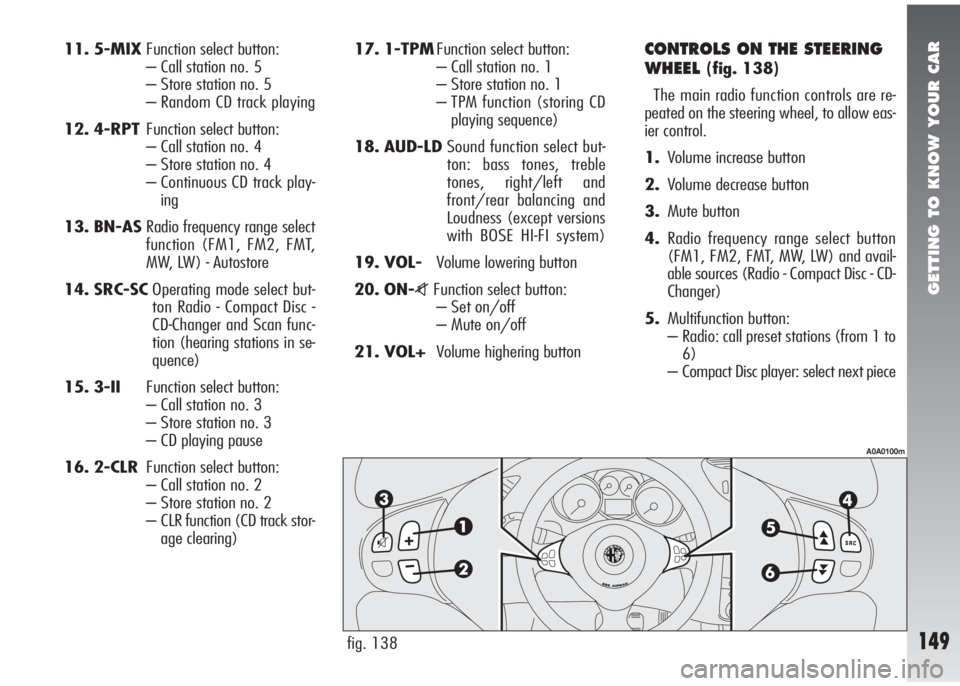
(fig. 138)
The main radio function controls are re-
peated on the steering wheel, to allow eas-
ier control.
1.Volume increase button
2.Volume decrease button
3.Mute button
4.Radio frequency range select button
(FM1, FM2, FMT, MW, LW) and avail-
able sources (Radio - Compact Disc - CD-
Changer)
5.Multifunction button:
– Radio: call preset stations (from 1 to
6)
– Compact Disc player: select next piece
fig. 138
A0A0100m
Page 179 of 291
CORRECT USE OF THE CAR
177
EMERGENCY STARTING
If the Alfa Romeo CODE system does not
recognise the code transmitted by the igni-
tion key (
Y)warning light on the instru-
ment cluster on glowing steadily) emer-
gency starting may be carried out using the
code of the CODE card.
For the correct procedure see the chapter
“In an emergency”.
PARKING
When the vehicle is parked, proceed as fol-
lows:
– Switch off the engine.
– Engage the handbrake.
– Engage first gear if the vehicle is fac-
ing uphill or reverse if the vehicle is facing
downhill.
– Turn the front wheels so that the vehi-
cle will immediately come to a halt if the
handbrake slips. Never bump, tow, or
coast start the vehicle as
this would cause fuel to
flow into the catalyst causing irre-
versible damage.
To avoid useless con-
sumption of power and
possibly draining the bat-
tery, never leave the ignition key
in the MAR position when the en-
gine is not running.
Sharp accelerating before
switching the engine off
should be avoided. A
“kick” on the accelerator serves
no purposes and consumes fuel
pointlessly.
IMPORTANT
If the engine turns off with
the vehicle on the move, the next time it
is started, the Alfa Romeo CODE warning
light may turn on (
Y). In this case, check
that switching off and starting the engine
again with the vehicle stationary, the warn-
ing light stays off. If not, contact Alfa Romeo
Authorised Services.
Remember that the servo-
brake and power steering
are not operational until the engine
has been started, therefore much
more effort than usual is required
on the brake pedal and steering
wheel.
WARNING
Never leave children unat-
tended in the vehicle. Al-
ways remove the ignition key
when leaving the vehicle and take
it with you.
WARNING
Page 180 of 291
CORRECT USE OF THE CAR
178
SAFE DRIVING
In designing your Alfa 147 GTA, Al-
fa Romeo has worked thoroughly to achieve
a vehicle able to offer top levels of safety to
its passengers. However, the behaviour of
the driver is still a decisive factor for road
safety.
Below you will find a few simple rules for
travelling safely under different conditions.
You are certainly familiar with many of them
but it is still helpful to read them all care-
fully.
BEFORE DRIVING OFF
– Make sure the lights and headlights are
working properly.
– Adjust the seat, steering wheel and rear-
view mirrors, in order to obtain a correct po-
sition for driving.
– Carefully adjust the headrests so that
the head and not the neck rests on them.
Check that nothing (mats etc.) can get un-
der the foot pedals.– Make sure that any child restraint sys-
tems (seats, cradles, etc.) are correctly fas-
tened on the rear seat.
– Place any objects in the boot with care
to prevent abrupt braking from throwing
them forwards.
– Avoid heavy meals before a journey. A
light meal will help to keep reflexes ready.
Above all avoid alcohol.
Routinely remember to check:
– tyre pressure and conditions;
– engine oil level;
– engine coolant fluid level and system
conditions;
– brake fluid level;
– power steering oil level;
– windscreen washer fluid level.
WHEN TRAVELLING
– The first rule for safe driving is care.
– Care also means being able to predict
the actions of other road users.
– Strictly respect the traffic regulations in
all countries, especially the speed limits.
– Ensure that both yourself and your pas-
sengers are wearing their seat belts, that
children are carried with the appropriate
seats and that any animals are in appropri-
ate compartments.
– Long distances should be tackled in good
health.
Driving under the influence
of drugs and/or some
medicines is highly dangerous for
oneself and for others.
WARNING
Page 181 of 291
CORRECT USE OF THE CAR
179
– Do not drive for long periods without a
break. During breaks get out of the vehicle
and move around a bit to shake off the
drowsiness.
– Make sure the air in the passenger com-
partment is changed constantly.
– Never coast the vehicle downhill with
the engine switched off: this eliminates the
engine braking and power steering effect
thus requiring a greater effort on the pedal
and steering wheel.
NIGHT DRIVING
Here are some suggestions for night dri-
ving.
– Drive with particular care: night driving
involves a greater degree of concentration.
– Reduce speed, especially on unlit roads.
– At the first signs of drowsiness stop the
car: continuing the journey is dangerous for
yourself and others. Continue driving only
after sufficient rest.
– Maintain a greater distance from the ve-
hicle in front than in the day: it is more dif-
ficult to judge the speed of a vehicle when
only the lights can be seen.
– Ensure that the headlights are correctly
aimed: if they are too low, visibility is re-
duced and eyesight is tired. If they are too
high they may cause disturbance to other
road users.
– Use the main beams only outside built-
up areas and only when you are certain that
other drivers are not disturbed by their use.
– When meeting oncoming vehicles,
switch off the main beams and drive with
the dipped-beam headlights on.
– Keep the headlights and light units
clean.
– Outside built-up areas take care of ani-
mal crossings.Always fasten the front and
rear seat belts including
those of any children’s seat. Trav-
elling without seat belts increases
the risks of serious injury or even
death in the event of an accident.
WARNING
Take car when fitting addi-
tional spoilers, alloy wheels
and wheel caps: they might reduce
ventilation of the brakes, thus their
efficiency, during abrupt and re-
peated braking, or long downhill
slopes.
WARNING
Never drive with objects
on the floor in front of the
driver’s seat: they might get stuck
under the pedals making it impos-
sible to accelerate or brake.
WARNING
Make sure any mats are
appropriate in size: even a
slight inconvenience to the braking
system may require a higher ped-
al stroke than normal.
WARNING
Water, ice and salt on the
roads may deposit on the
brake disks, reducing the effec-
tiveness of the brakes the first
time they are used.
WARNING
Page 182 of 291

CORRECT USE OF THE CAR
180
DRIVING WITH RAIN
Rain and wet roads can be dangerous.
If the road is wet, the traction between
wheel and asphalt is greatly reduced, thus
increasing the stopping distance and de-
creasing road holding.
Here are a few suggestions in the case of
rain:
– Reduce speed and keep further back
from the vehicle in front.
– Heavy rain also reduces visibility. In
these cases, turn on the headlights even dur-
ing the day to make yourself more visible
to others.
– Do not drive over puddles at high speed
and hold the steering wheel firmly: you may
lose control of the car (aquaplaning).
– Position the ventilation controls for
demisting (as described in the chapter (“Get-
ting to know your car”), to prevent visibili-
ty from worsening.
– Routinely check the conditions of the
windscreen wiper blades.
DRIVING IN FOG
– If fog is very thick, avoid travelling
where possible. If travelling with mist,
ground fog or the possibility of fog banks:
– Drive at moderate speed.
– Also in the day turn on the dipped-beam
headlights, rear fog guards and front fog
lights. Do not use the main-beam headlights.
IMPORTANTIf visibility in some parts
improves, switch off the rear fog guards; the
intense light disturbs the occupants of ve-
hicles behind.
– Remember that fog also involves wet
asphalt, thus greater difficulty in all types of
manoeuvres and longer stopping distances.
– Keep well away from the vehicle in
front.
– Where possible avoid sudden changes
in speed.
– Possibly avoid overtaking other vehicles.
– If the vehicle is forced to stop (faults,
impossibility to continue due to poor visi-
bility, etc.), firstly try to pull off the road.
Then turn on the hazard warning lights and,
if possible the dipped-beam headlights.
Rhythmically sound the horn if you note an-
other car coming.
MOUNTAIN DRIVING
– When travelling down hill use the en-
gine braking by engaging lower gears to pre-
vent the brakes from overheating.
– Never coast down hill with the engine
off or in neutral and especially not with the
ignition key removed.
– Drive at a moderate speed and avoid
cutting corners.
– Remember that overtaking up hill is
slower and therefore requires a greater
length of clear road. If you are being over-
taken on a hill, move over to enable the oth-
er vehicle to pass in safety.