change wheel Alfa Romeo 156 2005 Owner handbook (in English)
[x] Cancel search | Manufacturer: ALFA ROMEO, Model Year: 2005, Model line: 156, Model: Alfa Romeo 156 2005Pages: 357, PDF Size: 5.04 MB
Page 197 of 357
CORRECT USE OF THE CAR
195
DRIVING ON SNOW AND ICEHere are few suggestions for driving in
these conditions:
– Keep your speed down.
– On a snowy road, fit winter tyres or
snow chains; see the related paragraphs in
this section.
– Use exhaust brake where possible and
avoid abrupt braking.
– Avoid abrupt acceleration and changes
of direction.
– During cold weather even apparently dry
roads may be covered with occasional
patches of ice. Pay great attention therefore
when driving on roads which are in the
shade, or where rocks or trees line the road
and on which ice may persist.
– Keep further back from the vehicle in
front.
DRIVING WITH ABSThe ABS is a part of the braking system
which essentially offers two advantages:
1)It prevents wheel lock-up and conse-
quent skidding in emergency stops, partic-
ularly when the road does not offer much
grip;
2)It makes it possible to brake and steer
at the same time so you can avoid unex-
pected obstacles and direct the car where
you want while braking. The extent to which
this can be done will depend on the physi-
cal limits of the tyre’s sideways grip.
To make the most of the ABS:
– In emergency braking or when grip is
low, a slight pulsing can be felt on the brake
pedal: this means that the ABS has come
into action. Do not release the pedal, but
continue pressing it to give continuity to the
braking action.
– The ABS prevents the wheels from lock-
ing but it does not increase the physical lim-
its of grip between the asphalt and the road.
Therefore, also with a car fitted with ABS,
keep within a safety distance from the ve-
hicle in front and limit speed when ap-
proaching bends.
The ABS serves to increase car controlla-
bilty not to go faster.
REDUCING RUNNING
COSTS AND
ENVIRONMENT
POLLUTIONSome suggestions which may help you to
keep the running costs of your vehicle down
and lower the amount of toxic emissions re-
leased into the atmosphere are given below.GENERAL CONSIDERATIONSVehicle maintenance
The overalll state of the vehicle is an im-
portant factor which has a marked influence
over fuel consumption and driving comfort
and on the life span of your vehicle. For this
reason care should be taken to maintain
your vehicle by carrying out the necessary
checks and regulations in accordance with
specifications given in the “Scheduled Main-
tenance Programme” (see sections... spark
plugs, air cleaner, timing).
Page 204 of 357

CORRECT USE OF THE CAR
202
It is therefore necessary to limit their use
to the purposes for which they are certified.
WARNINGWhen snow tyres are used
with a max. speed index below the one that
can be reached by the car (increased by
5%), place a notice in the passenger com-
partment, plainly in the driver’s view which
states the max. permissible speed of the
snow tyres (as per EC Directive).
All four tyres should be the same (brand
and track) to ensure greater safety when
driving and braking and better driveability.
Remember that it is inappropriate to
change the direction of rotation of tyres.
WINTER TYRESThese tyres are specially designed for dri-
ving on snow and ice, to be fitted in place
of the existing tyres.
Use snow tyres of the same size as the
normal tyres provided with the car.
Alfa Romeo Authorized Services will be
glad to provide advice concerning the most
suitable type of tyre for the customer’s re-
quirements.
For the type of tyre to be used, inflation
pressures and the specifications of snow
tyres, follow the instructions given in chap-
ter “Technical Specifications”.
The winter features of these tyres are re-
duced considerably when the tread depth
is below 4 mm. In this case, they should be
replaced. Due to the snow tyre features, un-
der normal conditions of use or on long mo-
torway journeys, the performance of these
tyres is lower than that of normal tyres.
SNOW CHAINSUse of snow chains should be in compli-
ance with local regulations.
Use snow chains with reduced size:
– for tyres 185/65 R15” e 205/60
R15” use snow chains with reduced size
with max. protrusion beyond the tyre pro-
file of 12 mm.
– for tyres 205/55 R16” use snow
chains with reduced size with max. protru-
sion beyond the tyre profile of 9 mm.
Tyres 215/45 R17” can-
not be fitted with snow
chains due to interference
with front suspension support. Snow chains should only be applied to the
driving wheels (front wheels).
Alfa Romeo Authorized Services should first
be contacted before purchasing or using
snow chains.
Check the tension of the chains after the
first few metres have been driven.
The max. speed for snow
tyres with “Q” marking is
160 km/h, 190 km/h for tyres
with “T” marking and 210 km/h
for tyres with “H” marking. The
Road Traffic Code speed limits must
however be always strictly ob-
served.
WARNING
Page 209 of 357

IN AN EMERGENCY
207
STARTING BY INERTIA
IN THE EVENT OF A
PUNCTUREWARNINGIf the car is equipped with
“Fix&Go kit for tyre quick repair”, see the
instructions contained in the following
chapter.GENERAL INSTRUCTIONSWheel changing and correct use of the jack
and compact spare wheel call for some pre-
cautions as mentioned below. Never push, tow or coast
start the vehicle. This could
cause fuel to flow into the
catalyst damaging it irreversibly.
Remember that the engine
brake and power steering
are not operational until the engine
is started, therefore, much greater
effort than usual is needed on the
brake pedal and steering wheel.
WARNING
Signal the presence of the
stationary vehicle accord-
ing to the current regulations: haz-
ard warning lights, reflecting tri-
angle, etc.
Any passengers should leave the
car and wait for the wheel to be
changed out of harm of the traffic.
If parked on a slope or uneven road
surfaces, place wedges or other
suitable devices under the wheels
to prevent the car from rolling.
Never start the engine when the
car is raised on the jack.
When towing a trailer, always
remove the trailer before lifting
the car.
WARNING
Page 210 of 357

IN AN EMERGENCY
208
The spare wheel (for ver-
sions/markets where re-
quired) is specific to your model of
car; do not use it on other models,
or use the spare wheel of other
models on your car.
Should the type of wheels used be
changed (alloy rims instead of
steel), it is also necessary to re-
place the complete kit of fastening
bolts with others of suitable size.
The compact spare wheel should
only be used in an emergency and
even then its use should be kept to
a minimum. Do not drive at speeds
of over 80 km/h.
WARNING
On the compact spare
wheel there a sticker with
the main warnings regarding the
compact spare wheel use and lim-
itations. The sticker shall never be
removed or covered. The sticker
bears the following instructions in
four languages:
ATTENTION! ONLY FOR TEMPO-
RARY USE! 80 km/h MAX! RE-
PLACE IT AS SOON AS POSSIBLE
WITH A STANDARD WHEEL. DO
NOT COVER THIS INDICATION.
No wheel cap shall be placed on
the compact spare wheel.
The car will handle differently
when the spare wheel is fitted.
Avoid sudden acceleration or brak-
ing, sharp corners and fast bends.
WARNING
The life of the spare wheel
is approx. 3,000 km. After
this distance it should be replaced
with another of the same type.
Never attempt to fit a tradition-
al tyre to a rim designed for use as
compact spare wheel. Have the
punctured wheel repaired and re-
placed as soon as possible.
Two or more compact spare
wheels should never be used to-
gether.
Do not grease the threads of the
bolts before installing them; they
might slip out.
The jack only serves for chang-
ing wheels on the car with which it
is provided or on cars of the same
model. It must not be used for oth-
er purposes such as for instance
raising cars of other models. In no
case should it be used for repairs
under the vehicle.
The vehicle may fall if the jack is
not positioned correctly.
Do not use the jack for higher ca-
pacities than stated on its label.
WARNING
Page 211 of 357
IN AN EMERGENCY
209
CHANGING A WHEEL(optional for versions/markets
where applicable)
You are informed that:
– The jack mass is 2,100 kg.
– The jack requires no adjustment.
– The jack cannot be repaired, in the event
of breakage it must be replaced by anoth-
er original one.
– No tools other than its operating crank
can be fitted to the jack.
To change the wheel proceed as follows:
– Stop the car in such a position that it is
not dangerous for the traffic, where it is pos-
sible to change the wheel safely. Where pos-
sible, park on a level, compact surface.– Stop the engine and engage the hand-
brake.
– Engage first gear or reverse.
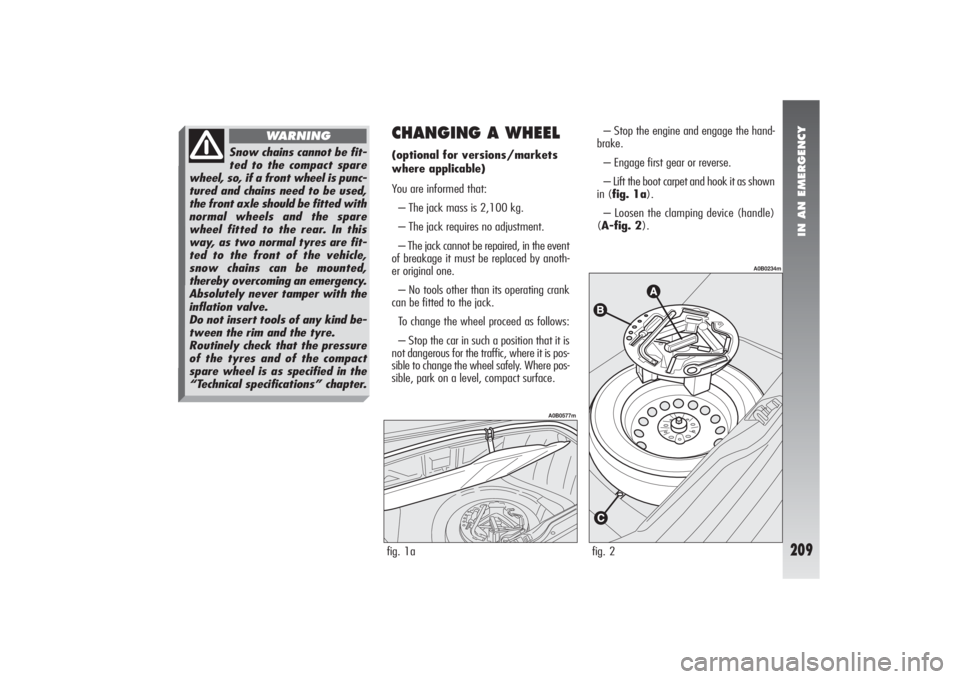
– Lift the boot carpet and hook it as shown
in (fig. 1a).
– Loosen the clamping device (handle)
(A-fig. 2).
fig. 2
A0B0234m
fig. 1a
A0B0577m
Snow chains cannot be fit-
ted to the compact spare
wheel, so, if a front wheel is punc-
tured and chains need to be used,
the front axle should be fitted with
normal wheels and the spare
wheel fitted to the rear. In this
way, as two normal tyres are fit-
ted to the front of the vehicle,
snow chains can be mounted,
thereby overcoming an emergency.
Absolutely never tamper with the
inflation valve.
Do not insert tools of any kind be-
tween the rim and the tyre.
Routinely check that the pressure
of the tyres and of the compact
spare wheel is as specified in the
“Technical specifications” chapter.
WARNING
Page 212 of 357

IN AN EMERGENCY
210
– Take out the tool container (B) and take
it near the wheel to be changed.
– Take the spare wheel (C).
– Remove the wheel cap (A-fig. 3) (for
versions wuth steel rims only).
– Loosen the fastening bolts by approx.
one turn (B-fig. 4).– Place the jack under the car near the
wheel to be changed.
– Work the jack crank (A-fig. 5)to ex-
tend it until the groove (B-fig. 6) on the
upper part of the jack is correctly inserted
on the lower profile of the body (C-fig. 6)
at about 40 cm from the profile of the
wheelhouse.
– Work the jack and raise the car until the
wheel is a few centimetres from the ground.
– Completely unscrew the bolts (B-
fig. 4), and remove the wheel.
– Make sure that the contact surfaces of
the compact spare wheel with the hub are
clean and free of impurities which may lat-
ter cause the fastening bolts to slacken.– Install the spare wheel by matching one
of the holes (A-fig. 7) with the corre-
sponding pin (B-fig. 7).
– Tighten the five fastening bolts.
– Lower the car and remove the jack.fig. 4
A0B0230m
fig. 3
A0B0229m
fig. 5
A0B0231m
fig. 7
A0B0226m
fig. 6
A0B0232m
Page 253 of 357
CAR MAINTENANCE
251
ADDITIONAL
OPERATIONSEvery 1000 kmor before long journeys
check and if necessary top up:
– engine coolant level
– brake fluid/hydraulic clutch control flu-
id level
– power steering fluid level
– windscreen washer and headlamp wash-
er fluid level
– tyre pressure and conditions.
Every 3000 kmcheck the level of the
engine oil and top up if necessary.
You are recommended to use products of
the FL Selenia, designed and developed
expressly for Alfa Romeo cars (see the table
“Specifications of fluids and lubricants” in
the “Technical specifications” chapter).
ANNUAL INSPECTION
PROGRAMMEAn annual inspection programme
has been established for cars thet
cover less than 20,000 km (e.g.
10,000 km). It consists of the fol-
lowing:
– Check tyre conditions/wear and adjust
pressure if required (including the compact
spare wheel)
– Check lighting system operation (head-
lights, direction indicators, hazard lights,
boot lights, passenger compartment lights,
glovebox light, warning lights of instrument
panel, etc.)
– Check windscreen and rear-screen
wiper/washer operation, adjust nozzles
– Check windscreen/rear-screen blade po-
sition/wear
– Check condition and wear of the front
brake pad
– Check for bonnet and boot lock clean-
ness, lever cleanness and lubrication– Visually check the following: engine,
gearbox, transmission, piping (exhaust - fu-
el - brakes) rubber components (casings -
sleeves - bushings, etc..), brake and fuel
hoses
– Check battery charge condition
– Visually check the condition of the belts
and various controls
– Check and top up if necessary, the flu-
id levels (coolant, brake fluid, windscreen
washer fluid, battery, etc.)
– Change engine oil
– Replace engine oil filter
– Change pollen filter.
Page 273 of 357

CAR MAINTENANCE
271
WHEELS AND TYRESTYRES PRESSURECheck the pressure of each tyre, includ-
ing the compact spare wheel, every two
weeks and before a long journey.
The pressure should be checked with the
tyre rested and cold.
It is normal for the pressure to increase
when the car is in use. If you have to check
or restore the pressure when the tyres are
hot, bear in mind that the pressure should
be +0.3 bar compare with the specified rat-
ing.
For the correct tyre inflation pressure, see
“Wheels” in the “Technical specifications”
chapter.Incorrect pressure causes abnormal tyre
wear fig. 25:
A- Normal pressure: tread evenly worn.
B- Low pressure: tread particularly worn
at the edges.
C- High pressure: tread particularly worn
in the centre.
fig. 25
A0B0235m
WARNINGS
Where possible, avoid sudden braking, tyre
squealing starts, etc.
Particularly avoid violent bumps against
kerbs, potholes or obstacles of various kinds.
Prolonged driving on rough roads may dam-
age the tyres.
Routinely check the tyres for cuts on the
sides, swellings or uneven tread wear. If nec-
essary contact Alfa Romeo Authorized Ser-
vices.
Avoid overloading the vehicle when trav-
elling: this may cause serious damage to the
wheels and tyres.
If a tyre is punctured, stop immediately
and change it to avoid damage to the tyre,
the rim, suspensions and steering system.
Tyres age even if they are not used much.
Cracks in the tread rubber are a sign of ag-
ing. In any case, if the tyres have been on
the car for over 6 years, they should be
checked by specialised personnel, to see if
they can still be used. Also remember to
check the spare wheel.
Remember that car road
holding also depends on
correct tyre inflation pressure.
WARNING
Excessively low pressure
causes overheating of the
tyre with the possibility of serious
damage to it.
WARNING
Tyres should be changed when the tread
thickness is reduced to 1.6 mm. In any case
follow local regulations.
Page 274 of 357

CAR MAINTENANCE
272
fig. 26
A0B0589m
In the case of replacement, always fit new
tyres, avoiding those of dubious origin.
Alfa 156uses Tubeless tyres. Never
use an inner tube with these tyres.
If a tyre is changed, also change the in-
flation valve
To allow even wear between the front and
rear tyres, it is advisable to change them
over every 10-15 thousand kilometres,
keeping them on the same side of the car
so as to not reverse the direction of rotation
(fig. 26).
RUBBER HOSESAs far as the brake system and fuel sup-
ply rubber hoses are concerned, carefully fol-
low the Scheduled Maintenance Programme
of this chapter. Indeed ozone, high tem-
peratures and prolonged lack of fluid in the
system may cause hardening and cracking
of the hoses, with possible leaks. Careful
control is therefore necessary.
Do not cross switch the
tyres, moving them from
the right of the car to the left and
vice versa.
WARNING
Alloy rim painting involv-
ing temperatures exceed-
ing 150°C should be avoided since
wheel mechanical characteristics
could be impaired.
WARNING
Page 296 of 357

ALFA 156 SPORTWAGON
294
IN THE EVENT
OF A PUNCTUREWARNINGIf the car is equipped with
“Fix&Go kit for tyre quick repair”, see the
instructions contained in the “In emergency”
chapter.fig. 47
A0B0127m
TOOL AND SPARE WHEEL
HOUSING
(for versions/markets where
required)
(fig. 47)
The tools and spare wheels are housed in
the boot floor, under the mat. To gain
access to them, raise or remove the boot
mat using the handle (A-fig. 47).
To take the container with the tools (B)
slacken the handle (C).
The spare wheel (D) can be taken after
removing the container with the tools.
IF AN EXTERIOR
LIGHT GOES OUTWARNINGBefore changing a bulb, read
the warnings and precautions given in the
chapter “In an emergency”.REVERSING LIGHTS AND REAR
FOG GUARDSTo change the bulbs (Type B, 21W):
– Open the tailgate.
– Remove the cover (Aor B-fig. 48) in
correspondence with the light concerned,
withdrawing it at the side.fig. 48
A0B0128m