instrument panel Alfa Romeo 166 2006 Owner handbook (in English)
[x] Cancel search | Manufacturer: ALFA ROMEO, Model Year: 2006, Model line: 166, Model: Alfa Romeo 166 2006Pages: 272, PDF Size: 4.17 MB
Page 12 of 272
11
Sit comfortably in your vehicle and carefully read through the fol-
lowing pages.
You will immediately recognize the parts described and rapidly get
to know the controls and devices fitted to your vehicle.STR (SPORT THROTTLE RESPONSE) SYSTEM.................................................63
CONSTANT SPEED REGULATOR (CRUISE CONTROL)
...................................64
PARKING SENSORS
...............................................................................................67
INSTRUMENT PANEL
.............................................................................................68
CLIMATE CONTROL
................................................................................................80
CLIMATE CONTROL UNIT
.....................................................................................83
ADDITIONAL HEATER
............................................................................................91
CONTROLS
................................................................................................................93
INTERNAL FITTINGS
..............................................................................................96
SUNROOF
.................................................................................................................103
LUGGAGE COMPARTMENT
..................................................................................105
BONNET
....................................................................................................................109
HEADLIGHTS
............................................................................................................110
EOBD SYSTEM
........................................................................................................113
ABS
.............................................................................................................................114
VDC AND ASR SYSTEMS
.......................................................................................117
SOUND SYSTEM
......................................................................................................122
REFUELLING
............................................................................................................124
FUEL CUT-OFF SWITCH
........................................................................................127
ENVIRONMENTAL PROTECTION
.........................................................................129 DASHBOARD
................................................................................................page 12
ALFA ROMEO I.C.S. SYSTEM: CONTROLS ON STEERING WHEEL
. ..........14
THE ALFA ROMEO CODE SYSTEM
......................................................................16
ELECTRONIC ALARM
..............................................................................................22
REMOTE CONTROL DOOR LOCKING SYSTEM
................................................26
IGNITION DEVICE
...................................................................................................26
DOORS
.......................................................................................................................28
SEATS
.........................................................................................................................31
STEERING WHEEL ADJUSTMENT
.......................................................................36
ADJUSTING THE REAR-VIEW MIRRORS
..........................................................36
POWER WINDOWS
................................................................................................38
SEAT BELTS
...............................................................................................................40
CARRYING CHILDREN SAFELY
............................................................................45
FRONT AND SIDE AIR BAGS
...............................................................................50
LIGHT SWITCHES & STEERING WHEEL LEVERS
............................................57
GETTING TO KNOW YOUR CAR
Page 59 of 272
58
Sidelights
The sidelights are switched on by turn-
ing the knurled ring (A) from Oto
6.
The
3warning light on the instru-
ment panel will come on at the same
time.
Dipped-beam headlights
These are switched on by turning the
knurled ring (A) from
6to2.
Parking lights
When the pointer of the switch (A) cor-
responds with the
Fsymbol, the side
lights stay on regardless of the position of
the ignition key.
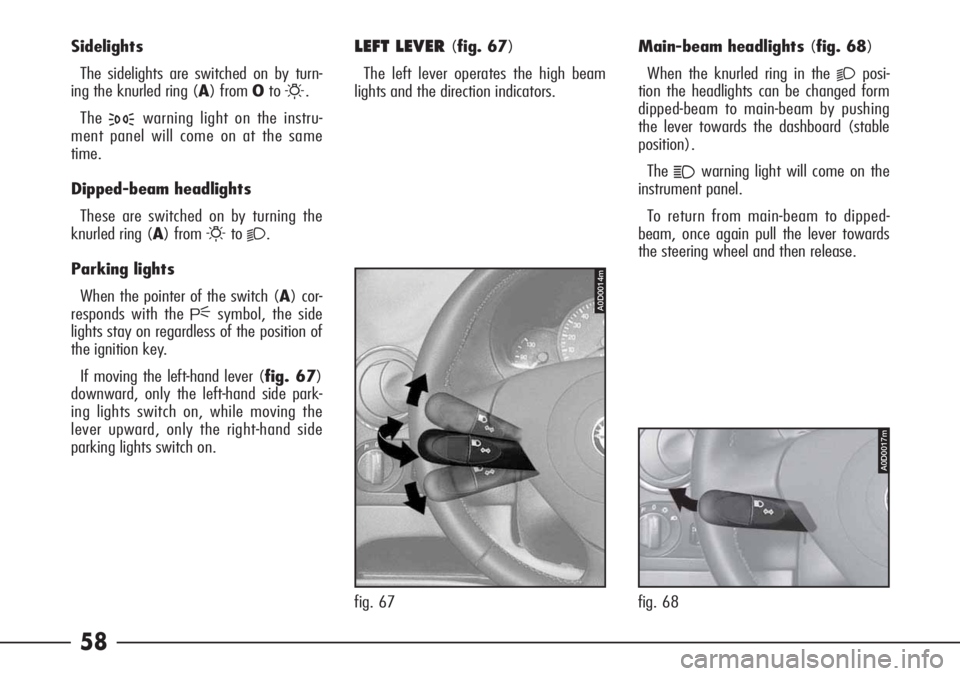
If moving the left-hand lever (fig. 67)
downward, only the left-hand side park-
ing lights switch on, while moving the
lever upward, only the right-hand side
parking lights switch on.Main-beam headlights (fig. 68)
When the knurled ring in the
2posi-
tion the headlights can be changed form
dipped-beam to main-beam by pushing
the lever towards the dashboard (stable
position).
The
1warning light will come on the
instrument panel.
To return from main-beam to dipped-
beam, once again pull the lever towards
the steering wheel and then release.
LEFT LEVER (fig. 67)
The left lever operates the high beam
lights and the direction indicators.
fig. 67
A0D0014m
A0D0017m
fig. 68
Page 60 of 272
59
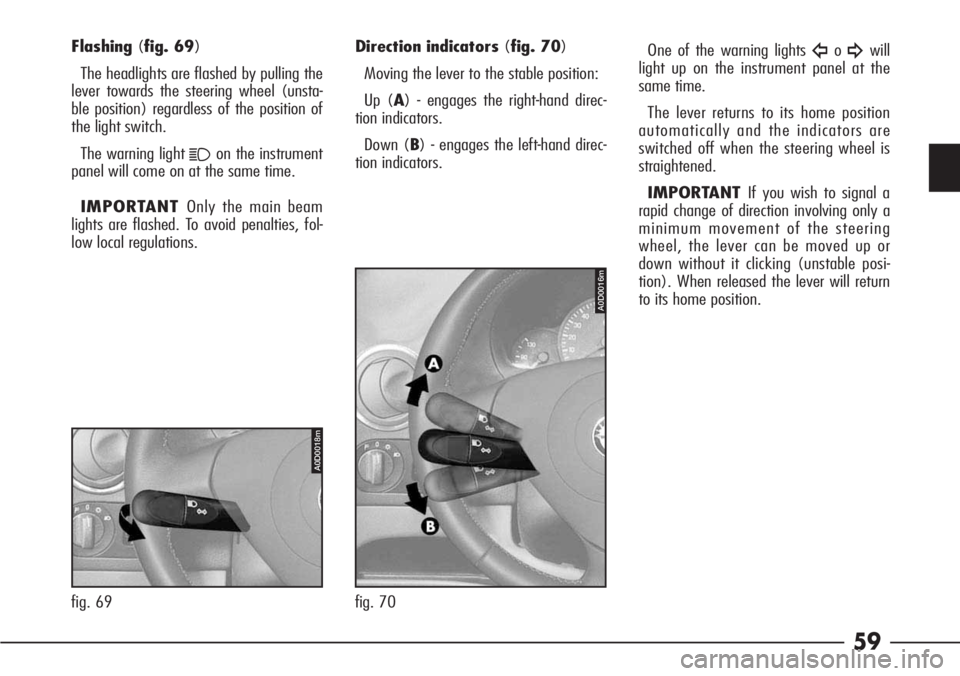
Flashing(fig. 69)
The headlights are flashed by pulling the
lever towards the steering wheel (unsta-
ble position) regardless of the position of
the light switch.
The warning light
1on the instrument
panel will come on at the same time.
IMPORTANT Only the main beam
lights are flashed. To avoid penalties, fol-
low local regulations.Direction indicators (fig. 70)
Moving the lever to the stable position:
Up (A) - engages the right-hand direc-
tion indicators.
Down (B) - engages the left-hand direc-
tion indicators.One of the warning lights
Îo¥will
light up on the instrument panel at the
same time.
The lever returns to its home position
automatically and the indicators are
switched off when the steering wheel is
straightened.
IMPORTANT If you wish to signal a
rapid change of direction involving only a
minimum movement of the steering
wheel, the lever can be moved up or
down without it clicking (unstable posi-
tion). When released the lever will return
to its home position.
A0D0018m
fig. 69
A0D0016m
fig. 70
Page 69 of 272
68
fig. 80 - 3.2 V6 24V version
INSTRUMENT PANEL
A0D0065m
Page 71 of 272
70
IMPORTANT Depending on the trim
levels, the dial of the instruments may be
either light grey or black, with green or
red light.
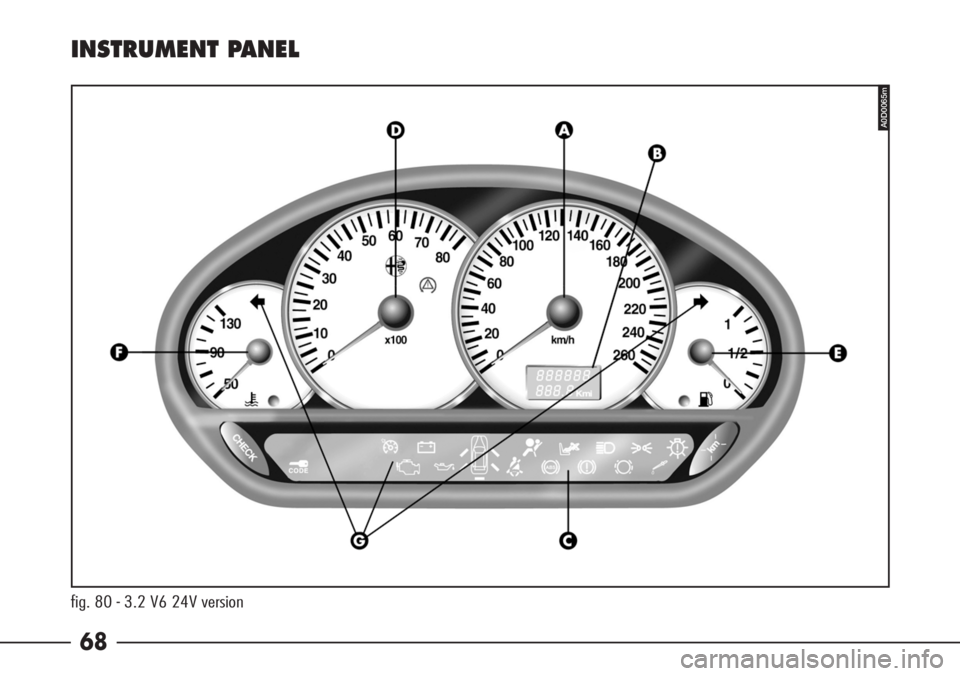
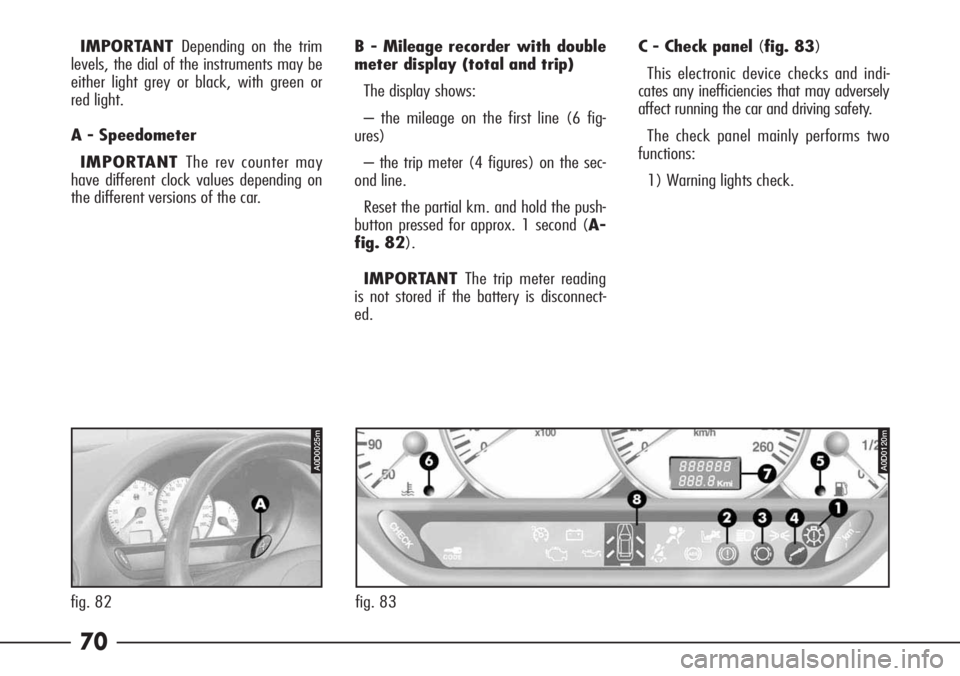
A - Speedometer
IMPORTANT The rev counter may
have different clock values depending on
the different versions of the car.B - Mileage recorder with double
meter display (total and trip)
The display shows:
– the mileage on the first line (6 fig-
ures)
– the trip meter (4 figures) on the sec-
ond line.
Reset the partial km. and hold the push-
button pressed for approx. 1 second (A-
fig. 82).
IMPORTANT The trip meter reading
is not stored if the battery is disconnect-
ed.C - Check panel (fig. 83)
This electronic device checks and indi-
cates any inefficiencies that may adversely
affect running the car and driving safety.
The check panel mainly performs two
functions:
1) Warning lights check.
A0D0025mA0D0120m
fig. 82 fig. 83
Page 94 of 272

93
CONTROLS
OPENING THE LUGGAGE
COMPARTMENT
(fig. 95)
To open the luggage compartment from
inside the car press the button (A) (with
the car stationary) inside the glovebox.
Because of its position, the control can-
not be operated when the glovebox is
key-locked.
IMPORTANT The corresponding
warning light on the check panel lights up
if the luggage compartment is not shut
properly.
HAZARD WARNING LIGHTS
(fig. 96)
These are switched on by pressing but-
ton (A) regardless of the position of the
ignition key.
When the hazard warning lights are
switched on the switch itself begins to
flash together with the direction indicator
on the instrument panel. This function is
switched off by pressing the button again.
IMPORTANT Use the hazard lights in
compliance with local regulations.
FRONT FOGLIGHTS (fig. 97)
These come on when the button (A) is
pressed and when the external lights are
already on.
When the foglights are on the led next
to the button lights up.
Press the button again to switch the
front foglights off.
IMPORTANT The front foglights
should be used in compliance with the lo-
cal traffic laws. The front foglights system
meets EEC/ECE regulations.
534PGSm
fig. 96 fig. 95
574PGSm
fig. 97
1008PGSm
Page 96 of 272
95
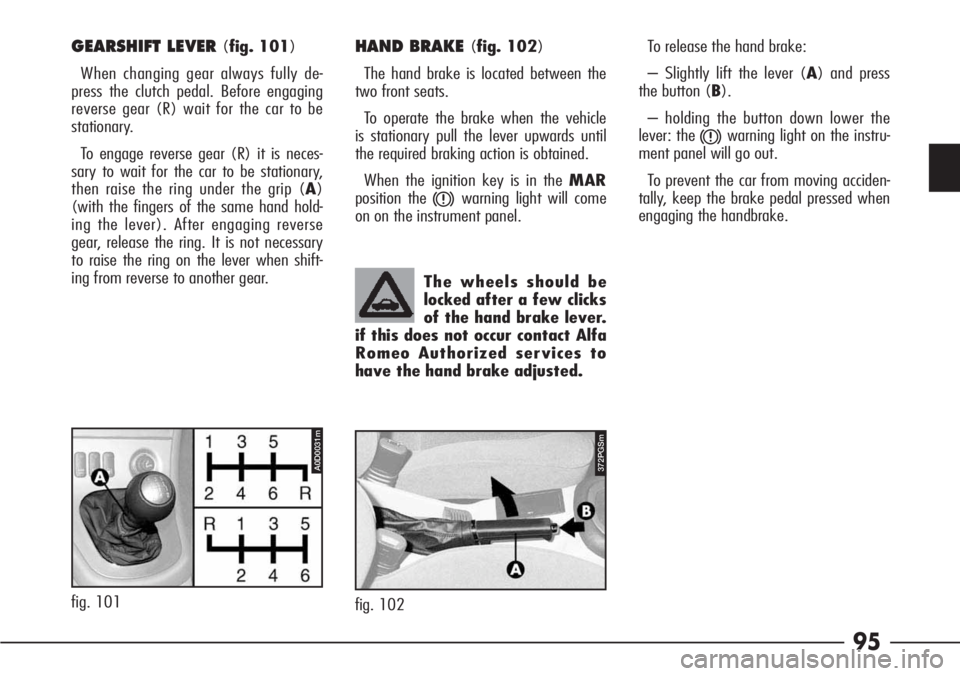
GEARSHIFT LEVER (fig. 101)
When changing gear always fully de-
press the clutch pedal. Before engaging
reverse gear (R) wait for the car to be
stationary.
To engage reverse gear (R) it is neces-
sary to wait for the car to be stationary,
then raise the ring under the grip (A)
(with the fingers of the same hand hold-
ing the lever). After engaging reverse
gear, release the ring. It is not necessary
to raise the ring on the lever when shift-
ing from reverse to another gear.
fig. 101
A0D0031m
HAND BRAKE (fig. 102)
The hand brake is located between the
two front seats.
To operate the brake when the vehicle
is stationary pull the lever upwards until
the required braking action is obtained.
When the ignition key is in the MAR
position the
xwarning light will come
on on the instrument panel.To release the hand brake:
– Slightly lift the lever (A) and press
the button (B).
– holding the button down lower the
lever: the
xwarning light on the instru-
ment panel will go out.
To prevent the car from moving acciden-
tally, keep the brake pedal pressed when
engaging the handbrake.
The wheels should be
locked after a few clicks
of the hand brake lever.
if this does not occur contact Alfa
Romeo Authorized services to
have the hand brake adjusted.
fig. 102
372PGSm
Page 114 of 272
113
EOBD SYSTEM
(optional for versions/
markets where applicable
)
The EOBD system (European On Board
Diagnosis) allows continuous diagnosis of
the components of the car correlated with
emissions.
This system continuously monitors the
components of the vehicle related to e-
missions; it also indicates, when the
Uwarning light comes on on the instrument
panel, that the components in question
are in poor condition.
IMPORTANTAfter the problem has
been resolved, to completely check the
system, the Alfa Romeo Authorized Ser-
vice Station must carry out tests on a test
bench and, if necessary, road tests that
could be long.If, when the ignition key
is turned to MAR, the
Uwarning light does
not come on or if, when driving, it
lights up and emits a fixed light
or a flashing one, contact an Alfa
Romeo Authorized Service Station
as soon as possible. Warning
light
Uoperation can be checked
by means of special equipment
by traffic agents. Always comply
with the traffic regulations in
force in the country where you
are travelling.
The objective is the following:
– to keep under control the efficiency of
the system;
– to warn when a fault causes emission
levels to increase;
– to indicate the need to replace the
deteriorated components.
The system also has a diagnostic con-
nector that can be interfaced with appro-
priate tools, which makes it possible to
read the error codes stored in the control
unit, together with a series of specific pa-
rameters for engine operation and diag-
nosis. This check can also be carried out
by the traffic police.
Page 138 of 272
137
– Check the operation of the horn.
– Check the operation and degree of
wear of the windscreen wipers.
– Check the operation of the external
lights and if necessary, clean the light
units.
– Above all when driving at night,
check the alignment of headlight beams
before starting off.
– Check that no oil or other liquid is
leaking out under the car.
– Ensure that luggage is stowed away
correctly.
– Ensure that, in addition to yourself,
all passengers have fastened their seat
belts.
– Ensure that the handbrake is re-
leased and that the warning lights on the
instrument panel do not indicate a mal-
function. To avoid accidental movements
of the car, disengage the handbrake
keeping the brake pedal pressed.
The following should also be noted:
– Long distances should be tackled
when in good health and should where
possible be programmed, especially when
the roads are busy.– A light meal containing easily assimil-
able foods will help keep reflexes ready
and aid concentration for a safe journey.– Use the direction indicators when
changing direction.
– Switch on the external lights at sun-
set.
– Keep a safe distance from the vehicle
in front. A “safe” distance will vary ac-
cording to the speed of the vehicle,
weather conditions and road-traffic condi-
tions.
– Never drive with one hand resting on
the gear lever. The involuntary movement
of the gear lever which this causes, even
if slight, will cause avoidable wear to the
internal elements of the gearbox.
– Never drive with the gearbox in neu-
tral.
– Do not drive with your foot resting on
the clutch pedal as this habit leads to
rapid wearing of the clutch.
– Do not drive for long periods without
a break. During a break get out of the ve-
hicle and move around a bit to shake off
drowsiness.
– Ensure that the air in the vehicle is
changed constantly using the many possi-
bilities offered by the heating-ventilation
and climate control system.
WHEN TRAVELLING
– Driving with care also means being
able to predict the actions of other road
users, respecting the speed limits and oc-
cupying the near-side lane on motorways.
Driving under the influ-
ence of alcohol, drugs
and/or some medicines is highly
dangerous.
Never drive when drunk or under
the effect of drugs or medicines.
WARNING
Page 141 of 272
140
– During cold weather even apparently
dry roads may be covered with occasion-
al patches of ice. Pay great attention
therefore when driving on roads which
are in the shade, or where rocks or trees
line the road and on which ice may per-
sist.
IMPORTANT To avoid damaging
tyres do not drive on bare patches of as-
phalt with snow chains fitted to the vehi-
cle. In extreme cases proceed slowly and
remove the chains as soon as possible.
When driving on snow with snow chains
fitted, it might be helpful to turn off the
ASR function of the VDC system (if pre-
sent): in fact, in these conditions, skid-
ding of the driving wheels when moving
off makes it possible to obtain higher
traction.
BRAKES
An efficient braking system is vital to
the safety of the vehicle and its passen-
gers.
To use the brakes correctly and to im-
prove their efficiency and limit wear the
following recommendations should be fol-
lowed:– Do not drive with your foot resting on
the brake pedal.
– Ensure that the brake pedal is not
blocked by the mat or other objects.
– Check the efficiency of the braking
system especially before long journeys.
– Check the handbrake and brake fluid
minimum level warning light
xon the
instrument panel. if the
xwarning light
comes on and stays on when the vehicle
is travelling check that the handbrake is
not engaged. If it is not, stop the vehicle
immediately and check the level of the
brake fluid. If the level is low the anom-
aly affecting the circuit should be rectified
immediately. If the
dwarning light
comes on when the brake pedal is
pressed, this means that the front brake
pads have reached the minimum permit-
ted thickness. Have them replaced as
soon as possible by Alfa Romeo Autho-
rized Services.
– The brake fluid is hygroscopic (i.e. it
absorbs humidity). To prevent the onset
of braking anomalies it should therefore
be replaced every two years regardless of
the kilometres travelled.
SERVO BRAKE
The vehicle is equipped with a servo-
braking system (active only when the en-
gine is running). When the engine is sta-
tionary a greater effort is required to de-
press the brake pedal in order to obtain
the same braking effect.
ANTI WHEEL-LOCK SYSTEM
(ABS)
The vehicle is equipped with an ABS sys-
tem with electronic braking device (EBD),
the following should be heeded:
– A slight pulsing may be felt on the
brake pedal caused by the intervention of
the ABS system.
– The performance of the system, in
terms of active safety, should not induce
the driver to take unnecessary and unjus-
tified risks.
– The conduct of the driver must always
reflect weather, road and traffic condi-
tions.
– Deceleration always depends on the
degree of grip between the tyres and the
road surface. Obviously road holding is