low beam Alfa Romeo 166 2007 Owner handbook (in English)
[x] Cancel search | Manufacturer: ALFA ROMEO, Model Year: 2007, Model line: 166, Model: Alfa Romeo 166 2007Pages: 272, PDF Size: 4.17 MB
Page 60 of 272
59
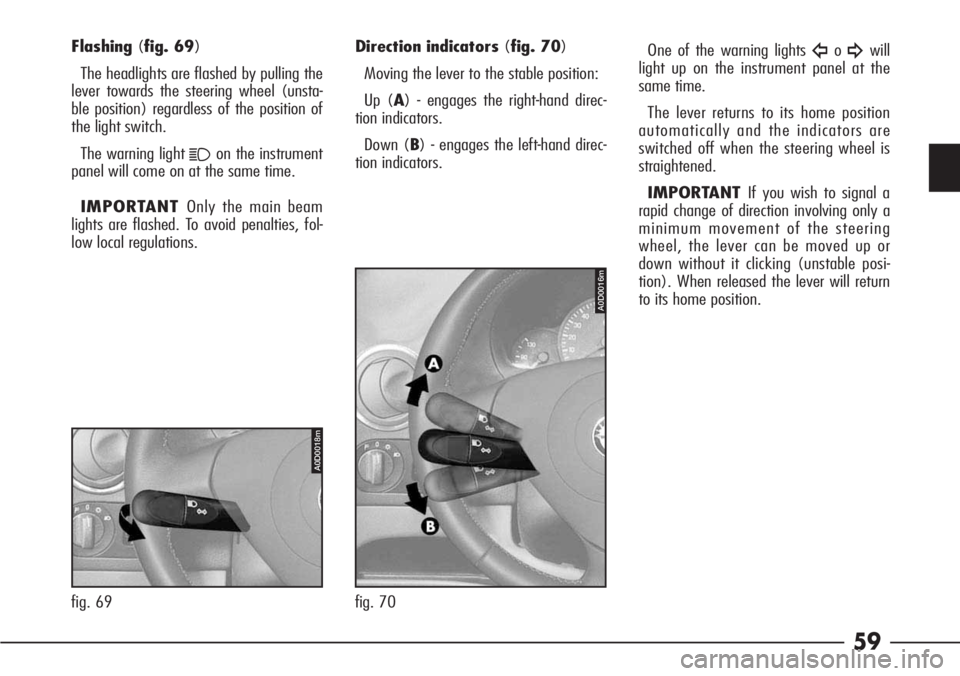
Flashing(fig. 69)
The headlights are flashed by pulling the
lever towards the steering wheel (unsta-
ble position) regardless of the position of
the light switch.
The warning light
1on the instrument
panel will come on at the same time.
IMPORTANT Only the main beam
lights are flashed. To avoid penalties, fol-
low local regulations.Direction indicators (fig. 70)
Moving the lever to the stable position:
Up (A) - engages the right-hand direc-
tion indicators.
Down (B) - engages the left-hand direc-
tion indicators.One of the warning lights
Îo¥will
light up on the instrument panel at the
same time.
The lever returns to its home position
automatically and the indicators are
switched off when the steering wheel is
straightened.
IMPORTANT If you wish to signal a
rapid change of direction involving only a
minimum movement of the steering
wheel, the lever can be moved up or
down without it clicking (unstable posi-
tion). When released the lever will return
to its home position.
A0D0018m
fig. 69
A0D0016m
fig. 70
Page 61 of 272
60
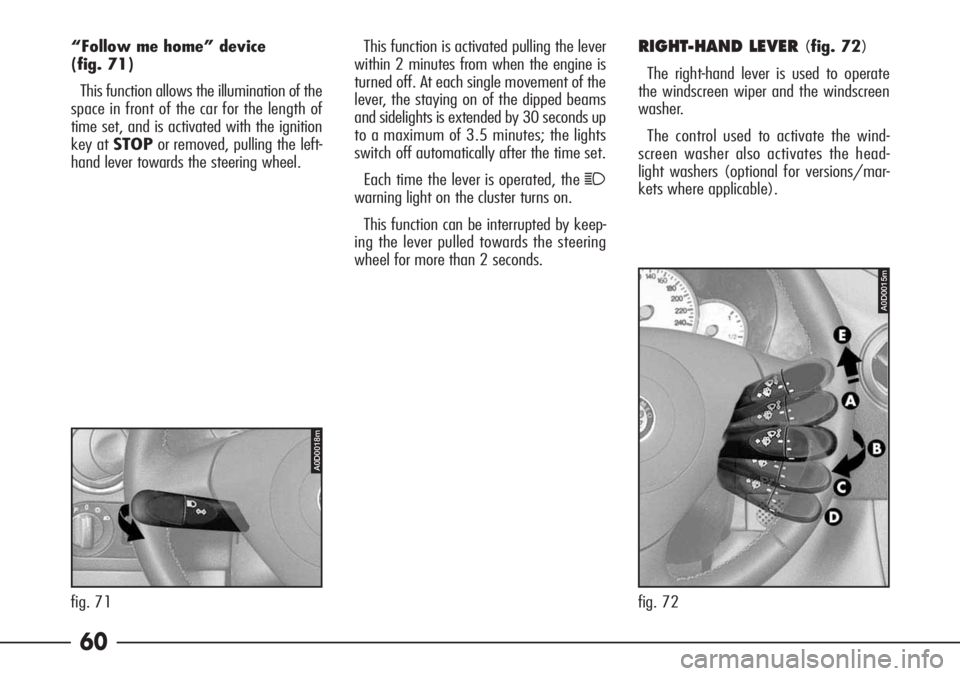
RIGHT-HAND LEVER (fig. 72)
The right-hand lever is used to operate
the windscreen wiper and the windscreen
washer.
The control used to activate the wind-
screen washer also activates the head-
light washers (optional for versions/mar-
kets where applicable). “Follow me home” device
(fig. 71)
This function allows the illumination of the
space in front of the car for the length of
time set, and is activated with the ignition
key at STOPor removed, pulling the left-
hand lever towards the steering wheel.This function is activated pulling the lever
within 2 minutes from when the engine is
turned off. At each single movement of the
lever, the staying on of the dipped beams
and sidelights is extended by 30 seconds up
to a maximum of 3.5 minutes; the lights
switch off automatically after the time set.
Each time the lever is operated, the
1
warning light on the cluster turns on.
This function can be interrupted by keep-
ing the lever pulled towards the steering
wheel for more than 2 seconds.
fig. 72
A0D0015m
A0D0018m
fig. 71
Page 63 of 272
62
At each start the rain sensor automati-
cally (in about 2 minutes) stabilises at a
temperature of about 40°C to eliminate
any condensation from the control surface
and prevent the formation of ice.
The rain sensor is capable of detecting
and adapting automatically to the pres-
ence of the following particular conditions
which call for different sensitivity:
– impurities on the control surface
(saline deposits, dirt, etc.)
– streaks of water caused by partial
wear of the windscreen wiper
– difference between day and night
(the human eye is more disturbed during
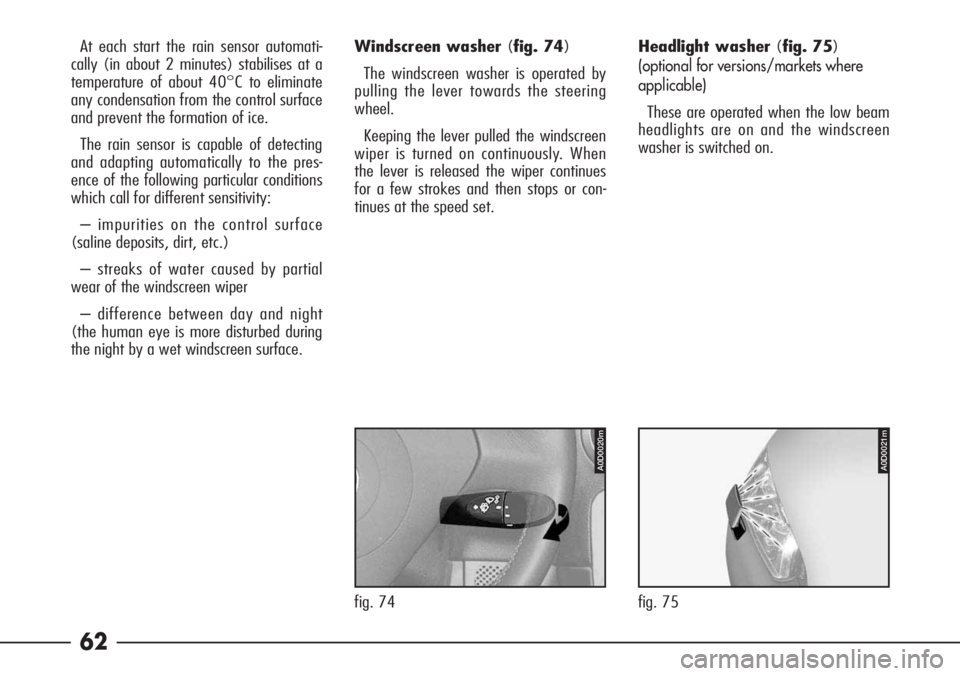
the night by a wet windscreen surface.Headlight washer (fig. 75)
(optional for versions/markets where
applicable)
These are operated when the low beam
headlights are on and the windscreen
washer is switched on. Windscreen washer (fig. 74)
The windscreen washer is operated by
pulling the lever towards the steering
wheel.
Keeping the lever pulled the windscreen
wiper is turned on continuously. When
the lever is released the wiper continues
for a few strokes and then stops or con-
tinues at the speed set.
A0D0020m
fig. 74
A0D0021m
fig. 75
Page 79 of 272
78
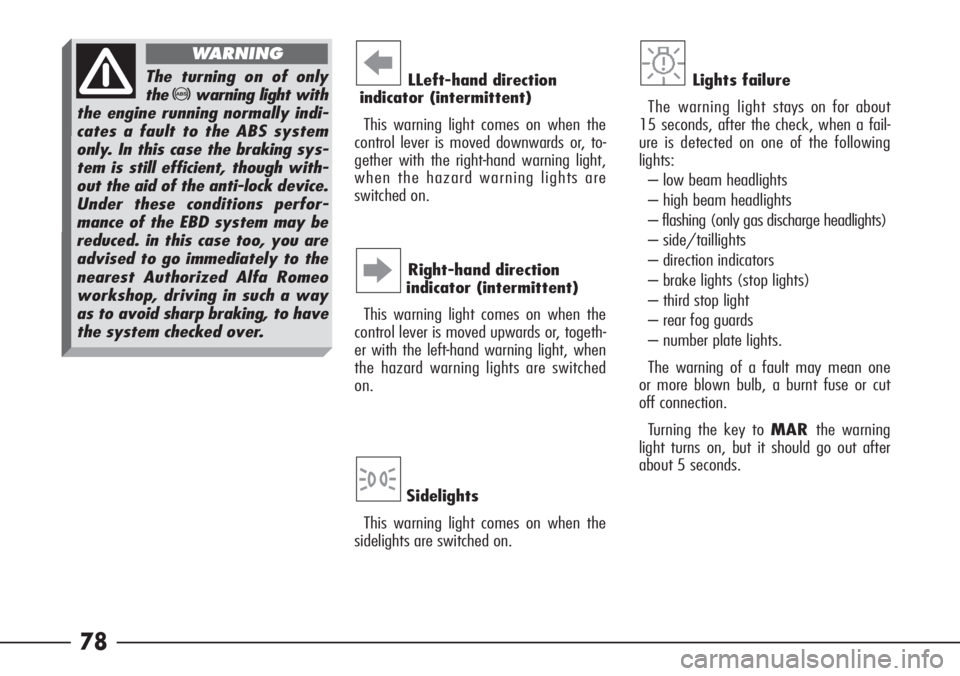
LLeft-hand direction
indicator (intermittent)
This warning light comes on when the
control lever is moved downwards or, to-
gether with the right-hand warning light,
when the hazard warning lights are
switched on. R
Sidelights
This warning light comes on when the
sidelights are switched on.3
Right-hand direction
indicator (intermittent)
This warning light comes on when the
control lever is moved upwards or, togeth-
er with the left-hand warning light, when
the hazard warning lights are switched
on.E
Lights failure
The warning light stays on for about
15 seconds, after the check, when a fail-
ure is detected on one of the following
lights:
– low beam headlights
– high beam headlights
– flashing (only gas discharge headlights)
– side/taillights
– direction indicators
– brake lights (stop lights)
– third stop light
– rear fog guards
– number plate lights.
The warning of a fault may mean one
or more blown bulb, a burnt fuse or cut
off connection.
Turning the key to MARthe warning
light turns on, but it should go out after
about 5 seconds.The turning on of only
the
>warning light with
the engine running normally indi-
cates a fault to the ABS system
only. In this case the braking sys-
tem is still efficient, though with-
out the aid of the anti-lock device.
Under these conditions perfor-
mance of the EBD system may be
reduced. in this case too, you are
advised to go immediately to the
nearest Authorized Alfa Romeo
workshop, driving in such a way
as to avoid sharp braking, to have
the system checked over.
WARNING
Page 109 of 272
108
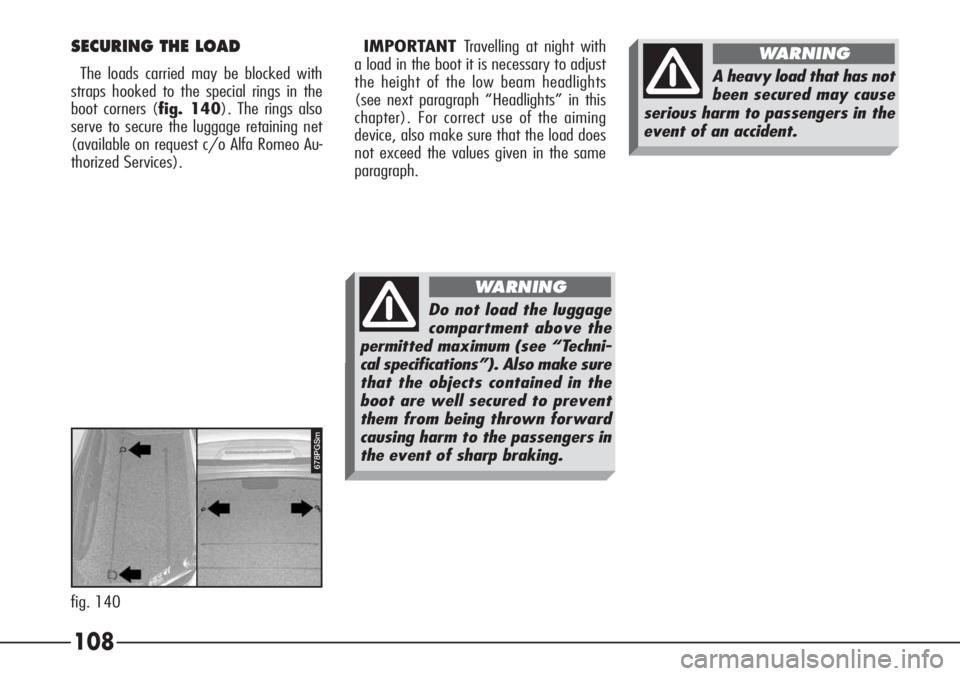
SECURING THE LOAD
The loads carried may be blocked with
straps hooked to the special rings in the
boot corners (fig. 140). The rings also
serve to secure the luggage retaining net
(available on request c/o Alfa Romeo Au-
thorized Services).
fig. 140
678PGSm
Do not load the luggage
compartment above the
permitted maximum (see “Techni-
cal specifications”). Also make sure
that the objects contained in the
boot are well secured to prevent
them from being thrown forward
causing harm to the passengers in
the event of sharp braking.
WARNING
A heavy load that has not
been secured may cause
serious harm to passengers in the
event of an accident.
WARNINGIMPORTANT Travelling at night with
a load in the boot it is necessary to adjust
the height of the low beam headlights
(see next paragraph “Headlights” in this
chapter). For correct use of the aiming
device, also make sure that the load does
not exceed the values given in the same
paragraph.
Page 112 of 272
111
GAS DISCHARGE HEADLIGHTS
(optional for versions/markets where
applicable)
Gas discharge headlights (xenon) work
with a voltaic arc, in an atmosphere satu-
rated with pressurised xenon gas, instead
of the incandescent filament.
The lighting produced is remarkably
higher than that of the conventional light
in both terms of the quality of the light
(lighter) and of the amplitude and posi-
tion of the lit area.
The advantages offered by better light-
ing are noted (due to less sight fatigue
and better orientation capability of the
driver, thus of travelling safety) especially
in bad weather, fog and/or insufficient
signs, because of the higher lighting
of the side beams which are normally
shaded.
The heavy increase of lighting in the
side beams considerably increases driving
safety because it allows the driver to bet-
ter see other users at the sides of the
road (pedestrians, cyclists and motorcy-
clists).Very high voltage is needed to trigger
the voltaic arc, after which the supply can
be at low voltage.
The headlights reach their maximum in-
tensity after about 15 seconds from
switching on.
The high luminosity produced by this
type of headlight calls for the use of an
automatic system to keep the headlight
beam aiming constant and prevent daz-
zling other vehicles when braking, accel-
erating and carrying loads.
The electromechanical system for auto-
matic constant beam aiming makes the
headlight aiming device superfluous.
Xenon lights are very long-lasting and
failure is unlikely.
If necessary, have the
system checked and any
repairs done only by Authorized Al-
fa Romeo Services.
WARNING
Page 113 of 272
112
AIMING LOW BEAM
HEADLAMPS FOR
LEFT/RIGHT CIRCULATION
(only for versions with gas discharge
headlamps)
On cars fitted with gas discharge head-
lamps (xenon bulbs)(optional for ver-
sions/markets where applicable) with
high lighting power, when passing from a
country with right circulation to one with
left circulation or vice versa it is necessary
to change the aiming of the low beams,
to optimise lighting of the edge of the
road and avoid glaring vehicles met.
IMPORTANT Contact Alfa Romeo Au-
thorised Services to have low beam head-
lamps correctly adjusted.
BEAM AIMING
(excluding versions with gas discharge
headlights)
The adjustment of the headlights is vital
to your safety and comfort and to that of
other road users.
The adjustment of the headlights is also
governed by precise regulations.
Contact Alfa Romeo Authorized Services
to have the headlights correctly adjusted.
When returning to the
country of origin, re-
member to change the low beam
aiming again.
WARNING
To have the position
checked and if neces-
sary adjusted, contact
Alfa Romeo Authorized Services.
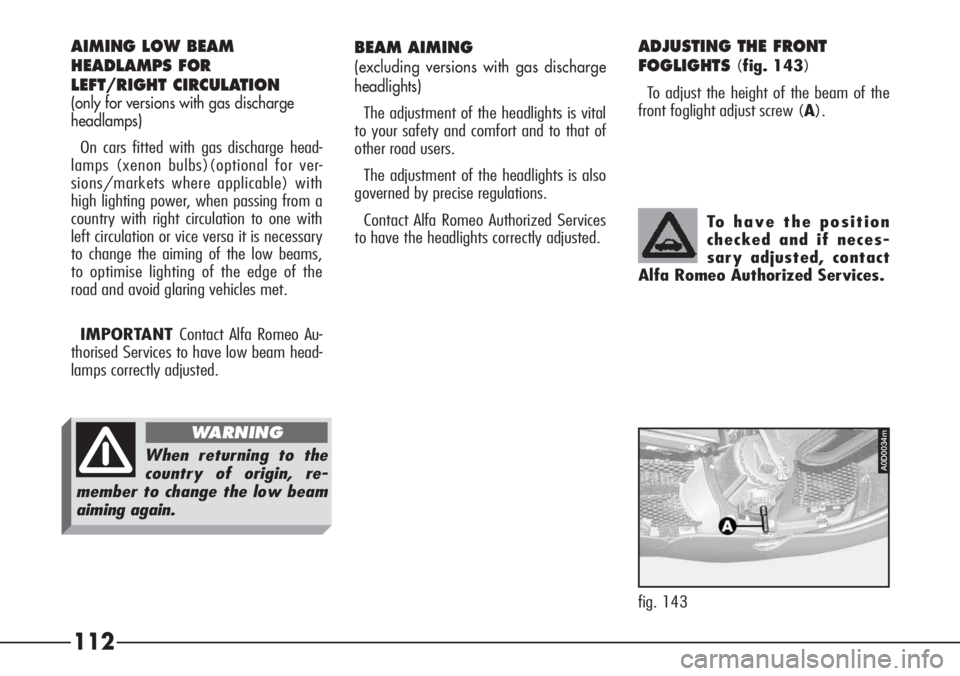
ADJUSTING THE FRONT
FOGLIGHTS
(fig. 143)
To adjust the height of the beam of the
front foglight adjust screw (A).
fig. 143
A0D0034m
Page 138 of 272
137
– Check the operation of the horn.
– Check the operation and degree of
wear of the windscreen wipers.
– Check the operation of the external
lights and if necessary, clean the light
units.
– Above all when driving at night,
check the alignment of headlight beams
before starting off.
– Check that no oil or other liquid is
leaking out under the car.
– Ensure that luggage is stowed away
correctly.
– Ensure that, in addition to yourself,
all passengers have fastened their seat
belts.
– Ensure that the handbrake is re-
leased and that the warning lights on the
instrument panel do not indicate a mal-
function. To avoid accidental movements
of the car, disengage the handbrake
keeping the brake pedal pressed.
The following should also be noted:
– Long distances should be tackled
when in good health and should where
possible be programmed, especially when
the roads are busy.– A light meal containing easily assimil-
able foods will help keep reflexes ready
and aid concentration for a safe journey.– Use the direction indicators when
changing direction.
– Switch on the external lights at sun-
set.
– Keep a safe distance from the vehicle
in front. A “safe” distance will vary ac-
cording to the speed of the vehicle,
weather conditions and road-traffic condi-
tions.
– Never drive with one hand resting on
the gear lever. The involuntary movement
of the gear lever which this causes, even
if slight, will cause avoidable wear to the
internal elements of the gearbox.
– Never drive with the gearbox in neu-
tral.
– Do not drive with your foot resting on
the clutch pedal as this habit leads to
rapid wearing of the clutch.
– Do not drive for long periods without
a break. During a break get out of the ve-
hicle and move around a bit to shake off
drowsiness.
– Ensure that the air in the vehicle is
changed constantly using the many possi-
bilities offered by the heating-ventilation
and climate control system.
WHEN TRAVELLING
– Driving with care also means being
able to predict the actions of other road
users, respecting the speed limits and oc-
cupying the near-side lane on motorways.
Driving under the influ-
ence of alcohol, drugs
and/or some medicines is highly
dangerous.
Never drive when drunk or under
the effect of drugs or medicines.
WARNING
Page 139 of 272
138
PARKING
When the vehicle is parked, proceed as
follows:
– Switch off the engine.
– Engage the handbrake.
– Engage first gear if parking the car
uphill or reverse if parking the car on a s-
loping road. On cars with automatic gear-
box set the gear lever to P.
– Turn the front wheels so that the vehi-
cle will immediately come to a halt if the
handbrake slips.
NIGHT DRIVING
Night driving involves a greater degree
of concentration, both physical and ner-
vous. Some suggestions concerning night
driving follow:
– Drive with particular care, reducing
speed if necessary especially on unlit
roads.
– Maintain a greater distance from the
vehicle in front than during the day as it
is more difficult to judge the speed of a
vehicle when only the lights can be seen.
– If you become drowsy stop the car
and rest. continuing the journey when
sleepy is dangerous for yourself and for
others.
–Ensure that the headlights are correct-
ly aligned: if they are too low visibility is
reduced and if they are too high they
may cause disturbance to other users.
– use the main-beam outside built-up
areas and only when you are certain that
other drivers are not disturbed by their
use.
– When meeting vehicles coming in the
opposite direction, switch off the main-
beam and drive with the dipped-beam
headlights on.
– Keep the headlights and light units
clean at all times. – Do not coast the vehicle down hill
with the engine switched off as this elimi-
nates the engine braking effect thus re-
quiring a greater effort on the brake ped-
al, on the power steering and consider-
ably more effort on the steering wheel.
– If it is necessary to stop the vehicle
following a malfunction, park off the
road, switch on the hazard warning lights
and set up the warning triangle to alert
other road users of the presence of your
vehicle. At all times comply with the cur-
rent road traffic regulations.To avoid useless con-
sumption of power and
possible draining of the
battery, never leave the ignition
key in the MAR position when
the engine is not running.Ensure that both yourself
and your passengers are
wearing their seat belts. Travelling
without seat belts greatly in-
creases the risks of serious injury
or even death in the event of an
accident.
WARNING
Never leave children un-
attended in the vehicle.
Always remove the key from the
ignition when leaving the vehicle
and take it with you.
WARNING
Page 140 of 272
139
DRIVING UNDER ADVERSE
WEATHER CONDITIONS
Rain and fog can be extremely danger-
ous if the style of driving is not adapted
to suit these conditions. Some sugges-
tions are given below:
– if the road is wet, the friction be-
tween wheel and asphalt is greatly re-
duced thus increasing the stopping dis-
tance and decreasing road holding when
cornering.
Reduce speed and keep further back
from the vehicle in front.
– Heavy rain and fog reduce visibility.
Headlights should be switched on as the
road traffic laws and common sense dic-
tate, above all to render yourself visible
to others.
– Do not drive over puddles or flooded
roads at high speed as the aquaplaning
phenomenon may cause you to loose
control over the vehicle.
– If visibility is already reduced prevent
it from worsening by ensuring that the
windows do not steam up. Use the heat-
ing-ventilation controls as indicated in the
chapter “Know your vehicle”.– Check the condition of the windscreen
wiper blades.
– If fog is very thick avoid travelling
where possible. If travelling cannot be
avoided drive with extreme care and
moderate your speed. Avoid overtaking.
– If the vehicle is forced to stop owing
to a malfunction or zero visibility condi-
tions, pull off the road, switch on the haz-
ard warning lights and if possible, the
dipped-beam headlights.
MOUNTAIN DRIVING
Mountain driving requires a greater de-
gree of concentration. Some practical
hints follow:
– Before driving off check the level of
fluids (engine oil, brakes, coolant) and
the state of the tyres.
– When travelling down hill use the en-
gine braking by engaging lower gears to
prevent the brakes from overheating.
– Never coast downhill with the engine
off or in neutral and especially not with
the ignition key removed.
– Drive at a moderate speed and avoid
cutting corners.– Remember that overtaking uphill is
slower and therefore requires a greater
length of clear road. If you are being
overtaken on a hill move over to enable
the other vehicle to pass in safety.
WINTER DRIVING
If the temperature falls below 0°C or in
the presence of snow or ice the following
recommendations should be followed:
– Before driving off check that the
windscreen wipers are not frozen to the
windscreen.
– Remove the snow from the air intake
(grille) at the base of the windscreen.
– Do not stop long on deep snow with
the engine running: the snow might di-
vert the exhaust gas carbon monoxide in-
to the passenger compartment.
– Ensure that brakes and tyres are in
perfect working order.
–Ensure that the detergent liquid locat-
ed in the windscreen/headlight washers
has been topped up with anti-freeze and
anti-scale additives.
– Use engine braking where possible
and avoid abrupt braking.