ABS Alfa Romeo 4C 2016 Owner handbook (in English)
[x] Cancel search | Manufacturer: ALFA ROMEO, Model Year: 2016, Model line: 4C, Model: Alfa Romeo 4C 2016Pages: 182, PDF Size: 9.49 MB
Page 94 of 182
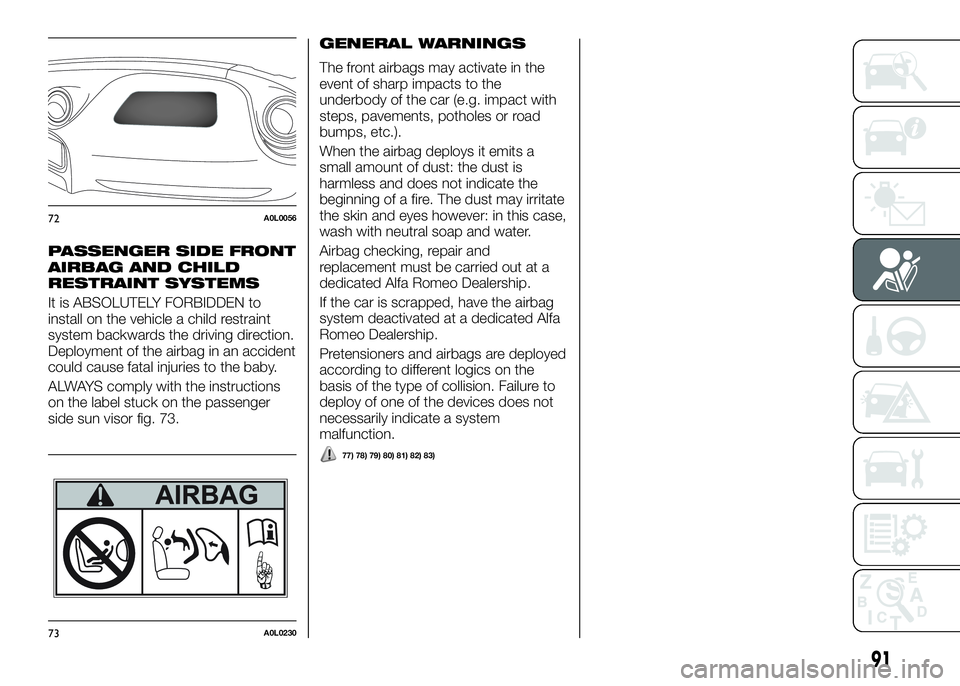
PASSENGER SIDE FRONT
AIRBAG AND CHILD
RESTRAINT SYSTEMS
It is ABSOLUTELY FORBIDDEN to
install on the vehicle a child restraint
system backwards the driving direction.
Deployment of the airbag in an accident
could cause fatal injuries to the baby.
ALWAYS comply with the instructions
on the label stuck on the passenger
side sun visor fig. 73.
GENERAL WARNINGS
The front airbags may activate in the
event of sharp impacts to the
underbody of the car (e.g. impact with
steps, pavements, potholes or road
bumps, etc.).
When the airbag deploys it emits a
small amount of dust: the dust is
harmless and does not indicate the
beginning of a fire. The dust may irritate
the skin and eyes however: in this case,
wash with neutral soap and water.
Airbag checking, repair and
replacement must be carried out at a
dedicated Alfa Romeo Dealership.
If the car is scrapped, have the airbag
system deactivated at a dedicated Alfa
Romeo Dealership.
Pretensioners and airbags are deployed
according to different logics on the
basis of the type of collision. Failure to
deploy of one of the devices does not
necessarily indicate a system
malfunction.
77) 78) 79) 80) 81) 82) 83)
72A0L0056
73A0L0230
91
Page 98 of 182
STARTING THE
ENGINE
Procedure84) 85) 86)
press the brake pedal;
turn the ignition key to AVV and
release it as soon as the engine starts.
IMPORTANT INFORMATION
9)
If the engine does not start at the first
attempt, return the ignition key to STOP
before repeating the procedure.
If, when the ignition key is at
MAR-ON, the
instrument panel
warning light stays on together with the
warning light, turn the key to STOP
and then back to MAR-ON; if the
warning light stays on, try the other
keys provided with the vehicle. If it is
still not possible to start the engine,
contact a dedicated Alfa Romeo
Dealership.
Do not leave the ignition key at
MAR-ON when the engine is stopped.
WARMING UP THE
ENGINE JUST AFTER IT
HAS STARTED
Proceduredrive off slowly, letting the engine turn
at medium revs. Do not accelerate
abruptly;
do not demand full performance at
first. It is advisable to wait until the
digital engine coolant temperatureindicator starts moving.
SWITCHING OFF THE
ENGINE
Procedure
Turn the ignition key to STOP while the
engine is idling.
IMPORTANT After a demanding drive,
keep the engine idling for at least a
couple of minutes before stopping it, in
order to permit the temperature inside
the engine compartment to lower.
WARNING
84)It is dangerous to run the engine in
enclosed areas. The engine takes in
oxygen and releases carbon dioxide,
carbon monoxide and other toxic gases.
85)The brake servo is not active until the
engine is started, so you would need to
apply much more force than usual to the
brake pedal.
86)Do not start the engine by pushing,
towing or driving downhill. These
manoeuvres may damage the catalytic
converter.
IMPORTANT
8)It is advisable not to demand maximum
performance from your car (e.g. excessive
acceleration, long distances at maximum
rpm, excessively intense braking, etc.)
when it is first used.9)When the engine is switched off never
leave the ignition device in the MAR
position to prevent useless current
absorption from draining the battery.
10)A quick burst on the accelerator before
stopping the engine serves no practical
purpose; it wastes fuel and is especially
damaging to turbocharged engines.
95
8)10)
Page 104 of 182
WARNING
89)The Launch control function is only
available in Race mode. Regardless of
what is explicitly indicated in the
description of these modes, the ESC and
ASR systems are deactivated during
operation of the Launch Control function.
This means that vehicle dynamic control is
the sole responsibility of the driver.
Therefore pay the utmost attention when
using the Launch Control. Take into
account traffic and road surface conditions
and during manoeuvres make sure there is
enough room in the area concerned.
SAVING FUEL
Alfa Romeo has designed and built the
vehicle using technologies, materials
and devices able to reduce negative
environmental impact. Here are some
suggestions to further contribute to
environmental protection.
GENERAL
CONSIDERATIONS
Car maintenance
Have checks and adjustments carried
out in accordance with the “Scheduled
Servicing Plan”.
Tyres
Check the tyre pressures at least once
every four weeks: if the pressure is too
low, consumption levels increase as
resistance to rolling is higher.
Climate control system
The use of the climate control system
leads to higher fuel consumption. If the
temperature outside permits, try to use
ventilation only.
DRIVING STYLE
Starting
Do not warm the engine with the car at
a standstill or at idle or high speed:
under these conditions the engine
warms up much more slowly, increasing
consumption and emissions. It is
therefore advisable to move off
immediately, slowly, avoiding high
speeds: in this way the engine will
warm up more quickly.Unnecessary actions
Avoid accelerating when stopped at
traffic lights or before switching off the
engine. This action is absolutely
pointless and only increases
consumption and pollution.
Gear selection
Using a low gear for faster acceleration
increases consumption.
In the same way, improper use of a high
gear increases consumption, emissions
and engine wear.
Max. speed
Fuel consumption increases
considerably with speed. Maintain a
constant speed, avoiding unnecessary
braking and acceleration, which cost in
terms of both fuel consumption and
emissions.
Acceleration
Accelerating violently will greatly affect
consumption and emissions: avoid
frequent and strong accelerations.
CONDITIONS OF USE
Cold starting
Short journeys and frequent cold starts
do not allow the engine to reach
optimum operating temperature.
This results in a significant increase in
consumption levels (from +15 to +30%
on the urban cycle) and emissions.
101
Page 128 of 182
IMPORTANT
19)Be careful to position the lift arms
correctly at the points illustrated, in order to
prevent damage to the carbon fibre chassis
and the bodywork components.
20)To avoid damage to the carbon fibre
chassis, the car cannot be raised with
standard hydraulic jacks, only with suitable
lowered hydraulic jacks. Contact a
dedicated Alfa Romeo Dealership.
TOWING THE CAR
21)
The tow hook provided with the car is
located in the tool box in the luggage
compartment.
ATTACHING THE TOW
HOOK
Take tow hook A and tighten it fully onto
the threaded pin fig. 120.
115) 116) 117)
IMPORTANT
21)The tow hook attachment is only
available at the front end of the car.
WARNING
115)Before towing, turn the key to MAR
and then to STOP without extracting it. The
steering column will automatically lock
when the key is removed and the wheels
cannot be steered. Also check that the
transmission is in neutral (N)
116)When towing, remember that the
assistance of the brake servo is absent.
Consequently, more force is required at the
pedal in order to brake. Do not use flexible
cables when towing and avoid jerky
movements. Make sure not to damage
parts in contact with the car while towing.
When towing the vehicle, you must comply
with all specific traffic regulations and
adopt an appropriate driving behaviour. Do
not start the engine while towing the car.
Before tightening the ring, clean the
threaded housing thoroughly. Make sure
that the ring is fully screwed into the
housing before towing the car.
117)The tow hook must be used
exclusively for roadside assistance
operations. You are allowed to tow the
vehicle for short distances using an
appropriate device in accordance with the
highway code (a rigid bar), to move the
vehicle on the road in readiness for towing
or transport via a tow truck. Tow hooks
MUST NOT be used to tow vehicles off the
road or where there are obstacles and/or
for towing operations using cables or other
non-rigid devices. In compliance with the
above conditions, towing must take place
with the two vehicles (one towing, the other
towed) aligned as much as possible along
the same centre line.
120A0L0107
125
Page 139 of 182
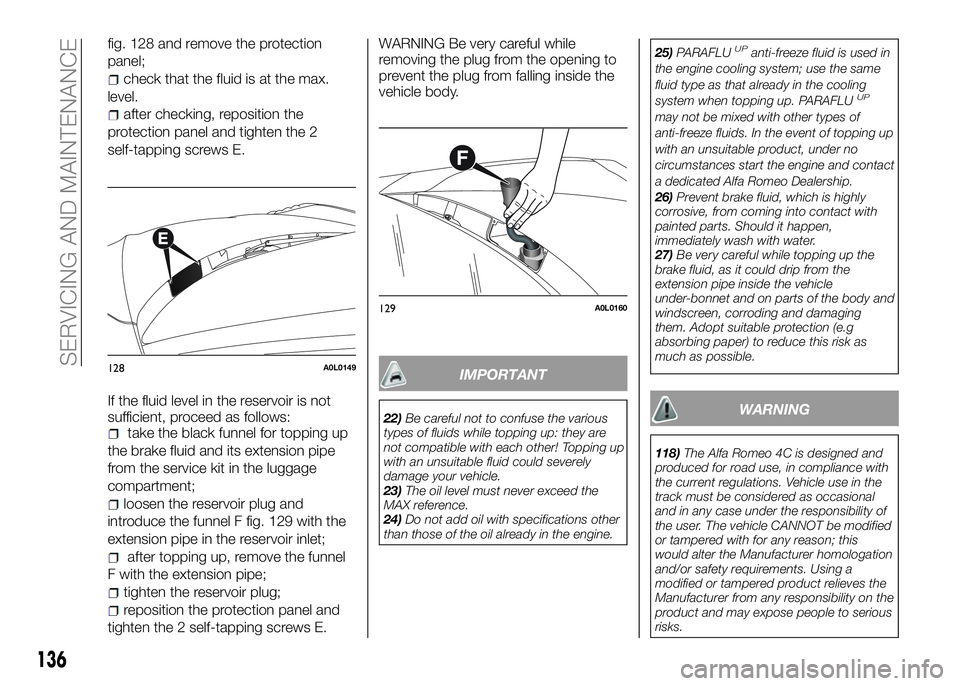
fig. 128 and remove the protection
panel;
check that the fluid is at the max.
level.
after checking, reposition the
protection panel and tighten the 2
self-tapping screws E.
If the fluid level in the reservoir is not
sufficient, proceed as follows:
take the black funnel for topping up
the brake fluid and its extension pipe
from the service kit in the luggage
compartment;
loosen the reservoir plug and
introduce the funnel F fig. 129 with the
extension pipe in the reservoir inlet;
after topping up, remove the funnel
F with the extension pipe;
tighten the reservoir plug;
reposition the protection panel and
tighten the 2 self-tapping screws E.WARNING Be very careful while
removing the plug from the opening to
prevent the plug from falling inside the
vehicle body.
IMPORTANT
22)Be careful not to confuse the various
types of fluids while topping up: they are
not compatible with each other! Topping up
with an unsuitable fluid could severely
damage your vehicle.
23)The oil level must never exceed the
MAX reference.
24)Do not add oil with specifications other
than those of the oil already in the engine.25)PARAFLU
UPanti-freeze fluid is used in
the engine cooling system; use the same
fluid type as that already in the cooling
system when topping up. PARAFLU
UP
may not be mixed with other types of
anti-freeze fluids. In the event of topping up
with an unsuitable product, under no
circumstances start the engine and contact
a dedicated Alfa Romeo Dealership.
26)Prevent brake fluid, which is highly
corrosive, from coming into contact with
painted parts. Should it happen,
immediately wash with water.
27)Be very careful while topping up the
brake fluid, as it could drip from the
extension pipe inside the vehicle
under-bonnet and on parts of the body and
windscreen, corroding and damaging
them. Adopt suitable protection (e.g
absorbing paper) to reduce this risk as
much as possible.
WARNING
118)The Alfa Romeo 4C is designed and
produced for road use, in compliance with
the current regulations. Vehicle use in the
track must be considered as occasional
and in any case under the responsibility of
the user. The vehicle CANNOT be modified
or tampered with for any reason; this
would alter the Manufacturer homologation
and/or safety requirements. Using a
modified or tampered product relieves the
Manufacturer from any responsibility on the
product and may expose people to serious
risks.
128A0L0149
129A0L0160
136
SERVICING AND MAINTENANCE
Page 146 of 182
INTERIORS
137) 138)
Periodically check the cleanliness of the
interior, beneath the mats, also to
prevent damage to carbon parts.
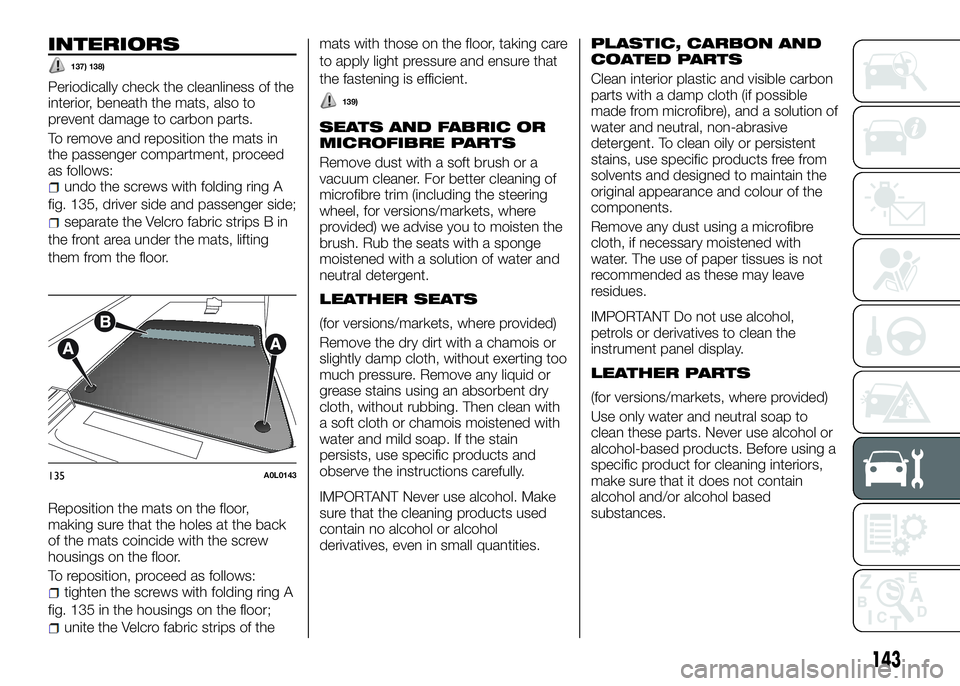
To remove and reposition the mats in
the passenger compartment, proceed
as follows:
undo the screws with folding ring A
fig. 135, driver side and passenger side;
separate the Velcro fabric strips B in
the front area under the mats, lifting
them from the floor.
Reposition the mats on the floor,
making sure that the holes at the back
of the mats coincide with the screw
housings on the floor.
To reposition, proceed as follows:
tighten the screws with folding ring A
fig. 135 in the housings on the floor;
unite the Velcro fabric strips of themats with those on the floor, taking care
to apply light pressure and ensure that
the fastening is efficient.
139)
SEATS AND FABRIC OR
MICROFIBRE PARTS
Remove dust with a soft brush or a
vacuum cleaner. For better cleaning of
microfibre trim (including the steering
wheel, for versions/markets, where
provided) we advise you to moisten the
brush. Rub the seats with a sponge
moistened with a solution of water and
neutral detergent.
LEATHER SEATS
(for versions/markets, where provided)
Remove the dry dirt with a chamois or
slightly damp cloth, without exerting too
much pressure. Remove any liquid or
grease stains using an absorbent dry
cloth, without rubbing. Then clean with
a soft cloth or chamois moistened with
water and mild soap. If the stain
persists, use specific products and
observe the instructions carefully.
IMPORTANT Never use alcohol. Make
sure that the cleaning products used
contain no alcohol or alcohol
derivatives, even in small quantities.
PLASTIC, CARBON AND
COATED PARTS
Clean interior plastic and visible carbon
parts with a damp cloth (if possible
made from microfibre), and a solution of
water and neutral, non-abrasive
detergent. To clean oily or persistent
stains, use specific products free from
solvents and designed to maintain the
original appearance and colour of the
components.
Remove any dust using a microfibre
cloth, if necessary moistened with
water. The use of paper tissues is not
recommended as these may leave
residues.
IMPORTANT Do not use alcohol,
petrols or derivatives to clean the
instrument panel display.
LEATHER PARTS
(for versions/markets, where provided)
Use only water and neutral soap to
clean these parts. Never use alcohol or
alcohol-based products. Before using a
specific product for cleaning interiors,
make sure that it does not contain
alcohol and/or alcohol based
substances.
135A0L0143
143
Page 165 of 182
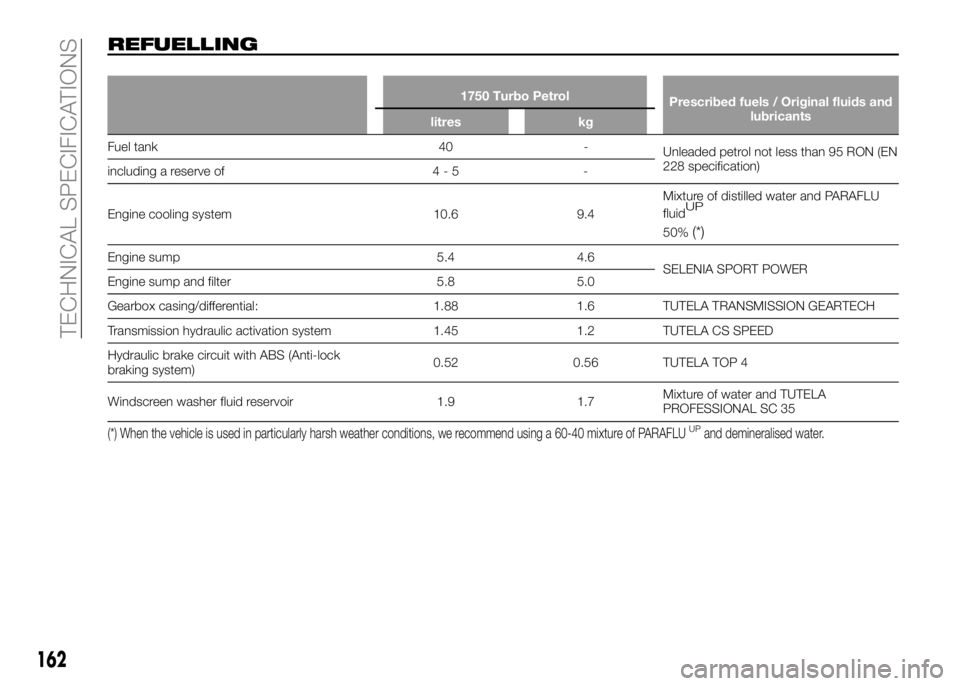
REFUELLING
1750 Turbo Petrol
Prescribed fuels / Original fluids and
lubricants
litres kg
Fuel tank 40 -
Unleaded petrol not less than 95 RON (EN
228 specification)
including a reserve of 4 - 5 -
Engine cooling system 10.6 9.4Mixture of distilled water and PARAFLU
fluid
UP
50%(*)
Engine sump 5.4 4.6
SELENIA SPORT POWER
Engine sump and filter 5.8 5.0
Gearbox casing/differential: 1.88 1.6 TUTELA TRANSMISSION GEARTECH
Transmission hydraulic activation system 1.45 1.2 TUTELA CS SPEED
Hydraulic brake circuit with ABS (Anti-lock
braking system)0.52 0.56 TUTELA TOP 4
Windscreen washer fluid reservoir 1.9 1.7Mixture of water and TUTELA
PROFESSIONAL SC 35
(*) When the vehicle is used in particularly harsh weather conditions, we recommend using a 60-40 mixture of PARAFLUUPand demineralised water.
162
TECHNICAL SPECIFICATIONS
Page 178 of 182
INDEX
"Alfa DNA" system............44
"All Weather" mode..........45
"Natural" mode............44
“Dynamic” mode...........44
“Race” mode..............45
Driving modes.............44
"Electronic Q2" system ("E-Q2")....42
"Follow Me Home" device........29
ABS.....................41
System intervention..........41
Accessories purchased by the
owner....................5
Air cleaner.................137
Alarm.....................16
Alfa Romeo Code system........14
Alzacristalli elettrici
Funzionamento............37
Ashtray....................35
ASR system (AntiSlip Regulation) . . .42
Backrest pocket.............35
Battery...................138
advice for extending lifetime. . . .138
replacement..............138
Battery (recharging)...........124
Body
body codes..............148
Bodywork
maintenance.............141protection against atmospheric
agents.................141
warranty................141
Bodywork versions...........148
Brakes...................152
brake fluid level............135
bulb replacement.........117 ,118
Bulb replacement
exterior lights.............116
interior lights.............119
Bulbs
types of bulbs............114
Car inactivity...............103
Carrying children safely..........86
CBC (Cornering Brake Control)
system..................41
Central locking...............32
Changing a bulb.............112
General instructions.........112
Changing a wheel............109
Cigar lighter.................34
Cleaning and maintenance
bodywork...............141
car interior...............143
engine compartment........142
front headlights............142
leather parts.............143
leather seats.............143
plastic and coated parts......143seats and fabric parts........143
windows................142
Climate control...............22
Passenger compartment air
diffusers.................23
Climatic comfort..............23
Clutch...................151
CO2 emissions..............167
Conditions of use............101
Control buttons..............60
Control panel and instruments.....58
Controls...................32
Cruise Control...............30
Cup holder.................35
Daytime running lights (DRL)......28
Diffusori aria laterali............22
Dimensions................159
Dipped beam headlights
bulb replacement..........116
Dipped headlights
bulb replacement..........116
Direction indicators............29
“Lane change” function.......29
bulb replacement..........116
Door mirrors
Door mirrors..............20
Doors.....................36
Central door locking/unlocking . . .36