lock Alfa Romeo 4C 2018 Workshop Manual
[x] Cancel search | Manufacturer: ALFA ROMEO, Model Year: 2018, Model line: 4C, Model: Alfa Romeo 4C 2018Pages: 279, PDF Size: 3.08 MB
Page 167 of 279
2. Turn bulb holder counterclockwise, remove bulb andreplace it.Roof Light
To change the bulb, proceed as follows:
1. Remove roof light working at the points indicated bythe arrows.
1 — Bulb Holder
2 — Bulb
Roof Light
7
IN CASE OF EMERGENCY 165
Page 168 of 279
2. Open protective flap (2) and replace bulb (1), releas-ing it from the side contacts. Make sure that the new
bulb is correctly secured between the contacts.
3. Close protective flap (2) and install roof light in its housing, making sure that it is locked in place.Luggage Compartment Roof Light
To replace the bulb, proceed as follows:
1. Open the luggage compartment and remove luggagecompartment roof light, working in the direction
shown by the arrow.
2. Open light protector (2) and replace the bulb.
3. Close protector on the lens.
1 — Bulb
2 — Protective Flap
1 — Light Cover
2 — Light Protector
166 IN CASE OF EMERGENCY
Page 171 of 279
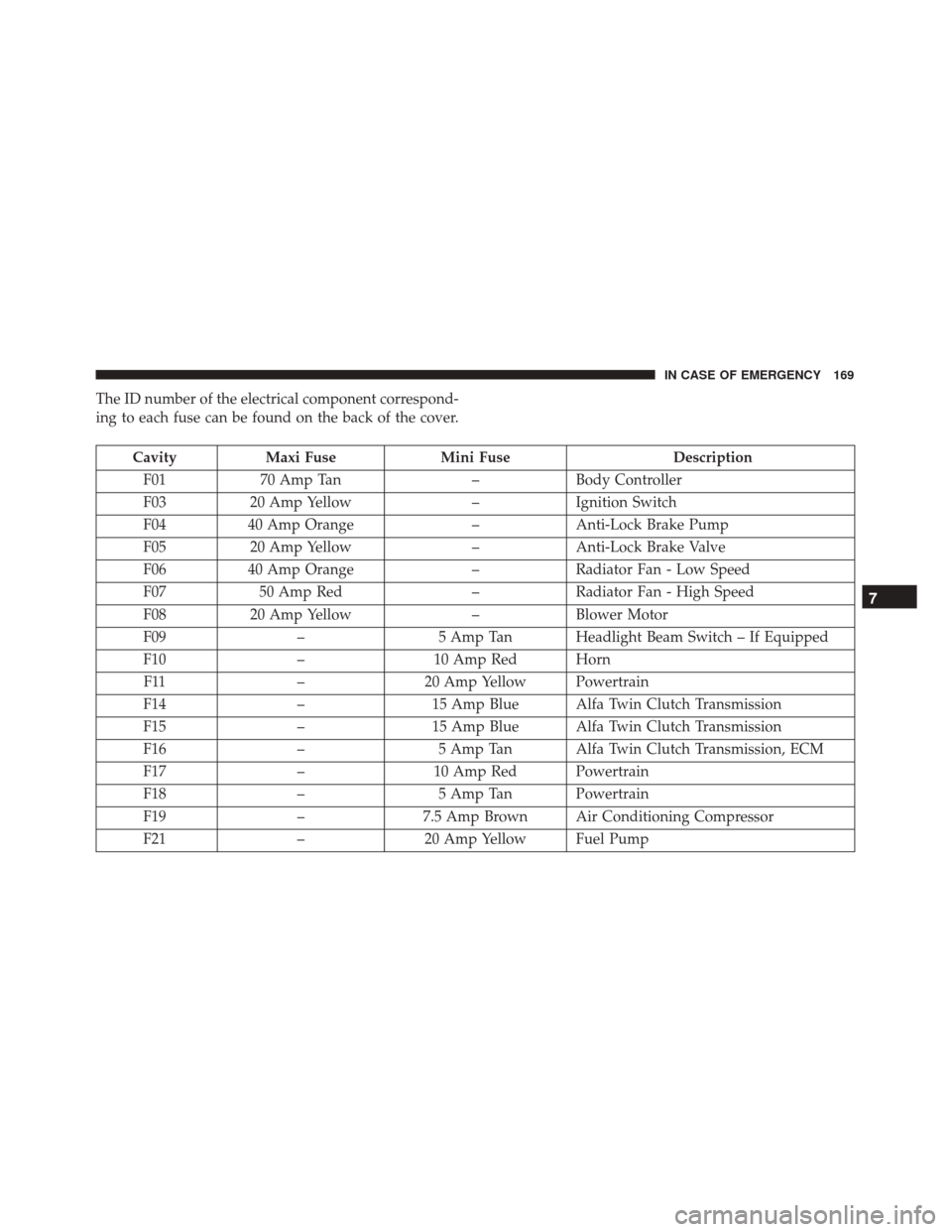
The ID number of the electrical component correspond-
ing to each fuse can be found on the back of the cover.
CavityMaxi Fuse Mini Fuse Description
F01 70 Amp Tan –Body Controller
F03 20 Amp Yellow –Ignition Switch
F04 40 Amp Orange –Anti-Lock Brake Pump
F05 20 Amp Yellow –Anti-Lock Brake Valve
F06 40 Amp Orange –Radiator Fan - Low Speed
F07 50 Amp Red –Radiator Fan - High Speed
F08 20 Amp Yellow –Blower Motor
F09 –5 Amp Tan Headlight Beam Switch – If Equipped
F10 –10 Amp Red Horn
F11 –20 Amp Yellow Powertrain
F14 –15 Amp Blue Alfa Twin Clutch Transmission
F15 –15 Amp Blue Alfa Twin Clutch Transmission
F16 –5 Amp Tan Alfa Twin Clutch Transmission, ECM
F17 –10 Amp Red Powertrain
F18 –5 Amp Tan Powertrain
F19 –7.5 Amp Brown Air Conditioning Compressor
F21 –20 Amp Yellow Fuel Pump
7
IN CASE OF EMERGENCY 169
Page 172 of 279
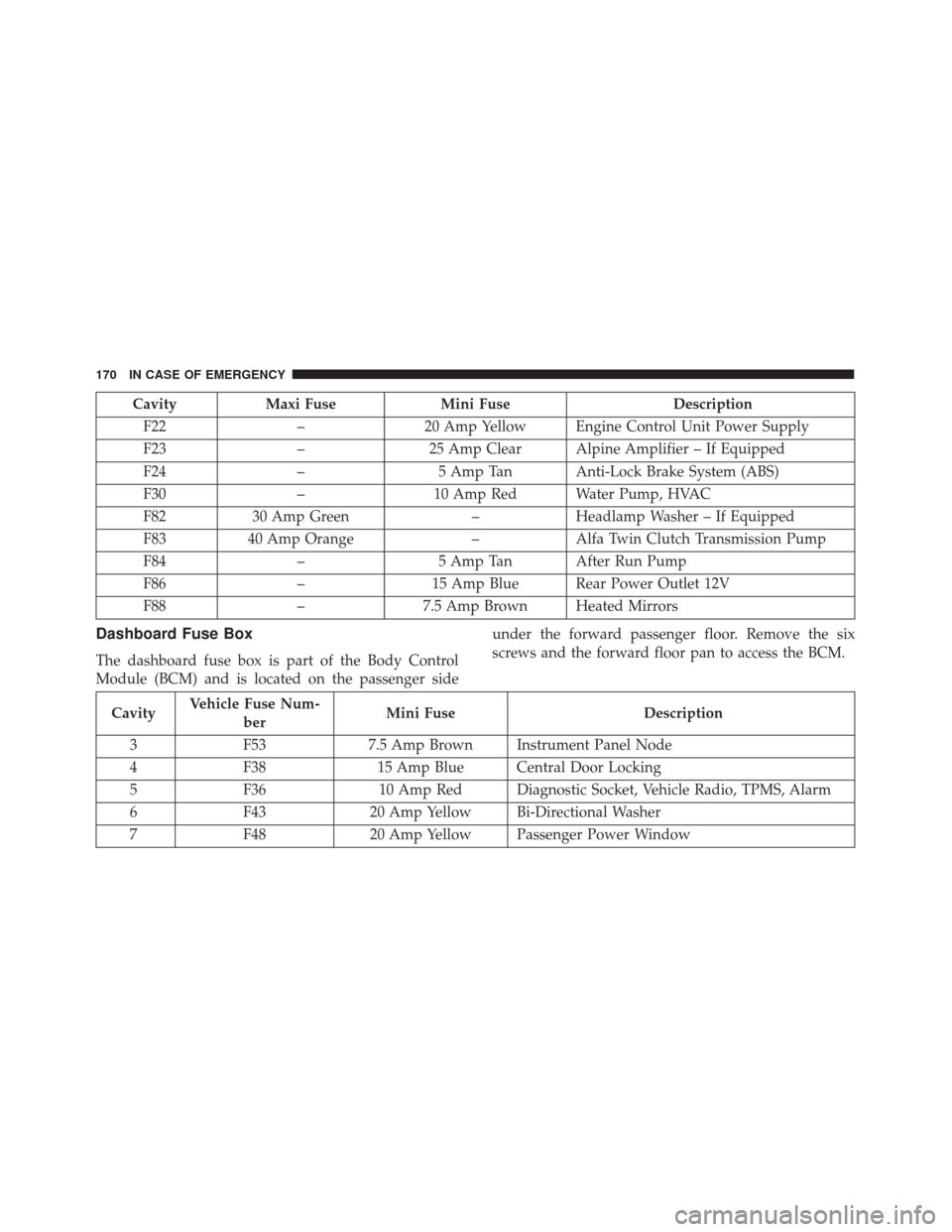
CavityMaxi Fuse Mini Fuse Description
F22 –20 Amp Yellow Engine Control Unit Power Supply
F23 –25 Amp Clear Alpine Amplifier – If Equipped
F24 –5 Amp Tan Anti-Lock Brake System (ABS)
F30 –10 Amp Red Water Pump, HVAC
F82 30 Amp Green –Headlamp Washer – If Equipped
F83 40 Amp Orange –Alfa Twin Clutch Transmission Pump
F84 –5 Amp Tan After Run Pump
F86 –15 Amp Blue Rear Power Outlet 12V
F88 –7.5 Amp Brown Heated Mirrors
Dashboard Fuse Box
The dashboard fuse box is part of the Body Control
Module (BCM) and is located on the passenger side under the forward passenger floor. Remove the six
screws and the forward floor pan to access the BCM.
Cavity
Vehicle Fuse Num-
ber Mini Fuse
Description
3 F53 7.5 Amp Brown Instrument Panel Node
4 F38 15 Amp Blue Central Door Locking
5 F36 10 Amp Red Diagnostic Socket, Vehicle Radio, TPMS, Alarm
6 F43 20 Amp Yellow Bi-Directional Washer
7 F48 20 Amp Yellow Passenger Power Window
170 IN CASE OF EMERGENCY
Page 190 of 279
•Check cleanliness of tailgate locks.
• Check cleanliness and lubrication of chassis and
steering linkage.
• Visually inspect condition of: engine, gearbox, trans-
mission, pipes and hoses (exhaust - fuel system -
brakes) and rubber elements (gaiters - sleeves -
bushes - etc.).
• Check battery charge and battery fluid level (electro-
lyte).
• Visually inspect condition of the auxiliary drive belts.
• Check and, if necessary, change engine oil and re-
place oil filter.
• Check and, if necessary, replace air cleaner filter.
Using the vehicle on a track should be regarded as an
exception. The vehicle has been designed and manufac-
tured for road use.
Change engine oil at 4,000 miles (6,500 km) if the
vehicle is operated in a dusty and off road environment.
This type of vehicle use is considered Severe Duty. If the vehicle is operated in a dusty or dirty environ-
ment the engine air filter has to be changed every 6,500
miles (10,000 km).
Once A Month Or Before A Long Trip/Periodic
Checks
Every 600 miles (1,000 km) or before long trips, check
and, if necessary, top off the following:
•
Check engine oil level.
• Check brake fluid level.
• Check windshield washer fluid level.
• Check the tire inflation pressures and look for un-
usual wear or damage.
• Check the fluid levels of the coolant reservoir and
brake master cylinder reservoir, and add as needed
• Check function of all interior and exterior lights.
Every 2,000 miles (3,000 km) check and, if necessary, top
up: engine oil level.
188 SERVICING AND MAINTENANCE
Page 193 of 279
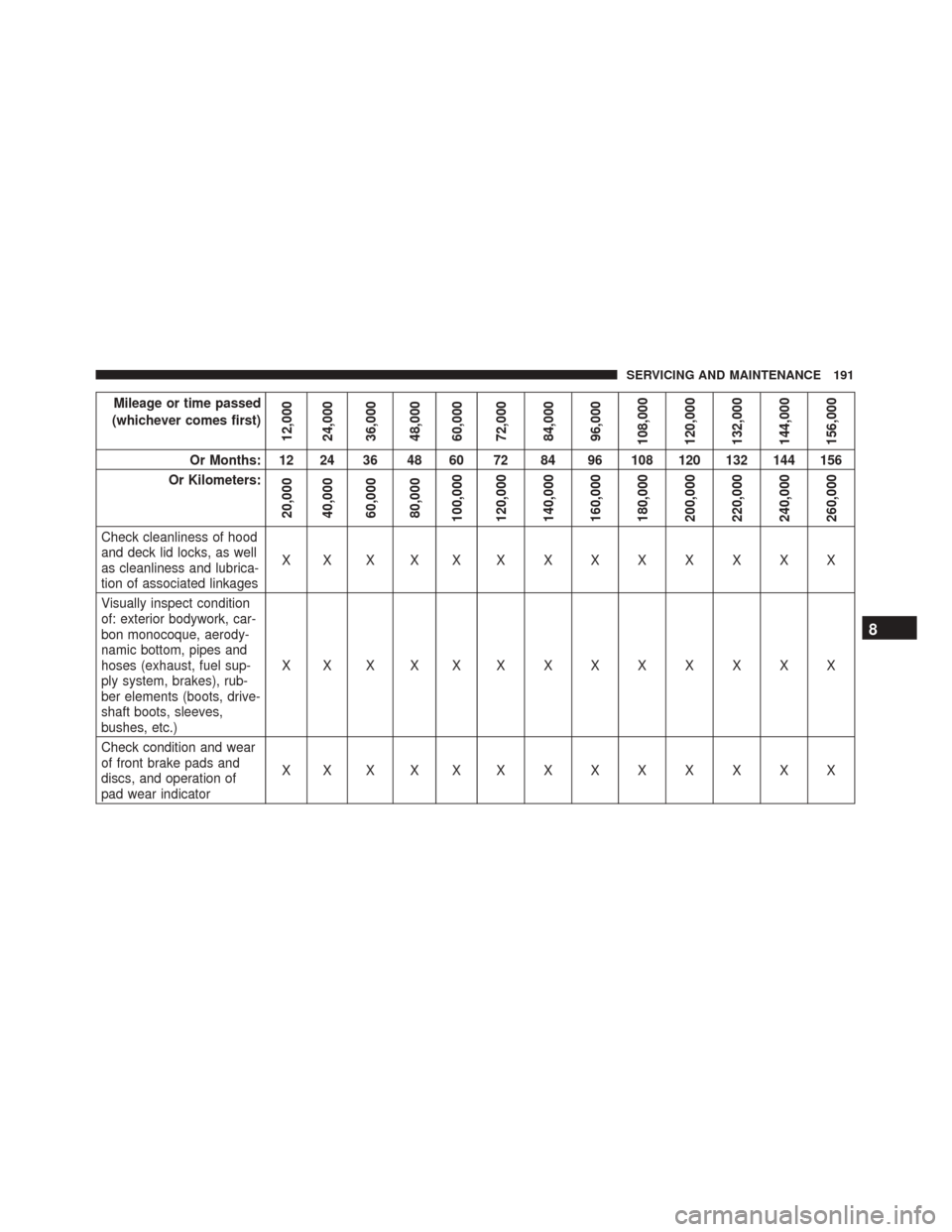
Mileage or time passed
(whichever comes first)
12,000
24,000
36,000
48,000
60,000
72,000
84,000
96,000
108,000
120,000
132,000
144,000
156,000
Or Months: 12 24 36 48 60 72 84 96 108 120 132 144 156
Or Kilometers:
20,000
40,000
60,000
80,000
100,000
120,000
140,000
160,000
180,000
200,000
220,000
240,000
260,000
Check cleanliness of hood
and deck lid locks, as well
as cleanliness and lubrica-
tion of associated linkages XXXXXXXXXXXXX
Visually inspect condition
of: exterior bodywork, car-
bon monocoque, aerody-
namic bottom, pipes and
hoses (exhaust, fuel sup-
ply system, brakes), rub-
ber elements (boots, drive-
shaft boots, sleeves,
bushes, etc.) XXXXXXXXXXXXX
Check condition and wear
of front brake pads and
discs, and operation of
pad wear indicator XXXXXXXXXXXXX
8
SERVICING AND MAINTENANCE 191
Page 205 of 279
WARNING!(Continued)
flammable and can explode, injuring you. Other
unapproved refrigerants or lubricants can cause
the system to fail, requiring costly repairs. Refer
to Warranty Information Book, for further war-
ranty information.
• The air conditioning system contains refrigerant
under high pressure. To avoid risk of personal
injury or damage to the system, adding refriger-
ant or any repair requiring lines to be discon-
nected should be done by an experienced techni-
cian.
CAUTION!
Do not use chemical flushes in your air condition-
ing system as the chemicals can damage your air
conditioning components. Such damage is not cov-
ered by the New Vehicle Limited Warranty.
Refrigerant Recovery And Recycling — R–1234yf
R–1234yf Air Conditioning Refrigerant is a hydrofluo-
roolefin (HFO) that is endorsed by the Environmental
Protection Agency and is an ozone-friendly substance with a low global-warming potential. The manufacturer
recommends that air conditioning service be performed
by an authorized dealer using recovery and recycling
equipment.
NOTE:
Use only manufacturer approved A/C system
PAG compressor oil, and refrigerants.
Body Lubrication
Locks and all body pivot points, including such items as
seat tracks, door hinge pivot points and rollers, liftgate,
tailgate, decklid, sliding doors and hood hinges, should
be lubricated periodically with a lithium based grease,
such as Mopar Spray White Lube to assure quiet, easy
operation and to protect against rust and wear. Prior to
the application of any lubricant, the parts concerned
should be wiped clean to remove dust and grit; after
lubricating excess oil and grease should be removed.
Particular attention should also be given to hood latch-
ing components to ensure proper function. When per-
forming other underhood services, the hood latch,
release mechanism and safety catch should be cleaned
and lubricated.
The external lock cylinders should be lubricated twice a
year, preferably in the Fall and Spring. Apply a small
8
SERVICING AND MAINTENANCE 203
Page 206 of 279
amount of a high quality lubricant, such as Mopar Lock
Cylinder Lubricant directly into the lock cylinder.
Wiper Blades
Clean the rubber edges of the wiper blades, the wind-
shield, and rear window periodically with a sponge or
soft cloth and a mild nonabrasive cleaner. This will
remove accumulations of salt, waxes, or road film, and
help reduce streaking and smearing.
Operation of the wipers on dry glass for long periods
may cause deterioration of the wiper blades. Always
use washer fluid when using the wipers to remove salt
or dirt from a dry windshield or rear window.
Avoid using the wiper blades to remove frost or ice from
the windshield or rear window. Make sure that they are
not frozen to the glass before turning them on to avoid
damaging the blade. Keep the wiper blade out of contact
with petroleum products such as engine oil, gasoline, etc.
NOTE:Life expectancy of wiper blades varies depend-
ing on geographical area and frequency of use. Poor
performance of blades may be present with chattering,
marks, water lines, or wet spots. If any of these condi-
tions are present, clean the wiper blades or replace as
necessary.
Blade Lifting
If it is necessary to lift the blade from the windshield (In
the event of snow or blade replacement) Proceed as
directed:
1. Rotate the end of the multifunction lever to the OFF position.
2. Turn the ignition to the MAR-ON position then to STOP.
3. After turning the ignition to the STOP, within two minutes move the right stalk upward, into the un-
stable (“anti-panic”) position, for at least half of a
Windshield Wiper/Washer Lever
204 SERVICING AND MAINTENANCE
Page 208 of 279
If there is not a jet of fluid, first check that there is fluid
in the washer reservoir. Refer to “Adding Washer
Solvent” in this chapter for further information.
Then check that the nozzle holes are not clogged; use a
suitable tool such as a needle to unblock them if
necessary.
Exhaust System
The best protection against carbon monoxide entry into
the vehicle body is a properly maintained engine ex-
haust system.
If you notice a change in the sound of the exhaust
system; or if the exhaust fumes can be detected inside
the vehicle; or when the underside or rear of the vehicle
is damaged; have an authorized technician inspect the
complete exhaust system and adjacent body areas for
broken, damaged, deteriorated, or mispositioned parts.
Open seams or loose connections could permit exhaust
fumes to seep into the passenger compartment. In
addition, have the exhaust system inspected each time
the vehicle is raised for lubrication or oil change.
Replace as required.
WARNING!
•Exhaust gases can injure or kill. They contain
carbon monoxide (CO), which is colorless and
odorless. Breathing it can make you unconscious
and can eventually poison you. To avoid breath-
ing CO, refer to “Safety Tips” in “Safety” for
further information.
• A hot exhaust system can start a fire if you park
over materials that can burn. Such materials
might be grass or leaves coming into contact with
your exhaust system. Do not park or operate your
vehicle in areas where your exhaust system can
contact anything that can burn.
CAUTION!
• The catalytic converter requires the use of un-
leaded fuel only. Leaded gasoline will destroy the
effectiveness of the catalyst as an emissions con-
trol device and may seriously reduce engine per-
formance and cause serious damage to the engine.
• Damage to the catalytic converter can result if
your vehicle is not kept in proper operating
(Continued)
206 SERVICING AND MAINTENANCE
Page 268 of 279
Adding Engine Coolant (Antifreeze)...........209
Adding Fuel ........................... .149
Adding Washer Fluid .....................196
Additives, Fuel ......................... .248
AirBag .............................. .104
Air Bag Operation .....................106
Air Bag Warning Light ..................103
Driver Knee Air Bag ....................107
Enhanced Accident Response ..............184
Event Data Recorder (EDR) ...............184
If A Deployment Occurs .................110
Knee Impact Bolsters ....................106
Maintaining Your Air Bag System ...........113
Transporting Pets ..................... .122
Air Bag Light .....................71, 103, 124
Air Bag Maintenance ......................113
Air Cleaner, Engine (Engine Air Cleaner Filter) . . .201
Air Conditioner Maintenance ................202
Air Conditioning Refrigerant .............202, 203
Air Conditioning System ...................202
Air Filter ............................. .201
Air Pressure, Tires ....................... .227
Alarm System (Security Alarm) ...............20
Alfa DNA System (Dynamic Car Control System) .138
Alfa Twin Clutch Transmission............77, 133 Fluid Type
....................... .216, 254
Alterations/Modifications, Vehicle ..............6
Antifreeze (Engine Coolant) ..............208, 252
Capacities .......................... .252
Disposal .............................211
Anti-Lock Brake System (ABS) ................82
Anti-Lock Warning Light ....................74
Automatic Transaxle .......................17
Automatic Transmission ...................133
Fluid Type .......................... .254
Auxiliary Electrical Outlet (Power Outlet) ........50
Battery ............................ .71, 199
Charging System Light ...................71
Keyless Key Fob Replacement ..............16
Belts, Seat ............................. .124
Body Mechanism Lubrication ................203
B-Pillar
Location ........................ .222
Brake Fluid ........................... .254
Brake, Parking ......................... .131
Brake System ....................... .212, 248
Anti-Lock (ABS) ........................82
Master Cylinder ...................... .212
Parking ............................ .131
Warning Light .........................69
266 INDEX