lock Alfa Romeo 4C 2018 User Guide
[x] Cancel search | Manufacturer: ALFA ROMEO, Model Year: 2018, Model line: 4C, Model: Alfa Romeo 4C 2018Pages: 279, PDF Size: 3.08 MB
Page 25 of 279
WARNING!(Continued)
•Never leave children alone in a vehicle, or with
access to an unlocked vehicle. Allowing children
to be in a vehicle unattended is dangerous for a
number of reasons. A child or others could be
seriously or fatally injured. Children should be
warned not to touch the parking brake, brake
pedal or the transmission gear selector.
• Do not leave the key fob in or near the vehicle, or
in a location accessible to children. A child could
operate power windows, other controls, or move
the vehicle.
Door Opening/Closing Mechanism Reset
If the battery is disconnected or the protection fuse
blows, the door opening/closing mechanism must be
reset as follows:
1. Close all the doors.
2. Push the unlock button on the key fob or the door locking/unlocking LED indicator button on the
dashboard. 3. Push the lock button on the key fob or the door
locking/unlocking LED indicator button on the
dashboard.
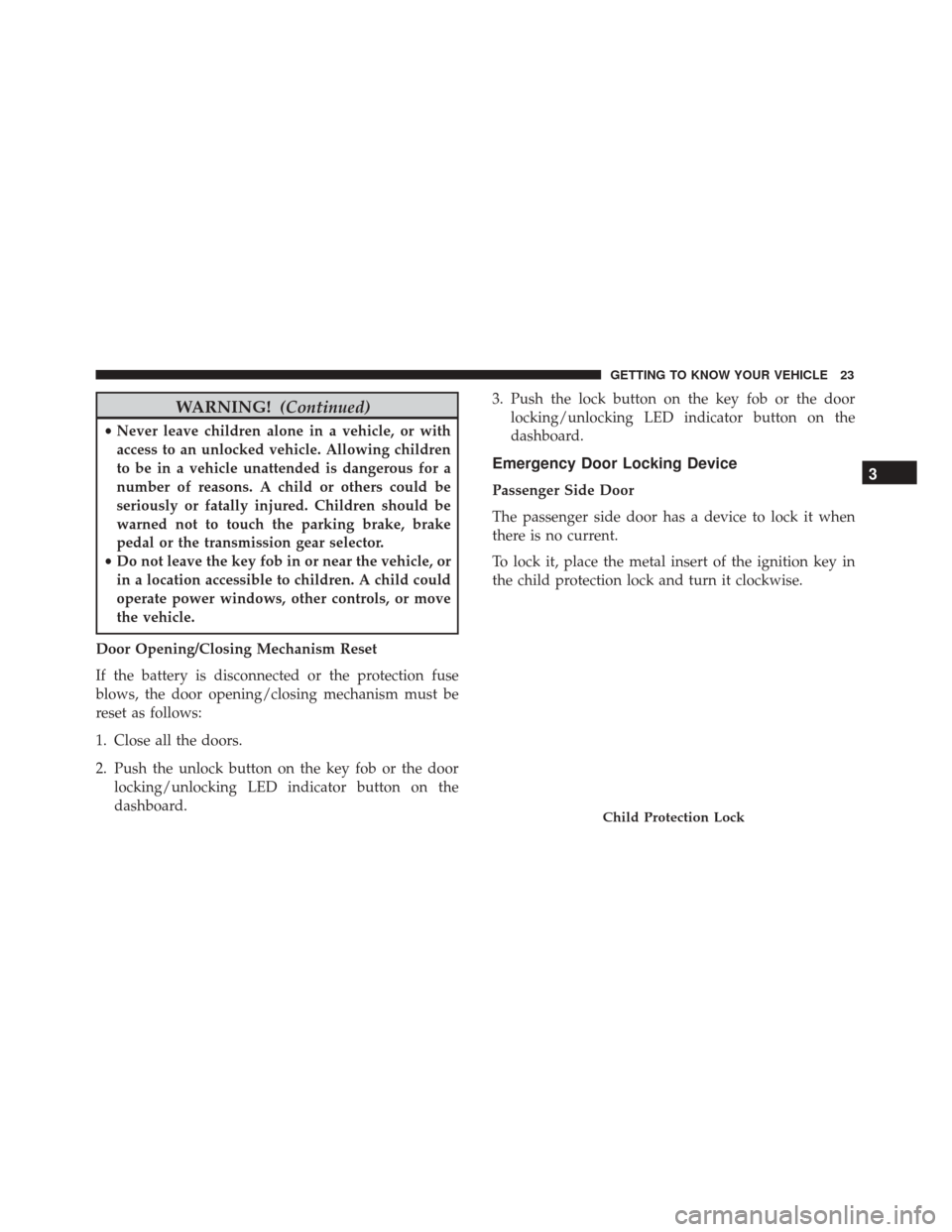
Emergency Door Locking Device
Passenger Side Door
The passenger side door has a device to lock it when
there is no current.
To lock it, place the metal insert of the ignition key in
the child protection lock and turn it clockwise.
Child Protection Lock
3
GETTING TO KNOW YOUR VEHICLE 23
Page 26 of 279
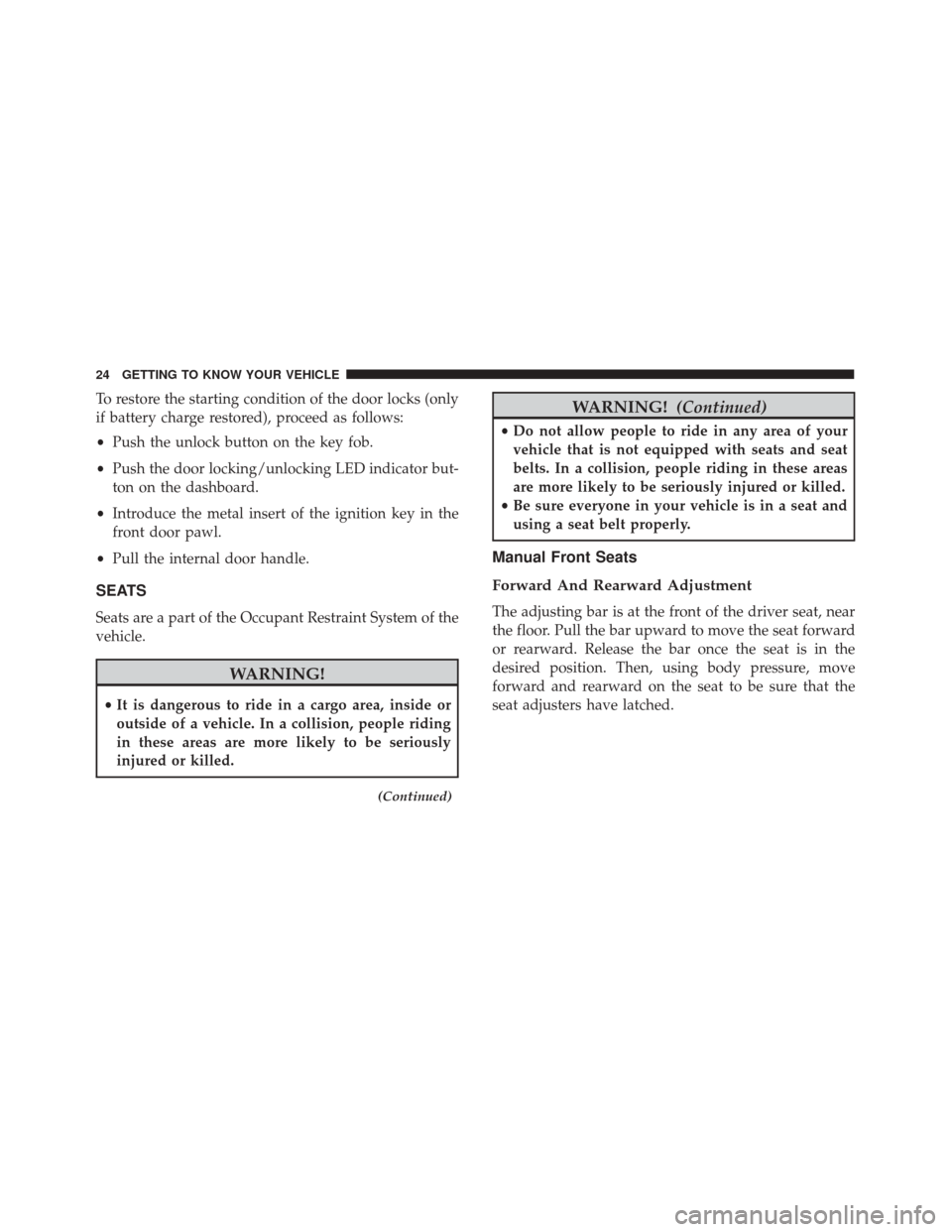
To restore the starting condition of the door locks (only
if battery charge restored), proceed as follows:
•Push the unlock button on the key fob.
• Push the door locking/unlocking LED indicator but-
ton on the dashboard.
• Introduce the metal insert of the ignition key in the
front door pawl.
• Pull the internal door handle.
SEATS
Seats are a part of the Occupant Restraint System of the
vehicle.
WARNING!
•It is dangerous to ride in a cargo area, inside or
outside of a vehicle. In a collision, people riding
in these areas are more likely to be seriously
injured or killed.
(Continued)
WARNING! (Continued)
•Do not allow people to ride in any area of your
vehicle that is not equipped with seats and seat
belts. In a collision, people riding in these areas
are more likely to be seriously injured or killed.
• Be sure everyone in your vehicle is in a seat and
using a seat belt properly.
Manual Front Seats
Forward And Rearward Adjustment
The adjusting bar is at the front of the driver seat, near
the floor. Pull the bar upward to move the seat forward
or rearward. Release the bar once the seat is in the
desired position. Then, using body pressure, move
forward and rearward on the seat to be sure that the
seat adjusters have latched.
24 GETTING TO KNOW YOUR VEHICLE
Page 28 of 279
WARNING!(Continued)
injury or death could result from a poorly ad-
justed seat belt.
• Do not ride with the seatback reclined so that the
shoulder belt is no longer resting against your
chest. In a collision you could slide under the seat
belt, which could result in serious injury or death.
HEAD RESTRAINTS
Non-Adjustable Head Restraints
The non-adjustable head restraints are form fitted into
the upper structure of the seatback, and are designed to
reduce the risk of injury by restricting head movement
in the event of a rear impact. The seatback should be
properly adjusted to an upright position where the head
restraint is positioned as close as possible to the back of
the occupant’s head.
WARNING!
• All occupants, including the driver, should not
operate a vehicle or sit in a vehicle’s seat until the
(Continued)
WARNING! (Continued)
head restraints are placed in their proper posi-
tions in order to minimize the risk of neck injury
in the event of a crash.
• Be certain that the seatback is securely locked into
position. If the seatback is not securely locked
into position the seat will not provide the proper
stability for child seats and/or passengers. An
improperly latched seat could cause serious in-
jury.
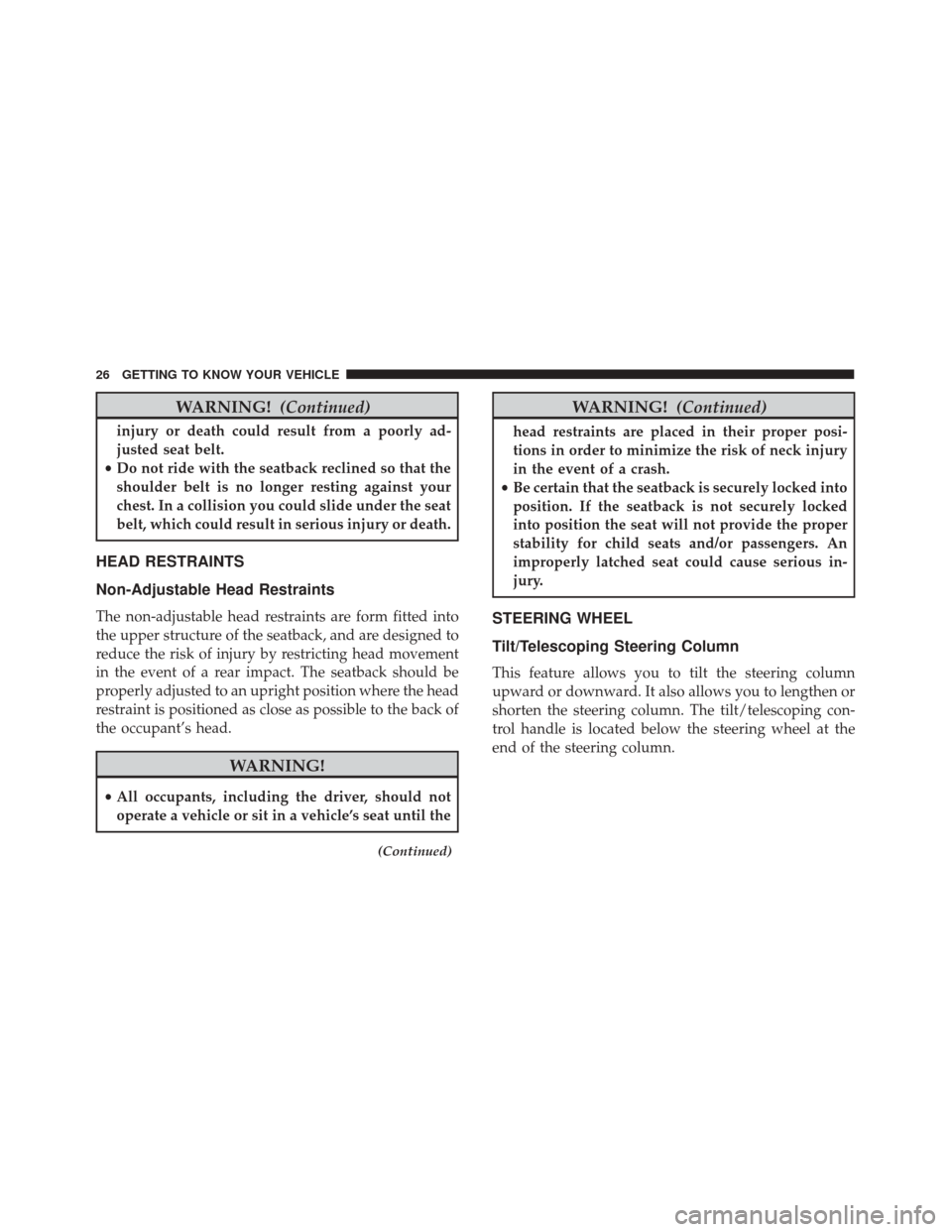
STEERING WHEEL
Tilt/Telescoping Steering Column
This feature allows you to tilt the steering column
upward or downward. It also allows you to lengthen or
shorten the steering column. The tilt/telescoping con-
trol handle is located below the steering wheel at the
end of the steering column.
26 GETTING TO KNOW YOUR VEHICLE
Page 29 of 279
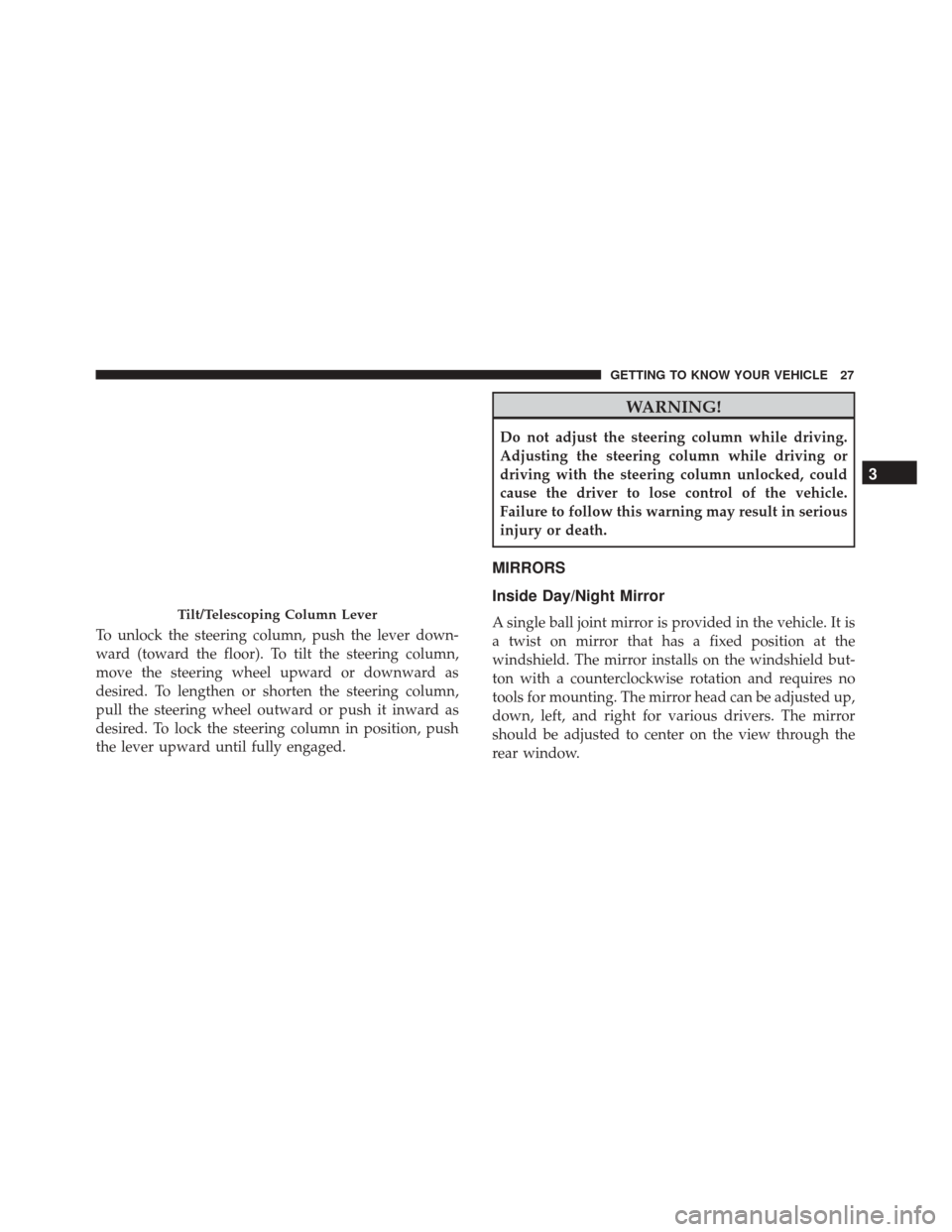
To unlock the steering column, push the lever down-
ward (toward the floor). To tilt the steering column,
move the steering wheel upward or downward as
desired. To lengthen or shorten the steering column,
pull the steering wheel outward or push it inward as
desired. To lock the steering column in position, push
the lever upward until fully engaged.
WARNING!
Do not adjust the steering column while driving.
Adjusting the steering column while driving or
driving with the steering column unlocked, could
cause the driver to lose control of the vehicle.
Failure to follow this warning may result in serious
injury or death.
MIRRORS
Inside Day/Night Mirror
A single ball joint mirror is provided in the vehicle. It is
a twist on mirror that has a fixed position at the
windshield. The mirror installs on the windshield but-
ton with a counterclockwise rotation and requires no
tools for mounting. The mirror head can be adjusted up,
down, left, and right for various drivers. The mirror
should be adjusted to center on the view through the
rear window.Tilt/Telescoping Column Lever
3
GETTING TO KNOW YOUR VEHICLE 27
Page 33 of 279
Daytime Running Lights
To activate the Daytime Running Lights (DRL), rotate
the end of the multifunction lever to theOsymbol.
NOTE: The low beams and side/tail lights will not be
on with DRL.
High Beams
With the low beams activated, pull the multi-
function lever towards the steering wheel to turn
on the high beams. A high beam symbol will illuminate
in the cluster to indicate the high beams are on. Pull the
multifunction lever a second time to switch the head-
lights back to low beam.
Flash-To-Pass
You can signal another vehicle with your headlights by
partially pulling the multifunction lever toward the
steering wheel. This will cause the high beam head-
lights to turn on until the lever is released.
Parking Lights
To turn on the parking lights, remove the key
or turn the ignition to OFF/LOCK position
and turn on the headlights.
Follow Me Home/Headlight Delay
When this feature is selected, the driver can choose to
have the headlights remain on for a preset period of
time after the engine is turned OFF.
Activation
Remove the key or turn the ignition to the STOP
(OFF/LOCK) position, and pull the multifunction lever
toward the steering wheel within two minutes. Each
time the lever is pulled, the activation of the lights will
be extended by 30 seconds. The activation of the lights
can be extended to a maximum of 210 seconds.
Deactivation
Pull the multifunction lever toward the steering wheel
and hold it for more than two seconds.
3
GETTING TO KNOW YOUR VEHICLE 31
Page 35 of 279
Interior Light Timing (Center Position)
There are four different modes of operation that can be
activated in this position:
•When one door is opened, a three minute timer is
activated.
• When the key is removed from the ignition (within
two minutes of the ignition being turned OFF), a 10
second timer is activated.
• When the doors are unlocked with the key fob, a 10
second timer is activated.
• When the doors are locked with the key fob, the
lights will turn off.
Dimmer Controls
The dimmer controls are located on the left side of the
instrument panel below the instrument cluster.
Pushing the up or down arrow will increase or decrease
the brightness of the instrument panel lights.
Dimmer Controls
3
GETTING TO KNOW YOUR VEHICLE 33
Page 39 of 279
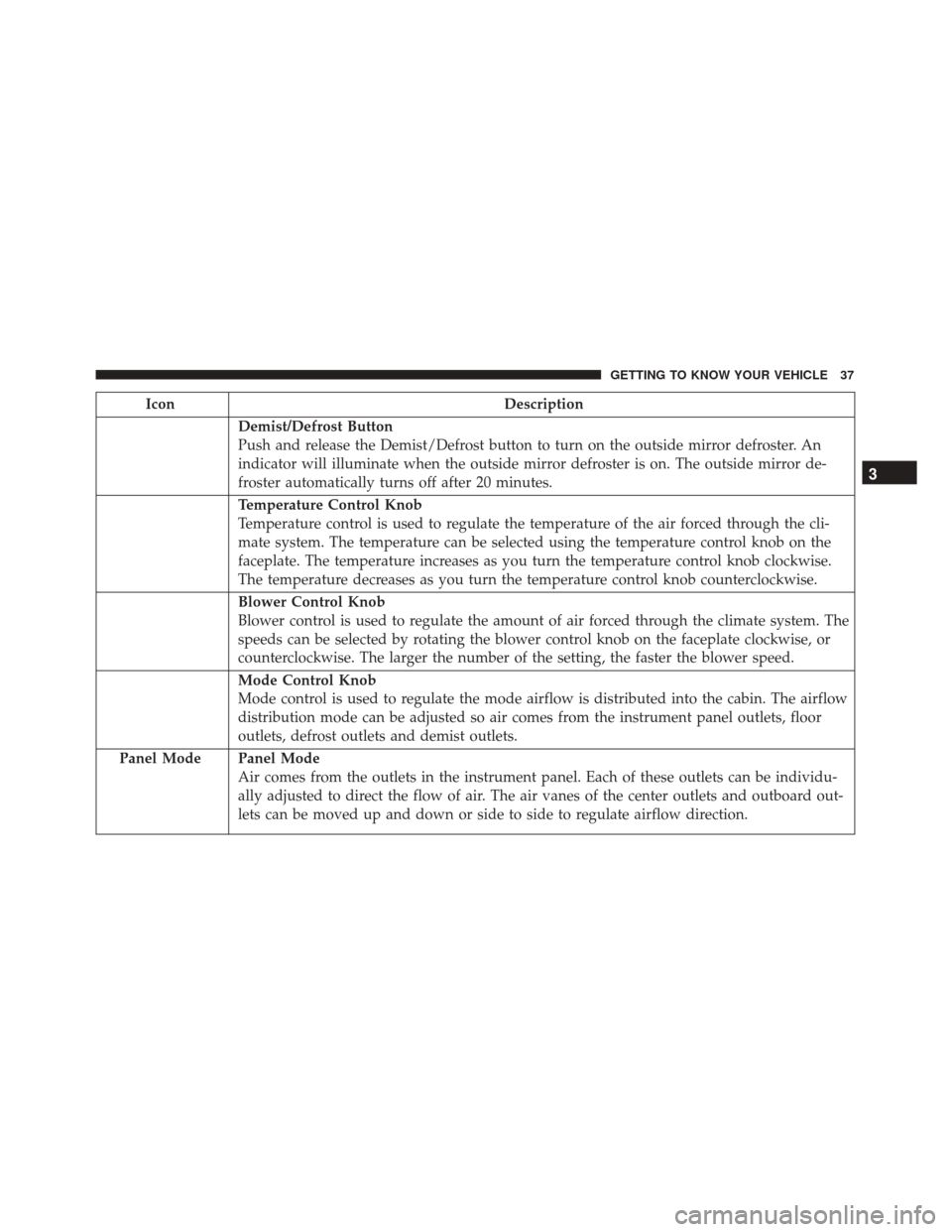
IconDescription
Demist/Defrost Button
Push and release the Demist/Defrost button to turn on the outside mirror defroster. An
indicator will illuminate when the outside mirror defroster is on. The outside mirror de-
froster automatically turns off after 20 minutes.
Temperature Control Knob
Temperature control is used to regulate the temperature of the air forced through the cli-
mate system. The temperature can be selected using the temperature control knob on the
faceplate. The temperature increases as you turn the temperature control knob clockwise.
The temperature decreases as you turn the temperature control knob counterclockwise.
Blower Control Knob
Blower control is used to regulate the amount of air forced through the climate system. The
speeds can be selected by rotating the blower control knob on the faceplate clockwise, or
counterclockwise. The larger the number of the setting, the faster the blower speed.
Mode Control Knob
Mode control is used to regulate the mode airflow is distributed into the cabin. The airflow
distribution mode can be adjusted so air comes from the instrument panel outlets, floor
outlets, defrost outlets and demist outlets.
Panel Mode
Panel Mode
Air comes from the outlets in the instrument panel. Each of these outlets can be individu-
ally adjusted to direct the flow of air. The air vanes of the center outlets and outboard out-
lets can be moved up and down or side to side to regulate airflow direction.
3
GETTING TO KNOW YOUR VEHICLE 37
Page 43 of 279
3. Turn the Blower Control counterclockwise to reducethe fan speed.
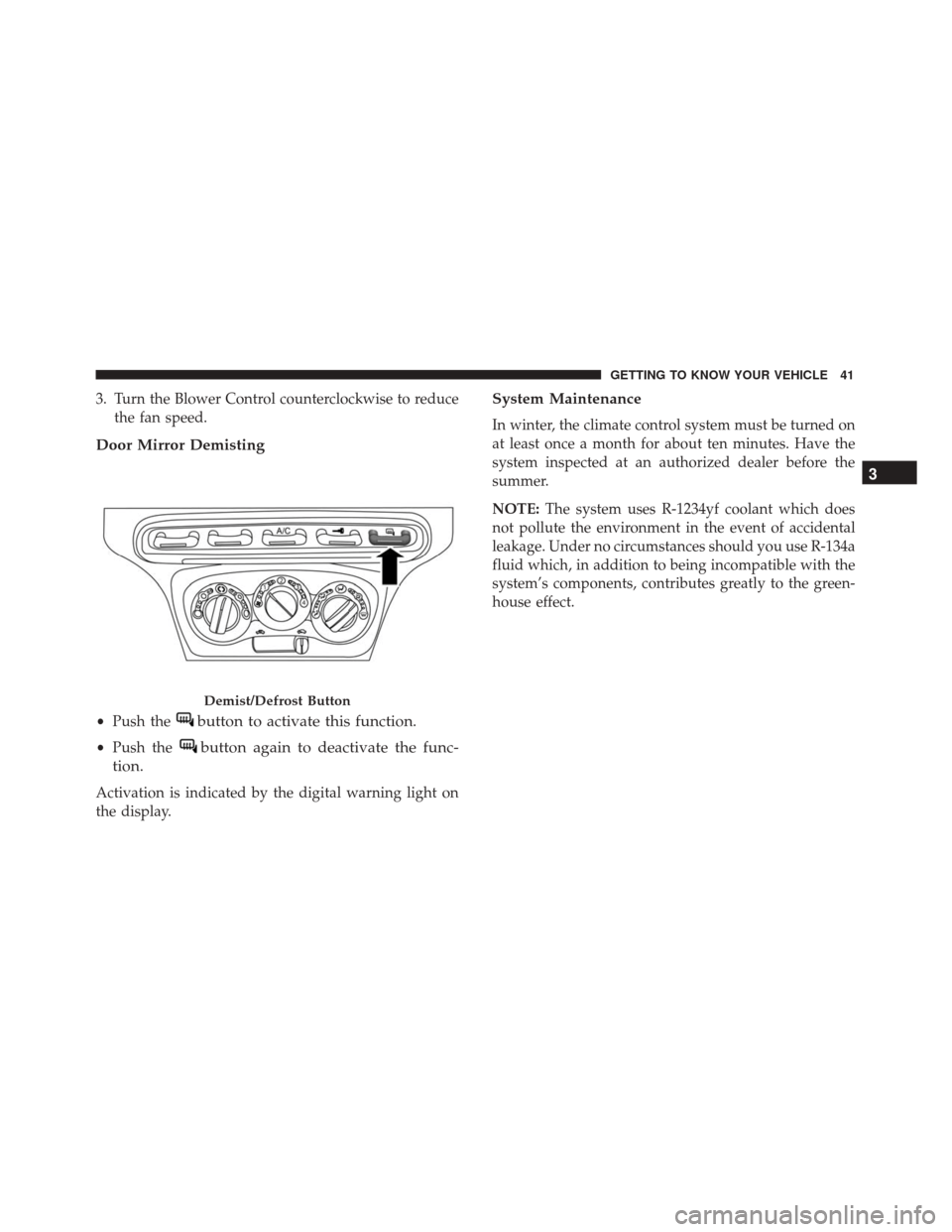
Door Mirror Demisting
•Push thebutton to activate this function.
•Push thebutton again to deactivate the func-
tion.
Activation is indicated by the digital warning light on
the display.
System Maintenance
In winter, the climate control system must be turned on
at least once a month for about ten minutes. Have the
system inspected at an authorized dealer before the
summer.
NOTE: The system uses R-1234yf coolant which does
not pollute the environment in the event of accidental
leakage. Under no circumstances should you use R-134a
fluid which, in addition to being incompatible with the
system’s components, contributes greatly to the green-
house effect.
Demist/Defrost Button
3
GETTING TO KNOW YOUR VEHICLE 41
Page 48 of 279
WARNING!(Continued)
should always place the vehicle into FIRST gear
or REVERSE, apply the parking brake, and re-
move the key from the ignition. Never leave the
key fob in the vehicle or in a location accessible to
children.
• The decklid may drop suddenly, causing serious
injury, if the supporting rod is not positioned
correctly.
• The decklid must always be closed properly, and
the lock engaged, while the vehicle is in motions.
To Close The Decklid
1. Hold the decklid up with one hand and use the other to remove rod from housing and reinsert it in its
locking device.
2. Lower the decklid approximately 7.8 inches (20 cm) from the engine compartment and let it drop. Make
sure that the decklid is completely closed and not
only fastened in safety position by trying to open it.
If it is not completely closed, do not push the decklid
down, but raise it and repeat the procedure. NOTE:
Always check that the decklid is closed correctly
to prevent it from opening while the vehicle is travel-
ling.
WARNING!
• The maximum load limit for the luggage compart-
ment, in addition to the kits provided, is 33.1 lbs.
(15kg). Do not exceed the maximum permitted
load in the luggage compartment. When accessing
the rear luggage compartment, do not come into
contact with engine, or other components, that
may be hot and could burn you if touched.
• Access the luggage compartment only with the
vehicle stationary. Before exiting the vehicle, you
should always place the vehicle into FIRST gear
or REVERSE, apply the parking brake, and re-
move the key from the ignition. Never leave the
key fob in the vehicle or in a location accessible to
children.
• The decklid may drop suddenly, causing serious
injury, if the supporting rod is not positioned
correctly.
• The decklid must always be closed properly, and
the lock engaged, while the vehicle is in motions.
46 GETTING TO KNOW YOUR VEHICLE
Page 51 of 279
WARNING!
•The maximum load limit for the luggage compart-
ment, in addition to the kits provided, is 33.1 lbs.
(15kg). Do not exceed the maximum permitted
load in the luggage compartment. When accessing
the rear luggage compartment, do not come into
contact with engine, or other components, that
may be hot and could burn you if touched.
(Continued)
WARNING! (Continued)
•Access the luggage compartment only with the
vehicle stationary. Before exiting the vehicle, you
should always place the vehicle into FIRST gear
or REVERSE, apply the parking brake, and re-
move the key from the ignition. Never leave the
key fob in the vehicle or in a location accessible to
children.
• The decklid may drop suddenly, causing serious
injury, if the supporting rod is not positioned
correctly.
• The decklid must always be closed properly, and
the lock engaged, while the vehicle is in motions.
Rear Compartment Light
3
GETTING TO KNOW YOUR VEHICLE 49