lock Alfa Romeo 4C Spider 2017 Owner's Guide
[x] Cancel search | Manufacturer: ALFA ROMEO, Model Year: 2017, Model line: 4C Spider, Model: Alfa Romeo 4C Spider 2017Pages: 297, PDF Size: 2.84 MB
Page 45 of 297
•Turn on the interior lights, which remain on as long
as the battery has power or for 15 minutes from the
intervention of the Enhanced Accident Response
System.
• Unlock the power door locks.
Enhanced Accident Response System Reset
Procedure
After the event occurs, when the system is active, a
message regarding fuel cutoff is displayed. Turn the
ignition switch from ignition AVV/START or MAR/
ACC/ON/RUN to ignition STOP/OFF/LOCK. Care-
fully check the vehicle for fuel leaks in the engine
compartment and on the ground near the engine com-
partment and fuel tank before resetting the system and
starting the engine.
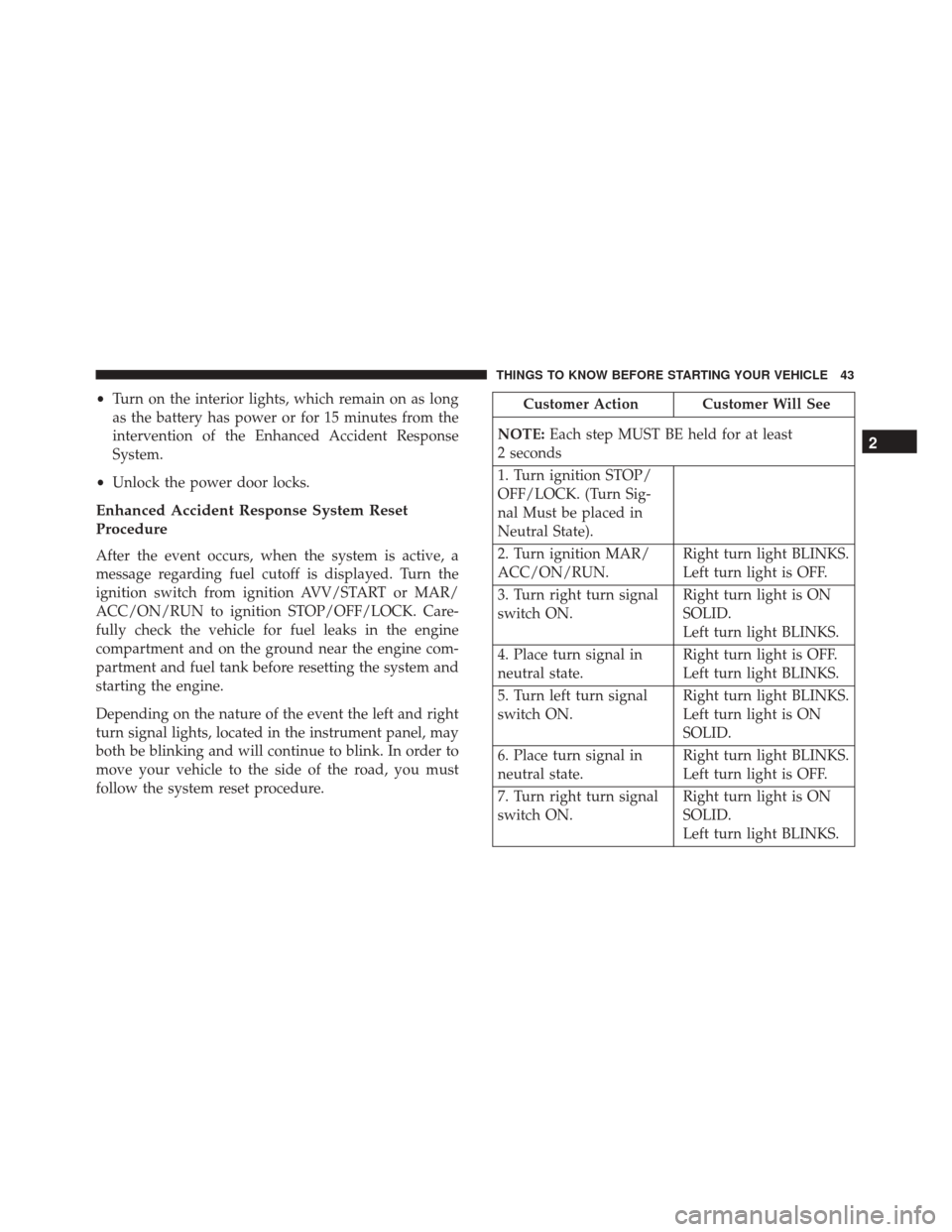
Depending on the nature of the event the left and right
turn signal lights, located in the instrument panel, may
both be blinking and will continue to blink. In order to
move your vehicle to the side of the road, you must
follow the system reset procedure.
Customer Action Customer Will See
NOTE: Each step MUST BE held for at least
2 seconds
1. Turn ignition STOP/
OFF/LOCK. (Turn Sig-
nal Must be placed in
Neutral State).
2. Turn ignition MAR/
ACC/ON/RUN. Right turn light BLINKS.
Left turn light is OFF.
3. Turn right turn signal
switch ON. Right turn light is ON
SOLID.
Left turn light BLINKS.
4. Place turn signal in
neutral state. Right turn light is OFF.
Left turn light BLINKS.
5. Turn left turn signal
switch ON. Right turn light BLINKS.
Left turn light is ON
SOLID.
6. Place turn signal in
neutral state. Right turn light BLINKS.
Left turn light is OFF.
7. Turn right turn signal
switch ON. Right turn light is ON
SOLID.
Left turn light BLINKS.
2
THINGS TO KNOW BEFORE STARTING YOUR VEHICLE 43
Page 46 of 297
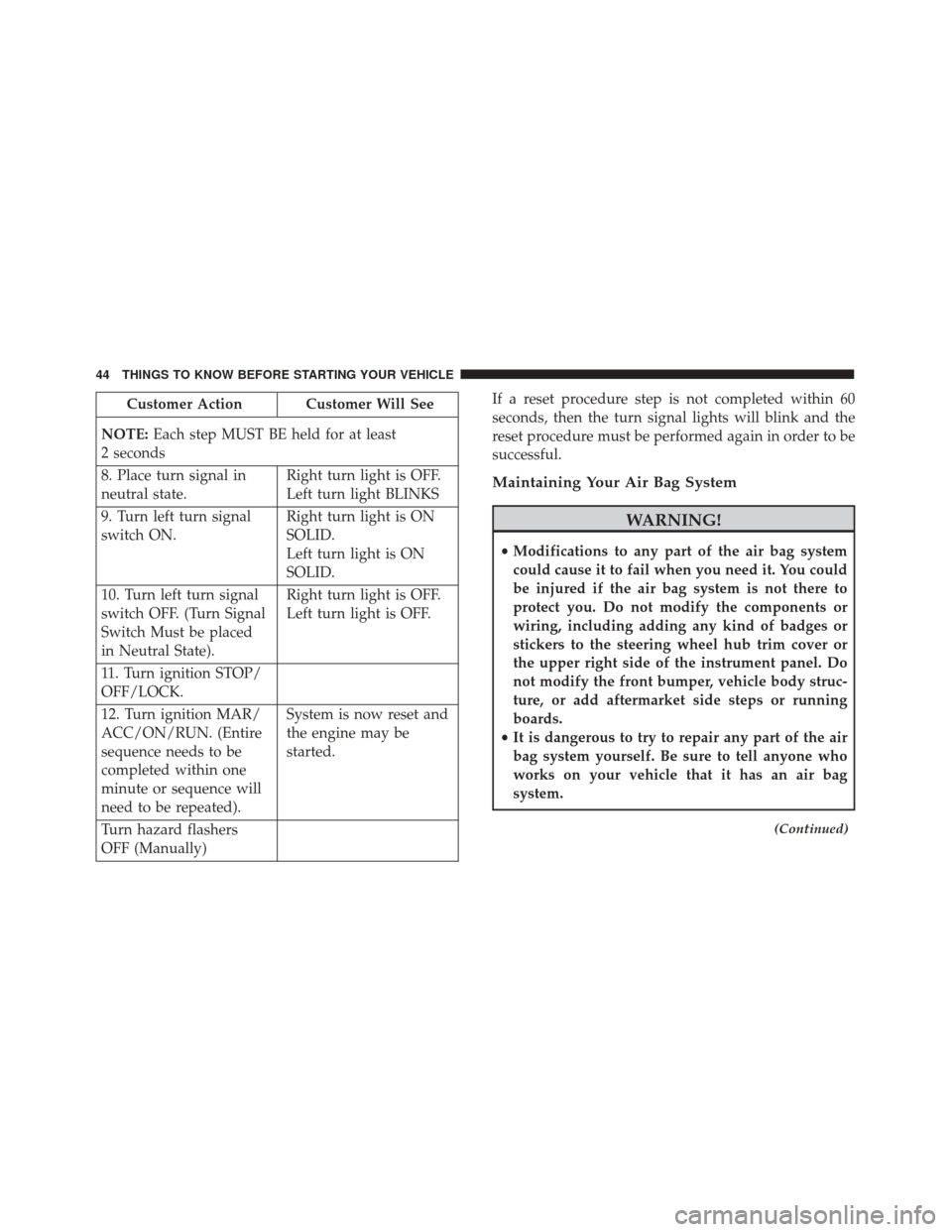
Customer Action Customer Will See
NOTE: Each step MUST BE held for at least
2 seconds
8. Place turn signal in
neutral state. Right turn light is OFF.
Left turn light BLINKS
9. Turn left turn signal
switch ON. Right turn light is ON
SOLID.
Left turn light is ON
SOLID.
10. Turn left turn signal
switch OFF. (Turn Signal
Switch Must be placed
in Neutral State). Right turn light is OFF.
Left turn light is OFF.
11. Turn ignition STOP/
OFF/LOCK.
12. Turn ignition MAR/
ACC/ON/RUN. (Entire
sequence needs to be
completed within one
minute or sequence will
need to be repeated). System is now reset and
the engine may be
started.
Turn hazard flashers
OFF (Manually) If a reset procedure step is not completed within 60
seconds, then the turn signal lights will blink and the
reset procedure must be performed again in order to be
successful.
Maintaining Your Air Bag System
WARNING!
•
Modifications to any part of the air bag system
could cause it to fail when you need it. You could
be injured if the air bag system is not there to
protect you. Do not modify the components or
wiring, including adding any kind of badges or
stickers to the steering wheel hub trim cover or
the upper right side of the instrument panel. Do
not modify the front bumper, vehicle body struc-
ture, or add aftermarket side steps or running
boards.
• It is dangerous to try to repair any part of the air
bag system yourself. Be sure to tell anyone who
works on your vehicle that it has an air bag
system.
(Continued)
44 THINGS TO KNOW BEFORE STARTING YOUR VEHICLE
Page 52 of 297
belt out of position. If the shoulder belt contacts the face
or neck, move the child closer to the center of the
vehicle, or use a booster seat to position the seat belt on
the child correctly.
WARNING!
Never allow a child to put the shoulder belt under
an arm or behind their back. In a crash, the shoulder
belt will not protect a child properly, which may
result in serious injury or death. A child must
always wear both the lap and shoulder portions of
the seat belt correctly.
Installing Child Restraints Using The Vehicle
Seat Belt
Child restraint systems are designed to be secured in
vehicle seats by lap belts or the lap belt portion of a
lap/shoulder belt.
WARNING!
•Improper installation or failure to properly secure
a child restraint can lead to failure of the restraint.
The child could be badly injured or killed.
• Follow the child restraint manufacturer ’s direc-
tions exactly when installing an infant or child
restraint.
The seat belts in the passenger seating positions are
equipped with a Switchable Automatic Locking Retrac-
tor (ALR) that is designed to keep the lap portion of the
seat belt tight around the child restraint so that it is not
necessary to use a locking clip. The ALR retractor can be
“switched” into a locked mode by pulling all of the
webbing out of the retractor and then letting the web-
bing retract back into the retractor. If it is locked, the
ALR will make a clicking noise while the webbing is
pulled back into the retractor. Refer to the “Automatic
Locking Mode” description under “Occupant Re-
straints” for additional information on ALR.
50 THINGS TO KNOW BEFORE STARTING YOUR VEHICLE
Page 53 of 297
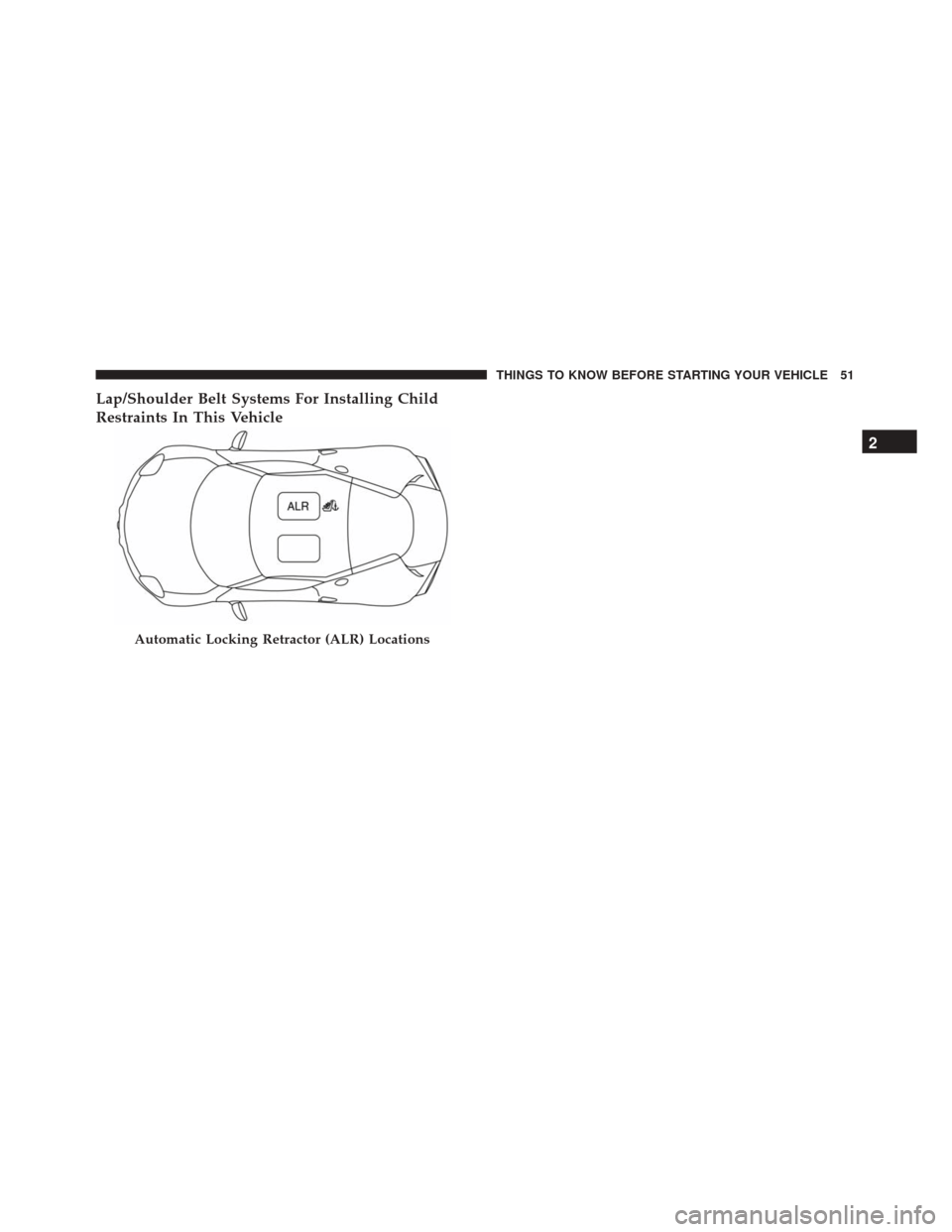
Lap/Shoulder Belt Systems For Installing Child
Restraints In This Vehicle
Automatic Locking Retractor (ALR) Locations
2
THINGS TO KNOW BEFORE STARTING YOUR VEHICLE 51
Page 54 of 297
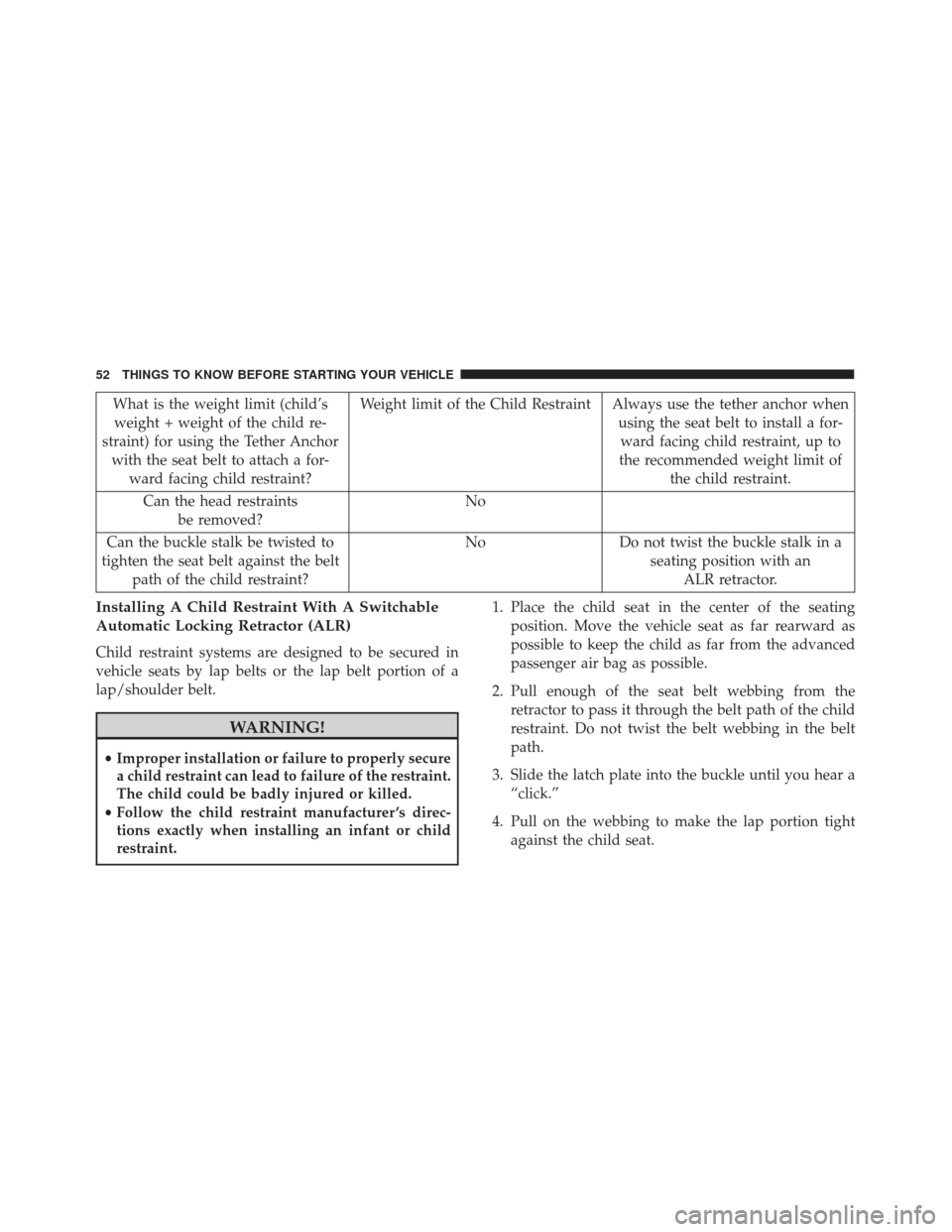
What is the weight limit (child’sweight + weight of the child re-
straint) for using the Tether Anchor with the seat belt to attach a for- ward facing child restraint? Weight limit of the Child Restraint Always use the tether anchor when
using the seat belt to install a for-ward facing child restraint, up to
the recommended weight limit of the child restraint.
Can the head restraints be removed? No
Can the buckle stalk be twisted to
tighten the seat belt against the belt path of the child restraint? No
Do not twist the buckle stalk in a
seating position with an ALR retractor.
Installing A Child Restraint With A Switchable
Automatic Locking Retractor (ALR)
Child restraint systems are designed to be secured in
vehicle seats by lap belts or the lap belt portion of a
lap/shoulder belt.
WARNING!
•Improper installation or failure to properly secure
a child restraint can lead to failure of the restraint.
The child could be badly injured or killed.
• Follow the child restraint manufacturer ’s direc-
tions exactly when installing an infant or child
restraint. 1. Place the child seat in the center of the seating
position. Move the vehicle seat as far rearward as
possible to keep the child as far from the advanced
passenger air bag as possible.
2. Pull enough of the seat belt webbing from the retractor to pass it through the belt path of the child
restraint. Do not twist the belt webbing in the belt
path.
3. Slide the latch plate into the buckle until you hear a “click.”
4. Pull on the webbing to make the lap portion tight against the child seat.
52 THINGS TO KNOW BEFORE STARTING YOUR VEHICLE
Page 55 of 297
5. To lock the seat belt, pull down on the shoulder partof the belt until you have pulled all the seat belt
webbing out of the retractor. Then, allow the web-
bing to retract back into the retractor. As the webbing
retracts, you will hear a clicking sound. This means
the seat belt is now in the Automatic Locking mode.
6. Try to pull the webbing out of the retractor. If it is locked, you should not be able to pull out any
webbing. If the retractor is not locked, repeat step 5.
7. Finally, pull up on any excess webbing to tighten the lap portion around the child restraint while you push
the child restraint rearward and downward into the
vehicle seat.
8. If the child restraint has a top tether strap and the seating position has a top tether anchorage, connect
the tether strap to the anchorage and tighten the
tether strap. See the section “Installing Child Re-
straints Using the Top Tether Anchorage” for direc-
tions to attach a tether anchor.
9. Test that the child restraint is installed tightly by pulling back and forth on the child seat at the belt
path. It should not move more than 1 inch (25.4 mm)
in any direction. Any seat belt system will loosen with time, so check the
belt occasionally, and pull it tight if necessary.
Installing Child Restraints Using The Top Tether
Anchorage:
WARNING!
Do not attach a tether strap for a rear-facing car seat
to any location in front of the car seat, including the
seat frame or a tether anchorage. Only attach the
tether strap of a rear-facing car seat to the tether
anchorage that is approved for that seating position,
located behind the top of the vehicle seat.
2
THINGS TO KNOW BEFORE STARTING YOUR VEHICLE 53
Page 61 of 297
Lights
Have someone observe the operation of brake lights
and exterior lights while you work the controls. Check
turn signal and high beam indicator lights on the
instrument panel.
Door Latches
Check for positive closing, latching, and locking.
Fluid Leaks
Check area under vehicle after overnight parking for
fuel, engine coolant, oil, or other fluid leaks. Also, if
gasoline fumes are detected or if fuel, power steering
fluid (if equipped), or brake fluid leaks are suspected,
the cause should be located and corrected immediately.
2
THINGS TO KNOW BEFORE STARTING YOUR VEHICLE 59
Page 65 of 297
MIRRORS
Inside Day/Night Mirror
A single ball joint mirror is provided in the vehicle. It is
a twist on mirror that has a fixed position at the
windshield. The mirror installs on the windshield but-
ton with a counterclockwise rotation and requires no
tools for mounting. The mirror head can be adjusted up,
down, left, and right for various drivers. The mirror
should be adjusted to center on the view through the
rear window.
Headlight glare from vehicles behind you can be re-
duced by moving the small control under the mirror to
the night position (toward the rear of the vehicle). The
mirror should be adjusted while the small control under
the mirror is set in the day position (toward the
windshield).
Outside Mirrors
To receive maximum benefit, adjust the outside mirrors
to center on the adjacent lane of traffic and a slight
overlap of the view obtained from the inside mirror.
NOTE:The passenger side convex outside mirror will
give a much wider view to the rear, and especially of the
lane next to your vehicle.
Adjusting Rearview Mirror
3
UNDERSTANDING THE FEATURES OF YOUR VEHICLE 63
Page 67 of 297
Folding Mirrors
The exterior mirrors are hinged to allow the mirror to
pivot forward or rearward to help avoid damage. The
mirror has three detent positions: full forward, full
rearward and normal.
Heated Mirrors
These mirrors are heated to melt frost or ice.
This feature can be activated whenever you
turn on the mirror defroster. The Door
Demist/Defrost button is located in the
switch bank above the Climate Controls.
REMOVABLE SOFT TOP — IF EQUIPPED
Your vehicle may be equipped with a removable soft
top.
To remove the soft top, proceed as follows:
1. Turn the front locking handles located near the sun visors to the left one quarter turn.
Folding Mirrors
Front Locking Handles
3
UNDERSTANDING THE FEATURES OF YOUR VEHICLE 65
Page 68 of 297
2. From the passenger side with the door open, movethe two side locking handles towards each other and
lift the top from the retainers.
3. Roll up the soft top to the center of the vehicle, repeat the procedure on the drivers side of the vehicle. 4. Remove the soft top with both sides rolled up and
store it in the storage bag that is provided.
Installing The Soft Top
To install the soft top, proceed as follows:
1. With the doors open take the soft top and place it incenter of the vehicle.
Side Locking Handles
Soft Top Removal
66 UNDERSTANDING THE FEATURES OF YOUR VEHICLE