ignition Alfa Romeo 4C Spider 2019 Service Manual
[x] Cancel search | Manufacturer: ALFA ROMEO, Model Year: 2019, Model line: 4C Spider, Model: Alfa Romeo 4C Spider 2019Pages: 292, PDF Size: 3.25 MB
Page 168 of 292
HAZARD WARNING FLASHER
The Hazard Warning flasher switch is located on the
center console.Push the switch to turn on the Hazard Warn-
ing flasher. When the switch is activated, all
directional turn signals will flash on and off to
warn oncoming traffic of an emergency. Push
the switch a second time to turn off the Hazard Warning
flasher.
This is an emergency warning system and it should not
be used when the vehicle is in motion. Use it when your
vehicle is disabled and it is creating a safety hazard for
other motorists.
When you must leave the vehicle to seek assistance, the
Hazard Warning flasher will continue to operate even
though the ignition is placed in the OFF position.
NOTE: With extended use the Hazard Warning flasher
may wear down your battery.
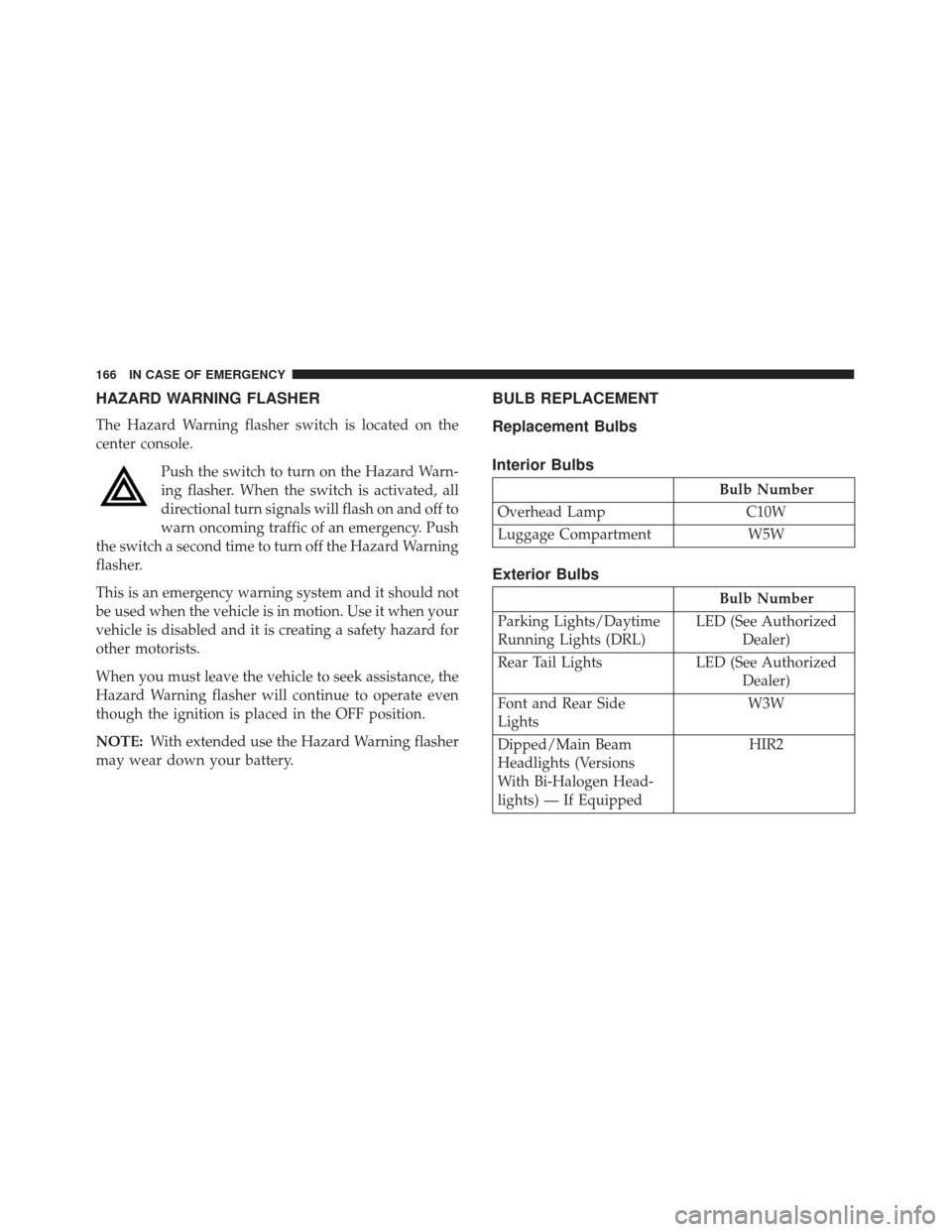
BULB REPLACEMENT
Replacement Bulbs
Interior Bulbs
Bulb Number
Overhead Lamp C10W
Luggage Compartment W5W
Exterior Bulbs
Bulb Number
Parking Lights/Daytime
Running Lights (DRL) LED (See Authorized
Dealer)
Rear Tail Lights LED (See Authorized
Dealer)
Font and Rear Side
Lights W3W
Dipped/Main Beam
Headlights (Versions
With Bi-Halogen Head-
lights) — If Equipped HIR2
166 IN CASE OF EMERGENCY
Page 181 of 292
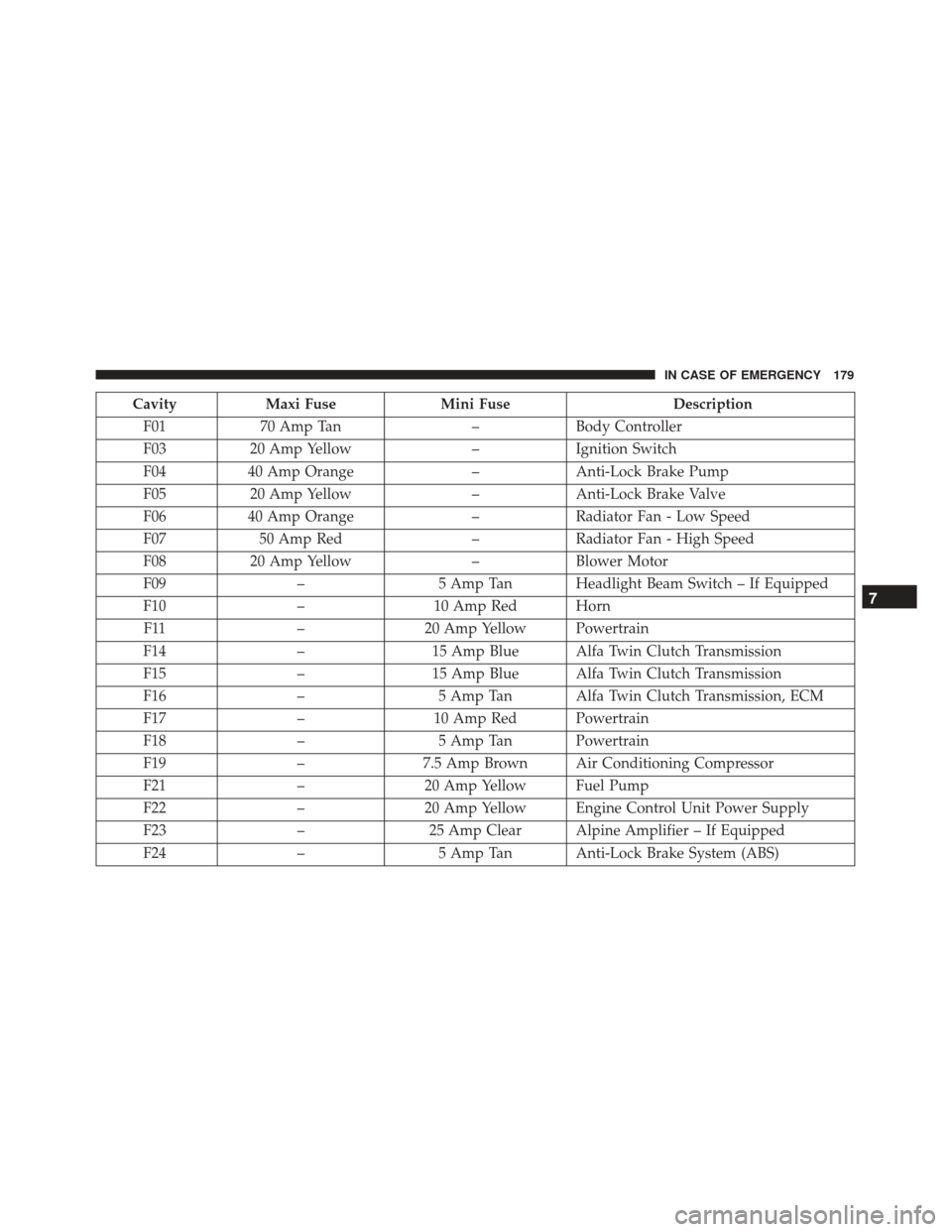
CavityMaxi Fuse Mini Fuse Description
F01 70 Amp Tan –Body Controller
F03 20 Amp Yellow –Ignition Switch
F04 40 Amp Orange –Anti-Lock Brake Pump
F05 20 Amp Yellow –Anti-Lock Brake Valve
F06 40 Amp Orange –Radiator Fan - Low Speed
F07 50 Amp Red –Radiator Fan - High Speed
F08 20 Amp Yellow –Blower Motor
F09 –5 Amp Tan Headlight Beam Switch – If Equipped
F10 –10 Amp Red Horn
F11 –20 Amp Yellow Powertrain
F14 –15 Amp Blue Alfa Twin Clutch Transmission
F15 –15 Amp Blue Alfa Twin Clutch Transmission
F16 –5 Amp Tan Alfa Twin Clutch Transmission, ECM
F17 –10 Amp Red Powertrain
F18 –5 Amp Tan Powertrain
F19 –7.5 Amp Brown Air Conditioning Compressor
F21 –20 Amp Yellow Fuel Pump
F22 –20 Amp Yellow Engine Control Unit Power Supply
F23 –25 Amp Clear Alpine Amplifier – If Equipped
F24 –5 Amp Tan Anti-Lock Brake System (ABS)
7
IN CASE OF EMERGENCY 179
Page 189 of 292
CAUTION!
Do not use a portable battery booster pack or any
other booster source with a system voltage greater
than 12 Volts or damage to the battery, starter motor,
alternator or electrical system may occur.
NOTE: When using a portable battery booster pack,
follow the manufacturer’s operating instructions and
precautions.
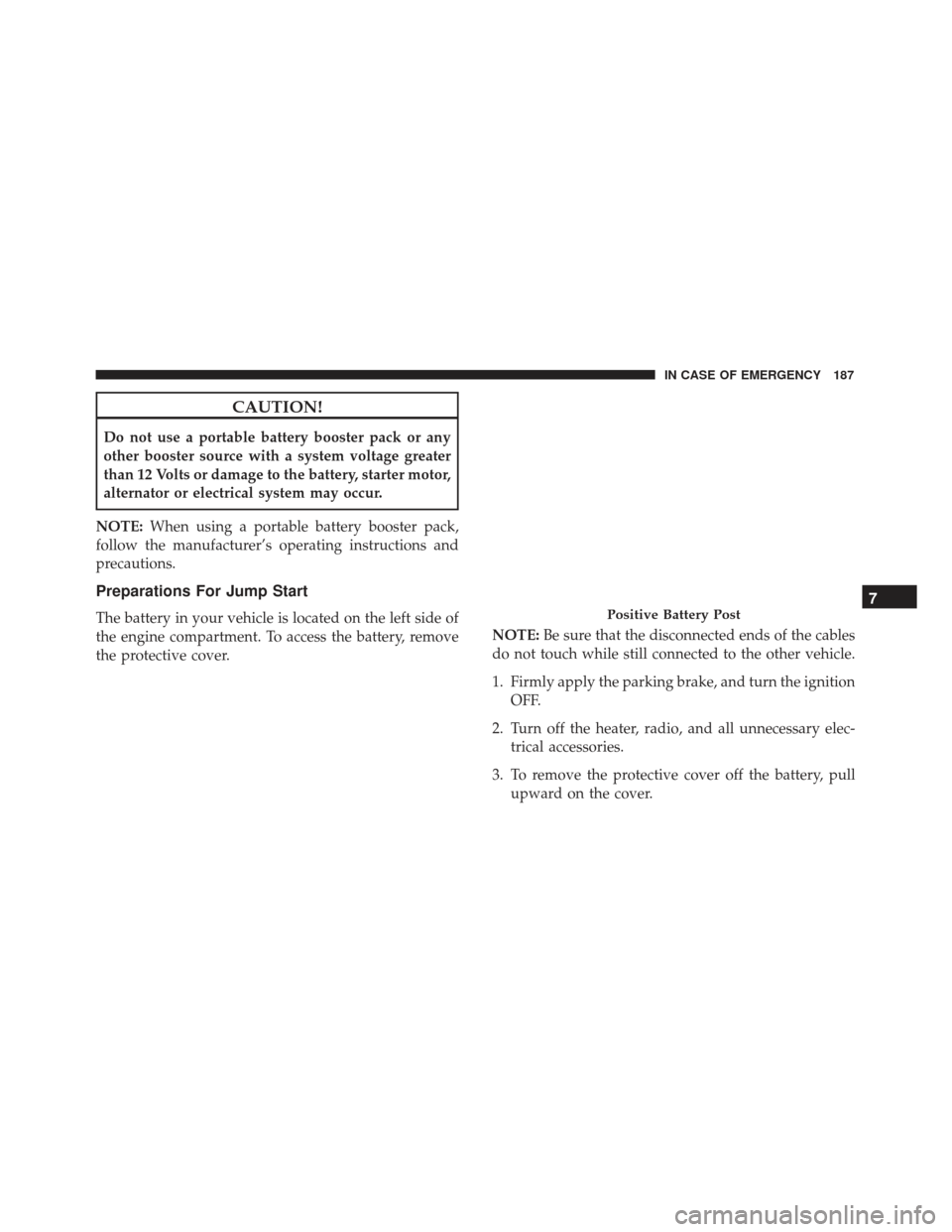
Preparations For Jump Start
The battery in your vehicle is located on the left side of
the engine compartment. To access the battery, remove
the protective cover. NOTE:
Be sure that the disconnected ends of the cables
do not touch while still connected to the other vehicle.
1. Firmly apply the parking brake, and turn the ignition OFF.
2. Turn off the heater, radio, and all unnecessary elec- trical accessories.
3. To remove the protective cover off the battery, pull upward on the cover.Positive Battery Post7
IN CASE OF EMERGENCY 187
Page 190 of 292
4. If using another vehicle to jump start the battery,park the vehicle within the jumper cable’s reach,
apply the parking brake and make sure the ignition
is OFF.
WARNING!
Do not allow vehicles to touch each other as this
could establish a ground connection and personal
injury could result.
Jump Starting Procedure
WARNING!
Failure to follow this jump starting procedure could
result in personal injury or property damage due to
battery explosion.
CAUTION!
Failure to follow these procedures could result in
damage to the charging system of the booster ve-
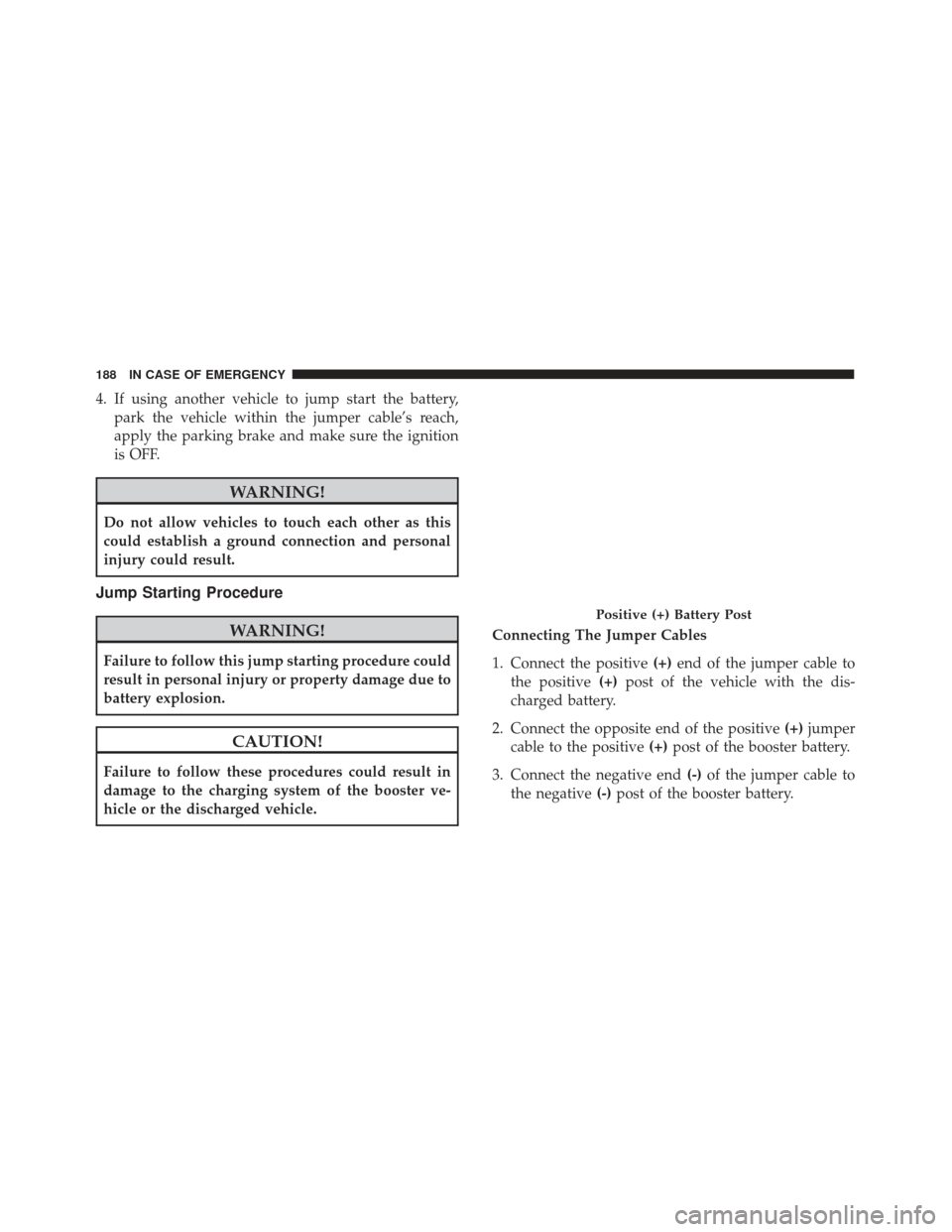
hicle or the discharged vehicle. Connecting The Jumper Cables
1. Connect the positive
(+)end of the jumper cable to
the positive (+)post of the vehicle with the dis-
charged battery.
2. Connect the opposite end of the positive (+)jumper
cable to the positive (+)post of the booster battery.
3. Connect the negative end (-)of the jumper cable to
the negative (-)post of the booster battery.
Positive (+) Battery Post
188 IN CASE OF EMERGENCY
Page 194 of 292
Tow Eye Usage Precautions
The transmission must be in NEUTRAL when flat
towing this vehicle. The ignition must be ON in order to
place the transmission in NEUTRAL. Therefore, if the
key is unavailable or the battery is discharged, this
vehicle must be towed with all four wheels OFF the
ground (using a vehicle trailer or flatbed truck).•
Ensure that the tow eye is properly seated and secure
in the mounting receptacle.
• The tow eye is recommended for use with an ap-
proved tow bar and or rope.
• Do not use the tow eye to pull the vehicle onto a
flatbed truck.
• Do not use the tow eye to free a stuck vehicle.
WARNING!
Stand clear of vehicles when pulling with tow eyes.
•Do not use a chain with a tow eye. Chains may
break, causing serious injury or death.
• Do not use a tow strap with a tow eye. Tow straps
may break or become disengaged, causing serious
injury or death.
• Failure to follow proper tow eye usage may cause
components to break resulting in serious injury
or death.Tow Eye
192 IN CASE OF EMERGENCY
Page 215 of 292
Wiper Blades
Clean the rubber edges of the wiper blades, the wind-
shield, and rear window periodically with a sponge or
soft cloth and a mild nonabrasive cleaner. This will
remove accumulations of salt, waxes, or road film, and
help reduce streaking and smearing.
Operation of the wipers on dry glass for long periods
may cause deterioration of the wiper blades. Always
use washer fluid when using the wipers to remove salt
or dirt from a dry windshield or rear window.
Avoid using the wiper blades to remove frost or ice
from the windshield or rear window. Make sure that
they are not frozen to the glass before turning them on
to avoid damaging the blade. Keep the wiper blade out
of contact with petroleum products such as engine oil,
gasoline, etc.
NOTE:Life expectancy of wiper blades varies depend-
ing on geographical area and frequency of use. Poor
performance of blades may be present with chattering,
marks, water lines, or wet spots. If any of these condi-
tions are present, clean the wiper blades or replace as
necessary.
Blade Lifting
If it is necessary to lift the blade from the windshield (In
the event of snow or blade replacement) Proceed as
directed:
1. Rotate the end of the multifunction lever to the OFF position.
2. Turn the ignition to the MAR-ON position then to STOP.
3. After turning the ignition to the STOP, within two minutes move the right stalk upward, into the un-
stable (“anti-panic”) position, for at least half of a
Windshield Wiper/Washer Lever
8
SERVICING AND MAINTENANCE 213
Page 216 of 292
second. The windshield wiper then executes part of a
stroke; at each command, approximately 1/3 of a
normal wiper stroke is triggered.
NOTE: The previous operation can be repeated up to
three times. In order to move the blades to the most
suitable position.
4. Lift the blade from the windshield and proceed with the required operation.
5. Carefully lower the blade, bringing it back in contact with the windshield.
6. Bring the blade to the initial rest position, turning the ignition to MAR-ON.
NOTE: Do not operate the screen wiper with the blades
lifted from the windshield.
Front Wiper Blade Removal/Installation
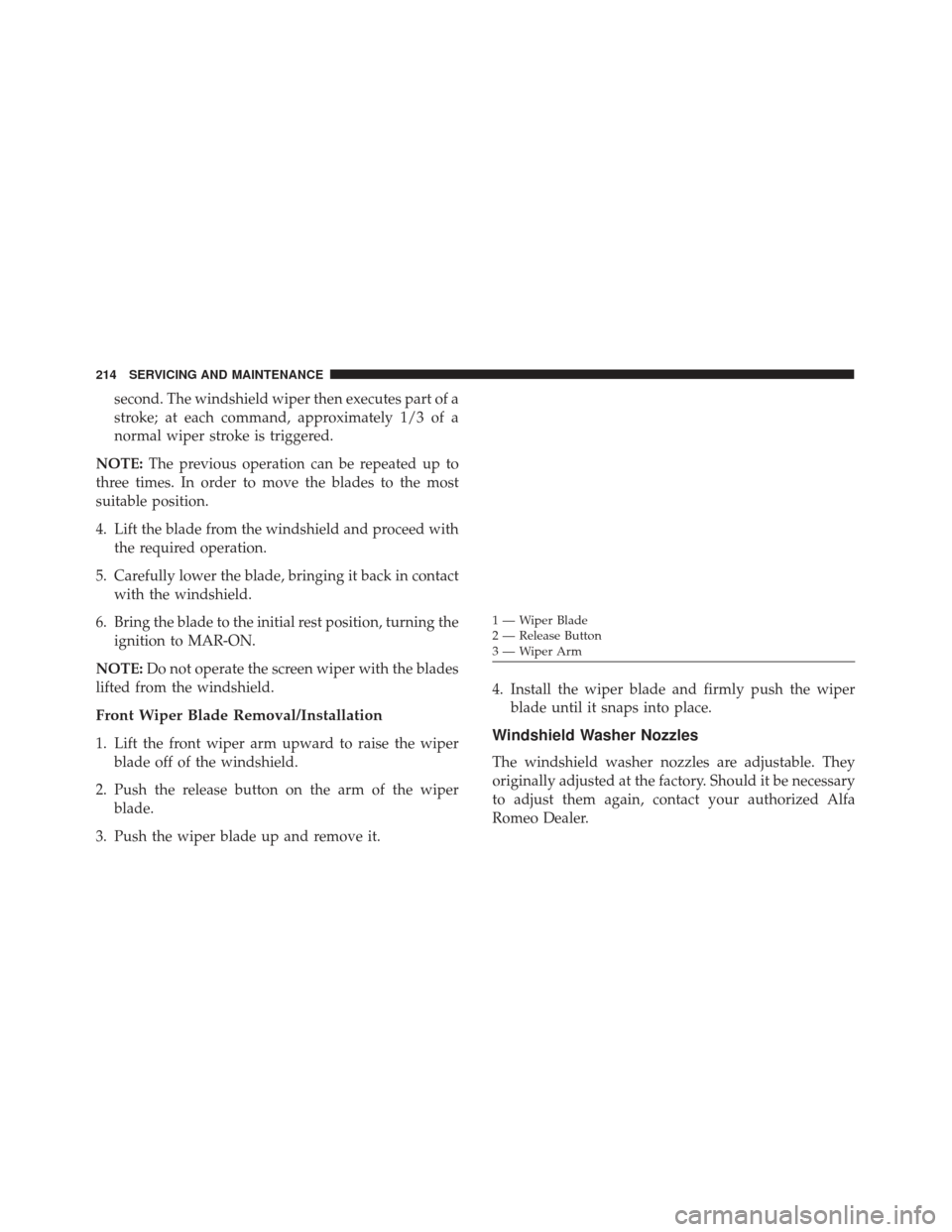
1. Lift the front wiper arm upward to raise the wiper blade off of the windshield.
2. Push the release button on the arm of the wiper blade.
3. Push the wiper blade up and remove it. 4. Install the wiper blade and firmly push the wiper
blade until it snaps into place.Windshield Washer Nozzles
The windshield washer nozzles are adjustable. They
originally adjusted at the factory. Should it be necessary
to adjust them again, contact your authorized Alfa
Romeo Dealer.
1—WiperBlade
2 — Release Button
3—WiperArm
214 SERVICING AND MAINTENANCE
Page 218 of 292
CAUTION!(Continued)
condition. In the event of engine malfunction,
particularly involving engine misfire or other
apparent loss of performance, have your vehicle
serviced promptly. Continued operation of your
vehicle with a severe malfunction could cause the
converter to overheat, resulting in possible dam-
age to the converter and vehicle.
Under normal operating conditions, the catalytic con-
verter will not require maintenance. However, it is
important to keep the engine properly tuned to assure
proper catalyst operation and prevent possible catalyst
damage.
NOTE: Intentional tampering with emissions control
systems can result in civil penalties being assessed
against you.
In unusual situations involving grossly malfunctioning
engine operation, a scorching odor may suggest severe
and abnormal catalyst overheating. If this occurs, stop
the vehicle, turn off the engine and allow it to cool.
Service, including a tune-up to manufacturer’s specifi-
cations, should be obtained immediately.
To minimize the possibility of catalytic converter damage:
• Do not shut off the engine or interrupt the ignition,
when the transmission is in gear and the vehicle is in
motion.
• Do not try to start the engine by pushing or towing
the vehicle.
• Do not idle the engine with any spark plug wires
disconnected or removed, such as when diagnostic
testing, or for prolonged periods during very rough
idle or malfunctioning operating conditions.
Cooling System
WARNING!
• Turn vehicle off and disconnect the fan motor
lead before working near the radiator cooling fan.
•
You or others can be badly burned by hot engine
coolant (antifreeze) or steam from your radiator. If
you see or hear steam coming from under the hood,
do not open the hood until the radiator has had
time to cool. Never open a cooling system pressure
cap when the radiator or coolant bottle is hot.
(Continued)
216 SERVICING AND MAINTENANCE
Page 219 of 292
WARNING!(Continued)
•Keep hands, tools, clothing, and jewelry away
from the radiator cooling fan when the hood is
raised. The fan starts automatically and may start
at any time, whether the engine is running or not.
• When working near the radiator cooling fan,
disconnect the fan motor lead or turn the ignition
switch to the OFF position. The fan is temperature
controlled and can start at any time the ignition
switch is in the ON position.
Coolant Checks
Check engine coolant (antifreeze) protection every 12
months (before the onset of freezing weather, where
applicable). If the engine coolant (antifreeze) is dirty or
rusty in appearance, the system should be drained,
flushed and refilled with fresh engine coolant (anti-
freeze). Check the front of the A/C condenser for any
accumulation of bugs, leaves, etc. If dirty, clean by
gently spraying water from a garden hose vertically
down the face of the condenser.
Cooling System — Drain, Flush And Refill
NOTE: Some vehicles require special tools to add
coolant properly. Failure to fill these systems properly
could lead to severe internal engine damage. If any
coolant is needed to be added to the system please
contact an authorized dealer.
If the engine coolant (antifreeze) is dirty or contains
visible sediment, have an authorized dealer clean and
flush with OAT coolant (antifreeze) (conforming to
MS.90032).
Refer to the “Maintenance Plan” in this section for the
proper maintenance intervals.
Selection Of Coolant
Refer to “Fluids And Lubricants” in “Technical Specifi-
cations” for further information.
NOTE:
•
Mixing of engine coolant (antifreeze) other than speci-
fied Organic Additive Technology (OAT) engine cool-
ant (antifreeze), may result in engine damage and may
decrease corrosion protection. Organic Additive Tech-
nology (OAT) engine coolant is different and should
8
SERVICING AND MAINTENANCE 217
Page 262 of 292
CNG And LP Fuel System Modifications
Modifications that allow the engine to run on Com-
pressed Natural Gas (CNG) or Liquid Propane (LP)
may result in damage to the engine, emissions, and fuel
system components. Problems that result from running
CNG or LP are not the responsibility of the manufac-
turer and may void or not be covered under the New
Vehicle Limited Warranty.
MMT In Gasoline
Methylcyclopentadienyl Manganese Tricarbonyl
(MMT) is a manganese-containing metallic additive
that is blended into some gasoline to increase octane.
Gasoline blended with MMT provides no performance
advantage beyond gasoline of the same octane number
without MMT. Gasoline blended with MMT reduces
spark plug life and reduces emissions system perfor-
mance in some vehicles. The manufacturer recom-
mends that gasoline without MMT be used in your
vehicle. The MMT content of gasoline may not be
indicated on the gasoline pump; therefore, you should
ask your gasoline retailer whether the gasoline contains
MMT. MMT is prohibited in Federal and California
reformulated gasoline.
Fuel System Cautions
CAUTION!
Follow these guidelines to maintain your vehicle’s
performance:
•The use of leaded gasoline is prohibited by Fed-
eral law. Using leaded gasoline can impair engine
performance and damage the emissions control
system.
• An out-of-tune engine or certain fuel or ignition
malfunctions can cause the catalytic converter to
overheat. If you notice a pungent burning odor or
some light smoke, your engine may be out of tune
or malfunctioning and may require immediate
service. Contact an authorized dealer for service
assistance.
• The use of fuel additives, which are now being
sold as octane enhancers, is not recommended.
Most of these products contain high concentra-
tions of methanol. Fuel system damage or vehicle
performance problems resulting from the use of
such fuels or additives is not the responsibility of
the manufacturer and may void or not be covered
under the New Vehicle Limited Warranty.
260 TECHNICAL SPECIFICATIONS