light Alfa Romeo 4C Spider 2019 Workshop Manual
[x] Cancel search | Manufacturer: ALFA ROMEO, Model Year: 2019, Model line: 4C Spider, Model: Alfa Romeo 4C Spider 2019Pages: 292, PDF Size: 3.25 MB
Page 112 of 292
WARNING!
Ignoring the Air Bag Warning Light in your instru-
ment panel could mean you won’t have the air bag
system to protect you in a collision. If the light does
not come on as a bulb check when the ignition is
first turned on, stays on after you start the vehicle,
or if it comes on as you drive, have an authorized
dealer service the air bag system immediately.
Front Air Bags
This vehicle has front air bags and lap/shoulder belts
for both the driver and front passenger. The front air
bags are a supplement to the seat belt restraint systems.
The driver front air bag is mounted in the center of the
steering wheel. The passenger front air bag is mounted
in the instrument panel, above the glove compartment.
The words “SRS AIRBAG” or “AIRBAG” are embossed
on the air bag covers.
WARNING!
•Being too close to the steering wheel or instru-
ment panel during front air bag deployment
could cause serious injury, including death. Air
bags need room to inflate. Sit back, comfortably
(Continued)
Front Air Bag/Knee Bolster Locations
1 — Driver And Passenger Front Air Bags
2 — Passenger Knee Impact Bolster
3 — Driver Knee Impact Bolster/Supplemental Driver Knee Air
Bag
110 SAFETY
Page 115 of 292
WARNING!
•Do not drill, cut, or tamper with the knee impact
bolsters in any way.
• Do not mount any accessories to the knee impact
bolsters such as alarm lights, stereos, citizen band
radios, etc.
Supplemental Driver Knee Air Bag
This vehicle is equipped with a Supplemental Driver
Knee Air Bag mounted in the instrument panel below
the steering column. The Supplemental Driver Knee Air
Bag provides enhanced protection during a frontal
impact by working together with the seat belts, preten-
sioners, and front air bags.
Supplemental Side Air Bags
Supplemental Door-Integrated Side Air Bag Inflat-
able Curtains (SABICs)
This vehicle is equipped with Supplemental Door-
Integrated Side Air Bag Inflatable Curtains (SABICs). SABICs may help reduce the risk of head and other
injuries to front seat outboard occupants in certain side
impacts, in addition to the injury reduction potential
provided by the seat belts and body structure.
The SABICs are located in the door trim below the side
windows. The trim covering the SABICs is labeled “SRS
AIRBAG” or “AIRBAG.”
The SABICs deploy upward, covering the side win-
dows. An inflating SABIC pushes the outside edge of
the trim out of the way and covers the window. The
SABICs inflate with enough force to injure occupants if
they are not belted and seated properly, or if items are
positioned in the area where the SABICs inflate. Chil-
dren are at an even greater risk of injury from a
deploying air bag.
The SABICs may help reduce the risk of partial or
complete ejection of vehicle occupants through side
windows in certain side impact events.
5
SAFETY 113
Page 117 of 292
WARNING!
•Occupants, including children, who are up
against or very close to Side Air Bags can be
seriously injured or killed. Occupants, including
children, should never lean on or sleep against
the door, side windows, or area where the side air
bags inflate, even if they are in an infant or child
restraint.
• Seat belts (and child restraints where appropriate)
are necessary for your protection in all collisions.
They also help keep you in position, away from
an inflating Side Air Bag. To get the best protec-
tion from the Side Air Bags, occupants must wear
their seat belts properly and sit upright with their
backs against the seats. Children must be prop-
erly restrained in a child restraint or booster seat
that is appropriate for the size of the child.
WARNING!
• Side Air Bags need room to inflate. Do not lean
against the door or window. Sit upright in the
center of the seat.
(Continued)
WARNING! (Continued)
•Being too close to the Side Air Bags during
deployment could cause you to be severely in-
jured or killed.
• Relying on the Side Air Bags alone could lead to
more severe injuries in a collision. The Side Air
Bags work with your seat belt to restrain you
properly. In some collisions, Side Air Bags won’t
deploy at all. Always wear your seat belt even
though you have Side Air Bags.
NOTE: Air bag covers may not be obvious in the
interior trim, but they will open during air bag deploy-
ment.
Air Bag System Components
NOTE: The Occupant Restraint Controller (ORC) moni-
tors the internal circuits and interconnecting wiring
associated with electrical Air Bag System Components
listed below:
• Occupant Restraint Controller (ORC)
• Air Bag Warning Light
•Steering Wheel and Column
5
SAFETY 115
Page 119 of 292
WARNING!
Deployed air bags and seat belt pretensioners can-
not protect you in another collision. Have the air
bags, seat belt pretensioners, and the seat belt
retractor assemblies replaced by an authorized
dealer immediately. Also, have the Occupant Re-
straint Controller System serviced as well.
NOTE:
• Air bag covers may not be obvious in the interior
trim, but they will open during air bag deployment.
• After any collision, the vehicle should be taken to an
authorized dealer immediately.
Enhanced Accident Response System
In the event of an impact, if the communication net-
work remains intact, and the power remains intact,
depending on the nature of the event, the ORC will
determine whether to have the Enhanced Accident
Response System perform the following functions:
• Cut off fuel to the engine (If Equipped)
• Cut off battery power to the electric motor (If
Equipped) •
Flash hazard lights as long as the battery has power
• Turn on the interior lights, which remain on as long
as the battery has power or for 15 minutes from the
intervention of the Enhanced Accident Response
System.
• Unlock the power door locks.
Your vehicle may also be designed to perform any of
these other functions in response to the Enhanced
Accident Response System:
• Turn off the Fuel Filter Heater, Turn off the HVAC
Blower Motor, Close the HVAC Circulation Door
• Cut off battery power to the:
• Engine
• Electric Motor (if equipped)
• Electric power steering
• Brake booster
• Electric park brake
• Automatic transmission gear selector
• Horn
• Front wiper
• Headlamp washer pump
5
SAFETY 117
Page 120 of 292
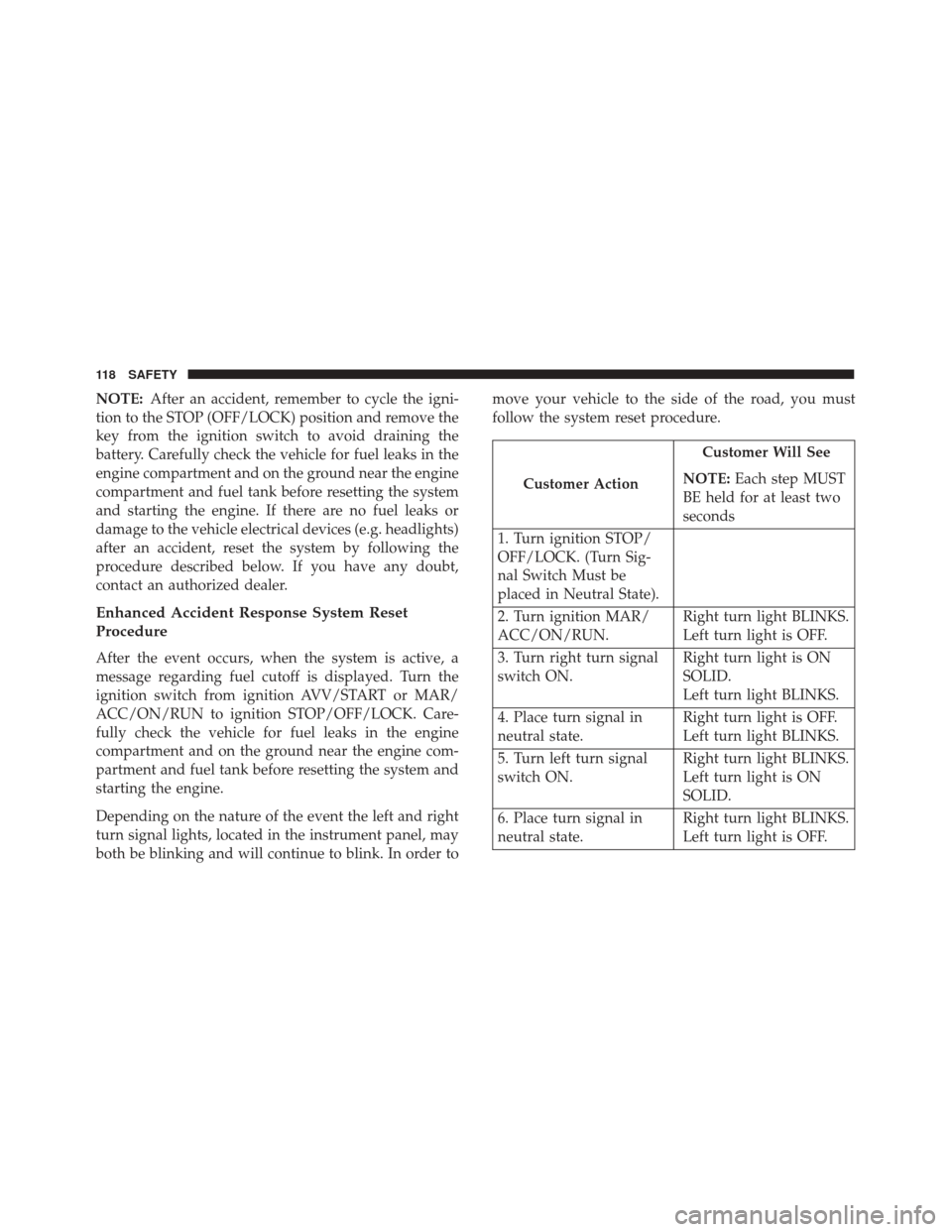
NOTE:After an accident, remember to cycle the igni-
tion to the STOP (OFF/LOCK) position and remove the
key from the ignition switch to avoid draining the
battery. Carefully check the vehicle for fuel leaks in the
engine compartment and on the ground near the engine
compartment and fuel tank before resetting the system
and starting the engine. If there are no fuel leaks or
damage to the vehicle electrical devices (e.g. headlights)
after an accident, reset the system by following the
procedure described below. If you have any doubt,
contact an authorized dealer.
Enhanced Accident Response System Reset
Procedure
After the event occurs, when the system is active, a
message regarding fuel cutoff is displayed. Turn the
ignition switch from ignition AVV/START or MAR/
ACC/ON/RUN to ignition STOP/OFF/LOCK. Care-
fully check the vehicle for fuel leaks in the engine
compartment and on the ground near the engine com-
partment and fuel tank before resetting the system and
starting the engine.
Depending on the nature of the event the left and right
turn signal lights, located in the instrument panel, may
both be blinking and will continue to blink. In order to move your vehicle to the side of the road, you must
follow the system reset procedure.
Customer Action
Customer Will See
NOTE: Each step MUST
BE held for at least two
seconds
1. Turn ignition STOP/
OFF/LOCK. (Turn Sig-
nal Switch Must be
placed in Neutral State).
2. Turn ignition MAR/
ACC/ON/RUN. Right turn light BLINKS.
Left turn light is OFF.
3. Turn right turn signal
switch ON. Right turn light is ON
SOLID.
Left turn light BLINKS.
4. Place turn signal in
neutral state. Right turn light is OFF.
Left turn light BLINKS.
5. Turn left turn signal
switch ON. Right turn light BLINKS.
Left turn light is ON
SOLID.
6. Place turn signal in
neutral state. Right turn light BLINKS.
Left turn light is OFF.
118 SAFETY
Page 121 of 292
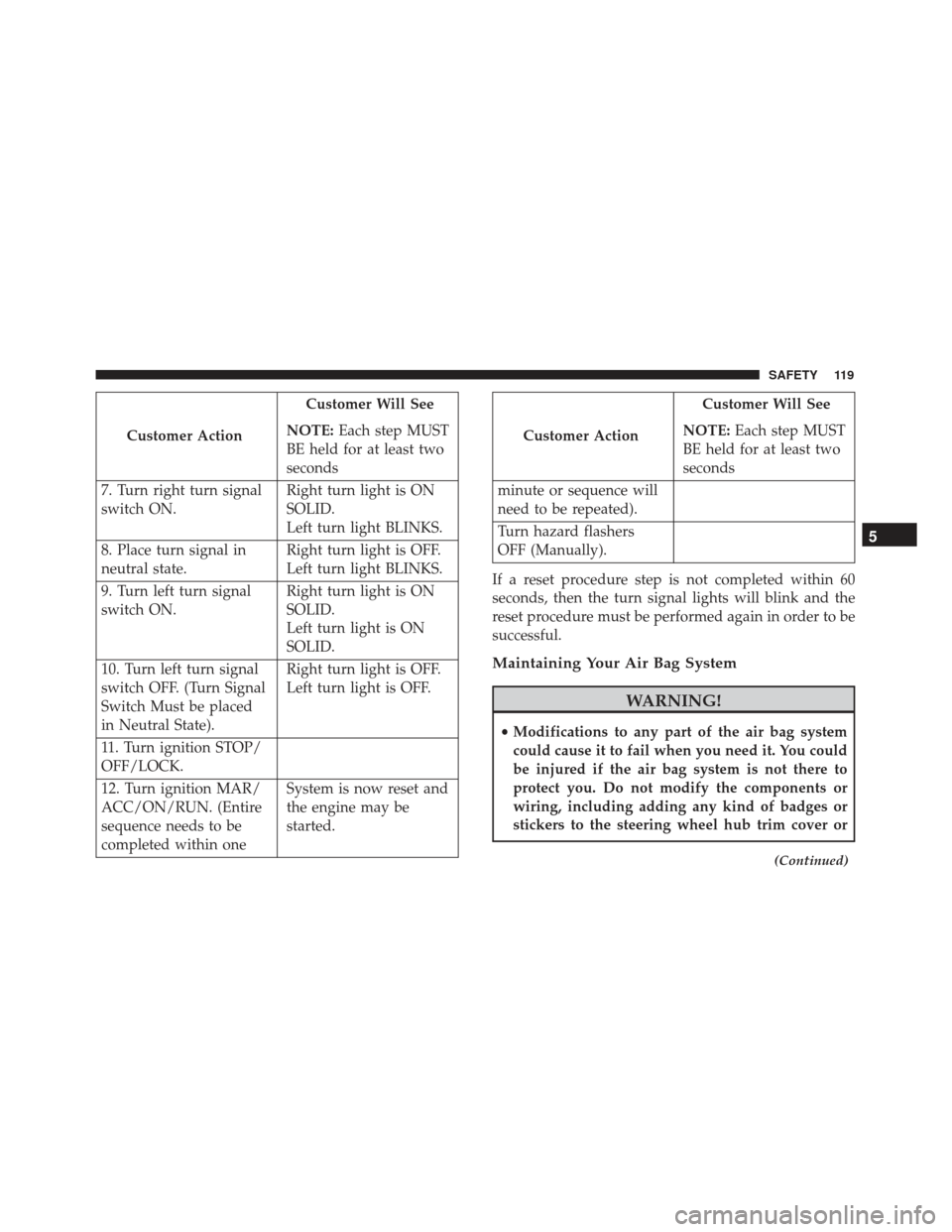
Customer ActionCustomer Will See
NOTE: Each step MUST
BE held for at least two
seconds
7. Turn right turn signal
switch ON. Right turn light is ON
SOLID.
Left turn light BLINKS.
8. Place turn signal in
neutral state. Right turn light is OFF.
Left turn light BLINKS.
9. Turn left turn signal
switch ON. Right turn light is ON
SOLID.
Left turn light is ON
SOLID.
10. Turn left turn signal
switch OFF. (Turn Signal
Switch Must be placed
in Neutral State). Right turn light is OFF.
Left turn light is OFF.
11. Turn ignition STOP/
OFF/LOCK.
12. Turn ignition MAR/
ACC/ON/RUN. (Entire
sequence needs to be
completed within one System is now reset and
the engine may be
started.Customer Action
Customer Will See
NOTE: Each step MUST
BE held for at least two
seconds
minute or sequence will
need to be repeated).
Turn hazard flashers
OFF (Manually).
If a reset procedure step is not completed within 60
seconds, then the turn signal lights will blink and the
reset procedure must be performed again in order to be
successful.
Maintaining Your Air Bag System
WARNING!
• Modifications to any part of the air bag system
could cause it to fail when you need it. You could
be injured if the air bag system is not there to
protect you. Do not modify the components or
wiring, including adding any kind of badges or
stickers to the steering wheel hub trim cover or
(Continued)
5
SAFETY 119
Page 133 of 292
Air Bag Warning Light
The Air Bag warning lightwill turn on for four to
eight seconds as a bulb check when the ignition
switch is first turned to ON/RUN. If the light is
either not on during starting, stays on, or turns on
while driving, have the system inspected at an
authorized dealer as soon as possible. After the bulb
check, this light will illuminate with a single chime
when a fault with the Air Bag System has been
detected. It will stay on until the fault is removed. If
the light comes on intermittently or remains on while
driving, have an authorized dealer service the ve-
hicle immediately.
Refer to “Occupant Restraint Systems” in “Safety” for
further information.
Defroster
Check operation by selecting the defrost mode and
place the blower control on high speed. You should be
able to feel the air directed against the windshield. See
an authorized dealer for service if your defroster is
inoperable.
Floor Mat Safety Information
Always use floor mats designed to fit your vehicle.
Only use a floor mat that does not interfere with the
operation of the accelerator, brake or clutch pedals.
Only use a floor mat that is securely attached using the
floor mat fasteners so it cannot slip out of position and
interfere with the accelerator, brake or clutch pedals or
impair safe operation of your vehicle in other ways.
WARNING!
An improperly attached, damaged, folded, or
stacked floor mat, or damaged floor mat fasteners
may cause your floor mat to interfere with the
accelerator, brake, or clutch pedals and cause a loss
of vehicle control. To prevent SERIOUS INJURY or
DEATH:
• ALWAYS securely attach
your floor mat using
the floor mat fasteners. DO NOT install your
floor mat upside down or turn your floor mat
over. Lightly pull to confirm mat is secured using
the floor mat fasteners on a regular basis.
• ALWAYS REMOVE THE EXISTING FLOOR
MAT FROM THE VEHICLE
before installing
(Continued)
5
SAFETY 131
Page 134 of 292
WARNING!(Continued)
any other floor mat. NEVER install or stack an
additional floor mat on top of an existing floor
mat.
• ONLY install floor mats designed to fit your
vehicle. NEVER install a floor mat that cannot be
properly attached and secured to your vehicle. If a
floor mat needs to be replaced, only use a FCA
approved floor mat for the specific make, model,
and year of your vehicle.
• ONLY use the driver ’s side floor mat on the
driver ’s side floor area. To check for interference,
with the vehicle properly parked with the engine
off, fully depress the accelerator, the brake, and
the clutch pedal (if present) to check for interfer-
ence. If your floor mat interferes with the opera-
tion of any pedal, or is not secure to the floor,
remove the floor mat from the vehicle and place
the floor mat in your trunk.
• ONLY use the passenger ’s side floor mat on the
passenger ’s side floor area.
• ALWAYS make sure objects cannot fall or slide
into the driver ’s side floor area when the vehicle
(Continued)
WARNING! (Continued)
is moving. Objects can become trapped under
accelerator, brake, or clutch pedals and could
cause a loss of vehicle control.
• NEVER place any objects under the floor mat
(e.g., towels, keys, etc.). These objects could
change the position of the floor mat and may
cause interference with the accelerator, brake, or
clutch pedals.
• If the vehicle carpet has been removed and re-
installed, always properly attach carpet to the
floor and check the floor mat fasteners are secure
to the vehicle carpet. Fully depress each pedal to
check for interference with the accelerator, brake,
or clutch pedals then re-install the floor mats.
• It is recommended to only use mild soap and
water to clean your floor mats. After cleaning,
always check your floor mat has been properly
installed and is secured to your vehicle using the
floor mat fasteners by lightly pulling mat.
132 SAFETY
Page 135 of 292
Periodic Safety Checks You Should Make
Outside The Vehicle
Tires
Examine tires for excessive tread wear and uneven wear
patterns. Check for stones, nails, glass, or other objects
lodged in the tread or sidewall. Inspect the tread for
cuts and cracks. Inspect sidewalls for cuts, cracks, and
bulges. Check the wheel nuts for tightness. Check the
tires (including spare) for proper cold inflation pres-
sure.
Lights
Have someone observe the operation of brake lights
and exterior lights while you work the controls. Check
turn signal and high beam indicator lights on the
instrument panel.
Door Latches
Check for proper closing, latching, and locking.
Fluid Leaks
Check area under the vehicle after overnight parking
for fuel, coolant, oil, or other fluid leaks. Also, if
gasoline fumes are detected or if fuel, or brake fluid
leaks are suspected. The cause should be located and
corrected immediately.
5
SAFETY 133
Page 141 of 292
ENGINE BREAK-IN RECOMMENDATIONS
A long break-in period is not required for the drivetrain
(engine, transmission, and rear axle) in your new ve-
hicle.
Driving your vehicle with a new transmission requires
no special techniques but, to reach optimal shifting
quality and help with engine Break-in, Dynamic and
Race Mode will be inhibited until the vehicle has
accumulated 155 miles (250 km).
Additionally, for the first 200 miles (300 km), following
these few simple guidelines is all that is necessary for a
good break-in.
•Avoid very aggressive driving.
• Avoid driving at a constant speed, either fast or slow,
for long periods.
• Do not make any full throttle starts and avoid full
throttle acceleration while cruising within the posted
speed limits of local traffic laws.
• Use the proper gear for your speed range.
• Wait until the engine has reached normal operating
temperature before driving at the recommended
maximum break-in speed. •
Avoid excessive idling.
• Check the engine oil level at every fuel fill.
PARKING BRAKE
Before leaving the vehicle, make sure that the parking
brake is fully applied. Also, be certain to leave manual
transmission in REVERSE (R) or FIRST (1st) gear.
The parking brake lever is located in the central tunnel.
To apply the parking brake, pull the parking brake lever
up as firmly as possible. To release the parking brake,
pull the parking brake lever up slightly, push the center
button, then lower the parking brake lever completely.
Parking Brake Lever
6
STARTING AND OPERATING 139