light Alfa Romeo 4C Spider 2019 Repair Manual
[x] Cancel search | Manufacturer: ALFA ROMEO, Model Year: 2019, Model line: 4C Spider, Model: Alfa Romeo 4C Spider 2019Pages: 292, PDF Size: 3.25 MB
Page 142 of 292
When the parking brake is applied with the ignition
switch in the MAR (ACC/ON/RUN) position, the
Brake Warning Light in the instrument cluster display
will illuminate.
When parking on a hill, it is important to turn the front
wheels toward the curb on a downhill grade and away
from the curb on an uphill grade. The parking brake
should always be applied whenever the driver is not in
the vehicle.
WARNING!
•Never leave children alone in a vehicle, or with
access to an unlocked vehicle.
•
Allowing children to be in a vehicle unattended is
dangerous for a number of reasons. A child or
others could be seriously or fatally injured. Chil-
dren should be warned not to touch the parking
brake, brake pedal or the transmission gear selector.
• Do not leave the key fob in or near the vehicle or
in a location accessible to children. A child could
operate power windows, other controls, or move
the vehicle.
(Continued)
WARNING! (Continued)
•Be sure the parking brake is fully disengaged
before driving; failure to do so can lead to brake
failure and a collision.
• Always fully apply the parking brake when leav-
ing your vehicle, or it may roll and cause damage
or injury. Also be certain to leave a manual
transmission in REVERSE or FIRST gear. Failure
to do so may allow the vehicle to roll and cause
damage or injury.
CAUTION!
If the Brake Warning Light remains on with the
parking brake released, a brake system malfunction
is indicated. Have the brake system serviced by an
authorized dealer immediately.
140 STARTING AND OPERATING
Page 149 of 292
Driving Modes
The Alfa DNA system lever will always return to the
center position after use.
The selected driving mode is indicated by the corre-
sponding LED switching in the panel and by an indi-
cation on the display.
Dynamic Mode
Activation
Move the Alfa DNA system lever upwards (to the letter
“D”) and hold in this position for half a second, until
the corresponding LED lights up and the Dynamic
mode activation indicator appears on the display.
When Dynamic mode is activated, the turbocharger
pressure and engine oil temperature screen is displayed
automatically. When released, the Alfa DNA system
lever will return to the central position.
NOTE:Dynamic Mode will be inhibited until the
vehicle has accumulated 155 miles (250 km). Electronic Stability Control (ESC) and Anti-Slip
Regulation (ASR) systems:
The ESC and ASR system ensures more enjoyable,
sportier driving while guaranteeing the stability of the
vehicle.
Electronic Q2 system:
The system increases vehicle stability while accelerating
on bends, improving the agility of the vehicle.
Engine And Gearbox/Transmission:
The system adjusts the transmission shift calibration for
sportier shifting.
NOTE:
In Dynamic mode, the engine response to the
accelerator pedal position increases considerably. Con-
sequently, driving is less fluid and comfortable.
Deactivation
To deactivate Dynamic mode and return to Natural,
move lever downwards (to letter “A”) and hold for half
a second.
The LED corresponding to Natural mode will light up
and the Natural mode activation indication will appear
on the display.6
STARTING AND OPERATING 147
Page 150 of 292
Race Mode
Activation
Starting in Dynamic mode, move the Alfa DNA system
lever upwards (to the letter “D”) and hold in this
position for five seconds, until the Race mode activation
indicator appears on the display.
When Race mode is activated, the longitudinal/lateral
accelerometer indicator screen (G-meter information) is
displayed automatically. This considers gravitational
acceleration (G).
Electronic Stability Control (ESC) and Anti-Slip
Regulation (ASR) systems:
These systems are deactivated in order to ensure the
fullest sensation of sport, leaving the driver in full
control of the vehicle. When the vehicle is in unstable
conditions, the ESC reactivates automatically when the
brake pedal is pressed until the ABS intervenes, thus
returning the vehicle to stable conditions. To deactivate
the ESC and ASR systems, reactivate Race mode.
Electronic Q2 system:
The system increases vehicle stability while accelerating
on bends, improving the agility of the vehicle.Engine And Gearbox/Transmission:
The system adjusts the transmission shift calibration for
sportier shifting.
NOTE:
In Race mode, the sensitivity of the accelerator
pedal increases considerably. Consequently, driving is
less fluid and comfortable.
In Race mode, the transmission only works in
MANUAL mode.
Deactivation
To deactivate Race mode and return to Dynamic mode,
move the Alfa DNA system lever downwards (to letter
“A”) and keep it in this position for half a second.
The LED corresponding to Dynamic mode will light up
and the Dynamic mode activation indication will ap-
pear on the display.
Natural Mode
Electronic Stability Control (ESC) and Anti-Slip
Regulation (ASR) systems:
ESC and ASR system thresholds are aimed at providing
comfort and safety in normal grip and driving condi-
tions.
148 STARTING AND OPERATING
Page 151 of 292
Electronic Q2 system:
The system is calibrated to ensure the best driving
comfort.
Engine And Gearbox/Transmission:
Standard response shifting.
All Weather Mode
Activation
Move the Alfa DNA system lever downwards (to the
letter “A”) and hold in this position for half a second,
until the corresponding LED lights up and the All
Weather mode activation indicator appears on the dis-
play.
Electronic Stability Control (ESC) and Anti-Slip
Regulation (ASR) systems:
ESC and ASR system thresholds are aimed at ensuring
maximum safety in low-grip driving conditions. It is
advisable to select All Weather mode in the presence of
low-grip road surfaces.
Electronic Q2 System:
The system is deactivated.Engine And Gearbox/Transmission:
Standard response shifting.
Deactivation
To deactivate All Weather mode and return to Natural
mode, move the Alfa DNA system lever upwards (to
letter “D”) and keep it in this position for half a second.
NOTE:
•
When the engine is next started, All Weather mode or
Natural mode will be retained when the vehicle is
restarted.
• When the engine is next started, Race mode or
Dynamic mode previously selected is not retained.
The system will reactivate in Natural mode.
• It is not possible to go directly from Dynamic mode
to All Weather mode and vice versa. You must
always first go back to Natural mode and then select
the other mode.
System Failure
In the event of system failure or a fault with the gear
selector, no driving modes can be selected.
6
STARTING AND OPERATING 149
Page 153 of 292
NOTE:In order to ensure proper operation, the Speed
Control system has been designed to shut down if
multiple speed control functions are operated at the same
time. If this occurs, the Speed Control system can be
reactivated rotating the end of the multifunction lever
(on/off) and resetting the desired vehicle set speed.
To Activate
Rotate the end of the multifunction lever upward to the
first detent, indicated by the speed control icon, to activate the Speed Control. The Cruise Control Indica-
tor Light in the instrument cluster display will illumi-
nate. To turn the system off, rotate the end of the
multifunction lever to the O (off) position. The Cruise
Control Indicator Light will turn off. The system should
be turned off when not in use.
WARNING!
Leaving the Speed Control system on when not in
use is dangerous. You could accidentally set the
system or cause it to go faster than you want. You
could lose control and have an accident. Always
leave the system off when you are not using it.
To Set A Desired Speed
Turn the Speed Control on. When the vehicle has
reached the desired speed, move the speed control lever
upward (+), and release. Release the accelerator, and the
vehicle will operate at the set speed.
NOTE:
The vehicle should be traveling at a steady
speed, and on level ground before setting the speed
control.
Speed Control Lever
6
STARTING AND OPERATING 151
Page 157 of 292
If an obstacle is detected in the rear central area, the
instrument cluster display shows all the arcs in the rear
central area, up to the one that corresponds to the
position of the obstacle itself.
The signal is similar for obstacles in the rear left or right
area.
The arc that corresponds to the position of the obstacle
will flash.
The color on the instrument cluster display depends on
the distance from and position of the obstacle.
The vehicle is close to the obstacle when the instrument
cluster display shows a single constant arc and emits a
continuous sound.
If there are several obstacles, the closest one is indi-
cated.
Activation/Deactivation
The sensors are automatically activated when REVERSE
gear is engaged and a visual display will appear in the
instrument cluster display. As the obstacle behind the
vehicle gets closer, the acoustic signal becomes more
frequent.
Fault Indication
Parking sensor failures, if any, will be indicated when
REVERSE gear is engaged by the illumination of the
warning light in the instrument cluster display.
General Warnings
When parking, take the utmost care over obstacles that
may be above or under the sensor.
Under certain circumstances, objects close to the vehicle
are not detected by the system and could therefore
cause damage to the vehicle or be damaged themselves.
Some conditions may influence the performance of the
parking sensors:
• The presence of ice, snow, mud or multiple layers of
paint on the sensor surface may cause reduced
sensitivity of the sensor itself and therefore reduce
the system performance.
• Mechanical interference (e.g washing the vehicle,
rain, strong wind, hail) may cause the sensor to
detect a non-existent obstacle (“echo interference”).
• The presence of ultrasonic systems (e.g. pneumatic
brake systems of trucks or pneumatic drills) near the
vehicle could alter the signals sent by the sensor.
6
STARTING AND OPERATING 155
Page 159 of 292
note to “check entire surroundings.” After five seconds
this note will disappear. The ParkView camera is lo-
cated on the trunk lid below the brake light.
When the vehicle is shifted out of REVERSE, the camera
image will continue to be displayed for up to 10 seconds
after shifting out of REVERSE.
Fixed guide lines are overlaid on the image to illustrate
the width of the vehicle.
Different colored zones indicate the distance to the rear
of the vehicle.
The following table shows the approximate distances
for each zone:
ZoneDistance To The Rear
Of The Vehicle
Red 0 - 1 ft (0 - 30 cm)
Yellow 1 ft - 3 ft (30 cm - 1 m)
Green 3 ft or greater (1 m or greater)
NOTE: If snow, ice, mud, or any foreign substance
builds up on the camera lens, clean the lens, rinse with
water, and dry with a soft cloth. Do not cover the lens.
WARNING!
Drivers must be careful when backing up even
when using the ParkView Rear Back Up Camera.
Always check carefully behind your vehicle, and be
sure to check for pedestrians, animals, other ve-
hicles, obstructions, or blind spots before backing
up. You are responsible for the safety of your
surroundings and must continue to pay attention
while backing up. Failure to do so can result in
serious injury or death.
CAUTION!
• To avoid vehicle damage, ParkView should only
be used as a parking aid. The ParkView camera is
unable to view every obstacle or object in your
drive path.
• To avoid vehicle damage, the vehicle must be
driven slowly when using ParkView to be able to
stop in time when an obstacle is seen. It is
recommended that the driver look frequently
over his/her shoulder when using ParkView.
6
STARTING AND OPERATING 157
Page 161 of 292
Emergency Gas Can Refueling:
Most gas cans will not open the flapper door.
A funnel is provided to open the flapper door to allow
emergency refueling with a gas can.
1. Retrieve the appropriate funnel from the storage areain the luggage compartment.
2. Insert funnel into same filler pipe opening as the fuel nozzle.
3. Ensure funnel is inserted fully to hold flapper door open. 4. Pour fuel into funnel opening.
5. Remove funnel from filler pipe, clean off prior to
putting back in the storage area.
WARNING!
•Never have any smoking materials lit in or near
the vehicle when the fuel door is open or the tank
is being filled.
• Never add fuel when the engine is running. This
is in violation of most state and federal fire
regulations and may cause the “Malfunction In-
dicator Light” to turn on.
• A fire may result if fuel is pumped into a portable
container that is inside of a vehicle. You could be
burned. Always place fuel containers on the
ground while filling.
CAUTION!
To avoid fuel spillage and overfilling, do not “top
off” the fuel tank after filling.
Emergency Fuel Fill Location
6
STARTING AND OPERATING 159
Page 164 of 292
Flowing/Rising Water
WARNING!
Do not drive on or across a road or path where water
is flowing and/or rising (as in storm run-off). Flow-
ing water can wear away the road or path’s surface
and cause your vehicle to sink into deeper water.
Furthermore, flowing and/or rising water can carry
your vehicle away swiftly. Failure to follow this
warning may result in injuries that are serious or
fatal to you, your passengers, and others around
you.
Shallow Standing Water
Although your vehicle is capable of driving through
shallow standing water, consider the following Cau-
tions and Warnings before doing so.
WARNING!
•Driving through standing water limits your vehi-
cle’s traction capabilities. Do not exceed 5 mph
(8 km/h) when driving through standing water.
(Continued)
WARNING! (Continued)
•Driving through standing water limits your vehi-
cle’s braking capabilities, which increases stop-
ping distances. Therefore, after driving through
standing water, drive slowly and lightly press on
the brake pedal several times to dry the brakes.
• Failure to follow these warnings may result in
injuries that are serious or fatal to you, your
passengers, and others around you.
CAUTION!
• Always check the depth of the standing water
before driving through it. Never drive through
standing water that is deeper than the bottom of
the tire rims mounted on the vehicle.
• Determine the condition of the road or the path
that is under water and if there are any obstacles
in the way before driving through the standing
water.
• Do not exceed 5 mph (8 km/h) when driving
through standing water. This will minimize wave
effects.
(Continued)
162 STARTING AND OPERATING
Page 168 of 292
HAZARD WARNING FLASHER
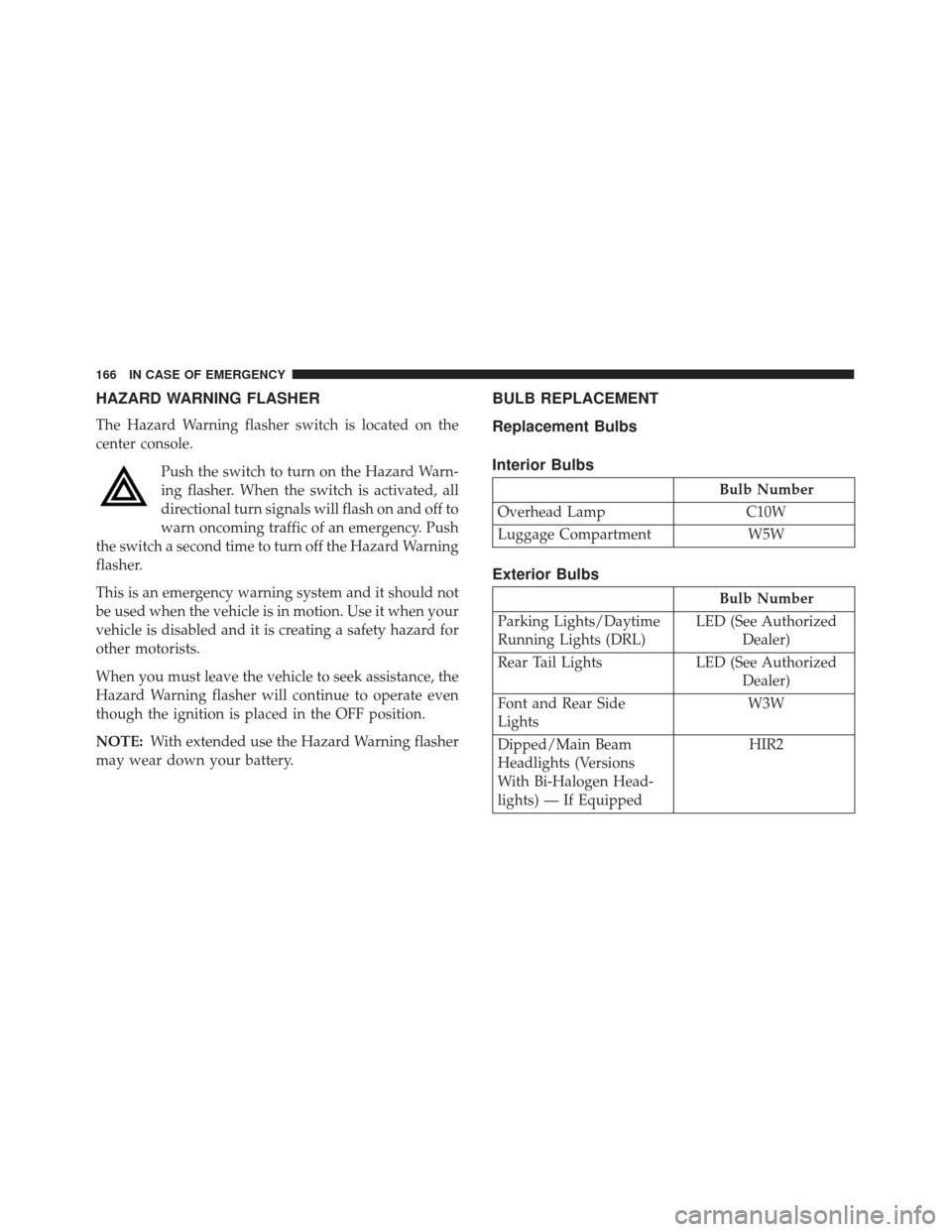
The Hazard Warning flasher switch is located on the
center console.Push the switch to turn on the Hazard Warn-
ing flasher. When the switch is activated, all
directional turn signals will flash on and off to
warn oncoming traffic of an emergency. Push
the switch a second time to turn off the Hazard Warning
flasher.
This is an emergency warning system and it should not
be used when the vehicle is in motion. Use it when your
vehicle is disabled and it is creating a safety hazard for
other motorists.
When you must leave the vehicle to seek assistance, the
Hazard Warning flasher will continue to operate even
though the ignition is placed in the OFF position.
NOTE: With extended use the Hazard Warning flasher
may wear down your battery.
BULB REPLACEMENT
Replacement Bulbs
Interior Bulbs
Bulb Number
Overhead Lamp C10W
Luggage Compartment W5W
Exterior Bulbs
Bulb Number
Parking Lights/Daytime
Running Lights (DRL) LED (See Authorized
Dealer)
Rear Tail Lights LED (See Authorized
Dealer)
Font and Rear Side
Lights W3W
Dipped/Main Beam
Headlights (Versions
With Bi-Halogen Head-
lights) — If Equipped HIR2
166 IN CASE OF EMERGENCY