stop start Alfa Romeo Giulia 2016 Owner's Guide
[x] Cancel search | Manufacturer: ALFA ROMEO, Model Year: 2016, Model line: Giulia, Model: Alfa Romeo Giulia 2016Pages: 204, PDF Size: 4.95 MB
Page 109 of 204
It is not possible to select N (Neutral)
mode from P (Park) mode.
P (Park) mode is automatically activated
if the following conditions are met
simultaneously:
D (Drive) or R (Reverse) mode is active;
the car’s speed is close to 0;
the brake pedal is released;
the driver’s seat belt is not fastened;
the driver’s door is open.
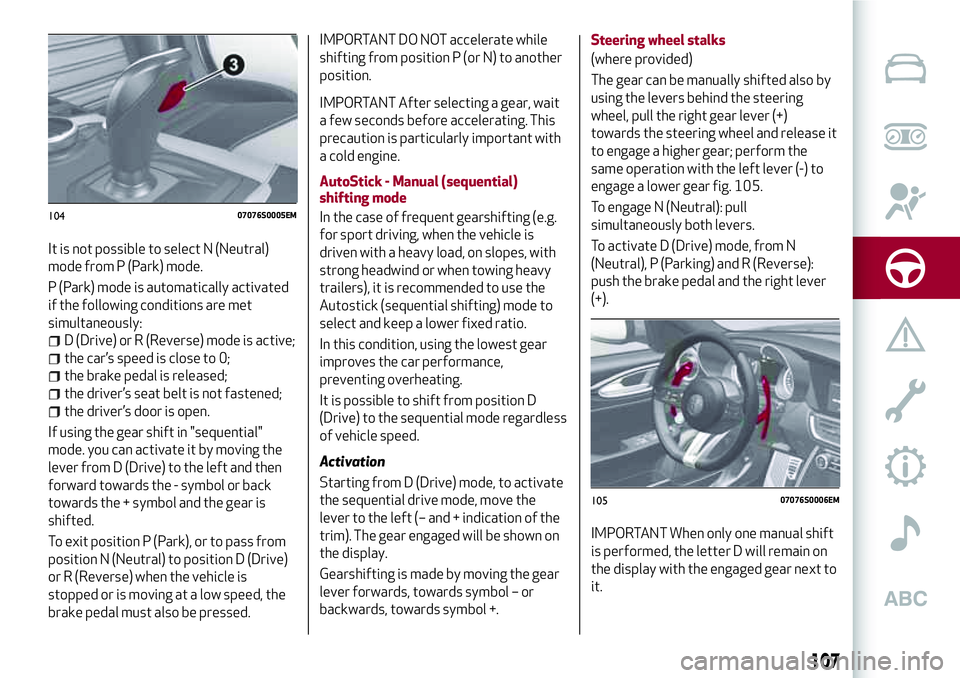
If using the gear shift in "sequential"
mode. you can activate it by moving the
lever from D (Drive) to the left and then
forward towards the - symbol or back
towards the + symbol and the gear is
shifted.
To exit position P (Park), or to pass from
position N (Neutral) to position D (Drive)
or R (Reverse) when the vehicle is
stopped or is moving at a low speed, the
brake pedal must also be pressed.
IMPORTANT DO NOT accelerate while
shifting from position P (or N) to another
position.
IMPORTANT After selecting a gear, wait
a few seconds before accelerating. This
precaution is particularly important with
a cold engine.
AutoStick - Manual (sequential)
shifting mode
In the case of frequent gearshifting (e.g.
for sport driving, when the vehicle is
driven with a heavy load, on slopes, with
strong headwind or when towing heavy
trailers), it is recommended to use the
Autostick (sequential shifting) mode to
select and keep a lower fixed ratio.
In this condition, using the lowest gear
improves the car performance,
preventing overheating.
It is possible to shift from position D
(Drive) to the sequential mode regardless
of vehicle speed.
Activation
Starting from D (Drive) mode, to activate
the sequential drive mode, move the
lever to the left (– and + indication of the
trim). The gear engaged will be shown on
the display.
Gearshifting is made by moving the gear
lever forwards, towards symbol – or
backwards, towards symbol +.Steering wheel stalks
(where provided)
The gear can be manually shifted also by
using the levers behind the steering
wheel, pull the right gear lever (+)
towards the steering wheel and release it
to engage a higher gear; perform the
same operation with the left lever (-) to
engage a lower gear fig. 105.
To engage N (Neutral): pull
simultaneously both levers.
To activate D (Drive) mode, from N
(Neutral), P (Parking) and R (Reverse):
push the brake pedal and the right lever
(+).
IMPORTANT When only one manual shift
is performed, the letter D will remain on
the display with the engaged gear next to
it.
10407076S0005EM
10507076S0006EM
107
Page 110 of 204
Deactivation
To deactivate the sequential driving
mode, bring the gear lever back in
position D (Drive) ("automatic" driving
mode).
TRANSMISSION EMERGENCY
FUNCTION
(where provided)
Transmission operation is constantly
monitored to detect any fault. If a
condition that might damage the
transmission is detected, the
"transmission emergency" function is
activated.
In this condition, the transmission stays
in 4
thgear, regardless of the selected
gear. Positions P (Parking), R (Reverse)
and N (Neutral) still work.
The
symbol might light up in the
display.
In the event of a "transmission
emergency" immediately contact the
nearest Alfa Romeo Dealership.
Temporary failure
If the warning light goes on, you can
confirm if the failure is temporary and
restore the gear's proper functioning by
proceeding as follows:
stop the vehicle;
engage P (Park);
bring the ignition device to STOP;
wait for about 10 seconds, then
restart the engine;
select the desired gear: if the problem
is not detected anymore the
transmission correct operation is
restored.
IMPORTANT In the event of a temporary
failure it is in any case recommended to
contact an Alfa Romeo Dealership as
soon as possible.
GEAR ENGAGEMENT DISABLING
SYSTEM WITHOUT BRAKE PEDAL
PRESSED
This system prevents you from moving
the gear lever from position P (Park) if
the brake pedal has not been previously
depressed.
To bring the gear lever to a position other
than P (Park), the ignition device must be
in position AVV (engine on or off) and the
brake pedal must be pressed.
WARNING
107)Never use position P (Park) instead of
the electric parking brake. Always engage
the electric parking brake when parking the
vehicle to avoid the accidental movement of
the vehicle.
108)If the P (Park) position is not engaged,
the vehicle could move and injure people.
Before leaving the vehicle, make sure that
the gear lever is in position P and that the
electric parking brake is engaged.109)Do not shift the gear lever to N
(Neutral) and do not stop the engine when
driving on a downhill road. This type of
driving is dangerous and reduces the
possibility of intervening in the case of
variation of the road traffic or surface. You
risk losing control of your vehicle and
causing accidents.
IMPORTANT
35)Before selecting P (Park) mode, bring the
ignition device to position ON and press the
brake pedal. Otherwise, the gear lever may
get damaged.
36)Engage reverse only with the car
stationary, engine at idling speed and
accelerator fully released.
108
STARTING AND DRIVING
Page 111 of 204
"ALFA DNA™"SYSTEM
"ALFA DNA™"SYSTEM
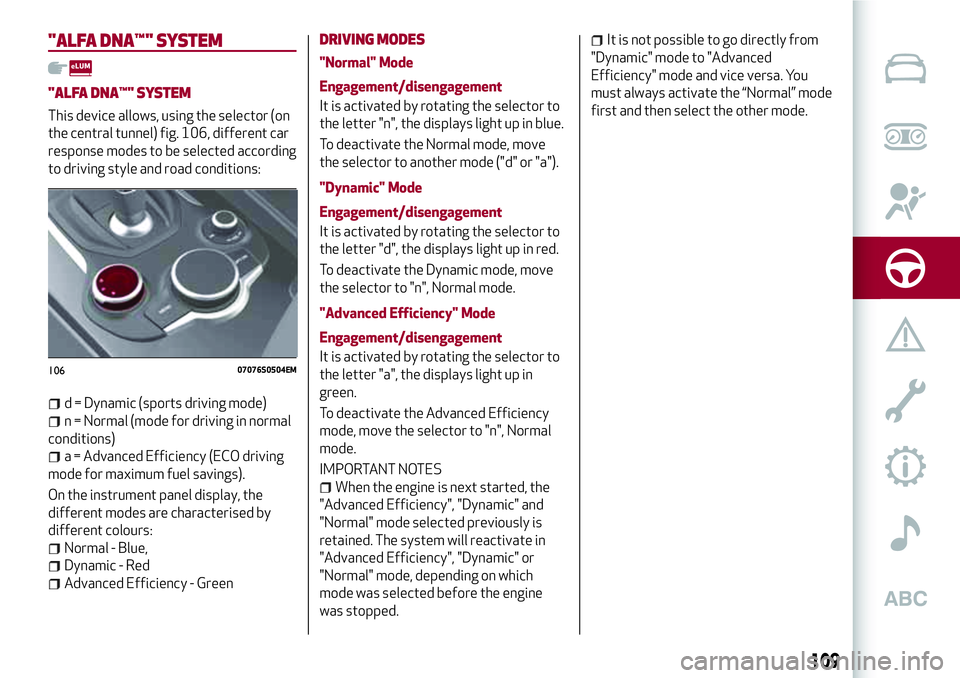
This device allows, using the selector (on
the central tunnel) fig. 106, different car
response modes to be selected according
to driving style and road conditions:
d = Dynamic (sports driving mode)
n = Normal (mode for driving in normal
conditions)
a = Advanced Efficiency (ECO driving
mode for maximum fuel savings).
On the instrument panel display, the
different modes are characterised by
different colours:
Normal - Blue,
Dynamic - Red
Advanced Efficiency - Green
DRIVING MODES
"Normal" Mode
Engagement/disengagement
It is activated by rotating the selector to
the letter "n", the displays light up in blue.
To deactivate the Normal mode, move
the selector to another mode ("d" or "a").
"Dynamic" Mode
Engagement/disengagement
It is activated by rotating the selector to
the letter "d", the displays light up in red.
To deactivate the Dynamic mode, move
the selector to "n", Normal mode.
"Advanced Efficiency" Mode
Engagement/disengagement
It is activated by rotating the selector to
the letter "a", the displays light up in
green.
To deactivate the Advanced Efficiency
mode, move the selector to "n", Normal
mode.
IMPORTANT NOTES
When the engine is next started, the
"Advanced Efficiency", "Dynamic" and
"Normal" mode selected previously is
retained. The system will reactivate in
"Advanced Efficiency", "Dynamic" or
"Normal" mode, depending on which
mode was selected before the engine
was stopped.
It is not possible to go directly from
"Dynamic" mode to "Advanced
Efficiency" mode and vice versa. You
must always activate the “Normal” mode
first and then select the other mode.
10607076S0504EM
109
Page 112 of 204
START & STOP EVO
The Start & Stop Evo system
automatically stops the engine each time
the vehicle is stationary and starts it
again when the driver wants to move off.
In this way, the vehicle efficiency is
increased, by reducing consumption,
dangerous gas emissions and sound
pollution.
OPERATING MODE
Stopping the engine
Versions with mechanical gearbox
With the vehicle stopped, the engine
stops with gearbox in neutral and clutch
pedal released.
Versions with automatic transmission
With vehicle at a standstill and brake
pedal pressed, the engine switches off if
the gear lever is in a position other than
R.
The system does not operate when the
gear lever is in R, for making parking
manoeuvres easier.
In the event of stops uphill, engine
switching off is disabled to make the "Hill
Start Assist" function available (works
only with running engine).
NOTE The engine can only be
automatically stopped after having run atabout 6 mph (10 km/h). After an
automatic restart, to stop the engine you
only need to move the vehicle (exceed a
speed of 0.3 mph (0.5 km/h)).
Engine stopping is signalled by the
symbol lighting up on the instrument
panel display.
Restarting the engine
Versions with mechanical gearbox
To restart the engine, press the clutch
pedal.
If the vehicle does not start when the
clutch is pressed, place the gear lever in
neutral and repeat the procedure. If the
problem persists, contact an Alfa Romeo
Dealership.
Versions with automatic transmission
To restart the engine, release the brake
pedal.
With brake pressed, if the gear lever is in
automatic mode - D (Drive) - the engine
can be restarted by moving the lever to R
(Reverse) or N (Neutral) or "AutoStick".
With brake pressed, if the gear lever is in
"AutoStick" mode, the engine can be
restarted by moving the lever to "+" or
"–", or R (Reverse) or N (Neutral).
When the engine has been stopped
automatically, keeping the brake pedal
pressed, the brake can be releasedkeeping the engine off by quickly shifting
the gear lever to P (Park).
To restart the engine, just move the lever
out of a position other than P.SYSTEM MANUAL ACTIVATION/
DEACTIVATION
110)
37)
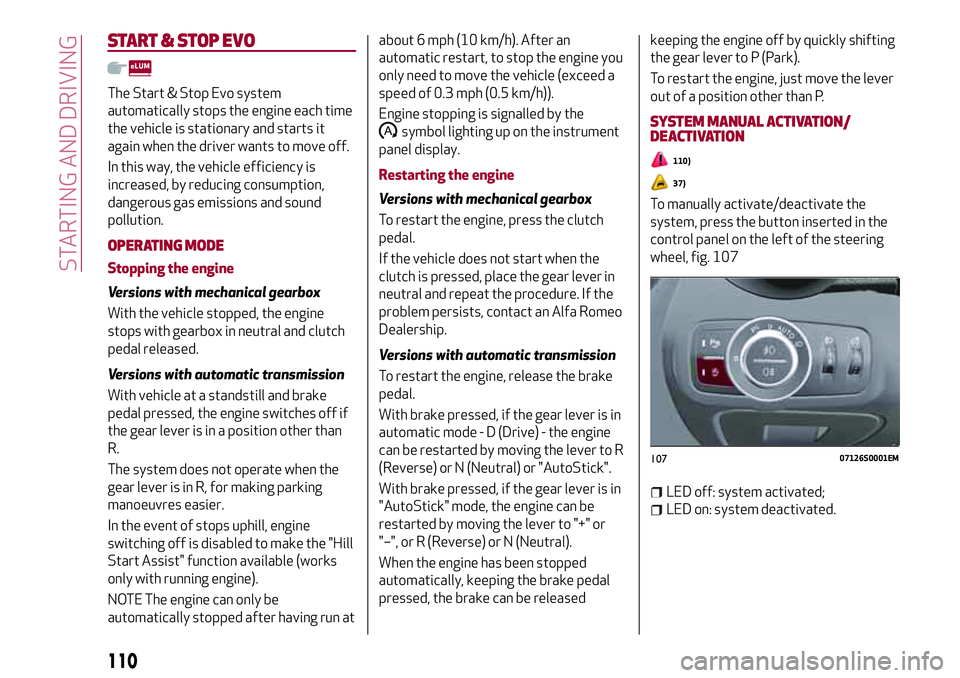
To manually activate/deactivate the
system, press the button inserted in the
control panel on the left of the steering
wheel, fig. 107
LED off: system activated;
LED on: system deactivated.
10707126S0001EM
110
STARTING AND DRIVING
Page 113 of 204
WARNING
110)When replacing the battery, always
contact an Alfa Romeo Dealership. Replace
the battery with one of the same type
(HEAVY DUTY) and with the same
specifications.
IMPORTANT
37)If the climate comfort is to be favoured,
the Start&Stop system can be deactivated,
for a continuous operation of the climate
control system.
SPEED LIMITER
DESCRIPTION
This device allows the speed of the
vehicle to be limited to values which can
be set by the driver.
The maximum speed can be set both with
vehicle stationary and in motion. The
minimum speed that can be set is 20 mph
(30 km/h).
When the device is active, the vehicle
speed depends on the pressure at the
accelerator pedal, until the set speed
limit is reached.
ACTIVATING THE DEVICE
The function can be activated/
deactivated on the Connect system.
Activating the device
To access the function, on the main menu
select the following items in sequence:
"Settings", "Safety", “Speed Limiter” and
“on”.
The activation of the device is signalled
by the displaying of the green symbol
along with the last speed set.
SPEED LIMIT PROGRAMMING
To access the function, on the main menu
select the following items in sequence:
"Settings", "Safety" and "Speed Limiter
Set Speed".
By turning the Rotary Pad, the speed
increases by 5 mph (5 km/h), on rotation,
from a minimum of 20 mph (30 km/h) to a
maximum of 110 mph (180 km/h).
DEACTIVATING THE DEVICE
Deactivating the device
To access the function, on the main menu
select the following items in sequence:
"Settings", "Safety", "Speed Limiter" and
"off".
Automatic deactivation of the device
The device deactivates automatically in
the event of fault in the system. In this
case, contact an Alfa Romeo Dealership.
111
Page 120 of 204
The table below shows the approximate
distances for each area fig. 115:
ZoneDistance from the
rear of the vehicle
Red 0 ÷ 11.8 in (30 cm)
Yellow11.8 in
(30 cm) ÷ 3.3
ft (1 m)
Green 3.3 ft (1 m) or more
IMPORTANT When parking, take the
utmost care over obstacles that may be
above or under the camera range. of the
video cam.
WARNING
115)Parking and other potentially
dangerous manoeuvres are, however,
always the driver’s responsibility. While
carrying out these manoeuvres, always
make sure that no people (especially
children) or animals are in the area
concerned. The camera is an aid for the
driver, but the driver must never allow
his/her attention to lapse during potentially
dangerous manoeuvres, even those
executed at low speeds. Always keep a slow
speed, so as to promptly brake in the case of
obstacles.
IMPORTANT
47)It is vital, for correct operation, that the
camera is always kept clean and free from
any mud, dirt, snow or ice. Be careful not to
scratch or damage the camera while cleaning
it. Avoid using dry, rough or hard cloths. The
camera must be washed using clean water,
with the addition of car shampoo if
necessary. In washing stations which use
steam or high-pressure jets, clean the
camera quickly, keeping the nozzle more
than 10 cm away from the sensors. Also, do
not apply stickers to the camera.
REFUELLING THE VEHICLE
Always stop the engine before refuelling.
PETROL ENGINES
Only use unleaded petrol with a number
of octanes (R.O.N.) not lower than 95
(EN228 specification).
116) 117) 118)
DIESEL ENGINES
Only use Diesel for motor vehicles
(EN590 specification).
REFUELLING PROCEDURE
The fuel flap is unlocked when the central
door locking system is released, while it
is automatically locked when the central
locking system is applied.
Opening the flap
To refuel proceed as follows:
open flap fig. 116, pressing on the
point shown by the arrow;
remove the closing cap;
introduce the dispenser in the filler
and refuel;
118
STARTING AND DRIVING
Page 135 of 204
make sure that switch 5 fig. 139 of
the compressor is in position O (OFF);
insert the plug into the socket on the
central tunnel, start the engine;
start the compressor, placing the
switch 5 fig. 139 to position I (ON);
inflate the tyre to the pressure
indicated in the “Rims and Tyres”
paragraph (see “Technical data” chapter).
In order to obtain a more precise reading,check the pressure value on pressure
gauge 6 fig. 139 with the compressor off;
if after 15 minutes pressure is not at
least 1.8 bar (26 psi), disengage the
compressor from the valve and power
socket, then move the vehicle forwards
approx. five tyre turns in order to
distribute the sealing fluid inside the tyre
evenly, then repeat the inflation
operation;
if you still cannot obtain a pressure of
at least 1,8 bar (26 psi) within
15 minutes from the compressor
switching on, do not drive off and contact
an Alfa Romeo Dealership;
after having driven for about 5 mph
(8 km), stop, engage the electric parking
brake and recheck the tyre pressure;
if the pressure is less than 1.8 bar
(26 psi), do not go back into gear but see
an Alfa Romeo dealer;
if a pressure value of at least 1.8 bar
(26 psi) is detected, restore the correct
pressure (with engine running and
electric parking brake), resume driving
immediately and drive with great care to
an Alfa Romeo Dealership.
SEALANT BOTTLE REPLACEMENT
IMPORTANT Only use original cartridges,
which can be purchased at an Alfa Romeo
dealership.
Proceed as follows:
Remove the tank 1 fig. 140 pressingthe unhooking button 9;
insert the new tank pressing it
downwards hard.
WARNING
127)Punctures on the sides of the tire may
not be repaired. Do not use the Tire Repair
kit if the tyre was damaged as a result of
being used when underinflated.
128)Wear the protective gloves provided
with the Tire Repair kit.
129)Apply the adhesive label where it can
be easily seen by the driver as a reminder
that the tyre has been treated with the Tire
Repair Kit. Drive carefully, particularly on
bends. Do not exceed 80 km/h. Avoid sudden
acceleration or braking.
130)You must always indicate that the tyre
was repaired using the Tire Repair Kit. Give
the booklet to the technicians who will be
handling the tyre that was treated using the
Tire Repair Kit.
13808066S0004EM
13908066S0005EM
14008066S0009EM
133
Page 137 of 204
The positive pole (+) can be accessed by
removing the cover fig. 142
open protective flap fig. 143.The pole is shown in fig. 144.
To carry out the operation, you need to
have the correct cables to connect the
auxiliary battery to the remote poles of
the flat battery. Usually, these cables
have terminals at the ends and are
identified by different sheath colours
(red = positive, black = negative).
JUMP STARTING
136) 137) 138)
Proceed as follows:
switch off all electrical devices in the
vehicle;
engage the parking brake, move the
lever to P (Park), for versions equipped
with automatic transmission, or neutral,
for versions with manual gearbox, then
set the ignition device to STOP;
should you be using the battery of
another vehicle, park the other vehicle
within the range of the cables used for
the connection, operate the parking
brake and ensure that its ignition is off.
IMPORTANT If the auxiliary battery is
installed on another vehicle, check that
there is no accidental contact of metal
parts between the two vehicles, since an
earth connection may result, with the risk
of serious injury to any people who may
be nearby.
IMPORTANT If the procedure below is
carried out incorrectly, it can cause
severe injury to people or damage the
recharging system of one or both
vehicles. Carefully follow the instructions
given below.
14108076S0006EM
14208076S0007EM
14308076S0002EM
14408076S0001EM
135
Page 141 of 204
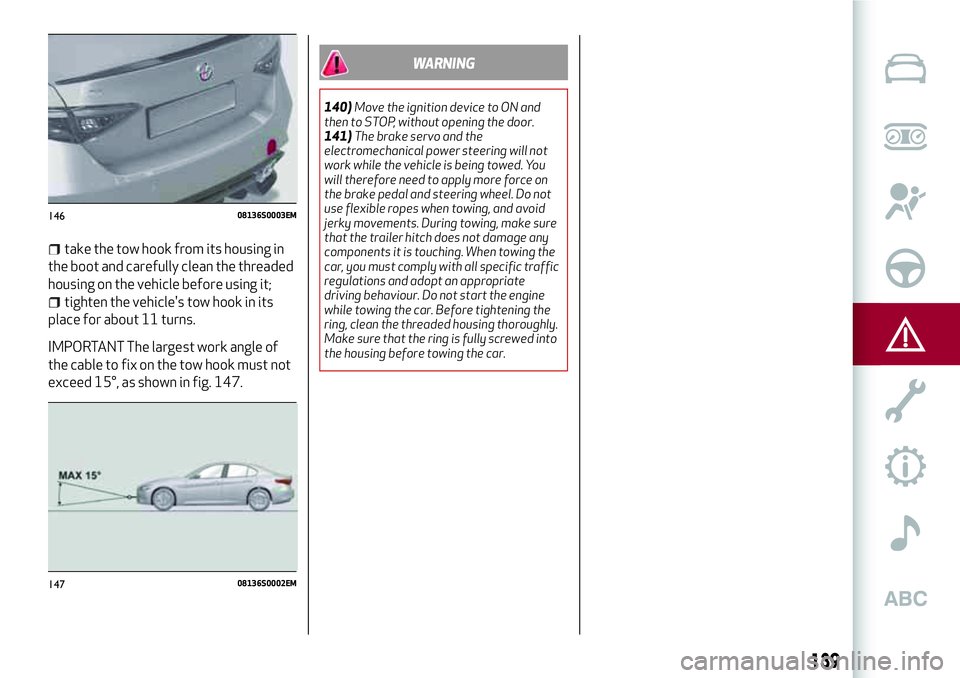
take the tow hook from its housing in
the boot and carefully clean the threaded
housing on the vehicle before using it;
tighten the vehicle's tow hook in its
place for about 11 turns.
IMPORTANT The largest work angle of
the cable to fix on the tow hook must not
exceed 15°, as shown in fig. 147.
WARNING
140)Move the ignition device to ON and
then to STOP, without opening the door.
141)The brake servo and the
electromechanical power steering will not
work while the vehicle is being towed. You
will therefore need to apply more force on
the brake pedal and steering wheel. Do not
use flexible ropes when towing, and avoid
jerky movements. During towing, make sure
that the trailer hitch does not damage any
components it is touching. When towing the
car, you must comply with all specific traffic
regulations and adopt an appropriate
driving behaviour. Do not start the engine
while towing the car. Before tightening the
ring, clean the threaded housing thoroughly.
Make sure that the ring is fully screwed into
the housing before towing the car.
14608136S0003EM
14708136S0002EM
139
Page 157 of 204
transmissions, automatic activation of P
(Park mode) must be disabled. You have
to switch off the engine in the following
conditions: car stopped, gear in N
(Neutral), press the starter button. The
car will remain in N (Neutral) for
15 minutes, after which P (Park) mode
will be activated.
IMPORTANT
71)In order to preserve the aesthetic
appearance of the paint abrasive products
and/or polishes should not be used for
cleaning the vehicle.
72)Avoid washing with rollers and/or
brushes in washing stations. Wash the
vehicle only by hand using neutral pH
detergents; dry it with a wet chamois leather.
Abrasive products and/or polishes should
not be used for cleaning the car. Bird
droppings must be washed off immediately
and thoroughly as the acid they contain is
particularly aggressive. Avoid (if at all
possible) parking the vehicle under trees;
remove vegetable resins immediately as,
when dried, it may only be possible to remove
them with abrasive products and/or polishes,
which is highly inadvisable as they could alter
the typical opaqueness of the paint. Do not
use pure windscreen washer fluid for
cleaning the front windscreen and rear
window; dilute it min. 50% with water. Only
use pure screen washer fluid when strictly
necessary due to outside temperature
conditions.
IMPORTANT
7)Detergents pollute the environment. Only
wash your vehicle in areas equipped to
collect and treat wastewater from this type
of activity.
155