light Alfa Romeo Giulia 2017 Workshop Manual
[x] Cancel search | Manufacturer: ALFA ROMEO, Model Year: 2017, Model line: Giulia, Model: Alfa Romeo Giulia 2017Pages: 268, PDF Size: 18.64 MB
Page 86 of 268
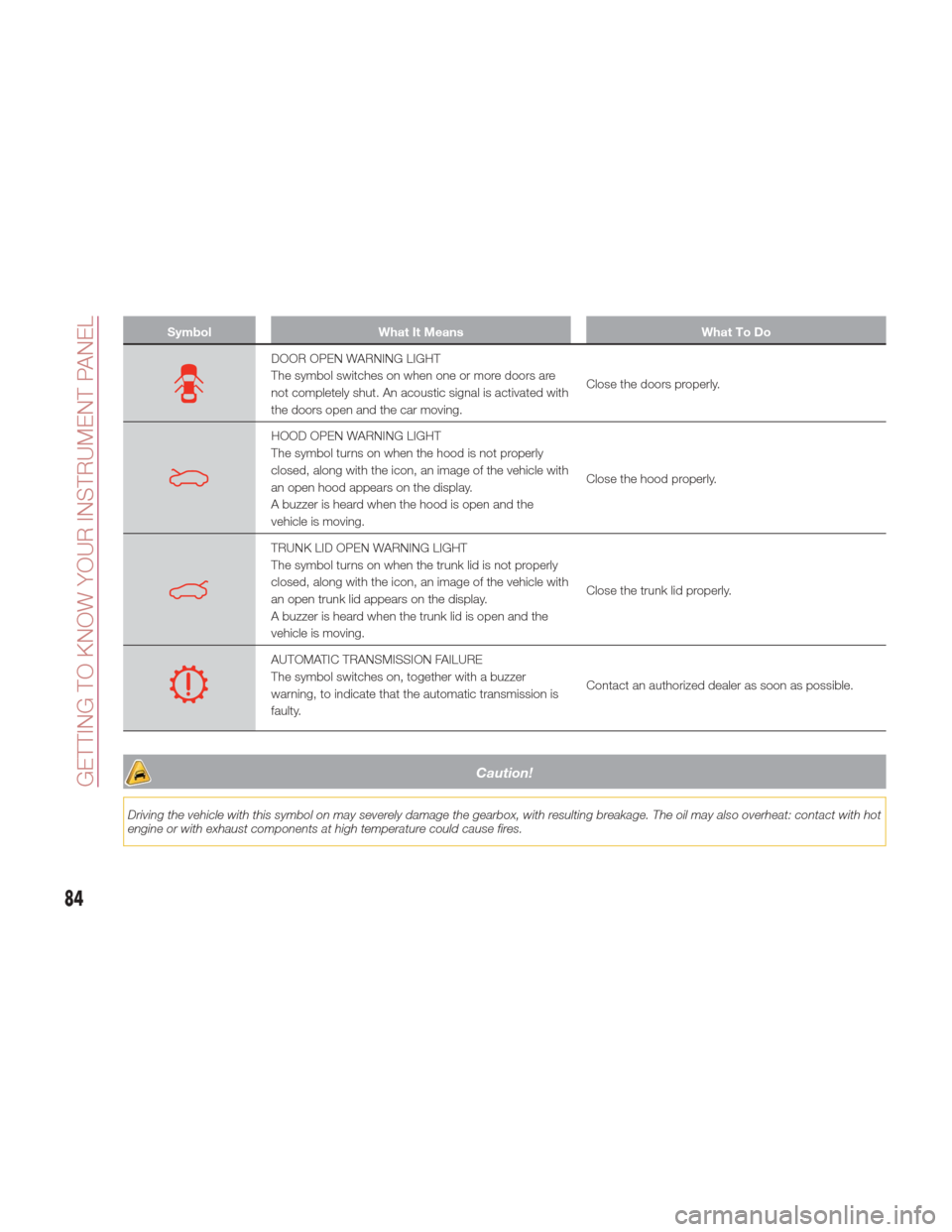
SymbolWhat It Means What To Do
DOOR OPEN WARNING LIGHT
The symbol switches on when one or more doors are
not completely shut. An acoustic signal is activated with
the doors open and the car moving.Close the doors properly.
HOOD OPEN WARNING LIGHT
The symbol turns on when the hood is not properly
closed, along with the icon, an image of the vehicle with
an open hood appears on the display.
A buzzer is heard when the hood is open and the
vehicle is moving.Close the hood properly.
TRUNK LID OPEN WARNING LIGHT
The symbol turns on when the trunk lid is not properly
closed, along with the icon, an image of the vehicle with
an open trunk lid appears on the display.
A buzzer is heard when the trunk lid is open and the
vehicle is moving.Close the trunk lid properly.
AUTOMATIC TRANSMISSION FAILURE
The symbol switches on, together with a buzzer
warning, to indicate that the automatic transmission is
faulty.
Contact an authorized dealer as soon as possible.
Caution!
Driving the vehicle with this symbol on may severely damage the gearbox, with resulting breakage. The oil may also overheat: contact with hot
engine or with exhaust components at high temperature could cause fires.
84
GETTING TO KNOW YOUR INSTRUMENT PANEL
Page 87 of 268
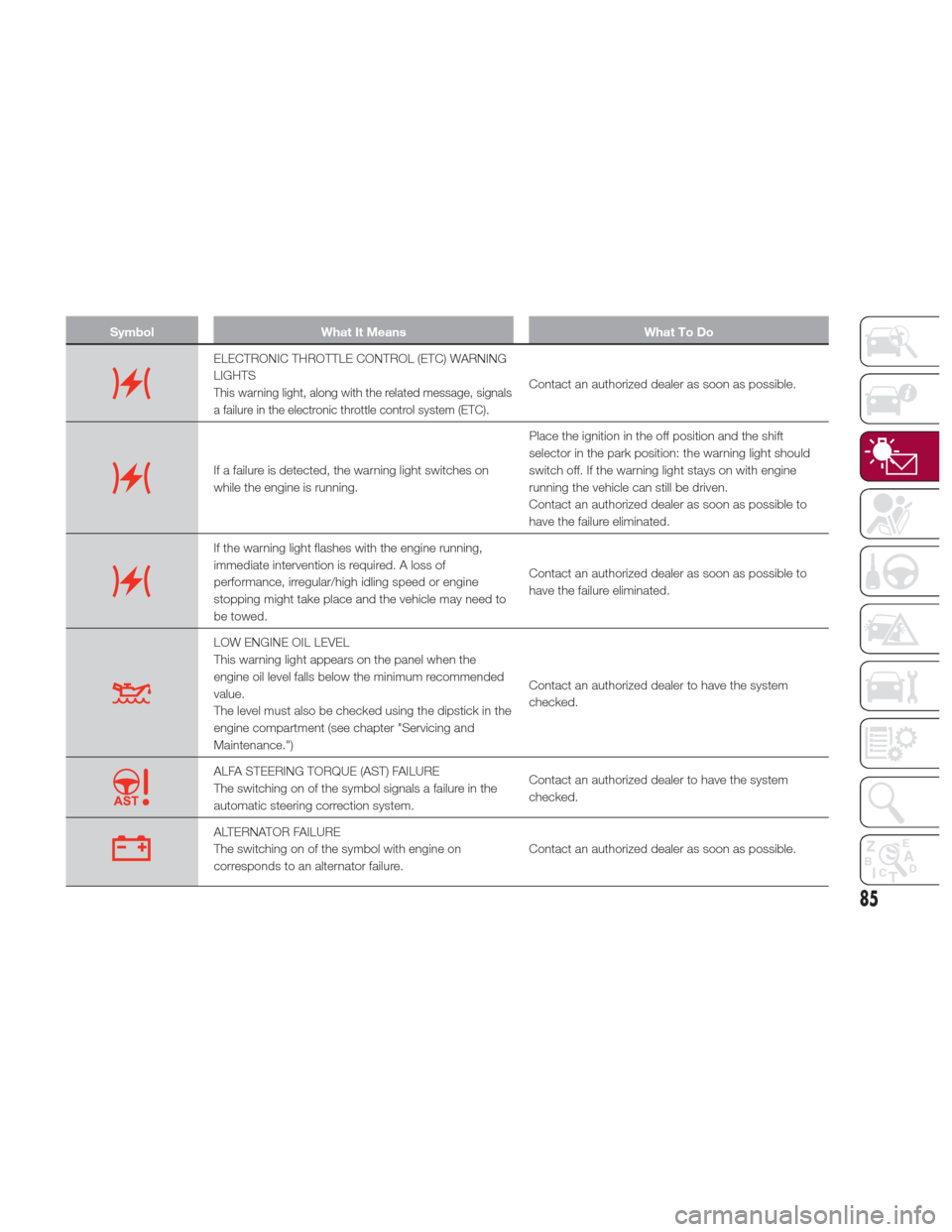
SymbolWhat It Means What To Do
ELECTRONIC THROTTLE CONTROL (ETC) WARNING
LIGHTS
This warning light, along with the related message, signals
a failure in the electronic throttle control system (ETC).Contact an authorized dealer as soon as possible.
If a failure is detected, the warning light switches on
while the engine is running.Place the ignition in the off position and the shift
selector in the park position: the warning light should
switch off. If the warning light stays on with engine
running the vehicle can still be driven.
Contact an authorized dealer as soon as possible to
have the failure eliminated.
If the warning light flashes with the engine running,
immediate intervention is required. A loss of
performance, irregular/high idling speed or engine
stopping might take place and the vehicle may need to
be towed.
Contact an authorized dealer as soon as possible to
have the failure eliminated.
LOW ENGINE OIL LEVEL
This warning light appears on the panel when the
engine oil level falls below the minimum recommended
value.
The level must also be checked using the dipstick in the
engine compartment (see chapter "Servicing and
Maintenance.")Contact an authorized dealer to have the system
checked.
ALFA STEERING TORQUE (AST) FAILURE
The switching on of the symbol signals a failure in the
automatic steering correction system.
Contact an authorized dealer to have the system
checked.
ALTERNATOR FAILURE
The switching on of the symbol with engine on
corresponds to an alternator failure.
Contact an authorized dealer as soon as possible.
85
Page 88 of 268

Amber Symbols
SymbolWhat It Means What To Do
ENGINE IMMOBILIZER FAILURE / BREAK-IN ATTEMPT
Engine Immobilizer System Failure
The symbol switches on to report a failure of the Engine
Immobilizer system.Contact an authorized dealer as soon as possible.
Break-In Attempt
The symbol switches on when the ignition is moved to
ON position, to indicate a possible break-in attempt
detected by the alarm system.
Electronic Key Not Recognized
The symbol switches on when the engine is started and
the electronic key is not recognized by the system.
Alarm System Failure
This symbol switches on to report an alarm system
failure.
FUEL CUT-OFF SYSTEM OPERATION
This telltale will illuminate after an accident has
occurred, and the system has shut the fuel off. For reactivating the fuel cut-off system, refer to
"Occupant Restraint Systems" in "Safety.” If it is not
possible to restore the fuel supply, contact an
authorized dealer.
PARK SENSORS SYSTEM FAILURE
Lights up when the system has failed or is not available.
Contact an authorized dealer to have the system
checked.
POSSIBLE ICE ON ROAD
The symbol turns on when the outside temperature falls
to or below 37°F.
86
GETTING TO KNOW YOUR INSTRUMENT PANEL
Page 91 of 268
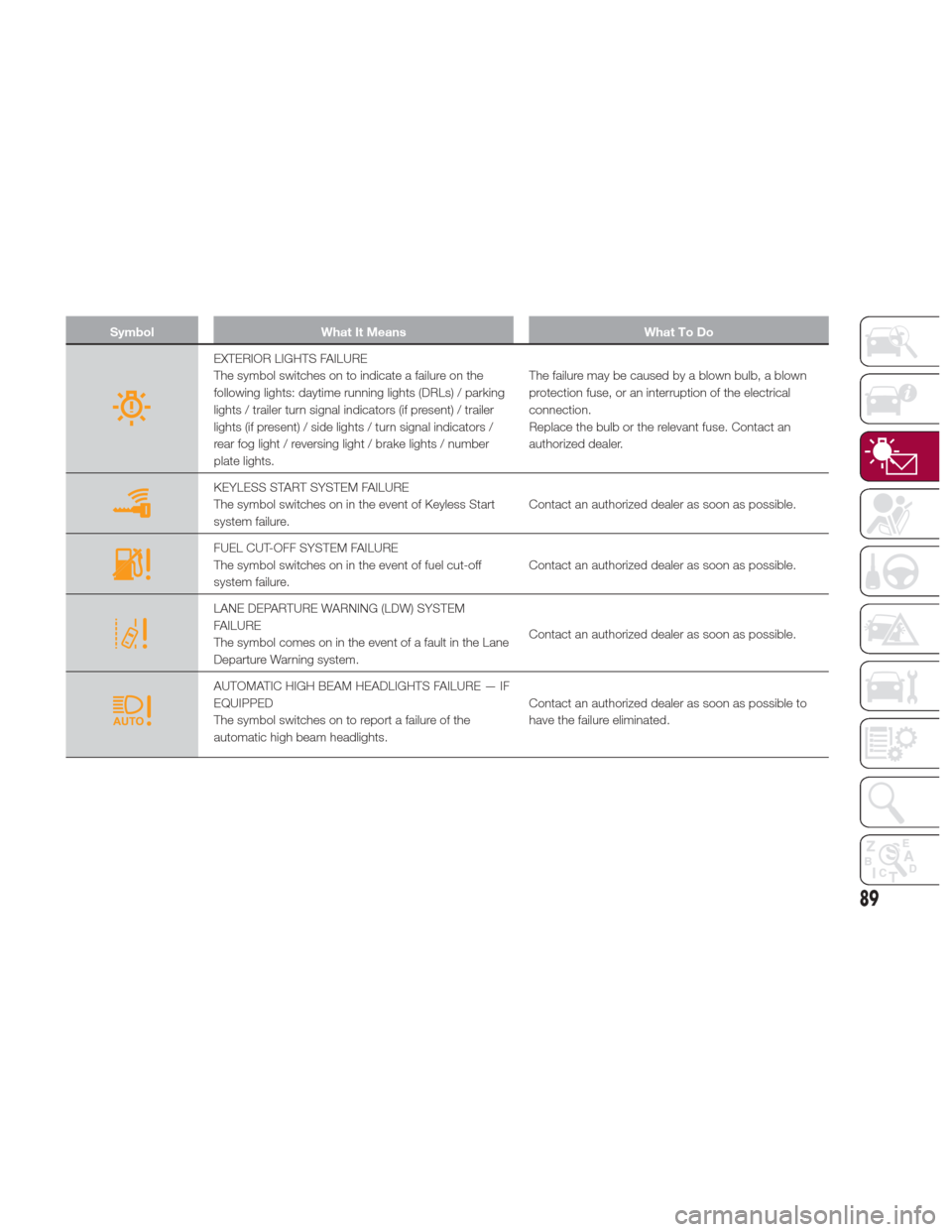
SymbolWhat It Means What To Do
EXTERIOR LIGHTS FAILURE
The symbol switches on to indicate a failure on the
following lights: daytime running lights (DRLs) / parking
lights / trailer turn signal indicators (if present) / trailer
lights (if present) / side lights / turn signal indicators /
rear fog light / reversing light / brake lights / number
plate lights.The failure may be caused by a blown bulb, a blown
protection fuse, or an interruption of the electrical
connection.
Replace the bulb or the relevant fuse. Contact an
authorized dealer.
KEYLESS START SYSTEM FAILURE
The symbol switches on in the event of Keyless Start
system failure.
Contact an authorized dealer as soon as possible.
FUEL CUT-OFF SYSTEM FAILURE
The symbol switches on in the event of fuel cut-off
system failure.Contact an authorized dealer as soon as possible.
LANE DEPARTURE WARNING (LDW) SYSTEM
FAILURE
The symbol comes on in the event of a fault in the Lane
Departure Warning system.Contact an authorized dealer as soon as possible.
AUTOMATIC HIGH BEAM HEADLIGHTS FAILURE — IF
EQUIPPED
The symbol switches on to report a failure of the
automatic high beam headlights.Contact an authorized dealer as soon as possible to
have the failure eliminated.
89
Page 92 of 268
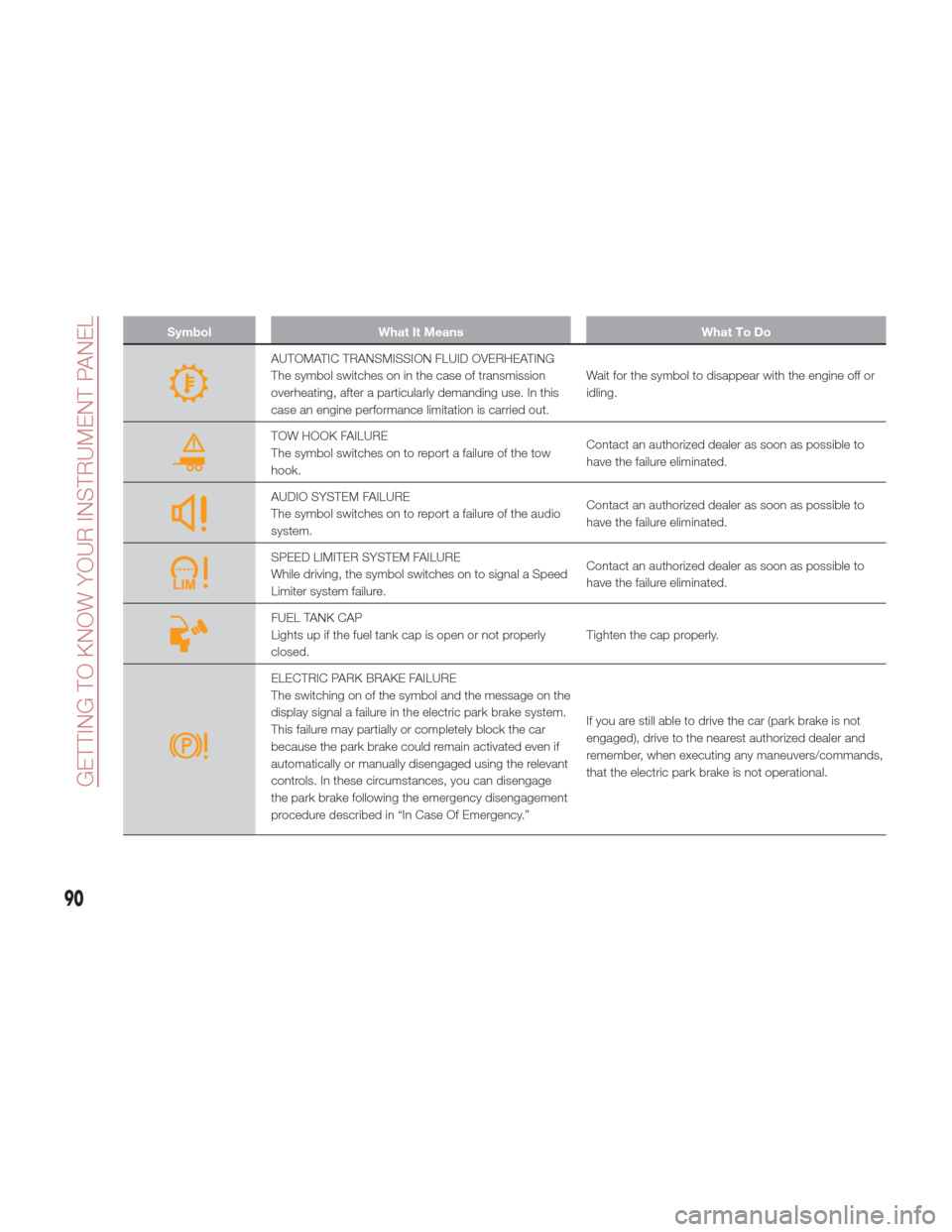
SymbolWhat It Means What To Do
AUTOMATIC TRANSMISSION FLUID OVERHEATING
The symbol switches on in the case of transmission
overheating, after a particularly demanding use. In this
case an engine performance limitation is carried out.Wait for the symbol to disappear with the engine off or
idling.
TOW HOOK FAILURE
The symbol switches on to report a failure of the tow
hook.
Contact an authorized dealer as soon as possible to
have the failure eliminated.
AUDIO SYSTEM FAILURE
The symbol switches on to report a failure of the audio
system.Contact an authorized dealer as soon as possible to
have the failure eliminated.
SPEED LIMITER SYSTEM FAILURE
While driving, the symbol switches on to signal a Speed
Limiter system failure.Contact an authorized dealer as soon as possible to
have the failure eliminated.
FUEL TANK CAP
Lights up if the fuel tank cap is open or not properly
closed.
Tighten the cap properly.
ELECTRIC PARK BRAKE FAILURE
The switching on of the symbol and the message on the
display signal a failure in the electric park brake system.
This failure may partially or completely block the car
because the park brake could remain activated even if
automatically or manually disengaged using the relevant
controls. In these circumstances, you can disengage
the park brake following the emergency disengagement
procedure described in “In Case Of Emergency.”If you are still able to drive the car (park brake is not
engaged), drive to the nearest authorized dealer and
remember, when executing any maneuvers/commands,
that the electric park brake is not operational.
90
GETTING TO KNOW YOUR INSTRUMENT PANEL
Page 93 of 268
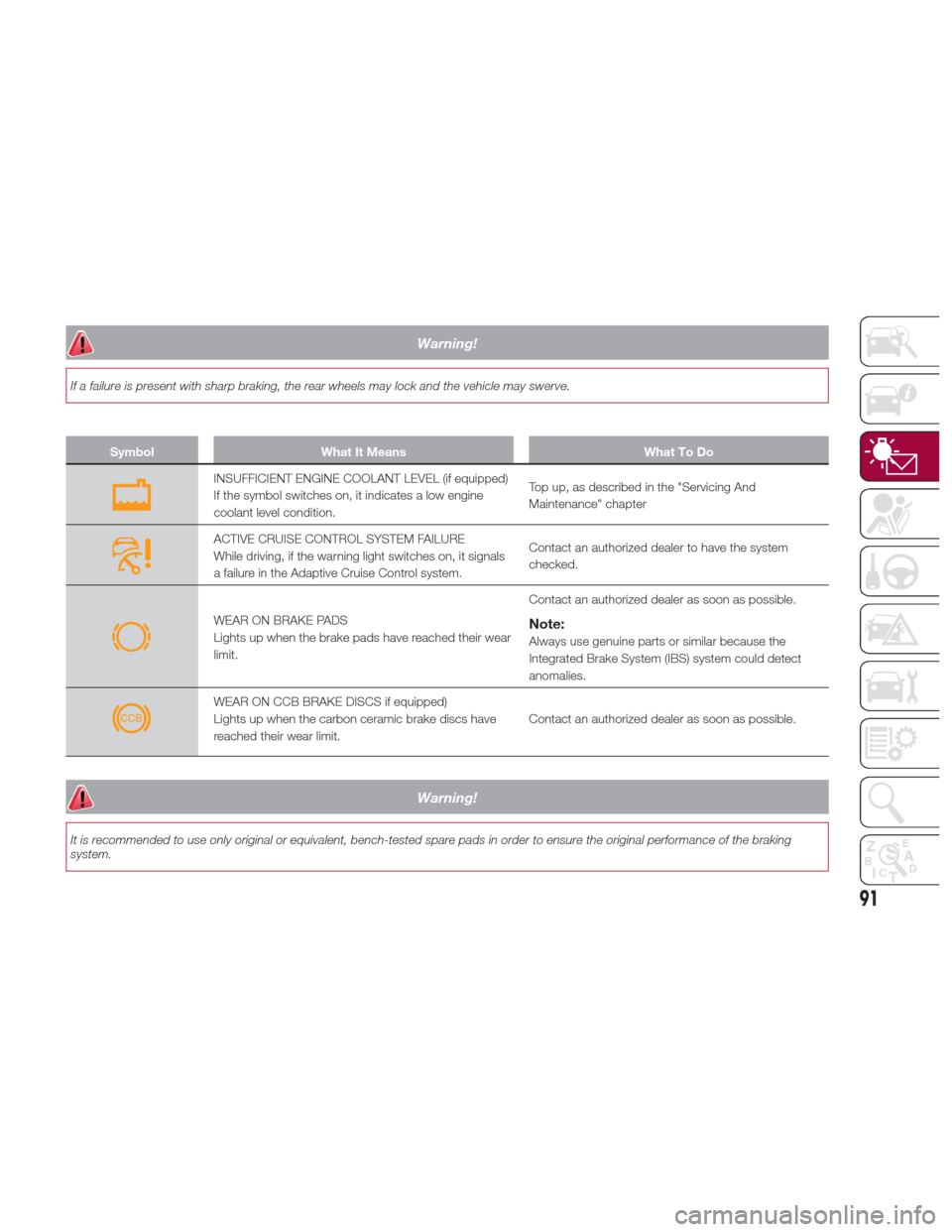
Warning!
If a failure is present with sharp braking, the rear wheels may lock and the vehicle may swerve.
SymbolWhat It Means What To Do
INSUFFICIENT ENGINE COOLANT LEVEL (if equipped)
If the symbol switches on, it indicates a low engine
coolant level condition.Top up, as described in the "Servicing And
Maintenance" chapter
ACTIVE CRUISE CONTROL SYSTEM FAILURE
While driving, if the warning light switches on, it signals
a failure in the Adaptive Cruise Control system.Contact an authorized dealer to have the system
checked.
WEAR ON BRAKE PADS
Lights up when the brake pads have reached their wear
limit.Contact an authorized dealer as soon as possible.Note:
Always use genuine parts or similar because the
Integrated Brake System (IBS) system could detect
anomalies.
WEAR ON CCB BRAKE DISCS if equipped)
Lights up when the carbon ceramic brake discs have
reached their wear limit.
Contact an authorized dealer as soon as possible.
Warning!
It is recommended to use only original or equivalent, bench-tested spare pads in order to ensure the original performance of the braking
system.
91
Page 94 of 268
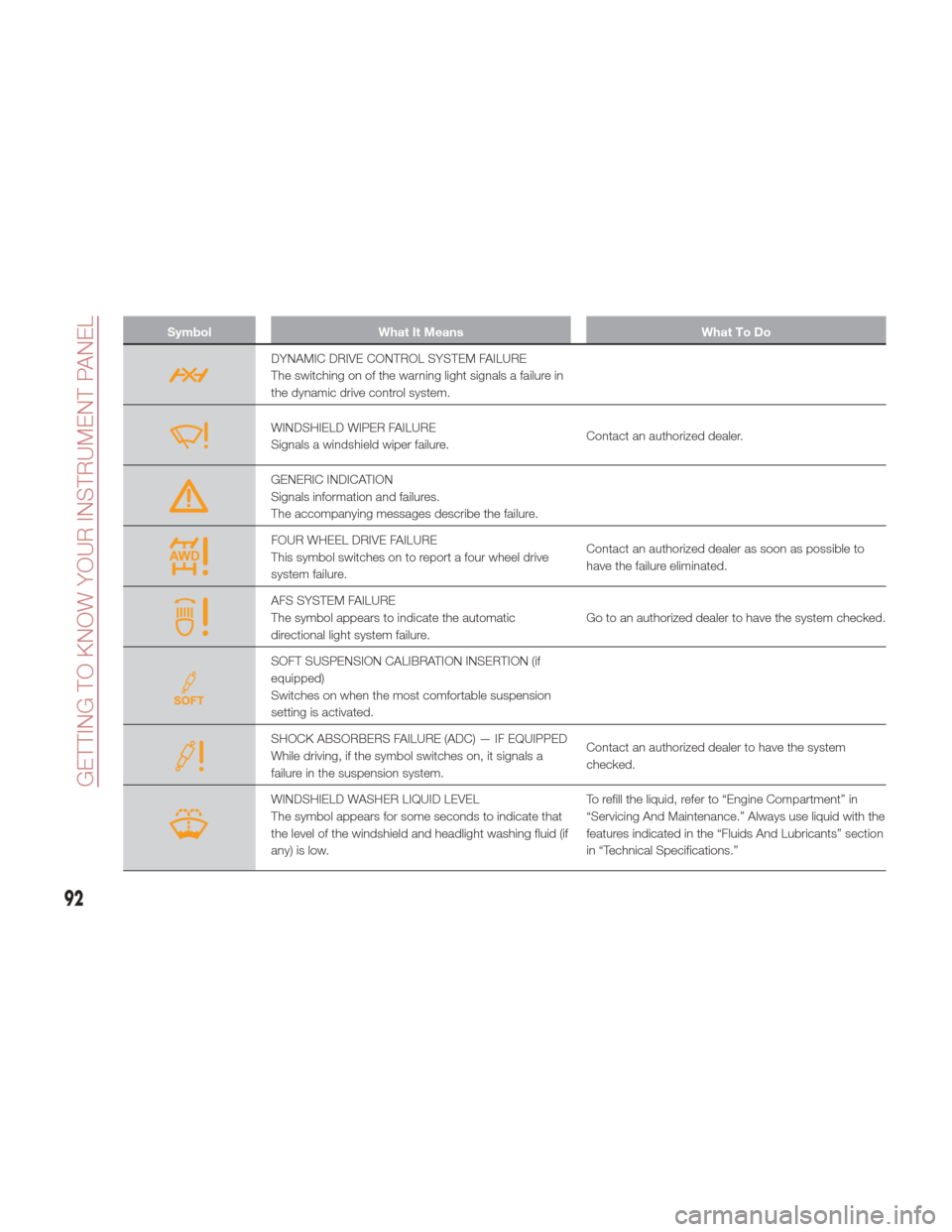
SymbolWhat It Means What To Do
DYNAMIC DRIVE CONTROL SYSTEM FAILURE
The switching on of the warning light signals a failure in
the dynamic drive control system.
WINDSHIELD WIPER FAILURE
Signals a windshield wiper failure.Contact an authorized dealer.
GENERIC INDICATION
Signals information and failures.
The accompanying messages describe the failure.
FOUR WHEEL DRIVE FAILURE
This symbol switches on to report a four wheel drive
system failure.Contact an authorized dealer as soon as possible to
have the failure eliminated.
AFS SYSTEM FAILURE
The symbol appears to indicate the automatic
directional light system failure.
Go to an authorized dealer to have the system checked.
SOFT SUSPENSION CALIBRATION INSERTION (if
equipped)
Switches on when the most comfortable suspension
setting is activated.
SHOCK ABSORBERS FAILURE (ADC) — IF EQUIPPED
While driving, if the symbol switches on, it signals a
failure in the suspension system.Contact an authorized dealer to have the system
checked.
WINDSHIELD WASHER LIQUID LEVEL
The symbol appears for some seconds to indicate that
the level of the windshield and headlight washing fluid (if
any) is low.To refill the liquid, refer to “Engine Compartment” in
“Servicing And Maintenance.” Always use liquid with the
features indicated in the “Fluids And Lubricants” section
in “Technical Specifications.”
92
GETTING TO KNOW YOUR INSTRUMENT PANEL
Page 95 of 268
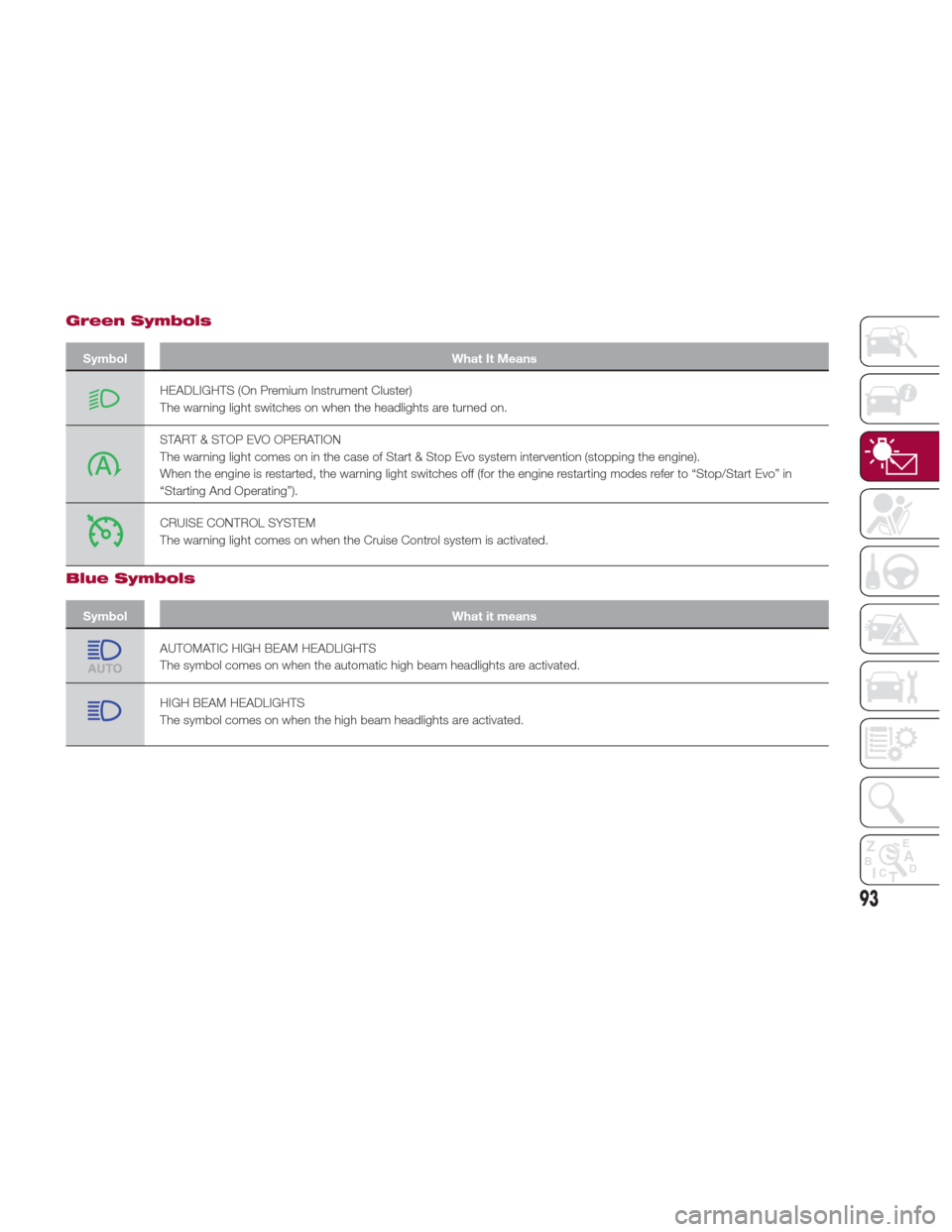
Green Symbols
SymbolWhat It Means
HEADLIGHTS (On Premium Instrument Cluster)
The warning light switches on when the headlights are turned on.
START & STOP EVO OPERATION
The warning light comes on in the case of Start & Stop Evo system intervention (stopping the engine).
When the engine is restarted, the warning light switches off (for the engine restarting modes refer to “Stop/Start Evo” in
“Starting And Operating”).
CRUISE CONTROL SYSTEM
The warning light comes on when the Cruise Control system is activated.
Blue Symbols
Symbol What it means
AUTOMATIC HIGH BEAM HEADLIGHTS
The symbol comes on when the automatic high beam headlights are activated.
HIGH BEAM HEADLIGHTS
The symbol comes on when the high beam headlights are activated.
93
Page 96 of 268
ONBOARD
DIAGNOSTIC
SYSTEM
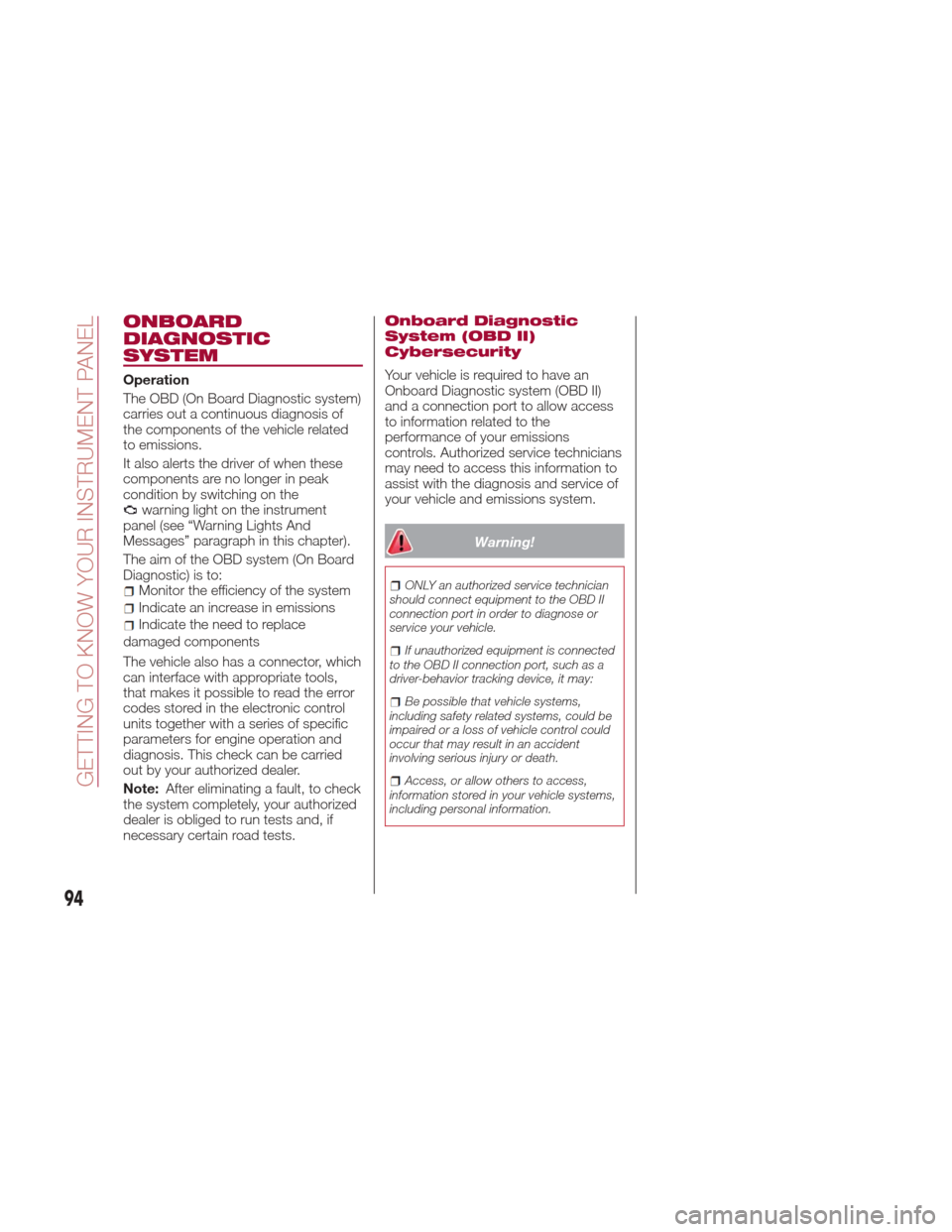
Operation
The OBD (On Board Diagnostic system)
carries out a continuous diagnosis of
the components of the vehicle related
to emissions.
It also alerts the driver of when these
components are no longer in peak
condition by switching on the
warning light on the instrument
panel (see “Warning Lights And
Messages” paragraph in this chapter).
The aim of the OBD system (On Board
Diagnostic) is to:
Monitor the efficiency of the system
Indicate an increase in emissions
Indicate the need to replace
damaged components
The vehicle also has a connector, which
can interface with appropriate tools,
that makes it possible to read the error
codes stored in the electronic control
units together with a series of specific
parameters for engine operation and
diagnosis. This check can be carried
out by your authorized dealer.
Note: After eliminating a fault, to check
the system completely, your authorized
dealer is obliged to run tests and, if
necessary certain road tests.
Onboard Diagnostic
System (OBD II)
Cybersecurity
Your vehicle is required to have an
Onboard Diagnostic system (OBD II)
and a connection port to allow access
to information related to the
performance of your emissions
controls. Authorized service technicians
may need to access this information to
assist with the diagnosis and service of
your vehicle and emissions system.
Warning!
ONLY an authorized service technician
should connect equipment to the OBD II
connection port in order to diagnose or
service your vehicle.
If unauthorized equipment is connected
to the OBD II connection port, such as a
driver-behavior tracking device, it may:
Be possible that vehicle systems,
including safety related systems, could be
impaired or a loss of vehicle control could
occur that may result in an accident
involving serious injury or death.
Access, or allow others to access,
information stored in your vehicle systems,
including personal information.
94
GETTING TO KNOW YOUR INSTRUMENT PANEL
Page 98 of 268
ACTIVE SAFETY
SYSTEMS
The vehicle may be equipped with the
following active safety devices:
Anti-Lock Braking (ABS) System
Drive Train Control (DTC) System
Electronic Stability Control (ESC)
System
Traction Control System (TCS)
Panic Brake Assist (PBA) System
Hill Start Assist (HSA) System
Dynamic Steering Torque (DST)
System
Active Torque Vectoring (ATV)
System
For the operation of the systems, see
the following pages.
Anti-Lock Braking (ABS)
System
An integral part of the braking system,
the ABS prevents one or more wheels
from locking and slipping in all road
surface conditions, regardless of the
intensity of the braking action. The
system ensures that the vehicle can be
controlled even during emergency
braking, allowing the driver to optimize
stopping distances.
The system intervenes during braking
when the wheels are about to lock,
typically in emergency braking or
low-grip conditions where locking may
be more frequent. The system also improves control and
stability of the vehicle when braking on
a surface where the grip of the left and
right wheels varies, such as in a corner.
The Electronic Braking Force
Distribution (EBD) system works with
the ABS, allowing the brake force to be
distributed between the front and rear
wheels.
System Intervention
The ABS equipped on this vehicle is
provided with the "Brake-by-wire"
(Integrated Brake System - IBS)
function. With this system, the
command given by pressing the brake
pedal is not transmitted hydraulically,
but electrically. Therefore, the light
pulsation that is felt on the pedal with
the traditional system is no longer
noticeable.Warning!
The ABS contains sophisticated
electronic equipment that may be
susceptible to interference caused by
improperly installed or high output radio
transmitting equipment. This interference
can cause possible loss of anti-lock braking
capability. Installation of such equipment
should be performed by qualified
professionals.
Pumping of the Anti-Lock Brakes will
diminish their effectiveness and may lead to
a collision. Pumping makes the stopping
distance longer. Just press firmly on your
brake pedal when you need to slow down
or stop.
The ABS cannot prevent the natural
laws of physics from acting on the vehicle,
nor can it increase braking or steering
efficiency beyond that afforded by the
condition of the vehicle brakes and tires or
the traction afforded.
The ABS cannot prevent collisions,
including those resulting from excessive
speed in turns, following another vehicle
too closely, or hydroplaning.
The capabilities of an ABS equipped
vehicle must never be exploited in a
reckless or dangerous manner that could
jeopardize the user’s safety or the safety of
others.
Drive Train Control
(DTC) System — If
Equipped
Some models of this vehicle are
equipped with an All-Wheel Drive
system (AWD), which offers an optimal
drive for countless driving conditions
and road surfaces. The system reduces
the slipping of the tires to a minimum,
automatically redistributing the torque
to the front and rear wheels as needed.
To maximize fuel savings, the vehicle
with AWD automatically passes to
rear-wheel drive (RWD) when the road
96
SAFETY